Computational Tools to Support Ethanol Pipeline
Network Design Decisions
Gustavo Dias da Silva*, Virgílio José Martins Ferreira Filho, Laura Bahiense Production Engineering Program, Federal University of Rio de Janeiro, Rio de Janeiro, Brazil
Email: *[email protected], [email protected], [email protected]
Received November 16, 2012; revised December 17, 2012; accepted December 30, 2012
ABSTRACT
This paper considers the pipeline network design problem (PND) in ethanol transportation, with a view to providing robust and efficient computational tools to assist decision makers in evaluating the technical and economic feasibility of ethanol pipeline network designs. Such tools must be able to address major design decisions and technical characteris- tics, and estimate network construction and operation costs to any time horizon. The specific context in which the study was conducted was the ethanol industry in São Paulo. Five instances were constructed using pseudo-real data to test the methodologies developed.
Keywords: Ethanol; Pipelines; Network Design; Mathematical Programming
1. Introduction
People use networks daily (sometimes unwittingly) in a wide range of contexts. Telephony networks, logistics networks for freight transportation and distribution net- works (water, energy) provide services that are essential to modern life and, therefore, must be properly designed to ensure service quality and meet user demands.
Brazil is projected to be both a major producer and supplier of biofuels, particularly biodiesel and ethanol. These fuels are gaining importance on the world stage in view of the environmental, technological and economic impacts caused by global dependence on fossil fuels, particularly oil [1].
However, Brazil’s transport logistics system still rests largely on its highway network, which—although eco- nomically competitive—is not safe for transporting fuel, especially in large volumes. A paradigm shift must take place and Operations Research can help in that process.
This study aims to provide robust and efficient com- putational tools to assist decision makers in evaluating the technical and economic feasibility of ethanol pipeline network designs. Such tools must be able to address ma- jor design decisions and technical characteristics, and estimate network construction and operation costs to any time horizon.
The paper is organized as follows: Section 2 presents the context that motivated the research; Section 3 de- scribes the problem under study, characterizing it in technical and theoretical terms; Section 4 presents the
optimization approaches taken to solving the problem; Section 5 reports the results and conclusions; and Section 6 offers some final remarks on the study.
2. Context
Current economic growth rates have generated increasing demand for oil. Consequently, market laws exert strong pressure on oil prices, which fluctuate, significantly in- creasing the cost of living. In parallel with this, the envi- ronmental effects of global warming are an issue globally. Pollutant emissions from burning fossil fuels aggravate the phenomenon, drawing criticism and spurring the search for viable alternatives [1]. Technological devel- opment has also contributed significantly to this substitu- tion. “Flex-fuel” vehicles have reduced fossil-fuel con- sumption by offering consumers freedom of choice [2].
Ethanol will play an important role in this process: firstly, because large-scale production costs have been competitive with those of oil since 2004, and secondly, because it is a cleaner energy source [3]. Brazil has be- come critical in this process, because it has the experi- ence and natural conditions for producing ethanol from sugarcane, and has invested strongly and achieved tech- nological improvements since the start of the Proálcool program [4,5]. Figure 1 shows Brazil’s output by region
in crop year 2008/2009 [6].
trend [6]. However, studies have found that bottlenecks in Brazil’s infrastructure significantly affect fuel logistics, burdening links in the supply chain and raising end- product prices [7].
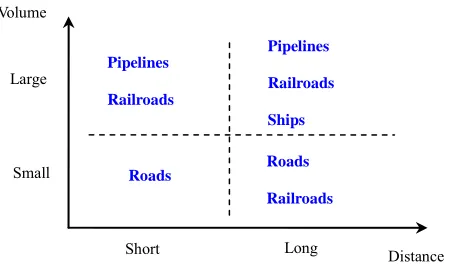
This result is worrying given that production is not evenly distributed across Brazil. Though concentrated mostly in the southeast [8], due mainly to different pro- duction technologies [3], a logistics network is essential to collecting it at lowest possible cost. Pipelines are a particularly appropriate transport mode for such transfers, as they always attain large volumes (Figure 3). Moti-
vated by this context, this study examines the logistics of fuel. The particular problem addressed is how to design a pipeline network to collect the ethanol produced by a set of regions and route it to a pre-determined destination region. Pipelines were chosen for their high reliability and economic competitiveness [9]. São Paulo State was chosen since it is currently Brazil’s largest ethanol pro- ducer [6], thus justifying investments in the sector. Fig- ure 2 illustrates its ouptut.
Designing such networks is a complex task due to the large number of technical and economic requirements to
be considered simultaneously. Proper project manage- ment is imperative, and projects are commonly divided into conceptual and hierarchically dependent phases that characterize their life cycle [10]. A pipeline project con- sists of the following stages [9]:
Planning: early stage of the potential enterprise, where technical, economic and social data are collected to assist feasibility evaluation.
Conceptual Engineering: identifies project technical and economic feasibility, and sets the basic and detail engineering agenda.
Basic Engineering: the basic design is developed and detailed to consolidate engineering aspects before any procurement and implementation expenditures are made.
Implementation: step execution and control. Activi- ties typical of this stage include construction and as- sembly, commissioning and conditioning.
Operation and Maintenance; Decommissioning: op- eration of pipeline is terminated because it is obso lescent, supplanted by other systems or no longer of interest to the owner.
Ethanol Production per Geopolitical Region (thousands of m3)m3)
0.0 2,000.0 4,000.0 6,000.0 8,000.0 10,000.0 12,000.0 14,000.0 16,000.0 18,000.0 20,000.0
North Northeast South Center-West Southeast
[image:2.595.162.437.367.534.2]Region
Figure 1. Ethanol production by geopolitical region, 2008/2009 harvest.
0.0 5.0 10.0 15.0
01/02 02/03 03/04 04/05 05/06 06/07 07/08
Cro
20.0 25.0 30.0
08/09
p Year
São Paulo Production (millions of m3) Brazilian Production (millions of m3)3 m ) 3
[image:2.595.169.426.576.721.2]m )
Volume
Long Large
Small Roads
Railroads Roads
Pipelines
Railroads
Ships Pipelines
Railroads
[image:3.595.62.287.86.219.2]Distance Short
Figure 3. Transport mode comparison matrix.
From an Operations Research viewpoint, meanwhile, Minoux [11] points out that, given a set of nodes, de- signing a network consists of constructing and/or install- ing better connections between some pairs of these nodes in compliance with certain operational specifications that govern the application’s behavior. That definition covers the planning and conceptual engineering phases men- tioned above, where the main concern is to assess the strategy’s competitiveness, and where the level of tech- nical detail is still low. This study intends to develop computational tools to assist in that endeavor. Silva [12] offers a brief literature review on the PND (and corre- lated problems). Distribution network designs are fre- quent, and entail deciding pipeline diameters, pump ca- pacities, reservoir elevation profiles and duct flows, sat- isfying constraints, ensuring hydraulic energy balance and meeting demand. Such decisions and constraints are handled in an integrated or hierarchical manner, fre- quently taking topology as given. None address the prob- lem examined here. The most similar, offered by Brim-berg et al. [13], consists in designing an optimal pipeline
network topology to transport output from oil fields in Gabon by connecting oil wells to a port.
Investment and operating costs tend to be of different orders of magnitude [9]. In the context considered here, however, all information about total project cost is im- portant, since roads historically form the backbone of Brazil’s logistics system [2] and are always an economi- cally competitive alternative. In addition, depending on the time horizon considered, operating costs may influ- ence design decisions. The combinatorial nature of the problem, coupled with the nonlinear equations of fluid dynamics, requires the use of a mixed-integer nonlinear program (MINLP) approach, which is solved via exact and heuristic algorithms.
3. Pipeline Network Design
This section will give an overview of ethnol pipeline network design, indicating the key theoretical and tech- nical characteristics. The problem is formally stated,
presenting the technical decisions that are being ad- dressed and the main assumptions. Next a cost analysis is made of pipeline network projects. Finally, the problem is formulated mathematically.
3.1. Fluid Dynamics Considerations
3.1.1. Flows
Flows are caused by the action of a shear stress on a fluid initially at rest. Temporal analysis of a flow allows it to be classified into one of two regimes, namely the transi- tional (early stage) regime, in which flow velocity, den- sity and temperature parameters at any point vary with time, and the steady-state (perennial stage) regime in which these parameters do not vary with time.
Steady-state flows, in turn, can be classified into two types: laminar, in which fluid particles move along par- allel streamlines (paths) without macroscopic interaction between the layers; and turbulent, in which fluid particles move along irregular trajectories with major macroscopic interaction. The dimensionless Reynolds number is used to indicate whether the flow is laminar or turbulent [14].
In ducts, flow may occur under the predominant, but not exclusive, action of two different mechanisms: grav- ity or a pressure gradient. The main characteristic of flow under gravity, known as open-channel flow, lies in the fact that the fluid flows without completely filling the duct. In the case of flows promoted by a pressure gradi- ent. The ducts are completely filled by the fluid transfer.
Finally, it is possible to characterize two regions in flow along a pipeline: the entrance region, where the velocity field profile is not yet fully developed, and the fully-developed flow region, where the velocity field is the same at any cross-section. The fully-developed re- gion may not exist, but generally, for a pipeline length
and diameter L 30
L , if , it can be assumed that
the steady state has been reached.
3.1.2. Energy Issues
Pipeline networks comprise ducts and other components such as valves, bends, fittings, pumps, turbines and tanks. All these elements contribute to system energy dissipa- tion. There are two types of losses, one due to friction between duct walls and the outer layers of the fluid, and the other due to geometric changes in cross-section pro- files along the pipeline route. The D’Arcy-Weisbach Equation enables losses to be calculated for incompressi- ble, permanent and fully-developed flows:
2 2 5
8
, π f
f LQ E
g
(1)
where Ef
,π Q
is the pressure drop along the pipeline whose transferred flow is the parameter pi, g the grav-
K and S
Flow machines are mechanical devices capable of ex- tracting energy from fluids (turbines) or adding energy to them (pumps) by dynamic interactions between the de- vice and the fluid [14]. Pumps, in turn, are described mainly by characteristic curves that relate the load pro- vided and the operation flow. Figure 4 exemplifies this.
Another important parameter in describing pump energy behavior is the Net Positive Suction Head (NPSH), which relates to cavitation (vapor bubbles inside the de- vice). Commonly, the pressure in the pump’s power sec- tion (input) is low and, when this value reaches the vapor pressure of the fluid, a fraction of the liquid evaporates. This phenomenon leads to loss of efficiency and struc- tural damage.
In 1738 Bernoulli formulated the basic equation gov- erning mechanical energy conservation in a fluid flow system. Generalized a few years later, the energy balance for an isothermal, confined, steady and turbulent flow of a viscous fluid that receives work from, and performs work on, flow machines is given by:
2
2
P V
Z E g
SWSWMF 0, (2) where is the density of the transferred fluid. It repre- sents the sum of pressure (1st term), kinetic (2nd term) and gravitational potential (3rd term) energies in the sys-tem, the total power loss S , the work done by the
system on its border , and the work performed by device B on the system
E
WS
WMF
2,
S
W KK Q
.
3.1.3. Equipment Selection
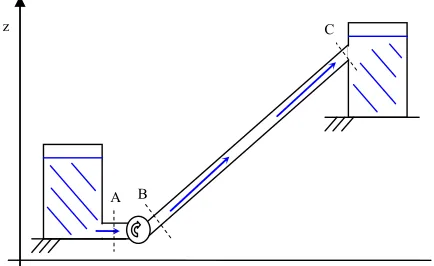
Pumps to ensure flows must be selected appropriately not to overestimate or underestimate the equipment’s capac- ity, thus avoiding unnecessary expense. The system curve is a curve relating energy flow to the load supplied to the fluid, considering the network’s technical and operational features. Consider the system in Figure 5. Substituting
Equation (1) into (2), between A and C:
MF (3)
System Curve
Pump Curve
QOPER
WOPER
Flow (m3/s)
Head (m)
0
Figure 4. Equipment selection using system and pump curves.
where K are appropriate parameters. The
Equation (3) characterizes the system curve, relating the energy supplied and the flow. This is shown in Figure 4
for a generic set of technical parameters.
System and pump curves are used to choose equip- ment. Given a system curve and an operating flow
, the best-suited pump B to provide the required
OPER energy is a pump whose characteristic curve in-
tersects the system curve at the desired flow operating point (Figure 4). However, the efficiency curve of the
pump should also be considered. Ideally, the operating point should be as close as possible to the highest effi- ciency point [14]. This latter curve will be disregarded for simplicity.
OPER Q W
3.2. General Characteristcs of the PND
Ethanol production is a seasonal activity, and the produc- tive capacity of any region is subject to the conditions necessary for crop development. Such issues make pro- duction minimally random in terms of constancy and amount to a given time horizon. Also sugar is produced from sugar cane, and high-demand situations impact ethanol production [15]. Proper treatment of these issues calls for stochastic approaches. Here, however, ethanol output is assumed to be known and not to vary to a given time horizon.
There is no minimum pressure requirement at the end of each section, provided the flow reaches its destination. Hence, pressures will be considered zero at these points. Economic gains also motivate this simplification. Still, assuming that the flows are promoted pressure gradients alone (Section 3.1.1), this hypothesis requires that at least one pumping station be installed at the entrance to each section. This requirement is naturally well conceived, since geographical dimensions require the use of storage tanks, which themselves result in pressure discontinue- ties.
In an ideal operating regime, storage tanks would be unnecessary in the producer regions, because flow bal- ance would be automatically guaranteed. In practice, in
B A
[image:4.595.66.282.544.711.2]z C
[image:4.595.316.533.586.719.2]addition to production inconstancy over time, mainte- nance system halts are usually necessary, requiring a minimum installed storage capacity in each region. Esti- mates of such capacities should consider both the ran- domness of the production and the system downtime schedule, leading again to a stochastic approach. Ideal balance is assumed and also that no storage capacity is required.
The essential nature of services provided by networks requires the system to be able to satisfy design demands even under failure. A redundant network ensures there are at least two distinct paths between any two network nodes. However, this solution requires construction of more pipelines than minimally required to connect all nodes in the network, which in geographically extensive networks, can represent overinvestment. The common solution in such cases is to implement a preventive maintenance policy. It is assumed therefore that the net- work is designed with no redundance.
On the other hand, for a given set of technical specifi- cations (diameter, thickness and material output), ducts are certified to withstand a certain maximum operating pressure. That relationship is given by the following equation:
MAX
2F e,
P
(4) where F is a safety factor [16], the circumferential
tension in the pipeline, the diameter and e the
thickness. The operating pressure is a function of the amount of energy supplied to the system through pump- ing stations. To prevent limits being exceeded, several stations are placed along sections of the network. For simplicity, however, it is assumed that only one station will be installed in each region. As a result, the maxi- mum operating pressure will occur exactly at the en- trance to each section. In a duct with constant flow and speed, zero final pressure and no flow machines, it fol- lows from (1), (2) and (4) that:
1 2 ,
2 2
e Z
Q
1, 2, ,
2
OPER
π g F
Q
f L
(5)
where OPER estimates the maximum value of the flow in the duct.
Route engineering entails certain difficulties. First, it is impossible to build pipelines in straight lines, since there may be impassable terrain between points of interest. Additionally, many slopes may be present in the altitude profile between two regions and this has considerable impact on pump dimensioning. Such issues are to be ad- dressed at data level: the former, when considering dis- tances among the regions, and the latter, using an “equivalent” altitude difference to reflect effects of slopes along routes.
Pump dimensioning is an important issue. This is done to avoid cavitation (Section 3.1.2) by estimating these pumps’ NPSH, which is a function of the height of an equivalent liquid column upstream of the pump. Esti- mating NPSH, however, would entail estimating the maximum capacity of the tanks upstream of the pump, which would make the mathematical model much more complex. Thus, dimensioning will be done by estimating the downstream energy.
Geographically distributed pipeline networks are sub- ject to temperature variations. This means that fluid property values may change significantly, which may invalidate use of the equations presented in Section 3.1. Thus, flow is assumed to be isothermal. Moreover, it is assumed to occur in a turbulent regime, but in fully de- veloped state, since the distance the flow travels in each network segment is much greater than the pipeline di- ameter, a necessary condition for such a hypothesis to be true (Section 3.1.1).
Finally, the flow along the network is not energy- conserving (Section 3.1.2). Energy losses are usually off- set using pumps in order to ensure system energy balance. Equation (2), used to guarantee this balance in the mathematical model, furnishes an estimate of the energy to be provided to the system at pumps downstream. Losses due to geometric changes will be considered us- ing an estimator for this loss, since there is no way a pri- ori to define the set of components installed. Finally, it is
assumed that the flow does not perform work on its sur- roundings.
3.3. The PND Studied
The problem of designing an ethanol pipeline network, given a set of production regions I N , a set
1, 2, ,
of associated flows Q Q Q QN and available
diameters D 1, , ,2D
, consists of selecting a subset of links between pairs of these regions to consti- tute the topology, an associated diameter for each of these connections and, finally, calculating the energy to be introduced into the system to ensure the flow to desti- nation region , while minimizing total project cost. 3.4. Cost AnalysisEconomically, there are many significant costs in a pipe- line project [9]. However it is virtually impossible to deal with them simultaneously, considering the technical complexity involved. One has to select those that repre- sent a significant proportion of project cost, those that can be adequately estimated from the decisions being taken, and those directly influenced by such decisions.
ferent diameters have different prices and are more or less costly to assemble. Pumps are dimensioned (Section 3.1.3) indirectly by calculating from path, length, diame- ter and flow. Thus, fixed and variable pumping costs are directly influenced by the decisions taken and will be considered in the model.
The first three costs are associated with the network construction phase and the last one with the operation phase (to a time horizon ). This can be expressed ma- thematically as:
t
,CBV t
RD D D
CT CA CM CBF (6)
where CTRD is total network cost; CAD total pipeline procurement cost; CMD
CBF
total pipeline installation cost: the total fixed pumping cost; and V t
CBF
CB the
variable pumping cost to operating time horizon t .
accounts for approximately 17% of total cost [9].
3.4.1. Pipe Procurement
Acquisition cost CAD
can be estimated using the costper unit mass
$ kg
ca
of the material from which they are manufactured. For this, consider the cross-section of sector trof length Ltr . Defining
as the cost of
procuring a unit length
$ m
of pipe with internal di-ameter int , one obtains:
π e e ,
M M
ca c (7)
That is, the unit procurement cost of length of a pipe with diameter is a function of the cost per unit mass
of the material
cM
M , the density
M , the thick-ness of the pipe
e and the diameter . Thus: ,D tr
tr
ca L
CA (8)
where is the set of sectors that constitute the topol- ogy. The Equation (8) represents a linear approximation to the total procurement cost.
3.4.2. Network Construction
It is unlikely that an analytical expression exists or can be derived (as in Section 3.4.1) to estimate pipeline in- stallation costs, as installation is a practical task that de- pends on many factors. However, it may be possible, by empirical analysis of historical data (past projects), to determine approximate, probably non-linear, equations for such costs. However, one can assume that the cost of installing a pipeline sector is directly proportional to its length (the longer the sector length, the greater the amount of resources needed to install it) and depends on the chosen diameter of pipe (handling pipes with differ- ent diameters can be more or less costly).
Thus, the cost of installing is given by: ,
D tr
tr
ci L
ci
CM (9)
where is the cost of installing a unit length of pipe- with diameter . More complex and realistic cost func- tions can be used to replace (9), although this introduces nonlinearities into the total project cost function, which would complicate the solution to the problem.
[image:6.595.317.530.418.544.2]3.4.3. Fixed Pumping
Figure 6 represents the system curve for a sector of
pipeline with diameter
tr
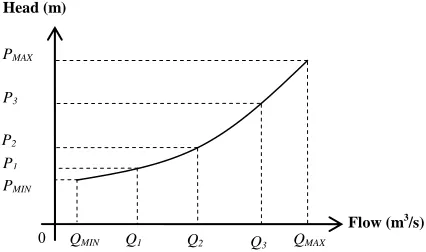
. For each of the intervals con-structed by partitioning the feasible flow space, defined by and MAX , a pump with procurement
cost MIN
Q Q B
B
C
P P
tris selected (Section 3.1.3). This yields the step cost function represented in Figure 7, for the pressure
domain defined by MIN and MAX.
The function obtained takes discrete values that de- pend on the pressure range sector is operating in. But selecting a reference pressure for each pressure in- terval, one can apply a linear regression to obtain the linear pumping cost function shown in Figure 7, de-
fined mathematically by:
,tr tr tr tr tr
CBF P cbf P cbfc
cbf
(10) where tr
is the cost of providing a unit of pressure,
tr
cbfc is the fixed cost associated with operating sector
, and tr
tr P its operating pressure. The regression must
satisfy the condition CBFtr
PMIN
0 (negative costsHead (m)
QMIN
P2
P1
PMIN
Q2 Q3
Q1 QMAX
PMAX
P3
Flow (m3/s)
0
Figure 6. System curve for pipe sector tr with diameter .
Cost ($)
PMIN
C2
C1
P2 P3
P1 PMAX
C4
C3
Head (m)
[image:6.595.316.530.576.711.2]0
for viable pressure values are meaningless). Considering all the sectors that constitute :
Ptr cbfctr
.
tr tr
CBF cbf
(11) Regressions for higher degree polynomials can be performed, resulting, however, in the inclusion of non- linearities in the project cost function.3.4.4. Variable Pumping
The procedure for estimating the variable pumping cost is the same, except that the costs CB
t
associated with the selected pumps represent the cost of operating them to time horizon . Thus, the operating cost of for can be estimated by:
t
Ptr cbvctr
,
trtr
CBV t cbv
tr
cbv
(12) where is the cost of providing a unit of pressure in sector tr, cbvctr
is the fixed cost of operating the sec-
tor, and Ptr
the operating pressure. The resulting ex-
pression is not time-dependent, but is addressed indi- rectly in (12). The positivity issue also applies here, as do higher-order regressions.
3.4.5. Total Cost
Substituting (8), (9), (11) and (12) in (6), the overall cost of network may be estimated by equation:
CT
tr tr tr tr tr trCT ca L cbf
ci L cbv
.tr tr tr tr tr tr
P cbfc
P cbvc
(13) Note that (13) was derived considering only one di-ameter value , but will be generalized later.
3.5. Mathematical Modeling
The set of producing regions and candidate links can be represented by a complete digraph, where vertices are regions and edges the links between them. Values for distances and inter-region height differences are associ- ated with edges. Similarly, a graph can be associated with the designed network structure. The graph that sat- isfies the coverage condition for all regions with the fewest connections is a spanning tree (ST) [17], which is adopted as a solution. The formulation by Gavish [18] will be taken as the basis for modeling.
3.5.1. Sets, Indexes and Nomenclature
The set of regions is represented by I and diameters by
. The reduced set of regions is defined by
D I I
,j
d
d
i j i
j
d
. The indexes i and and index represent the
regions and the diameters, respectively. An edge or link interconnecting any two vertices is called a sector of the network. For a sector , the flow
takes place in the direction . Accordingly, is the initial (input) vertex and the final (output) vertex of the sector considered.
k d
i j, ,
i j, ,
3.5.2. Decision Variables
Define binary variable xij, with value 1 if the sector
i j d, ,
q
d
p i
is selected and 0 otherwise. To quantify the flow associated with each sector, we define the non- negative continuous variable ij. We define the con- tinuous variable ij to quantify the energy supplied in the region of a sector
i j d, ,
.3.5.3. Constraints
Initially, it must be ensured that all regions will be served by the network. Therefore, except for the destination region, each must have at least one sector through which to dispatch its production. Since the desired topology is a ST, the condition that only one flow exit exist per region shall be forced. Mathematically:
,
1, , d
ij j I j i d D
x i I
i (14)
That is, for every region , only one pair j d,
i
may be selected. It is important to note that the equation does not restrict the number of sectors ending at any re- gion.
It is necessary to ensure the flow balance in the re- gions. For every region , the incoming flow from
kI at , plus its own production, is sent to i jI,
where i jk to avoid cycles. Mathematically:
, ,
, , .
ij i ki
j I j i k I k i
q Q q i I j k
(15)
There is flow in sector i j d, ,
0 : d 1
q d D x
if it is selected, i.e.,
ij ij . To ensure that condition, the following constraints can be used:
MIN MAX ,
, , ,
d d d
ij ij ij
d D d D
Q x q Q x
i I j I i j
(16) where:
MIN min i ,
i I
Q Q
(17)
MAX min OPER;
d d
T i
i I
Q Q Q Q
.
(18) The lower bound
QMIN
is defined as the lowestproduction of all regions. The upper bound
d
QMAX is
defined as the lesser value of the maximum flow sup-ported by the pipe or the total output being drained along the network. That is, at no time can any flow traversing the sector
i j d, ,
Q MAXd
Q
be below MIN or above ,
and flow is zero if the sector is not chosen.
destination ; nonetheless, restrictions (14), (15) and (16) together, ensure both conditions [18]. Basically, if the topology has cycles, the balance equations are satis- fied only if there is more than one flow exit sector at some of the nodes of the cycle or if there is consumption at any of them.
Finally, to ensure energy balance, the amount of en- ergy that must be provided to compensate for system losses must be estimated. In energy terms, each sector of the network can be viewed as an independent system with its own characteristics (flow, diameter, length, alti- tude difference etc.). Applying the assumptions of Sec- tion 3.2 to (2), it follows for every sector that:
2 5 2 8 π , , , d ij ij d dij ij i
d
f L q
p C
g
j I d D i j
, , d j ij
P H x i I
d CP (19)
where ij is the estimated losses due to geometry changes for the sector
i j d, ,
i j i
p p p p
d
p d
. By hypothesis, d
ij .
So ij represents the energy to be provided at i an not a pressure gradient within
i j d, ,
. Finally, the variable domain constraints:0 d 1, d , ,
ij ij , , ,
x x i I j
I d D i j (20)
, ,
ij
q i I j I i, j, (21)
, ,
d ij
p i I j I, d D i, j. (22)
3.5.4. Objective Function
The Equation (13) will be taken as the objective function. Using the decision variables defined in Section 3.5.2, gives:
,
,
ij j I j i d D i I
ij j I j i d D i I
OF CC L
CB p
, d d ijd d d d
ij ij ij
x CBC x D 0 d x
i j d, ,
d p d p d (23)
which was generalized to consider all diameters in . Note that when ij no contribution by any cost re- lated to is added to the project total cost.
3.5.5. General
The mathematical programming formulation (MF) of the
problem is as follows:
MF: Minimize (23) subject to (14)-(16), (19)-(22).
4. Sollution Approaches
4.1. General ConsiderationsMF can be manipulated. The ij variables appear only in the energy balance constraint (19), domain constraints
(22) and objective function (23). The constraint (19) is an equality and, therefore, may be incorporated into the ob- jective function. The variables ij can, in turn, be de- leted from the formulation, together with constraints (22). Substituting (19) in (23), gives the new objective func- tion of MF, where and ijdare appropriate parame- ters:
, 2 5 , . d d ij ij i I j I j i d Dd ij ij
d d d d
ij d ij ij ij
i I j I j i d D
OF CC L x
L q
CB CBC x
S , , ij Si j S
LT L
(24)
4.2. Heuristic
We consider (24) to develop the algorithm. By evaluating its parameters, three characterizations of a good solution to the problem can be inferred. First, consider the total length in a feasible solution :
(25)
, d 1 for any
ij
S i j x d D
LT
where . Both por-
tions of cost in (24) are, in some sense, directly propor- tional to S . The smaller the total length of the solu- tion network, the lower the cost associated with it. Sec- ond, consider
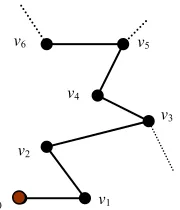
S v0v
L L L
(Figure 8), where is the des-
tination vertex.
Additionally, suppose that 6 is one of the vertices
with highest output among producing regions and that
65 60 6 0 L
v
, where ij represents the total length of the path connecting vertices i and vj
ij
L vi
, and represents the direct connection between and
j
v . The following expression is computed for S
in (24): 2 5 , , ij ij d i j SL q
(26)That is, the cost is proportional to the square of the flow in
i j d, ,
and the length of the sector. In addition, once flows increase in the direction of the destination, itv6 v5
v4
v3
v2
v1
v0
S [image:8.595.382.472.608.713.2]can be advantageous to connect 6 to v0 through the
path that minimizes the distance between them (directly, for example) in order to reduce the cost of transportation (operation) between 6 and 0, in exchange for build-
ing RD 60 65 additional units of pipe length.
The Figure 9 shows the new solution .
v
v L
S
i j d, ,
v L
LT
Finally, the cost of is inversely proportional to the fifth power of the selected diameters and directly propor- tional to the flows transferred. Since flows increase in the direction of the destination, this increase can be offset by forcing the diameters at least not to decrease in the direc- tion of flow. On the other hand, pipes of larger diameter are more expensive. Thus, it may be beneficial to in- crease the diameter of sectors with large flows, providing they are as short as possible.
S
Algorithm Description
Initially, the heuristic PNDH calculates the minimum
spanning (MST) tree for the case being solved. This is because the MST is the best estimate in terms of total network length and may be used as initial search point for problems of this nature [19]. The algorithm then de- fines the flow direction and its value in each sector
. The smallest available diameter capable of car- rying the flow calculated for each sector is selected. The cost of the initial solution is stored. The algorithm at- tempts to decrease the distance traveled by large flows and increase the diameter of some sectors, one at a time—in both cases, a predefined number of times. At each trial (path reduction and diameter increase), the new solution is stored if it improves cost.
4.3. Exact
The MF is solved via an exact Outer Approximation al-
gorithm proposed by Duran and Grossmann [20] for MINLP. Although the proposed model does not take into account all the necessary assumptions (linearity of the discrete variables, convexity of the nonlinear functions involving continuous variables and separability on the decision variables) to ensure the convergence of the al- gorithm to global optima, these global optima were ob- tained [12].
v3
v5
v6
v4
v2
v0 v1
Figure 9. Final part of
5. Computational Experiments
Computational experiments were conducted to test the efficiency and robustness of the model and algorithms. Because it is an original application to the PND problem, the literature on the subject contains no instances; these had first to be built. This section presents the cases con- structed, the results obtained with the algorithms and the main conclusions from the analysis of these results. 5.1. Instances
To build instances, the sugar industry of São Paulo was taken as context. In particular, Figure 10 shows the
pro-duction capacity (millions of cubic meters) and its geo-graphic distribution in 2006 [21]. The regions were named after the largest city in each region.
It can be readily seen how decentralized production is and how essential it is to use an appropriately designed and economically competitive logistics network to col- lect and concentrate production. Table 1 shows numeri-
cal values for output from each of the regions in 2006 [21].
Five instances were built, respectively with 4, 8, 12, 16 and 20 producing regions selected from among those listed in Table 1. Only five were built because, techni-
cally, a pipeline network designed to connect 20 produc- ing regions can already be considered large. Besides, there was no access to real data.
The distances between regions were determined using the geographic coordinates of the main town. The height differences were calculated directly via the towns’ alti- tudes. The outputs to be dispatched are listed in Table 1.
To determine the associated flow of ethanol, the system was considered to operate three hundred days a year, twenty-four hours a day. The resulting flow rates are listed in Table 1. The idea is to consider network down-
time indirectly.
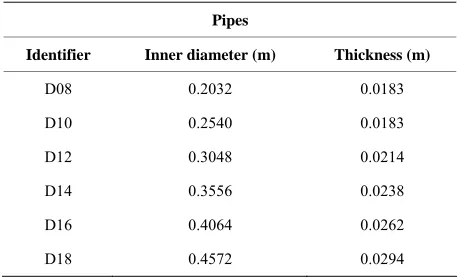
To compose the instances, a set of six possible values for the pair “pipe diameter and thickness” was consid- ered. Four of these pairs were associated with the small- est instance and all of them with the largest one. Table 2
shows the nominal values of the diameters and thick- nesses:
[image:9.595.121.216.607.714.2]Classical empirical equations were used to calculate the friction factors. There are three parameters to be con- sidered in this calculation: diameter, relative roughness [14] and Reynolds Number. The diameters are listed in
Table 2. The relative roughness is a characteristic of the
pipeline construction material, and the material selected was carbon steel [9]. Reynolds Numbers cannot be cal-culated as a priori every pipe flow is unkown.
Accord-ingly, an average flow traversing the network was con-sidered for each available diameter.
In all cases, the loss estimator was considered similar S
2000000 1000000 500000
Figure 10. Geographic distribution of ethanol production in São Paulo—2006.
Table 1. Producer regions and associated output in São Paulo—2006.
Producer Regions
Name Identifier Output (m3) Flow (m3/h)
Ribeirão Preto RIB 1760574.84 244.524
Jaboticabal JAB 838494.17 116.458
São Joaquim da Barra SJB 827575.62 114.941
Jaú JAU 747952.94 103.882
Assis ASS 539478.79 74.928
Catanduva CAT 492136.98 68.352
Araçatuba ARC 488406.16 67.834
Araraquara ARR 472506.72 65.626
Limeira LIM 333064.76 46.259
Piracicaba PIR 322051.47 44.729
Presidente Prudente PPR 296162.87 41.134
Bauru BAU 287329.26 39.907
Ituverava ITU 253191.72 35.166
Adamantina ADA 238679.21 33.150
Ourinhos OUR 228766.52 31.773
São Jose do Rio Preto SJR 209464.13 29.092
Birigui BIR 207890.22 28.874
Andradina AND 192191.56 26.693
Nhandeara NHA 174069.49 24.176
[image:10.595.100.499.337.736.2]for every
, i.e., ij . Construction unit costs were determined using Equation (7). The unit cost of carbon steel was obtained in [22]. Since pump com- mercial prices and real consumption data (
, ,
i j d d
CP CP
B
C costs)
were not obtained, the methodologies proposed in 3.4.3 and 3.4.4 were not used. Thus, the coefficients of the second portion of (23) were sorted so as at least to re-spect the percentage given in Section 3.4. Table 3
sum-marizes the values of technical parameters used in con-structing the instances. Table 4 summarizes the
[image:11.595.57.287.244.383.2]charac-teristics of the instances.
Table 2. Pipe diameter and thickness values considered.
Pipes
Identifier Inner diameter (m) Thickness (m)
D08 0.2032 0.0183
D10 0.2540 0.0183
D12 0.3048 0.0214
D14 0.3556 0.0238
D16 0.4064 0.0262
[image:11.595.60.287.408.598.2]D18 0.4572 0.0294
Table 3. Adopted values to technical parameters.
Parameter Value (Unit)
Steel unit mass cost cM 0.6 ($/kg)
Carbon steel density M 7860.0 (kg/m
3)
Equivalent carbon steel roughness M 0.0045 (cm)
Safety factor F 0.72
Circumferential tension 241.325 (MPa)
Ethanol density 789.0 (kg/m3)
Ethanol viscosity 1.19 e−3 (Ns/m2)
Head loss estimator
d ij CP
12.36 (m)
Gravity g 9.8 (m/s2)
[image:11.595.312.538.610.735.2]Pinumber π 3.14
Table 4. Basic description of instances.
Instance
Name Number of regions Number of diameters
PND_SP_04_04 04 04
PND_SP_08_05 08 05
PND_SP_12_05 12 05
PND_SP_16_06 16 06
PND_SP_20_06 20 06
5.2. Results
The experiments were performed on an Intel Core 2 Duo 2.66 GHz with 8 GB of RAM. The PNDH heuristic was
coded in ANSI C++. The MF was programmed in the
[image:11.595.59.287.623.737.2]commercial software AIMMS [23] and solved with the AOA package available in AIMMS. The OA algorithm problem solvers used were CPLEX 12.1 and CONOPT 3.14 M. The destination region is Campinas.
Table 5 shows the objective function values, PNDH
and MF execution times, and a comparative analysis of
results in terms of economic gains offered by the solu- tions. PNDH runtimes were null in all cases. MF pro-
duced the best solution for each case, which was ob- tained in low runtimes, as shown. By comparison, PNDH
was able to find two optimal solutions (~0%). The others solutions entail small economic losses ranging from 2% to 6.7%.
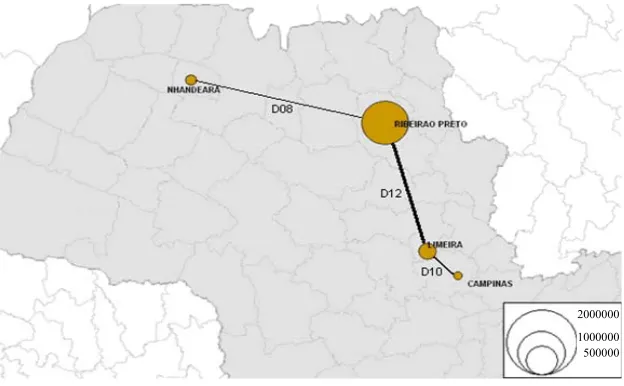
We now analyze solutions in non-financial technical terms. Figure 11 represents the optimal design for the
case PND_SP_04_04. It is topologically trivial. An in- teresting fact, however, is the reduction in diameter ob- served when passing through Limeira. We would expect the same diameter, since flow between Limeira and Campinas is larger. However, (5) suggests that a pipe- line’s maximum operating flow is inversely proportional to its length, which is shorter in sector Limeira-Campi- nas.
The PNDH solution to PND_SP_08_05 is shown in Figure 12. The network is 943.0 km in length and basi-
cally concentrates small outputs at Catanduva to be sent to Campinas via Jau. Only Ourinhos pipes directly to Jau, given their proximity. The production routed through Catanduva requires increased diameters on main sectors D12 and D14, successively. Figure 13 shows the MF
solution. The network is 984.0 km length (41.0 km longer). Despite the increase, transferring output from Presidente Prudente to Jau via Ourinhos apparently re- duces the transport cost (131.0 km shorter) and the con- struction cost of the Catanduva-Jau sector (from D12 to D10), since flow is decreased. The changes represent a Table 5. Upper bounds generated by PNDH, optimal solu-tions obtained by MF, and percentage economic gains.
PNDH MF
Instance OF ($) Time
(s) OF ($) Time
(s)
Economic gain (%)
PND_SP_04_04 43630086.61 0.0 43630086.61 0.00 0
PND_SP_08_05 96352887.34 0.0 94722203.45 0.05 1.72
PND_SP_12_05118738486.56 0.0 118738486.50 0.23 5.0e–08
PND_SP_16_06148306176.40 0.0 146584104.40 0.33 1.17
2000000 1000000 500000
Figure 11. Optimal solution to instance PND_SP_04_04.
[image:12.595.140.457.309.552.2]2000000 1000000 500000
Figure 12. Solution to PND_SP_08_05 by PNDH.
2000000 1000000 500000
[image:12.595.140.456.434.710.2]1.72% saving in project cost (Table 5).
Figure 14 represents the optimal solution obtained to
PND_SP_12_05, with 973.0 km total pipeline length. Interestingly, output from Nhandeara is initially trans- ported to the west, away from Campinas, probably be- cause the output is so small that it is not worthwhile connecting it to Ribeirao Preto or Bauru, 239.0 and 207.0 km away, respectively, even if the segment Adaman- tina-Assis (128.0 km) were removed, for example, in order to increase Nhandeara’s throughput. Pipe diameter increases significantly at Jau, because it concentrates almost all output even before it arrives at Campinas. At Bauru, on the contrary, pipeline diameter is reduced, probably for reasons of geography.
PNDH built the 1040.0 km solution to PND_SP_16_06,
as sketched in Figure 15. Prioritizing the shortest possi-
ble pipeline length, Ribeirão Preto was connected to Jaboticabal (54.0 km northwest). Since Ribeirão Preto has the highest output (Table 1), pipeline diameter from
Jaboticabal increased significantly (from D12 to D16). There is a diameter reduction at Limeira.
As compared with the optimal design (Figure 16),
there is little change when leaving Ribeirão Preto, from which flow now travels 75.0 kilometers to Araraquara. This adds 21.0 km to the network (1061.0 km), reduces the construction costs of the Jaboticabal-Araraquara sec- tor (from D16 to D12) and transport costs of output from Ribeirão Preto. The change represents a 1.17% project cost saving (Table 5). Finally, it is advantageous to
transport output from Assis to Araraquara via Presidente Prudente (582.0 km) rather than connecting them directly. Increased production could justify a direct connection.
[image:13.595.141.455.291.494.2]2000000 1000000 500000
Figure 14. Optimal solution to instance PND_SP_12_05.
[image:13.595.140.456.487.715.2]2000000 1000000 500000
Figure 15. Solution to PND_SP_16_06 by PNDH.
Finally, Figure 17 represents the PNDH solution to
PND_SP_20_06 (1361.0 km). Interestingly, Ribeirão Preto was connected to Campinas and not to a closer region (Araraquara or Limeira). This is because connect- ing it to Araraquara entails increasing diameters all the way to Campinas, thus also increasing the solution cost. Nevertheless, the Ribeirão Preto-Campinas connection does not form part of the optimal solution (Figure 18),
since dispatching from Ribeirão Preto to Araraquara is economically favorable. This modification undermines the heuristic topology (Araraquara-Jau), making it nec- essary to detour flow from Araraquara to Limeira. This modifies pipe diameters in the final portion of the net- work, reduces the network length to 1282.0 km and represents a 6.7% saving in project cost (Table 5).
Pipe-line diameter is reduced at Piracicaba.
5.3. Conclusions
These findings emphasize the quality of the solutions built by PNDH (economic losses of less than 6.7% at null
computational time cost). This result confirms the poten- tial of the set of characterizations of a good solution. However, the most encouraging results were those gen- erated by the exact algorithm. All except the largest case were solved in very low computational times. Improve- ment may possible be achieved by inputting information from the heuristic solution to the OA algorithm.
The tools developed to solve the PND addressed here met the expectations of robustness and efficiency and can be used as decision support tools for projects of this na-ture. Indeed, as the PND relates to a pipeline network whose purpose is to channel fluids to some central location,
[image:14.595.134.462.291.489.2]2000000 1000000 500000
Figure 16. Optimal solution to instance PND_SP_16_06.
2000000
[image:14.595.134.462.510.720.2]1000000 500000
2000000
[image:15.595.141.456.86.280.2]1000000 500000
Figure 18. Optimal solution to instance PND_SP_20_06.
and where the main characteristic of the required solution is a topology without cycles and with pressure disconti-nuities at vertexes, these tools can be used.
6. Final Remarks
6.1. GeneralIn this study, the problem of designing pipeline networks to transport fuel was addressed with a view to developing robust and efficient computational tools able to consider and assess the main design-related technical characteris-tics and decisions, as well as to estimate the construction cost and the operating cost (to any time horizon), in order to assist decision makers when evaluating the technical and economic feasibility of such projects.
Technical decisions are interdependent. For example: for a given flow rate, the larger the diameter of the duct, the lower the power dissipation. Thus pumps can be smaller and cheaper. However, the larger the diameter, the more expensive the pipe becomes. Conversely, if pipe diameter is diminished in order to reduce construc-tion cost for the same flow rate, power dissipaconstruc-tion is higher and thus higher-capacity (and more costly) pumps have to be installed. The larger the network, the harder it is to address these issues.
Accordingly, the combinatorial nature of the problem coupled with non-linear equations governing the flow energy balance, recommended the use of MINL mathe-matical programming models. To solve the problem, a heuristic algorithm that traces the main features of a technically feasible solution was developed to search for the best possible solutions in terms of cost. The mathe-matical program was coded in the AIMMS development environment, which provided the necessary optimization tools.
The particular context adopted was the ethanol indus-try in São Paulo State. The tools developed were tested on five cases built on the basis of output data from around the state. The computational results were ex-tremely satisfactory, since all cases were solved effi-ciently by the heuristics, and also to global optimality by the exact algorithm, with low execution times, thus con-firming the robustness of the approaches adopted. 6.2. Future Work
The most radical paradigm that can be broken is the de-terministic approach. The assumption that the supply of ethanol is uncertain to the operating time horizon would probably lead to addressing the time variable directly, in order to design a network that best suits many different possible supply scenarios, as well as to using stochastic mathematical programs.
Technically, there are many options. Allocation of more than one diameter per sector of pipeline in the net-work may be considered. Pressure loss will be calculated as the sum of the losses in each of the sub-sections with different diameters. The energy balance equation should consider the different kinetic energy in the sectors, since different cross-sections produce different flow velocities for the same flow rate.
Another variant might consider finite storage capaci-ties in the regions, to be decided in view of the related cost. This capacity is influenced by the stochasticity of production and the NPSHR pump parameter. If only the
latter is considered, a stochastic approach to the problem can be avoided by estimating the minimum storage ca-pacity of each region.
pos-sible to provide all the power necessary in each region by using one single station (technical limitation) and that, since pipes have maximum pressure tolerances, it may be necessary to distribute the energy supplied so that theses limits are observed.
7. Ackowledgements
The authors would like to thank the Agência Nacional do Petróleo, Gás Natural e Biocombustíveis (ANP) for fi-nancial support provided under grant PRH-ANP-21.
REFERENCES
[1] J. Goldemberg, “Ethanol for a Sustainable Energy Fu- ture,” Science, Vol. 315, No. 5813, 2007, pp. 808-810. doi:10.1126/science.1137013
[2] H. Pacini and S. Silveira, “Consumer Choice between Ethanol and Gasoline: Lessons from Brazil and Sweden,” Energy Policy, Vol. 39, No. 11, 2010, pp. 6936-6942. doi:10.1016/j.enpol.2010.09.024
[3] R. G. Compeán and K. R. Polenske, “Antagonistic Bio-energies: Technological Divergence of the Ethanol Indus-try in Brazil,” Energy Policy, Vol. 39, No. 11, 2011, pp. 6951-6961.doi:10.1016/j.enpol.2010.11.017
[4] A. Hira and L. G. Oliveira, “No Substitute for Oil? How Brazil Developed Its Ethanol Industry,” Energy Policy, Vol. 37, No. 6, 2009, pp. 2450-2456.
doi:10.1016/j.enpol.2009.02.037
[5] A. T. Furtado, M. I. G. Scandiffio and L. A. B. Cortez, “The Brazilian Sugarcane Innovation System,” Energy Policy, Vol. 39, No. 1, 2010, pp. 156-166.
doi:10.1016/j.enpol.2010.09.023
[6] União da Indústria de Cana de Açucar, “Dados e Cota- ções-Estatísticas,” 2009.
http://www.unica.com.br/dadosCotacao/estatistica [7] Centro de Estudos Logísticos e Instituto Brasileiro de
Petróleo, Gás e Biocombstíveis, “Planejamento Integrado do Sistema Logístico de Distribuição de Combustíveis,” 2008. www.ibp.org.br
[8] L. C. Freitas and S. Kaneko, “Ethanol Demand in Brazil: Regional Approach,” Energy Policy, Vol. 39, No. 5, 2011, pp. 2289-2298.doi:10.1016/j.enpol.2011.01.039
[9] J. L. F. Freire, “Engenharia de Dutos,” ABCM, Rio de Janeiro, 2009.
[10] Project Management Institute, “Um Guia do Conjunto de
Conhecimentos em Gerenciamento de Projetos (Guia PMBOK®),” 3rd Edition, PMI Publications, Newtown Square, 2004.
[11] M. Minoux, “Network Synthesis and Optimum Network Design Problems: Models, Solution Methods and Appli-cations,” Networks, Vol. 19, No. 3, 1989, pp. 313-360. doi:10.1002/net.3230190305
[12] G. D. Silva, “Abordagens Heurísticas e Exatas para o Problema de Projeto de Redes de Dutos,” M.Sc. Thesis, COPPE/UFRJ, Rio de Janeiro, 2009.
[13] J. Brimberg, P. Hansen and K. Lih, “An Oil Pipeline De-sign Problem,” Operations Research, Vol. 51, No. 2, 2003, pp. 228-239.doi:10.1287/opre.51.2.228.12786
[14] B. Munson, D. F. Young and T. H. Okiishi, “Funda- mentos da Mecânica dos Fluidos,” 4th Edition, Edgard Blücher, São Paulo, 2004.
[15] J. R. Moreira and J. Goldemberg, “The Alcohol Pro-gram,” Energy Policy, Vol. 27, No. 4, 1999, pp. 229-245. doi:10.1016/S0301-4215(99)00005-1
[16] B. C. Forlano and R. Maclain, “Facilities Piping,” Para-gon Engineering Services, Houston, 1991.
[17] F. Harary, “Graphs Theory,” Addison-Wesley, Reading, 1969.
[18] B. Gavish, “Topological Design of Centralized Computer Networks—Formulations and Algorithms,” Networks, Vol. 12, No. 4, 1982, pp. 355-377.
doi:10.1002/net.3230120402
[19] F. Rothlauf, “On Optimal Solutions for the Optimal Com- munication Spanning Tree Problem,” Operations Re-search, Vol. 57, No. 2, 2009, pp. 413-425.
doi:10.1287/opre.1080.0592
[20] M. A. Duran and I. E. Grossmann, “An Outer-Approxi- mation Algorithm for a Class of Mixed-Integer Nonlinear Programs,” Mathematical Programming, Vol. 36, No. 3, 1986, pp. 307-339.doi:10.1007/BF02592064
[21] L. N. S. M. Dória, “Construção e Entendimento dos Cenários dos Mercados Interno e Externo do Álcool no Brasil (2006-2015),” Final paper on course in Operation Management in Oil Exploration and Production, Poly- technic School, Rio de Janeiro, 2007.
[22] MEPS LTD, “MEPS—World Carbon Steel Prices—With Individual Product Forecasts,” 2009.
http://www.meps.co.uk/World%20Carbon%20Price.htm [23] M. Roelofs and J. Bisschop, “AIMMS User’s Guide,” Pa-
ragon Decision Technology B.V., 2011.

![Table 2Classical empirical equations were used to calculate pipeline construction material, and the material selected was carbon steel [9]](https://thumb-us.123doks.com/thumbv2/123dok_us/1574818.703644/9.595.121.216.607.714/classical-empirical-equations-calculate-pipeline-construction-material-material.webp)