15
Short-Term Economic Forecasting
o By BRENDAN MENTON, M Sc. (Econ.) Ph.D.{Read before the Society on Friday, 18th December, 1964)
PART I: GENERAL CONSIDERATIONS
The mam purpose of short-term economic forecasting is to try to assess prospective economic conditions as a guide to the policy required to maintain economic activity at the liighest sustainable level. The period of the forecast is usually one of nine to twelve months, l e., to the end of the calendar or fiscal year ahead. This distinguishes it from the type of forecasting, or more properly programming, in which targets or aims covering a period of years are set.
As a result of general acceptance of Keynesian theories, governments since the end of the war have become increasingly concerned with problems of economic growth and demand management. This has called for a continuous review of economic trends so that the implications of various alternative policies can be assessed. Intelligent decision-taking by the government—just as in the case of private individuals or business firms— must rest on a view of all the salient facts. It must obviously rest also on a view about the future, in particular a view about the appropriate pressure of demand as given by the prospective relationship between total demand and total supply,, Short-term forecasting provides a framework in. which all the ascertamable facts and predictions m connection with future trends are assembled. In the absence of knowledge of what is happening in the economy and without an informed view of its likely performance in the months ahead, government policy cannot be intelligently formulated to further the economic objectives considered necessary. Alfred Marshall stated that a chief purpose of every study of human action should be to suggest the probable outcome of present tendencies and thus to indicate, tacitly if not expressly, such modifications of those tendencies as might further the well-being of mankind.
It is chiefly m connection with the formulation of fiscal policy at budget time that short-term economic forecasts are most useful from the point of view of management of the economy. This is particularly true in Ireland where the room for manoeuvre m monetary policy is at present limited and reliance has to be placed mainly on fiscal policy. The budget is the most effective instrument available for management of the economy and short-term forecasts are an invaluable aid to the making of budgetary decisions.
with long-term programmes or plans of economic development It may too have other subsidiary uses In the Netherlands, for example, short-term forecasts play a part in the process of wage deshort-termination.
The growing importance of short-term forecasting m relation to fiscal control arises from the fact that the budgets of central governments in nearly all countries since the last world war have become much more than an arithmetical exercise of balancing current expenditure and revenue and gearing public capital expenditure to available financial resources Even from the narrow viewpoint of government finance, public sector expenditure is now so vital a factor in the national economy that it is impossible to construct a budget for exchequer revenue and expenditure without at the same time forming a view of the national economy as a whole. With the assumption by the State of responsibility for not alone maintaining overall economic balance but indeed m this and other countries of responsibility also for conscious economic development, the central government budget has in fact become an instrument for central direction of the economy. Because of this new role, the whole economic situation has to be assessed and projections of the mam economic trends made to try to ensure that the overall financing of the budget is consistent with the objective of promoting and maintaining the maximum feasible rate of economic advance. Changes in taxation and government spending should fit m with these considerations
Demand management, to be effective, requires the prior development of suitable tools of analysis. These have been made available mainly as a result of the great improvement after the last world war m the range, frequency and quality of statistical data. This has been especially true of the national income accounts which are so important in this field. The national income data fit nicely into the theoretical framework that has been developed as a basis for economic analysis. They provide a com-prehensive measure of the level of economic activity and much detailed information about the various components of demand which determine that level.
Methods of short-term economic forecasting vary widely. They range from the simple and naive1 to the elaborate and sophisticated but neither simplicity nor sophistication guarantees accuracy. The forecasting may be done, for example, on the basis of a question and answer technique, intuition or hunchmanship, extrapolation of past trends, the use of business cycle indicators or statistical series which past experience has shown are a guide to cyclical fluctuation, or the use of the national income accounting framework to derive quantitative forecasts on the basis of either an eclectic or econometric approach. Whatever the methodology employed, economic forecasting is an attempt to predict, on the basis of certain assumptions,1 the relationship between total demand and the capacity available to meet it.
Before the second world war, techniques were so imperfect and the statistical data so limited that most macro-economic forecasts, irrespective of the method used, were the result of a process which was almost
17
tuitive Nowadays, most countries have developed the necessary statistical tools and rely mainly on the national income framework as a foundation for economic forecasting. The national income accounting procedure as many advantages over other methods whether an eclectic or econo-metric approach is employed First, it provides a framework for quanti-tative analysis. Secondly, it ties down the forecaster to the necessity for balancing the overall accounts and observing all the known relationships. Thirdly, estimates of the mam components of national income and expen-diture aggregates may be built up independently on the basis of incomes, output and expenditure and the results then checked for internal consis-tency. The use of the national income accounts ensures that the forecaster takes account of the whole economic situation and not just part of it
Apart from the Netherlands, reliance on expert appraisal of the sources of information available has so far been preferred m most countries to the use of econometric models for short-term forecasting. This preference is justified mainly on the grounds (1) that many of the factors that affect economic conditions m the actual world are not readily subject to mathe-matical treatment and econometric models, therefore, cannot take account of specific influences affecting such factors and (n) for short-term fore-casting there is direct information about probable future trends, such as the level of government expenditure and investment intentions, which makes it unnecessary to have recourse to econometric models with their precisely-stated quantitative relationships. "Feel" of the situation is very important m short-term forecasting and the informal or flexible approach by which judgments are expressed quantitatively in terms of the expected levels of demand and supply allows maximum scope for imagination and judgment in contrast to the rigidities of the mathematical processes em-ployed in the use of econometric models The fact that computers have a superhuman ability to do sums does not mean that they have independent judgment The formulation of accurate relationships and provision of accurate data are human responsibilities. It is men who make all the important assumptions, the machine merely calculates the effects of these assumptions in a given environment
corrected before the next approximation is taken The end-result should be a forecast internally consistent and incorporating all that is known about the special forces affecting each important sector.
In contrast to the arithmetical and successive approximation procedure of the informal approach, the use of econometric models involves a system of precisely-stated quantitative relationships from which forecasts are derived by solving simultaneous equations. The case for the use of econometrics in short-term forecasting is that, while the forecast of variables must be based on qualitative and implicit functional relation-ships, there is no way of testing these relationships against reality, unless the assumptions underlying them are set out quantitatively Bassie,2 however, states that "the more a function is complicated by additional variables or by non-linear relationships, the surer it is to make a good fit with past data and the surer it is to go wrong at some time in the future". This seems an exaggerated view but the record of econometric models in the field of short-term forecasting is not particularly impressive Moreover, as stated above, there are always special factors affecting the short-term economic situation which cannot be satisfactorily quantified and cannot be taken into account if the forecaster relies on an econometric model.
The flexibility of the informal method gives it, to my mind, a consider-able advantage over the use of econometric models for short-term fore-casting. For forecasts extending over two years or more, however, econo-metric models are invaluable because little direct information about conditions so far ahead is available and the forecasts have to be based on presumed conditions more or less explicitly stated Econometric models are in fact extensively used for long-term programming.
In most countries short-term forecasts are on the basis of a whole year, either the fiscal or calendar year In the United Kingdom and the United States, however, forecasts of gross national output and expenditure are made in quarterly terms, 1 e , they relate to the position in the last quarter of the period covered rather than to changes in the course of the year as compared with the preceding twelve months In these countries the period covered ranges from six to eighteen months depending on the time the forecast is made. Short-term forecasting on the basis of the calendar year has its drawbacks since economic changes rarely follow the course of the calendar year and an annual figure can mask developments within the year. It is doubtful, however, whether forecasting on the basis of quarterly figures represents much improvement, as reliable figures for quarterly national accounts have not been achieved in any country. Initial quarterly aggregates are nearly always subject to substantial revision and any forecasts based on such figures must be regarded with the greatest reserve. In any event, quarterly estimates of national income are not really feasible for countries such as Ireland with a large agricultural sector, the output of which is seasonal. The difficulty may be visualised easily when it is realised that to arrive at an appropriate figure of output, national accounts
19
theory would require estimates to be made of the product generated in respect of growing crops each quarter'
A possible way out of this difficulty would be to forecast gross national product, excluding agriculture, on the basis of projected developments quarter by quarter In the more advanced countries in which agriculture accounts for, say, less than ten per cent of total production this could give worthwhile results provided reasonably reliable quarterly data on current trends were available. There is a snag, however, in this procedure. Other sectors, m particular the construction sector, are also subject to wide seasonal variations m many countries. Having regard to the possi-bility of serious errors in forecasting on a quarterly basis, it would seem preferable to rely on full-year forecasts, despite their imperfections, until national income accounting has made further substantial advances The implications of forecasts on the basis of the calendar or fiscal year can be reassessed quarterly or even more frequently with the aid of various economic indicators The trend of imports and exports, the behaviour of prices and the level of industrial activity, to mention but a few, can tell a lot about the direction the economy is taking within the year
Apart from the period covered by the forecast, there is the question of the frequency with which short-term forecasts should be made Fore-casting is essentially continuous in nature and the predictions require modification and adjustment as the economic scene changes. Except m the United States, where full forecasts are made every quarter, and Canada, where forecasting is relatively continuous, most developed countries in the West adopt the same procedure They have a forecast prior to the budget made on the basis of unchanged policies, a second some months later, which takes account of the budgetary decisions, and a third some months later again when a first tentative assessment of the economic situation in the following twelve months (eighteen months m the case of the United Kingdom) is also usually made
Short-term economic forecasting is beset with difficulties but, no matter how imperfect our ability, the attempt must be made to predict the future as a guide to policy in this complex dynamic world of ours with its booms and slumps and recurrent need to accelerate or brake Otherwise, in a situation calling for, say, corrective measures, action would have to be deferred until all indicators pointed that way. Drastic steps might then be necessary which could have been avoided if the unfavourable situation were predicted and brought under control at an early stage It is a funda-mental principle of fiscal and monetary policy that "a stitch m time saves nine". It is true that at times when the economy is undergoing violent change as a result of internal or external developments short-term forecasts could prove so inaccurate that they might actually mislead the policy-maker. This chance has to be taken. The quality of short-term predictions will inevitably improve with the development of statistics and better knowledge of the behaviour of the economy and the relationships between the different forces operating on it.
every day, or indeed in every budget, to have long-term plans for stable growth. Otherwise there is the danger of the retarding effects on growth of the stop-go policies which some countries have suffered from m recent years Aims or targets, however, can be achieved and expectations ful-filled only if the economy continues to run smoothly. It is the purpose of short-term economic forecasting to assist in achieving this, if the economy leaves the rails, it is difficult to get it back
PART II: IRISH SHORT-TERM ECONOMIC FORECASTING
Introduction
Although forecasts have not been published, economic and fiscal policy m Ireland has rested for many years on explicit predictions of the course of the economy. Since the early 1950s the Department of Finance have carried out regular projections of the economy from the macro-economic point of view. The Minister for Finance m his 1950 Budget stressed the importance of these surveys when he said
"One of the primary responsibilities of a government is to promote, . by an enlightened budgetary and investment policy, the continuous and efficient use of national resources in men and materials A sound economic system is an essential condition of progress but, unfor-tunately, the automatic working of economic forces does not guarantee that available resources will adequately and unfailingly be employed to advance the national interest The modern democratic State is, therefore, rightly expected not only to maintain the essential liberties of its citizens but to take an active part in securing conditions favour-able to their material well-being This entails a continuous survey of the economic and social scene"
The publication of national mcome and expenditure figures on a regular annual basis by the Central Statistics Office from 1950 made it possible to undertake these surveys Over most of the 1950s the economic budget or short-term macro-economic forecast was prepared as an in-flationary/deflationary gap calculation on the basis of an assessment of the prospective overall supply and demand situation In recent years it has been the practice to prepare more elaborate short-term predictions of the likely outturn in the mam sectors of the economy and of the impact of the mam forces of demand and supply and from these to build up projections of total national income and national expenditure
The objective of current financial policy in this country, as defined in the Second Programme for Economic Expansion,3 is to maintain adequate —while avoiding excessive—demand as a basis for maximum economic advance. The Programme states that the maintenance of adequate demand m the sense of productive activity at the highest rate consistent with a competitive level of prices and costs and a reasonable degree of external balance cannot be expected to be automatic. It is constantly m danger of being upset by both external and internal forces If demand should begin
21
to fall below the desirable level the government will be concerned to ensure that appropriate action is taken to make good the deficiency by fiscal measures, increased public capital expenditure or other means The opposite situation—an excessive increase in demand—must also be guarded against Obviously, continuous review of the current and pros-pective situation is essential if this policy objective is to be attained
Short-term projections of the likely trend of events in the economy from the macro-economic point of view are prepared in the Department of Finance at least twice and often three times a year The forecasts are made following close consultation with the Central Statistics Office and informal consultations, whenever necessary, with other departments. The first exercise is carried out in February 'm order to have available before the budget a statistical picture of the economy extending to the end of the calendar year The projections and the reasoning behind them are then discussed between departmental officials and a small group of outside economic consultants and a composite view of the economic climate ahead obtained The Director of the Central Statistics Office attends the meetings with the economic consultants Particular attention is paid to the key projections of the growth rate and the balance of payments out-turn. The Minister for Finance m his 1964 budget speech described the purpose of the pre-budgetary assessment m that year as "to help in framing the budget in such a way that economic growth will be sustained at a high rate without too great a deficit being incurred m our external payments". Because of our open economy—imports and exports of goods and services represent over 80 per cent of gross national product—the likely impact of demand pressures on the external account is of special significance
The February or pre-budgetary assessment is usually reviewed in June, especially if the trade figures or other economic indicators point to signs of strain or stress m the economy The June forecast takes account, of course, of the budgetary measures The situation is always reassessed in the second half of the year from the macro-economic point of view, usually in October-November, when the detailed estimates of national income and expenditure for the previous calendar year become available
Apart from the projections of total national income and expenditure as a guide to policy, regular and careful watch is maintained on the various economic indicators issued weekly, monthly or quarterly by the Central Statistics Office showing the trend, inter aha, of imports and exports, agricultural and industrial production, activity in construction, employ-ment and unemployemploy-ment, emigration, retail sales, prices and wages and earnings On the monetary side quarterly banking statistics are available from the Central Bank. With this information it is possible in the autumn to evaluate with a reasonable degree of assurance the performance of the economy m most sectors in the year under review. At this time tentative predictions of likely developments in the following year are also made.
1962 projections4 and Dr C. E V Leser for those in 1963 and 1964 5 Another recent development has been the initiation by the Central Bank mits Quarterly Statistical Bulletin for January 1963 of a series of estimates of national income and expenditure for the preceding year m anticipation of the official C S O estimates These are based on the supply-of-money approach to national income
As mentioned earlier, the short-term forecasts as a guide to policy prepared in the Department of Finance have not been published The Minister for Finance in his budget speeches gives, however, a general view of the outlook for the calendar year ahead on the basis of the pre-budgetary projections In Britain predictions about the future have now also to be read between the lines of the Chancellor's budget speech Up to 1963 official predictions of the course of the economy were made m the "Economic Survey" published before the budget This procedure was dropped m 1963 and the "Economic Report" which replaced the "Econ-omic Survey" in that year is concerned with the past, like most of the other official documents issued prior to the budget Some countries, e g the United States, the Netherlands, Sweden and France, publish at least some of their official forecasts In Ireland we have some distance to go m the field of publication before reaching the position of having a dis-edifymg proliferation of contradictory forecasts!
With the publication of the Second Programme for Economic Expansion and the establishment of the National Industrial Economic Council (NIEC) the need has arisen m this country for an extension of the present formal arrangements for the preparation of macro-economic projections. The NIEC m its second interim report on "Procedures for continuous review of progress under the Second Programme for Economic Expansion", published in June 1964, says that it believes that "the flexible, timely and rational adaptation and modification of the framework of the second programme is an essential element in its effective execution" and for this purpose adequate information will be required in order to keep the per-formance of the economy under continuous review It recommends an annual review of the economy at the macro-economic level and suggests that the Department of Finance, after consultation with the Central Statistics Office and other departments and with the Economic Research Institute, should make available to the Council, for consideration at its February meeting in each year, a report describing what happened to output and employment in the mam sectors, to costs, incomes, savings and prices, and to private and public consumption, investment, exports and imports in the previous year and indicating the mam developments expected m the year that lies ahead.
This recommendation has been accepted by the government and it is intended that every February the Central Statistics Office, the Economic Research Institute and the Central Bank will be invited to take part in a conference to discuss macro-economic projections prepared in the Depart-ment of Finance on the basis of stated assumptions and judgDepart-ments
v 2 3
Following consideration of the projections by the conference a final version will be prepared for the NIEC The customary pre-budgetaiy consultations with independent economists and forecasts of economic prospects by the Department of Finance in the summer and autumn will continue as heretofore
Method of Forecasting
The national income and expenditure framework is used by the Department of Finance in assessing macro-economic prospects Projec-tions of total national income and total national expenditure are built up independently by estimating their mam components
Qualitative judgments play a very important part in the process These are based on extrapolation of past trends, views on various relationships which hold good in the economy, e g between real disposable income and consumer spending, the facts available about supply and demand at home and abroad and other aspects of the economic position and also to a very appreciable extent on "feel" of the situation "Feel" of the situation comes into play in regard to the weighting given to the various pieces of evidence available and in testing and synthesismg the estimates obtained from the different methods used It is precisely here that judgment is all-important Expressing the various qualitative judgments in quantitative terms within the national income framework imposes a discipline on the forecaster, ensures that all the implications of the various judgments are taken fully into account and makes for an internally consistent forecast, though, of course, it does not guarantee its validity
In arriving at an aggregate forecast of the value of gross national pro-duct by the income approach regard is had to the likely trend of propro-duction considered from both the demand and supply sides Independent forecasts are made of employee and other factor income (profits, etc) arising m both the agricultural and principal non-agricultural sectors as well as of net factor income earned abroad (wages and salaries, pensions, profits, etc , and emigrants' remittances)
Income from Agriculture
The projection of employee income in agriculture gives little trouble The total has changed little in recent years, the rising level of wage rates being offset more or less by the secular decline in employment
On the other hand, the forecasting of trends m farmers' incomes is particularly hazardous especially at the beginning of the year when the first set of projections are prepared The vagaries of the weather can affect output to a considerable extent not alone in regard to crop production but also in regard to livestock and livestock products, particularly milk and beef output. The best that can be done is to postulate average weather conditions.
cattle are exported m one year, the depletion of the cattle herd will take some time to make good. Even if ample markets for cattle are available, supplies will not be forthcoming till further numbers are born and reared to an age at which they can be disposed of unless stocks are run down abnormally So far as cattle and beef are concerned, demand considera-tions are the determining factor m the short-term
On the demand side, the limiting factor is, of course, what markets will be available for our products Since our domestic economy is small and consumption of food relatively stable this resolves itself m the mam into an enquiry about how export markets for our products are likely to shape This question has to be studied from a number of aspects, first, com-petitiveness, 1 e , whether our products will be attractive from the point of view of both price and quality, secondly, whether we will have a reasonable degree of access to foreign markets—an important question m \iew of the limitation on agricultural imports into many countries, thirdly, the supply position of our competitors, and, finally, what is the state of prosperity of export markets
This final aspect, the state of demand abroad, especially for live cattle and beef m Britain, is the most important of all on the demand side. All available information is assembled m regard to the current position m that market and an effort is made to determine the underlying trends. Prices have, of course to be examined first. If they are likely to remain favourable it is probable that farmers will be encouraged to dispose of their stocks during the year, if unfavourable, they may prefer to hold on to them. To determine the likely trend, it is necessary to take into account the state of supply from domestic British producers and from external sources other than this country. The fodder position in Britain m relation to the market for stores and many other such considerations have also to be taken into account Then the general state of health of the British economy has to be examined since if incomes are rising steadily the demand for meat will be greater, while m a static situation one would expect the demand to show little, if any, improvement The state of markets abroad for some other important agricultural products is also reviewed. On the basis of all these factors, a figure of the prospective change in farmers' profits is arrived at.
25
estimate of the seeds used is based on the acreage of crops Firm figures are available for the quantities and prices of fertilisers since inputs of fertilisers m the crop year ending the previous 30th June are used Up-to-date estimates of the production of compound feeding stuffs, together with imports, enable estimates of inputs of feeding stuffs to be made For other agricultural expenses, which must be subtracted in order to derive agricultural income, extrapolations are made, taking account of available data on specific items such as rates
Non-Agricultural Income
Industry is by far the most important sector of non-agricultural activity. In 1963 it accounted for 42% of non-agricultural domestic income and 30 % of total national income
Projection of the change m total income arising m industry is arrived at in two ways First, a forecast is made of the volume of production and of the expected change in prices Secondly, independent assessments are made of changes m employee income and profits Both methods give a projection of the total change in income arising m the sector. The forecast of employee income is on the basis of the likely trends in earnings and m numbers employed, while the forecast of profits is based on extrapolation of past trends and expected developments in regard to wage pressure and other factors such as the level of demand For the pre-budgetary projection, when little, if any, data is available on the economic situation in the year under review, reliance has to be placed on the cross-check provided by these two methods and the process of successive approximations in the hope that a reasonably accurate forecast will emerge For later forecasts, however, especially that made in the Autumn, a considerable amount of data regarding trends m the industrial sector is available for assessing trends m both output and income
In assessing the likely change m incomes from the production side, both supply and demand factors have to be taken into account as m agriculture The supply factors are not so important m this country as elsewhere, since there is no indication yet that there is pressure on resources of capital or manpower. Industrial capacity still seems to be capable of further extension without strain while our unemployed are relatively large m numbers
we have to take account not only of any prospective rise in domestic costs but also of the costs of our competitors abroad It is, obviously, not the absolute change m costs m this country alone that is important but their relationship to costs elsewhere
The exact effects of a British recession or boom on production in this country have never been worked out. One would, pnma facie, expect that because of the open nature of the Irish economy, it would, for example be depressed if Britain's economy is stagnant This, however, has not been the position in recent years J h e average annual rise m the volume of gross national product over recent periods has been as follows
1954-1957 (mcl) 1959-1963 (mcl.)
0/ ' 0/
/o /o
Ireland 0-7 4-3 United Kingdom 2 7 2-8
On the other hand there is obviously some relationship as the following figures of the annual increase in the volume of GNP for recent years show
Ireland
United Kingdom
1959
0 /
/ o 4 4 3 5
1960
0 /
/ o 5 4 4-3
1961
0 /
/ o 4-7 3 3
1962
0 /
/ o 2 9 0-2
1963
0 /
/ o 4 0 2 9 In these years the table shows that when the rate of increase in output rose in the UK as compared with the preceding year, the same phenomenon occurred here, while, if the rate of increase dropped, our rate slackened also In preparing the projections it is safe, therefore, to assume that an increase m activity in Britain will have a stimulating effect on our industrial production and exports and that a contraction of activity may have some adverse repercussions, though not to the point of causing depressed conditions here.
When prospects for the competitiveness of our products and demand abroad have been assessed, we aie in a better position to project increases in income m the industrial sector on the basis of changes in the volume of production and prices The quarterly estimates of the volume of output m manufacturing and transportable goods industries m the previous year and the annual Census of Industrial Production returns for preceding years, together with the various price indices are, of course, also of some value m assessing the probable trend at the time of the pre-budgetary fore-cast. For the June forecast, and more so the October forecast, some data for the year under review on the volume of production in manufacturing and transportable goods industries and on the trend in prices of materials used and of output are available for the projection of total income.
consider-27
able variation from year to year. Weather conditions in the winter and spring can have an appreciable effect on output. Apart from this factor, output is conditioned by the demand for houses, factories, offices, hotels, roads and bridges and other construction work. Projection of trends is especially difficult m the early part of the year. Reliance must be placed then on the expenditure plans of the State and local authorities for housing, roads and other construction and on the intentions of the private sector re-garding major building projects. For the June and Autumn forecasts a number of indicators are available Useful trends are disclosed by the monthly statistics of employment derived from the sales of wet-time stamps,6 the monthly figures of the numbers employed on construction works of local authorities, the statistics of production of building materials (cement, bricks, etc.) obtained from the quarterly inquiry into transportable goods industries and the monthly series of houses built and m course of construction. These give a good line on the prospective change in the volume of production for the year as a whole and, using relevant wholesale price index numbers, an estimate of income from building and construction activity can be derived
The alternative method is to project factor income directly for the industrial sector as a whole As regards remuneration of employees, the wages climate must first be examined to see what are the prospects of a further general increase m wages and salaries and, if so, how much is it likely to amount to and for how much of the year will it be in operation To arrive at conclusions on these matters a whole host of questions must be considered. Has there recently been a rise m wages ? If so, have the full effects of the wage round been felt? Is there likely to be stability m earnings following this round apart from normal wage drift?
When these and other relevant factors have been assessed, a forecast is made of the likely increase m incomes of the existing industrial labour force This has then to be increased to take account of a rise in employment m the industrial sector if this is anticipated. The size of the increase is a matter for rough estimation and takes account of the probable rise m industrial output and m output per worker in relation to past trends
The forecast for profits in industry will, of course, be closely connected with and largely derived from the predicted trend in production and m employee incomes If, as m 1964, a substantial increase in wages and salaries is anticipated because of a wage and salary round, the expectation is that there will be some tightening of profit margins
For the Autumn forecast a total for employee income can be derived from the data on movements of wage and salary rates and earnings and on the change m employment during the first half of the year The forecast of the trend in profits can be checked against the profit figures of public companies published during the year.
The non-agricultural sector outside industry covers distribution, transport and communication and various services comprising a wide
6 Building workers are insured against loss of work due to bad weather. Sales of
variety of activities ranging from banking, insurance, teaching, enter-tainment and other personal seivices to public services such as adminis-tration and defence. In these sectors there is much less to go on m pre-paring forecasts of output. A number of economic indicators, e g. the index of retail sales in the case of distribution, offers some guide to activity but, generally, only very broad conclusions can be drawn Reliance is placed mainly on the projection of incomes and profits which are worked out on the same lines as for industry
Income from Abroad
The sum of incomes m agriculture, industry and the remaining sectors gives a total for domestic income. To obtain total national income, a forecast of factor income from abroad must be added. This arises under three heads, viz., net inflow of profits, wages, salaries and pensions and emigrants' remittances. The aggregate of these various items has not varied much from year to year—no more than £1 to £2 million up or down—and foreign income is not, therefore, too difficult to forecast.
Adjustment for Stock Depreciation
There is one final calculation necessary to arrive at a figure for national income In accordance with international practice only the value of the
volume change m stocks is taken into account for national income purposes
and, accordingly, an adjustment has to be made for the change m the value of non-agricultural stocks arising from price movements alone This is based on the trend m certain wholesale index numbers
Gross National Product at Current Prices
The sum of the projections of all these items gives a forecast of national income or net national product at factor cost To obtain the value of gross national product at factor cost an allowance must be made for depreciation or that part of the nation's assets which has been used up in the current production of goods and services Finally, to obtain the value of gross national product at market prices, I e in terms of the prices actually paid, which is the most convenient valuation and the one generally adopted, any indirect taxes on expenditure and subsidy payments must be accounted for. Valuation at market prices differs from factor cost by the amount of in-direct taxes less subsidies When estimates of these have been made, a figure for gross national production at current market prices has been built up
Gross Nationcl Expenditure
29
change in stocks and of imports and exports of goods and services. A direct assessment is made of personal expenditure For the pre-budgetary forecast, estimates are made of the change in the value of consumption on the basis of trends m retail sales at current values and the relationship between disposable income and consumer spending Past experience indicates some time-lag between a rise in incomes and in consumer spending For the later forecasts other economic indicators besides the retail sales index, such as car registrations, provide supple-mentary data The forecast of net current expenditure of public authorities is based mainly on the estimates of expenditure in the public services for the financial year
The projection of fixed asset formation is based to a large extent on prospective expenditure on the public capital programme (this accounts for about 50 % of the financing of total fixed asset formation) and on information about investment intentions m the private sector For the later forecasts, estimates of domestic capital formation (houses, other building and construction and plant and machinery) and of imported capital goods are built up from estimates of the trend of production of capital goods derived from the Census of Industrial Production and from merchandise trade figures
Stocks are the most difficult of all the aggregates to forecast. Projections are m fact purely guesswork However, in making the guesses regard is had to certain probable developments—how cattle stocks are likely to be affected by the trends in exports and output and how the business climate is likely to be reflected m changes m industrial stocks. The level of activity, particularly m manufacturing industry and m building and construction, is a pointer to the change m non-agricultural stocks
introduced in 1965, is, of course, taken into account. The projection of investment income and outgo depends mamly on the level of interest rates and the level of profits
As gross national expenditure is equal to gross national product this calculation acts as a check on the results arrived at for gross national pro-duct on the basis of the income approach If the totals obtained from the two methods show any wide divergence the calculations are redone and the results synthesized to give the most reasonable forecast in the light of all the information available
Volume of Gross National Product
To arrive at the change in the volume of gross national product, the separate constituents of national expenditure must be adjusted for any anticipated changes in prices Price changes, e g consumer prices, whole-sale prices and import and export prices, have already been assessed in arriving at the total of national expenditure at current prices A large increase in gross national product at current prices need not indicate any increase in the volume of total production available for consumer spending, domestic capital formation or external investment if prices have risen appreciably The elimination of changes in money values also helps year-to-year comparisons This is done by deflating expenditure rather than output because of the difficulty of measuring the output of education services, transport, etc The constituents of expenditure are deflated separately Personal expenditure is deflated by the consumer price index and current expenditure of public authorities by a weighted average of the index of wage rates for public authority employees and the general wholesale price index in the ratio of about 3 1. Fixed asset formation is deflated by an index of the prices of capital goods. Visible exports and imports are deflated by the export and import unit price numbers respec-tively while invisibles, both import and export, are deflated by the con-sumer price index.
The resultant overall rise in the volume of national production can be checked at this point by rough sectoral calculations of the likely growth in the economy, viz in agriculture, industry and other non-agricultural activity which contribute approximately fifth, three-tenths and one-half of total national income
Another check is provided by broad calculations of the likely percentage increases m national productivity and employment which together add up to the percentage increase in the volume of national production This enables the forecaster to see whether the projected rise in the growth rate is reasonable from this point of view
Savings and Capital Formation
31
amount available to finance domestic capital formation is the sum of current savings, provision for depreciation and net foreign disinvestment. An allowance for depreciation has been made m arriving at an estimate for gross national product while the figure for net external disinvestment, plus or minus, has been arrived at m calculating national expenditure. The difference between the totals of these two items and the value of total gross capital formation represents total current savings. This is a pure residual The figure, however, can be checked roughly, at least in the case of the forecast m the autumn, against the trend in such categories of monetary savings as deposits in the trustee and Post Office savings banks, sales of savings certificates, subscriptions to prize bonds, interest-bearing deposits m the commercial banks, life assurance premiums and cash subscriptions to private share issues.
PART III: SHORT-TERM FORECASTING IN OTHER COUNTRIES In this part of my paper an attempt is made to summarize the short-term forecasting procedure followed m the United Kingdom, the United States, Sweden and the Netherlands It would be impossible in a paper of this length to go into all the aspects of economic forecasting in these countries I propose, therefore, to touch only on the more interesting features of the different approaches followed.
(1) United Kingdom
Three official forecasts of short-term economic prospects are prepared in the United Kingdom every year These forecasts cover periods of up to eighteen months ahead and consist of a preliminary appraisal in the Autumn, a forecast in the new year m preparation for the Budget and a further projection m early June to take account of budgetary changes They are prepared by two committees of the Treasury on which other government departments concerned are represented. One committee deals with internal economic prospects and the other with the balance of payments. An econometric model is not used, both committees relying on a building up of relevant data to arrive at the final aggregates The pre-dominant aim is to forecast the level of activity at the end of a period. The change is typically shown as a change between the present or recent past and a quarter near the end of the forecast period rather than a change from one calendar year to another
items. The surveys of business intentions are used in the preparation of estimates for the private sector while a good deal of information is avail-able about the plans of the public sector.
In forecasting the balance of payments, estimates of the current position are prepared first Then an assessment is made of prospects for the world economy. Forecasts are made of the movement of gross national product and its mam components m the principal industrial countries, drawing on the information available from these countries and from parallel studies made m the United Kingdom and by international organisations. The forecast of exports is essentially a demand forecast The Treasury believe that m the short run it is principally conditions m overseas markets which determine the value of exports of British goods Separate forecasts are made of the value of exports to each mam area To project imports, there is a detailed commodity by commodity approach This is checked by calculations which deduce the volume of total imports as a function of the forecast of final sales and stock-buildmg Invisible and long-term capital transactions are then projected and a forecast of the identified balance of current and long-term capital transactions is arrived at
Besides the official short-term forecasts prepared by the Treasury a number of projections by private groups are prepared during the year, e g. those of the National Institute of Economic and Social Research and the London and Cambridge Economic Service These projections are published and provide useful information on the likely trend of the economy
(n) United States
Considerable work is done in the United States on the preparation of short-term economic projections Consultative groups of academic and business economists prepare appraisals of the business outlook, periodicals of economic and financial interests publish their own projections while economists in the various departments of the Federal Government and in the Federal Reserve System make forecasts for internal use
The mam official forecast—the only one published—is prepared jointly by the Treasury Department, the Bureau of the Budget and the Council of Economic Advisers This is used as a basis for the formulation of the Federal Government's fiscal policy Estimates of GNP, personal income and corporate profits, on which the budget calculations are based, are given m the Budget Document published in January These are discussed later in detail m the Economic Report by the Council of Economic Advisers. Revised GNP figures are given m the Annual Review of the Budget published in late Summer or Autumn depending on when Congress adjourns
33
figures, price levels, the unemployment rate and Federal receipts and expenditure These figures are submitted to the President and discussed with him by the heads of the three Agencies
While a fully-articulated econometric model is not used in the prepara-tion of official United States forecasts, the Department of Commerce has recently begun to make use of a model constructed in the University of Pennsylvania for quarterly forecasts The need for using judgment to check closely the results obtained from such a model is, however, realised. Forecasters in the United States have access to a great volume of in-formation on current trends m the economy because of the advanced stage which the preparation of statistical data has reached Important indices such as those of retail sales and car and steel production are compiled remarkably quickly Regular sample surveys give indications of businessmen's confidence, the state of stocks and investment intentions A special quarterly forecast of government expenditure is also available from the Bureau of the Budget Because of the magnitude of government spending and its effect on the whole economy, this calculation is of considerable importance.
While the balance of payments is of vital concern to the U S it does not act as a major determinant of economic activity Imports are not very volatile and most of their short-term fluctuations have been induced rather than automatic For the prediction of exports the forecasters rely on the views of government specialists m the field of external trade The forecasts for exports are built up from an analysis by commodity and by country of world markets
When the projections of one quarter's figures are prepared, the forecast proceeds to the next quarter of the year and so on Finally, the forecasts are studied for their implications for the utilisation of capital and labour resources
(in) Sweden
In Sweden a "preliminary national budget" is prepared at the beginning of each year giving projections for the national economy which form the background to the economic policy proposals in the Finance Bill. A "revised national budget" is prepared at the end of the Spring session of Parliament, giving revised figures for the fiscal year which extends from 1st July to 30th June.
Both sets of calculations are prepared in the Economic Department of the Ministry of Finance in co-operation with experts from other govern-ment authorities, such as the National Labour Market Board, the National Institute of Economic Research and the Board of Trade. Advice is avail-able from a Research Council founded m 1954, consisting of the heads of Agricultural and Industrial Research Institutions, the National Institute of Economic Research and the Research Departments of the Federation of Trade Unions and of the Organisation of Salaried Employees.
economic policy remains unchanged If a gap emerges suitable economic policy to restore equilibrium is then considered Economic forecasts in Sweden, therefore, aim to provide a guide for policy rather than to suggest what may actually happen
On the supply side the estimated growth in GNP is calculated by adding together the forecasts in the various sectors of production, which are worked out independently. At a later stage of the analysis, corrections, by gradual adjustments of the various items to one another, take account of the manpower supply and estimated changes in productivity. Imports are calculated on the assumption of constant marginal relations between imports and certain sectors of demand and production On the demand side calculations of consumption are based on estimates of disposable real income. For exports, the views of exporters on prospects are available through the Swedish Board of Trade These are checked against estab-lished relationships in the export sector on the basis of the international demand for Swedish goods Investment figures are based on the published plans of State capital expenditure and on statistics of investment plans produced by certain types of private industry. In other sectors, e g. agriculture, extrapolation of present trends is used.
(IV) The Netherlands
In the Netherlands the State budget for the following year (which coincides with the calendar year) is submitted to Parliament in September. A quantitative macro-economic forecast is published simultaneously containing comments on the resources and expenditure tables for the coming year The Central Economic Plan which is published at the beginning of each year is in a sense a more elaborate and, if necessary, revised version of the Autumn forecast. Both forecasts are based on broad policy outlines adopted by the government for the following year and are carried out by the Central Planning Bureau which belongs formally to the Ministry of Finance.
The most important tool of analysis in the preparation of the forecasts is the econometric model constructed by the Central Planning Bureau for making short-term projections. This model contains relationships for the categories of expenditure (exports, consumption, investment and stocks), prices, the volume of imports and the manpower position. In constructing the model, the years 1923 to 1960 (excluding the war years) were taken as the sample period, with equations formulated so as to fit the widely diverging earlier and later parts of the period. Where an estimate for a pre-determmed variable appears uncertain an alternative estimate is introduced into the model and the effect of the changed assumption is then considered. As a check on the reliability of the forecast, an indepen-dent analysis, based on an input-output model at constant prices, is made of the mam branches of production
35
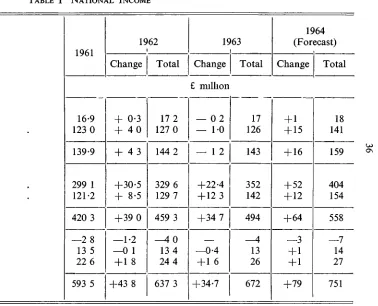
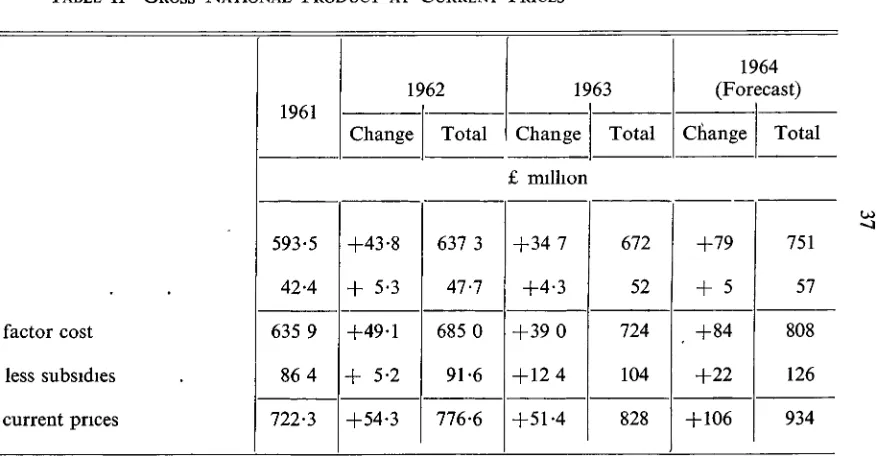
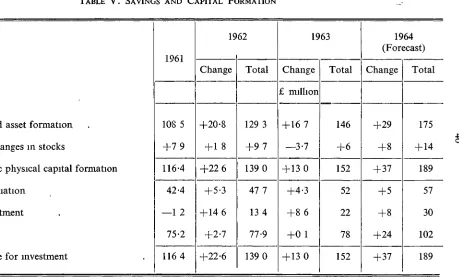
forecast, which of course has no official standing and for which I am solely responsible, is set out m the following five tables Its salient points are
(1) a growth rate somewhat in excess of 4 per cent,
(n) a balance of payments deficit in. the region of £30 million, (in) a rise of £79 million (11 8%) m national income as a result of
substantial increases m both agricultural and non-agricultural income,
(IV) a 10 per cent rise in consumer spending of which 6^- per cent is attributed to higher prices and 3^ per cent to increased volume The projected volume increase of Z\ per cent compares with the 1963 estimate of 4-J per cent,
(v) a further substantial expansion of fixed capital formation which, together with the anticipated increase m stocks, gives a ratio for investment of 20 per cent of GNP,
(vi) a marked rise in. savings accompanying the increase in invest-ment
Agriculture
Remuneration of Employees Farmers' Incomes
TOTAL
Non-agricultural sector.
Wages, salaries and pensions Profits, etc
TOTAL
Adjustment for stock appreciation Emigrants' remittances
Other foreign income Total national income
1961 16-9 123 0 139-9 299 1 121-2 420 3 — 2 8 13 5 22 6 593 5 1962 i Change Total + 0-3 + 40 + 43 +30-5 + 8-5 +39 0 —1-2 —0 1 + 1 8
+43 8 17 2 127 0 144 2 329 6 129 7 459 3 — 4 0 13 4 24 4 637 3 1963 Change £ million
— 0 2 — 1-0 — 1 2
+22-4 + 12 3
+34 7
—0-4 + 1 6
[image:22.686.242.620.60.366.2]TABLE II GROSS NATIONAL PRODUCT AT CURRENT PRICES
National Income
Plus depreciation .
Gross national product at factor cost
Plus Taxes on expenditure less subsidies
Gross national product at current prices
1961
1962 Change Total
IS Change
>63 Total
IS
(For
Change )64 ecast)
Total £ million
593-5 42-4 635 9 86 4 722-3
+43-8 + 5-3 +49-1 + 5-2 +54-3
637 3 47-7 685 0 91-6 776-6
+34 7
+4-3
+39 0
+ 12 4
+51-4
672 52 724 104 828
+79
+ 5
f +84
+22
+106
Personal expenditure
Net current expenditure of public authorities Gross domestic fixed asset formation Value of physical changes m stocks Exports of goods and services Imports of goods and services ... GNP at current prices . .
1961
19 Change
62 Total
19 Change
63 Total
1964 (Forecast) Change Total £ million
521-0 83 7 108 5 +7 9
291 7 —290-5
722 3
+38-6
+7 7
+20 8
+1-8
+ 15
—16-1 +54 3
559 6 91 4 129 3 +9 7
293 2 —306-6
776 6
+39 4
+7 6
+ 16 7
—3 7 +25 8
—34 4 +51 4
599 99 146
+6
319 —341 828
+61
+ 16
+29
+8
+35
—43 + 106
660 115 175 +14
354 —384 934
TABLE IV EXPENDITURE ON GROSS NATIONAL PRODUCT AT CONSTANT (1958) PRICES
1961
1962 Change Total
1963 Change Total
1964 Change £ million
Total
Personal expenditure
Net current expenditure of public authorities . Gross domestic fixed asset formation
Value of physical changes in stocks Exports of goods and services Imports of goods and services GNP at constant market prices
504-7 75 3 104-2 +7 6
286-4 —287-6
690-6
+17-6
+4-1
+15 6
+2-2
—5-2 —14-5 +19-8
522 3 79-4 119 8 +9 8
281 2 —302 1
710 4
+23-7
+4-6
14 2
—38
+ 18 8
—28-9 +28 6
546 84 134
+6
300 —331 739
+ 19
+4
+ 19
+7
+ 13
—31 +31
565 88 153 + 13
Gross domestic fixed asset formation Value of physical changes in stocks
Total gross domestic physical capital formation Provision for depreciation
Net foreign disinvestment Total savings
Gross total available for investment
1961
108 5 +7 9
116-4 42-4 —1 2 75-2 116 4
1962
Change
+20-3
+ 1 8
+22 6
+5-3
+ 14 6
+2-7
+22-6
Total
129 3
+9 7
139 0 47 7 13 4 77-9 139 0
1963
Change £ million
+ 16 7
—3-7
+13 0
+4-3
+8 6
+ 0 1
+13 0
Total
146
+ 6
152 52 22 78 152
1964 (Forecast) Change
+29
+8
+37
+5
+8
+24
+37
Total
175 + 14
[image:26.687.153.612.76.356.2]41
DISCUSSION
Mr. Bourke in seconding the vote of thanks stated that this was not the first occasion upon which the Society was indebted to Dr. Menton. He had read in February 1948 a paper on the Theories of Adjustment of the Balance of Payments under Fixed Exchanges, and in March 1958 a paper on Ireland and International Monetary Institutions, both of which were valuable contributions The present paper was no less valuable, and was written in a lucid straight-forward non-mathematical style.
This was an age of rapid technical progress and one m which govern-ments had had the responsibility for economic growth and demand management thrust upon them. A new importance therefore attached to predictions of total demand and the capacity availablle to meet it.
The paper rightly emphasised the importance of budgetary decisions m the management of the economy, and that this is particularly so m Ireland where the room for manoeuvre in monetary policy is limited and reliance must therefore be placed on fiscal policy. It is of interest that the Radcliffe Commission reached a non-dissimilar conclusion for the British economy, viz. "monetary measures are aimed at the level of demand, but by their nature they are incapable by themselves of having an effect sufficiently prompt and far-reaching for their purpose unless applied with a vigour that itself creates a major emergency", and again "Not so much a policy in themselves as a part of one general economic policy which includes among its instruments fiscal and monetary measures and direct physical controls".
The Second Economic Programme gives as its objective "To maintain adequate demand m the sense of productive activity at the highest rate consistent with a competitive level of prices and costs and a reasonable degree of external balance", and the National Industrial Economic Council has highlighted the necessity for an extension of the present formal arrangements for the preparation of macro-economic projections. It must be regarded as a substantial achievement that it will be possible to meet these requirements, and that the various bodies concerned are to take part m a Conference which will present to the Council for consideration at its February meeting a Report indicating not only what happened in the mam sectors of the economy during the past year, but providing projec-tions for what lies ahead
econometric models, should be helpful Computers are admirable for the speed and accuracy with which they carry out the most complicated cal-culations, but the computer is a slave to two masters, its programme and the data upon which it is fed, and it is bereft of that intangible thing that Dr. Menton calls "feel" for a situation, a factor which is to be disregarded at one's peril.
Reference is made by Dr Menton to the initiation by the Central Bank in its Quarterly Statistical Bulletin of a series of estimates of National Income and Expenditure which are based on the supply-of-money approach to National Income These estimates which are m anticipation of the more detailed official ones of the C S O are, I suggest, valuable as an indepen-dent approach based upon the relationship between the National Income (G D.E) and the supply-of-money and its velocity The figures are a useful check on results arrived at by more laborious methods, and they have the advantage of enabling a quick approximation to be made at almost any point of time They must be regarded as being still somewhat in the experimental stage, but the results arrived at have been good, though it must be borne in mind that normal relationships may be upset by some major departure from the norm in the supply or velocity element
The measurement of demand of industrial output is not easy It depends not only on whether our goods will remain competitive, and foreign markets will be buoyant or stagnant, but also on a variety of subsidiary factors In our economy there has been a significant advance in the acquisition-of expertise and know-how, and a break-through of a mental barrier This is best proved by a perusal of the Coras Trachtala Report for 1963 If one excludes food, drink and tobacco, which rose by almost £19m , and live animals £83m in that period, the figures show an increase m our exports of manufactured goods and raw materials from £18m to £53m , a remarkable achievement, especially when the range and variety of the exports is studied The more these figures grow the greater becomes the importance and the difficulty of accurate prediction The United Kingdom Market is and will no doubt continue to be of the greatest importance to us. One hesitates to draw too many conclusions from a limited range of figures, but it would appear from the annual increase in the volume of G N P. in Ireland and Great Britain for the five years 1959-1963 that our rate of progress is becoming less dependent upon that in the United Kingdom In those five years the percentage increase in Ireland has been 21.4, as against 14 2 in the U K In no year has the rate in Ireland been less than the rate in the U K., and the annual figures indicate that our better percentage achievement varies from a low of 0 9 to a high of 2 7
43
a percentage of the G N P (less a similar deduction) being for the four years 16 2, 16 4, 16 2, and 17 6
One provocative figure is that for Net Foreign Disinvestment, shown m Table 5 for the four years 1961-1964 at £64.2m Table 1, however, shows that "Other Foreign Income" so far from having fallen between 1961 and 1964, as one would have thought probable, has risen from £22 6m in 1961 to £24 4m. m 1962, £26m in 1963, and £27m. in 1964 The discrepancy may be explained in part by the tendency of investors in recent years to prefer Equities to fixed Interest Securities, with a con-sequential rise in income Moreover, much of the Foreign Capital which has moved into the country may not yet have resulted in an outward dram in the payment of dividends, no doubt m turn due to the ploughing back of the whole or the major part of profits which have arisen into financing expansion and there may be other causes explaining what seems at first glance to be a considerable discrepancy
It is a very great pleasure to me to second the vote of thanks to Dr Menton for this very excellent and opportune paper
Dr C E V. Leser The measurement of quarterly agricultural output
seems to be a case of "what is difficult, we attempt today, the impossible will take a little longer" An Foras Taluntais is tackling this very problem at present The Economic Research Institute is also preparing a continuous study of quarterly economic indicators, m comparison with previous periods and with the help of seasonal corrections A study on wages and prices made by O'Herhhy should help with price forecasting and thus improve the accuracy of national accounts forecasts made in the Institute