ISSN Online: 2331-4249 ISSN Print: 2331-4222
Electrode Effects on Polyurethane Soft Actuator
Masato Ohmukai
1, Jun Kyokane
21Department of Electrical and Computer Engineering, Akashi College of Technology, Akashi, Japan 2Center for International Education, Toyohashi University of Technology, Toyohashi, Japan
Abstract
A polymer soft actuator is under investigation using a poly urethane elasto-mer film that bends by means of an applied voltage, which is based on the electrostriction. Bending experiments were performed under different metal electrodes deposited the both sides of the film. Even if the thickness of the both electrodes is the same, the metal of the both electrodes is desirable to be the same to bend more. It is suggested that the balance of the physical proper-ties of the both metal is critical for larger bending.
Keywords
Poly Urethane Elastomer, Soft Actuator, Fullerenol, Metal Electrode
1. Introduction
A polymer soft actuator of polyurethane elastomer is now under investigation. The soft actuator is quite attractive because the structure is so simple as to be prepared at low cost. Actually the device consists of a polyurethane film with a thickness of several hundred micrometers equipped with two metal electrodes on the both sides. Other advantages of the device are soundless action, high energy efficiency and only use of environment-friendly materials [1][2]. The technology is now expected to be the one that is developed to robotic fingers [3]. It will also proceed to the fascinating artificial muscle technologies [4]. Some other research histo-ries are in the literature cited in our previous article [5].
Although the soft actuator is promisingly an interesting device, there are sev-eral problems unfortunately. The biggest problem among them is that the ap-plied voltage is required to be above 1 kV even to bend several centimeters. Ob-viously this voltage is too high from the aspect of artificial muscle applications. Some breakthrough to the lower driving voltage will be needed.
This article reports the effect of electrode materials on bending characteristic. The role of the metal electrodes is to supply the applied voltage over the surface. How to cite this paper: Ohmukai, M. and
Kyokane, J. (2017) Electrode Effects on Po-lyurethane Soft Actuator. World Journal of Engineering and Technology, 5, 520-525.
https://doi.org/10.4236/wjet.2017.53044
Received: July 18, 2017 Accepted: August 18, 2017 Published: August 21, 2017
Copyright © 2017 by authors and Scientific Research Publishing Inc. This work is licensed under the Creative Commons Attribution International License (CC BY 4.0).
This actuator acts to bend, so the mechanical properties of the electrode metal may affect the bending performance. The obtained results will be discussed in relation to the Young’s modulus of the metal used in the electrodes.
2. Experimental
First described is the way to form a polyurethane elastomer film. Before the for-mation of the film, fullerenol was synthesized, that was added to enhance the amount of bending. The synthesizing step of fullerenol is that fullerene is sulfo-nated and then hydrolyzed. Actually, fullerene (3 g) and oleum (25 ml) were mixed for 7 days to obtain multivalent sulfonated fullerene. By controlling the time and temperature of this mixing determines the degree of sulfonation. The sulfonated fullerene (3 g) was mixed with distilled water (60 ml) for 4 days for hydrolyzing. More detailed conditions can be referred to the literature [5]. This fullerenol was added in the process of a polyurethane film described later.
For the synthesis of polyurethane, prepolymer was prepared in such a way that a certain amount of polyol (P-3010 by Kuraray Co. Ltd.) was reacted with para-phenylene diisocyanate to replace the hydroxyl group to the isocyanate group. The number of para-phenylene diisocyanate moles should be the same as that of –OH group moles for the replacement of all –OH groups. The mixture of the two substances was heated up to around 100˚C in vacuum for the elimination of water in the mixture and even in the air.
The obtained prepolymer was blended with extenders that are actually diol and triol: 1,2-propanediol (1,2-PD) and trimethylolpropane (TMP). We were quite careful to degas thoroughly before and after the mixing at 80˚C in vacuum. The fullerenol was added together at this stage. The ratio of the fullerenol was 0.25% that gives the best performance as reported [5]. When prepolymer and extenders were mixed together, the coupling reaction between –OH and –NCO groups started spontaneously. The mixture was rapidly put into a mold of stainless steel and cured for 18 hours after it was well mixed and degassed. The thickness of the film was 400 μm, which was determined by a spacer put between a pair of two molds.
After curing, the film was taken out and cut into a rectangular form of 15 by 50 mm. Afterwards metal electrodes were deposited by means of an ion-assisted vacuum deposition method. The film thickness was under 0.5 μm. Four kinds of combinations were tried using Al and Au metals.
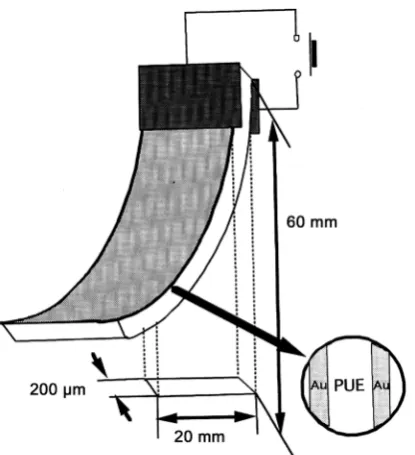
The actuation of bending was performed using a laser displacement meter (LB-1000 by Keyence Corp.) at the bottom end of the film while the film was clipped at the upper end as shown in Figure 1. The displacement meter meas-ures the forward or backward movement of the film at the laser-irradiated point.
3. Results and Discussion
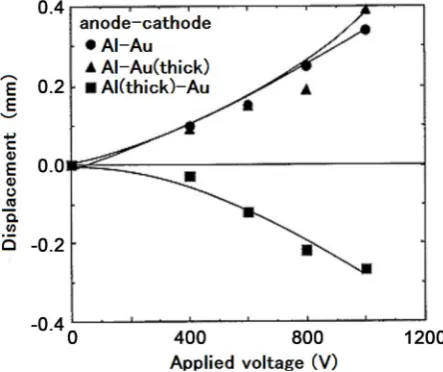
Figure 2 shows the displacement depending on the applied voltage. The
Figure 1. Dimension of polyurethane elastomer and its external appearance of bending action.
Figure 2. The bending displacement of the film as a function of applied voltage. Four kinds of combinations of metal were shown.
film is inversely proportional to the film thickness.
[image:3.595.263.477.338.528.2]We pay attention to the Young’s modulus of the metal. The Young’s moduli of aluminum and gold are 70.3 and 78.0 GPa, respectively. From the point of view, gold is harder than aluminum to bend by about 10%. It can well explain the Al - Al and Au - Au samples qualitatively. However, the Young’s modulus cannot explain the Au - Al and Al - Au cases at the same time. The discrepancy between Au - Al and Al - Au samples is meaningfully large. It was concluded that the unknown effect was triggered when the kinds of metal is different in an anode and a cathode.
Take the Al - Au case to consider further. Figure 3 shows other experimental results of Al - Au samples. The “thick” indicated in the figure means the ness of the film was about three times thicker. When the Au anode was thick-ened the characteristic was not apparently changed. On the other hand, when the Al cathode was thickened, the bending direction was reversed while the bending amount was not so varied. From the facts above, the cathode among the two electrodes, have an effect on bending mechanism. The effect was not clearly recognized at this stage. It is interesting to pursue the effect thoroughly because it may possibly unveil the closer mechanism of bending.
Another difference between the two metals is resistivity. Aluminum and gold have the resistivity of 27.5 and 24.0 nΩm, respectively. The resistivity of alumi-num has about 20% larger than that of gold. However the difference may not contribute to the change in bending characteristics because the polyurethane film is an insulator and the electric current does not play an important role for the actuation.
[image:4.595.260.482.520.706.2]J. Kyokane et al. have reported the interesting results that both positive and negative electric charges were accumulated near a cathode when the voltage was applied [7]. It is unlikely to the fact that negative and positive charges were ac-cumulated near the cathode and the anode, respectively, in case of polyethylene terephthalate that does not shows electrostriction. The cathode side shrinks and the anode side expands so that the film always bends in the direction of the ca-
thode. Since this result was when carbon nanotube was included in the film, it is too rough to apply this idea to our experimental results directly.
On the basis of the unaccountable phenomena shown in Figure 2, it is specu-lated that fine particles of the anode and the cathode permeated into the film and partly mixed in the film when the electrodes were deposited. In order to cla-rify the phenomena, it is needed to investigate more closely, even including a physical structure in the film, in the future.
4. Conclusions
Polyurethane elastomer films were fabricated with two metal electrodes on the both sides. Aluminum and gold were used as a metal material and so four kinds of combination were considered for the two electrodes. The effect of metal materi-al of the electrodes on the bending characteristics was investigated.
When the both two electrodes of front and back sides are composed by the same material, bending displacement is comparatively large. In this case, alumi-num, which has a Young’s modulus smaller than gold by about 10%, bended more. When the two electrodes were made of two different metals, the bending dis-placement became small. It is more noticeable when aluminum was used for a cathode. In this case, the results cannot be explained on the basis of the Young’s modulus alone.
Another interesting feature was found in the case of aluminum in cathode and gold in cathode. The characteristic was not changed when the thickness of the gold thickened three times larger. But if the thickness of the aluminum was three times larger, the bending direction turned into the opposite side.
Further studies were expected including the physical structure inside the film. It will help us understand the mechanism of this fascinating phenomenon of elec-tro-bending action more closely in the future.
References
[1] Shankar, R., Ghosh, T.K. and Spontak, R.J. (2007) Dielectric Elastomers as Next-Generation Polymeric Actuators. Soft Matter, 3, 1116-1129.
https://doi.org/10.1039/b705737g
[2] Pelrine, R.E., Kornbluh, R.D. and Joseph, J.P. (1998) Electrostriction of Polymer Di-electrics with Compliant Electrodes as a Means of Actuation. Sensors and Actuators A, 64, 77-85. https://doi.org/10.1016/S0924-4247(97)01657-9
[3] Ueda, T., Kasazaki, T., Kunitake, N., Hirai, T., Kyokane J. and Yoshino, K. (1997) Polyurethane Elastomer Actuator. Synthetic Metals, 85, 1415-1416.
https://doi.org/10.1016/S0379-6779(97)80299-8
[4] Nam, J.-D. Choi, H.R., Koo, J.C., Lee, Y.K. and Kim, K.J. (2007) Dielectric Elasto-mers for Artificial Muscles. In: Kim, K.J. and Tadokoro, S., Eds., Electroactive Po-lymers for Robotic Applications Artificial Muscles and Sensors, Springer Publishing Co., New York, 37-48.
[5] Ohmukai, M. and Kyokane, J. (2013) Hysteresis Phenomenon in Electro-Bending Displacement of Polyurethane Elastomer. Materials Focus, 2, 482-486.
[6] Ohmukai, M. and Kyokane, J. (2014) Bending Characteristic of Polyurethane Soft Actuator: Dependence on Film Thickness. Advanced Science, Engineering and Medicine, 6, 715-717. https://doi.org/10.1166/asem.2014.1560
[7] Kyokane, J., Tsujimoto, N., Ishida, M. and Fukuma, M. (2005) Space Charge Cha-racteristics of Fullerenol and Carbon Nanotube Doped Polyurethane Elastomer (PUE) Actuators. Proceedings of 2005 International Symposium on Electrical Insu-lating Materials (ISEIM 2005), Kitakyushu, 5-9 June 2005, 2125-2128.
Submit or recommend next manuscript to SCIRP and we will provide best service for you:
Accepting pre-submission inquiries through Email, Facebook, LinkedIn, Twitter, etc. A wide selection of journals (inclusive of 9 subjects, more than 200 journals)
Providing 24-hour high-quality service User-friendly online submission system Fair and swift peer-review system
Efficient typesetting and proofreading procedure
Display of the result of downloads and visits, as well as the number of cited articles Maximum dissemination of your research work