ISSN Online: 2327-5227 ISSN Print: 2327-5219
DOI: 10.4236/jcc.2017.510005 Aug. 18, 2017 36 Journal of Computer and Communications
An Automatic Text Region Positioning Method
for the Low-Contrast Image
Gongqin Liu, Murong Jiang
*, Helin Cun, Zhenzhong Shi, Jianyu Hao
School of Information Science and Engineering, Yunnan University, Kunming, China
Abstract
Text extraction is the key step in the character recognition; its accuracy highly relies on the location of the text region. In this paper, we propose a new method which can find the text location automatically to solve some regional problems such as incomplete, false position or orientation deviation occurred in the low-contrast image text extraction. Firstly, we make some pre- processing for the original image, including color space transform, contrast- limited adaptive histogram equalization, Sobel edge detector, morphological method and eight neighborhood processing method (ENPM) etc., to provide some results to compare the different methods. Secondly, we use the con-nected component analysis (CCA) method to get several concon-nected parts and non-connected parts, then use the morphology method and CCA again for the non-connected part to erode some noises, obtain another connected and non-connected parts. Thirdly, we compute the edge feature for all con-nected areas, combine Support Vector Machine (SVM) to classify the real text region, obtain the text location coordinates. Finally, we use the text region coordinate to extract the block including the text, then binarize, cluster and recognize all text information. At last, we calculate the precision rate and re-call rate to evaluate the method for more than 200 images. The experiments show that the method we proposed is robust for low-contrast text images with the variations in font size and font color, different language, gloomy environ-ment, etc.
Keywords
Low-Contrast Image, Text Region Positioning, Connected Component Analysis, SVM
1. Introduction
Text information extraction from images and video is a very important subject
How to cite this paper: Liu, G.Q., Jiang, M.R., Cun, H.L., Shi, Z.Z. and Hao, J.Y. (2017) An Automatic Text Region Position-ing Method for the Low-Contrast Image. Journal of Computer and Communications, 5, 36-49.
https://doi.org/10.4236/jcc.2017.510005
Received: June 30, 2017 Accepted: August 15, 2017 Published: August 18, 2017 Copyright © 2017 by authors and Scientific Research Publishing Inc. This work is licensed under the Creative Commons Attribution International License (CC BY 4.0).
http://creativecommons.org/licenses/by/4.0/
DOI: 10.4236/jcc.2017.510005 37 Journal of Computer and Communications in computer vision, it’s widely used in specific applications including page seg-mentation, address block location, license plate location, etc. Because there are so many possible sources of variation when extracting text from a shaded or textured background, from low-contrast or complex images, or from images having variations in font size, style, color, orientation and alignment. These var-iations make the problem of automatic text information extraction extremely difficult. Numerous of existing methods have been proposed to detect and rec-ognize text in scene imagery, which can be categorized into edge-based detec-tion, connected component based detection and texture based detection. The connected component based methods assume that the text pixels belonging to the same connected region share some common features such as color or gray intensity [1] [2]; texture based methods may be unsuitable for small fonts and poor contrast text [3]; edge based methods return a lot of false alarms and are not robust to complex background images. In Ref. [4], Wei Fan presented a nov-el text segmentation method which is independent of variations in text font style, size, intensity, and polarity, and of string orientation with separating the pixels of a document image into four categories: “dark text/lines”, “bright text/ lines”, “dark figure/graphics” and “white background”. But this method is only valid for text embedded in a simple background. Antani et al. [5] assumed that text and background in localized region had consistent gray levels that all cha-racters were either lighter than or darker than the background, so the detection rate may get reduced. Lowell L. Winger [6] used a fast thresholding scheme which could deal with the texture background images better. It was unable to deal with the low-contrast text images with both English and Chinese character, especially when a background of the text images is various, including building, objects, clouds, houses and so on. These methods only do well for the text images with high reso-lution, huge text or simple background, which not for the low contrast text im-ages, even text in small size or in different color, etc., for appearing a series of problems such as location bias, imperfect or fault, etc., and finally causing poor text recognition results.
In order to solve the problem of text recognition in low-contrast colorful im-ages, we proposed a new method for positioning text region automatically. This method includes the image color space transform, edge detection, image en-hancement, morphological, connected component, SVM, etc. In order to evaluate our method efficiently, we collect a new data set with 200 images with various low-contrast, compute their precision rate and recall rate. Experiments show that our method not only can accurately position the text area but also gain good results on the low-contrast images with different sizes and languages.
DOI: 10.4236/jcc.2017.510005 38 Journal of Computer and Communications summarized.
2. Text Region Positioning
The goal of our approach is to detect low contrast text images without being af-fected by the language, font color or font size. For the simplify, we assume that text present in images is in the horizontal direction with uniform spacing be-tween words. The processing to locate the text region is divided into four steps: pre-processing, gain the connect component part using CCA method, first and second layer judge to locate the text location coordinates, merging the text re-gions.
2.1. Step 1: Pre-Processing
1) Convert Original Image to YUV Color Space Image
RGB color space is complex in describing the color pattern and has redundant information between each component. Since pixel values in RGB color space are highly correlated, RGB color space is converted into other color spaces. The YUV color model defines a color space in terms of one luminance and two chrominance components. Because of the low-contrast images we choose have similar color between character and background, meanwhile, the luminance in-formation can get a better result than colorful inin-formation for further processing, so, we convert the input image (see Figure 1) into YUV color space (luminance + chrominance), and use only luminance (Y) channel (see Figure 2) for further processing.
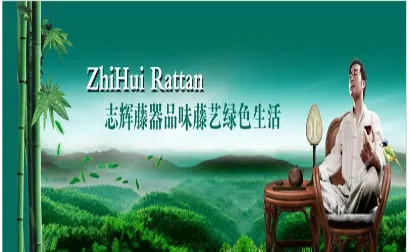
[image:3.595.271.476.433.559.2]Figure 1. Original image.
DOI: 10.4236/jcc.2017.510005 39 Journal of Computer and Communications 2) Enhance the Above Y Channel Image to Increase Image Contrast
Owing to the text images we choose are low-contrast, so, in order to get a bet-ter result, we first select some methods to enhance the image, comparing with multi-scale retina algorithm, adjust image intensity, histogram equalization and contrast-limited adaptive histogram equalization, finally finds that contrast-li- mited adaptive histogram equalization (see Figure 3) can get a good results than other algorithms.
3) Use Sobel Edge Detector Operator to Detect the Above-Enhanced Image After doing some enhancement for the image, we need to select a kind of edge operator to detect the image edge. In the experiment, we can see Sobel operator [7] [8] (see Figure 4) is able to detect all the text edge and meanwhile remove the non-text edge.
4) Use Morphology Method (MM) and Eight Neighborhood Processing Me-thod (ENPM) to Enhance Edge Information
Observing the Sobel detector results, we found the edge density is very weak, so we decide to adopt morphology method [9] and eight neighborhood processing method proposed by us to enhance edge information. About method ENPM, it is that the value in edge map gets by its eight neighborhood value, only if there is one appearance in its neighborhood, its value will be replaced by one. Figure 4 displays Sobel operator detector results, and Figure 5 and Figure 6 respectively show the results processed by morphology method and eight neighborhood processing method. Obviously, edge density is enhanced after using morphology method and eight neighborhood processing method.
[image:4.595.269.481.428.543.2]Figure 3. Enhanced image using contrast-limited adap-tive histogram equalization.
[image:4.595.268.480.586.705.2]DOI: 10.4236/jcc.2017.510005 40 Journal of Computer and Communications Figure 5. Image processed by MM.
Figure 6. Image processed by ENPM.
Following is the algorithm about ENPM (see Table 1).
2.2. Step 2: Use Connected Component Analysis (CCA) to
Gain Connected Components
CCA could be regarded as a graph algorithm, where subsets of connected com-ponents are uniquely labeled based on heuristics about feature consensus, i.e., color similarity and spatial layout. In the implementation of CCA, syntactic pat-tern recognition methods are often used to analyze the spatial and feature con-sensus, and to define text regions. Considering the complexity of fine turning the syntactic rules, a new trend is to perform CCA with statistical models.
The basic steps of the connected-component text extraction algorithm are given below. 1) Convert the input image to YUV color space (luminance + chrominance), use only luminance channel for further processing; 2) Convert the image gray scale using only Y channel; 3) Compute the edge image for Y channel gray image; 4) Sharpen the edge image by convolving it with sharpening filter; 5) Compute horizontal and vertical projection files considering the shar-pened edge image as the input intensity image; 6) Segment the candidate text re-gions based on adaptive threshold values calculated for vertical and horizontal projections; 7) Perform gap filling to eliminate possible non-text regions [10].
Through the above steps, we can use CCA method to remove part overlap blocks from connect component.
[image:5.595.268.480.217.333.2]DOI: 10.4236/jcc.2017.510005 41 Journal of Computer and Communications Table 1. The algorithm about ENPM.
Input:
ImgSobelMorph: ImgSobelMorph is the image, which the source image has been processed by step one to step three and morphology method.
r: r is the row of the image. c: c is the column of the image. Algorithm:
ImgENP is a two-dimensional array with r rows and c columns, whose value set to be zero. For i set 2 to r-1
For j set 2 to c-1
If the sum of ImgSobelMorph (i-1:i+1, j-1:j+1) is greater than 1 Then ImgENP (i, j) set to be 1
End If End For End For Output:
ImgENP: ImgENP is the output image after being processed by ENPM algorithm.
(a) Un-removed overlap image (b) Removed part overlap blocks
Figure 7. (a) is the test images; (b) is the correspondence image removed part overlap blocks.
overlap blocks. After removing the overlap regions, we need to extract the re-maining regions except for the regions gained by CCA.
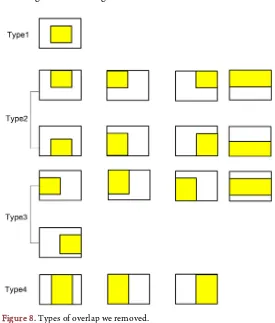
The type of split overlap region is as follows. In which the yellow color region the first block and the white color region is the second block. According to dual law, there are four types (see Figure 8) for overlap which the second block is on the border or inside in the first block.
Figure 9 presents the extracted results from image processed by CCA re-moved part overlap blocks.
2.3. Step 3: Locate the Text Region Coordinates with Two Layer
Judge
1) First Layer Judge (FLJ)
[image:6.595.213.540.276.380.2]DOI: 10.4236/jcc.2017.510005 42 Journal of Computer and Communications 2) Second Layer Judge (SLJ)
[image:7.595.235.510.99.422.2]a) Get the Edge Detector Image
Figure 8. Types of overlap we removed.
Figure 9. Extracted results from image processed by CCA removed part overlap blocks.
[image:7.595.271.481.597.704.2]DOI: 10.4236/jcc.2017.510005 43 Journal of Computer and Communications Figure 11. The result for used first layer judge.
Edge is the distinct characteristic which can be used to find possible text areas. The text is mainly composed of the strokes in horizontal, vertical, up-right, up- left direction, so it can be considered that the region with higher edge strength in these directions is the text region. In order to get a better edge strength, we made a lot of experiments to see which style of computing would be better.
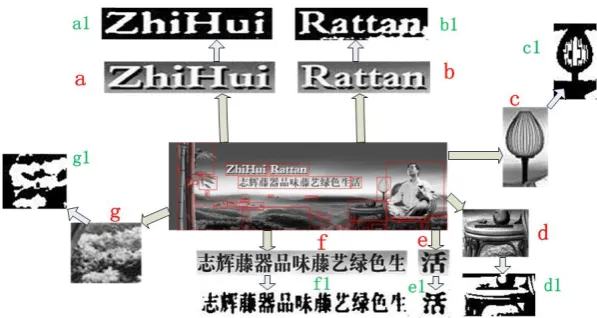
In Figure 12 the number a from g shows the block extracted from the Y channel image and a1 from the g1 shows the correspondence binary image.
Figure 13 gives the edge detection results with four angles. We find that 45 with 135 averages are better than others. For saving time, undoubtedly, we choose these two directional edge maps to represent the density and strength for edge enhancement.
b) Based Edge Map Image to Detection Unsupervised Text Regions
To some extent, the text has weak and irregular texture property, so we can look text as a special texture. We employ the statistical features in the edge maps to capture the texture property. The features are mean, standard deviation, energy, inertia, local homogeneity and correlation of edge maps [11].
After feature computing, we get 5 features form the feature vector representa-tion for each block, then use Support Vector Machine Classifier Algorithm to classify the feature vectors into two clusters: text regions and background re-gions (see Table 2).
Figure 14 is the flow chart of an overall process for a specific image to realize automatically text position.
2.4. Step 4: Text Regions Merge
Text region merges mainly rely on the location of the text region, finding the neigh-borhood region, and compute the distance in near neighneigh-borhood regions. Then merge with those regions which their distance is small. Figure 15 shows the start state before merging to end state which had successfully located all the text re-gions.
3. Text Extraction and Recognition
DOI: 10.4236/jcc.2017.510005 44 Journal of Computer and Communications Figure 12. The flow chart of region extract and process.
[image:9.595.59.544.246.690.2]DOI: 10.4236/jcc.2017.510005 45 Journal of Computer and Communications Figure 14. Each step result for special image during automatically position text image.
text, then, based on the coordinate of text to extract the text regions. For each text region, first use global threshold method to gain binarization images, then, use means filter to filter the small spot pixels so as to get a smooth image. After doing that, we use OCR system to recognize text, including Chinese or English. Figure 16 presents the flow chart of recognizing text in low-contrast images in detail.
4. Experiment Results
4.1. Text Region Position
DOI: 10.4236/jcc.2017.510005 46 Journal of Computer and Communications Figure 15. Shows the original text region result and final position results.
Table 2. The results of regions show.
Text regions Non-text regions
DOI: 10.4236/jcc.2017.510005 47 Journal of Computer and Communications
(a) (e)
(b) (f)
(c) (g)
[image:12.595.207.541.65.502.2](d) (h)
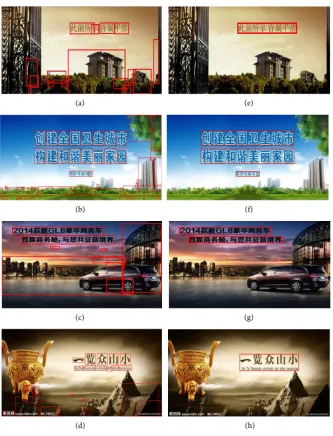
Figure 17. Some experiments result. (a) Middle process result 1; (b) Middle process result 2; (c) Middle process result 3; (d) Middle process result 4; (e) Final text position result about middle process 1; (f) Final text position result about middle process 2; (g) Final text position result about middle process 3; (h) Final text position result about middle process 4.
4.2. Evaluation
Here we collect a new dataset with 200 images of various low-contrast images. In addition, in order to evaluate our method, we compute the precision rate and recall rate, meanwhile, makes comparisons with other methods.
The performance of each algorithm has been evaluated based on its precision rate, an average run time obtained. The precision and recall rates are calculated as [12]
Correctly detected
Precision Rate 100%
Correctly detected False positives
= ×
DOI: 10.4236/jcc.2017.510005 48 Journal of Computer and Communications Table 3. Text location results.
Method Test Images Number Precision Rate (%) Recall Rate (%) Runtime in (s) Average Our
Method 200 76.5 60.39 27
Table 4. The results of text detection.
Text Chinese English Number of characters 2281 1304
Correctly detected 1924 1271 Missed 357 33 Number of false alarm regions 490
Missed rate (%) 15.6 2.5
Correctly detected
Recall Rate 100%
Correctly detected False negatives
= ×
+ (2)
We compute the results in Table 3. After counting the recognition results, we get the Table 4.
5. Conclusion
In this paper, we provide a new method to find the text region in low-contrast image automatically. In the first, we use the only luminance (Y) channel for fur-ther processing, and use the contrast-limited adaptive histogram equalization to enhance the image. Then we use the connected component analysis (CCA) me-thod to analysis the location of connected parts to remove inner or border parts so as to reduce the connected parts. Thirdly, we compute the edge feature for all connected parts, and combine Support Vector Machine (SVM) to obtain the real text region. Finally, we merge the text region to extract the block including the text, and use OCR system to recognize all text informations. In order to evaluate our method efficiently, we collect a new data setting with 200 images with vari-ous low-contrast, and compute their precision rate and recall rate. Experiments show that our method can not only accurately position the text area but also gain good results on the low-contrast images with different sizes and languages.
Acknowledgements
This work was supported by Chinese National Natural Science Foundation (No. 11161055) and Program for Innovative Research Team (in Science and Technolo-gy) in University of Yunnan Province.
References
[1] Jain, A.K. and Yu, B. (1998) Automatic Text Location in Images and Video Frames.
Pattern Recognition, 31, 2055-2076.
[image:13.595.206.539.181.298.2]DOI: 10.4236/jcc.2017.510005 49 Journal of Computer and Communications Video Sequences. Pattern Recognition Letters,24, 2607-2623.
[3] Ye, Q., Huang, Q., Gaoand, W. and Zhao, D. (2005) Fast and Robust Text Detection in Images and Video Frames. Image and Vision Computing, 23, 565-576.
[4] Fan, W., Sun, J. and Naoi, S. (2015) Separation of Text and Background Regions for High Performance Document Image Compression. DRR, San Francisco, 8 February 2015, 94020K.
[5] Antani, S., Crandall, D. and Kasturi, R. (2000) Robust Extraction of Text in Video.
Proceedings 15th International Conference on Pattern Recognition, Barcelona, 3-7 September 2000, Vol. 1, 831-834.https://doi.org/10.1109/ICPR.2000.905537
[6] Winger, L.L., Jernigan, M.E. and Robinson, J.A. (1996) Character Segmentation and Thresholding in Low-Contrast Scene Images. In: Electronic Imaging: Science and Technology, International Society for Optics and Photonics, 286-296.
[7] Sahoo, T. and Pine, S. (2016) Design and Simulation of SOBEL Edge Detection Us-ing MATLAB Simulink.
[8] Gonzalez, C.I., Melin, P., Castro, J.R., Mendoza, O. and Castillo, O. (2016) An Im-proved Sobel Edge Detection Method Based on Generalized Type-2 Fuzzy Logic.
Soft Computing, 20, 773-784.https://doi.org/10.1007/s00500-014-1541-0
[9] Hasan, Y.M. and Karam, L.J. (2000) Morphological Text Extraction from Images.
IEEE Transactions on Image Processing, 9, 1978-1983. https://doi.org/10.1109/83.877220
[10] Bo, T., Tang, J. and Chan, C.C.K. (2016) Enhanced Blind Modulation Formats Rec-ognition Using Connected Component Analysis with Quadruple Rotation. Opto Electronics and Communications Conference (OECC) Held Jointly with 2016 In-ternational Conference on Photonics in Switching (PS), Niigata, 3-7 July 2016, 1-3. [11] Liu, C., Wang, C. and Dai, R. (2005) Text Detection in Images Based on
Unsuper-vised Classification of Edge-Based Features. Proceedings of 8th International Con-ference on Document Analysis and Recognition, 31 August-1 September 2005, 610- 614.
[12] Das, M.S., Bindhu, B.H. and Govardhan, A. (2012) Evaluation of Text Detection and Localization Methods in Natural Images. International Journal of Emerging Technology and Advanced Engineering, 2, 277-282.
Submit or recommend next manuscript to SCIRP and we will provide best service for you:
Accepting pre-submission inquiries through Email, Facebook, LinkedIn, Twitter, etc. A wide selection of journals (inclusive of 9 subjects, more than 200 journals)
Providing 24-hour high-quality service User-friendly online submission system Fair and swift peer-review system
Efficient typesetting and proofreading procedure
Display of the result of downloads and visits, as well as the number of cited articles Maximum dissemination of your research work
Submit your manuscript at: http://papersubmission.scirp.org/