Joint Semantic Relevance Learning with Text Data and Graph Knowledge
Dongxu Zhang1,3, Bin Yuan1,3, Dong Wang∗1,2, Rong Liu1,41CSLT, RIIT, Tsinghua University
2Tsinghua National Lab for Information Science and Technology 3PRIS, Beijing University of Posts and Telecommunications
4Huilan Limited, Beijing, P.R. China
{zhangdx,yuanb,lr}@cslt.riit.tsinghua.edu.cn [email protected]
Abstract
Inferring semantic relevance among enti-ties (e.g., entries of Wikipedia) is impor-tant and challenging. According to the in-formation resources, the inference can be categorized into learning with either raw text data, or labeled text data (e.g., wik-i page), or graph knowledge (e.g, Word-Net). Although graph knowledge tends to be more reliable, text data is much less costly and offers a better coverage. We show in this paper that different re-sources are complementary and can be combined to improve semantic learning. Particularly, we present a joint learning ap-proach that learns vectors of entities by leveraging resources of both text data and graph knowledge. The experiments con-ducted on the semantic relatedness task show that text-based learning works well on general domain tasks, however for tasks in specific domains, joint learning that in-volves both text data and graph knowledge offers significant improvement.
1 Introduction
With the development of deep learning and the establishment of large knowledge bases, knowl-edge embedding has gained much interest in nat-ural language processing. In general, knowledge can be represented by someentitiesthat represent semantic concepts, plus therelationsamong them. Knowledge embedding involves representing enti-ties of knowledge bases in a low-dimensional con-tinuous space so that the relations among them can be well represented. The embedding can be conducted with different objectives with different tasks in concern. This paper focuses on the se-mantic learning task which intends to optimize the semantic relevance among entities by knowledge embedding, e.g., inferring appropriate knowledge (entity) vectors.
According to the information resource that is used to learn with, knowledge embedding can be classified into three categories: raw text learning, labeled text learning and graph knowledge learn-ing. In the raw text learning, the entities are treated as words or phrases, and the local word contex-t informacontex-tion in contex-the raw contex-texcontex-t is used contex-to drive contex-the embedding. Various approaches of word/phrase embedding belong to this category (Huang et al., 2012; Mikolov et al., 2013). In the labeled text learning, the embedding is based on the descrip-tion text associated to each entity. A simple ap-proach belonging to this category derives the vec-tor of an entity by averaging the word vecvec-tors of the description associated to the entity. Essential-ly, the knowledge used in this learning is the co-occurrence statistics of the words in the descrip-tions. Finally, in the graph knowledge learning, the relations among entities labeled by people are used to direct the embedding. Representative ap-proaches of this category include TransE (Bordes et al., 2013) and NTN (Socher et al., 2013).
Different information resources possess their respective advantages and disadvantages. Raw text is totally unstructured and unsupervised (no data annotated). The training data is easy to be col-lected and in most cases, it offers good entity cov-erage. The shortcoming, however, is that the use-ful information is often buried in noise and there-fore it is not trivial to extract the desired informa-tion. Finally, the learning purely relies on word occurrence statistics, which often under-estimates entities that are infrequent in the training data.
labeled text offers a text description for each en-tity, so it is more supervised than raw text in the sense that some human-specified annotations are involved. However, the supervision is rather weak, since the relations among entities are not explicit-ly annotated but implicitexplicit-ly encoded within word co-occurrences of entity descriptions. A particular advantage of the labeled text learning is that the entities that are difficult to learn with raw text be-cause of their limited occurrences can be learned
by referring to the words in the descriptions, for instance by averaging the vectors of the words.
Finally, graph knowledge is the most structured and supervised information resource. It is annotat-ed by people and therefore is much more clean and reliable, and the relations among entities can be far beyond the ones that are represented by word local contexts as in raw text. Additionally, the learning does not rely on word statistics and so is most-ly suitable for new and infrequent entities, for in-stance those in a specific domain. An obvious dis-advantage of graph knowledge is the high cost in data annotation and the low coverage of the enti-ties and relations. The emergence of large-scale public knowledge bases such as Freebase and Ya-go partly solved the problem, however for many infrequent entities, the annotations are far from satisfactory and most of the relations are missing.
Due to the respective advantages and disadvan-tages of different information resources, it is nat-ural to combine them to provide better knowl-edge embedding. A number of researches have been conducted in this direction. For example, Yu and Dredze (2014) proposed a method to em-ploy graph knowledge to improve word embed-ding, and Weston et al. (2013) used text data to assist new relation discovery for graph knowledge bases. Nevertheless, there is not a satisfactory framework to learn with multiple and heteroge-neous information resources. Particularly, there is limited investigation on to what extent heteroge-neous information can be complementary and how they contribute in different situations.
This paper presents a joint learning approach that learns entity vectors by leveraging resources of both raw and labeled text as well as graph knowledge. We first present a joint text learn-ing approach which learns word and entity vec-tors together with both raw and labeled text. This is similar to the paragraph vector (PV) model (Le and Mikolov, 2014) though a different training ap-proach is adopted in our study. This joint text learning approach is then combined with the graph knowledge learning to form a joint text and graph learning, by integrating the cost functions of the two learning methods.
The experiments are conducted with three in-formation resources: Wikipedia as the raw and la-beled text, WordNet and Yago as the graph knowl-edge. The entity relatedness task is selected to e-valuate the performance of the learning methods. Two scenarios have been conducted, one is based on WordNet and the other is based on Yago. The
test on WordNet is a general domain task while the test on Yago is a specific domain task. The experi-mental results show that the joint text learning of-fers consistent improvement compared to learning with raw text only. When involving graph knowl-edge, the performance on the general domain task does not show apparent improvement, however on the specific domain task, a significant performance improvement has been observed. These results confirm the importance of learning with heteroge-neous information resources.
The rest of the paper is organized as follows: Section 2 briefly describes the related works, Sec-tion 3 presents the joint learning approach. The experiments are presented in Section 4, and some discussions are in Section 5. Section 6 concludes the paper.
2 Related work
Many researches have been conducted to learn se-mantic relevance from raw text data, labeled text data or graph knowledge bases. Most of the stud-ies learn from single information resource.
For raw text learning, various unsupervised learning algorithms have been proposed to learn word representations from large-scale raw tex-t (Huang etex-t al., 2012; Mikolov etex-t al., 2013; Pen-nington et al., 2014). These methods hypothesize that statistics of word co-occurrences in contexts involve rich semantic and syntactic information and can be utilized to embed words and/or phras-es.
Some approaches have been presented to learn with raw text and labeled text together. Gabrilovich and Markovitch (2007) introduced the explicit semantic analysis which represents a word by its distribution over the labeled wikipedia pages instead of the latent concepts as in LSA (Deer-wester et al., 1990) and LDA (Blei et al., 2003). Its great performance owes to learning from the com-bination of raw text and labeled text (wiki pages labeled by entries) resources. Recently, paragraph vector (PV) was also applied to semantic relevance tasks (Dai et al., 2014), which infers word vectors and paragraph vectors together, as the joint text learning presented in this study.
databases into a low-dimensional continuous s-pace (Bordes et al., 2013; Socher et al., 2013; Fan et al., 2015).
Various approaches have been proposed to uti-lize heterogeneous resources. Recently, Riedel et al. (2013) demonstrated that text data can help dis-covering new relation in graph completing task. Weston et al. (2013) used text data for the same purpose while they used word vectors that may leverage text resources more effectively.
Most recently, joint learning approaches have been proposed to learn from heterogeneous re-sources. Yu and Dredze (2014) learned word vec-tors by considering not only the word context in text data but also relations in knowledge bases. Their training algorithm draws close the words that are proximate in both text and the knowledge graph. Xu et al. (2014) considered relation types in the joint training process. Faruqui et al. (2014) learned lexicon knowledge by forcing each word in the lexicon to be close to the corresponding pre-trained word vector. These studies demonstrat-ed that learning word vectors with both text data and graph knowledge is beneficial to semantic rel-evance learning.
This study is an extension to the existing join-t learning mejoin-thods. Parjoin-ticularly, we also learn knowledge embedding from descriptions(labeled text). This is contrary to most of the existing researches which learn the knowledge only from context and knowledge graph. Additionally, a new joint learning framework is presented in this work, which integrates text and graph learning as a uni-fied learning processing. Moreover, the contribu-tions of different resources in different situacontribu-tions will be investigated.
3 Method
This section first presents the joint text learning approach which learns entity vectors based on the descriptions that are extracted from Wikipedia. Then the graph knowledge learning is described. Finally the joint text and graph learning is pre-sented which learns with both text data and graph knowledge.
3.1 Joint text learning
Learning entity vectors with raw text can be sim-ply implemented by treating entities as words (or phrases) and learning them together with other words. There are a number of approaches to learn-ing word vectors (Huang et al., 2012; Mikolov et al., 2013; Pennington et al., 2014). In this
study, the skip-gram model implemented in the word2vec tool1is adopted.
The simple approach to learning with labeled text is to average the vectors of words involved in the description of the current entitye. This is formulated by:
ve= |D1
e|
X
w∈De
vw
where ve denotes the vector of entity e, and vw denotes the vector of wordw.Derepresents set of word tokens within the description ofe, and|De| represents the size ofDe.
A better approach is to learn word and entity vectors simultaneously. The training is based on negative sampling (Mikolov et al., 2013), with the cost function defined as follows:
Ltxt =X
e∈E K
X
i=1
max{0, γtxt−veTvwi+veTvw0i}
whereE is the set of entities to learn, andγtxt is the boundary margin which has been empirically set to0.5in this study. (wi, wi0)is a pair of word-s for whichwi is sampled from the description of entitye, andw0
iis sampled from a proposal distri-bution.wiis constrained to be different each time of sampling for a particular entity. K is the num-ber of samples for each entity. In our study,Kis set to30unless the description is shorter than 30
words. The proposal distribution for samplingw0
i is set to be the unigram distribution of all the word-s involved in the deword-scriptionword-s of all the entitieword-s. We call this model the joint text learning model. The stochastic gradient descendent (SGD) algorithm is employed to optimizeLtxtwith respect to the en-tity and word vectors.
Note that this model is similar to PV-DBOW, a distributed bag-of-words model proposed by Le and Mikolov (2014). In PV-DBOW, paragraphs are represented by paragraph vectors (PV) and are trained together with word vectors. The PVs cor-respond to the entity vectors in our model. A main difference between our model and the PV-DBOW model is that the cost function of our model is based on the hinge loss, while PV-DBOW uses the softmax function. This new cost function provides almost the same performance but offers a lower computation complexity because we don’t need to count the sum of distances of the whole dictionary (which is what softmax does).
In the experiments, word vectors that are pre-trained with raw text are used to initialize the en-tity vectors. This pre-training leads to a big im-provement compared with random initialization, as will be shown in Section 4.
3.2 Graph knowledge learning
As mentioned in Section 1, knowledge bases such as WordNet and Yago contain plenty of entities and their relations, leading to complex knowledge graphs. Since these entities and relations are an-notated by people, graph knowledge is highly reli-able and can be used to embed entities. Note that different knowledge bases contain different types of relations. For WordNet, nearly half of the re-lations are the hypernym-hyponym (is-a) relation, and for Freebase, the relation types are much more complicated. Although it is possible to learn d-ifferent relations (Bordes et al., 2013), this study does not consider it since our focus is semantic re-latedness instead of relation prediction. More dis-cussions about relation type learning will be given in Section 5.
For this reason, only entity vectors are learned (the global relation vector can be absorbed in-to the entity vecin-tors). This is similar in-to the un-structured model in Bordes’s early work (Bordes et al., 2013), except that distance between vectors is measured by inner product in our model, while Bordes’s work used Euclidean distance. We make this choice for two reasons: firstly, to make the graph knowledge learning consistent with the join-t join-texjoin-t learning so join-thajoin-t join-their resuljoin-ts are comparable, and more importantly they can be combined into a joint text and graph learning as will be presented in the next section; secondly, word vectors trained with raw text can be used to pre-train (initialize) the entity vectors, which has been demonstrated to be highly effective, as will be seen in Section 4.
Similar to the text learning, the negative sam-pling approach is used to train the model. Denote the related entity pairs defined by the knowledge base byP = {Pi;Pi = (eli, eri)}. For each pair
Pi, the negative sampling corrupts the pair by re-placing either the left entityel
i or the right entity
er
i with a randomly selected entity. The learning optimizes the following hinge loss function:
Lgrh= X
Pi∈P
max{0, γgrh−vel
i
Tv er
i +ve0li
Tv e0r
i}
whereγgrh is the boundary margin which is em-pirically set to 1.0 in this study, and (e0l
i, e0ri) is the corrupted version of(el
i, eri) (only one entity
corrupted). Again, the SGD algorithm is used to optimizeLgrhwith respect to the entity vectors.
3.3 Joint text and graph learning
The joint text learning and the graph knowledge learning can be combined. In fact, the two learning approaches are based on the same measure space (the inner product space) and the objective func-tions are both hinge loss; additionally, both the learning methods train the model using SGD and negative sampling. This means that they are high-ly consistent and can be easihigh-ly combined without much change, except that the objective function is modified to integrate the loss derived from both text and graph knowledge. This is formulated by:
Ljoint=Ltxt+βLgrh (1)
whereβis a hyper-parameter that is set to balance the contributions of the text data and the graph knowledge. The SGD algorithm is employed to optimizeLjointwith respect to the entity vectors and the vectors of words that are involved in the entity descriptions. In practice, an iterative strat-egy is adopted in this work, which performs the joint text learning and the graph knowledge train-ing alternatively and iteratively, with their respec-tive negarespec-tive sampling schemes applied.
4 Experiments
This section reports the experimental settings and results. The semantic relatedness task was cho-sen in the study, which measures semantic relat-edness among entities and compare the measure-ments with human-specified scores. We start by presenting the databases, and then report the re-sults on a general domain task and a specific do-main task. The data sets and codes are available online.2
4.1 Databases Training data
Three information resources are used in the ex-periments: Wikipedia as the raw and labeled tex-t, Wordnet and Yago as the graph knowledge. Wikipedia3 is a free-access, free content internet encyclopedia which at present contains more than
4.7 millions of English entries. Wikipedia itself offers plenty of information, including the main
2http://git.cslt.org/zhangdx/
jointsemanticlearning
content in plain text (description), category infor-mation, links to other entries, and info-boxes. On-ly the plain text and the entry name (title) of de-scriptions are used in this study. WordNet (Fell-baum, 1998) is a well-known semantic knowledge base which contains 117k English words and the associated information such as brief text descrip-tions and reladescrip-tions. Yago (Fabian et al., 2007) is another popular semantic knowledge base, derived from Wikipedia, WordNet and GeoNames.
The training (entity vector embedding) is con-ducted on two development data sets: a subset of entities of WordNet that involves only noun-s (WNet-N) and a noun-subnoun-set of entitienoun-s of Yago that involves animal names (Yago-A). WNet-N can be regarded as a data set in the general domain, while Yago-A is a data set in a particular domain. For each entity in the two data sets, the corresponding wiki page is retrieved from Wikipedia, from which the plain text is retrieved and used as the labeled text for the entity. The plain text of all the entities in WNet-N and Yago-A are used as raw text. More details of the data sets are described as follows.
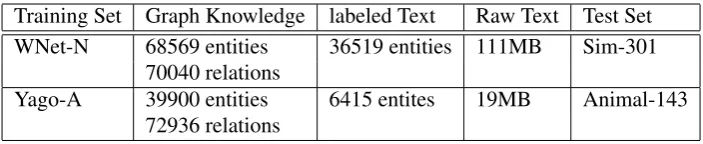
• WNet-N: A subset of WordNet which con-tains 68569 entities and 70040 relation pairs. All the entities are nouns and are words or phrases in the general domain. 36519 enti-ties find their text descriptions in Wikipedia (labeled text), resulting in 111MB raw text. • Yago-A: A subtree of Yago which
contain-s 39900 entitiecontain-s, 72936 relation paircontain-s. All the entities are Animal names, which means the entities are domain-specific. 6415 enti-ties find their text descriptions (labeled text), resulting in 19MB raw text.
Note that both WNet-N and Yago-A maintain a connected graph structure which means that for any two entities in the graph, there is at least one path that connects them. This enables the simple connection-based relevance inference which de-rives relateness of two entities as the connection strength between them in the knowledge graph. Section 5 will compare this simple approach with our proposal.
Test data
As mentioned, this study chooses the seman-tic relatedness task to evaluate the performance of learned entity vectors. This task computes the relevance (distance) of two entities and then compares the resulting relevance score with the human-specified score. The Spearman coefficient
is a widely-adopted metric to evaluate correlation between two variables and is used in this study to measure the consistence of the derived relevance with the human specification.
To test the performance on WNet-N, a sub-set of WordSimilarity-3534 is used. The WordSimilarity-353 collection is a well-known test set for semantic relatedness tasks, which con-tains 353 word pairs and the relatedness scores of all the pairs are manually annotated. After filtering out the words that are absent from the entities of WNet-N, the resulted301pairs are used as the test set, named as Sim-301 in the following sections.
For the test on Yago-A, we propose a new test set Animal-143, which contains143pairs of com-mon animal names and 92 different animals in-cluding mammals, birds, insects and marine ani-mals. All the names are entities of Yago-A. The relatedness score of each pair has been evaluated by 9 persons, and the average is used as the hu-man judgement. The range of score is from 0 to 3. For instance, the score between antelope and swan should probably be 0, and the score between cattle and bison can be 3. Table 1 summarizes the data sets used in the experiments.
4.2 Individual learning
The first experiment studies the performance of learning with raw text, labeled text and graph knowledge individually. As mentioned already, the test are conducted on two data sets: WNet-N and Yago-A, which represent a general domain task and a specific domain task, respectively. The impact of the dimension of the entity vectors is al-so investigated. The results in terms of Spearman coefficients are reported in Table 2.
For the raw text learning, the entities are treated as words or word sequences (phrases). The vec-tors of these words and word sequences are then learned by the word2vector tool, together with other words. The raw text data of WNet-N and Yago-A are merged, and combined with addition-al 200MB plain text to form a training data set to conduct the word vector training. Using the tex-t of botex-th tex-the tex-two datex-ta setex-ts is tex-to demonstex-tratex-te tex-the advantage that word vectors can be learned with out-of-domain data. Note that multi-word entities can be learned as phrase vectors (Mikolov et al., 2013), though this is not considered in this study since the two test sets Sim-301 and Animal-143 contain only single-word entities. The results with
4http://www.cs.technion.ac.il/˜gabr/
Training Set Graph Knowledge labeled Text Raw Text Test Set WNet-N 68569 entities 36519 entities 111MB Sim-301
70040 relations
[image:6.595.123.475.61.133.2]Yago-A 39900 entities 6415 entites 19MB Animal-143 72936 relations
Table 1: Data sets for knowledge embedding and relatedness test.
raw text learning are reported in the row denoted by ‘Word2vec’ in Table 2.
For the labeled text learning, the entity vectors are derived as the mean vectors of the words in-volved in the text descriptions. This approach in fact involves both raw text learning (for word vec-tors) and labeled text learning (vector average), however the main knowledge source is the entity labels of the descriptions. The results with labeled text learning are reported in the row denoted by ‘LT-mean’ in Table 2.
Different from the mean-vector approach which first trains word vectors and then derives entity vectors, the joint text learning learns word vectors and entity vectors together. Two configurations are tested: in JT-rand, the entity vectors are ran-domly initialized, while in JT-prt, the entity vec-tors are initialized (pre-trained) by corresponding word vectors. Note that all the multi-word enti-ties can not be pre-trained as the phrase vectors are not trained, however this does not much im-pact the resulting performance since the test sets do not involve multi-word entities.
For the graph knowledge learning, two configu-rations have been tested as well: with and without training. For those entities that can’t be pre-trained, random initialization is employed. The results are reported in the rows denoted by ‘GR-rand’ and ‘GR-prt’ in Table 2, for the configura-tions with and without pre-training, respectively.
From the results, it can be observed that the three learning approaches behave differently on the two test sets. The text-based learning ex-hibits clear advantage compared to graph knowl-edge learning on the WNet-N test, however on the Yago-A test, the graph knowledge learning is superior. This can be explained by the fact that WNet-N is in the general and involves popular en-tities that can be well trained with raw and labeled text, however for Yago-A, most of the entities are domain-specific and so it is not easy to learn the entities (and their relations) from unstructured tex-t datex-ta. In tex-this case, tex-the human-specified edge, i.e., the relations offered by the graph knowl-edge, tends to provide the most valuable
informa-tion. On the other hand, the graph knowledge of the general domain tends to be sparse and noisy, which will be discussed in Sec 5, while the graph knowledge of specific domains are generally less sparse and also quite clean. This also leads to more reliable inference with graph knowledge in specif-ic domains.
Another observation is that the dimension of the entity vectors indeed impacts the performance. A larger dimension tends to perform better, at the cost of higher complexity in model training. In the following experiments, the dimension will be set to100.
It can be also observed that the mean vector (LT-mean) approach does not work well, probably due to the information loss with the simple average. The joint text learning with pre-training (JT-prt) outperforms both LT-mean and Word2Vec. As JT-prt makes use of both raw text and labeled text, this superiority confirms that learning with hetero-geneous information resources is beneficial, and the joint learning (JT-prt) is an appropriate way to utilize heterogeneous information effectively.
Finally, it can be seen that the pre-training with word vectors (trained with raw text) contributes to both the text learning and the graph knowledge learning: the pre-trained systems (JT-prt and GR-prt) significantly outperform the random initial-ized systems (JT-rand and GR-rand). This from another perspective confirms the importance of in-volving multiple and heterogeneous information resources in knowledge embedding. In addition, the poor performance of JT-rand is mainly due to the incompleteness and bias of descriptions. And the bad results on GR-rand are probably caused by the loss of relation types in databases and also the loss of the variation of length on edges since every edge is trained equally. Thus, pre-training method helps a lot since additional knowledge can be added in and the incompleteness of both de-scription and graph can be hugely solved.
4.3 Joint text and graph learning
re-Model WNet-NSpearman CoefficientYago-A 50 100 200 50 100 200 Word2vec 0.700 0.720 0.729 0.668 0.681 0.704 LT-mean 0.084 0.091 0.083 0.366 0.421 0.470 JT-rand 0.421 0.447 0.422 0.436 0.466 0.449 JT-prt 0.726 0.744 0.749 0.677 0.704 0.719 GR-rand 0.119 0.178 0.180 0.305 0.303 0.410 GR-prt 0.644 0.690 0.690 0.726 0.727 0.718
Table 2: Experimental results with raw text learning, labeled text learning, joint text learning and graph knowledge learning. Bold numbers shows the highest performance in each column.
sults of the previous section, it has been found that learning with multiple resources is helpful, even if with the simple pre-training. The joint text and graph learning takes into account both word con-texts and relations when learning the entity vec-tors, and so may utilize text data and graph knowl-edge in a more effective way.
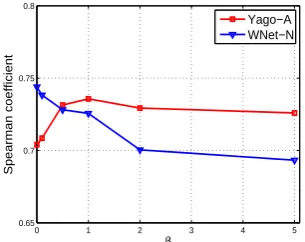
Figure 1 presents the experimental results with the joint text and graph learning. The two curves present the Spearman coefficients on WNet-N and Yago-A respectively. The learning rate of the SGD algorithm is set to0.01, and the iteration number is set to200. The dimension of the entity vectors and word vectors is set to 100. According to the cost function (1), the learning is impacted by the hyper-parameterβ, so the results with various values of
βare reported in Figure 1.
From the results presented in Figure 1, very different patterns on the two test sets are ob-served: for WNet-N, the best β is close to 0.0, which means that involving graph knowledge in the learning simply reduce the performance. How-ever for Yago-A, the best β is around1.0, which means that to achieve the best performance, the contribution from text and graph resources should be balanced. This discrepancy on the optimal β
can be explained in the same way as in the previ-ous experiment, that Yago-A is a specific domain test so that the entities can not be well trained by either text data or graph knowledge, so the two resources need to be utilized together, which is where the joint training contributes. In practical applications, people should increase the β when domain becomes narrow.
4.4 Performance comparison
The joint text and graph learning with the indi-vidual learning methods are compared in Table 3, where the optimal values of β (0.0 for WNet-N and 1.0 for Yago-A) have been applied. It can be
0 1 2 3 4 5
0.65 0.7 0.75 0.8
β
Spearman coefficient
Yago−A WNet−N
Figure 1: Experimental results with joint text and graph learning, with various values ofβ.
seen that the joint learning contributes significant-ly to the specific domain task on Yago-A, while for the general domain task on WNet-N, no improve-ment is found. Nevertheless, since the individual learning is a special case of the joint learning, the latter should be not worse than the former, given that the optimalβis applied.
[image:7.595.335.488.242.363.2]Model Spearman CoefficientWNet-N Yago-A Word2vec 0.720 0.681 JT-prt 0.744 0.704 GR-prt 0.690 0.727 JTGR-prt 0.744 0.735
Table 3: Experimental results with joint text and graph learning, whereβhas been optimized.
5 Discussion
5.1 Performance of graph knowledge learning on different domains
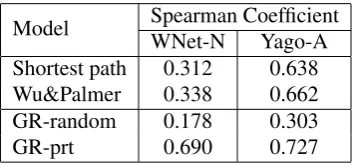
[image:7.595.334.499.518.600.2]the variation of length on edges in the knowledge base since every edge is trained equally. Notice that, the number of relation pairs in WNet-N is close to Yago-A while entities in WNet-N is more than entities in Yago-A. To further investigate the problem, two simple ‘direct inference’ algorithms are employed to conduct the tests on WNet-N and Yago-A respectively. The first algorithm is based on the shortest path between two entities in query, and the second one is Wu&Palmer’s model (1994) which considers not only the shortest path but al-so the depth of their common parents. Note that both these two models do not learn any entity vec-tors but infer relatedness from the relations in the knowledge base, so the results can reflect the qual-ity of the knowledge base.
The results are presented in Table 4. It can be seen clearly that both the shortest-path approach and Wu&Palmer’s model show much better per-formance on Yago-A than on WNet-N. These re-sults provide strong evidence that the general do-main is much more complicated, so that the lack of graph knowledge and the problem caused by iden-tical length of edges will easily hurt graph-based inference.
It is also clear that the two direct inference ap-proaches outperform the graph learning approach when no training applied, however with pre-training, the graph learning approach is much more superior, particularly for the WNet-N task. This suggests that learning with broad domain knowledge base is pretty hard, and extra informa-tion from raw text is essentially important.
[image:8.595.344.490.162.247.2]Model Spearman CoefficientWNet-N Yago-A Shortest path 0.312 0.638 Wu&Palmer 0.338 0.662 GR-random 0.178 0.303 GR-prt 0.690 0.727
Table 4: Experimental results with various graph-based entity relateness inference methods.
5.2 Relation type learning
In our experiments, all the relations in the graph knowledge bases are treated indifferently. One may argue that different types of relations should be distinguished and learned distinctively. This is true for some tasks such as relation prediction; however, for the semantic learning task, it is still challenging to use relation information.
Table 5 presents the results with TransE as the graph knowledge learning using all the relation
pairs from prolog of WordNet 3.0 which includes 15 types of relations. Note that TransE learns dif-ferent types of relations as difdif-ferent relation vec-tors. It can be seen that substituting with TransE has very little effect on performance in both graph knowledge learning (TransE-prt) and joint text and graph learning (JTGR-TransE-prt).
Model Spearman JT-prt 0.729 Gr-prt 0.723 TransE-prt 0.726 JTGR-prt 0.739 JTGR-TransE-prt 0.740
Table 5: Performance with TransE in graph knowl-edge learning.
This can be explained as follows. Intuitively, when people evaluate the relatedness of two enti-ties, both the relation types and the number of re-lations (directly and indirectly) between them are considered. Although different relation types may impact the judgement differently, learning relation types may force entity vectors to learn to distin-guish different types of relations. This is an extra constraint that is irrelevant to our semantic relat-edness task. If the constraint is too strong (TransE for example), it may lead to biased learning. Still, relations should be used, but maybe a weak con-straint is more appropriate. This is one of the fu-ture work.
6 Conclusions
This paper presented a joint text and graph learn-ing method which can learn entity vectors with text data and graph knowledge bases together. We evaluated the proposed method on the se-mantic relatedness task, and found that involving both text data and graph knowledge does improve performance. Particularly, the experimental re-sults demonstrated that for general domain tasks, the graph knowledge tends to be incomplete thus learning with raw or labeled text is the most effec-tive, however for specific domain tasks, the graph knowledge tends to be more complete, that it can contribute a lot to learning.
Acknowledge
[image:8.595.93.270.501.584.2]References
David M Blei, Andrew Y Ng, and Michael I Jordan. 2003. Latent dirichlet allocation. Journal of ma-chine Learning research, 3:993–1022.
Antoine Bordes, Nicolas Usunier, Alberto Garcia-Duran, Jason Weston, and Oksana Yakhnenko. 2013. Translating embeddings for modeling multi-relational data. InAdvances in Neural Information Processing Systems 26, pages 2787–2795.
Andrew M Dai, Christopher Olah, Quoc V Le, and Greg S Corrado. 2014. Document embedding with paragraph vectors. InNIPS 2014 in Deep Learning and Representation Learning Workshop.
Scott C. Deerwester, Susan T Dumais, Thomas K. Lan-dauer, George W. Furnas, and Richard A. Harshman. 1990. Indexing by latent semantic analysis.Journal of The American Society for Information Science, 41(6):391–407.
MS Fabian, K Gjergji, and W Gerhard. 2007. Yago: A core of semantic knowledge unifying wordnet and wikipedia. In 16th International World Wide Web Conference, WWW, pages 697–706.
Miao Fan, Qiang Zhou, Andrew Abel, Thomas Fang Zheng, and Ralph Grishman. 2015. Probabilistic belief embedding for knowledge base completion.
CoRR, abs/1505.02433.
Manaal Faruqui, Jesse Dodge, Sujay K Jauhar, Chris Dyer, Eduard Hovy, and Noah A Smith. 2014. Retrofitting word vectors to semantic lexicons. arX-iv preprint arXarX-iv:1411.4166.
Christiane Fellbaum. 1998. WordNet. Wiley Online Library.
Evgeniy Gabrilovich and Shaul Markovitch. 2007. Computing semantic relatedness using wikipedia-based explicit semantic analysis. InProceedings of the 20th International Joint Conference on Artificial Intelligence, volume 7, pages 1606–1611.
Eric H Huang, Richard Socher, Christopher D Man-ning, and Andrew Y Ng. 2012. Improving word representations via global context and multiple word prototypes. InProceedings of the 50th Annual Meet-ing of the Association for Computational LMeet-inguistic- Linguistic-s: Long Papers-Volume 1, pages 873–882. Associa-tion for ComputaAssocia-tional Linguistics.
Quoc V Le and Tomas Mikolov. 2014. Distributed representations of sentences and documents. In Pro-ceedings of The 31st International Conference on Machine Learning, pages 1188–1196.
Tomas Mikolov, Ilya Sutskever, Kai Chen, Greg S Cor-rado, and Jeff Dean. 2013. Distributed representa-tions of words and phrases and their compositional-ity. InAdvances in Neural Information Processing Systems 26, pages 3111–3119.
Jeffrey Pennington, Richard Socher, and Christopher D
Manning. 2014. Glove: Global vectors for
word representation. Proceedings of the Empiricial Methods in Natural Language Processing (EMNLP 2014), 12.
Roy Rada, Hafedh Mili, Ellen Bicknell, and Maria Blettner. 1989. Development and application of a metric on semantic nets. Systems, Man and Cyber-netics, IEEE Transactions on, 19(1):17–30.
Philip Resnik. 1995. Using information content to e-valuate semantic similarity in a taxonomy. InIn Pro-ceedings of the 14th International Joint Conference on Artificial Intelligence, pages 448–453.
Sebastian Riedel, Limin Yao, Andrew McCallum, and Benjamin M Marlin. 2013. Relation extraction with matrix factorization and universal schemas. In Pro-ceedings of NAACL-HLT, pages 74–84.
Richard Socher, Danqi Chen, Christopher D Manning, and Andrew Ng. 2013. Reasoning with neural ten-sor networks for knowledge base completion. In
Advances in Neural Information Processing Systems 26, pages 926–934.
Jason Weston, Antoine Bordes, Oksana Yakhnenko, and Nicolas Usunier. 2013. Connecting language and knowledge bases with embedding models for re-lation extraction. InProceedings of the Empiricial Methods in Natural Language Processing (EMNLP 2013), pages 1366–1371.
Zhibiao Wu and Martha Palmer. 1994. Verbs seman-tics and lexical selection. InProceedings of the 32nd annual meeting on Association for Computational Linguistics, pages 133–138. Association for Com-putational Linguistics.
Chang Xu, Yalong Bai, Jiang Bian, Bin Gao, Gang Wang, Xiaoguang Liu, and Tie-Yan Liu. 2014. Rc-net: A general framework for incorporating knowl-edge into word representations. InProceedings of the 23rd ACM International Conference on Confer-ence on Information and Knowledge Management, pages 1219–1228. ACM.