The Interplay of User-Centered Dialog Systems and AI Planning
Florian Nothdurft?, Gregor Behnke†, Pascal Bercher†,Susanne Biundo†and Wolfgang Minker?
?Institute of Communications Engineering,†Institute of Artificial Intelligence Ulm University, Ulm, Germany
florian.nothdurft,gregor.behnke,pascal.bercher, susanne.biundo,[email protected]
Abstract
Technical systems evolve from simple dedicated task solvers to cooperative and competent assistants, helping the user with increasingly complex and demand-ing tasks. For this, they may proactively take over some of the users responsibilities and help to find or reach a solution for the user’s task at hand, using e.g., Artificial In-telligence (AI) Planning techniques. How-ever, this intertwining of user-centered di-alog and AI planning systems, often called mixed-initiative planning (MIP), does not only facilitate more intelligent and com-petent systems, but does also raise new questions related to the alignment of AI and human problem solving. In this pa-per, we describe our approach on integrat-ing AI Plannintegrat-ing techniques into a dialog system, explain reasons and effects of aris-ing problems, and provide at the same time our solutions resulting in a coherent, user-friendly and efficient mixed-initiative sys-tem. Finally, we evaluate our MIP system and provide remarks on the use of expla-nations in MIP-related phenomena.
1 Introduction
Future intelligent assistance systems need to inte-grate cognitive capabilities to adequately support a user in a task at hand. Adding cognitive capa-bilities to a dialog system (DS) enables the user to solve increasingly complex and demanding tasks, as solving complex combinatorial problems can be delegated to the machine. Further, the user may be assisted in finding a solution in a more structured way. In this work we focus on the cognitive capa-bility of problem solving via help of AI Planning technology in the form of Hierarchical Task Net-work (HTN) planning (Erol et al., 1994; Geier and
Bercher, 2011). It resembles the human top-down way to solve problems. Such planners can help users to find courses of action, i.e., a sequence of actions, which achieve a given goal. In HTN
plan-ning the user states the goal in terms of a set of
ab-stract actions, e.g., train(abs), which are repeat-edly refined into more concrete courses of action – using so-called methods – during the planning
process. For example,train(abs)could be refined
into acrunches(20)and asit-up(50)action. A
so-lution is found if the the plan only contains
prim-itiveactions, i.e., actions which cannot be refined further, and the plan itself is executable.
In Section 2, we explain in more detail the ad-vantages of integrating AI planning capabilities into a DS. Such an integration poses significant challenges, however. Most importantly, the way planners search for solution plans is very differ-ent from the way humans do, as their concern is mainly efficiency. In Section 3 we hence show how a planner can be adapted to better suit hu-man needs. Further, we describe which kinds of planning-specific phenomena can not be avoided and thus the dialog manager must be able to han-dle. In Section 4 we describe the architecture of our intertwined system, followed by some re-marks on the implementation in Section 5. Within this section we also discuss why a common source of knowledge for both the planner and the dialog manager is needed and how it can be created. Sec-tion 6 contains an evaluaSec-tion of the implemented system in a fitness-training scenario.
2 Why Integrating a Planner?
In classical use-case scenarios for HTN plan-ners (Nau et al., 2005; Biundo et al., 2011) a plan is generated without any user involvement, besides the specification of the goal, and afterwards pre-sented to him. Hence, the planner is a black-box to the user, which is often not adequate. If execut-ing the plan involves grave risks, e.g., in military
settings (Myers et al., 2002) or spaceflight (Ai-Chang et al., 2004), humans must have the final decision on which actions are to be contained in the plan. Planning systems can also be utilized to create plans for personal tasks like fitness train-ing, cooktrain-ing, or preparing a party. Here, it is expected that created plans are highly individual-ized, i.e., that they not only achieve given goals but also respect the user’s wishes about the final plan. One might argue that such individualization could be achieved by integrating preferences or action costs into planning (Sohrabi et al., 2009). How-ever, this approach requires that the user can spec-ify his preferences completely and a priori and that they must be expressible, e.g., in terms of action or method costs or LTL formulae. Even if the user’s preferences were expressible, it would be required to question the user extensively prior to the ac-tual interaction, which is very likely to result in the user aborting the interaction.
Instead the dialog manager and especially the planner should learn about the user’s preferences during interaction, fostering an understanding of the user’s preferences. This requires the integra-tion of the user into the planning process, result-ing in a so-called mixed-initiative plannresult-ing (MIP) system. A few approaches to creating such sys-tems have already been investigated (Myers et al., 2003; Ai-Chang et al., 2004; Fern´andez-Olivares et al., 2006). Unfortunately, they cannot support a complete dialog with the user, as they mostly re-act on inquiries and demands from the user and only present the user with completed plans, i.e., plans that have already been refined into a solu-tion. We deem such schemes impractical, as they require the user to comprehend a (potentially com-plicated) solution at once, making it hard to ex-press opinions or wishes about it. For us, it would be more natural to iteratively integrate the user during the plan generation, making it on the one hand easier for the user to comprehend the plan and options to refine it, and on the other hand re-ducing the cognitive load, as the user does not have to understand the complete plan at once.
MIP can be interpreted as the system-initiated integration of the user in the planning process, but from a user’s perspective it is the attempt to solve problems by using promised competencies of a technical system. For the user dedicating planning and decision-making to a technical system is done with the intent of finding a solution the user is not
able to find at all or only with great effort. It aims at relieving the user’s cognitive load and simpli-fying the problem at hand. Hence, the iterative integration of the user seems to be not only more natural, but also more practical for the user.
3 Challenges of MIP
In this section, we describe arising challenges of MIP. We discuss the differences between state-of-the-art AI Planning and the way humans solve problems, as they raise issues for a successful inte-gration of a planner into a DS. To achieve it never-theless, we show how a planner can be modified to accommodate them and which issues must be ad-dressed by an advanced dialog management (DM).
How to Integrate the Planner. The integration of AI Planning begins with the statement of a plan-ner objective in a dialog. This requires on the one hand a user-friendly and efficient objective-selection dialog, and on the other hand the creation
of a validplanning problem. Thus, the semantics
of the dialog has to be coherent to the planning
domain, resulting in a validplanning problem.
User-friendly Search Strategies. Almost all AI Planning systems use efficient search strategies, like A* or greedy, to find a solution for a given planning problem. The order with which plans are visited is based upon a heuristic estimating the number of modifications needed to refine the given plan into a solution. Plans with smaller heuris-tic value are hence regarded more promising and visited earlier. In A* search, as well as in any other heuristic-based search approach, it may hap-pen that after one plan was explored, the next one
explored will beanyplan within the search space
– not just one that is a direct successor of the plan explored last. As such, these strategies may result in the perception that the user’s decisions only ar-bitrarily influence the planning process, which in turn may result in an experience of lack of control and transparency.
In contrast, humans tend to search for a plan by repeatedly refining the last one. A search strategy
that resembles that strategy is depth-first search
recursively. A major drawback of DFS is that it does not consider a heuristic to select plans which are more promising, i.e., closer to a solution. DFS is blind, leading to a efficient search and non-optimal plans, i.e., the final plan may contain un-necessary actions. This problem can be addressed if the planner prefers refinements of plans with lower heuristic value if the user is indifferent about them. This scheme enables the interplay of user decisions and the planner’s ability to solve com-plex combinatorial problems. The user controls the search until such a problem arises by selecting preferred refinements. Then he may signal the DS that he does not care about the remaining refine-ment, resulting in the planner using its heuristic to find a valid solution.
Handling of Failures During Planning. A ma-jor difference between human problem solving and DFS is the way failures are handled. In plan-ning, a failure occurs if the current plan is proved unsolvable (e.g., by using well-informed
heuris-tics). As mentioned earlier, DFS uses
backtrack-ingto systematically explore all remaining options
for decisions that lead to a failure, until a suc-cessful option has been found. Practical heuristics are necessarily imperfect, i.e., they cannot deter-mine for every plan whether it is unsolvable or it may be refined into a solution. Hence, even when using a well-informed heuristic, the planner will present the user with options for refining a plan
that will inevitably causebacktracking. DFS
back-trackingis a very tedious and frustrating process, especially if the faulty decision was made early on but is found much later. Large parts of the search space, i.e., all plans that can be refined based on the faulty decision have to be explored manually until the actually faulty decision is reverted. This may result in the user deeming the system’s strat-egy naive and the system itself incompetent. This is important, since the use of automation correlates highly to a user’s trust into an automated system, which in turn depends mainly on the perception of its competence (Muir and Moray, 1996). To pre-vent the user, at least partially, from perceiving the system as incompetent, we can utilize the comput-ing power of the planner to determine whether an option for refinement only leads to faulty plans.
We call such refinementsdead-ends. If options are
presented to the user, the planner starts exploring the search space induced by each refinement us-ing an efficient search procedure. If he determines
that such a search space cannot contain a solution,
the respective refinement is adead-end. It is the
objective of the dialog manager to appropriately convey this information to the user, especially if computing this information took noticeable time, i.e., the user has already considered the presented options and one has to be removed.
How to Integrate the User. Another important factor for a successful human-computer interac-tion is the quesinterac-tion when a user should be involved into the planning process and if, how to do it. Clearly, the planner should not be responsible for this kind of decisions as it lacks necessary capa-bilities, but may contribute information for it, e.g., by determining how critical the current decision is with respect to the overall plan. From the plan-ner’s view every choice is delegated to the user via the DM, achieving maximal flexibility for the manager. The dialog manager on the other hand can either perform an interaction with the user, or determine by itself that the choice should be made by the planner, which is equivalent with the user signaling “Don’t care”. It should be considered whether interaction is critical and required to suc-cessfully continue the dialog or to achieve short-term goals, but risks the user’s cooperativeness for interaction in the long run, e.g., by overstraining his cognitive capabilities or boring him. If the user is to be involved, the question arises how this should be rendered, i.e., what kind of integration is the most beneficial. Additionally, if he is not, the dialog manager must decide whether and if how he may be informed of the decisions the planner has made for him.
4 Concept and Design
The integration of AI Planning and user-centered dialog begins with the statement of an objective. This first dialog between user and machine has the goal of defining the task in a way understandable for the planner. Once the problem is passed to the planner the interactive planning itself may start.
Using the described depth-first search the plan
is refined by selecting appropriate modifications for open decisions. In order to decide whether to involve the user or not during this process, an elaborate decision model, integrating various in-formation sources, is required. Relevant
informa-tion sources are, e.g., thedialog history(e.g., was
the user’s decision the same for all past similar
relevant for the user?), theuser profile(e.g., does the user have the competencies for this decision?),
or the currentsituation(e.g., is the current
cogni-tive load of the user low enough for interaction?). Those examples of relevant information sources il-lustrate that a decision model can not be located
eitherin the DMorthe planner, but in a
superor-dinate component, the so-calledDecision Model.
In case of user involvement the information on
the currentplan decisionhas to be communicated
to the user. This means that the open decision and the corresponding choice between available
modifications have to be represented in a dialog suitable for the user. Hence, the corresponding plan information needs to be mapped to human-understandable dialog information. As this map-ping is potentially required for every plan informa-tion and vice versa for every dialog informainforma-tion, coherent models between planner and DS become crucial for MIP systems. The thorough matching of both models would be an intricate and strenu-ous process, requiring constant maintenance, es-pecially when models need to be updated. Thus, a more appropriate approach seems to be the au-tomatic generation of the respective models using
one mutual model as source, the Mutual
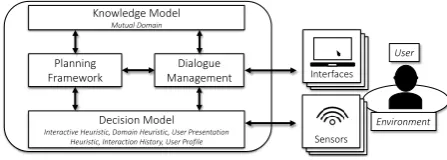
Knowl-edge Model. This way, once the transformation functions work correctly, coherence is not an is-sue any more, even for updating the domain. How these essential constituents of a conceptual MIP system architecture (depicted in Figure 1) were implemented in our system, will be explained in the next Section.
Planning Framework
Decision Model Interactive Heuristic, Domain Heuristic, User Presentation
Heuristic, Interaction History, User Profile Dialogue
Management Interfaces
Sensors
User
Environment
[image:4.595.72.296.519.599.2]Knowledge Model Mutual Domain
Figure 1: Essential components of a MIP system.
5 Implementation
We implemented and tested a multimodal MIP system using a knowledge-based cognitive archi-tecture (Bercher et al., 2014). The multimodal interface uses speech and graphical user input as
well as output. The Dialog Management uses
a modality-independent representation,
communi-cating with the user via theFission(Honold et al.,
2012), User Interface(Honold et al., 2013) , and
Fusion(Sch¨ussel et al., 2013) modules. Here, we will describe in more detail the two components, which are of particular interest for MIP systems: The Mutual Knowledge Model and the Decision Model.
5.1 Mutual Knowledge Model
This model, from which the planning and dialog domain models are automatically generated using automated reasoning, is crucial for a coherent MIP system. It is implemented in the form of an OWL ontology (W3C OWL Working Group, 2009). By generating the HTN planning domains from the ontology, a common vocabulary is ensured – for every planning task a corresponding concept exists in the ontology. Hierarchical structures (i.e., de-composition methods) inherent of HTN planning are derived using declarative background knowl-edge modeled in the ontology. For the delica-cies of modeling planning domains in an ontology (e.g., how to model ordering or preconditions), in-cluding proofs for the transformation and remarks on the complexity of this problem, see Behnke et al. (2015) for further details.
The model is also utilized to infer a basic dialog structure, which is needed for the user to specify the objective for the planner. Us-ing a mutual model addresses one of the chal-lenges of MIP, since translation problems be-tween dialog and planner semantics can be
pre-vented. For the dialog domain generation a
mapping between ontology concepts and dialogs is used. The dialog hierarchy can be derived
using ontology knowledge. A dialog Ae can
be decomposed into a sequence of sub dialogs
containing the dialogs Be1, . . . ,Ben by an axiom
Class:A EquivalentTo:includesonlysome
[B1, . . . , Bn], which is interpreted by the dialog as
a corresponding decomposition method. For ex-ample, a strength training can be conducted using
a set of workoutsAe1, . . . ,Aen, each of which
con-sists of a set of exercises Be1, . . . ,Ben. This way
a dialog hierarchy can be created, using the top-most elements as entry points for the dialog be-tween user and machine. Nevertheless, this
re-sults only in avalid dialog structure, but not in a
for the user. The dialogs are also relevant during the MIP process. When selecting between several
Plan Modifications, these have to be translated to a format understandable by the user. Hence, in addition to the knowledge used to generate plan steps, resources are required for communicating these steps to the user. Therefore, texts, pictures, or videos are needed, which can be easily refer-enced from an ontology. Using this information, dialogs suitable for a well-understandable human-computer interaction can be created and presented to the user.
One key aspect of state-of-the-art DS is the abil-ity to individualize the ongoing dialog according to the user’s needs, requirements, preferences, or history of interaction. Coupling the generation of the dialog domain to the ontology enables us to accomplish these requirements using ontological reasoning and explanation in various ways. The dialogs can be pruned using ontological reason-ing accordreason-ing to the user’s needs (e.g., “show only exercises which do not require gym access”), to the user’s requirements (e.g., “show only beginner exercises”) or adapted to the user’s dialog history (e.g., “preselect exercises which were used the last time”) and preferences (e.g., “present only exer-cises with dumbbells”). Additionally, integrating pro-active as well as requested explanations into the interaction is an important part of imparting used domain knowledge and clarifying system be-havior. Using a coherent knowledge source to create dialog and planning domains enables us to use predefined declarative explanations (Nothdurft et al., 2014) together with dynamically generated plan explanation (Seegebarth et al., 2012) and ex-planations for ontological inferences (Schiller and Glimm, 2013) without dealing with inconsistency
issues. This wayPlan Steps(e.g., exercises) can
be explained in detail, dependencies between plan steps can be explained to exemplify the necessity of tasks (i.e., plan explanation), and ontology ex-planations can justify decompositions from which the planning model and the dialog domain where generated. All of which increase the user’s per-ceived system transparency.
5.2 Decision Model
This model is in charge of deciding when and how to involve the user in the planning process. It is the interface to the planner and decides, upon plan-ner requests, whether a user involvement is useful. For this it includes a list of essential domain
deci-sions that are interesting and relevant for the user (e.g., for a training domain: day, workout, and ex-ercises) - the rest is left for the fallback-heuristic, and thus decided by the planner. Hence, the user is only involved in the decision making if a user-relevant planning decision is pending (e.g., “which leg exercise do you prefer?”). If it is in favor of user involvement the open decision and its modi-fications have to be passed to the user. Hence, the decision on the form of user integration has to be made. The dialog may either consist of the com-plete set of modifications, a pruned or sorted list, implicit or explicit confirmations of system-made preselections, or only of a user information. This decision depends not only on the interaction his-tory, but also on additional information (e.g., af-fective user states like overextension, interest, or engagement) stored in the user state.
The Decision Model also records the dialog-and planning history. There are several reasons for that: The dialog history may enable a prediction of future user behavior (e.g., in selections), and
ad-ditionally this knowledge is mandatory for
back-trackingprocesses, when the current plan does not lead to a solution. The history saves which
deci-sions were made by the user. In case of
backtrack-ingthe decisions are undone step-by-step, with the
goal of finding a solution by applying alternative modifications. Whenever a user-made decision is undone, the user is notified, because this system behavior would otherwise appear irritating.
Sincebacktrackingas well asdead-endsare
pe-culiar phenomena in a MIP system, the communi-cation of these might be a critical influence on the
user experience. Together with theDM, the
Deci-sion Modelorchestrates the corresponding system
behavior. The main difference between
backtrack-inganddead-endsis the temporal ordering of the awareness of the unsolvable plan and made
deci-sion. Forbacktrackingthe awareness is achieved
after the decision, and for dead-ends during the
decision. As we assumed that backtracking will
impair the user experience significantly, a parallel
search for dead-ends, as described in Section 3,
was implemented. The process itself is, of course,
inherently different from backtracking, but may
prevent it. Removing dead-ends from the search space, when the relevant modification is not part of the current selection, is a rather easy task. Oth-erwise, the current selection has to be modified to
How-ever, removing it without any notification from the list seems like a confusing behavior. As we had only hypotheses on the effects of these peculiar events as well as on the effects of the different forms of integrating the user into the planning pro-cess, we conducted a matching user study.
6 Evaluation
MIP may lead to the user experiencing
planning-related phenomena, such asbacktrackingor
dead-ends. These phenomena revoke decisions made
by the user or alter the present decision-making and therefore may influence the user’s experience of the system. As mentioned before, this may im-pair the perceived competency of the system, lead-ing to a loss of trust, which correlates highly to a reduced use of automation (Muir and Moray, 1996). As our MIP system aims at assisting the user in complex and demanding tasks, maintain-ing the user’s trust into the system and thereby the willingness to let the system decide autonomously is crucial. Furthermore, previous research has shown that the use of explanations can help to address trust issues related to intelligent adaptive systems (Glass et al., 2008) and that it may re-duce negative effects in incomprehensible situa-tions (Nothdurft et al., 2014). Therefore, we have
assessed the effects of MIP phenomena like
back-trackinganddead-endson the user-experience and tested different strategies, and especially explana-tions, to communicate these events to the user.
6.1 Methodology
For the subjective measurement through self-ratings by the user, questionnaires have been used. The most fundamental user data is personal infor-mation, assessing age, gender and education. We asked for the participants experience in the gen-eral use of technical systems and the user’s fore-knowledge in the corresponding domain of the ex-periment. Apart from the persona, we included a number of standardized and validated
question-naires: Human-Computer Trust (HCT) describes
the trust relationship between human and ma-chine and was assessed using the questionnaire by Madsen and Gregor (2000) measuring five di-mensions (Perceived Understandability, Perceived Reliability, Perceived Technical Competence,
Per-sonal Attachment, Faith). The AttrakDiff
ques-tionnaire extends the assessment of a DS or soft-ware in general from the limited view of
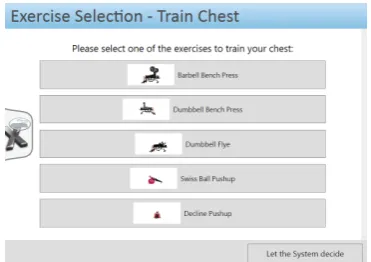
usabil-ity, which represents mostly pragmatic qualusabil-ity, to the integration of scales measuring hedonic qual-ities. This questionnaire was developed by Has-senzahl et al. (2003) and measures the perceived pragmatic quality, the hedonic qualities of stimu-lation and identity, and the attractiveness in gen-eral. In total 104 participants took part in the ex-periment. In average the subjects were 23.9 years old with the youngest being 18 and the oldest 41. Gender-wise the participants were almost equally distributed with 52.9% males and 47.1% females. In this scenario the user’s task was to create individual strength training workouts. In each strength training workout at least three different muscle groups had to be trained and exercises cho-sen accordingly. The user was guided through the process by the system, which provided a selec-tion of exercises for training each specific muscle group necessary for the workout. For example, when planning a strength training for the upper body, the user had to select exercises to train the
[image:6.595.323.509.424.555.2]chest (see Figure 2). This selection corresponds to the integration of the user into the MIP process. The decision how to refine the task of training the chest is not made by the system, but left to the user.
Figure 2: Screenshot of the UI. Here, the user has to select one chest exercise. If he doesn’t want to decide, “Let the System decide” can be clicked or said, starting the planner for this decision.
6.2 MIP Phenomena
For the MIP phenomena we implemented 4 vari-ants: The variants used in the evaluation were
the following:Backtracking with Notification
(BT-N) where the system informs the user that previ-ously user-made decisions will not lead to a
solu-tion and have to be undone. Dead-End
some refinements had to be deactivated in the up-coming selections, because they would not lead
to a solution. Dead-End Notification during
(DE-D), where the selection provided, on each
selec-tion slide, the notificaselec-tion that some of the op-tions below had to be deactivated, because they would not lead to a solution. The fourth variant tested the effect of the content of the notification.
This means, that the Backtracking with
Explana-tion (BT-E)variation additionally explained to the user why the already made decisions had to be rolled back. The participants were distributed by a random-function to the variants, resulting in 25 participants for BT-N, 18 for BT-E, 18 for DE-B, and 21 for DE-D (without unusable subjects).
6.2.1 Temporal Contiguity
Our first hypothesis was that in general the tempo-ral contiguity of the system-provided notification does affect the user-experience. We assumed that providing the notification before the upcoming se-lection will perform better than on the sese-lection it-self, and way better than providing the notification after the decision, because the amount of conse-quences for the user is directly influenced by the temporal contiguity of the notification. In terms of HCT we expected that especially the bases of perceived reliability and understandability will be defected stronger by a larger temporal contiguity.
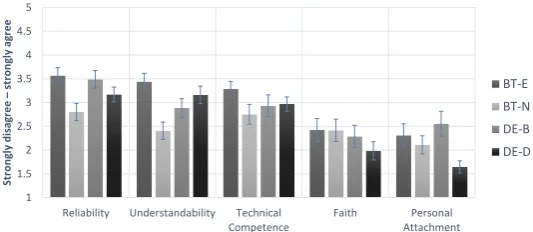
Results. There was a statistically significant dif-ference between groups with notifications (i.e., without BT-E) in HCT-bases (see fig. 3) as
deter-mined by one-way ANOVA forperceived
reliabil-ity (F(2,70) = 3.548, p = .034), perceived un-derstandability(F(2,70) = 4.391, p=.016), and
significant for personal attachment (F(2,44) =
3.401, p=.042). While analyzing the AttrakDiff
questionnaire data we found a statistically
signifi-cant difference for the dimension ofhedonic
quali-ties - stimulationbetween groups as determined by
one-way ANOVA (F(2,44) = 3.266, p = .048).
The Fisher LSD post hoc test revealed statistical
difference at the .05 level between BT-N (M =
4.04, SD = 1.03) and DE-D (M = 3.26, SD =
.72). Also DE-D was significantly different at the
.05 level from DE-B (M = 4.12, SD= 1.03).
Discussion. The results support our hypothesis that the temporal contiguity of the notification does indeed influence the user-experience. A tech-nical system will be perceived to be most reli-able, when the notification is presented before the
decision-making (DE-B), because no unexpected events occur, and the least when user decisions have to be undone (BT-N). For perceived under-standability presenting the notification during the decision performed best, maybe because the de-activation of selection options could be allocated more directly to the notification itself and there-fore foster the user’s understanding of the situ-ation. The personal attachment was mostly de-fected when using notifications during decision making. The results in general support that a pos-itive temporal contiguity (i.e., DE-B) seems to be the best option for a technical system. While the understandability performs only second best, the perceived reliability, personal attachment, overall cognitive load, difficulty, fun, extraneous load and pragmatic as well as hedonic qualities, and over-all attractiveness perform either best or as good as the other conditions using only notifications. This notification, which only represents some sort of shallow justification for the experienced system behavior, also seems to be important for the per-ceived user-experience. Hence, we evaluated how a real explanation would perform opposed to shal-low justifications (i.e., the notification condition).
6.2.2 The Effects of Explaining MIP
For testing the effects of an extensive explanation,
we exchanged the backtracking notification with
an explanation. The notification that the made de-cision will not lead to a solution was exchanged with “the system has detected that the gym is closed today due to a severe water damage. There-fore, you have to decide again and select exercises suitable for training at home”. This condition (BT-E) was then compared to the notification condition (BT-N). Thus, a pairwise t-test was used.
Results. Examining the HCT-bases we found
significant differences between BT-N (M =
2.8, SD = 1.05) and BT-E (M = 3.56, SD =
.82) for perceived reliability (t(3.0) = 57, p =
.004). For perceived understandabilitythe mean
differed significant (t(3.99) = 57, p=.000) with
BT-N (M = 2.40, SD = 1.05) and BT-E (M =
3.44, SD = .87). Observing theperceived
tech-nical competenceBT-N (M = 2.75, SD= 1.03)
and BT-E (M = 3.28, SD =.66) also performed
significantly different (t(2.06) = 41, p=.045).
In the AttrakDiff we observed a significant
difference (t(2.37) = 41, p = .022) for
qual-1 1.5 2 2.5 3 3.5 4 4.5 5
Reliability Understandability Technical Competence
Faith Personal Attachment
Str
on
gl
y
d
isa
gr
ee
–
st
ron
gl
y
ag
re
e
BT-E
BT-N
DE-B
[image:8.595.165.432.62.178.2]DE-D
Figure 3: This shows the average mean of the bases of human-computer trust for each variant on a 5-point Likert scale. The whiskers represent the standard errors of the mean.
ities comparing BT-E (M = 4.86, SD =
1.16) and BT-N (M = 4.01, SD = 1.15).
Taking a closer look at the word pairs sig-nificant differences below the .05 level were
found for complicated-simple,
unpredictable-predictable,confusing-clearly structured, unruly-manageable, as well as forunpleasant-pleasant.
Discussion. Providing detailed explanations of the system behavior, in this case of backtracking, does indeed help to perceive the system as more reliable, more understandable, and more
techni-cally competent. As only the backtracking
noti-fication was modified, we can only infer that for the other variants (i.e., DE-D and DE-B) the ef-fect would be similar. However, this seems logical because the goal of increasing the system’s trans-parency to the user can be achieved using simi-lar explanations as well. Taking a look at the At-trakDiff and its single word pairs it becomes obvi-ous that explaining system behavior helps to im-prove the pragmatic qualities of a system com-pared to providing none to minimal notifications. Systems with explanation capabilities seem to be perceived as not so complicated, more predictable, manageable, more clearly structured and in gen-eral as more pleasant.
Experiment Conclusion. Combing the results of both evaluated factors (i.e., temporal contigu-ity and explanations) we argue that the best option for MIP system behavior would be explaining the user why e.g., several options have been pruned from a selection beforehand. This strengthens the need for, on the one hand, intelligent and under-standable explanation capabilities of such systems and on the other hand that the user is only inte-grated into the decision making when the system is sure that the presented options do in fact, or at least most probably, lead to a solution. Otherwise,
the negative effects of occurringbacktrackingand
similar planning peculiarities will impair the rela-tionship between human and machine.
7 Conclusion
In this paper we pointed out the importance for fu-ture intelligent systems of intertwining dialog sys-tems and AI Planning into a MIP system. First, we elucidated the potentials, but also the risks and arising problems of these mixed-initiative sys-tems. On the one hand, humans can profit from planning techniques like parallel exploration, ex-cluding non-valid planning paths from the search space. On the other hand, planning-related events like backtracking or dead-ends may impair the user experience. Second, we described our ap-proach of a coherent and user-friendly mixed-initiative system. This included the use of a mu-tual knowledge model, in form of an ontology, to generate coherent domain models for dialog and planning as well as the development of a subordi-nate decision model, controlling who is in charge of the decision-making process. Furthermore, we evaluated our implementation on the effects of MIP events and tested different strategies to han-dle those. Concluding, we remark that the po-tentials of the integration of AI planning into a DS have to be weighed against the drawbacks like
backtrackingordead-endsand their effects on the user experience. However, increasing the user’s perceived system transparency by including valid explanations on these behaviors may mitigate the negative effects, thus increasing the potential ar-eas of application for this kind of mixed-initiative systems.
Acknowledgment
References
Mitchell Ai-Chang, John Bresina, Len Charest, Adam Chase, JC-J Hsu, Ari Jonsson, Bob Kanefsky, Paul Morris, Kanna Rajan, Jeffrey Yglesias, et al. 2004. Mapgen: mixed-initiative planning and scheduling for the mars exploration rover mission. Intelligent Systems, IEEE, 19(1):8–12.
Gregor Behnke, Denis Ponomaryov, Marvin Schiller, Pascal Bercher, Florian Nothdurft, Birte Glimm, and Susanne Biundo. 2015. Coherence across compo-nents in cognitive systems – one ontology to rule them all. In Proc. of the 25th Int. Joint Conf. on Artificial Intelligence (IJCAI 2015). AAAI Press. Pascal Bercher, Susanne Biundo, Thomas Geier, Thilo
Hoernle, Florian Nothdurft, Felix Richter, and Bernd Schattenberg. 2014. Plan, repair, execute, ex-plain - How planning helps to assemble your home theater. InProc. of the 24th Int. Conf. on Automated Planning and Scheduling (ICAPS 2014), pages 386– 394. AAAI Press.
Susanne Biundo, Pascal Bercher, Thomas Geier, Felix M¨uller, and Bernd Schattenberg. 2011. Advanced user assistance based on AI planning. Cognitive Sys-tems Research, 12(3-4):219–236. Special Issue on Complex Cognition.
Kutluhan Erol, James A. Hendler, and Dana S. Nau. 1994. UMCP: A sound and complete procedure for hierarchical task-network planning. InProc. of the 2nd Int. Conf. on Artificial Intelligence Planning Systems (AIPS 1994), pages 249–254. AAAI Press.
Juan Fern´andez-Olivares, Luis A. Castillo, ´Oscar Garc´ıa-P´erez, and Francisco Palao. 2006. Bring-ing users and plannBring-ing technology together. experi-ences in SIADEX. InProc. of the 16th Int. Conf. on Automated Planning and Scheduling (ICAPS 2006), pages 11–20. AAAI Press.
Thomas Geier and Pascal Bercher. 2011. On the decid-ability of htn planning with task insertion. InProc. of the 22nd Int. Joint Conf. on Artificial Intelligence (IJCAI 2011), pages 1955–1961. AAAI Press. Alyssa Glass, Deborah L. McGuinness, and Michael
Wolverton. 2008. Toward establishing trust in adap-tive agents. InProc. of the 13th Int. Conf. on Intel-ligent User Interfaces (IUI 2008), pages 227–236. ACM.
Marc Hassenzahl, Michael Burmester, and Franz Koller. 2003. Attrakdiff: Ein fragebogen zur mes-sung wahrgenommener hedonischer und pragmatis-cher qualitt. In Gerd Szwillus and J¨urgen Ziegler, editors, Mensch & Computer 2003: Interaktion in Bewegung, pages 187–196, Stuttgart. B. G. Teubner. Frank Honold, Felix Sch¨ussel, and Michael Weber. 2012. Adaptive probabilistic fission for multimodal systems. InProc. of the 24th Australian Computer-Human Interaction Conf., OzCHI ’12, pages 222– 231, New York, NY, USA, November, 26–30. ACM.
Frank Honold, Felix Schussel, Michael Weber, Florian Nothdurft, Gregor Bertrand, and Wolfgang Minker. 2013. Context models for adaptive dialogs and mul-timodal interaction. In9th Int. Conf. on Intelligent Environments (IE 2013), pages 57–64. IEEE. Maria Madsen and Shirley Gregor. 2000. Measuring
human-computer trust. In Proc. of the 11 th Aus-tralasian Conf. on Information Systems, pages 6–8. ISMRC, QUT.
Bonnie M Muir and Neville Moray. 1996. Trust in automation. part ii. experimental studies of trust and human intervention in a process control simulation.
Ergonomics, 39(3):429–460.
Karen L. Myers, W. Mabry Tyson, Michael J. Wolver-ton, Peter A. Jarvis, Thomas J. Lee, and Marie des-Jardins. 2002. PASSAT: A user-centric planning framework. InProc. of the 3rd Int. NASA Workshop on Planning and Scheduling for Space, pages 1–10. Karen L. Myers, Peter A. Jarvis, W. Mabry Tyson, and Michael J. Wolverton. 2003. A mixed-initiative framework for robust plan sketching. InProc. of the 13th Int. Conf. on Automated Planning and Schedul-ing (ICAPS 2003), pages 256–266. AAAI Press. D. Nau, T.-C. Au, O. Ilghami, U. Kuter, D. Wu, F.
Ya-man, H. Munoz-Avila, and J.W. Murdock. 2005. Applications of shop and shop2. Intelligent Systems, IEEE, 20(2):34–41, March.
Florian Nothdurft, Felix Richter, and Wolfgang Minker. 2014. Probabilistic human-computer trust handling. In Proc. of the Annual Meeting of the Special Interest Group on Discourse and Dialogue, pages 51–59. ACL.
Marvin Schiller and Birte Glimm. 2013. Towards ex-plicative inference for OWL. InProc. of the Int. De-scription Logic Workshop, volume 1014, pages 930– 941. CEUR.
Felix Sch¨ussel, Frank Honold, and Michael Weber. 2013. Using the transferable belief model for multi-modal input fusion in companion systems. In Multi-modal Pattern Recognition of Social Signals in HCI, volume 7742 ofLNCS, pages 100–115. Springer. Bastian Seegebarth, Felix M¨uller, Bernd Schattenberg,
and Susanne Biundo. 2012. Making hybrid plans more clear to human users – a formal approach for generating sound explanations. InProc. of the 22nd Int. Conf. on Automated Planning and Scheduling (ICAPS 2012), pages 225–233. AAAI Press. Shirin Sohrabi, Jorge Baier, and Sheila A. McIlraith.
2009. HTN planning with preferences. In21st Int. Joint Conf. on Artificial Intelligence (IJCAI 2009), pages 1790–1797. AAAI Press.
W3C OWL Working Group. 2009. OWL 2 Web
Ontology Language: Document Overview.
Available at http://www.w3.org/TR/
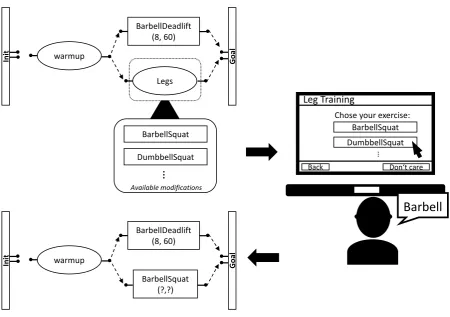
8 Appendix A: Example Planning and Dialog Snippet
In
it
G
o
al
warmup
BarbellDeadlift (8, 60)
Legs
BarbellSquat
DumbbellSquat
…
BarbellSquat DumbbellSquat
…
Leg Training
Chose your exercise:
Don‘t care Back
Barbell
In
it
G
o
al
warmup
BarbellDeadlift (8, 60)
[image:10.595.73.524.91.408.2]BarbellSquat (?,?) Available modifications