What is in a text and what does it do: Qualitative Evaluations of an NLG
system – the BT-Nurse – using content analysis and discourse analysis.
Rahul Sambaraju
Queen Margaret Univ, UK [email protected]Ehud Reiter
Univ of Aberdeen, UK [email protected]Robert Logie
Univ of Edinburgh, UK [email protected]Andy McKinlay
Univ of Edinburgh, UK [email protected]
Chris McVittie
Queen Margaret Univ, UK [email protected]Albert Gatt
Univ of Malta, Malta [email protected]Cindy Sykes
Edinburgh Royal Infirmary, U.K
Abstract
Evaluations of NLG systems generally are quantiative, that is, based on corpus comparison statistics and/or results of experiments with people. Outcomes of such evaluations are important in demonstrating whether or not an NLG system is successful, but leave gaps in understanding why this is the case. Alternatively, qualitative evaluations carried out by experts provide knowledge on where a system needs to be improved. In this paper we describe two such evaluations carried out for the BT-Nurse system, using two different methodologies (content analysis and discourse analysis). The outcomes of such evaluations are discussed in comparison to what was learnt from a quantitiave evaluation of BT-Nurse. Implications for the role of similar evaluations in NLG are also discussed.
1
Introduction
Natural-Language Generation (NLG) systems are usually evaluated quantitatively, by measuring im-pact on task performance, human opinions on Likert-like scales, and/or similarity to a gold-standard corpus. While such evaluations are essen-tial, we believe there is also a role for qualitative evaluations, especially when the goal of the evaluation is formative that is, assessing weak-nesses and identifying how the NLG system could be improved.
In this paper we describe how we used two qualitative methodologies, content analysis and discourse analysis, to evaluate texts produced by
the BT-Nurse system (Hunter et al., 2011). These methodologies require a human analyst to read and analyse the generated texts; and indeed for both types of analysis it is helpful to conduct a similar analysis of human-written corpus texts, so that generated texts can be compared to manually-authored texts. From a practical perspective this means that only a relatively limited number of texts can be analysed using these methodologies; but nevertheless we believe they can substantially help in formative evaluation of NLG systems.
2
Background
2.1 Evaluation in NLG
The great majority of published evaluations of NLG systems are quantitative: as described by Reiter and Belz (2009), they either measure the impact of a generated text on task performance, ask human subjects to rate generated texts on a Likert-like scale, or compare the similarity of gen-erated texts to corpus texts using automatic metrics such as BLEU (Papineni et al., 2002). Reiter and Belz point out that many human-based quantitative NLG evaluations also solicit free-text comments from their subjects, and these are very helpful in diagnosing and fixing problems in generated texts. Soliciting such comments, however is usually a secondary goal of evaluations of NLG systems, the primary goal being quantitative.
One instance of the use of qualitative method-ologies in evaluating NLG systems was that by McKinlay et al (2010) who used discourse analysis to analyse texts generated by the BT45 NLG sys-tem (Portet et al., 2009). The evaluation revealed certain problems with generated texts, such as a
poor narrative structure (Reiter et al., 2008). The discourse analysis work presented here uses a simi-lar approach to McKinlay et al (2010).
2.2 BT-Nurse
The BT-Nurse system (Hunter et al., 2011) gener-ates nursing shift handover reports for babies in a Neonatal Intensive Care Unit (NICU), from data stored in the baby‟s electronic medical record. The input data include numeric time-series data (e.g., heart rate), ad-hoc structured data (e.g., lab re-sults), and descriptions of actions and observations of medical and nursing staff (such as administering drugs and performing surgical procedures). The handover report is produced at the end of a 12-hour nursing shift, and is given to the incoming nurse on the next shift as part of the handover process. Its purpose is to help the incoming nurse plan her care activities, and also ensure that she is aware of the baby‟s circumstances.
BT-Nurse is part of the BabyTalk family of sys-tems (Gatt et al., 2009), and like other BabyTalk systems it combines signal analysis and pattern matching, data interpretation based on expert medical knowledge, and NLG techniques. It was developed in close consultation with NICU nurses, and used no input data other than what was stored in the electronic medical record.
As part of the development process, an expert NICU nurse wrote a corpus of 32 example nursing summaries based on data in the medical record related to 10 babies collated over a period of 3 months. The babies concerned here were diag-nosed to have a range of medical conditions affect-ing various body systems at differaffect-ing levels of pathology. These texts differed from real-world existing handover reports in two ways: (1) they were much longer and more detailed (on-duty nurses do not have the time to write detailed shift-handover reports), and (2) they were purely based on the electronic patient record (and not, for exam-ple, on visual observation of the baby).
BT-Nurse was designed so that the output texts resemble corpus texts with the aim of complement-ing nurses engaged in their duties. In the remainder of this paper, corpus text refers to one of the spe-cially written summaries above for the purposes of designing the system, and actual handover text refers to a real-world handover report written by an on-duty nurse for a baby she was looking after. At the time of analysis the BT-Nurse was focusing on
producing texts that described only the baby‟s clinical history and respiratory system, so qualita-tive analyses were limited to these parts of the cor-pus texts, actual handover texts and BT-Nurse generated texts.
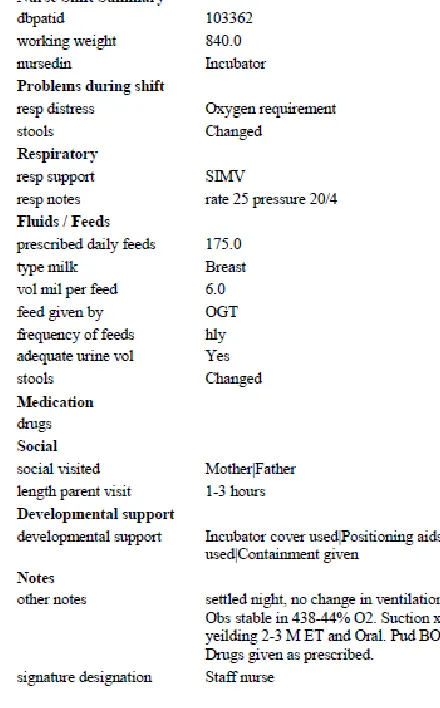
An extract from an actual handover text is shown in Figure 1, an extract from nurse-written corpus text is shown in Figure 2, and an extract from the corresponding BT-Nurse text is shown in Figure 3 (the complete texts are several pages long).
Figure 1: Actual handover text
2.3 Quantitative Evaluation:
[image:2.612.318.538.218.572.2]understand-able, 70% thought they were completely accurate, and 60% thought they were helpful. Free-text comments focused on specific content issues (re-quests for additional information, complaints about incorrect content, suggestions to remove content). There were fewer comments about language is-sues. These tended to be fairly specific when ad-dressing microplanning issues (for example “would prefer not to see the word 'since' with the date”), but vaguer when addressing document-planning and narrative issues (for example, “this summary does not convey the feeling that the baby has made progress” and “The above comments are accurate statements, however they do not present a 'picture' of current condition”).
This evaluation worked well from the perspec-tive of getting some numbers on the system‟s per-ceived utility, which was its primary goal. However, from the perspective of diagnosing prob-lems and suggesting enhancements, it worked much better for content and low-level phrasing issues than for document structure and narrative issues. This suggests that other methodologies, probably involving analysts with specialist exper-tise in narrative and structural issues, might be needed to diagnose and address these issues. In the remainder of this paper we describe how we used two such methodologies, content analysis and dis-course analysis, to gain a better understanding of BT-Nurse‟s deficiencies from this perspective.
3
Evaluation using content analysis
3.1 Content Analysis
Content analysis is widely used as a data explora-tory tool by qualitative researchers in psychology, linguistics and other social sciences. In content analysis, qualitative data, mainly texts, are coded according to some coding scheme which is usually predetermined, either from previous research or researcher expectations. Following this, frequen-cies can be calculated to enable a numerical com-parison. A unit of analysis (sentence, paragraph or a page) is identified and classified according to specific codes. These codes could either be de-scriptive or analytic (Richards, 2009). The level of coding and what is done on these codes depends to a good extent on the research question (Saldaña, 2009). Here we were interested in what sorts of data representation was contained within BT-Nurse generated texts as compared to that in corpus texts.
Therefore, the analysis had as its focus identifying content in these texts which was reflective of rep-resentations of data in textual form.
3.2 Method
The corpus of 32 nurse written texts was first ana-lyzed to come up with a coding scheme; this was then applied to corpus texts, BT-Nurse texts, and actual handover texts. The extent of corpus texts subjected to analysis was defined in two ways: (1) focus here was on identifying lexical items that communicated „complex‟ information; for example temporal relations and causality (but not simple statements of parameter values such as heart rate) and (2) as mentioned above those parts of the texts relating to babies‟ clinical history and respiratory system only. Analysis led to the identification of various items that were abstracted into higher order „codes‟ forming the coding scheme A sample of nurse written corpus text was made available to a doctorate student with brief notes on what was be-ing looked for in those texts and to form some sort of codes relating to data representation. Codes identified were checked against the first authors‟ for agreement (Cohen‟s ĸ = .74), in line with common practices of doing such analyses with codes (Saldaña, 2009). The coding scheme pre-sented here was used to calculate frequency of oc-currence of each item in nurse written corpus texts, BT-Nurse summaries and actual handover texts.
3.3 Coding Scheme
Items on the coding scheme can be usefully differ-entiated into descriptive items that describe various particulars of information and inferential elements, which provide for inferences amongst data items.
1) Descriptive items in the coding scheme: a) Temporal information: Data items, have time stamps, that is, they are presented as having occurred at some time:
i. Specific clock times: Temporal information is provided in terms of normative clock times – 11:00 or 13:30. E.g.: “The last blood gas was at 18:30 and no changes were made”.
iii. Shift time: shift start and end times are made use of as temporal markers. E.g.: “Insulin just com-menced”.
iv.References to other events: Clock time is pro-vided for one event „A‟ and another event „B‟ is temporally located via references to „A‟. E.g.: “He received morphine prior to intubation at 00:30; no spontaneous respiratory effort noted since being re-ventilated”.
b) Time intervals: Provision of temporal in-formation for events that do not have a single tem-poral marker but two that refer to the start and end times, is made as unitary condensed entities. E.g.: “However, over the day his oxygen requirements generally have come down from 30% to 25%”. c) Trends in parameter values: Recordings of parameter values are made to capture changes in the parameter over a period of time providing the initial and final values along with the direction of such change. E.g.: “Baseline SpO2 drifted down from 95% to 88% accompanied by increasing SpO2 variability associated with handling”. [SpO2 – Oxygen saturation in blood]
d) Evaluations of parameter values: Parame-ter values are also evaluated either in Parame-terms of what is physiologically normal or in terms of what is locally taken to be normal for that particular shift and that particular baby. E.g.: “ABG at 23:10 showed CO2 increased from 7.7 to 9.27 in three hours”. [ABG – Arterial Blood Gas; CO2 – Carbon Di-oxide]
e) Events in temporal relation with other events: Information about certain events and data items is presented as preceding or succeeding other events. E.g.: “Received one dose of surfactant after admission to NNU”. [NNU – Neonatal Unit]
2) Inferential items in the coding scheme: a) Event characterizations: Events are those data items that indicate a recording of a parameter value, a change in a parameter value, interventions and such.
i.Events „marked up‟: Events are presented as im-portant within the local context via providing clock times and describing other events in rela-tion to this particular event. The use of one event „A‟ as a temporal anchor for another „B‟ presents it as consequential to „A‟. E.g.: “Elec-tively re-intubated at 00:30 to CMV rate 50, pressures 18/4 in 30% oxygen. On ventilation, oxygen requirement reduced to 30% and ABG
initially improved”. [CMV – Continuous Man-datory Ventilation]
ii.Event presented as forming a context for other events: Events are presented as occurring over a period of time and then other events are pre-sented as having occurred in the contextual background of the former event. E.g.: “While on BiPAP, oxygen requirement increased to 50% by 23:00.” [BiPAP – Bi-level Positive Airway Pressure]
b) Evaluation: The presentation of parameter values or medical interventions forms an evalua-tion of a prior event or parameter value. E.g.: “ABG taken 2 hours post-extubation was reasona-bly good: pH 7.33 and pCO2 7.08”. [pCO2 – Par-tial pressure of Carbon Di-oxide]. Evaluative information together with the temporal marker an-chored in „extubation‟ serves to present changes in ABG as an evaluation of the outcomes of „extuba-tion‟.
c) Parameters grouped together: Two or more dissimilar parameter descriptions are made together with a conjunctive indicating some sort of an association between the two parameters. E.g.: “Desaturation to 15% with bradycardia to 50-60s”.
d) Grouping similar events: descriptions of two or more event descriptions are juxtaposed to each other. As above these descriptions are of their temporal status, outcomes and such. E.g.: “Tried off CPAP once but put back on after 30 minutes due to increased work of breathing; otherwise has not been off CPAP”. [CPAP – Continuous Positive Airway Pressure]. Here, descriptions attend to two events: being on CPAP and being off CPAP. In-cluding descriptions on these two events provides for inferences as to the reasons, outcomes and other such features of those events.
e) Causation: Events are presented to be causally related to each other either via an explicit discourse marker or presenting the parameter re-cordings or events in temporal relation to each other that makes relevant causal links between them. E.g.: “several episodes (about 3 per hour) of bradycardia with desaturation that only resolved after stimulation or increase in FiO2”.
3.4 Results and Discussion
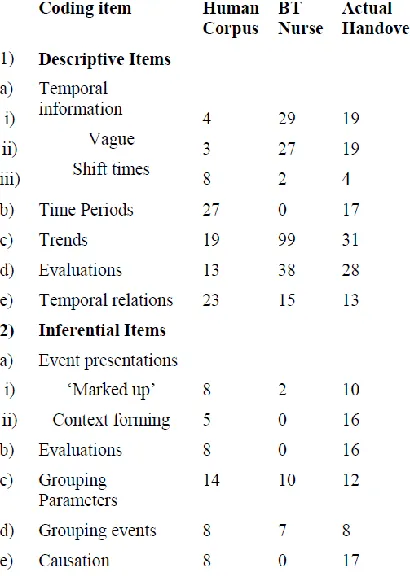
Results shown in Table 1 include frequencies of coding items in corpus texts, BT-Nurse texts, and
Table 1: Frequencies of coding items.
more on descriptive items: they contain quantita-tively more temporal information, higher reporting of trends in parameters, and more items of evalua-tion on parameter values. However, they do not contain representations of „time intervals‟ (1 (b)). Representing time intervals can be thought of as using at least two time stamps on a temporal axis: the „start‟ and „end‟ (Adlassnig et al., 2006). BT-Nurse software apparently does not enable such representation, the outcome of which is reflected in item 2 (a) ii. The lack of representing an event „B‟ as occurring over a period of time in BT-Nurse texts does not make for characterizing an event „A‟ as occurring in the background context of the on-going event „B‟ (the event „B‟ having „start‟ time and an „end‟ time). Although BT-Nurse texts do contain inferential items, overall these items are less frequent compared to nurse written corpus texts. Moreover, inferential items presented do not readily make it clear as to the nature of the rela-tionship (see 4.3 below). These findings then re-veal how representing temporal information has outcomes on other forms of data representation in BT-Nurse texts, and thus contribute to the design of the system.
Analysis of actual handover texts served to at-tend to issues of external validity of the evaluation. Results indicate that actual handover texts are more similar to nurse written corpus texts in con-taining more inference enabling items and more instances of explicit inferences. These results at one level are not very surprising as nurses engaged in doing their duties would arguably require infor-mation of this sort. In that sense, this evaluation has pointed to features of data-to-text systems that are indicative of the sorts of requirements users of these systems have. Thus, by providing more in-formation on relevant parameters, a better trend detection ability and producing an easily usable textual document, BT-Nurse has significant poten-tial to enhance nurse care planning in the NICU.
4
Evaluation using discourse analysis
4.1 Discourse analysis:
A prior use of such methodology in conducting an evaluation of another data-to-text system – BT-45 – showed that corpus texts written by domain experts had better narrative structures than system generated texts (McKinlay et al., 2010). These are considered to be desirable aspects in texts gener-ated by NLG systems (Reiter et al., 2008), there-fore we conducted an evaluation using this methodology.
This evaluation was in fact conducted on a pre-liminary version of BT-Nurse, and some changes were made to the final version of BT-Nurse based on this evaluation; for example the way „causality‟ was expressed was changed in some cases to en-hance clarity. The content analysis and quantitative evaluations, in contrast, were carried out on the final version of BT-Nurse.
4.2 Method
For reasons of illustration and space we provide here a comparative analysis of one nurse written corpus text and the corresponding BT-Nurse gen-erated text for one 12 hour shift. This particular shift summary pair was randomly selected amongst the 32 pairs available. Analysis provided here aims to demonstrate the utility of discourse analysis in formative evaluations of NLG systems. The analy-sis was conducted by three of the authors on an extract taken from each of these texts that detailed occurrences within the shift related to baby‟s respi-ratory system. Analysis involved identification of lexical items (words, sentences and such) that were selected for inclusion and how they were sequen-tially combined within the summary. The identifi-cation of such was considered for the sorts of outcomes made available. Here, this led to the identification of three pragmatic discursive fea-tures present in nurse written corpus texts. These analytic findings were subsequently made use of in evaluating BT-Nurse output texts.
4.3 Analyses:
Figure 2 is an example nurse written corpus text that includes descriptions of baby‟s respiratory status. Figure 3 is the corresponding BT-Nurse generated text produced for the same baby for the same shift. It can readily be seen that they are simi-lar in terms of producing a list of events that oc-curred during the said shift. The following comparative analysis aims to show the pragmatic outcomes of these two summaries. For the
pur-poses of this paper, the analysis is presented along three main pragmatic features:
a) Foregrounding the actor:
The summary in Figure 2 begins with the admis-sion of the baby and the status of his respiration. Through the use of „he‟ at line 2, the author explic-itly introduces the baby as a character. This first item also specifies a particular, desirable health status for the baby at that time: „in air‟. This pro-vides a context for the rest of the description or-ganized around the baby as a central character in a sequence of events. The final item selected for in-clusion at lines 21-22 also makes explicit reference to the baby, thereby presenting a conclusion that is designed to highlight health of the central character at the end of the sequence.
Figure 3, however, begins at line 2 by describing an event, namely a decrease in oxygen saturation, occurring over an extended period of time which commences towards the beginning of shift. Thus, this account treats as the first reportable item a de-scription of an event and not of the baby. It is not until line 7 of the summary that we see any men-tion of the baby himself. This relatively late intro-duction of the baby into the summary fails to foreground the baby himself as a central character in relation to the events that are being described. Additionally, the final item on the list makes no reference to the initial topic or a change in baby‟s respiratory status.
b) Temporal organization of events:
Figure 2: Nurse written corpus text.
Figure 3: BT-Nurse generated text.
Such temporal organization in Figure 3 however is limited. The initial description does make ex-plicit reference to specific times and so marks the starting point for a temporally organised summary.
As the listing of events continues, at a number of points specific events are also temporally marked in order to indicate their relationship to the chrono-logical starting point of the description, ending at lines 15-16 with a description of drug administra-tion presented as occurring towards the end of the period of observation. This sequence, however, is not organised entirely chronologically, in that the temporal reference at line 4 to „12.15‟ precedes the second such reference at line 2 which is to „14.30‟. To the extent that the description provided is framed by reference to times near the start and end of the observational period it is presented in the form of a temporal sequence.
c) Causal connectivity:
and linking of events presents the events being de-scribed as connected and as located within an on-going narrative relating to the breathing of the baby over the course of the shift.
With respect to causal connectivity, in Figure 3 there is seen to be variation in how events are causally linked. First, some events are explicitly linked: at lines 7-8, the process of intubation is clearly marked as linked to the baby being moved from incubator oxygen to „CMV‟ (CMV is a form of mechanical ventilation that follows from being intubated). Second, some are not marked in this way but can be read as being connected through the consecutive descriptions of particular actions and states: at lines 4-6, we see a description of a blood gas measurement being taken, an evaluation of parameters, and descriptions of particular meas-urements that allow them to be treated as conse-quentially relevant and the later descriptions to be treated as presenting the outcomes of the proce-dure. Third, the form of description works to sug-gest that there is no immediate connection between different events being described: at lines, 7-14, we are given a description of a process of intubation, of the baby being given morphine, and of the baby being given suxamethonium. Explicitly describing these events as occurring at a similar approximate time suggests that these are not related events oc-curring in a connected manner but rather are dis-crete events that simply happen to have occurred at the same time in the shift. This combination of de-scriptions that are explicitly linked, those that can be read as linked and those that are presented in an unconnected manner fails to provide a coherent ongoing causal narrative for the period of observa-tion.
4.4 Discussion
Taken together, these pragmatic features function to present descriptions in Figure 2 in a recognisa-bly narrative form. Figure 3, however differs from Figure 2 in the following ways. The selection of reportable events, particularly the first and last items in the summary, differs markedly from those in Figure 2. The first reported item provides little, if any, context for the descriptions to follow and makes no reference to the baby as the focus of the summary. Further, the causal organization of the events being described is variable, making some connections explicit, other connections inferable, and failing to make relevant causality in instances
where it might be appropriate. In these respects, the text produced by the NLG system does not have the narrative form seen in the nurse-written corpus text in Figure 2. However, temporal organi-zation of events and inclusion of some causal ele-ments provide a more coherent organization of descriptions and thus make available at least some causal connections between events. To this extent, the NLG system appears to have produced text that more closely resembles that produced in nurse written corpus text. These findings show that dis-course analysis represents a useful tool for evalua-tion of NLG systems. The analyses identified a range of pragmatic features which are desirable features in a text which seeks to describe in an ef-ficient and useable manner the sequence of events and occurrences which can arise in nursing shifts in an NICU.
These findings have implications for the design of NLG systems. First, in terms of content selec-tion, corpus texts show that the nurse does not merely select items as being topically relevant, but treats these items as topically relevant in terms of how descriptions of actions and events are de-signed and of how these descriptions are sequen-tially organized. In this respect, topical relevance must be viewed not as an objective feature of the situations being described, but rather as a prag-matic outcome of texts themselves. Second, it is apparently important to carefully select those items that are reported at the very start and the very end of the text. The first and last entries function to introduce the topic of the summary and offer an upshot of the matters at the end, that is these items take up functional „slots‟. Third, the human nurse expert attends to the topic flow: the sequential or-ganization of a text to provide for readily recogniz-able shifts from one topic to another; this is absent from the text produced by the BT-Nurse system.
5
General Discussion
5.1 Findings on BT-Nurse:
In terms of types of content, BT-Nurse texts have more instances of trend detection and recordings of parameter values, and fewer instances of inference enabling data representations than the corpus texts. This is perhaps a natural consequence of the differ-ences in capabilities between a computer (good at crunching numbers) and a person (good at making domain inferences). It probably makes sense to accept this distinction and try to determine how a computer-generated text can most usefully support a nurse: an improved analysis of numeric data.
The evaluation using discourse analysis showed that BT-Nurse texts are deficient from a narrative perspective. They show a minimal foregrounding of the baby as a central character, inconsistent temporal organization of events and variable causal connectivity. Narrative form is a desirable feature of texts from an understandability and utility per-spective (Reiter et al., 2008) more so because nar-ratives are a pervasive feature of human interaction (Jefferson, 1978; Sacks, 1992).
5.2 Implications for NLG systems:
A content analysis of corpus texts reveals various ways in which domain experts represent various domain relevant types of information. For instance, here we see various ways in which both temporal markers and events are presented in corpus texts which can inform ways in which inferential items can potentially be included in NLG system gener-ated texts. Knowledge of this sort then is certainly useful in designing NLG systems to produce texts which present information in appropriate ways for the domain.
Discourse analysis differs from content analysis in providing an understanding of ways in which users engaged in their daily duties present summa-ries or similar texts as part of their duties and helps in producing texts that take up such concerns. Here, aspects of presenting the baby as a central character was one feature of producing corpus texts. This is readily seen to be relevant for activi-ties performed by nurses in that their duactivi-ties are about caring and/or providing nursing care for one particular party, namely „the baby‟. To see that human users take up aspects such as these to be relevant features is knowledge useful in the design of NLG systems that are to be deployed in specific
domains. Another finding of relevance is the role of items that occupy the start and final positions in a text. The inclusion of specific items at certain points in a text by human users allows them to do specific functions: doing an introduction, offering an upshot and others. Of note is that such features serve to make the text more of a narrative.
The interesting thing about the above findings is that they did not arise from the quantitative evalua-tion of BT-Nurse. To us, this suggests that such findings are more likely to arise from a qualitative evaluation conducted by analysts with expertise in discourse analysis or content analysis; they are not likely to be spontaneously suggested by subjects who have domain expertise but no expertise in analysis of texts.
5.3 Limitations:
Although, the extent of texts covered in these analyses is limited, outcomes of such evaluations are useful and a complete analysis is likely to throw up further useful knowledge. For instance, across the corpus texts foregrounding the baby as a central character and how descriptions offered are made in ways to make overall evaluations of the baby‟s status, such as being „okay‟ or „deteriorat-ing‟ are seen to be consistent features.
Additionally matters that appear to be of a quan-titative nature were revealed as relevant aspects of these texts only posterior to qualitative analyses. For example, the content analysis showed a differ-ence in the frequency of trend descriptions of pa-rameter values between corpus texts and BT-Nurse texts. This could probably be tested using quantita-tive techniques; this would require annotating the texts, and the annotation scheme could be based on the scheme used in content analysis. In theory a task evaluation study could even be performed to evaluate the impact of having more trend descrip-tions, although this would be an expensive under-taking.
6
Conclusion
actions (making the baby a central character, for instance). In particular, content analysis is appro-priate in showing what goes into a text and dis-course analysis reveals what the texts are designed to do.
Qualitative analyses described above identified many differences between generated texts and cor-pus texts. Some of the differences identified may be desirable, such as the fact that BT-Nurse texts contain more trend descriptions than corpus texts. Other differences are probably not desirable, such as narrative deficiencies in the generated texts. However, the key point is that qualitative analyses have identified these differences, so that develop-ers are aware of them and can decide what action to take.
Acknowledgements
This research was funded by the UK Engineering and Physical Sciences Research Council under grants EP/D049520/1, EP/D05057X/1, and EP/E011764/1. The authors would like to thank other members of the BABYTALK project including François Portet, Jim Hunter, Somayajulu Sripada, and Neil McIntosh for their help.
References
K Adlassnig, C Combi, A Das, E Keravnou, and G Pozzi. 2006. Temporal representation and reasoning in medicine: Research directions and challenges. Artificial Intelligence in Medicine, 38(2): 101 - 113. C Daiute and C Lightfoot. 2003. Narrative analysis:
Studying the development of individuals in society. London: Sage.
A Gatt, F Portet, E Reiter, J Hunter, S Mahamood, W Moncur, and S Sripada. 2009. From data to text in Neonatal Intensive Care Unit: Using NLG technology for decision support and information management. AI Communications, 22: 153 - 186. E Hovy 1993. Automated Discourse Generation Using
Discourse Structure Relations. Artificial Intelligence, 63(1-2): 341 - 386.
J Hunter, Y Freer, A Gatt, E Reiter, S Sripada, C Sykes, and D Westwater. 2011. BT-Nurse: Computer generation of natural language shift summaries from complex heterogenous medical data., Journal of American Medical Informatics Association 18 :621-624.
G Jefferson 1978. Sequential aspects of storytelling in conversation. In, J. Schenkein (Ed), Studies in the organization of conversational interaction. London: Academic Press.
A McKinlay, C McVittie, E Reiter, Y Freer, C Sykes, and R Logie. 2010. Design issues for socially
intelligent user-interfaces: A Discourse analysis of a data-to-text system for summarizing clinical data. Methods of Information in Medicine, 49(4): 379 - 387.
A McKinlay and C McVittie. 2008. Social Psychology & Discourse. Sussex: Wiley-Blackwell.
K Papineni, S Roukos, T Ward, and W Zhu. 2002. BLEU: A method for automatic evaluation of machine translation. Proceedings of ACL-2002, pages 311-318.
F Portet, E Reiter, A Gatt, S Sripada, Y Freer, and C Sykes. 2009. Automatic generation of textual summaries from neonatal intensive care data. Artificial Intelligence, 173(7,8): 789 - 816. E Reiter and A Belz. 2009. An investigation into the
validity of some metrics for automatically evaluating Natural Language Generating systems.
Computational Linguistics, 35: 529 - 558.
E Reiter, A Gatt, F Portet, and M van der Meulen. 2008. The importance of narrative and other lessons from an evaluation of an NLG system that summarizes clinical data. Proceedings of INLG-08, pages 147-155
L Richards. 2009. Handling Qualitative Data: A Practical Guide. London: SAGE.
H Sacks. 1992. Lectures on Conversation. Oxford: Blackwell's.
J Saldaña. 2009. The Coding Manual for Qualitative Researchers. London: SAGE.