Parser Evaluation Using Elementary Dependency Matching
Rebecca Dridan
NICTA Victoria Research Laboratory
Dept. of Computer Science and Software Engineering University of Melbourne
Stephan Oepen Department of Informatics
Universitetet i Oslo
Abstract
We present a perspective on parser evalua-tion in a context where the goal of parsing is to extract meaning from a sentence. Us-ing this perspective, we show why current parser evaluation metrics are not suitable for evaluating parsers that produce logical-form semantics and present an evaluation metric that is suitable, analysing some of the char-acteristics of this new metric.
1 Introduction
A plethora of parser evaluation metrics exist, which evaluate different types of information, at different levels of granularity, using different methods of calculation. All attempt to measure the syntactic quality of parser output, but that is not the only goal of parsing. The DELPH-IN consor-tium1 has produced many grammars of different languages, as well as a number of parsers, all with the aim of extracting meaning from text. In order to drive development, we need a parser evaluation metric that evaluates against that goal. That is, we require a metric that measures semantic rather than syntactic output. In the following section, we reflect on and categorize the semantic informa-tion we wish to evaluate, and discuss how current metrics partially overlap with this framework. We then, after describing some of the specifics of the tools we work with, present an evaluation metric that fits within the given framework, and show, us-ing a couple of case studies, some characteristics of the metric.
2 Semantic Information
Our primary goal in parsing is to extract meaning from text. To evaluate progress towards this goal in a granular fashion, one needs to break up the semantic information into discrete elements. For
1
Seehttp://www.delph-in.netfor background.
this purpose, we distinguish three broad classes of information that contribute to meaning:
class 1 core functor – argument structure, whether syntactic or semantic
class 2 predicate information, such as the lemma, word category, and sense
class 3 properties of events and entities, such as tense, number, and gender The widely-used PARSEVAL metric (Black et al., 1991) evaluates phrase structure, which covers none of these classes directly. Dependency-based evaluation schemes, such as those used by Malt-Parser (Nivre et al., 2004) and MSTMalt-Parser (Mc-Donald et al., 2005) evaluate class 1 surface infor-mation. The annotation used in the Briscoe and Carroll (2006) DepBank for parser evaluation also describes just class 1 syntactic information, al-though the relationships are different to those that MaltParser or MSTParser produce. The annota-tion of the original King et al. (2003) PARC700 DepBank does describe all three classes of infor-mation, but again in terms of syntactic rather than semantic properties.
A common element between all the dependency types above is the use of grammatical relations to describe class 1 information. That is, the depen-dencies are usually labels like SUBJ, OBJ, MOD, etc. While these grammatical functions allow one to describe the surface linguistic structure, they do not make the underlying deep structure explicit. This deep structure describes semantic rather than syntactic arguments and can be seen in resources such as the Prague Dependency Tree-bank (B ¨ohmov´a et al., 2003) and the Redwoods Treebank (Oepen et al., 2004b). Using this se-mantic argument structure for parser evaluation not only gets closer to the actual sentence mean-ing that we are trymean-ing to extract, but is potentially more general, as there is generally wider agree-ment on semantic arguagree-ments than on, for example, whether the main verb depends on the auxiliary, or
vice versa.2
3 Background
The parser that we will be evaluating in this work encodes its semantic output in the form of Mini-mal Recursion Semantics (Copestake et al., 2005), although the derivation that we use for the evalu-ation metric should be compatible with any parser that produces information in classes given in the previous section.
3.1 Minimal Recursion Semantics
Minimal Recursion Semantics (MRS) is a flat se-mantic formalism that represents sese-mantics as a bag of elementary predications and a set of under-specified scopal constraints. An elementary pred-ication can be directly related to words in the text, or can reflect a grammatical construction, such as compounding. Each elementary predication has a relation name, a label and a distinguished variable (designated ARG0). Arguments of a predication are identified by ‘bleached’ARGnroles (which are to be semantically interpreted for classes of pred-icates). Figure 1 shows the MRS analysis of He
persuaded Kim to leave. Here we see six
elemen-tary predications, four with text referents and two as construction-specific covert quantifiers. The ARG1, ARG2and ARG3 roles of the verbal pred-icates describe the predicate–argument relations and demonstrate co-indexation between theARG2 of persuade and the ARG1 of leave. Entity and event variables carry properties such as gender or tense. An evaluation scheme based on MRS there-fore allows us to evaluate class 1 information us-ing the roles, class 2 information through predi-cate names and class 3 information from the prop-erties of the distinguished variables.
3.2 Setup
We will use the PET parser (Callmeier, 2000) and associated grammars as our test environment to evaluate. The traditional accuracy metric for PET has been sentence accuracy which requires an ex-act match against the very fine-grained gold analy-sis, but arguably this harsh metric supplies
insuffi-2
At the same time, we wish to focus parser evaluation on information determined solely by grammatical analysis, i.e. all contributions to interpretation by syntax, and only those. For these reasons, the task of semantic role labeling (SRL) against PropBank-style target representations (Kingsbury et al., 2002) is too far removed from parser evaluation proper; Copestake (2009) elaborates this argument.
cient information about parser performance on its own. In order to evaluate a parser for its use in an application, we are also interested in knowing how good the top ranked parse is, rather than only whether it is the very best parse possible. Even if the goal of evaluation were just parser devel-opment, a nuanced granular evaluation may help reveal what types of mistakes a parser is making.
4 EDM: Elementary Dependency Match
In addition to our focus on semantic information, we considered two other requirements for an ef-fective parser evaluation metric. It should be:
1. understandable not just by parser developers, but also potential users of the parser.
2. configurable to suit the level of detail re-quired for a particular scenario.
4.1 Elementary Dependencies
The metric we have devised to satisfy these requirements is Elementary Dependency Match (EDM), based on so-called Elementary Depen-dencies (EDs), a variable-free reduction of MRS developed by Oepen and Lønning (2006).3 In our work, we use sub-string character spans (e.g.
<3:12>) to identify nodes in the dependency graph,
to facilitate alignment of corresponding elements across distinct analyses. In keeping with our infor-mation classes, this allows us to separate the eval-uation of class 2 information from class 1. Our EDM metric hence consists of three triple types which align with the three information classes:
ARGS: spani rolej spank NAMES: spani NAME relationi PROPS: spani propertyj valuej In these forms,relationis the predicate name of an elementary predication from the MRS,role is an argument label such as ARG1, property refers to an attribute such asTENSE orGENDand value is an appropriate instantiation for the re-spective property. Figure 2 shows the triples pro-duced for the MRS in Figure 1. The text segment associated with each character span is shown for illustrative purposes, but is not part of the triple.
During evaluation, we compare the triples from the gold standard analysis with that ranked top by
hh1,
h3:pron<0:2>(ARG0x4{PERS 3,NUM sg,GEND m,PRONTYPE std pron}),
h5:pronoun q<0:2>(ARG0x4,RSTRh6,BODYh7),
h8: persuade v of<3:12>(ARG0e2{SF prop,TENSE past,MOOD indicative},ARG1x4,ARG2x10,ARG3h9),
h11:proper q<13:16>(ARG0x10{PERS 3,NUM sg},RSTRh12,BODYh13),
h14:named<13:16>(ARG0x10,CARGKim),
h15: leave v 1<20:26>(ARG0e16{SF prop-or-ques,TENSE untensed,MOOD indicative},ARG1x10,ARG2p17) {h12=q h14,h9=q h15,h6=qh3} i
Figure 1: MRS representation of He persuaded Kim to leave.
“He” <0:2> ARG0 <0:2> “He” “persuaded” <3:12> ARG1 <0:2> “He” “persuaded” <3:12> ARG2 <13:16> “Kim”
“persuaded” <3:12> ARG3 <20:26> “leave.” “Kim” <13:16> ARG0 <13:16> “Kim”
“leave.” <20:26> ARG1 <13:16> “Kim”
“He” <0:2> NAME pronoun q “He” <0:2> NAME pron
“persuaded” <3:12> NAME persuade v of “Kim” <13:16> NAME proper q
“Kim” <13:16> NAME named “leave.” <20:26> NAME leave v 1
“He” <0:2> GEND m
“He” <0:2> NUM sg
“He” <0:2> PERS 3
“He” <0:2>PRONTYPEstd pron
“persuaded” <3:12> MOOD indicative
“persuaded” <3:12> SF prop
“persuaded” <3:12> TENSE past
“Kim” <13:16> NUM sg
“Kim” <13:16> PERS 3
“leave.” <20:26> MOOD indicative
“leave.” <20:26> SF prop-or-ques
[image:3.595.76.279.191.458.2]“leave.” <20:26> TENSE untensed
Figure 2: Gold triples for He persuaded Kim to leave.
the parser, and calculate precision, recall and F1 -score across all triples, as well as across the three separate triple types (NAME,ARGandPROP).
4.2 Alternate Configurations
The full EDM metric weights each triple equally which may not be ideal for all scenarios. The divi-sion by triple type gives one alternative view that provides a more complete picture of what sort of mistakes are being made by the parser. For par-ticular applications, it might be that only class 1 information will be used, and in that case just mea-suringARGs might be a better metric. Further fine-tuning is possible by assigning weights to individ-ual predicate types via a configuration file similar to the parameter files used with the EvalBPARSE -VALscript (Sekine and Collins, 1997). This will allow a user to, for example, assign lower weight to entity properties, or only evaluate ARG1 and
ARG2roles. One particular configuration we have found useful is to assign zero weight to the PROP triples and only evaluateARGs andNAMEs. While the class 3 information is useful for applications such as machine translation, and ideally would be evaluated, some applications don’t make use of this information, and so, in certain scenarios, it makes sense to ignore these triples in evaluation. This configuration produces a metric broadly sim-ilar to the CCG dependencies used by Clark and Curran (2007) and also to the predicate argument structures produced by the Enju parser (Miyao and Tsujii, 2008), in terms of the information classes included, although the CCG dependencies again encode syntactic rather than semantic structure.
5 Analysis
To get some idea of the numeric range of the dif-ferent EDM configurations, we parsed a section of the SemCor corpus (Miller et al., 1994) using the English Resource Grammar (ERG: (Flickinger, 2000)), and then calculated the average F1-score for each rank, as ranked by the statistical model packaged with the ERG. Figure 3 shows the relative differences between five configurations: all triples together (EDM), the NAME, ARG and PROP triple types separately (EDMN, EDMA and EDMP, respectively) and measuring just the NAMEandARGtypes together (EDMN A).
We can see that all configurations show approx-imately the same trends, and maintain their rela-tive order. EDMP is consistently higher, which follows from the fact that many of the properties are inter-dependent, and that the parser enforces agreement. Most difficult to identify correctly is the ARG type, which represent the core semantic arguments. All of the scores are quite high, even at the 40th rank parse, which is due to using a highly constrained grammar with fine-grained analyses that can vary in only small details.
0.7 0.75 0.8 0.85 0.9 0.95
0 5 10 15 20 25 30 35 40
Parse rank
EDM EDMN EDMA
[image:4.595.319.513.62.135.2]EDMP EDMN A
Figure 3: Average F1score at each rank (up to 40).
Config 1 Config 2
Sent. Acc. 0.095 0.093
P R F P R F
EDM 0.847 0.677 0.753 0.847 0.693 0.763
EDMNA 0.796 0.635 0.707 0.798 0.652 0.717
EDMA 0.778 0.620 0.690 0.780 0.637 0.701
EDMN 0.815 0.651 0.724 0.815 0.668 0.734
[image:4.595.83.293.67.198.2]EDMP 0.890 0.714 0.792 0.890 0.729 0.801
Table 1: Comparing unknown word handling configu-rations.
that allow us to see relative differences in parser performance, measured using EDM and variants, as well as the traditional sentence accuracy.
5.1 Cross-Configuration
One possible evaluation scenario involves chang-ing a parameter in the parser and measurchang-ing the effect. The results in Table 1 come from parsing a single corpus using a variant of the ERG with a much smaller lexicon in order to test two unknown word handling configurations.
The sentence accuracy figures are very low, since the grammar has been limited, and show no real difference between the two configurations. In the EDM results, we can see that, while the preci-sion between the two configurations is very simi-lar, recall is consistently lower for Config 1 (which had a slightly better sentence accuracy).
5.2 Cross-Grammar
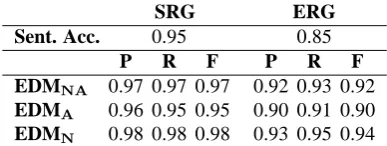
In this comparison, we look at two different grammars, over parallel test data.4 The Span-ish Resource Grammar (SRG: (Marimon et al., 2007)) also produces MRS, although properties are treated differently, so we leave out the EDM
4
The MRS test suite was constructed to represent a range of phenomena and consists of 107 short sentences which have been translated into multiple languages, maintaining parallel MRS analyses as far as possible.
SRG ERG
Sent. Acc. 0.95 0.85
P R F P R F
EDMNA 0.97 0.97 0.97 0.92 0.93 0.92
EDMA 0.96 0.95 0.95 0.90 0.91 0.90
EDMN 0.98 0.98 0.98 0.93 0.95 0.94
Table 2: Comparing between the SRG and ERG gram-mars over a parallel test suite. PROP type triples are excluded for compatibility.
and EDMP metric for compatibility and compare to ERG performance over the same small test set.
While the SRG is a less mature grammar, and does not analyse the full range of constructions that the ERG parses, EDM allows us to compare over items and information types that both gram-mars cover, and in Table 2 we can see that the SRG ranking model performs better over this data.
6 Conclusion
The current range of parser evaluation metrics all evaluate the syntactic quality of parser output, which makes them unsuitable to evaluate parsers which aim to output semantic analysis. The EDM metric we describe here allows us to evaluate the semantic output of any parser that can encode information in the Minimal Recursion Semantic framework, and indeed, the derivation that we use should be generalisable to any logical-form se-mantic output. This metric can measure three dif-ferent classes of deep semantic information, and can be configured to evaluate whatever level is suitable for the potential application, or for the parser being evaluated. We have demonstrated that EDM and its variants, together with sentence ac-curacy, can give a detailed picture of how accu-rately a parser can extract meaning from text, al-lowing useful comparisons in a variety of circum-stances. Furthermore, since MRS is used in appli-cations and other semantic research (Oepen et al., 2004a; Dridan, 2007; Schlangen and Lascarides, 2003; Fuchss et al., 2004), the metric we have de-scribed here may prove useful in other areas where semantic comparison is required.
Acknowledgements
References
Ezra Black, Steve Abney, Dan Flickinger, Claudia Gdaniec, Ralph Grishman, Phil Harrison, Don Hindle, Robert Ingria, Fred Jelinek, J. Klavans, Mark Liberman, Mitch Marcus, S. Roukos, B. Santorini, and Tomek Strzalkowski. 1991. A procedure for quantitatively comparing the syn-tactic coverage of English grammars. In
Pro-ceedings of the Workshop on Speech and Nat-ural Language, pages 306–311, Pacific Grove,
USA.
Alena B ¨ohmov´a, Jan Hajiˇc, Eva Hajiˇcov´a, and Barbora Hladk´a. 2003. The Prague Depen-dency Treebank: A three level annotation sce-nario. In Anne Abeill, editor, Treebanks:
build-ing and usbuild-ing parsed corpora. Sprbuild-inger.
Ted Briscoe and John Carroll. 2006. Evaluat-ing the accuracy of an unlexicalised statistical parser on the PARC DepBank. In
Proceed-ings of the 44th Annual Meeting of the ACL and the 21st International Conference on Computa-tional Linguistics, pages 41–48, Sydney,
Aus-tralia.
Ulrich Callmeier. 2000. PET - a platform for experimentation with efficient HPSG process-ing techniques. Natural Language Engineer-ing, 6(1):99–107.
Stephen Clark and James R. Curran. 2007. Wide-coverage efficient statistical parsing with CCG and log-linear models. Computational
Linguis-tics, 33(4):493–552.
Ann Copestake, Dan Flickinger, Ivan A. Sag, and Carl Pollard. 2005. Minimal Recursion Seman-tics: an introduction. Research on Language
and Computation, 3(4):281–332.
Ann Copestake. 2009. Invited talk: Slacker se-mantics: Why superficiality, dependency and avoidance of commitment can be the right way to go. In Proceedings of the 12th Conference of
the European Chapter of the ACL (EACL 2009),
pages 1–9, Athens, Greece.
Rebecca Dridan. 2007. Using Minimal Recur-sion Semantics in Japanese question answering. Master’s thesis, The University of Melbourne.
Dan Flickinger. 2000. On building a more ef-ficient grammar by exploiting types. Natural
Language Engineering, 6(1):15–28.
Ruth Fuchss, Alexander Koller, Joachim Niehren, and Stefan Thater. 2004. Minimal recursion se-mantics as dominance constraints: Translation, evaluation, and analysis. In Proceedings of the
42nd Annual Meeting of the ACL, pages 247–
254, Barcelona, Spain.
Tracy Holloway King, Richard Crouch, Stefan Riezler, Mary Dalrymple, and Ronald M. Ka-plan. 2003. The PARC 700 Dependency Bank. In Proceedings of the LINC-03 Workshop, pages 1–8, Budapest, Hungary.
Paul Kingsbury, Martha Palmer, and Mitch Mar-cus. 2002. Adding semantic annotation to the Penn treebank. In Proceedings of the Human
Language Technology 2002 Conference, pages
252–256, San Diego, California.
Montserrat Marimon, N ´uria Bel, and Natalia Seghezzi. 2007. Test-suite construction for a Spanish grammar. In Proceedings of the
GEAF 2007 Workshop, pages 224–237,
Stan-ford, USA.
Ryan McDonald, Fernando Pereira, Kiril Rib-arov, and Jan Hajiˇc. 2005. Non-projective dependency parsing using spanning tree algo-rithms. In Proceedings of Human Language
Technology Conference and Conference on Em-pirical Methods in Natural Language Process-ing (HLT/EMNLP), pages 523–530, Vancouver,
Canada.
George A. Miller, Martin Chodorow, Shari Lan-des, Claudia Leacock, and Robert G. Thomas. 1994. Using a semantic concordance for sense identification. In Proceedings of ARPA Human
Language Technology Workshop, pages 240–
243, Plainsboro, USA.
Yusuke Miyao and Jun’ichi Tsujii. 2008. Feature forest models for probabilistic HPSG parsing.
Computational Linguistics, 34(1):35–80.
Joakim Nivre, Johan Hall, and Jens Nilsson. 2004. Memory-based dependency parsing. In
Pro-ceedings of the 8th Conference on Natural Lan-guage Learning (CoNLL-2004), pages 49–56,
Boston, USA.
Stephan Oepen and Jan Tore Lønning. 2006. Discriminant-based MRS banking. In
on Language Resources and Evaluation (LREC 2006), pages 1250–1255, Genoa, Italy.
Stephan Oepen, Helge Dyvik, Jan Tore Lønning, Erik Velldal, Dorothee Beermann, John Car-roll, Dan Flickinger, Lars Hellan, Janne Bondi Johannessen, Paul Meurer, Torbjørn Nordg˚ard, and Victoria Ros´en. 2004a. Som˚a kapp-ete med trollet? Towards MRS-based Norwegian— English machine translation. In Proceedings
of the 10th International Conference on Theo-retical and Methodological Issues in Machine Translation, pages 11–20, Baltimore, USA.
Stephan Oepen, Dan Flickinger, Kristina Toutanova, and Christopher D. Manning. 2004b. LinGO redwoods: a rich and dynamic treebank for HPSG. Journal of Research in Language and Computation, 2(4):575–596.
David Schlangen and Alex Lascarides. 2003. A compositional and constraint-based approach to non-sentential utterances. In Proceedings
of the 10th International Conference on Head-Driven Phrase Structure Grammar, pages 380–
390, East Lansing, USA.
Satoshi Sekine and Michael Collins. 1997. EvalB: a bracket scoring program. http://