Proceedings of the NAACL HLT 2010 First Workshop on Statistical Parsing of Morphologically-Rich Languages, pages 94–102,
On the Role of Morphosyntactic Features in Hindi Dependency Parsing
Bharat Ram Ambati*, Samar Husain*, Joakim Nivre† and Rajeev Sangal*
*Language Technologies Research Centre, IIIT-Hyderabad, India. †Department of Linguistics and Philology, Uppsala University, Sweden.
{bharat,samar}@research.iiit.ac.in, [email protected], [email protected]
Abstract
This paper analyzes the relative importance of different linguistic features for data-driven dependency parsing of Hindi, using a feature pool derived from two state-of-the-art parsers. The analysis shows that the greatest gain in accuracy comes from the addition of morpho-syntactic features related to case, tense, aspect and modality. Combining features from the two parsers, we achieve a labeled attachment score of 76.5%, which is 2 percentage points better than the previous state of the art. We fi-nally provide a detailed error analysis and suggest possible improvements to the parsing scheme.
1 Introduction
The dependency parsing community has since a few years shown considerable interest in parsing morphologically rich languages with flexible word order. This is partly due to the increasing availabil-ity of dependency treebanks for such languages, but it is also motivated by the observation that the performance obtained for these languages has not been very high (Nivre et al., 2007a). Attempts at handling various non-configurational aspects in these languages have pointed towards shortcom-ings in traditional parsing methodologies (Tsarfaty and Sima'an, 2008; Eryigit et al., 2008; Seddah et al., 2009; Husain et al., 2009; Gadde et al., 2010). Among other things, it has been pointed out that the use of language specific features may play a crucial role in improving the overall parsing per-formance. Different languages tend to encode syn-tactically relevant information in different ways, and it has been hypothesized that the integration of morphological and syntactic information could be
a key to better accuracy. However, it has also been noted that incorporating these language specific features in parsing is not always straightforward and many intuitive features do not always work in expected ways.
In this paper, we are concerned with Hindi, an Indian language with moderately rich morphology and relatively free word order. There have been several previous attempts at parsing Hindi as well as other Indian languages (Bharati et al., 1995, Bharati et al., 2009b). Many techniques were tried out recently at the ICON09 dependency parsing tools contest (Husain, 2009). Both the best per-forming system (Ambati et al., 2009a) and the sys-tem in second place (Nivre, 2009b) used a transition-based approach to dependency parsing, as implemented in MaltParser (Nivre et al., 2007b). Other data driven parsing efforts for Indian lan-guages in the past have been Bharati et al. (2008), Husain et al. (2009), Mannem et al. (2009b) and Gadde et al. (2010).
In this paper, we continue to explore the transi-tion-based approach to Hindi dependency parsing, building on the state-of-the-art results of Ambati et al. (2009a) and Nivre (2009b) and exploring the common pool of features used by those systems. Through a series of experiments we select features incrementally to arrive at the best parser features. The primary purpose of this investigation is to study the role of different morphosyntactic features in Hindi dependency parsing, but we also want to improve the overall parsing accuracy. Our final results are 76.5% labeled and 91.1% unlabeled at-tachment score, improving previous results by 2 and 1 percent absolute, respectively. In addition to this, we also provide an error analysis, isolating specific linguistic phenomena and/or other factors that impede the overall parsing performance, and suggest possible remedies for these problems.
2 The Hindi Dependency Treebank
Hindi is a free word order language with SOV as the default order. This can be seen in (1), where (1a) shows the constituents in the default order, and the remaining examples show some of the word order variants of (1a).
(1) a. malaya ne sameer ko kitaba dii. Malay ERG Sameer DAT book gave “Malay gave the book to Sameer” (S-IO-DO-V)1 b. malaya ne kitaba sameer ko dii. (S-DO-IO-V) c. sameer ko malaya ne kitaba dii. (IO-S-DO-V) d. sameer ko kitaba malaya ne dii. (IO-DO-S-V) e. kitaba malaya ne sameer ko dii. (DO-S-IO-V) f. kitaba sameer ko malaya ne dii. (DO-IO-S-V)
Hindi also has a rich case marking system, al-though case marking is not obligatory. For exam-ple, in (1), while the subject and indirect object are explicitly marked for the ergative (ERG) and da-tive (DAT) cases, the direct object is unmarked for the accusative.
The Hindi dependency treebank (Begum et al., 2008) used for the experiment was released as part of the ICON09 dependency parsing tools contest (Husain, 2009). The dependency framework (Bha-rati et al., 1995) used in the treebank is inspired by Panini’s grammar of Sanskrit. The core labels, called karakas, are syntactico-semantic relations that identify the participant in the action denoted by the verb. For example, in (1), ‘Malay’ is the agent, ‘book’ is the theme, and ‘Sameer’ is the b e-neficiary in the activity of ‘give’. In the treebank, these three labels are marked as k1, k2, and k4 re-spectively. Note, however, that the notion of kara-ka does not capture the ‘global’ semantics of thematic roles; rather it captures the elements of the ‘local semantics’ of a verb, while also taking cues from the surface level morpho-syntactic in-formation (Vaidya et al., 2009). The syntactic re-lational cues (such as case markers) help identify many of the karakas. In general, the highest availa-ble karaka,2 if not case-marked, agrees with the verb in an active sentence. In addition, the tense,
1
S=Subject; IO=Indirect Object; DO=Direct Object; V=Verb; ERG=Ergative; DAT=Dative
2 These are the karta karaka (k1) and karma karaka (k2). k1
and k2 can be roughly translated as ‘agent’ and ‘theme’ re-spectively. For a complete description of the tagset and the dependency scheme, see Begum et al. (2008) and Bharati et al. (2009a).
aspect and modality (TAM) marker can many a times control the case markers that appear on k1. For example, in (1) ‘Malay’ takes an ergative case because of the past perfective TAM marker (that appears as a suffix in this case) of the main verb ‘gave’. Many dependency relations other than ka-rakas are purely syntactic. These include relations such as noun modifier (nmod), verb modifier (vmod), conjunct relation (ccof), etc.
Each sentence is manually chunked and then an-notated for dependency relations. A chunk is a mi-nimal, non-recursive structure consisting of correlated groups of words (Bharati et al., 2006). A node in a dependency tree represents a chunk head. Each lexical item in a sentence is also annotated with its part-of-speech (POS). For all the experi-ments described in this paper we use gold POS and chunk tags. Together, a group of lexical items with some POS tags within a chunk can be utilized to automatically compute coarse grained morphosyn-tactic information. For example, such information can represent the postposition/case-marking in the case of noun chunks, or it may represent the TAM information in the case of verb chunks. In the ex-periments conducted for this paper this local in-formation is automatically computed and incorporated as a feature of the head of a chunk. As we will see later, such information proves to be extremely crucial during dependency parsing.
For all the experiments discussed in section 4, the training and development data size was 1500 and 150 sentences respectively. The training and development data consisted of ~22k and ~1.7k words respectively. The test data consisted of 150 sentences (~1.6k words). The average sentence length is 19.85.
3 Transition-Based Dependency Parsing
A transition-based dependency parser is built of two essential components (Nivre, 2008):
· A transition system for mapping sentences to dependency trees
PTAG CTAG FORM LEMMA DEPREL CTAM OTHERS
Stack: top 1 5 1 7 9
Input: next 1 5 1 7 9
Input: next+1 2 5 6 7
Input: next+2 2
Input: next+3 2
Stack: top-1 3
String: predecessor of top 3
Tree: head of top 4
Tree: leftmost dep of next 4 5 6
Tree: rightmost dep of top 8
Tree: left sibling of rightmost dep of top 8
Merge: PTAG of top and next 10
[image:3.612.65.548.71.257.2]Merge: CTAM and DEPREL of top 10
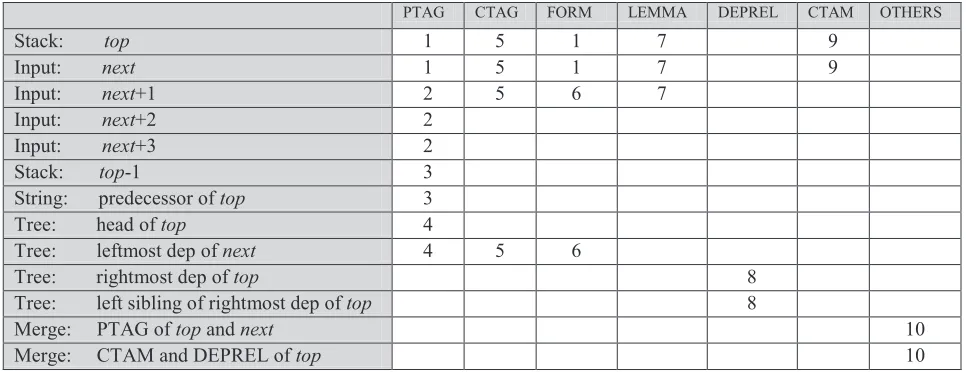
Table 1. Feature pool based on selection from Ambati et al. (2009a) and Nivre (2009b).
Given these two components, dependency parsing can be realized as deterministic search through the transition system, guided by the classifier. With this technique, parsing can be performed in linear time for projective dependency trees. Like Ambati et al. (2009a) and Nivre (2009b), we use MaltPars-er, an open-source implementation of transition-based dependency parsing with a variety of transi-tion systems and customizable classifiers.3
3.1 Transition System
Previous work has shown that the arc-eager projec-tive transition system first described in Nivre (2003) works well for Hindi (Ambati et al., 2009a; Nivre, 2009b). A parser configuration in this sys-tem contains a stack holding partially processed tokens, an input buffer containing the remaining tokens, and a set of arcs representing the partially built dependency tree. There are four possible tran-sitions (where top is the token on top of the stack and next is the next token in the input buffer):
· Left-Arc(r): Add an arc labeled r from next to
top; pop the stack.
· Right-Arc(r): Add an arc labeled r from top to
next; push next onto the stack.
· Reduce: Pop the stack.
· Shift: Push next onto the stack.
Although this system can only derive projective dependency trees, the fact that the trees are labeled
3
MaltParser is available at http://maltparser.org.
allows non-projective dependencies to be captured using the pseudo-projective parsing technique pro-posed in Nivre and Nilsson (2005).
3.2 Classifiers
Classifiers can be induced from treebank data us-ing a wide variety of different machine learnus-ing methods, but all experiments reported below use support vector machines with a polynomial kernel, as implemented in the LIBSVM package (Chang and Lin, 2001) included in MaltParser. The task of the classifier is to map a high-dimensional feature vector representation of a parser configuration to the optimal transition out of that configuration. The features used in our experiments represent the fol-lowing attributes of input tokens:
· PTAG: POS tag of chunk head. · CTAG: Chunk tag.
· FORM: Word form of chunk head. · LEMMA: Lemma of chunk head.
· DEPREL: Dependency relation of chunk. · CTAM: Case and TAM markers of chunk.
The pool of features used in the experiments are shown in Table 1, where rows denote tokens in a parser configuration – defined relative to the stack, the input buffer, the partially built dependency tree and the input string – and columns correspond to attributes. Each non-empty cell represents a fea-ture, and features are numbered for easy reference.
4 Feature Selection Experiments
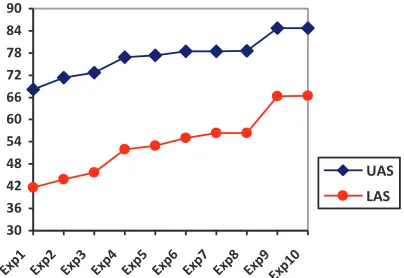
Starting from the union of the feature sets used by Ambati et al. (2009a and by Nivre (2009b), we first used 5-fold cross-validation on the combined training and development sets from the ICON09 tools contest to select the pool of features depicted in Table 1, keeping all features that had a positive effect on both labeled and unlabeled accuracy. We then grouped the features into 10 groups (indicated by numbers 1–10 in Table 1) and reran the cross-validation, incrementally adding different feature groups in order to analyze their impact on parsing accuracy. The result is shown in Figure 1.
30 36 42 48 54 60 66 72 78 84 90
Exp1 Exp2 Exp3 Exp4 Exp5 Exp6 Exp7 Exp8 Exp9Exp1 0
[image:4.612.88.290.361.500.2]UAS LAS
Figure 1. UAS and LAS of experiments 1-10; 5-fold cross-validation on training and development data of the
ICON09 tools contest.
Experiment 1: Experiment 1 uses a baseline
model with only four basic features: PTAG and FORM of top and next. This results in a labeled attachment score (LAS) of 41.7% and an unlabeled attachment score (UAS) of 68.2%.
Experiments 2–3: In experiments 2 and 3, the PTAG of contextual words of next and top are added. Of all the contextual words, next+1,
next+2, next+3, top-1 and predecessor of top were
found to be useful.4 Adding these contextual fea-tures gave a modest improvement to 45.7% LAS and 72.7% UAS.
Experiment 4: In experiment 4, we used the
PTAG information of nodes in the partially built tree, more specifically the syntactic head of top
and the leftmost dependent of next. Using these features gave a large jump in accuracy to 52% LAS and 76.8% UAS. This is because partial in-formation is helpful in making future decisions. For example, a coordinating conjunction can have a node of any PTAG category as its child. But all the children should be of same category. Knowing the PTAG of one child therefore helps in identify-ing other children as well.
Experiments 5–7: In experiments 5, 6 and 7, we explored the usefulness of CTAG, FORM, and LEMMA attributes. These features gave small in-cremental improvements in accuracy; increasing LAS to 56.4% and UAS to 78.5%. It is worth not-ing in particular that the addition of LEMMA attributes only had a marginal effect on accuracy, given that it is generally believed that this type of information should be beneficial for richly in-flected languages.
Experiment 8:In experiment 8, the DEPREL of
nodes in the partially formed tree is used. The rightmost child and the left sibling of the rightmost child of top were found to be useful. This is be-cause, if we know the dependency label of one of the children, then the search space for other child-ren gets reduced. For example, a verb cannot have more than one k1 or k2. If we know that the parser has assigned k1 to one of its children, then it should use different labels for the other children. The overall effect on parsing accuracy is neverthe-less very marginal, bringing LAS to 56.5% and UAS to 78.6%.
Experiment 9: In experiment 9, the CTAM
attribute of top and next is used. This gave by far the greatest improvement in accuracy with a huge jump of around 10% in LAS (to 66.3%) and slightly less in UAS (to 84.7%). Recall that CTAM consists of two important morphosyntactic fea-tures, namely, case markers (as suffixes or postpo-sitions) and TAM markers. These feature help because (a) case markers are important surface
4 The predecessor of top is the word occurring immediately
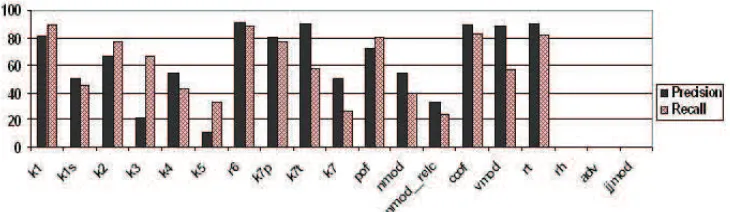
Figure 2. Precision and Recall of some important dependency labels.
cues that help identify various dependency rela-tions, and (b) there exists a direct mapping be-tween many TAM labels and the nominal case markers because TAMs control the case markers of some nominals. As expected, our experiments show that the parsing decisions are certainly more accurate after using these features. In particular, (a) and (b) are incorporated easily in the parsing process.
In a separate experiment we also added some other morphological features such as gender, num-ber and person for each node. Through these fea-tures we expected to capture the agreement in Hindi. The verb agrees in gender, number and per-son with the highest available karaka. However, incorporating these features did not improve pars-ing accuracy and hence these features were not used in the final setting. We will have more to say about agreement in section 5.
Experiment 10: In experiment 10, finally, we
added conjoined features, where the conjunction of POS of next and top and of CTAMand DEPREL of top gaveslight improvements. This is because a child-parent pair type can only take certain labels. For example, if the child is a noun and the parent is a verb, then all the dependency labels reflecting noun, adverb and adjective modifications are not relevant. Similarly, as noted earlier, certain case-TAM combinations demand a particular set of la-bels only. This can be captured by the combination tried in this experiment.
Experiment 10 gave the best results in the cross-validation experiments. The settings from this ex-periment were used to get the final performance on the test data. Table 2 shows the final results along with the results of the first and second best per-forming systems in the ICON09 tools contest. We see that our system achieved an improvement of 2 percentage points in LAS and 1 percentage point in
UAS over the previous state of the art reported in Ambati et al. (2009a).
System LAS UAS
Ambati et al. (2009a) 74.5 90.1
Nivre (2009b) 73.4 89.8
Our system 76.5 91.1
Table 2. Final results on the test data from the ICON09 tools contest.
5 Error Analysis
In this section we provide a detailed error analysis on the test data and suggest possible remedies for problems noted. We note here that other than the reasons mentioned in this section, small treebank size could be another reason for low accuracy of the parser. The training data used for the experi-ments only had ~28.5k words. With recent work on Hindi Treebanking (Bhatt et al., 2009) we expect to get more annotated data in the near future.
Correct Incorrect
k1 k1s k2 pof k7p k7t k7 others
k1 184 5 3 8 3 1 3
k1s 12 6 1 6 1
k2 126 14 1 7 5 11
pof 54 1 8 4
k7p 54 3 7 1 2 3
k7t 27 3 3 3 1 10
[image:6.612.76.297.71.193.2]k7 3 2 2 4
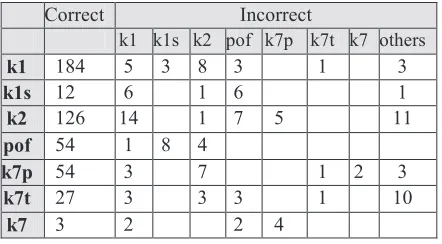
Table 3. Confusion matrix for important labels. The
diagonal under ‘Incorrect’ represents attachment errors.
Table 3 shows the confusion matrix for some important labels in the test data. As the present information available for disambiguation is not sufficient, we can make use of some semantics to resolve these ambiguities. Bharati et al. (2008) and Ambati et al. (2009b) have shown that this ambi-guity can be reduced using minimal semantics. They used six semantic features: human, non-human, in-animate, time, place and abstract. Using these features they showed that k1-k2 and k7p-k7t ambiguities can be resolved to a great extent. Of course, automatically extracting these semantic features is in itself a challenging task, although Øvrelid (2008) has shown that animacy features can be induced automatically from data.
In section 4 we mentioned that a separate expe-riment explored the effectiveness of morphological features like gender, number and person. Counter to our intuitions, these features did not improve the overall accuracy. Accuracies on cross-validated data while using these features were less than the best results with 66.2% LAS and 84.6% UAS. Agreement patterns in Hindi are not straightfor-ward. For example, the verb agrees with k2 if the k1 has a post-position; it may also sometimes take the default features. In a passive sentence, the verb agrees only with k2. The agreement problem wor-sens when there is coordination or when there is a complex verb. It is understandable then that the parser is unable to learn the selective agreement pattern which needs to be followed. Similar prob-lems with agreement features have also been noted by Goldberg and Elhadad (2009).
In the following sections, we analyze the errors due to different constructions and suggest possible remedies.
5.1 Simple Sentences
A simple sentence is one that has only one main verb. In these sentences, the root of the dependen-cy tree is the main verb, which is easily identified by the parser. The main problem is the correct identification of the argument structure. Although the attachments are mostly correct, the dependency labels are error prone. Unlike in English and other more configurational languages, one of the main cues that help us identify the arguments is to be found in the nominal postpositions. Also, as noted earlier these postpositions are many times con-trolled by the TAM labels that appear on the verb. There are four major reasons for label errors in simple sentences: (a) absence of postpositions, (b) ambiguous postpositions, (c) ambiguous TAMs, and (d) inability of the parser to exploit agreement features. For example in (2), raama and phala are arguments of the verb khaata. Neither of them has any explicit case marker. This makes it difficult for the parser to identify the correct label for these nodes. In (3a) and (3b) the case marker se is ambi-guous. It signifies ‘instrument’ in (3b) and ‘agent’ in (3a).
(2) raama phala khaata hai ‘Ram’ ‘fruit’ ‘eat’ ‘is’ ‘Ram eats a fruit’
(3) a. raama se phala khaayaa nahi gaya ‘Ram’ INST ‘fruit’ ‘eat’ ’not’ ‘PAST’ ‘Ram could not eat the fruit’
b. raama chamach se phala khaata hai ‘Ram’ ‘spoon’ INST ‘fruit’ ‘eat’ ‘is’ ‘Ram eats fruit with spoon’
5.2 Embedded Clauses
are two sources of errors here: (a) argument shar-ing, and (b) ambiguous attachment sites.
Some arguments such as place/time nominals can be shared. Shared arguments are assigned to only one verb in the dependency tree. So the task of identifying the shared arguments, if any, and attaching them to the correct parent is a complex task. Note that the dependency labels can be identi-fied based on the morphosyntactic features. The task becomes more complex if there is more than one participle in a sentence. 12 out of 130 in-stances (9.23%) of shared arguments has an incor-rect attachment.
Many participles are ambiguous and making the correct attachment choice is difficult. Similar par-ticiples, depending on the context, can behave as adverbials and attach to a verb, or can behave as adjectives and attach to a noun. Take (4) as a case in point.
(4) maine daurte hue kutte ko dekhaa ‘I’-ERG (while) running dog ACC ‘saw’
In (4) based on how one interprets ‘daurte hue’, one gets either the reading that ‘I saw a running dog’ or that ‘I saw a dog while running’. In case of the adjectival participle construction (VJJ), 2 out of 3 errors are due to wrong attachment.
5.3 Coordination
Coordination poses problems as it often gives rise to long-distance dependencies. Moreover, the tree-bank annotation treats the coordinating conjunction as the head of the coordinated structure. Therefore, a coordinating conjunction can potentially become the root of the entire dependency tree. This is simi-lar to Prague style dependency annotation (Hajico-va, 1998). Coordinating conjunctions pose additional problems in such a scenario as they can appear as the child of different heads. A coordinat-ing conjunction takes children of similar POS cat-egory, but the parent of the conjunction depends on the type of the children.
(5) a. raama aur shyaama ne khaana khaayaa ‘Ram’ ‘and’ ‘Shyam’ ‘ERG’ ‘food’ ‘ate’
‘Ram and Shyam ate the food.’
b. raama ne khaanaa khaayaa aur paanii ‘Ram’ ‘ERG’‘food’ ‘ate’ ‘and’ ‘water’ piyaa
‘drank’
‘Ram ate food and drank water.’
In (5a), raama and shyaama are children of the coordinating conjunction aur, which gets attached to the main verb khaayaa with the label k1. In ef-fect, syntactically aur becomes the argument of the main verb. In (5b), however, the verbs khaayaa
and piyaa are the children of aur. In this case, aur
becomes the root of the sentence. Identifying the nature of the conjunction and its children becomes a challenging task for the parser. Note that the number of children that a coordinating conjunction can take is not fixed either. The parser could iden-tify the correct head of the conjunctions with an accuracy of 75.7% and the correct children with an accuracy of 85.7%.
The nature of the conjunction will also affect the dependency relation it has with its head. For ex-ample, if the children are nouns, then the conjunc-tion behaves as a noun and can potentially be an argument of a verb. By contrast, if the children are finite verbs, then it behaves as a finite verb and can become the root of the dependency tree. Unlike nouns and verbs, however, conjunctions do not have morphological features. So a child-to-head feature percolation should help make a coordinat-ing node more transparent. For example, in (5a) the Ergative case ne is a strong cue for the dependency label k1. If we copy this information from one of its children (here shyaama) to the conjunct, then the parser can possibly make use of this informa-tion.
5.4 Complex Predicates
Complex predicates are formed by combining a noun or an adjective with a verbalizer kar or ho. For instance, in taariif karanaa ‘to praise’, taariif
‘praise’ is a noun and karanaa ‘to do’ is a verb.
identifying pof or misclassifies other labels as pof. In particular, the confusion is with k2 and k1s which are object/theme and noun complements of k1, respectively. These labels share similar contex-tual features like the nominal element in the verb complex. Table 3 includes the confusion matrix for pof errors.
5.5 Non-Projectivity
As noted earlier, MaltParser’s arc-eager parsing algorithm can be combined with the pseudo-projective parsing techniques proposed in Nivre and Nilsson (2005), which potentially helps in identifying non-projective arcs. The Hindi treebank has ~14% non-projective arcs (Mannem et al., 2009a). In the test set, there were a total of 11 non-projective arcs, but the parser did not find any of them. This is consistent with earlier results show-ing that pseudo-projective parsshow-ing has high preci-sion but low recall, especially when the percentage of non-projective relations is small (Nilsson et al, 2007).
Non-projectivity has proven to be one of the ma-jor problems in dependency parsing, especially for free word-order languages. In Hindi, the majority of non-projective arcs are inter-clausal (Mannem et al., 2009a), involving conjunctions and relative clauses. There have been some attempts at han-dling inter-clausal non-projectivity in Hindi. Hu-sain et al. (2009) proposed a two-stage approach that can handle some of the inter-clausal non-projective structures.
5.6 Long-Distance Dependencies
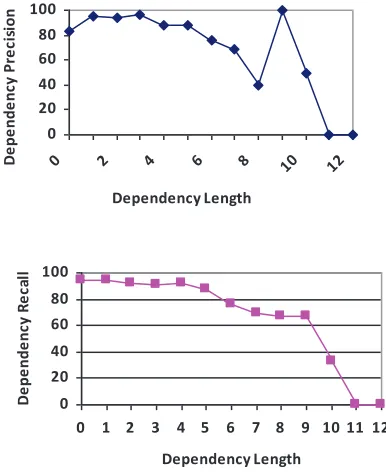
Previous results on parsing other languages have shown that MaltParser has lower accuracy on long-distance dependencies. Our results confirm this. Errors in the case of relative clauses and coordina-tion can mainly be explained in this way. For ex-ample, there are 8 instances of relative clauses in the test data. The system could identify only 2 of them correctly. These two are at a distance of 1 from its parent. For the remaining 6 instances the distance to the parent of the relative clause ranges from 4 to 12.
Figure 3 shows how parser performance de-creases with increasing distance between the head and the dependent. Recently, Husain et al. (2009) have proposed a two-stage setup to parse inter-clausal and intra-inter-clausal dependencies separately.
They have shown that most long distance relations are inter-clausal, and therefore, using such a clause motivated parsing setup helps in maximizing both short distance and long distance dependency accu-racy. In a similar spirit, Gadde et al. (2010) showed that using clausal features helps in identifying long distance dependencies. They have shown that pro-viding clause information in the form of clause boundaries and clausal heads can help a parser make better predictions about long distance depen-dencies.
0 20 40 60 80 100
0 2 4 6 8 10 12
Dependency Length
D
e
p
e
n
d
e
n
c
y
P
re
c
is
io
n
0 20 40 60 80 100
0 1 2 3 4 5 6 7 8 9 10 11 12
Dependency Length
D
e
p
e
n
d
e
n
c
y
R
e
c
a
[image:8.612.327.520.225.461.2]ll
Figure 3. Dependency arc precision/recall relative to dependency length, where the length of a dependency from wi to wj is |i-j| and roots are assumed to have
dis-tance 0 to their head.
6 Conclusion
References
B. R. Ambati, P. Gadde, and K. Jindal. 2009a. Experi-ments in Indian Language Dependency Parsing.
Proc. of ICON09 NLP Tools Contest: Indian Lan-guage Dependency Parsing, 32-37.
B. R. Ambati, P. Gade, C. GSK and S. Husain. 2009b. Effect of Minimal Semantics on Dependency Pars-ing.Proc. of RANLP Student Research Workshop.
R. Begum, S. Husain, A. Dhwaj, D. Sharma, L. Bai, and R. Sangal. 2008. Dependency annotation scheme for Indian languages. Proc. of IJCNLP.
A. Bharati, V. Chaitanya and R. Sangal. 1995. Natural Language Processing: A Paninian Perspective, Pren-tice-Hall of India, New Delhi.
A. Bharati, S. Husain, B. Ambati, S. Jain, D. Sharma, and R. Sangal. 2008. Two semantic features make all the difference in parsing accuracy. Proc. of ICON.
A. Bharati, R. Sangal, D. M. Sharma and L. Bai. 2006. AnnCorra: Annotating Corpora Guidelines for POS and Chunk Annotation for Indian Languages. Tech-nical Report (TR-LTRC-31), LTRC, IIIT-Hyderabad.
A. Bharati, D. M. Sharma, S. Husain, L. Bai, R. Begam and R. Sangal. 2009a. AnnCorra: TreeBanks for In-dian Languages, Guidelines for Annotating Hindi TreeBank.
http://ltrc.iiit.ac.in/MachineTrans/research/tb/DS-guidelines/DS-guidelines-ver2-28-05-09.pdf A. Bharati, S. Husain, D. M. Sharma and R. Sangal.
2009b. Two stage constraint based hybrid approach to free word order language dependency parsing. In Proc. of IWPT.
R. Bhatt, B. Narasimhan, M. Palmer, O. Rambow, D. M. Sharma and F. Xia. 2009. Multi-Representational and Multi-Layered Treebank for Hindi/Urdu. Proc. of the Third LAW at ACL-IJCNLP, 186-189.
M. Butt. 1995. The Structure of Complex Predicates in Urdu. CSLI Publications.
G. Eryigit, J. Nivre, and K. Oflazer. 2008. Dependency Parsing of Turkish. Computational Linguistics 34(3), 357-389.
P. Gadde, K. Jindal, S. Husain, D. M. Sharma, and R. Sangal. 2010. Improving Data Driven Dependency Parsing using Clausal Information. Proc. of NAACL-HLT.
Y. Goldberg and M. Elhadad. 2009. Hebrew Dependen-cy Parsing: Initial Results. Proc. of IWPT, 129-133. E. Hajicova. 1998. Prague Dependency Treebank: From
Analytic to Tectogrammatical Annotation. Proc. of TSD.
J. Hall, J. Nilsson, J. Nivre, G. Eryigit, B. Megyesi, M. Nilsson and M. Saers. 2007. Single Malt or Blended? A Study in Multilingual Parser Optimization. Proc. of EMNLP-CoNLL, 933-939.
S. Husain. 2009. Dependency Parsers for Indian Lan-guages. Proc. of ICON09 NLP Tools Contest: Indian Language Dependency Parsing.
S. Husain, P. Gadde, B. Ambati, D. M. Sharma and R. Sangal. 2009. A modular cascaded approach to com-plete parsing. Proc. of the COLIPS International Conference on Asian Language Processing.
P. Mannem, H. Chaudhry, and A. Bharati. 2009a. In-sights into non-projectivity in Hindi. Proc. of ACL-IJCNLP Student Research Workshop.
P. Mannem, A. Abhilash and A. Bharati. 2009b. LTAG-spinal Treebank and Parser for Hindi. Proceedings of International Conference on NLP, Hyderabad. 2009. R. McDonald, K. Lerman, and F. Pereira. 2006. Multi-lingual dependency analysis with a two-stage discri-minative parser. Proc. of CoNLL, 216-220.
R. McDonald and J. Nivre. 2007. Characterizing the errors of data-driven dependency parsing models.
Proc. of EMNLP-CoNLL, 122-131.
I. A. Mel'Cuk. 1988. Dependency Syntax: Theory and Practice, State University Press of New York. J. Nilsson, J. Nivre and J. Hall. 2007. Generalizing Tree
Transformations for Inductive Dependency Parsing.
Proc. of ACL, 968-975.
J. Nivre. 2008. Algorithms for Deterministic Incremen-tal Dependency Parsing. Computational Linguistics
34(4), 513-553.
J. Nivre and R. McDonald. 2008. Integrating graph-based and transition-graph-based dependency parsers. In
Proceedings of ACL-HLT, pp. 950-958.
J. Nivre. 2009a. Non-Projective Dependency Parsing in Expected Linear Time. Proc. of ACL-IJCNLP, 351-359.
J. Nivre. 2009b. Parsing Indian Languages with Malt-Parser. Proc. of ICON09 NLP Tools Contest: Indian Language Dependency Parsing, 12-18.
J. Nivre, J. Hall, S. Kubler, R. McDonald, J. Nilsson, S. Riedel and D. Yuret. 2007a. The CoNLL 2007 Shared Task on Dependency Parsing. Proc. of EMNLP/CoNLL, 915-932.
J. Nivre, J. Hall, J. Nilsson, A. Chanev, G. Eryigit, S. Kübler, S. Marinov and E Marsi. 2007b. MaltParser: A language-independent system for data-driven de-pendency parsing.NLE, 13(2), 95-135.
L. Øvrelid. 2008. Argument Differentiation. Soft con-straints and data-driven models. PhD Thesis, Uni-versity of Gothenburg.
D. Seddah, M. Candito and B. Crabbé. 2009. Cross parser evaluation: a French Treebanks study. Proc. of IWPT, 150-161.
R. Tsarfaty and K. Sima'an. 2008. Relational-Realizational Parsing. Proc. of CoLing, 889-896. A. Vaidya, S. Husain, P. Mannem, and D. M. Sharma.