Feature Weight Optimization for Discourse-Level SMT
Sara Stymne, Christian Hardmeier, J¨org Tiedemann and Joakim Nivre
Uppsala University
Department of Linguistics and Philology Box 635, 751 26 Uppsala, Sweden [email protected]
Abstract
We present an approach to feature weight optimization for document-level decoding. This is an essential task for enabling future development of discourse-level statistical machine translation, as it allows easy inte-gration of discourse features in the decod-ing process. We extend the framework of sentence-level feature weight optimization to the document-level. We show experi-mentally that we can get competitive and relatively stable results when using a stan-dard set of features, and that this frame-work also allows us to optimize document-level features, which can be used to model discourse phenomena.
1 Introduction
Discourse has largely been ignored in traditional machine translation (MT). Typically each sentence has been translated in isolation, essentially yield-ing translations that are bags of sentences. It is well known from translation studies, however, that discourse is important in order to achieve good translations of documents (Hatim and Mason, 1990). Most attempts to address discourse-level issues for statistical machine translation (SMT) have had to resort to solutions such as post-processing to address lexical cohesion (Carpuat, 2009) or two-step translation to address pronoun anaphora (Le Nagard and Koehn, 2010). Recently, however, we presented Docent (Hardmeier et al., 2012; Hardmeier et al., 2013), a decoder based on local search that translates full documents. So far this decoder has not included a feature weight optimization framework. However, feature weight optimization, or tuning, is important for any mod-ern SMT decoder to achieve a good translation performance.
In previous research with Docent, we used grid search to find weights for document-level features
while base features were optimized using stan-dard sentence-level techniques. This approach is impractical since many values for the extra fea-tures have to be tried, and, more importantly, it might not give the same level of performance as jointly optimizing all parameters. Principled fea-ture weight optimization is thus essential for re-searchers that want to use document-level features to model discourse phenomena such as anaphora, discourse connectives, and lexical consistency. In this paper, we therefore propose an approach that supports discourse-wide features in document-level decoding by adapting existing frameworks for sentence-level optimization. Furthermore, we include a thorough empirical investigation of this approach.
2 Discourse-Level SMT
Traditional SMT systems translate texts sentence by sentence, assuming independence between sen-tences. This assumption allows efficient algo-rithms based on dynamic programming for explor-ing a large search space (Och et al., 2001). Be-cause of the dynamic programming assumptions it is hard to directly include discourse-level features into a traditional SMT decoder. Nevertheless, there have been several attempts to integrate inter-sentential and long distance models for discourse-level phenomena into standard decoders, usually as ad-hoc additions to standard models, address-ing a saddress-ingle phenomenon.
Several studies have tried to improve pro-noun anaphora by adding information about the antecedent, either by using two-step decoding (Le Nagard and Koehn, 2010; Guillou, 2012) or by extracting information from previously trans-lated sentences (Hardmeier and Federico, 2010), unfortunately without any convincing results. To address the translation of discourse connectives, source-side pre-processing has been used to anno-tate surface forms either in the corpus or in the
phrase-table (Meyer and Popescu-Belis, 2012) or by using factored decoding (Meyer et al., 2012) to disambiguate connectives, with small improve-ments. Lexical consistency has been addressed by the use of post-processing (Carpuat, 2009), multi-pass decoding (Xiao et al., 2011; Ture et al., 2012), and cache models (Tiedemann, 2010; Gong et al., 2011). Gong et al. (2012) addressed the issue of tense selection for translation from Chi-nese, by the use of inter-sentential tense n-grams, exploiting information from previously translated sentences. Another way to use a larger context is by integrating word sense disambiguation and SMT. This has been done by re-initializing phrase probabilities for each sentence (Carpuat and Wu, 2007), by introducing extra features in the phrase-table (Chan et al., 2007), or as ak-best re-ranking task (Specia et al., 2008). Another type of ap-proach is to integrate topic modeling into phrase tables (Zhao and Xing, 2010; Su et al., 2012). For a more thorough overview of discourse in SMT, see Hardmeier (2012).
Here we instead choose to work with the re-cent document-level SMT decoder Dore-cent (Hard-meier et al., 2012). Unlike in traditional decod-ing were documents are generated sentence by sentence, feature models in Docent always have access to the complete discourse context, even before decoding is finished. It implements the phrase-based SMT approach (Koehn et al., 2003) and is based on local search, where a state con-sists of a full translation of a document, which is improved by applying a series of operations to im-prove the translation. A hill-climbing strategy is used to find a (local) maximum. The operations allow changing the translation of a phrase, chang-ing the word order by swappchang-ing the positions of two phrases, and resegmenting phrases. The initial state can either be initialized randomly in mono-tonic order, or be based on an initial run from a standard sentence-based decoder. The number of iterations in the decoder is controlled by two pa-rameters, the maximum number of iterations and a rejection limit, which stops the decoder if no change was made in a certain number of iterations. This setup is not limited by dynamic programming constraints, and enables the use of the translated target document to extract features. It is thus easy to directly integrate discourse-level features into Docent. While we use this specific decoder in our experiments, the method proposed for
document-level feature weight optimization is not limited to it. It can be used with any decoder that outputs feature values at the document level.
3 Sentence-Level Tuning
Traditionally, feature weight optimization, or tun-ing, for SMT is performed by an iterative process where a development set is translated to produce a
k-best list. The parameters are then optimized us-ing some procedure, generally to favor translations in the k-best list that have a high score on some MT metric. The translation step is then repeated using the new weights for decoding, and optimiza-tion is continued on a newk-best list, or on a com-bination of all k-best lists. This is repeated until some end condition is satisfied, for instance for a set number of iterations, until there is only very small changes in parameter weights, or until there are no new translations in thek-best lists.
SMT tuning is a hard problem in general, partly because the correct output is unreachable and also because the translation process includes la-tent variables, which means that many efficient standard optimization procedures cannot be used (Gimpel and Smith, 2012). Nevertheless, there are a number of techniques including MERT (Och, 2003), MIRA (Chiang et al., 2008; Cherry and Foster, 2012), PRO (Hopkins and May, 2011), and Rampion (Gimpel and Smith, 2012). All of these optimization methods can be plugged into the standard optimization loop. All of the meth-ods work relatively well in practice, even though there are limitations, for instance that many meth-ods are non-deterministic meaning that their re-sults are somewhat unstable. However, there are some important differences. MERT is based on scores for the full test set, whereas the other meth-ods are based on sentence-level scores. MERT also has the drawback that it only works well for small sets of features. In this paper we are not concerned with the actual optimization algorithm and its properties, though, but instead we focus on the integration of document-level decoding into the existing optimization frameworks.
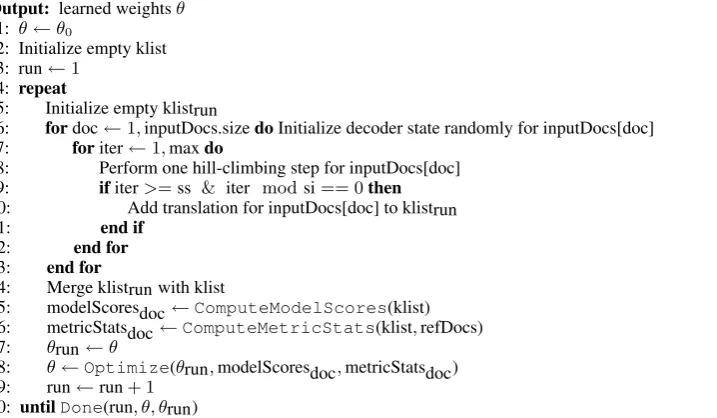
Input: inputDocs, refDocs, init weightsθ0, max decoder iters max, sample start ss, sample interval si,
Output: learned weightsθ 1: θ←θ0
2: Initialize empty klist 3: run←1
4: repeat
5: Initialize empty klistrun
6: fordoc←1,inputDocs.sizedoInitialize decoder state randomly for inputDocs[doc] 7: foriter←1,maxdo
8: Perform one hill-climbing step for inputDocs[doc] 9: ifiter>=ss & iter modsi== 0then 10: Add translation for inputDocs[doc] to klistrun
11: end if
12: end for
13: end for
14: Merge klistrun with klist
15: modelScoresdoc←ComputeModelScores(klist) 16: metricStatsdoc←ComputeMetricStats(klist,refDocs) 17: θrun←θ
18: θ←Optimize(θrun,modelScoresdoc,metricStatsdoc) 19: run←run+ 1
[image:3.595.78.437.72.281.2]20: untilDone(run, θ, θrun)
Figure 1: Document-level feature weight optimization algorithm
straightforward in our hill-climbing decoder as in standard sentence-level decoders such as Moses (Koehn et al., 2007) where such a list can be ap-proximated easily from the internal beam search strategy. Working on output lattices is another op-tion in standard approaches (Cherry and Foster, 2012) which is also not applicable in our case.
In the following section we describe how we can address these issues in order to adapt sentence-level frameworks for our purposes.
4 Document-Level Tuning
To allow document-level feature weight optimiza-tion, we make some small changes to the sentence-level framework. Figure 1 shows the algorithm we use. It assumes access to an optimization algo-rithm, Optimize, and an end criterion, Done. The changes from standard sentence-level opti-mization is that we compute scores on the docu-ment level, and that we sample translations instead of using standardk-best lists.
The main challenge is that we need meaning-ful scores which we do not have at the sentence level in document decoding. We handle this by simply computing all scores (model scores and metric scores) exclusively at the document level. Remember that all standard MT metrics based on sentence-level comparisons with reference trans-lations can be aggregated for a complete test set. Here we do the same for all sentences in a given document. This can actually be an advantage com-pared to optimization methods that use
sentence-level scores, which are known to be unreliable (Callison-Burch et al., 2012). Document-level scores should thus be more stable, since they are based on more data. A potential drawback is that we get fewer data points with a test set of the same size, which might mean that we need more data to achieve as good results as with sentence-level op-timization. We will see the ability of our approach to optimize weights with reasonable data sets in our experiments further down.
The second problem, the extraction of k-best lists can be addressed in several ways. It is pos-sible to get ak-best list from Docent by extract-ing the results from the lastkiterations. However, since Docent operates on the document-level and does not accept updates in each iteration, there will be many identical and/or very similar hypotheses with such an approach. Another option would be to extract the translations from the k last differ-ent iterations, which would require some small changes to the decoder. Instead, we opt to usek -lists, lists of translations sampled with some inter-val, which containsktranslations, but not neces-sarily all thekbest translations that could be found by the decoder. Ak-best list is of course ak-list, which we get with a sample interval of 1.
German–English English–Swedish
Type Sentences Documents Type Sentences Documents
Training Europarl 1.9M – Europarl 1.5M –
News Commentary 178K – – – –
Tuning News2009 2525 111 Europarl (Moses) 2000 –
News2008-2010 7567 345 Europarl (Docent) 1338 100
[image:4.595.97.500.62.137.2]Test News2012 3003 99 Europarl 690 20
Table 1: Domain and number of sentences and documents for the corpora
As seen in Figure 1, there are some additional parameters in our procedure: the sample start iter-ation and the sample interval. We also need to set the number of decoder iterations to run. In Sec-tion 5 we empirically investigate the effect of these parameters.
Compared to sentence-level optimization, we also have a smaller number of units to get scores from, since we use documents as units, and not sentences. The importance of this depends on the optimization algorithm. MERT calculates metric scores over the full tuning set, not for individual sentences, and should not be affected too much by the change in granularity. Many other opti-mization algorithms, like PRO, work on the sen-tence level, and will likely be more affected by the reduction of units. In this work we focus on MERT, which is the most commonly used opti-mization procedure in the SMT community, and which tends to work quite well with relatively few features. However, we also show contrastive re-sults for PRO (Hopkins and May, 2011). A fur-ther issue is that Docent is non-deterministic, i.e., it can give different results with the same param-eter weights. Since the optimization process is al-ready somewhat unstable this is a potential issue that needs to be explored further, which we do in Section 5.
Implementation-wise we adapted Docent to out-putk-lists and adapted the infrastructure available for tuning in the Moses decoder (Koehn et al., 2007) to work with document-level scores. This setup allows us to use the variety of optimization procedures implemented there.
5 Experiments
In this section we report experimental results where we investigate several issues in connec-tion with document-level feature weight optimiza-tion for SMT. We first describe the experimental setup, followed by baseline results using sentence-level optimization. We then present validation ex-periments with standard sentence-level features,
which can be compared to standard optimization. Finally, we report results with a set of document-level features that have been proposed for joint translation and text simplification (Stymne et al., 2013).
5.1 Experimental Setup
Most of our experiments are for German-to-English news translation using data from the WMT13 workshop.1 We also show results with document-level features for English-to-Swedish Europarl (Koehn, 2005). The size of the training, tuning, and test sets are shown in Table 1. First of all, we need to extract documents for tuning and testing with Docent. Fortunately, the news data al-ready contain document markup, corresponding to individual news articles. For Europarl we define a document as a consecutive sequence of utterances from a single speaker. To investigate the effect of the size of the tuning set, we used different subsets of the available tuning data.
All our document-level experiments are car-ried out with Docent but we also contrast with the Moses decoder (Koehn et al., 2007). For the purpose of comparison, we use a standard set of sentence-level features used in Moses in most of our experiments: five translation model features, one language model feature, a distance-based re-ordering penalty, and a word count feature. For feature weight optimization we also apply the standard settings in the Moses toolkit. We opti-mize towards the Bleu metric, and optimization ends either when no weights are changed by more than 0.00001, or after 25 iterations. MERT is used unless otherwise noted.
Except for one of our baselines, we always run Docent with random initialization. For test we run the document decoder for a maximum of227 iter-ations with a rejection limit of 100,000. In our experiments, the decoder always stopped when reaching the rejection limit, usually between 1–5
million iterations.
We show results on the Bleu (Papineni et al., 2002) and NIST (Doddington, 2002) metrics. For German–English we show the average result and standard deviation of three optimization runs, to control for optimizer instability as proposed by Clark et al. (2011). For English–Swedish we re-port results on single optimization runs, due to time constraints.
5.2 Baselines
Most importantly, we would like to show the effec-tiveness of the document-level tuning procedure described above. In order to do this, we created a baseline using sentence-level optimization with a tuning set of 2525 sentences and the News2009 corpus for evaluation. Increasing the tuning set is known to give only modest improvements (Turchi et al., 2012; Koehn and Haddow, 2012).
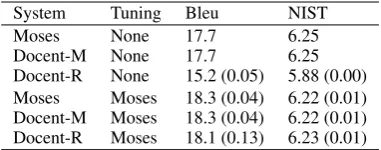
The feature weights optimized with the stan-dard Moses decoder can then directly be used in our document-level decoder as we only include sentence-level features in our baseline model. As expected, these optimized weights also lead to a better performance in document-level decoding compared to an untuned model as shown in Ta-ble 2. Note, that Docent can be initialized in two ways, by Moses and randomly. Not surpris-ingly, the result for the runs initialized with Moses are identical with the pure sentence-level decoder. Initializing randomly gives a slightly lower Bleu score but with a larger variation than with Moses initialization, which is also expected. Docent is non-deterministic, and can give somewhat varying results with the same weights. However, this vari-ation has been shown experimentally to be very small (Hardmeier et al., 2012).
Our goal now is to show that document-level tuning can perform equally well in order to verify our approach. For this, we set up a series of ex-periments looking at varying tuning sets and dif-ferent parameters of the decoding and optimiza-tion procedure. With this we like to demonstrate the stability of the document-level feature weight optimization approach presented above. Note that the most important baselines for comparison with the results in the next sections are the ones with Docent and random initialization.
5.3 Sentence-Level Features
In this section we present validation results where we investigate different aspects of
document-System Tuning Bleu NIST
Moses None 17.7 6.25
Docent-M None 17.7 6.25
[image:5.595.320.511.62.137.2]Docent-R None 15.2 (0.05) 5.88 (0.00) Moses Moses 18.3 (0.04) 6.22 (0.01) Docent-M Moses 18.3 (0.04) 6.22 (0.01) Docent-R Moses 18.1 (0.13) 6.23 (0.01) Table 2: Baseline results, where Docent-M is ini-tialized with Moses and Docent-R randomly
Docs Sent. Min Max Bleu NIST
111 2525 3 127 18.0 (0.11) 6.19 (0.04) 345 7567 3 127 18.1 (0.14) 6.25 (0.02) 100 1921 8 40 18.0 (0.05) 6.25 (0.10) 200 3990 8 40 17.9 (0.25) 6.20 (0.09) 100 2394 8 100 18.0 (0.12) 6.27 (0.07) 200 4600 8 100 18.1 (0.29) 6.26 (0.10) 300 6852 8 100 18.2 (0.13) 6.27 (0.03)
Table 3: Results for German–English with varying sizes of tuning set, where the number of sentences and documents are varied, as well as the minimum and maximum number of sentences per document
level feature weight optimization with standard sentence-level features. In this way we can com-pare the results directly to standard sentence-level optimization, and to the results of Moses.
Corpus size We investigate how tuning is af-fected by corpus size. The corpus size was var-ied in two ways, by changing the number of docu-ments in the tuning set, and by changing the length of documents in the tuning sets. In this exper-iment we run 20000 decoder iterations per opti-mization iteration, and use a k-list of size 101, with sample interval 100. Table 3 shows the re-sults with varying tuning set sizes for German– English. There is very little variation between the scores, and no clear tendencies. All results are of similar quality to the baseline with random initial-ization and sentence-level tuning, and better than not using any tuning. The top line in Table 3 is News2009, the same tuning set as for the base-lines. The scores are somewhat more unstable than the baseline scores, but stability is not related to corpus size. In the following sections we will use the tuning set with 200 documents, size 8-40.
[image:5.595.304.529.183.270.2]Iterations K-list UTK Bleu NIST 20000 101 55.6 17.9 (0.25) 6.20 (0.09) 30000 201 67.2 17.9 (0.06) 6.21 (0.01) 40000 301 79.9 18.2 (0.11) 6.28 (0.09) 50000 401 86.9 18.1 (0.20) 6.22 (0.05) 75000 651 99.2 17.8 (0.15) 6.13 (0.03) 100000 901 106.8 17.9 (0.17) 6.16 (0.03) 30000 101 21.6 18.0 (0.15) 6.21 (0.02) 40000 101 12.6 17.7 (0.53) 6.12 (0.15) 50000 101 8.2 17.9 (0.24) 6.18 (0.06) Table 4: Results for German–English with a vary-ing number of iterations and k-list size (UTK is the average number of unique translations per doc-ument in thek-lists)
quality of the translations in each optimization it-eration, and the spread in thek-list. We will report the average number of unique translations per doc-ument in the k-lists, UTK, during feature weight optimization, in this section.
The top half of Table 4 shows results with a different number of iterations, when we sample
k-lists from iteration 10000 with interval 100 for German–English, which means that the size of the
k-lists also changes. The differences on MT met-rics are very small. The number of new unique translations in thek-lists decrease with the number of decoder iterations. With 20K iterations, 55% of the k-lists entries are unique, which could be compared to only 12% with 100K iterations. The majority of the unique translations are thus found in the beginning of the decoding, which is not sur-prising.
The bottom half of Table 4 shows results with a different number of decoder iterations, but a set
k-list size. In this setting the number of unique hypotheses in thek-lists obviously decreases with the number of decoder iterations. Despite this, there are mostly small result differences, except for 40K iterations, which has more unstable results than the other settings. It does not seem useful to increase the number of decoder iterations without also increasing the size of thek-list. An even bet-ter strategy might be to only include unique entries in thek-lists. We will explore this in future work.
We also ran experiments where we did not restart the decoder with a random state in each iter-ation, but instead saved the previous state and con-tinued decoding with the new weights from there. This, however, was largely unsuccessful, and gave very low scores. We believe that the reason for this is mainly that a much smaller part of the search space is explored when the decoder is not restarted
[image:6.595.309.522.62.116.2]Interval Start UTK Bleu NIST 1 19900 1.4 18.2 (0.07) 6.25 (0.04) 10 19000 5.2 18.1 (0.08) 6.22 (0.03) 100 10000 55.6 17.9 (0.25) 6.20 (0.09) 200 0 82.2 17.9 (0.19) 6.15 (0.05) Table 5: Results with differentk-list-sample inter-vals fork-lists size 101 (UTK is the average num-ber of unique translations per document in thek -lists)
with a new seed repeatedly. The fact that a higher overall quality can be achieved with a higher num-ber of iterations (see Figure 2) can apparently not compensate for this drawback.
Finally, we investigate the effect of the sam-ple interval for thek-lists. To get k-lists of equal size, 101, we start the sampling at different itera-tions. Table 5 shows the results, and we can see that with a small sample interval, the number of unique translations decreases drastically. Despite this, there are no large result differences. There is actually a slight trend that a smaller sample in-terval is better. This does not confirm our intuition that it is important with many different translations in thek-list. Especially for interval 1 it is surpris-ing, since there is often only 1 unique translation for a single document. We believe that the fact that
k-lists from different iterations are joined, can be part of the explanation for these results. We think more work is needed in the future, to further ex-plore these settings, and the interaction with the total number of decoder iteration, and the k-list sampling.
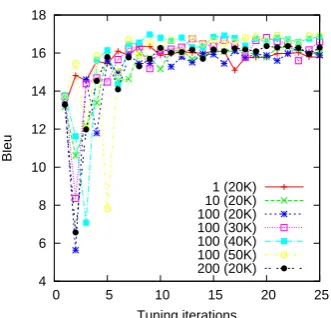
To further shed some light to these results, we show learning curves from the optimization. Fig-ure 2 shows Bleu scores for the system optimized with 100K decoder iterations after different num-bers of iterations, for the last three iterations in each of the three optimization runs. As shown in Hardmeier et al. (2012), the translation quality in-creases fast at first, but start to level out at around 40K iterations. Despite this, the optimization re-sults are good even with 20K iterations, which is somewhat surprising. Figures 3 and 4 show the Bleu scores after each tuning iteration for the sys-tems in Tables 4 and 5. As is normal for SMT tun-ing, the convergence is slow, and there are some oscillations even late in the optimization. Over-all systems with many iterations seem somewhat more stable.
14 14.5 15 15.5 16 16.5 17 17.5
10 20 30 40 50 60 70 80 90 100
Bleu
[image:7.595.306.472.66.225.2]Decoder iterations (*1000) 1-23 1-24 1-25 2-23 2-24 2-25 3-23 3-24 3-25
Figure 2: Bleu scores during 100000 Docent iter-ations during feature weight optimization
4 6 8 10 12 14 16 18
0 5 10 15 20 25
Bleu
[image:7.595.72.237.71.223.2]Tuning iterations 20K 30K 40K 50K 75K 100K
Figure 3: Bleu scores during feature weight opti-mization for systems with different number of de-coder iterations andk-list sizes.
baseline and on par with the sentence-level tuning baselines in all settings, with a relatively modest variation, even across settings. In fact, if we cal-culate the total scores of all 36 systems in Tables 4 and 5, we get a Bleu score of 18.0 (0.23) and a NIST score of 6.19 (0.07), with a variation that is not higher than for many of the different settings.
Optimization method In this section we com-pare the performance of the MERT optimiza-tion algorithm with that of PRO, and a combi-nation that starts MERT with weights initialized with PRO (MERT+PRO), suggested by Koehn and Haddow (2012). Here we run 30000 decoder it-erations. Table 6 shows the results. Initializing MERT with PRO did not affect the scores much. The scores with only PRO, however, are slightly lower than for MERT, and have a much larger score variation. This could be because PRO is
4 6 8 10 12 14 16 18
0 5 10 15 20 25
Bleu
Tuning iterations 1 (20K) 10 (20K) 100 (20K) 100 (30K) 100 (40K) 100 (50K) 200 (20K)
Figure 4: Bleu scores during feature weight opti-mization for systems with different k-list sample interval and number of decoder iterations.
Bleu NIST
MERT 17.9 (0.06) 6.21 (0.01) PRO 17.5 (0.41) 6.15 (0.20) MERT+PRO 18.0 (0.12) 6.18 (0.06)
Table 6: Results with different optimization algo-rithms for German–English
likely to need more data, since it calculates met-ric scores on individual units, sentences or docu-ments, not across the full tuning set, like MERT. This likely means that 200 documents are too few for stable results with optimization methods that depend on unit-level metric scores.
5.4 Document-Level Features
In this section we investigate the effect of opti-mization with a number of document-level fea-tures. We use a set of features proposed in Stymne et al. (2013), in order to promote the readability of texts. In this scenario, however, we use these features in a standard SMT setting, where they can potentially improve the lexical consistency of translations. The features are:
• Type token ratio (TTR) – the ratio of types, unique words, to tokens, total number of words
• OVIX – a reformulation of TTR that has tra-ditionally been used for Swedish and that is less sensible to text length than TTR, see Eq. 1
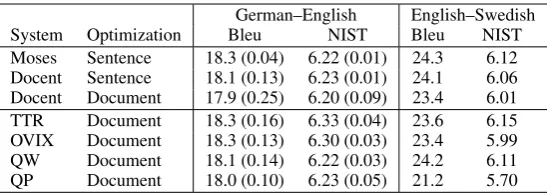
[image:7.595.72.237.286.442.2]German–English English–Swedish System Optimization Bleu NIST Bleu NIST Moses Sentence 18.3 (0.04) 6.22 (0.01) 24.3 6.12 Docent Sentence 18.1 (0.13) 6.23 (0.01) 24.1 6.06 Docent Document 17.9 (0.25) 6.20 (0.09) 23.4 6.01 TTR Document 18.3 (0.16) 6.33 (0.04) 23.6 6.15 OVIX Document 18.3 (0.13) 6.30 (0.03) 23.4 5.99 QW Document 18.1 (0.14) 6.22 (0.03) 24.2 6.11 QP Document 18.0 (0.10) 6.23 (0.05) 21.2 5.70 Table 7: Results when using document-level features
the phrase pair,n(s)is the number of unique target phrases which the source phrase is aligned to in the document, and n(t) is the same for the target phrase. Here the Q-value is applied on the phrase level.
• Q-value, word level (QW) - Same as above, but here we apply the Q-value for source words and their alignments on the target side.
OVIX= log(count(tokens)) log
2− log(count(types)) log(count(tokens))
(1)
Q-value= f(st)
n(s) +n(t) (2)
We added these features one at a time to the standard feature set. Optimization was performed with 20000 decoder iterations, and ak-list of size 101. As shown in the previous sections, there are slightly better settings, which could have been used to boost the results somewhat.
The results are shown in Table 7. For German– English, the results are generally on par with the baselines for Bleu and slightly higher on NIST for OVIX and TTR. For English–Swedish, we used a smaller tuning set on the document level than on the sentence level, see Table 1, due to time con-straints. This is reflected in the scores, which are generally lower than for sentence-level decoding. Using the QW feature, however, we receive com-petitive scores to the sentence-based baselines, which indicates that it can be meaningful to use document-level features with the suggested tuning approach.
While the results do not improve much over the baselines, these experiments still show that we can optimize discourse-level features with our approach. We need to identify more useful document-level features in future work, however.
6 Conclusion
We have shown how the standard feature weight optimization workflow for SMT can be adapted to
document-level decoding, which allows easy inte-gration of discourse-level features into SMT. We modified the standard framework by calculating scores on the document-level instead of the sen-tence level, and by usingk-lists rather thank-best lists.
Experimental results show that we can achieve relatively stable results, on par with the results for sentence-level optimization and better than with-out tuning, with standard features. This is spite the fact that we use the hill-climbing de-coder without initialization by a standard dede-coder, which means that it is somewhat unstable, and is not guaranteed to find any global maximum, even according to the model. We also show that we can optimize document-level features success-fully. We investigated the effect of a number of parameters relating to tuning set size, the number of decoder iterations, andk-list sampling. There were generally small differences relating to these parameters, however, indicating that the suggested approach is robust. The interaction between pa-rameters does need to be better explored in future work, and we also want to explore better sampling, without duplicate translations.
This is the first attempt of describing and exper-imentally investigating feature weight optimiza-tion for direct document-level decoding. While we show the feasibility of extending sentence-level optimization to the document level, there is still much more work to be done. We would, for in-stance, like to investigate other optimization pro-cedures, especially for systems with a high num-ber of features. Most importantly, there is a large need for the development of useful discourse-level features for SMT, which can now be optimized.
Acknowledgments
References
Chris Callison-Burch, Philipp Koehn, Christof Monz, Matt Post, Radu Soricut, and Lucia Specia. 2012. Findings of the 2012 workshop on statistical
ma-chine translation. In Proceedings of the Seventh
Workshop on Statistical Machine Translation, pages 10–51, Montr´eal, Canada.
Marine Carpuat and Dekai Wu. 2007. Improving sta-tistical machine translation using word sense
disam-biguation. In Proceedings of the 2007 Joint
Con-ference on Empirical Methods in Natural Language Processing and Computational Natural Language Learning, pages 61–72, Prague, Czech Republic.
Marine Carpuat. 2009. One translation per discourse. InProceedings of the Workshop on Semantic Evalu-ations: Recent Achievements and Future Directions (SEW-2009), pages 19–27, Boulder, Colorado.
Yee Seng Chan, Hwee Tou Ng, and David Chiang. 2007. Word sense disambiguation improves statisti-cal machine translation. InProceedings of the 45th Annual Meeting of the ACL, pages 33–40, Prague, Czech Republic.
Colin Cherry and George Foster. 2012. Batch tuning strategies for statistical machine translation. In Pro-ceedings of the 2012 Conference of the North Amer-ican Chapter of the Association for Computational Linguistics: Human Language Technologies, pages 427–436, Montr´eal, Canada.
David Chiang, Yuval Marton, and Philip Resnik. 2008. Online large-margin training of syntactic and struc-tural translation features. InProceedings of Human Language Technologies: The 2008 Annual Con-ference of the NAACL, pages 224–233, Honolulu, Hawaii.
Jonathan H. Clark, Chris Dyer, Alon Lavie, and Noah A. Smith. 2011. Better hypothesis testing for statistical machine translation: Controlling for op-timizer instability. InProceedings of the 49th An-nual Meeting of the ACL: Human Language Tech-nologies, pages 176–181, Portland, Oregon, USA.
Louise Del´eger, Magnus Merkel, and Pierre
Zweigen-baum. 2006. Enriching medical terminologies:
an approach based on aligned corpora. In
Inter-national Congress of the European Federation for Medical Informatics, pages 747–752, Maastricht, The Netherlands.
George Doddington. 2002. Automatic evaluation
of machine translation quality using n-gram
co-occurence statistics. In Proceedings of the
Sec-ond International Conference on Human Language Technology, pages 228–231, San Diego, California, USA.
Kevin Gimpel and Noah A. Smith. 2012.
Struc-tured ramp loss minimization for machine
transla-tion. In Proceedings of the 2012 Conference of
the NAACL: Human Language Technologies, pages 221–231, Montr´eal, Canada.
Zhengxian Gong, Min Zhang, and Guodong Zhou. 2011. Cache-based document-level statistical
ma-chine translation. InProceedings of the 2011
Con-ference on Empirical Methods in Natural Language Processing, pages 909–919, Edinburgh, Scotland, UK.
Zhengxian Gong, Min Zhang, Chew Lim Tan, and Guodong Zhou. 2012. N-gram-based tense models for statistical machine translation. In Proceedings of the 2012 Joint Conference on Empirical Meth-ods in Natural Language Processing and Computa-tional Natural Language Learning, pages 276–285, Jeju Island, Korea.
Liane Guillou. 2012. Improving pronoun translation for statistical machine translation. InProceedings of the EACL 2012 Student Research Workshop, pages 1–10, Avignon, France.
Christian Hardmeier and Marcello Federico. 2010.
Modelling pronominal anaphora in statistical
ma-chine translation. In Proceedings of the
Interna-tional Workshop on Spoken Language Translation, pages 283–289, Paris, France.
Christian Hardmeier, Joakim Nivre, and J¨org Tiede-mann. 2012. Document-wide decoding for
phrase-based statistical machine translation. In
Proceed-ings of the 2012 Joint Conference on Empiri-cal Methods in Natural Language Processing and Computational Natural Language Learning, pages 1179–1190, Jeju Island, Korea.
Christian Hardmeier, Sara Stymne, J¨org Tiedemann, and Joakim Nivre. 2013. Docent: A document-level decoder for phrase-based statistical machine
transla-tion. InProceedings of the 51st Annual Meeting of
the ACL, Demonstration session, Sofia, Bulgaria.
Christian Hardmeier. 2012. Discourse in statistical machine translation: A survey and a case study. Dis-cours, 11.
Basil Hatim and Ian Mason. 1990. Discourse and the
Translator. Longman, London, UK.
Mark Hopkins and Jonathan May. 2011. Tuning as
ranking. InProceedings of the 2011 Conference on
Empirical Methods in Natural Language Process-ing, pages 1352–1362, Edinburgh, Scotland.
Philipp Koehn and Barry Haddow. 2012. Towards
effective use of training data in statistical machine translation. InProceedings of the Seventh Workshop on Statistical Machine Translation, pages 317–321, Montr´eal, Canada.
Philipp Koehn, Hieu Hoang, Alexandra Birch, Chris Callison-Burch, Marcello Federico, Nicola Bertoldi, Brooke Cowan, Wade Shen, Christine Moran, Richard Zens, Chris Dyer, Ondrej Bojar, Alexandra Constantin, and Evan Herbst. 2007. Moses: Open source toolkit for statistical machine translation. In
Proceedings of the 45th Annual Meeting of the ACL, Demo and Poster Sessions, pages 177–180, Prague, Czech Republic.
Philipp Koehn. 2005. Europarl: A parallel corpus
for statistical machine translation. In Proceedings of MT Summit X, pages 79–86, Phuket, Thailand.
Ronan Le Nagard and Philipp Koehn. 2010. Aiding pronoun translation with co-reference resolution. In
Proceedings of the Joint Fifth Workshop on Statis-tical Machine Translation and MetricsMATR, pages 252–261, Uppsala, Sweden.
Thomas Meyer and Andrei Popescu-Belis. 2012. Us-ing sense-labeled discourse connectives for statisti-cal machine translation. InProceedings of the Joint Workshop on Exploiting Synergies between Informa-tion Retrieval and Machine TranslaInforma-tion (ESIRMT) and Hybrid Approaches to Machine Translation (HyTra), pages 129–138, Avignon, France.
Thomas Meyer, Andrei Popescu-Belis, Najeh Hajlaoui, and Andrea Gesmundo. 2012. Machine translation of labeled discourse connectives. InProceedings of the 10th Biennial Conference of the Association for Machine Translation in the Americas, San Diego, California, USA.
Franz Josef Och, Nicola Ueffing, and Hermann Ney. 2001. An efficient A* search algorithm for
Statisti-cal Machine Translation. InProceedings of the ACL
2001 Workshop on Data-Driven Machine Transla-tion, pages 55–62, Toulouse, France.
Franz Josef Och. 2003. Minimum error rate training in statistical machine translation. InProceedings of the 42nd Annual Meeting of the ACL, pages 160– 167, Sapporo, Japan.
Kishore Papineni, Salim Roukos, Todd Ward, and Wei-Jing Zhu. 2002. BLEU: A method for automatic
evaluation of machine translation. In Proceedings
of the 40th Annual Meeting of the ACL, pages 311– 318, Philadelphia, Pennsylvania, USA.
Lucia Specia, Baskaran Sankaran, and Maria das Grac¸as Volpe Nunes. 2008. N-best reranking for the efficient integration of word sense disambigua-tion and statistical machine transladisambigua-tion. In Proceed-ings of the 9th International Conference on Intelli-gent Text Processing and Computational Linguistics (CICLING), pages 399–410, Haifa, Israel.
Sara Stymne, J¨org Tiedemann, Christian Hardmeier, and Joakim Nivre. 2013. Statistical machine trans-lation with readability constraints. InProceedings of the 19th Nordic Conference on Computational Linguistics (NODALIDA’13), pages 375–386, Oslo, Norway.
Jinsong Su, Hua Wu, Haifeng Wang, Yidong Chen, Xiaodong Shi, Huailin Dong, and Qun Liu. 2012. Translation model adaptation for statistical machine translation with monolingual topic information. In
Proceedings of the 50th Annual Meeting of the ACL, pages 459–468, Jeju Island, Korea.
J¨org Tiedemann. 2010. Context adaptation in statisti-cal machine translation using models with
exponen-tially decaying cache. In Proceedings of the ACL
2010 Workshop on Domain Adaptation for Natural Language Processing (DANLP), pages 8–15, Upp-sala, Sweden.
Marco Turchi, Tijl De Bie, Cyril Goutte, and Nello Cristianini. 2012. Learning to translate: A statis-tical and computational analysis. Advances in Arti-ficial Intelligence, 2012. Article ID 484580.
Ferhan Ture, Douglas W. Oard, and Philip Resnik. 2012. Encouraging consistent translation choices. In Proceedings of the 2012 Conference of the NAACL: Human Language Technologies, pages 417–426, Montr´eal, Canada.
Tong Xiao, Jingbo Zhu, Shujie Yao, and Hao Zhang.
2011. Document-level consistency verification in
machine translation. InProceedings of MT Summit
XIII, pages 131–138, Xiamen, China.
Bing Zhao and Eric P. Xing. 2010. HM-BiTAM: Bilin-gual topic exploration, word alignment,and
transla-tion. InAdvances in Neural Information Processing