Proceedings of the Second International Conference on Dependency Linguistics (DepLing 2013), pages 207–216,
Grammatical markers and grammatical relations
in the simple clause in Old French
Nicolas Mazziotta
Universität Stuttgart
Institut für Linguistik/Romanistik
Germany
[email protected]
Abstract
The focus of this paper is the descrip-tion of the surface syntax reladescrip-tions in the simple clause in Old French and the way they can be described in a dependency grammar. The declension system of Old French is not reliable enough to cope with the identification of the dependents of the main verb, but it remains true that related grammatical markers are still observable and obey rules that forbid them to appear in specific syntactic positions.
This study relies on three previous ac-counts; Igor Mel’ˇcuk’s “criteria B”, the criteria that are used to determine which is the syntactic governor in a syntactic de-pendency relation, Thomas Groß’s intra-word analysis, which grants morphs node status in the tree, and the concept of speci-ficationas used by Alain Lemaréchal, who understands grammatical markers as a set of formal constraints that stack over a re-lation.
I demonstrate that the structure of the nominal dependents of the verb is highly unstable, ranging from explicit marking of the relation to constructions that do not make use of any segmental marker: some structures use bound morphemes, some others use free morphemes and some use only semantic features to express the rela-tions. Moreover, markers are mainly op-tional and can stack up in a hierarchical way, which results in variable structural organization of the nominal phrase.
1 Introduction
This paper investigates the grammatical markers at work in the structure of the simple clause in Old French (henceforth “OF”) and the way they can be
described in a dependency framework (henceforth “DF”). As an introduction, I will first give a quick overview of OF (1.1), and define the focus of this study (1.2).
1.1 Old French: an overview
The term Old French roughly corresponds to a continuum of romance varieties that were spoken in the northern half of France, in Wallonia and in England during the Middle Ages (9th-13th C.). To carry on a description of OF, one has to sys-tematize the common ground that all these idioms share as well as the major differences that distin-guish the varieties. The paper will focus on that common ground, which can be seen as the direct ancestor of modern French.
From a grammatical point of view, OF is much more analytic than Latin is: many relations are in-troduced by prepositions. The traditional descrip-tion of the nominal inflecdescrip-tion tells us that Latin declension had shrunk in OF to a simple two-fold opposition between the nominative (Fr. cas su-jet) and a universal oblique case (Fr. cas régime). Periphrastic verbal tenses had developed and the whole aspectual system had changed; the system had become clearly dominated by the opposition between bare forms and compound verbs (express-ing aspectual/temporal anteriority).
The distribution of the major constituents of the clause tends to express information-structural properties rather than grammatical ones. There-fore, word order was a lot freer than it is in modern French.
1.2 Question
Others have demonstrated that the declension sys-tem of OF is not reliable enough to cope with the identification of dependents1of the verb. Several
1In the remainder of this paper, when no additional
pre-cision is given, the termsdependency,governor,dependent, actant,tree, etc. as well as the→symbol between a governor
studies have shown: 1/ that the valence of the verb as well as the semantic properties of the actants are more important than the declension patterns (Schøsler, 1984); 2/ that the declension pattern is so heterogeneous that it cannot be described as a systematic tool (Chambon, 2003; Chambon and Davidsdottir, 2007); 3/ that case markers are an ad-ditional mean to express dependencies that would exist without them.2
General grammatical descriptions acknowledge these conclusions, but still deliver long lists of ta-bles describing the different “paradigms” (Buri-dant, 2000).
As unreliable as declension is, it is neverthe-less a fact that related grammatical markers are still observable and appear to obey at least some rules. These rules ensure that declension is well integrated with the rest of the grammar, which is invoked as a whole during the communication pro-cess (Schøsler, 2013, 173-175). Apparently, the rules block the markers from appearing in cer-tain specific syntactic positions. The purpose of this paper is to describe the syntactic structure of the constructions where they appear. I will make use of DF to model grammatical relations between words (and morphemes, see 2.2), focusing mainly on verbal dependents of the intransitive and tran-sitive minimal clause. As it will appear in the fol-lowing sections, identifying the dependencies is not a trivial matter, because one has to cope with an unreliable declension system. Even the sim-plest examples involve complex phenomena inside the noun phrase, that have not yet been described under the scope of DF.3
To achieve a proper description, three major theoretical choices (2) will be used to carry out the analyses (3).
2 Theoretical grounds
My study relies on three primary sources:
• Igor Mel’ˇcuk’s “criteria B”, which, given a pair of forms united by a syntactic
depen-and a dependent, will fall under the scope of surface syntax (Mel’ˇcuk, 2009, 6-7)
2Given the high level of instability of the system, some
authors even claim their main purpose is sociolinguistic and indicates that “the speaker is well-integrated in the speech community” (Detges, 2009, esp. 117).
3As explained by Peter Stein and Claudia Benneckenstein
(2006) (who mainly focus on the verb), as far as OF is con-cerned, hardly any question has been described under the scope of DF so far. Nevertheless, the works of Lene Schøsler, starting with her thesis (1984), makes use of Lucien Tes-nière’s approach (1966).
dency relation, are used to distinguish be-tween the governor and the dependent (2.1); • Thomas Groß’s intra-word analysis, which
treats morphs (surface expression of mor-phemes) in the syntactic tree (2.2);
• the concept ofspecificationas employed by Alain Lemaréchal, who understands gram-matical markers as a set of formal constraints over a relation (2.3).
2.1 Mel’ˇcuk’s criteria for finding dependencies
Given two forms f1 and f2, united by a depen-dency, which form is the governor? This crucial is-sue has been debated by so many scholars in many different frameworks that it would not be possi-ble to name them all. From the DF perspective, it seems fair to assume that Arnold Zwicky (1985) has played a major role in clarifying things. Many criteria have been investigated since his work, but it seems that Igor Mel’ˇcuk (2009) has given the most rigorous hierarchized list so far. There are three criteria: namely, in order of importance, B1, B2 and B3.4 It is important to note that these
cri-teria are initially meant to be used when f1and f2 arewords(see sec. 2.2 about morphs).
B1. Igor Mel’ˇcuk claims that the orientation of a dependency between f1and f2mainly depends on the syntactic criterion based of what he calls
passive valence:
Passive syntactic valence of a lexeme/of a phrase: a set of syntactic roles which the lexeme/the phrase can take in larger constructions (maybe with some inflec-tional modifications). In other words, the passive syntactic valence of a lex-eme/a phrase is its syntactic distribution. (Mel’ˇcuk, 2009, 4)
The main idea is that the governor controls the passive valence; i.e., f1 S-governs f2 if the dis-tribution of the phrase f1+f2is more the one of f1 than the one of f2. In ex. 1, the wordhorse governs the wordwhite, because the distribution of
white horseis more the distribution ofhorsethan of white(which can be deleted). Note that Igor Mel’ˇcuk speaks aboutsyntacticdistribution only, without any reference to word order.
4C criteria (used to discriminate different dependencies)
(1) the white horse
One should not confuse this criterion with the omissibility property. Most of the time, gover-nors are not omissible, but it is not always the case; e.g.: in English, the subordination marker
thatconstrains the distribution of the clause when it is present, but can be omitted in some cases (Mel’ˇcuk, 2009, 42).
This criterion is a genuinely syntactic one. As such, it must be used first: B2 and B3 must be invoked only if B1 fails. B1 will be extensively used in sec. 3.
B2. Sometimes, B1 simply does not work, be-cause both forms are required in a given context and it is not possible to tell which of the two forms is the one that most constrains the syntactic distri-bution. In such cases, Igor Mel’ˇcuk invokes the morphological properties of the forms involved: the governor is either the form that controls agree-ment or morphological governagree-ment outside of the phrase, or the form that is morphologically gov-erned from outside the phrase.
E.g., the French finite clause must have a sub-ject and the relation between the main verb and the subject is compulsory. Therefore, the distribu-tion of the clause is constrained by both the subject and the verb and B1 does not apply. However, if the clause is subordinate, it is the verb in the subor-dinate clause that is morphologically dependent of the governing verb. Here, the syntactic governor is themorphological contact pointof the phrase.
(2) Je
I
veux
want
qu’
that
il
he
vienne
comes-SUBJUNCTIVE
“I want him to come”
In ex. 2, the subjunctive mood ofvienne morpho-logically depends on the wordveux. Therefore, at the syntactic level,viennegovernsilandqu’ gov-ernsvienne.
B3. If both B1 and B2 fail, one may then have a look at semantics. The governor is the form that expresses the referential class of the phrase most accurately.
(3) I eat this jam sandwich
Take jam sandwich in ex. 3; both terms have the same distribution (B1) and neither of the two words is the morphological contact point to some agreement outside the phrase (B2), butjam sand-wich “refers to a kind of sandwich, rather than a
kind of jam (Mel’ˇcuk, 2009, 31), quoting (Hud-son, 1990). Hence,sandwich→jam.
2.2 Thomas Groß’s intra-word analysis
Expanding the Meaning-Text Theory (henceforth “MTT”) model (Mel’ˇcuk, 2009) to handle intra-word syntactic dependencies can help produce a more explicit analysis of the relations between segmental units. Thomas Groß’s (2011) sugges-tion will lead to reconsider some of the basic defi-nitions provided by Igor Mel’ˇcuk.
Grammatical markers in MTT. According to Igor Mel’ˇcuk (2009, 23-24), there are only four linguistic means to express meaning:
• lexemes (free words); • order of lexemes; • prosody;
• inflection.
For Igor Mel’ˇcuk, there are no other means; ex-cepting inflection, they are all used in all lan-guages in every sentence, and they can express semantic meaning as well as syntactic relations. Igor Mel’ˇcuk also posits out that only lexical units (“full” words or “empty” ones, e.g. prepositions and conjunctions) must be represented in the tree. The order of the lexemes, the prosody and the in-flection are not part of the tree: they merely permit one to build it. Let us have a look at a simple Ger-man example (ex. 4) from (Groß, 2011, 48).
(4) mit
withKindchild-erPLURAL -n
DATIVE
“with children”
Fig. 1 displays the classic MTT tree of this phrase, where the bound morphemes expressing the plural and the dative are merged with the lexeme into a single word-form.
MIT
KINDdat+pl
Figure 1: MTT analysis of Germ.mit Kindern
be-tween morpheme(abstract unit) and morph (sur-face realization of this abstract unit) is very impor-tant here: only morphs, are considered. The idea is not new, since that Leonard Bloomfield (1933, ch. 10) already considered immediate constituents can be bound or free morphemes and that analy-sis acknowledging inflection as a functional head
is widely spread in the Government and Binding paradigm (Haegemann, 1994, esp. ch. 11).
The main argument backing the idea of an intra-word syntax is that bound morphs, which are segmental units, behave similar to grammati-cal words such as prepositions and conjunctions. Most of these morphs constrain the distribution of the word they are attached to (B1). Conse-quently, trees should represent intra-word depen-dencies, i.e. the relation between the lexeme and the bound morphs. This conception is very close to Gilbert Lazard’s idea of tripartition of syntax
(Lazard, 1984). Gilbert Lazard distinguishes three levels: clause level, phrase level and intra-word level. The intra-word level is traditionally called
morphology, but these classical terms fails to ex-press the rules of distribution and the combina-tion contraints that morphs undergo with regard to the organization at higher level (syntax). Thomas Groß suggests the tree in fig. 2 to represent the de-pendencies at work in ex. 4.5The German
preposi-mit
-n -er
Kind
Figure 2: Groß’s analysis of Germ.mit Kindern
tionmitgoverns a dative complement, because the dative marker is compulsory with this preposition. The distribution of the dependent ofmitis the one of any dative noun, butonlydative nouns: an ac-cusative form would not be grammatically correct. Therefore, -n governs the whole nominal phrase (B1). The plural marker-eralso governs the lex-eme, because-nmust dominate a plural word.
Syntactic vs. morphological dependencies.
One must pay attention to the distinction between
5The dotted lines represent intra-word dependencies and
the hyphen represents lack of phonological autonomy. Also note that the tree somewhat represents word order. Although this aspect is not crucial for this paper, using this convention enhances readability.
morphological and syntactic dependencies6.
Fol-lowing Igor Mel’ˇcuk (Mel’ˇcuk, 2009, 12), one can definemorphological dependencyas follows:
The wordformw2is said to morpholog-ically depend on the wordformw1in the given utterance if and only if at least one grammeme ofw2is selected depending on w1.
On the other hand the existence of a syntactic de-pendency between two forms (f1and f2) can be checked by the means of two criteria (A1 and A2) that must be met (2009, 25-27):
1. A1: the linear arrangement of f1and f2must be linearly constrained in a neutral utterance. 2. A2: the combination of f1 and f2, or the combination of f1and the subtree governed by f2 must form a potential prosodic unit (which is equivalent to aphrasein the MTT framework).
Of course, a morphological dependency can affect the same forms as a syntactic dependency; e.g.: in
It is blue, the agreement between the verb and the subject is a morphological dependency, but there also exists a syntactic relation betweenitandis.
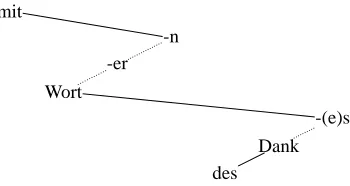
From the moment one chooses to split words in the syntactic dependency tree, the definition of morphological dependency cannot work any longer and must be revised. With bound morphs, there are fewer problems with A1 than with free lexemes. As far as A2 is concerned, it helps clar-ify things. In a phrase likemit Kindern, it is quite clear thatmitand-ndo not form a phrase, but the fact that-ngoverns the rest of the word is enough to ensure that A2 is met. There is no problem either with other intra-word dependencies. The main issue is about inter-word agreement. E.g., in ex. 5 (Groß, 2011, 59), the genitive marker-es
licenses the occurrence of the word Dankes, but it also implies that the article has the form des
(which could even be split ind→es). However, the tree (fig. 3) does not display this dependency, but ratherWord→des.
(5) mit
with
Wort
word
-er
PLURAL -n
DATIVE des
the-GEN Dank
thank
-es
GEN
“with words of gratitude”
6The third major type of dependency, namely, semantic
mit
-n -er
Wort
[image:5.612.109.284.48.141.2]-(e)s Dank des
Figure 3: Groß’s analysis if Germ. mit Wortern des Dankes
This appears to be quite right because of criterion A2: the reason why -es → des is not a syntac-tic dependency is that it does not form a poten-tial prosodic unit (phrase). Therefore, agreement is not a syntactic dependency. Agreement is not sufficient to bring together enough blocks of syn-tactic units to form a proper phrase. This lets us clearly define the distinction between morphologi-cal and syntactic dependencies in the case of form determination: in the case of a syntactic depen-dency, the form determination constrains the dis-tribution at a higher level and must apply to the head of a phrase; in the case of a morphological dependency, form determination does not neces-sarily apply to the head of a phrase. This dis-tinction is very different from the one proposed by Igor Mel’ˇcuk.
The only problem that remains is that the pres-ence of one case marker is sometimes compul-sory in languages (e.g.: for most Latin nouns, case marking is compulsory). Nouns cannot form a phrase without inflection. Hence, if there is some adjective depending on the noun, such as carum
in Latin carum amicum– see ex. 6 (indices dis-tinguish between forms in the demonstration) and fig. 4 –, the dependencyamic→-um2seems not to satisfy the A2 criterion (it does not form a phrase).
(6) Amic
friend
-um1 ACC
car
dear
-um2 Acc
video
I see “I see (my) dear friend”
video
amic -um1
car -um2
Figure 4: Analysis of Lat.Amicum carum video
To solve this kind of problem without loosing the benefit of the A2 criterion, we have to posit:
Letf1→f2be a compulsory intra-word syntactic dependency. For all inter-word dependencies f2 — f3, A2 holds if either f1f2f3 or f1f2 and the sub-tree governed by f3 forms a potential prosodic unit (= phrase).
Since-um1→amicis a compulsory intra-word de-pendency and um2 is the governor ofcar, there exist a relation between amic and um2 because carum amicumis a potential prosodic unit. How-ever, there is no syntactic relation beweenum1and um2because-um carumis not a phrase – and-um carum videois not a phrase either.
2.3 Alain Lemaréchal’sspecification
Hierarchy of markers. My third theoretical milestone is the concept ofspecificationas used by Alain Lemaréchal in his works (1997). The main assumption is that grammatical markers are hier-archized and that the parts of speech also play a role in the way the markers interconnect. Hence, the grammatical markers are the following, in de-creasing order of importance:
1. integrative markers (prosody); 2. lexeme order;
3. part of speech compatibilities;
4. segmental units (free relational morphemes and inflection).
This hierarchy is based on the fact that the only compulsory markers are prosodic ones and that words can be connected simply because of their respective part of speech; e.g.:John slept(simple past) works because Johnis a noun and slept is a verb. In this conception, segmental markers are added at the very last level and are the least impor-tant for the relation to exist.
Markers and government. Alain Lemaréchal’s view basically contradicts the idea that preposi-tions, conjunctions and bound morphemes should often be seen as the governor of the relation. His point is that these markers are added to an existing relation and that they form astackof grammati-cal constraints thatspecifythe relation, both syn-tactically and semantically. Specifications are not compulsory to establish relations. In this frame-work, a morpheme such as a preposition behaves similar to what Lucien Tesnière calls atranslatif
the words it combines with – e.g.: a preposition can change a noun to an adverb and allow this noun to be an adjunct.
Even if it belongs to a dependency framework, this analysis does not follow the same theoretical guidelines as the ones introduced in sec. 2.1 and sec. 2.2. However, Alain Lemaréchal (1997, 117) also adds a very important detail in his presenta-tion: markers may not be compulsory, but if they appear, they have to be the right ones. He com-pares ex. 7 and 8. In ex. 7, the verbal form carries no segmental marker expressing the person and the sentence remains understandable (although not very satisfactory). In ex. 8, the bound morph-ons
conflicts with the 3rd pers. sg. of the proper name. Hence, the sentence is not understandable at all.
(7) *Alfred
Alfred chanterto sing (8) *Alfred
Alfred chantonswe sing
If this point is transferred to the B1 criterion, it means that when such a specific marker is present, it firmly constrains the syntactic distribution of the construction.
Stacking markers. One other important point in Alain Lemaréchal’s model is the concept of
marker stacking(Fr.cumul des marques). His idea is that homonyms do not exist among grammati-cal markers (Lemaréchal, 1983). Markers can be ambiguous, because they are not specific enough on their own. E.g., traditionally, in French, que
has been described as a pronoun (L’homme que tu vois “The man you see”) or as a conjunction (Je veux que tu viennes “I want you to come”). If one takes into account that the clause beginning with que works with a noun (homme) or with a verb (veux), this ambiguity disappears. In other words, there is a stacking of markers that gradu-ally specify the relation between words: instead of two differentqueone should see an undespecified
quethat stacks with part of speech compatibilities to specify several different relations.
3 Major relations in the clause in OF
This section investigates the grammatical means of expressing dependencies in the OF clause. The theoretical aspects described above will prove use-ful in order to achieve a description that encom-passes the main characteristics of the phenomena
under study. The description reveals the strik-ing instability of the system: DF trees will help demonstrate this lack of systematicity in a rigor-ous way.
I will give the classical idealized approach of the declension system in OF and underline the main problems (3.1). Then, we will see that the definite article plays an important role in the syn-tactic organization of the clause (3.2) and that some nouns have a syntactically specialized theme (3.3). Some structures that completely lack overt markers will also be introduced (3.4). I will clude with a synthesis and point out historical con-cerns (3.5).
3.1 Classical approach to declension in OF Ideal system. The traditional analysis of the de-clension system in OF relies on the fact that a few nouns are marked with a bound morpheme that in-dicates whether they assume the role of the sub-ject or not. Following this point of view, OF dis-tinguishes between two cases: the nominative case
cas sujetand the universal oblique casecas régime
(which is used for all functions but the subject). Therefore, the minimal sentence in ex. 13 clearly shows that the noun Charle has an -s
morph at the end. (9) Charle
Charles-sNOM respunt
answers
– Roland (Moignet, 1972, v. 156)
The resulting analysis would thus be the one shown in fig. 5.
respunt -s
Charle
Figure 5: Analysis of OFCharles respunt
Problems. However, even with little knowledge of OF, one feels that the traditional analysis over-simplifies things.
The second issue is that the presence of-sis not compulsory even for the nouns that generally have a marked nominative form. Nevertheless, “inverse mistakes”, where-sappears in the oblique case are very seldom (Schøsler, 1984, 237-8), which means that Alain Lemaréchal’s prediction holds, that is, the markers must be correct when they do appear (sec. 2.3).
But there is a third problem: -s is highly syn-cretic in the grammar of OF, because it is also used to mark the plural form of the oblique case of the nouns that do follow the declension rules (for other nouns,-smerely marks the plural). In a nutshell, the classical paradigm is the one shown in tab. 1 (Moignet, 1988, 19). This paradigm con-trasts with the one of most feminine nouns ending in-e(tab. 2).
[image:7.612.159.231.280.318.2]sg. pl. NOM -s – OBL – -s
Table 1: Ideal case marker paradigm in OF
[image:7.612.360.479.349.411.2]sg. pl. NOM/OBL – -s
Table 2: Case marker paradigm for OF feminine nouns in-e
If one accepts that there is only one-s(last para-graph in sec. 2.3) that, as it will appear, may stack with other markers, one can say that the distribu-tion of the nominal phrase is constrained by -s,
modulo the syntactic distribution is not homoge-neous, because the marker is underspecified.
3.2 Definite article
A more reliable marker. The definite article is a marker that can optionally specify the noun phrase in OF.7It is more reliable than nominal inflection
in determining the case, but, unlike its modern counterpart, it is by no means compulsory – all nouns can be used as a complete phrase without a determiner: when the latter is absent, the meaning is general (Moignet, 1988, 105-11).8
Some of the forms of this article are specific: for masculine nouns,lireliably corresponds to the 7Although this paper only discusses the definite article,
OF has a wide range of determiners that can accompany the noun.
8The fact that a morph can be omitted does not mean it
does not qualifies as a governor (see sec. 2.1).
nominative (singular and plural), le corresponds to the oblique singular andlescorresponds to the oblique plural. Therefore, let us assume that re-lations are most likely to be oriented this way:
li/le/les→noun.
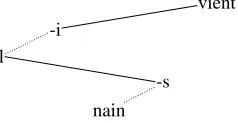
Marker stacking. Since the-sdoes not reliably fixate the distribution, it has to be demoted at least one level below the article when both markers are present. Still, one must bear in mind that “inverse mistakes” are rare, and that this-sdoes not have a random distribution. In ex. 12,-sdoes not mark the case, but when the article is present, -s may only appear if the article is compatible.
(10) Li
The-NOM nain
dwarf
-s
“stacking”-s
[. . . ] vient
comes “The dwarf comes” – Erec (Roques, 1952, v. 161)
It becomes clear that-sis a mere optional agree-ment with its morphological governorli. The re-sulting tree is shown in fig. 6. Note that the form
vient -i
l
-s
nain
Figure 6: Analysis of OFLi nains vient
determination relation between-iand-sis purely morphological, according to the revision of the A2 criterion (sec. 2.2).
Intra-paradigm discrepancies. Nevertheless, feminine forms are not case-specific at all. Therefore, while li and le clearly constrain the
MASC. FEM.
sg. pl. sg. pl. NOM li li
la les OBL le les
Table 3: Definite article paradigm in OF
syntactic distribution of the noun phrase, la
[image:7.612.357.482.548.597.2](11) La
The-FEM
reïne [. . . ]
queen
voit
sees
le
the-MASC-DIROBJ
chevalier
knight – Erec (Roques, 1952, v. 149)
voit
la
reïne -e
l
[image:8.612.100.275.50.180.2]chevalier
Figure 7: Analysis of OFLa reïne voit le chevalier
While it is true that le → chevalier, because of the existence of the phraseli→chevalier(s), that has another distribution (subject), one must posit
reïne →la, because B1 does not apply well and
reïne serves as a morphological contact point for the feminine category (B2).
3.3 Theme variation
Another important feature of OF is the existence of variable nominal themes. A subset of nouns have two themes: one specifically corresponds to the nominative singular (the form is specialized in this function), the other is not specialized. Considering examples where the specialized form stacks with a specialized definite article, such as in ex. 12. In this example, beris specifically a singular nomi-native (plural forms and accusative forms are built on another theme: baron).
(12) Cunquerrantment
As a hero sisofinereitwould endlithe-NOM ber
noble man-NOMSG -s
-s
“The noble man would end like a hero” – Roland (Moignet, 1972, v. 2867) In this example, both ber and li are specialized. Both of them correspond to the syntactic distri-bution of the phrase and B1 does not work well. Again, B2 works better, since it is the noun that would morphologically govern optional predica-tive adjecpredica-tives in constructions using a copula – the copula would syntactically govern the adjec-tive. Therefore, the hierarchy would be the one shown in fig. 8. The position of -s can be justi-fied by at least two arguments: fistly, ber is the most specific form and should dominate the whole nominal phrase (sec. 2.1); secondly,li . . . -swould not form a phrase and the relation between-iand
-sis purely morphological (see sec. 2.2, 2.2).
finereit
-i l
-s ber
Figure 8: Analysis of OFfinereit li bers
3.4 No overt marker at all
As a result of phenomena exposed in sec. 3.1 and sec. 3.2, segmental markers can be completely ab-sent. A sentence where the subject and the object are both feminine nouns in -e displays no overt contrast between the dependents of the main verb – ex. 13 and ex. 14 (Schøsler, 1984, 34 and 41).
(13) La nouvele
The news
oït
heard
l’abesse
the abbess “The abbess heard the news” (14) La dame
The ladyesmethinks highly ofla comtessethe countess “The lady thinks highly of the countess” or “The countess thinks highly of the lady” Lene Schøsler claims that the semantic properties of the dependents is the only available clue within the scope of ex. 13 (abesse is animate, whereas
nouveleis not), but to understand the structure of ex. 14, only contextual clues can help. This pos-sibility also provides strong support to the claim that markers must be seen as an additional mean to express argument structure of sentences that are mostly understandable without them (Detges, 2009).
3.5 Synthesis and diachronics
As demonstrated in the previous sections, the structure of the nominal dependents in OF is highly unstable, ranging from a completely speci-fied construction (ex. 12) to a completely under-specified one (ex. 14). Moreover, the level of specificity of the markers is also variable. This variable specificity entails that the presence of a more specific marker automatically demotes less specific ones through a stacking mechanism (sec. 3.2 and sec. 3.3).
(15) Le chat
The cat
voit
sees
la souris
the mouse
Much as in English, the dependency type is ex-pressed by the relative position of the phrases around the main verb and morphological agree-ment: the subject, with which the verb agrees, to the left, the object to the right9. The DF
analy-sis of ex. 15 is sketched in fig. 9. The typological
voit chat le
souris la
Figure 9: Analysis of Fr. Le chat voit la souris
contrast between Old French and modern French is strikingly clear. In the noun phrase, all mor-phemes (bound or free) intended to mark the rela-tion between the verb and its arguments have dis-appeared. The immediate consequence of this lan-guage change is that the structure of the French noun phrase is now completely homogeneous.
4 Conclusion
DF is a great tool to emphasize the differences between the analyses of the various simple noun phrases that are described above. There is a temp-tation to simplify everything to give it a more co-herent look and feel. From the point the perspec-tive of this paper, this would clearly be a mis-take because that would reduce syntax to a mere paradigmatic system. Why would one treat mem-bers of the same morphological paradigm exactly the same way if they behave differently at the syn-tactic level? On the contrary, I find it more inter-esting to redefine paradigms taking into account syntactic behavior.
By not smoothing trees too much, one also ben-efits from a powerful tool that helps discover un-derspecified markers. These markers are used in different trees and are demoted to lower levels when they stack with more specific ones. There-fore, DF is able to model the syntactic behavior
9Assuming that one accepts Willy Van Langendonck’s
demonstration (1994), the definite article has to be defined as a dependent of the noun. Note that transferring the idea that the determiner is the governor – “DP hypothesis”, see the introduction in (Haegemann, 1994, 607-611) – from the Government and Binding framework to syntactic dependency does not change much to the conclusions of this paper: the form of the determiner does not distinguish between verbal dependents.
of units that have always been problematic for tra-ditional descriptions simply by using its core me-chanics:hierarchy.
Acknowledgements
I would like to thank, for their suggestions and cor-rections (in no particular order): Thomas Groß, Sylvain Kahane, Timothy Osborne and Lene Schøsler, as well as the anonymous reviewers of the Depling conference.
References
Leonard Bloomfield. 1933. Language. George Allen & Undwin Ltd., London.
Claude Buridant. 2000. Grammaire nouvelle de l’ancien français. Sedes, Paris.
Jean-Pierre Chambon and Rosa Davidsdottir. 2007. Approche de la déclinaison des substantifs en ancien français: de moignet à skøarup (lecture critique et suggestions). Bulletin de la Société de Linguistique de Paris, 102(1):173–192.
Jean-Pierre Chambon. 2003. La déclinaison en ancien occitan, ou: comment s’en débarrasser? une réanal-yse non orthodoxe de la flexion substantivale.Revue de linguistique romane, 67:342–363.
Ulrich Detges. 2009. How useful is case morphology? the loss of the old french two-case system within a theory of preferred argument structure. In Jóhanna Bar ¯ddal and Chelliah Shobhana, editors,The Role of Semantic, Pragmatic, and Discourse Factors in the Development of Case, number 108 in Studies in Lan-guage Companion Series, pages 93–120. Benjamins, Amsterdam.
Thomas Groß. 2011. Catenae in morphology. In Kim Gerdes, Elena Hajiˇcová, and Leo Wanner, editors, Proceedings of Depling 2011, International Confer-ence on Dependency Linguistics, Barcelona, pages 47–57. Barcelona.
Lilinane Haegemann. 1994. Introduction to Govern-ment and Binding Theory. Blackwell, Oxford and Malden, 2nd edition.
Richard Hudson. 1990. English word grammar. Blackwell, Oxford.
Gilbert Lazard. 1984. La distinction entre nom et verbe en syntaxe et en morphologie. Modèles lin-guistiques, 6(1):29–39.
Alain Lemaréchal. 1983. Sur la prétendue homonymie des marques de fonction: la superposition des mar-ques. Bulletin de la Société de Linguistique de Paris, 78(1):53–76.
Igor Mel’ˇcuk. 2009. Dependency in natural language. In Alain Polguère and Igor Mel’ˇcuk, editors, Depen-dency in linguistic description, pages 1–110. John Benjamins, Amsterdam and Philadelphia.
Gérard Moignet, editor. 1972. La chanson de Roland. Bordas, Paris, 3rd edition.
Gérard Moignet. 1988. Grammaire de l’ancien français. Morphologie – Syntaxe. Number 2 in Ini-tiation à la linguistique. Série B. Problèmes et méth-odes. Klincksieck, Paris, 2nd edition.
Mario Roques, editor. 1952. Chrétien de Troyes, Erec et Enide. Number 80 in Classiques français du moyen âge. Champion, Paris.
Lene Schøsler. 1984. La déclinaison bicasuelle de l’ancien français: son rôle dans la syntaxe de la phrase, les causes de sa disparation. Number 19 in Etudes romanes de l’Université d’Odense. Odense University Press, Odense.
Lene Schøsler. 2013. The development of the declen-sion system. In Deborah L. Arteaga, editor, Re-search on Old French: the state of the art, pages 167–186. Springer, London.
Peter Stein and Claudia Benneckenstein. 2006. His-torische fallstudie: Altfranzösisch. In Vilmos Àgel, Ludwig M. Eichiner, Hans-Werner Eroms, Pe-ter Hellwig, Hans Jürgen Heringer, and Henning Lobin, editors,Dependenz und Valenz. Ein interna-tionales Handbuch der zeitgenössischen Forschung. 2. Halbband, Handbücher zur Sprach- und Kommu-nikationswissenschaft, pages 1508–1515. Walter de Gruyter, Berlin and New York.
Lucien Tesnière. 1966. Éléments de syntaxe struc-turale. Klincksieck, Paris, 2nd edition.
Willy Van Langendonck. 1994. Determiners as heads? Cognitive Linguistics, 5(3):243–259.