MSTParser Model Interpolation for Multi-source Delexicalized Transfer
Rudolf Rosa and Zdenˇek ˇZabokrtsk´y
Charles University in Prague, Faculty of Mathematics and Physics Institute of Formal and Applied Linguistics
Malostransk´e n´amˇest´ı 25, Prague, Czech Republic {rosa, zabokrtsky}@ufal.mff.cuni.cz
Abstract
We introduce interpolation of trained MSTParser models as a resource combi-nation method for multi-source delexical-ized parser transfer. We present both an unweighted method, as well as a variant in which each source model is weighted by the similarity of the source language to the target language. Evaluation on the HamleDT treebank collection shows that the weighted model interpolation performs comparably to weighted parse tree combi-nation method, while being computation-ally much less demanding.
1 Introduction
The task of delexicalized dependency parser trans-fer (or delex transtrans-fer for short) is to train a parser on a treebank for a source language (src), us-ing only non-lexical features, most notably part-of-speech (POS) tags, and to apply that parser to POS-tagged sentences of a target language (tgt) to obtain dependency parse trees. Delex transfer yields worse results than a supervised lexicalized parser trained on thetgt language treebank. How-ever, for languages with no treebanks available, it may be useful to obtain at least a lower-quality parse tree for tasks such as information retrieval.
Usually, multiple src treebanks are available, and it is non-trivial to select the best one for a giventgt language. Therefore, information from some or allsrc treebanks is usually combined to-gether. The standard ways are to train a parser on the concatenation of all src treebanks, or to train a separate parser on each src treebank and to combine the parse trees produced by the parsers using a maximum spanning tree algorithm. The tree combination method typically performs bet-ter; it can also be easily extended by weighting thesrc parser predictions by similarity of thesrc
language to the tgt language, which can further improve its results.
In this work, we present a novel method forsrc
information combination, based on interpolation of trained parser models. Our approach was mo-tivated by an intuition that the more fine-grained information provided by thesrcedge scores could be of benefit, probably serving assrc parser con-fidence. Moreover, model interpolation is signif-icantly less computationally demanding at infer-ence than the parse tree combination method, as instead of running a set of separate src parsers, only one parser is run.
2 Related Work
Delex transfer was conceived by Zeman and Resnik (2008), who also introduced two important preprocessing steps – mapping treebank-specific POS tagsets to a common set using Interset (Ze-man, 2008), and harmonizing treebank annotation styles into a common style, which later led to the HamleDT harmonized treebank collection (Zeman et al., 2012).
McDonald et al. (2011) applied delex transfer in a setting with multiplesrc treebanks available, finding that the problem of selecting the bestsrc
treebank without access to atgtlanguage treebank for evaluation is non-trivial, and proposed the tree-bank concatenation method as a solution. Søgaard and Wulff (2012) introduced weighting into the method, using a POSn-gram model trained on a
tgt POS-tagged corpus to weightsrcsentences in a weighted perceptron learning scenario (Caval-lanti et al., 2010); due to its large computational complexity, we only compare to the unweighted variant in our paper.
The parse tree combination method was intro-duced by Sagae and Lavie (2006) for a super-vised monolingual setting, optionally weighting each src parser with a weight based on its accu-racy. In (Rosa and ˇZabokrtsk´y, 2015), we ported
the method to a crosslingual setting by combining delex parsers for different languages, weighted by
src-tgt language similarity; we largely build upon that work in this paper.
Other possibilities of estimating src-tgt lan-guage similarity for delex transfer include employ-ment of WALS (Dryer and Haspelmath, 2013), focusing e.g. on genealogy distance and word-order features, as done by Naseem et al. (2012) and T¨ackstr¨om et al. (2013), among others.
We are not aware of any prior work on interpo-lating dependency parser models. However, there is work on interpolating trained phrase-structure parsers, both in a monolingual setting for domain adaptation by McClosky et al. (2010), as well as in a multilingual setting by Cohen et al. (2011).
3 Method
In this section, we present our suggested approach of combining information from multiplesrc tree-banks for parsing tgt language sentences in a crosslingual delex transfer scenario. The method proceeds as follows:
1. Train a delex parser model on eachsrc tree-bank (Section 3.1).
2. Normalize the parser models (Section 3.2). 3. Interpolate the parser models (Section 3.3). 4. Parse the tgt text with a delex parser using
the interpolated model. 3.1 Delexicalized MSTParser
Throughout this work, we use MSTperl (Rosa, 2015b), an unlabelled first-order non-projective single-best implementation of the MSTParser of McDonald et al. (2005b), trained using 3 iterations of MIRA (Crammer and Singer, 2003).
The MSTParser model uses a set of binary fea-tures F that are assigned weights wf by
train-ing on a treebank. When parstrain-ing a sentence, the parser constructs a complete weighted directed graph over the tokens of the input sentence, and assigns each edgeea scoresewhich is the sum of
weights of features that are active for that edge:
se=
X
∀f∈F
f(e)·wf. (1)
The sentence parse tree is the maximum spanning tree over that graph, found using the algorithm of Chu and Liu (1965) and Edmonds (1967).
The delex feature set we use is based on the set of McDonald et al. (2005a) with lexical features
removed. It consists of combinations of signed edge length (distance of head and parent, bucketed for values above 4 and for values above 10) with POS tag of the head, dependent, their neighbours, and all nodes between them. We use the Universal POS Tagset (UPOS) of Petrov et al. (2012). The parser configuration files containing the full fea-ture set, together with the scripts we used for our experiments, are available in (Rosa, 2015a). 3.2 Model Normalization
An important preliminary step to model interpo-lation is to normalize each of the trained models, as the feature weights in models trained over dif-ferent treebanks are often not on the same scale (we do not perform any regularization during the parser training). We use a simplified version of normalization by standard deviation. First, we compute the uncorrected sample standard devia-tion of the weights of the features in the model as
sM =
s 1
|M|
X
∀f∈M
(wf −w¯)2, (2)
wherew¯is the average feature weight, and|M|is the number of feature weights in modelM; only features that were assigned a weight by the train-ing algorithm are taken into account.
We then divide each feature weight by the stan-dard deviation:1
∀f ∈M :wf := swf
M . (3)
The choice of normalization by standard devia-tion is based on its high and stable performance on our development set, and Occam’s razor.2
3.3 Model Interpolation
The interpolated model is a linear combination of the normalized models trained over the src tree-banks. The result is a model that can be used in the same way as a standard MSTParser model.
1We have not found any further gains in performance when subtracting the sample mean from the weight before the division; the MSTParser models seem to be typically cen-tered very similarly.
In unweighted model interpolation, the weight of each feature (wf) is computed as the sum of the
weights of that feature in thesrcmodels (wf,src):
∀f ∈F :wf =
X
∀src
wf,src. (4)
In the weighted variant of model interpolation, we extend (4) with multiplication by theKL−cpos4 3
weight of Rosa and ˇZabokrtsk´y (2015):
∀f ∈F :
wf =
X
∀src
wf,src·KL−cpos4 3(tgt,src). (5)
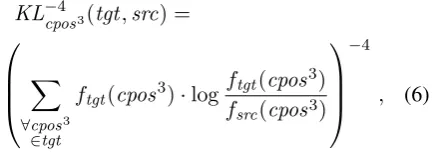
TheKL−cpos4 3 weight corresponds to the similarity
of thesrclanguage to thetgt language, and is de-fined as the negative fourth power of the KL diver-gence (Kullback and Leibler, 1951) of coarse POS tag trigram distributions intgt andsrccorpora:
KL−cpos4 3(tgt,src) =
X
∀cpos3
∈tgt
ftgt(cpos3)·logftgt(cpos 3)
fsrc(cpos3)
−4
, (6)
wherecpos3 is a UPOS trigram, andf(cpos3)is
its relative frequency in asrcortgt corpus.3
4 Baseline Methods
In this section, we describe the two baseline re-source combination methods against which we compare our model interpolation method.
4.1 Treebank Concatenation
The treebank concatenation method of McDonald et al. (2011) proceeds as follows:
1. Concatenate allsrctreebanks.
2. Train a delex parser on the resulting treebank. 3. Apply the parser to thetgt text.
4.2 Parse Tree Combination
The parse tree combination method is defined by Rosa and ˇZabokrtsk´y (2015) in the following way:
1. Train a delex parser on eachsrctreebank. 2. Apply each of the parsers to thetgt sentence,
obtaining a set of parse trees. 3f
src(cpos3) := N1 if thesrccorpus does not contain the
given trigram (Nis the number of tokens in the corpus).
3. Construct a weighted directed graph overtgt
sentence tokens, with each edge assigned a score equal to the number of parse trees that contain this edge. (i.e., each parse tree con-tributes by 0 or 1 to the edge score). In the weighted variant, the contribution of eachsrc
parse tree is multiplied byKL−cpos4 3(tgt,src).
4. Find the maximum spanning tree over the graph with the Chu-Liu-Edmonds algorithm.
Note that if eachsrc parse tree contributed with a (normalized) score of the edge as assigned by its model rather than with a 0 or 1, this method would be equivalent to the model interpolation method.
5 Dataset
We carry out all experiments using HamleDT 2.0 (Rosa et al., 2014), a collection of 30 tree-banks converted into Universal Stanford Depen-dencies (de Marneffe et al., 2014). We use gold-standard UPOS tags in all experiments; while this is not fully realistic in the setting of under-resourced languages, there exist high-performance semi-supervised taggers that could be used instead of gold tags (Das and Petrov, 2011; Agi´c et al., 2015), which we plan to evaluate in future. We use the treebank training sections for parser train-ing andKL−cpos4 3computation, and the test sections
for evaluation. We used 12 of the treebanks as a development set to select the model normalization method to avoid overfitting it to the dataset.4
[image:3.595.75.293.346.427.2]6 Evaluation
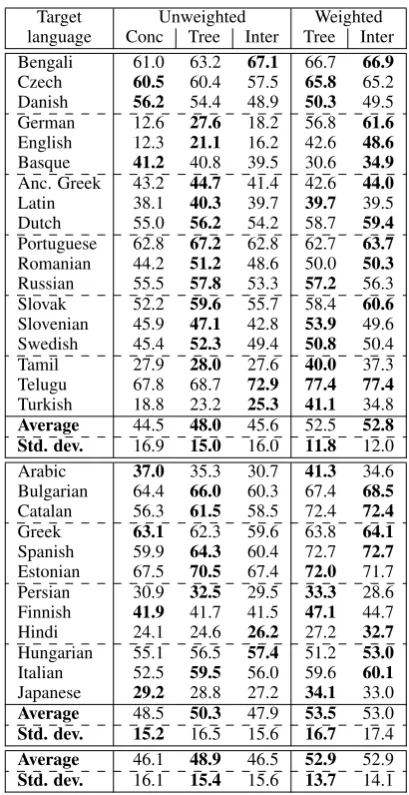
Table 1 contains the results of our model interpola-tion methods, as well as the baseline methods. For eachtgt language, all remaining 29src treebanks were used for parser training. We base our evalua-tion on comparing absolute differences in UAS on the whole set of 30 languages as targets.5
The performance of the weighted model inter-polation is comparable to the weighted tree com-bination – the difference in average UAS of the methods is lower than 0.1%, with model interpo-lation achieving a higher UAS than the tree combi-nation for 16 of the 30tgt languages. This shows 4The development set was chosen to contain multiple members of several language families (Uralic, Romance), as well as a very solitary language (Japanese), etc.; also, we cared that both smaller and larger treebanks are represented.
Target Unweighted Weighted language Conc Tree Inter Tree Inter Bengali 61.0 63.2 67.1 66.7 66.9
Czech 60.5 60.4 57.5 65.8 65.2 Danish 56.2 54.4 48.9 50.3 49.5 German 12.6 27.6 18.2 56.8 61.6
English 12.3 21.1 16.2 42.6 48.6
Basque 41.2 40.8 39.5 30.6 34.9
Anc. Greek 43.2 44.7 41.4 42.6 44.0
Latin 38.1 40.3 39.7 39.7 39.5 Dutch 55.0 56.2 54.2 58.7 59.4
Portuguese 62.8 67.2 62.8 62.7 63.7
Romanian 44.2 51.2 48.6 50.0 50.3
Russian 55.5 57.8 53.3 57.2 56.3 Slovak 52.2 59.6 55.7 58.4 60.6
Slovenian 45.9 47.1 42.8 53.9 49.6 Swedish 45.4 52.3 49.4 50.8 50.4 Tamil 27.9 28.0 27.6 40.0 37.3 Telugu 67.8 68.7 72.9 77.4 77.4
Turkish 18.8 23.2 25.3 41.1 34.8
Average 44.5 48.0 45.6 52.5 52.8
Std. dev. 16.9 15.0 16.0 11.8 12.0
Arabic 37.0 35.3 30.7 41.3 34.6 Bulgarian 64.4 66.0 60.3 67.4 68.5
Catalan 56.3 61.5 58.5 72.4 72.4
Greek 63.1 62.3 59.6 63.8 64.1
Spanish 59.9 64.3 60.4 72.7 72.7
Estonian 67.5 70.5 67.4 72.0 71.7 Persian 30.9 32.5 29.5 33.3 28.6 Finnish 41.9 41.7 41.5 47.1 44.7 Hindi 24.1 24.6 26.2 27.2 32.7
Hungarian 55.1 56.5 57.4 51.2 53.0
Italian 52.5 59.5 56.0 59.6 60.1
Japanese 29.2 28.8 27.2 34.1 33.0
Average 48.5 50.3 47.9 53.5 53.0
Std. dev. 15.2 16.5 15.6 16.7 17.4
Average 46.1 48.9 46.5 52.9 52.9
[image:4.595.78.283.59.457.2]Std. dev. 16.1 15.4 15.6 13.7 14.1
Table 1: UAS on testtgt treebanks (upper part of table) and developmenttgt treebanks (lower part). Conc= Treebank concatenation
Tree= Parse tree combination Inter= Model interpolation
Average= Average UAS (on test/development/all)
Std. dev.= Standard sample deviation of UAS, serving as an indication of robustness of the method
that weighted model interpolation is a good alter-native to weighted tree combination.
In the unweighted setting, the situation is quite different, with model interpolation scoring much lower than tree combination (-2.4%), and only slightly higher than treebank concatenation (+0.4%) on average. This suggests that, contrary to our original intuition, edge scores assigned by thesrcmodels are not a good proxy for parser con-fidence, not even when appropriately normalized.6 Furthermore, the weighted methods generally
out-6The same tendency was observed across all normaliza-tion methods evaluated on the development set.
perform the unweighted ones (by +4.0% for tree combination and by +6.4% for model interpolation on average), which suggests, among other, that the
src-tgt language similarity is much more impor-tant than the exact values ofsrc edge scores for resource combination in delex transfer.
7 Conclusion
We presented trained parser model interpolation as an alternative method for multi-source crosslin-gual delexicalized dependency parser transfer. Evaluation on a large collection of treebanks showed that in a setting where the source lan-guages are weighted by their similarity to the tar-get language, model interpolation performs com-parably to the parse tree combination approach. Moreover, model interpolation is significantly less computationally demanding than the tree combi-nation when parsing the target text, as the inter-polation can be efficiently performed beforehand, thus only requiring to invoke a single parser at run-time, while in the tree combination approach, each source parser has to be invoked individually.
In the unweighted setting, model interpolation consistently performed much worse than tree com-bination, which we find rather surprising, and we therefore plan to further investigate this in fu-ture. Still, the weighted methods generally outper-formed the unweighted ones, and as the language similarity measure that we used only requires the source treebanks and a target POS-tagged text, i.e. exactly the resources that are required even for the unweighted delex transfer methods, there is little reason not to employ the weighting. Therefore, the low performance of the unweighted model in-terpolation is of less importance than its high per-formance in the weighted setting.
In this work, we only used the unlabelled MST-Parser for all experiments. We believe that extend-ing our method to other parsers constitutes an in-teresting path for future research.
Acknowledgments
References
ˇZeljko Agi´c, Dirk Hovy, and Anders Søgaard. 2015. If all you have is a bit of the bible: Learning POS taggers for truly low-resource languages. In Pro-ceedings of ACL-IJCNLP. Hrvatska znanstvena bib-liografija i MZOS-Svibor.
Giovanni Cavallanti, Nicolo Cesa-Bianchi, and Clau-dio Gentile. 2010. Linear algorithms for online multitask classification. The Journal of Machine Learning Research, 11:2901–2934.
Yoeng-Jin Chu and Tseng-Hong Liu. 1965. On shortest arborescence of a directed graph. Scientia Sinica, 14(10):1396.
Shay B. Cohen, Dipanjan Das, and Noah A. Smith. 2011. Unsupervised structure prediction with non-parallel multilingual guidance. In Proceedings of EMNLP, pages 50–61, Stroudsburg, PA, USA. ACL.
Koby Crammer and Yoram Singer. 2003. Ultracon-servative online algorithms for multiclass problems.
The Journal of Machine Learning Research, 3:951– 991.
Dipanjan Das and Slav Petrov. 2011. Unsupervised part-of-speech tagging with bilingual graph-based projections. In Proceedings of ACL-HLT, pages 600–609. ACL.
Marie-Catherine de Marneffe, Natalia Silveira, Tim-othy Dozat, Katri Haverinen, Filip Ginter, Joakim Nivre, and Christopher D. Manning. 2014. Univer-sal Stanford dependencies: A cross-linguistic typol-ogy. In Proceedings of LREC’14, Reykjav´ık, Ice-land. ELRA.
Matthew S. Dryer and Martin Haspelmath, editors. 2013. WALS Online. Max Planck Institute for Evo-lutionary Anthropology, Leipzig.
Jack Edmonds. 1967. Optimum branchings. Journal of Research of the National Bureau of Standards B, 71(4):233–240.
Solomon Kullback and Richard A Leibler. 1951. On information and sufficiency. The annals of mathe-matical statistics, pages 79–86.
David McClosky, Eugene Charniak, and Mark John-son. 2010. Automatic domain adaptation for pars-ing. InProceedings of HLT-NAACL, pages 28–36. ACL.
Ryan McDonald, Koby Crammer, and Fernando Pereira. 2005a. Online large-margin training of de-pendency parsers. InProceedings of ACL, pages 91– 98. ACL.
Ryan McDonald, Fernando Pereira, Kiril Ribarov, and Jan Hajiˇc. 2005b. Non-projective dependency pars-ing uspars-ing spannpars-ing tree algorithms. InProceedings of HLT-EMNLP, pages 523–530. ACL.
Ryan McDonald, Slav Petrov, and Keith Hall. 2011. Multi-source transfer of delexicalized dependency parsers. In Proceedings of EMNLP, pages 62–72, Stroudsburg, PA, USA. ACL.
Tahira Naseem, Regina Barzilay, and Amir Globerson. 2012. Selective sharing for multilingual dependency parsing. In Proceedings of ACL, pages 629–637, Stroudsburg, PA, USA. ACL.
Slav Petrov, Dipanjan Das, and Ryan McDonald. 2012. A universal part-of-speech tagset. InProc. of LREC-2012, pages 2089–2096, Istanbul, Turkey. ELRA. Rudolf Rosa and Zdenˇek ˇZabokrtsk´y. 2015. KLcpos3
– a language similarity measure for delexicalized parser transfer. In Proceedings of ACL-IJCNL, Stroudsburg, PA, USA. ACL.
Rudolf Rosa, Jan Maˇsek, David Mareˇcek, Martin Popel, Daniel Zeman, and Zdenˇek ˇZabokrtsk´y. 2014. HamleDT 2.0: Thirty dependency treebanks stanfordized. InProceedings of LREC 2014, pages 2334–2341, Reykjav´ık, Iceland. ELRA.
Rudolf Rosa. 2015a. MSTperl delexicalized parser transfer scripts and configuration files. http:// hdl.handle.net/11234/1-1485.
Rudolf Rosa. 2015b. MSTperl parser (2015-05-19). http://hdl.handle.net/11234/1-1480. Kenji Sagae and Alon Lavie. 2006. Parser combina-tion by reparsing. InProceedings of HLT-NAACL, pages 129–132. ACL.
Anders Søgaard and Julie Wulff. 2012. An empiri-cal etudy of non-lexiempiri-cal extensions to delexiempiri-calized transfer. InCOLING (Posters), pages 1181–1190. Oscar T¨ackstr¨om, Ryan McDonald, and Joakim Nivre.
2013. Target language adaptation of discriminative transfer parsers. In Proceedings of HLT-NAACL, pages 1061–1071.
Daniel Zeman and Philip Resnik. 2008. Cross-language parser adaptation between related lan-guages. InIJCNLP 2008 Workshop on NLP for Less Privileged Languages, pages 35–42, Hyderabad, In-dia. Asian Federation of Natural Language Process-ing, International Institute of Information Technol-ogy.
Daniel Zeman, David Mareˇcek, Martin Popel, Loganathan Ramasamy, Jan ˇStˇep´anek, Zdenˇek ˇZabokrtsk´y, and Jan Hajiˇc. 2012. HamleDT: To parse or not to parse? InProceedings of LREC’12, Istanbul, Turkey, May. ELRA.