Emotion in Code-switching Texts: Corpus Construction and Analysis
Sophia Yat Mei Lee
†, and Zhongqing Wang
†,‡†
Department of Chinese and Bilingual Studies, The Hong Kong Polytechnic University
‡
Natural Language Processing Lab, Soochow University, China
{sophiaym, wangzq.antony}@gmail.com
Abstract
Previous researches have focused on ana-lyzing emotion through monolingual text, when in fact bilingual or code-switching posts are also common in social media. Despite the important implications of code-switching for emotion analysis, ex-isting automatic emotion extraction methods fail to accommodate for the code-switching content. In this paper, we propose a general framework to construct and analyze the code-switching emotion-al posts in sociemotion-al media. We first propose an annotation scheme to identify the emotions associated with the languages expressing them in a Chinese-English code-switching corpus. We then make some observations and generate statistics from the corpus to analyze the linguistic phenomena of code-switching texts in social media. Finally, we propose a mul-tiple-classifier-based automatic detection approach to detect emotion in the code-switching corpus for evaluating the effec-tiveness of both Chinese and English texts.
1
Introduction
Due to the popularity of opinion-rich resources (e.g., online review sites, forums, and the micro-blog websites), emotion analysis in text is of great significance in obtaining useful information for studies on social media (Pang et al., 2002; Liu et al., 2013; Lee et al., 2014). Previous re-searches have mainly focused on analyzing emo-tion through monolingual text (Chen et al., 2010; Lee et al., 2013a). However, code-switching posts are also common in social media. Emotions can be expressed by either monolingual text or bilingual text in the code-switching posts.
Code-switching text is defined as text that contains more than one language (‘code’) (Adel et al., 2013; Auer, 1999). [E1-E3] are three examples of code-switching emotional posts on Weibo.com
that contain both Chinese and English texts. [E1] expresses the happiness emotion through English, and the sadness emotion in [E2] is expressed through both Chinese and English, while the
sadness emotion in [E3] is expressed through a mixed Chinese-English phrase (hold 不住 ‘ can-not take it’).
[E1] 玩了一下午轮滑 so happy !
(I went rollerblading the whole afternoon, so happy!)
[E2] 开学以来,浮躁的情绪。不安稳的心
态。确实该自己检讨一下了。。。sigh~~~
(I have been grumpy and emotional since the first day of school, unstable mindset too. It's re-ally time to self-evaluate...sigh~~~)
[E3] 上了一天的课,嗓子hold不住了啊
(Ihave been teaching the whole day, my throat
can't take it anymore.)
Despite the important implications of code-switching for emotion analysis, existing emotion analysis approaches fail to accommodate for the code-switching content. Thus, there is a crucial need for analyzing emotions in code-switching texts.
In this paper, we provide a well-defined and efficient method for constructing and analyzing a large-scale code-switching corpus from social media. We believe the annotated corpus provides a valuable resource for both linguistic analysis as well as natural language processing of emotion and code-switching texts. We construct and ana-lyze the corpus using the below steps: First, we extract and filter the code-switching posts from the large-scale dataset by removing monolingual
and noise posts. Second, we propose an annota-tion scheme to annotate both emoannota-tions and the language(s) expressing the emotions (hereafter caused language(s)) in the data set. Third, we analyze the agreement of the corpus to verify the quality of the annotation and effectiveness of the scheme. We also show some observations and statistics on the corpus to analyze the linguistic phenomena of code-switching texts on social media. Finally, we propose a multiple-classifier-based automatic detection approach to detect emotion in the annotated code-switching corpus for indicating the effectiveness of both Chinese text and English text in code-switching posts in detecting emotions.
The rest of the paper is organized as follows. In Section 2, we give an overview on the related work. In Section 3, we introduce our data collec-tion method and the annotacollec-tion scheme. In Sec-tion 4, we report the analysis of the corpus in-cluding the inter-annotator agreement as well as other relevant statistics. In Section 5, we propose an automatic emotion detection framework on code-switching text. Finally, we conclude our work in Section 6.
2
Related Work
In this section, we discuss related works on emotion analysis and code-switching text analysis.
2.1 Emotion Analysis
The earliest research on emotion has focused on the representation and processing of emotion in facial expressions and body language (Andrew, 1963; Ekman and Friesen, 1978). More recently, there has been mounting research on the neuro-biological basis of emotion (Olson et al., 2007; Hervé et al., 2012) and how emotion is linked with other aspects of human cognition (Smith and Lazarus, 1993; Smith and Kirby, 2001; Bridge et al., 2010).
Emotion has been well studied in natural lan-guage processing, while most previous research-es focused on analyzing emotions in monolingual text. Some of these studies focus on lexicon building, for example, Rao et al. (2012) automat-ically building the word-emotion mapping dic-tionary for social emotion detection, and Yang et al., (2014) propose a novel emotion-aware topic model to build a domain specific lexicon. More-over, emotion classification is one of the im-portant tasks in emotion analysis. For example, Liu et al., (2013) used co-training framework to
infer the news reader’s and comment writer’s emotion collectively; Wen and Wan (2014) used class sequential rules for emotion classification of micro-blog texts by regarding each post as a data sequence.
The research of emotion has also been linked to the field of bilingualism. Previous studies have demonstrated that emotion is closely related to second language learning and use (Arnold, 1999; Schumann, 1999), as well as bilingual perfor-mance and language choice (Schrauf, 2000; Pavlenko, 2008). For example, there are a num-ber of factors that may impact the use of emotion vocabulary, such as sociocultural competence, gender, and topic (Dewaele and Palvenko, 2002). Despite a growing body of research on tion, little has been done on the analysis of emo-tion in code-switching contexts due to the com-plications in processing two languages at the same time.
2.2 Analysis of Code-switching Texts
Research on code-switching can be traced back to the 1970s. Several theories have been pro-posed to account for the motivation behind code-switching such as diglossia (Blom and Gumperz, 1972), communication accommodation theory (Giles and Clair, 1979), the markedness model (Myers-Scotton, 1993), and the conversational analysis model (Auer, 1984).
Code-switched documents have also received considerable attention in the NLP community. Several studies have focused on identification and analysis, including mining translations in code-switched documents (Ling et al., 2013), predicting code-switched points (Solorio and Liu, 2008), identifying code-switched tokens (Lignos and Marcus, 2013), adding code-switched sup-port to language models (Li and Fung, 2012), and learning poly-lingual topic models from code-switching text (Peng et al., 2014).
Another related research topic, multilingual natural language processing, has begun to attract attention in the computational linguistic commu-nity due to its broad real-world applications. Rel-evant studies have been reported in different nat-ural language processing tasks, such as parsing (Burkett et al., 2010), information retrieval (Gao et al., 2009), text classification (Amini et al., 2010), and sentiment analysis (Lu et al., 2011).
the important implications of code-switching in emotion analysis serve as a first step towards an automatic multilingual classification system.
3
Data Collection and Annotation
In this section, we describe how to collect and filter code-switching posts on Weibo.com. We also discuss the annotation scheme and the anno-tation tool.
3.1 Data Collection
We sourced our data set from Weibo.com, one of the famous SNS websites in China. We identified a post as code-switched if at least two predicted languages, i.e. Chinese and English, appeared in the text. As the encoding of Chinese and English characters is different (the maximum number of encoded English characters is less than 128), we thus utilized each character code to identify the language in a simple manner. We also remove the noise, and advertisement posts ([E4] and [E5] are the examples of noise and advertisement posts).
[E4]分 享 Carpenters 的 歌 曲 《Close To You》
(Share Carpenters’ music <Close To You>)
[E5]the face shop 提供新款化妆品
(the face shop provides new make-up)
3.2 Annotation Scheme
Five basic emotions were annotated, namely
happiness, sadness, fear, anger and surprise (Lee et al., 2013b). Two languages, Chinese and Eng-lish, were annotated as caused languages. Since emotion can be expressed through the two lan-guages separately or collectively, and also could be expressed through mixed phrases e.g. “笑cry” (very happy), we thus need to annotate four kinds of causal situations, i.e. English, Chinese, Both, and Mixed. Following are descriptions of these situations:
Chinese (CN) means the emotion of the post is individually expressed through the Chi-nese text. As Weibo.com is a Chinese SNS Web-site, Chinese is the dominant language on this website. Most of the posts express emotions through the Chinese text. [E6] is an example. The emotion of surprise is expressed through the Chinese text.
[E6] 静静坐下来看别人show啦。刚刚在节
目里看到妈咪和弟的视频真的很意外! (I set down quietly to watch someone else’s
show. To my surprise, both my mother and brother appeared on the programme.)
English (EN) means the emotion of the post is individually expressed through the Eng-lish text. As EngEng-lish is the minority language, there are fewer English words in the posts to ex-press emotions. [E1] is an examples exex-pressing
happiness emotion and expressed through Eng-lish text.
Both (BOTH) means the emotions of the post are expressed through both Chinese and English text. Note that the emotions expressed through the two languages would either be the same or different. [E2] and [E7] are two exam-ples. The anger emotion of [E2] is expressed through both the Chinese and English text. How-ever, the happiness emotion of [E7] is expressed through the Chinese text, while the surprise emo-tion is expressed through English.
[E7] 太感动这真是一个大 surprise 看的时
候就鸡冻屎了
(I was so touched and excited to see this great
surprise.)
Mixed (MIXED) means the emotion of the post is expressed through a Chinese-English mixed phrase, such as the emotion being ex-pressed through the mixed phrase “hold不住” in [E3]. Note that there are limited mixed patterns, and Table 1 illustrates the examples of mixed phrases in our dataset.
Moreover, the emotions of some posts are ex-pressed implicitly, and do not contain explicit keywords to express emotions. [E8] and [E9] are examples of this, while these two posts both ex-press a sadness emotion, [E8] is expressed through Chinese text, and [E9] is expressed through both Chinese and English text.
[E8] 英语的魅力在于,好不容易看懂每个
word却看不懂组成的sentence.
(The charm of English is that you can’t always understand the meaning of the sentence, even though you understand the meaning of each word in the sentence.)
[E9] stream flow, slowly away a few leaf, al-so taking the memory.溪水缓慢地流动着,带
(The Chinese text is translated from English text)
Pattern Examples
有feel
(sense) -
hold住 hold住 (can take it) hold不住 (cannot take it)
XX cry
笑cry (smile, very happy) 感动cry (touched) 帅cry (awesome) 太man了
(handsome) -
Table 1: Examples of mixed phrases
3.3 Annotation Tool and Format
[image:4.595.79.289.94.249.2]An annotation tool is designed to facilitate the annotation process which allows better con-sistency.
[image:4.595.71.298.325.456.2]Figure 1: A sample of code-switching emotion anno-tation using the annoanno-tation tool
Figure 1 shows an example instance annotated with both emotion and caused languages using our annotation tool. For each emotion, annotators marked whether the post expresses emotion, to-gether with the caused languages toward the emotion.
Figure 2 is a sample of an annotated instance. Each instance contains the caused language with the emotion tag, e.g., “<Happiness>CN </Happiness>”, while the example tag means the post expresses the happiness emotion through Chinese text.
<Post id="1"> <Happiness> CN
</Happiness> <Sadness> None </Sadness> <Anger> None </Anger> <Fear> None </Fear> <Surprise> None </Surprise> <Content>
baby 生日快乐!附加征婚:此女贤良
淑德 拥有现代女性智慧和古典女性的温婉 诚
征凹凸曼非诚勿扰
</Content> </Post>
Figure 2: A sample of an annotated instance
4
Statistics and Analysis
In this section, we analyze the agreement of the corpus, and present some observations and statis-tics.
4.1 Agreement Analysis
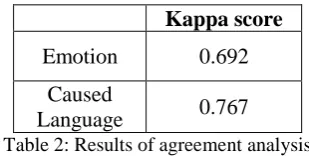
To verify the quality of the annotation, two hu-man annotators were asked to annotate 1,000 posts. We then calculated the inter-annotator agreement between them using Cohen’s Kappa coefficient. Table 2 shows the results of agree-ment analysis. We find that the agreeagree-ment is high, indicating that the quality of the annotation and scheme is effective. In addition, the agreement of emotion annotation is lower than that of caused language, which probably due to the fact that some posts express more than one emotion, and some emotions are expressed implicitly.
Kappa score
Emotion 0.692
Caused
Language 0.767
Table 2: Results of agreement analysis
4.2 Statistics and Observations
[image:4.595.335.490.612.690.2]General Distribution of Data
Out of 4,195 annotated posts, 2,312 posts are found to express emotions. Moreover, 81.4% of emotional posts are expressed through Chinese. Although English contains relatively fewer words in each post, there are still 43.5% of emo-tional posts are expressed through English. This indicates that English is of vital importance to emotion expression even in code-switching con-texts dominated by Chinese. Note that, there are overlaps between Chinese and English emotional posts, since some emotional posts are conducted in both Chinese and English. Besides, although some posts express the same emotion through both Chinese and English text ([E2]), there are still some posts expressed different emotions through different languages. For example, the
happiness emotion in [E7] is expressed through Chinese, while the surprise emotion is expressed through English.
[image:5.595.308.521.112.238.2]Moreover, as shown in Figure 3, we find that most posts describe people’s daily lives, since people like to discuss their life on their micro-blogs, and posts from financial and political do-mains were limited.
Figure 3: Domain statistics from the data set
Joint Distribution of Emotions and Caused Languages
For the purpose of analyzing the distribution of emotions and the caused languages, we first calculate the joint distribution between emotions and caused languages as in Figure 4. The Y-axis of the figure presents the conditional probability of a post expressing the emotion ei given that lj
is the caused language, ( | )p e li j .
It is suggested in Figure 4 that: 1) happiness
occurs more frequently than other emotions; 2) people prefer to use English text to express hap-piness more than sadness; 3) the distribution of emotions expressed through Chinese and English
[image:5.595.74.292.404.543.2]text are similar; and 4) fear and surprise occur less frequently in English text.
Figure 4: Joint Distribution of Emotions and Caused Languages
Transfer Probability between Emotions
We then examine the conditional probabilities of a post expressing emotion ei given that the
post contains emotionej. The conditional
proba-bilities are shown as in Table 3.
From the table, we find that the probability that a post contains more than one emotion is small. Moreover, the probability of polarity shift-ing between emotions (happiness vs. sadness,
fear, anger) is limited.
Happiness Sadness Fear Anger Surprise Happiness - 0.060 0.016 0.025 0.019
Sadness 0.088 - 0.023 0.033 0.023
Fear 0.114 0.114 - 0.068 0.023
Anger 0.090 0.079 0.034 - 0.011
Surprise 0.086 0.071 0.014 0.043 - Table 3: The transfer probability between emotions
Transfer Probability between Caused Lan-guages
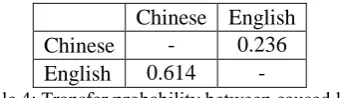
We also examine the conditional probabilities of the emotion(s) expressed in one language li
given that the emotion is expressed in another language lj simultaneously in a post. The
condi-tional probabilities are shown as in Table 4.
Chinese English
Chinese - 0.236
English 0.614 -
Table 4: Transfer probability between caused lan-guages
From the table, we find that there is a high probability that the two languages both express emotions, especially when given that the emotion 0.00
0.05 0.10 0.15 0.20 0.25 0.30 0.35
Life Finance Service Celebrities Products Politics
Pr
o
b
a
b
il
it
y
0 0.1 0.2 0.3 0.4 0.5 0.6 0.7
Happiness Sadness Fear Anger Surprise
Pr
o
b
a
b
il
it
y
[image:5.595.329.500.637.686.2]is expressed in English. It is also highly likely that the emotion would be expressed in Chinese.
Sentence Length Distribution of Each Lan-guage
Table 5 shows the statistics on the average sentence length of each language. We notice, as our data are always written by Chinese individu-als, the length of Chinese words is longer than English words. Besides, the emotions expressed through English text are mostly single words, e.g., happy, high, and surprise. Note that, as mentioned above, although the length of Chinese words is longer than English words, English is of vital importance to emotion expressions even in code-switching context dominated by Chinese.
#avg. word
Chinese 19.8
[image:6.595.103.260.287.328.2]English 2.9
Table 5: Statistics on average word length
Distribution of Cue Words
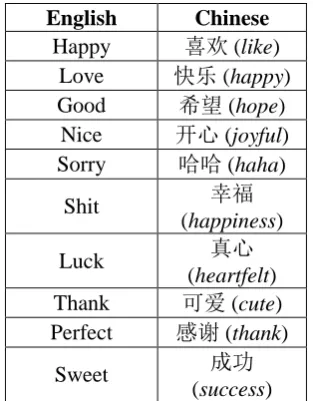
In addition, we count the top-10 frequency emotion cue words of both English and Chinese text as given in Table 6. We find that the most frequent cue words express happiness emotions, for example, happy, nice, and喜欢 (like). What is more, there are several negative expressions in the top-10 English cue words, e.g. sorry and shit, while the top-10 Chinese cue words are all posi-tive. This may be due to the fact that expressing the negative emotion through native language (Chinese) would be too explicit for Chinese indi-viduals, while most of them tend to express their negative emotions implicitly.
English Chinese
Happy 喜欢 (like)
Love 快乐 (happy)
Good 希望 (hope)
Nice 开心 (joyful)
Sorry 哈哈 (haha)
Shit 幸福
(happiness)
Luck 真心
(heartfelt)
Thank 可爱 (cute)
Perfect 感谢 (thank)
Sweet 成功
[image:6.595.313.523.326.607.2](success) Table 6: Statistics of emotional cue words
5
Automatic Emotion Detection in
Code-switching Texts
Based on the annotated corpus data, we attempt to detect emotion in code-switching text auto-matically. Results show both Chinese and Eng-lish texts are effective, and the classifier combi-nation approach which incorporates both Chinese and English text achieves the best performance.
5.1 Overview of Detection Approach
A straightforward approach to detect emotion in code-switching text is using a supervised learn-ing approach to classify the mixed text without any processing. Besides, we extract unigrams as a feature for each post. As emotions could be expressed in either Chinese or English text, we also adopt two classification approaches which consider Chinese or English texts individually.
Figure 5: Overview of the multiple-classifiers-based detection framework
However, a more effective way to detect emo-tion in code-switching posts is incorporating both Chinese and English text through a Multiple Classifier System (MCS). The key issue in con-structing a multiple classifier system is to find a suitable way to combine the outputs of the base classifiers. In MCS literature, various methods are available for combining the outputs, such as fixed rules including the voting rule, the product
Documents
Chinese Text English Text
Code-switching text Identification
Chinese Text
Classifier fCN
English Text
Classifier f
EN
Classifiers Combination by sum rule
[image:6.595.103.260.541.742.2]rule and the sum rule (Kittler et al., 1998; Li et al., 2010). In this study, we adopt the sum rule, a popular fixed rule to combining the outputs of both Chinese and English text classifiers.
For utilizing MCS to detect emotion in code-switching texts, we first define the base classifi-ers. In this paper, we use the Chinese text classi-fier fCN and English text classifier fEN which only considers Chinese text or English text indi-vidually as two base classifiers. Each base classi-fier provides a kind of confidence measurement, e.g., posterior probabilities of the test sample belonging to each class. Formally, each base classifier fi assigns a test sample (denoted as xi)
a posterior probability vector P x( )i :
( )i ( | i),..., ( j| i),..., ( n| i) t
P x p c x p c x p c x (1)
Where (p cj|xi) denotes the probability that the
i-th base classifier considers the sample belong-ing cj .
After we define the two base classifiers, we can use a sum rule to combine the base classifiers by summing the posterior possibilities and using the sum possibility for decision, i.e.
assign j where = argmax ( j| i)
j i
yc k
p c xFigure 5 illustrates the process of the multiple classifier system for emotion detection in code-switching texts.
5.2 Experiments
As described in Section 3, the data are collected from Weibo.com. We randomly select half of the posts as the training data and another half as the test data. We use FudanNLP1 for Chinese word segmentation and Maximum Entropy (ME) as the basic supervised classification model, while the ME algorithm is implemented with the MAL-LET Toolkit2. Note that, as the number of posts which express fear and surprise are limited, we only detect the other three kinds of emotions, i.e.
happiness, sadness, and anger.
As discussed in the above subsection, we use the following approaches for automatic emotion detection in code-switching text:
fALL: which uses all the words of each post as a feature to train a Maximum Entropy (ME) classification model.
1
https://code.google.com/p/fudannlp/
2 http://mallet.cs.umass.edu
fCN: which only uses the Chinese text of each post as a feature to train a Maximum Entropy (ME) classification model.
fEN: which only uses the English text of each post as a feature to train a Maximum Entropy (ME) classification model.
fcomb: which combines the results of the Chinese text classifier fCN and English text classifier fEN using the sum rule.
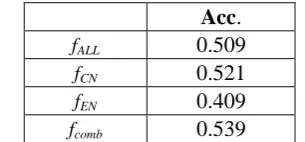
[image:7.595.334.487.241.312.2]The results of emotion detection are shown in Table 7. The performance indicates the accuracy of detecting emotions in code-switching text.
Acc.
fALL 0.509
fCN 0.521
fEN 0.409
fcomb 0.539
Table 7: Results of emotion detection in code-switching text
From the table, we find that:
1) The performance of basic approach fALL which uses mixed text directly is inferior. 2) As Chinese is the dominant language, and
the English text is loosely distributed, us-ing Chinese text (fCN) outperforms both using all text (fALL) and English text (fEN). Besides, as the English texts in the posts are always composed of single words, fEN is much lower than the other two ap-proaches.
3) As incorporating both Chinese classifiers and English classifiers to a multiple clas-sifier system, fcomb achieves a better per-formance than the other approaches. It al-so indicates that both Chinese text and English text in code-switching posts are effective for detecting emotions.
6
Conclusion
This paper presents the development of a code-switching emotion corpus in which the emotion is expressed through either Chinese or English. We first collect and filter the data from
in detecting emotions. We believe that emotions analysis in code-switching text underlies an in-novative approach towards a linguistic model of emotion as well as automatic emotion detection and classification.
Acknowledgments
The work is funded by an Early Career Scheme (ECS) sponsored by the Research Grants Council of Hong Kong (No. PolyU 5593/13H), and sup-ported by the National Natural Science Founda-tion of China (No. 61273320, and No. 61375073) and the Key Project of the National Natural Sci-ence Foundation of China (No. 61331011).
Firstly, we need to thank the hard works of the annotators. We thank Prof. Shoushan Li for his useful discussion. We acknowledge Helena Yan Ping Lau for corpus analysis and insightful comments. We also thank anonymous reviewers for their valuable suggestions and comments.
References
Adel H., N. Vu, and T. Schultz. 2013. Combination of Recurrent Neural Networks and Factored Language Models for Code-Switching Language Modeling. In Proceedings of ACL-13.
Andrew R. 1963. Evolution of Facial Expressions. Science, 142, 1034-1041.
Amini, M., C. Goutte, and N. Usunier. 2010. Combin-ing Coregularization and Consensusbased Self-training for Multilingual Text Categorization. In Proceeding of SIGIR-10.
Auer P. 1999. Code-Switching in Conversation.
Routledge.
Arnold J. 1999. Affect in Language Learning.
Cam-bridge, MA: CUP.
Auer P. 1984. Bilingual Conversation. Amsterdam:
John Benjamins.
Blom J., and J. Gumperz. 1972. Social Meaning in Linguistic Structures: Code Switching in Northern
Norway. Directions in Sociolinguistics. New York:
Winston.
Bridge D., J. Chiao, and K. Paller. 2010. Emotional Context at Learning Systematically Biases Memory
for Facial Information. Memory & Cognition, 38,
125-133.
Burkett, D., and D. Klein. 2008. Two Languages are
Better than One (for Syntactic Parsing). In
Pro-ceedings of EMNLP-08.
Chen Y., S. Lee, S. Li, and C. Huang. 2010. Emotion Cause Detection with Linguistic Constructions. In Proceeding of COLING-10.
Dasgupta S., and V. Ng. 2009. Mine the Easy, Classi-fy the Hard: A Semi-Supervised Approach to
Au-tomatic Sentiment Classification. In Proceedings of
ACL-IJCNLP-09.
Dewaele J., and A. Pavlenko. 2002. Emotion
Vocabu-lary in Interlanguage. Language Learning, 52 (2),
265-324.
Ekman, P., and W.V. Friesen. 1978. Facial Action
Coding System. California: Consulting Psychology Press.
Gao W., J. Blitzer, M. Zhou, and K. Wong. 2009. Exploiting Bilingual Information to Improve Web
Search. In Proceedings of ACL/IJCNLP-09.
Giles, H., and R. Clair. 1979. Language and Social
Psychology. London: Basil Blackwell.
Hervé, P., A. Razafimandimby, M. Vigneau, B. Ma-zoyer, and N. Tzourio-Mazoyer. 2012. Disentan-gling the Brain Networks Supporting Affective
Speech Comprehension. NeuroImage, 61(4),
1255-1267.
Kittler J., M. Hatef, R. Duin, and J. Matas. 1998. On
Combining Classifiers. IEEE Trans. PAMI.
20.226-239.
Lee S., H. Zhang, and C. Huang. 2013a. An
Event-Based Emotion Corpus. In Proceedings of CLSW
2013.
Lee S., Y. Chen, C. Huang, and S. Li. 2013b. Detect-ing Emotion Causes with a LDetect-inguistic Rule-Based
Approach. Computational Intelligence, 29(3),
390-416.
Lee S., S. Li, and C. Huang. 2014. Annotating Events
in an Emotion Corpus. In Proceedings of LREC-14.
Li S., S. Lee, Y. Chen, C. Huang, and G. Zhou. 2010. Sentiment Classification and Polarity Shifting. In Proceeding of COLING-10.
Li Y., and P. Fung. 2012. Code-switch Language Model with Inversion Constraints for Mixed
Lan-guage Speech Recognition. In Proceedings of
COLING-12.
Ling W., G. Xiang, C. Dyer, A. Black, and I. Trancoso. 2013. Microblogs as Parallel Corpora. In Proceedings of ACL-13.
Liu H., S. Li, G. Zhou, C. Huang, and P. Li. 2013. Joint Modeling of News Reader's and Comment
Writer's Emotions. In Proceedings of ACL-13,
shorter.
Lignos C., and M. Marcus. 2013. Toward Web-scale
Analysis of Codeswitching. In Proceedings of
An-nual Meeting of the Linguistic Society of America.
Lu B., C. Tan, C. Cardie, and B. Tsou. 2011. Joint Bilingual Sentiment Classification with Unlabeled
Myers-Scotton C. 1997. Duelling Language: Gram-matical Structure in Code-switching. Oxford: Clar-endon.
Olson I., A. Plotzker, and Y. Ezzyat. 2007. The En-igmatic Temporal Poles: A Review of Findings on
Social and Emotional Processing. Brain.
Pavlenko A. 2008. Structural and Conceptual Equiva-lence in Acquisition and Use of Emotion Words in
a Second Language. Mental Lexicon, 3(1): 91-120.
Peng N., Y. Wang, and M. Dredze. 2014. Learning Polylingual Topic Models from Code-Switched
Social Media Documents. In Proceedings of
ACL-14.
Quan C., and F. Ren. 2009. Construction of a Blog Emotion Corpus for Chinese Emotional Expression
Analysis. In Proceedings of EMNLP-09.
Rao Y., X. Quan, W. Liu, Q. Li, and M. Chen. 2012. Building Word-emotion Mapping Dictionary for
Online News. In Proceedings of SDAD 2012 The
1st International Workshop on Sentiment Discov-ery from Affective Data.
Schrauf R. 2000. Bilingual Autobiographical Memory:
Experimental Studies and Clinical Cases. Culture
and Psychology. 6 (4), 387-417.
Schumann J. 1999. A Neurobiological Perspective on Affect and Methodology in Second Language
Learning. Affect in Language Learning. Cambridge:
CUP, 28-42.
Smith C., and L. Kirby. 2001. Toward Delivering on
the Promise of Appraisal Theory. Appraisal
pro-cesses in emotion: Theory, methods, research. Ox-ford, UK: Oxford University Press.
Smith C., and R. Lazarus. 1993. Appraisal Compo-nents, Core Relational Themes, and the Emotions. Cognition and Emotion, 7, 233–269.
Solorio T., and Y. Liu. 2008. Learning to Predict
Code-Switching Points. In Proceedings of
EMNLP-08.
Volkova S., W. Dolan, and T. Wilson. 2012. CLex: A Lexicon for Exploring Color, Concept and Emotion
Associations in Language. In Proceedings of
EACL-12.
Wen S. and X. Wan. 2014. Emotion Classification in Microblog Texts Using Class Sequential Rules. In Proceedings of AAAI-14.
Xu G., X. Meng, and H. Wang. 2010. Build Chinese Emotion Lexicons Using A Graph-based
Algo-rithm and Multiple Resources. In Proceeding of
COLING-10.
Yang M., B. Peng, Z. Chen, D. Zhu, and K. Chow. 2014. A Topic Model for Building Fine-grained
Domain-specific Emotion Lexicon. In Proceedings