Selecting Domain-Specific Concepts for Question Generation
With Lightly-Supervised Methods
Yiping Jin
and
Phu T. V. Le
Knorex Pte. Ltd.
1003 Bukit Merah Central
Singapore 159836
{
jinyiping,le phu
}
@knorex.com
Abstract
In this paper we propose content selection methods for question generation (QG) which exploit domain knowledge. Traditionally, QG systems apply syntactical transformation on individual sentences to generate open domain questions. We hypothesize that a QG sys-tem informed by domain knowledge can ask more important questions. To this end, we propose two lightly-supervised methods to se-lect salient target concepts for QG based on domain knowledge collected from a corpus. One method selects important semantic roles with bootstrapping and the other selects im-portant semantic relations with Open Infor-mation Extraction (OpenIE). We demonstrate the effectiveness of the two proposed methods on heterogeneous corpora in the business do-main. This work exploits domain knowledge in QG task and provides a promising paradigm to generate domain-specific questions.
1 Introduction
Automatic question generation (QG) has been suc-cessfully applied in various applications. QG was used to generate reading comprehension questions from text (Heilman and Smith, 2009; Becker et al., 2012), to aid academic writing (Liu et al., 2010; Liu et al., 2012) and to build conversational char-acters (Yao et al., 2012; Nouri et al., 2011).
In this work, we focus on generating a set of ques-tion and answer (Q&A) pairs for a given input doc-ument. Possible applications of this task are to auto-matically generate a Q&A section for company pro-files or product descriptions. It can also help the
reader to recapitulate the main ideas of a document in a lively manner.
We can coarsely divide QG into two steps: “what to ask” (target concept selection andquestion type determination), and “how to ask” (question realisa-tion) (Nielsen, 2008).
It is important to view question generation not merely as realising a question from a declarative sentence. When the input is a document, the sen-tences (and candidate concepts) are of different im-portance. It is therefore critical for a QG system to identify a set of salient concepts as target con-cepts before it attempts to generate questions. In this work, we propose two novel target concept se-lection methods that lead to QG systems which can ask more important questions.
Our approaches are motivated by the conditions for a human reader to ask good questions. In order to ask good questions, he needs to satisfy three prereq-uisites: 1) good command of the language, 2) good reasoning and analytical skills and 3) sufficient do-main knowledge. Some may argue prior knowledge is not necessary because we ask about things we do not know. However, it is no surprise that a profes-sor in computational linguistics may not ask as im-portant and relevant questions in the field of organic chemistry as a second-year chemistry student. What makes the difference is the domain knowledge.
Correspondingly, we hypothesize that a success-ful QG system needs to satisfy the following require-ments: 1) able to generate questions that are gram-matical and understandable by humans, 2) able to analyse the input document (e.g. keyword identifi-cation, discourse parsing or summarization), and 3)
able to exploit domain knowledge.
Previous works mainly focused on addressing the first two requirements. Researchers tend to pre-fer systems that ask open domain questions because the dependency on domain knowledge is usually re-garded as an disadvantage. Several NLG applica-tions successfully utilized domain knowledge, such as virtual shopping assistant (Chai et al., 2001) and sport event summarization (Bouayad-Agha et al., 2011). However, the domain knowledge that they used are manually constructed by human experts. To the best of our knowledge, this paper is the first work in QG that attempts to utilize domain knowledge ob-tained in a lightly-supervised manner.
Although we choose QG as the application in this work, the lightly-supervised content selection meth-ods that we propose could also be applied to aug-ment other NLG tasks such as summarization.
In section 2, we present previous works of QG and how we position this work into the full storyline. In section 3, we briefly describe the dataset we use. Section 4 introduces two target concept selection methods based on automatically constructed domain knowledge. Section 5 describes methods to generate Q&A pairs from target concepts. In section 6, we present our experimental results. Lastly, we present conclusions and suggest future directions. The con-tributions of this paper are:
1. Propose to select target concepts for question generation with lightly-supervised approaches. 2. Demonstrate that the use of domain knowledge
helps to ask more important questions.
3. Quantitatively evaluate the impact of different ways to represent and select target concepts on question generation task.
2 Connections with Prior Work
Olney et al. (2012) classified question generation (QG) approaches into two categories: knowledge-poor and knowledge-rich.
The knowledge-poor approaches (Ali et al., 2010; Heilman and Smith, 2009; Kalady et al., 2010; Varga, 2010; Wyse and Piwek, 2009) focus mainly on question realisation. A representative approach was proposed by Heilman et. al (2009). Their system took an “overgenerate-and-rank” strategy.
Firstly, they applied manual transformation rules to simplify declarative sentences and to transform them into questions. The system generated different types of questions by applying different transformation rules. Secondly, they utilized a question ranker to rank all the questions generated from a input doc-ument based on features such as length, language model and the presence of WH words.
The knowledge-poor approaches suffer mainly from two problems. Firstly, they have difficulty determining the question type (Olney et al., 2012). Secondly, it is difficult to evaluate the importance of the questions with respect to the input document.
In contrast, the knowledge-rich approaches build intermediate semantic representations before gen-erating questions. Knowledge-rich approaches not only address “how to ask” but also propose promis-ing methods to select target concepts to generate questions. Knowledge-rich approaches have the ad-vantage of asking more important questions with the help of specific linguistic phenomena, discourse connectors or topic modelling.
Chen (2009) made use of discourse relations (con-ditions and temporal contexts) as well as modal-ity verbs to generate questions. His work acknowl-edged that language understanding is tightly related to question asking (Graesser and Franklin, 1990; Ol-son et al., 1985). After knowing the discourse re-lation in the sentence, the system could ask ques-tions like “what-would-happen-if” or “when-would-x-happen” using a handful of question templates. However, the system is limited to asking only con-dition, temporal and modality questions.
Olney et al. (2012) continued the progress made by Chen (2009). They semi-automatically built a concept graph using 30 abstract and domain-independent relations1. To extract the relation
triples, they firstly applied semantic role labelling and then labeled the argument A0, A1 or A2 to the desired argument of the relations with a man-ual mapping created for every frequent predicate in the corpus. To generate questions from conceptual graph, they firstly rendered the relation triple as a declarative sentence. Then they substituted one of the relation nodes with “what” to form the question.
1Examples of relations are “after”, “enables”,
Becker et al. (2010) utilized summarization to select key sentences for QG. Internally, the sum-mariser identifies key concepts, links the concepts and selects the important ones through concept graph analysis.
Chali and Hasan (2015) employed similar sen-tence simplification and transformation pipeline as the knowledge-poor system proposed in Heil-man (2009). However, the system performed topic modelling to identify subtopics of the document. It then ranked the questions based on how well they align towards the subtopics.
Our approach belongs to knowledge-rich category and is most similar to Becker et al. (2010) and Chali and Hasan (2015). However, these two systems do not take domain knowledge into consideration when selecting the target concepts. When the input docu-ment contains multiple topics, the underlying sum-marization and topic modeling methods may not se-lect a balanced list of concepts (Gupta and Lehal, 2010; Lu et al., 2011). Instead of relying on the input document alone, we also exploit automatically con-structed domain knowledge to select concepts that are important not only to the input document, but also to the underlying domain.
3 Datasets
We make use of two datasets obtained from the In-ternet. One is 200k company profiles from Crunch-Base. Another is 57k common crawl business news articles. We refer to these two corpora as “Company Profile Corpus” and “News Corpus”. Each article in News Corpus is also assigned a subcategory by edi-tors (e.g. credit-debt-loan, financial planning, hedge fund, insurance.). There are altogether 12 subcate-gories.
We randomly selected 30 company profiles and 30 news articles for manual evaluation. The rest of the datasets are used for development.
4 Target Concept Selection
We propose two target concept selection methods based on the following intuitions:
1. Target concepts shall contain important seman-tic roles (e.g. company name, product name). 2. Target concepts shall contain important
seman-tic relations (e.g. merger, acquisition).
Whether a target concept is important depends not only on itself, but also on the input document and the domain. Hence, we choose to rely primarily on contextual statistics calculated in a corpus instead of human-crafted knowledge in the form of annotated data, lexicons or rules.
4.1 Role-Based Target Concept Selection
Our role-based concept selection method identifies different semantic roles and ask questions about them. This method is inspired by Wikipedia In-fobox. Wikipedia Infobox contains key facts (con-cepts) of the entities. Extracting infobox-like infor-mation prior to generating questions solves the two problems of knowledge-poor QG systems. Firstly, we can easily determine the correct question type by knowing the semantic class. For example, for “customer” and “competitor”, it is natural to ask a “Who” question while for “product” we will ask a “What” question. Secondly, because we extract con-cepts defined in Wikipedia Infobox, they are by na-ture important. Therefore the system is less likely to generate trivial or unrelated questions.
We could have chosen to manually define extrac-tion rules to perform informaextrac-tion extracextrac-tion. How-ever, such method is not portable to other domains. Suppose we build a rule-based QG system for com-pany profiles, if we want to port it to product de-scriptions, we need to rewrite almost all the rules. We prefer a system that takes as little manual super-vision as possible, yet able to capture the important semantic roles in a domain.
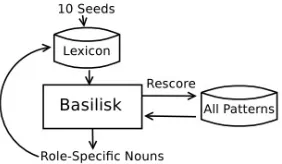
We employed bootstrapping to mine semantic roles. Bootstrapping is not limited to a predefined set of roles, but can adapt itself based on the seed words the user provides. We used Basilisk (Thelen and Riloff, 2002) to perform bootstrapping. Basilisk was originally designed to mine semantic lexicons. As shown in figure 1, Basilisk takes a small set of seed nouns for each semantic class, learns the pat-terns that extract these nouns and uses the patpat-terns to extract more nouns playing the same semantic role. The authors applied this system on MUC-4 corpus and demonstrated it was able to learn high-quality semantic lexicons for multiple categories.
Figure 1:Basilisk algorithm.
the category is important. For this work, we used the following categories: company, location, prod-uct/service, customer, partner and date. Following Phillips and Riloff (2007), we only used patterns whose anchor is a verb. We empirically tuned the number of iterations for bootstrapping to avoid do-main drifting. The number of iterations in our ex-periment ranged from 50 to 500.
Note that some of the categories (company, loca-tion and date) can also be identified using named entity recognisers (NER) trained on annotated cor-pora. The difference between bootstrapping and NER is bootstrapping determines the semantic class of a word not by the surrounding window, but by the semantic role it plays. Since it is not the fo-cus of this work, we neither use information from NER, nor compare the accuracy of our bootstrap-ping method with NER systems.
Basilisk tends to prefer low frequency terms that occur only with patterns in the pattern dictionary. In our experiment, the highest ranked locations were “Rijsenhout”, “Dunston” and “Endicott”. All of them are little-known towns. The low frequency terms did not provide robust statistics and easily caused domain drift. We modified the original for-mula (forfor-mula 1) to boost more frequent candidate words (formula 2). 2 We do not add 1 to Fj, so
all the infrequent patterns that co-occur with only one candidate word will be ignored. We take square root to the denominatorPi to encourage words that
co-occur with more patterns. Table 1 shows exam-ple words learned for each semantic category along with the top patterns in the corresponding category.
AvgLog(wordi) =
Pj=1
Pi log2(Fj+ 1))
Pi (1)
2P
iis the number of patterns that extractwordi, andFj is
the number of distinct category members extracted by pattern j.
Company:
Communications, Electronics, Net-works, Energy, Media, Packaging
<SUBJ>passive verb(base)
<SUBJ>active verb(offer) noun(subsidiary) prep of<POBJ>
Location:
East, Africa, Republic, Asia, Zealand, Kingdom, America, Europe
passive verb(base) prep in<POBJ>
passive verb(headquarter) prep in <POBJ>
noun(office) prep in<POBJ>
Product:
equipment, devices, food, material, electronics, infrastructure, vehicles
active verb(provide)<DOBJ>
noun(manufacture) prep of<POBJ>
active verb(sell)<DOBJ>
Customer:
consumers, manufacturers, profession-als, organizations, retailers, agencies
active verb(serve)<DOBJ>
active verb(provide) prep to<POBJ>
active verb(enable)<DOBJ>
Partner:
alliance, partnership, agreement, rela-tionship, shareholding, royalty
active verb(sign)<DOBJ>
noun(alliances) have<DOBJ>
Date:
March, August, 2009, 2010
passive verb(found) prep in<POBJ>
active verb(announce) prep on<POBJ>
active verb(introduce) prep during<POBJ>
Table 1:Example semantic lexicon entries and extraction pat-terns.
AvgLog∗(wordi) =
Pj=1
Pi √log2(Fj))
Pi (2)
We used the bootstrapped patterns to extract se-mantic roles. The system first identifies all the noun phrases in the input document. A noun phrase will be tagged if it triggers one of the patterns in the pattern dictionary. 3 We noted that a few general
patterns also appeared in the pattern dictionary (e.g.
<PRODUCT> active verb(include). Subsequently all the subject of the trigger “include” will be re-garded as “product”). This may cause problem when we determine the question word based on the se-mantic type. However, we did not manually edit the bootstrapped pattern dictionary, trying to adhere to our lightly-supervised paradigm.
3We also tried to restrict the head word of the noun phrase
[image:4.612.115.256.74.156.2]4.2 Relation-Based Target Concept Selection
Our second approach selects salient relations as tar-get concepts. Traditionally, relation extraction sys-tems worked only for predefined relation types and required sizeable training data for each type of rela-tion (GuoDong et al., 2005). Open Informarela-tion Ex-traction (OpenIE) becomes the right choice because we neither want to limit the types of relations, nor want to spend many hours annotating training data.
OpenIE systems extract <subject, relation, object>triples using surface, part-of-speech or de-pendency patterns (Fader et al., 2011; Angeli et al., 2015). Some OpenIE implementations also provide confidence measure for the extracted triples. How-ever, this measure only evaluates the validity of the triples, but not the importance. Balasubramanian et al. (2013) observed that one of the major error sources of OpenIE systems was generating trivial and not informative triples.
We borrowed idea from an early work in semi-supervised information extraction to rank the relation triples based on domain relevance. Riloff (1996) proposed to rank patterns based on un-labelled relevant and irrelevant corpora. A pattern is regarded important if it occurs relatively frequently in the relevant corpus and much less frequently in the irrelevant corpus. She used the RlogF score (formula 3) to rank all the patterns.
RlogFi=log2(relfreqi)∗P(relevant|patterni) (3)
We first ran OpenIE 4 on News Corpus and
ex-tracted roughly 1.7 million relation triples. Extend-ing the idea of Riloff (1996), we ran one-versus-all experiments for each subcategory. In each run, we treated the documents in one subcategory as the rel-evant corpus and the rest as irrelrel-evant corpus. Ev-ery relation phrase would receive a RlogF score for each subcategory (it received 0 score for sub-categories where it did not appear in). If a relation phrase appeared in multiple subcategories, we sim-ply took the highestRlogF score it received as the final score. More formally, we used formula 4 to cal-culate the salience for each relation phrase. Where
counti,j is the number of times relation phrasei
ap-pears in documents in subcategoryjwhilecountiis 4We used the implementation of Angeli et al. (2015).
Hedge Fund Investing
lose value in have trade between be underwriter for cross below
pend against represent premium to Stocks Retirement Planning
be pay on retire at
trade dividend on be underfund by release earnings on contribute at time Credit Debt Loans Financial News contribute from arrest in be cut at time outraise
[image:5.612.309.523.69.211.2]downgrade have donate
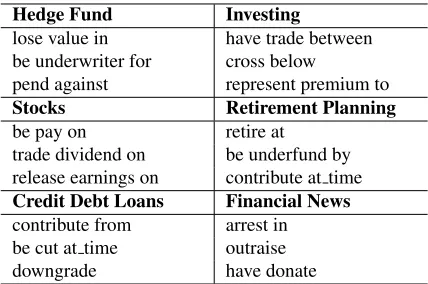
Table 2:Top relation phrases for selected subcategories.
the number of times relation phraseiappears in the whole News Corpus.
RlogF∗
i = arg maxj (log2(counti,j)∗ countcounti,j i ) (4)
Table 2 shows the top relation phrases for selected subcategories.
We measured the salience of each triple based on information collected on sentence, triple and word level. TheRlogF score measures the relevance of a
tripleto a domain. We denote this score asStriple.
We also used LexRank (Erkan and Radev, 2004), a summarization algorithm to calculate the salience of the sourcesentencewhere the question is generated. We denote this score asSsent. Lastly, we usedT F
-IDF scores of the triple’s subject headwordto es-timate the importance of the subject. We denote this score asSsubj.
We also incorporated trigram language model score Slm of the triple 5 to ensure the fluency of
the generated QA pairs. The final score of a triple is calculated as linear combination of the individ-ual scores. We empirically tuned the weights of the terms and obtained the final equation:6
S= 2·Striple+ 1·Ssent+ 0.3·Ssubj+ 10·Slm (5)
5 Question Generation From Concepts
We used SimpleNLG (Gatt and Reiter, 2009) to realise questions for both role-based and
relation-5We did not calculate language model scores based on
gen-erated questions because our language model is trained on a large News Corpus, where questions are relatively rare.
6Scores are not normalized to [0,1], so the weights cannot
active verb(offer) dobj(PRODUCT) What does Zoho offer?
Zoho offer Office Suite.
[image:6.612.86.279.69.183.2]passive verb(acquire) prep in(DATE) Q: When was StumbleUpon acquired in? A: StumbleUpon was acquired in May 2007. passive verb(acquire) agent(COMPANY) Q: StumbleUpon was acquired by whom? A: Ebay.
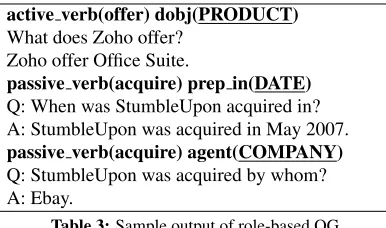
Table 3:Sample output of role-based QG.
based systems. SimpleNLG is a natural language generation framework which has been widely used for summarization, sentence simplification and data-to-text generation (Gatt et al., 2009; Genest and Lapalme, 2010). SimpleNLG can also transform declarative sentences to questions simply by declar-ing the interrogative type.
For role-based QG, we proceed to generate ques-tion if at least one semantic role is extracted from the sentence. We also identify from the sentence the subject, direct and indirect object and open clausal complement. We choose one of the noun phrases as answer phrase7and determine the question word
(Who, What, When, Where, How many, How much) based on the semantic type of the answer phrase. Ta-ble 3 shows examples of Q&A pairs role-based QG generated together with the patterns that extracted the answer phrase.
For relation-based QG, we proceed to generate questions from a triple if the triple’s final score is above 1.0. We set the maximum number of ques-tions for an input document to 15.
The triples are in<subject, relation, object> for-mat. However, the “object” of the triple is not al-ways the direct object or indirect object of the sen-tence. It can be an object of a preposition or even a verb compliment. As observed by Genest and La-palme (2010), the syntactical roles known to Sim-pleNLG are not the same as those known to a de-pendency parser. There is a need to treat the argu-ments differently based on their syntactic roles. We followed Genest and Lapalme (2010)’s approach to build noun phrase, prepositional phrase, verb com-pliment and verb phrase using SimpleNLG.
7The term “answer phrase” refers to phrases which may
serve as targets for questions, and therefore as possible answers to generated questions.
<Mr. Gibbs, consulting with, White House chief of staff>
Who is consulting with the White House chief of staff?
Mr. Gibbs.
<estimated cost, is, $6.65 billion>
How much is the estimated cost? $6.65 billion for the 43 banks.
<finance minister, post, link to satirists video>
What did the finance minister post? A link to satirists video on affair on Twitter.
Table 4:Sample output of relation-based QG.
We followed algorithm 1 to select the answer phrase (subject, object or none if it is a Yes/No ques-tion). If the answer phrase is a named entity, we choose the question word according to the entity type. Table 4 shows example relation triples and the Q&A pairs generated from the triples.
Algorithm 1Algorithm to select the answer phrase
ifrelation is a single frequent verb (e.g. do, go)then generate Yes/No question
else ifobject is a named entitythen select object as answer phrase else ifsubject is a named entitythen
select subject as answer phrase else ifobject is longer than subjectthen
select object as answer phrase else
select subject as answer phrase end if
6 Evaluation
We benchmarked our two systems with Heilman and Smith(2009), which is often used as a baseline for later QG systems8. Heilman’s system took an
overgeneration approach which relied on a question ranker to rank the Q&A pairs. We noted that many top questions the system generated are near dupli-cates of each other9. Hence, we manually removed
the near duplicate Q&A pairs before the evaluation and kept only the ones with the highest score.
8The source code is available at
www.ark.cs.cmu.edu/mheilman/questions/.
9Generated by applying different question templates on the
We generated questions with the three systems (Heilman, role-based QG and relation-based QG) on the evaluation set, which consists of 30 company profiles and 30 news articles.
6.1 Method
Following 2010 Question Generation Shared Task Evaluation Challenge (QG-STEC) (Boyer and Pi-wek, 2010) Task A10, we assigned individual scores
for different aspects to assess the quality of the gen-erated question and answer pairs.
Besides the five criteria used in QG-STEC11, we
added another measure “importance” as we prefer questions that ask about the main idea of the doc-ument. We also modified the “specificity” criterion to require the question to be sufficiently specific. A question like “Tell me about IBM.” is not specific enough and “What system does IBM provide?” is preferred in our evaluation.
The “specificity”, “syntax”, “semantics”, “impor-tance” and “question type correctness” scores are assigned for each question. They receive a bi-nary score (0 for unacceptable and 1 for accept-able/good).
The “overall” and “diversity” scores are assigned for the set of questions a system generated for an input document. They receive a score between 0 (worst) to 3 (best). 0 means “unacceptable”, 1 means “slightly unacceptable”, 2 means “acceptable” and 3 means “good”. The “overall” score is not an average of the individual scores. It is the subjective judge-ment on whether the set of Q&A pairs resembles the Q&A pairs a human would construct after reading the same document. We assign high “overall” score if the individual questions are of good quality and the set of questions covers the main ideas of the in-put document.
We invited two human judges to rate all the Q&A pairs independently. Both of the judges are native English speaker and are not involved in the develop-ment of this work. The judges were asked to read the input document before rating the Q&A pairs. They blindly rated the system output without being told which system generated the Q&A pairs.
10Task A is “Question Generation from Paragraph”, while
task B is “Question Generation from Sentence”.
11The five criteria are for “specificity”, “syntax”,
“seman-tics”, “question type correctness” and “diversity”
Measure κ % Agreement
Overall 0.51 (0.82) Specificity 0.18 (0.77) Syntactic 0.11 (0.85) Semantic 0.18 (0.79)
QType 0.27 (0.87)
Importance 0.10 (0.50) Diversity 0.80 (0.91) Table 5:Inter-Rater reliability.
Heilman Role-Based Relation-Based Corpus Prf. News Prf. News Prf. News Overall 1.65 1.9 1.67 1.7 1.85 1.88 Diversity 2.15 2.27 1.68 1.98 2.1 2.28 Specificity 0.84 0.88 0.83 0.76 0.93 0.87 Syntactic 0.86 0.89 0.88 0.92 0.93 0.95 Semantic 0.82 0.87 0.83 0.83 0.90 0.86
QType 0.86 0.9 0.9 0.84 0.93 0.94
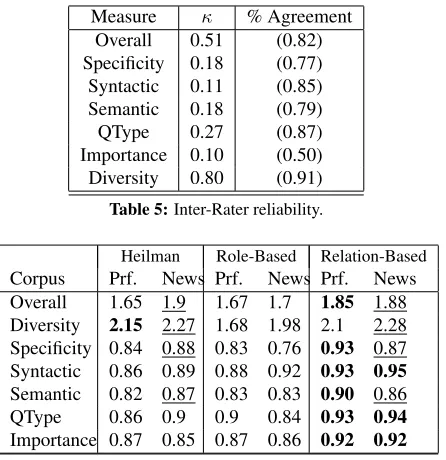
[image:7.612.308.531.68.298.2]Importance 0.87 0.85 0.87 0.86 0.92 0.92 Table 6: Mean ratings across different systems and genre. “Prf.” denotes results on the 30 company profiles in the eval-uation dataset and “News” denotes results on the 30 news arti-cles in the evaluation dataset. The best score for each measure is bolded. If there is a tie for the best score (difference<1%), both scores are underlined.
We used weighted Cohen’s κ to measure inter-rater reliability between the two judges. For “over-all” and “diversity” scores, we penalized only when the scores assigned by the two annotators differed for more than 1. Table 5 show bothκand percent-age of agreement between them.
Although κ is consistently low, the judges as-signed the same score about 80% of the times (ex-cept for the importance measurement). There are two main reasons for the low κ score. Firstly, both the annotators assigned 1 (acceptable) for most questions, making the probability of random agree-ment very high. Secondly, we observe annotator 1 is consistently more generous than annotator 2 when assigning scores. Most of the disagreement cases consist of annotator 1 assigning 1 (acceptable) and annotator 2 assigning 0 (unacceptable).
6.2 Results
Table 6 presents the mean ratings of the three sys-tems assigned by the two human judges.
on Company Profile Corpus. For News Corpus, relation-based QG and Heilman’s system performed roughly equally well. Relation-based QG outper-formed Heilman’s system in terms of “question type” and “importance” on both corpora, confirming that exploiting domain knowledge helped QG sys-tems to ask more important questions.
Our two systems also generated more grammati-cal Q&A pairs. Heilman’s system relied heavily on manual transformation rules on the parse tree to sim-plify sentences. Instead of trying to remove unim-portant constituents (e.g.: relative clauses, temporal modifiers), our systems focused on important con-cepts and generated questions about them. As a re-sult, the questions our systems generated are often more concise compared to the questions generated by Heilman’s system. The average length of ques-tions generated by role-based and relation-based QG were 7.4 and 9.1 words. Heilman’s system generated questions with average length of 14.4 words, 95% and 58% longer.
The performance of role-based QG was lacklus-ter. It managed to obtain similar scores as the base-line on Company Profile Corpus, yet still lagging behind relation-based QG. On News Corpus, it per-formed noticeably worse than the other two systems. Why relation-based QG performs better than role-based QG? OpenIE triples have been widely used in different tasks, including question answering, infor-mation retrieval and inference (Angeli et al., 2015). Their advantage is that they are concise and yet are able capture either a static relation or an event. It is relatively simple to realise sentences from relation triples and we do not need to refer to the original sentence to realise the questions.
We identified two major problems with the role-based approach. Firstly, not all sentences contain-ing an important semantic role should be considered for QG. Some sentences only mention the seman-tic role briefly, making it difficult to generate self-contained questions. That is why relation triples might be a more preferable unit than single seman-tic roles to represent target concepts. Secondly, al-though we used lightly-supervised method, we still need to handpick the semantic categories. For com-pany profiles, it is acceptable because the number of candidate concepts are fewer. For news articles, the categories we predefined may fail to cover the
vari-ety of topics (E.g. semantic types like stock name, funding rounds are not covered in our list).
While individual questions received relatively high scores (>80%) across different measures, none of the three systems managed to obtain comparable overall score (the highest being 63%). This suggests possible directions for future work to select, orga-nize and present a set of questions generated from a text document in a meaningful manner to replace manually compiled FAQs.
7 Conclusions and Future Works
Motivated by the prerequisites for humans to ask good questions, we proposed two target concept se-lection methods for question generation (QG) that acquire and exploit domain knowledge.
We divided QG into two steps: firstly to extract target concepts in the form of semantic roles or re-lation triples, secondly to ask questions about the extracted concepts. Aiming to make the approach general and easily adaptable, both target concept se-lection approaches are lightly-supervised and do not require manually written rules or lexicons.
One of our proposed systems, relation-based QG, was able to generate more important questions on heterogeneous corpora, showing the feasibility of building a domain-specific question generation sys-tem without heavy human supervision. By focusing on the most important concepts, our systems could also to ask more concise and grammatical questions. In future work, we plan to benchmark our systems with other knowledge-rich QG systems such as Ol-ney et al.(2012), Becker et al.(2010) and Chali and Hasan.(2015). We want to quantitatively evaluate the advantage of using domain knowledge over rely-ing on content analysis of the input document alone. We also aim to generate high-level questions that are beyond single sentence and to learn paraphrases of questions from community-based Q&A websites.
Acknowledgments
References
Husam Ali, Yllias Chali, and Sadid A Hasan. 2010. Automation of question generation from sentences.
InProceedings of QG2010: The Third Workshop on
Question Generation, pages 58–67.
Gabor Angeli, Melvin Johnson Premkumar, and Christo-pher D Manning. 2015. Leveraging linguistic struc-ture for open domain information extraction. In Pro-ceedings of the 53rd Annual Meeting of the Associa-tion for ComputaAssocia-tional Linguistics and the 7th Inter-national Joint Conference on Natural Language Pro-cessing of the Asian Federation of Natural Language Processing, ACL, pages 26–31.
Niranjan Balasubramanian, Stephen Soderland, Oren Et-zioni Mausam, and Robert Bart. 2013. out of the box information extraction: a case study using bio-medical texts.
Lee Becker, Rodney D Nielsen, Ifeyinwa Okoye, Tamara Sumner, and Wayne H Ward. 2010. Whats next? tar-get concept identification and sequencing. In Proceed-ings of QG2010: The Third Workshop on Ques-tion Generation, page 35.
Lee Becker, Sumit Basu, and Lucy Vanderwende. 2012. Mind the gap: learning to choose gaps for question generation. In Proceedings of the 2012 Conference of the North American Chapter of the Association for Computational Linguistics: Human Language
Tech-nologies, pages 742–751. Association for
Computa-tional Linguistics.
Nadjet Bouayad-Agha, Gerard Casamayor, and Leo Wan-ner. 2011. Content selection from an ontology-based knowledge base for the generation of football sum-maries. InProceedings of the 13th European
Work-shop on Natural Language Generation, pages 72–81,
Nancy, France, September. Association for Computa-tional Linguistics.
Kristy Elizabeth Boyer and Paul Piwek. 2010. Proceed-ings of qg2010: The third workshop on question gen-eration.
Joyce Yue Chai, Malgorzata Budzikowska, Veronika Horvath, Nicolas Nicolov, Nanda Kambhatla, and Wlodek Zadrozny. 2001. Natural language sales assistant-a web-based dialog system for online sales. InIAAI, pages 19–26.
Yllias Chali and Sadid A Hasan. 2015. Towards topic-to-question generation. Computational Linguistics. Wei Chen, Gregory Aist, and Jack Mostow. 2009.
Gener-ating questions automatically from informational text. InProceedings of the 2nd Workshop on Question Gen-eration (AIED 2009), pages 17–24.
G¨unes Erkan and Dragomir R Radev. 2004. Lexrank: Graph-based lexical centrality as salience in text sum-marization. Journal of Artificial Intelligence Re-search, 22:457–479.
Anthony Fader, Stephen Soderland, and Oren Etzioni. 2011. Identifying relations for open information ex-traction. InProceedings of the Conference on
Empiri-cal Methods in Natural Language Processing, pages
1535–1545. Association for Computational Linguis-tics.
Albert Gatt and Ehud Reiter. 2009. Simplenlg: A realisa-tion engine for practical applicarealisa-tions. InProceedings of the 12th European Workshop on Natural Language
Generation, pages 90–93. Association for
Computa-tional Linguistics.
Albert Gatt, Francois Portet, Ehud Reiter, Jim Hunter, Saad Mahamood, Wendy Moncur, and Somayajulu Sripada. 2009. From data to text in the neonatal in-tensive care unit: Using nlg technology for decision support and information management. Ai Communi-cations, 22(3):153–186.
Pierre-Etienne Genest and Guy Lapalme. 2010. Text generation for abstractive summarization. In Proceed-ings of the Third Text Analysis Conference, Gaithers-burg, Maryland, USA. National Institute of Standards and Technology.
Arthur C Graesser and Stanley P Franklin. 1990. Quest: A cognitive model of question answering. Discourse processes, 13(3):279–303.
Zhou GuoDong, Su Jian, Zhang Jie, and Zhang Min. 2005. Exploring various knowledge in relation extrac-tion. InProceedings of the 43rd annual meeting on association for computational linguistics, pages 427– 434. Association for Computational Linguistics. Vishal Gupta and Gurpreet Singh Lehal. 2010. A
sur-vey of text summarization extractive techniques.
Jour-nal of Emerging Technologies in Web Intelligence,
2(3):258–268.
Michael Heilman and Noah A Smith. 2009. Ques-tion generaQues-tion via overgenerating transformaQues-tions and ranking. Technical report, DTIC Document.
Saidalavi Kalady, Ajeesh Elikkottil, and Rajarshi Das. 2010. Natural language question generation using syntax and keywords. InProceedings of QG2010: The Third Workshop on Question Generation, pages 1–10. questiongeneration. org.
Ming Liu, Rafael A Calvo, and Vasile Rus. 2010. Auto-matic question generation for literature review writing support. InIntelligent Tutoring Systems, pages 45–54. Springer.
Ming Liu, Rafael A Calvo, and Vasile Rus. 2012. G-asks: An intelligent automatic question generation system for academic writing support. Dialogue and
Discourse: Special Issue on Question Generation,
3(2):101–124.
models: an empirical study of plsa and lda. Informa-tion Retrieval, 14(2):178–203.
Rodney D Nielsen. 2008. Question generation: Pro-posed challenge tasks and their evaluation. InIn Pro-ceedings of the Workshop on the Question Generation Shared Task and Evaluation Challenge. Arlington, VA. Elnaz Nouri, Ron Artstein, Anton Leuski, and David R Traum. 2011. Augmenting conversational characters with generated question-answer pairs. In AAAI Fall Symposium: Question Generation.
Andrew M Olney, Arthur C Graesser, and Natalie K Per-son. 2012. Question generation from concept maps.
Dialogue and Discourse, 3(2):75–99.
Gary M Olson, Susan A Duffy, and Robert L Mack. 1985. Question-asking as a component of text com-prehension. The psychology of questions, pages 219– 226.
William Phillips and Ellen Riloff. 2007. Exploiting role-identifying nouns and expressions for information ex-traction. InProceedings of International Conference on Recent Advances in Natural Language Processing, pages 165–172. Citeseer.
Ellen Riloff. 1996. Automatically generating extraction patterns from untagged text. In Proceedings of the national conference on artificial intelligence, pages 1044–1049.
Michael Thelen and Ellen Riloff. 2002. A bootstrap-ping method for learning semantic lexicons using ex-traction pattern contexts. InProceedings of the ACL-02 conference on Empirical methods in natural lan-guage processing-Volume 10, pages 214–221. Associ-ation for ComputAssoci-ational Linguistics.
Andrea Varga. 2010. Le an ha 2010 wlv: A question generation system for the qgstec 2010 task b. In Pro-ceedings of QG2010: The Third Workshop on Ques-tion GeneraQues-tion, pages 80–83.
Brendan Wyse and Paul Piwek. 2009. Generating ques-tions from openlearn study units.