Proceedings of the 5th Workshop on Vision and Language, pages 19–28,
Focused Evaluation for Image Description with Binary Forced-Choice
Tasks
Micah Hodosh and Julia Hockenmaier Department of Computer Science, University of Illinois
Urbana, IL 61801, USA
{mhodosh2, juliahmr}@illinois.edu
Abstract
Current evaluation metrics for image de-scription may be too coarse. We therefore propose a series of binary forced-choice tasks that each focus on a different aspect of the captions. We evaluate a number of different off-the-shelf image description systems. Our results indicate strengths and shortcomings of both generation and rank-ing based approaches.
1 Introduction
Image description, i.e. the task of automatically associating photographs with sentences that de-scribe what is depicted in them, has been framed in two different ways: as a natural language gener-ation problem (where each system produces novel captions, see e.g. Kulkarni et al. (2011)), and as a ranking task (where each system is required to rank the same pool of unseen test captions for each test image, see e.g. Hodosh et al. (2013)).
But although the numbers reported in the litera-ture make it seem as though this task is quickly ap-proaching being solved (on the recent MSCOCO challenge,1the best models outperformed humans
according to some metrics), evaluation remains problematic for both approaches (Hodosh, 2015).
Caption generation requires either automated metrics (Papineni et al., 2002; Lin, 2004; Denkowski and Lavie, 2014; Vedantam et al., 2015), most of which have been shown to corre-late poorly with human judgments (Hodosh et al., 2013; Elliott and Keller, 2014; Hodosh, 2015) and fail to capture the variety in human captions, while human evaluation is subjective (especially when reduced to simple questions such as “Which is a better caption?”), expensive, and difficult to repli-cate. Ranking-based evaluation suffers from the
1http://mscoco.org/dataset/#captions-challenge2015
problem that the pool of candidate captions may, on the one hand, be too small to contain many meaningful and interesting distractors, and may, on the other hand, contain other sentences that are equally valid descriptions of the image.
To illustrate just how much is still to be done in this field, this paper examines a series of bi-nary forced-choice tasks that are each designed to evaluate a particular aspect of image descrip-tion. Items in each task consist of one image, paired with one correct and one incorrect caption; the system has to choose the correct caption over the distractor. These tasks are inspired both by ranking-based evaluations of image description as well as by more recent work on visual question answering (e.g. Antol et al. (2015)), but differ from these in that the negatives are far more re-stricted and focused than in the generic ranking task. Since most of our tasks are simple enough that they could be solved by a very simple deci-sion rule, our aim is not to examine whether mod-els could be trained specifically for these tasks. Instead, we wish to use these tasks to shed light on which aspects of image captions these mod-els actually “understand”, and how modmod-els trained for generation differ from models trained for rank-ing. The models we compare consist of a num-ber of simple baselines, as well as some publicly available models that each had close to state-of-the-art performance on standard tasks when they were published. More details and discussion can be found in Hodosh (2015).
2 A framework for focused evaluation
In this paper, we evaluate image description sys-tems with a series of binary (two-alternative) forced choice tasks. The items in each task consist of one image from the test or development part of the Flickr30K dataset (Young et al., 2014), paired
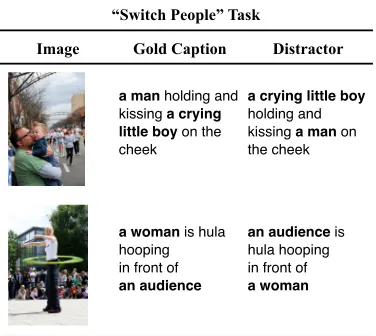
“Switch People” Task
Image Gold Caption Distractor
a man holding and kissing a crying little boy on the cheek
a crying little boy
holding and kissing a man on the cheek
a woman is hula hooping in front of
an audience
an audience is hula hooping in front of
[image:2.612.103.291.68.236.2]a woman
Figure 1: The“switch people”task
with one correct and one incorrect caption, and the system has to choose (i.e. assign a higher score to) the correct caption over the distractor.
The correct caption is either an original caption or a part of an original caption for the image. Dis-tractors are shorter phrases that occur in the orig-inal caption, complete captions for different im-ages that share some aspect of the correct caption, or are artificially constructed sentences based on the original caption. While all distractors are con-structed around the people or scene mentions in the original caption, each task is designed to focus on a particular aspect of image description. We focus on scene and people mentions because both occur frequently in Flickr30K. Unlike MSCOCO, all images in Flickr30K focus on events and ac-tivities involving people or animals. Scene terms (“beach”, “city”, “office”, “street”, “park”) tend to describe very visual, unlocalized components that can often be identified by the overall layout or other global properties of the image. At the same time, they restrict what kind of entities and events are likely to occur in the image. For in-stance, people do not “run” , “jump”, or “swim” in an “office”. Hence, models trained and tested on standard caption datasets do not necessarily need to model what “jumping in an office” might look like. We therefore suspect that much of the generic ranking task can be solved by identifying the vi-sual appearance of scene terms.
Some tasks require the system to choose be-tween two captions that provide similar descrip-tions of the main actor or the scene. In others, the distractor is not a full sentence, but consists only
“Replace Scene” Task
Image Gold Caption Distractor
two dogs playing
on a beach
two dogs playing
on frozen tundra
a brown dog is bending down trying to drink from
a jet of water
a brown dog is bending down trying to drink from
your local brewery
a man in a restaurant having lunch
a man in an office boardroom
[image:2.612.321.514.69.242.2]having lunch
Figure 2: The“replace scene”task
of the main actor or scene description. We also evaluate a converse task in which the distractor de-scribes the scene correctly (but everything else in the sentence is wrong), while the correct answer consists only of the NP that describes the scene. Finally, we consider a task in which the distractor swaps two people mentions, reversing their corre-sponding semantic roles while keeping the same vocabulary.
3 Our tasks
Our first task (switch people, Fig. 1) identifies the extent to which models are able to distinguish sentences that share the same vocabulary but con-vey different semantic information. In this task, the correct sentences contain one person tion as the main actor and another person men-tion that occupies a different semantic role (e.g. “A man holding a child”). The distractors (“A child holding a man”) are artificially constructed sentences in which those two people mentions are swapped. This allows us to evaluate whether mod-els can capture semantically important differences in word order, even when the bag-of-words repre-sentation of two captions is identical (and bag-of-words-based evaluation metrics such as BLEU1, ROUGE1 or CIDER would not be able to capture the difference either).
“Share Scene” Task
Image GoldCaption Distractor
a man in a suit and tie in a fancy building is speaking at the podium
a lady is giving a speech at the podium
there is a woman riding a bike down the road and she popped a wheelie
[image:3.612.320.516.63.241.2]two men in jeans and jackets are walking down a small road
Figure 3: The“share scene”task
aim to elicit how much systems are able to iden-tify correct person or scene descriptions. Mod-els should be able to understand when a person is being described incorrectly, even when the rest of the sentence remains correct. Similarly, since the scene is important to the overall understanding of the a caption, we wanted to make sure models grasp that changing the scene terms of a caption can drastically change its meaning.
Theshare person andshare scenedistractors (Fig. 3) are complete sentences from the training portion of Flickr30K whose actor or scene men-tions share the same headword as the correct de-scription for the test image. These tasks aim to elicit the extent to which systems focus only on the person or scene descriptions, while ignoring the rest of the sentence.
We also evaluate whether models are able to identify when a complete sentence is a better description of an image than a single NP. The
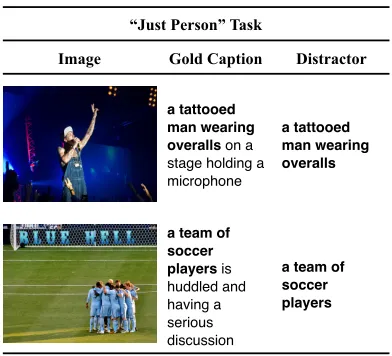
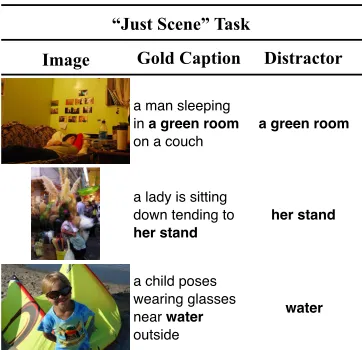
just person and just scene distractors (Figs. 4 and 5) are NPs that consist only of the person or scene mentions of the correct description, and aim to identify whether systems prefer more detailed (correct) descriptions over shorter (but equally correct) ones. Finally, since systems can perform well on these tasks by simply preferring longer captions, we also developed a conversejust scene (+)task, which pairs the (short, but correct) scene description with a (longer, but incorrect) sentence that shares the same scene.
3.1 Task construction
All our tasks are constructed around people and scene mentions, based on the chunking and the dictionaries provided in Plummer et al. (2015). Person mentions are NP chunks whose head noun
“Just Person” Task
Image Gold Caption Distractor
a tattooed man wearing overalls on a stage holding a microphone
a tattooed man wearing overalls
a team of soccer players is huddled and having a serious discussion
[image:3.612.102.292.68.201.2]a team of soccer players
Figure 4: The“just person”task
refer to people (“a tall man”) or groups of people (“a football team”), or “NP1-of-NP2” construc-tions where the head of the first NP is a collec-tive noun and the head of the second NP refers to people (“a group of protesters”). Subsequent NP chunks that refer to clothing are also included (“a girl in jeans”,“a team in blue”. Scene mentions are NP chunks whose head noun refers to locations (e.g.“beach”, “city”, “office”, “street”, “park”).
“Just Scene” Task
Image Gold Caption Distractor
a man sleeping in a green room
on a couch
a green room
a lady is sitting down tending to
her stand
her stand
a child poses wearing glasses near water
outside
[image:4.612.102.283.64.239.2]water
Figure 5: The“just scene”task
Replace person/scene tasks For the “replace person” task, we isolate person chunks, in both the training and development data. For each develop-ment sentence, we create a distractor by replacing each person chunk with a random chunk from the training data, resulting in 5816 example pairs to evaluate. For the “replace scene” task we created negative examples by replacing the scene chunk of a caption with another scene chunk from the data. Because multiple surface strings can describe the same overall scene, we use the training corpus to calculate which scene chunk’s headwords can co-occur in the training corpus. We avoid all such replacements in order to ensure that the negative sentence does not actually still describe the im-age. In theory, this should be a baseline that all state-of-the-art image description models excel at.
Share person/scene tasks Here, the distractors consist of sentences from the Flickr30K training data which describe a similar main actor or scene as the correct caption. For each sentence in the de-velopment data, we chose a random training sen-tence that shares the same headword for its “actor” chunk, resulting in 4595 items to evaluate. We did the same for development sentences that mention a scene term, resulting in 2620 items.
Just person/scene tasks Finally, the “just per-son” and “just scene” tasks require the models to pick a complete sentence (again taken from the de-velopment set) over a shorter noun phrase that is a substring of the correct answer, consisting of ei-ther the main actor or the scene description. Al-though the distractors are not wrong, they
typi-cally only convey a very limited amount of infor-mation about the image, and models should pre-fer the more detailed descriptions provided by the complete sentences, as long as they are also cor-rect. But since these tasks can be solved perfectly by any model that consistently prefers longer cap-tions over shorter ones, we also investigate a con-verse “just scene (+)” task; here the correct an-swer is a noun phrase describing the scene, while the distractor is another full sentence that contains the same scene word (as in the “share scene” task). Taken together, these tasks allow us to evaluate the extent to which models rely solely on the person or scene description and ignore the rest of the sen-tence.
4 The Models
We evaluate generation and ranking models that were publicly available and relatively close in per-formance to state of the art, as well as two simple baselines.
Generation models Our baseline model for generation (Bigram LM) ignores the image en-tirely. It returns the caption that has a higher prob-ability according to an unsmoothed bigram lan-guage model estimated over the sentences in the training portion of the Flickr30K corpus.
As an example of an actual generation model for image description, we evaluate a publicly available implementation2of the generation model
originally presented by Vinyals et al. (2015) (Generation). This model uses an LSTM (Hochreiter and Schmidhuber, 1997) conditioned on the image to generate new captions. The par-ticular instance we evaluate was trained on the MSCOCO dataset (Lin et al., 2014), not Flickr30K (leading to a possible decrease in performance on our tasks) and uses VGGNet (Simonyan and Zis-serman, 2014) image features (which should ac-count for a significant jump in performance over the previously published results of Vinyals et al. (2015)). Works such as Vinyals et al. (2015) and Mao et al. (2014) present models that are de-veloped for the generation task, but renormalize the probability that their models assign to sen-tences when they apply them to ranking tasks (even though their models include stop probabil-ities that should enable them to directly compare sentences of different lengths). To examine the
fect of such normalization schemes, we also con-sider normalized variants of our two generation models in which we replace the original sentence probabilities by their harmonic mean. We will see that the unnormalized versions of these mod-els tend to perform poorly when the gold caption is measurably longer than the distractor term, and well in the reverse case, while normalization at-tempts to counteract this trend.
Ranking models Ranking models learn embed-dings of images and captions in the same space, and score the affinity of images and captions in terms of their Euclidian distance in this space. We compare the performance of these generation models with two (updated) versions of the ranking model originally presented by Kiros et al. (2014)3
(LSTM Ranking), one trained on MSCOCO, and the other on Flickr30K. This model uses an LSTM to learn the embedding of the captions. While the Flickr30K trained model should be more appropri-ate for our test data, the MSCOCO trained model might be more directly comparable to the genera-tion model of Vinyals et al. A comparison between the two variants can offer insight into the degree of domain shift between the two datasets.
Our ranking baseline model (BOW Ranking) replaces the LSTM of Kiros et al. (2014) with a simple bag-of-words text representation, allow-ing us to examine whether the expressiveness of LSTMs is required for this task. We use the aver-age of the tokens’ GloVe embeddings (Pennington et al., 2014) as input to a fully connected neural network layer that produces the final learned text embedding4. More formally, for a sentence
con-sisting of tokensw1...wn, GloVe embeddingsφ(),
and a non-linear activation functionσw, we define the learned sentence embedding asF(w1...wn) =
σw(Ww·(1
n)
P
iφ(wi) +bw). Similarly, the
em-bedding of an image represented as a vector pis defined asG(p) =σi(Wi·p+bi). We use a rank-ing loss similar to Kiros et al. (2014) to train the parameters of our model, θ = (Ww, Wi, bw, bi). We define the distance of the embeddings of image
i and sentence s as ∆(i, s) = cos(F(i), G(s)). UsingSto refer to the set of sentences in the train-ing data, Si for the training sentences associated with imagei,S−i for the set of sentences not
as-sociated withi,Ifor the set of training images,Is 3https://github.com/ryankiros/visual-semantic-embedding 4Deeper and more complex representations showed no conclusive benefit
for the image associated with sentences, andI−s
for the set of all other training images, and em-ploying a free parametermfor the margin of the ranking, our loss function is:
L(θ) = X
i∈I,s∈Si,s0∈S−i
max(0, m−∆(i, s)+∆(i, s0))
+ X
s∈S,i∈Is,i0∈I−s
max(0, m−∆(i, s))+∆(i0, s)))
As input image features, we used the 19 layer VGGNet features (Simonyan and Zisserman, 2014), applied as by Plummer et al. (2015). We first process the GloVe embeddings by performing whitening through zero-phase component analysis (ZCA) (Coates and Ng, 2012) based on every to-ken appearance in our training corpus. We setσw
to be a ReLU and simply use the identity func-tion for σi(i.e. no non-linearity) as that resulted in the best validation performance. We train this model on the Flickr30K training data via stochas-tic gradient descent, randomly sampling either 50 images (or sentences), and randomly sampling one of the other training sentences (images). We adjust the learning rate of each parameter using Adagrad (Duchi et al., 2010) with an initial learning rate of 0.01, a momentum value of 0.8, and a parameter decay value of 0.0001 for regularization.
5 Results
Results for all tasks can be found in Table 1.
Switch Replace Replace Share Share Just Just Just People Person Scene Person Scene Person Scene Scene(+) # of pairs 296 5816 2513 4595 2620 5811 2624 2620
Bigram LM 69.8 83.0 77.5 49.6 47.9 1.1 0.0 99.6 Normalized Bigram LM 69.8 69.9 76.5 50.2 50.9 31.3 28.2 71.0
Generation (COCO) 69.3 85.2 85.2 56.5 54.7 3.8 7.4 94.2
Normalized Generation (COCO) 68.9 74.0 85.5 61.6 59.2 79.5 97.3 5.5
BOW Ranking (Flickr30K) 50.0 84.9 89.3 93.6 89.9 81.2 84.6 71.3
LSTM Ranking (COCO) 52.0 79.4 86.6 89.9 88.0 79.8 86.5 58.2
LSTM Ranking (Flickr30K) 52.0 81.1 87.0 92.5 89.3 82.6 78.8 75.5
Table 1: Accuracies of the different models on our tasks
seems that localization of entities (Plummer et al., 2015; Xu et al., 2015) may be required to address this issue and go beyond baseline performance.
The “replace person/scene” tasks On the “re-place person” task, the (unnormalized) bigram baseline has a relatively high accuracy of 83%, perhaps because the distractors are again artifi-cally constructed sentences. The ranking baseline model and the (unnormalized) generation model outperform this baseline somewhat at around 85%, while the ranking models perform below the bi-gram baseline. The ranking model trained on Flickr30K has a slight advantage over the same model trained on MSCOCO, an (unsurprising) dif-ference that also manifests itself in the remaining tasks, but both models perform below the rank-ing baseline. Normalization hurts both generation models significantly. It is instructive to compare performance on this task with the “replace scene” task. We see again that normalization hurts for generation, while the baseline ranking model out-performs the more sophisticated version. But here, all models that consider the image outperform the bigram model by a very clear eight to almost twelve percent. This indicates that all image de-scription models that we consider here rely heav-ily on scene or global image features. It would be interesting to see whether models that use explicit object detectors could overcome this bias.
The “share person/scene” tasks The distrac-tors in these tasks are captions for other images that share the same actor or scene head noun. Since the bigram language models ignore the im-age, they cannot distinguish the two cases (it is unclear why the unnormalized bigram model’s ac-curacy on the “share scene” task is not closer to fifty percent). And while normalization helps the generation model a little, its accuracies of 61.6% and 59.2% are far below those of the ranking
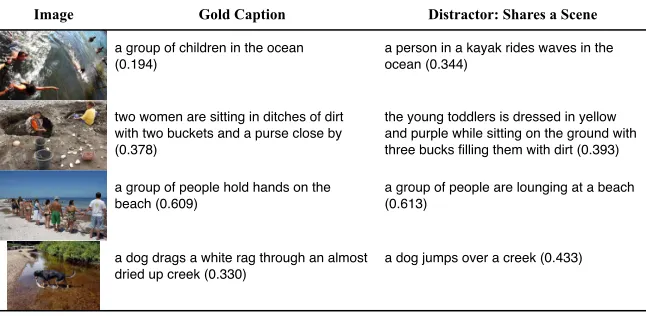
mod-els, indicating that the latter are much better at distinguishing between the correct caption and an equally fluent, but incorrect one. This is perhaps not surprising, since this task is closest to the rank-ing loss that these models are trained to optimize. By focusing on an adversarial ranking loss be-tween training captions, the ranking model may be able to more correctly pick up important subtle differences between in-domain images, while the generation model is not directly optimized for this task (and instead has to also capture other proper-ties of the captions, e.g. fluency). With an accu-racy of 93.6% and 89.9%, the bag-of-word ranking baseline model again outperforms the more com-plex LSTM. But examining its errors is informa-tive. In general, it appears that it makes errors when examples require more subtle understanding or are atypical images for the words in the caption, as shown in Figure 6.
Image Gold Caption Distractor: Shares a Scene
a group of children in the ocean (0.194)
a person in a kayak rides waves in the ocean (0.344)
two women are sitting in ditches of dirt with two buckets and a purse close by (0.378)
the young toddlers is dressed in yellow and purple while sitting on the ground with three bucks filling them with dirt (0.393)
a group of people hold hands on the beach (0.609)
a group of people are lounging at a beach (0.613)
a dog drags a white rag through an almost dried up creek (0.330)
[image:7.612.144.467.64.222.2]a dog jumps over a creek (0.433)
Figure 6: Examples from the “share scene” task that the BOW ranking model gets wrong, together with its scores for each of the captions.
does not take the image into account), and, to a slightly lesser extent, by the unnormalized gen-eration model (which does). Both models have near perfect accuracy on the “just scene (+)” task, and near complete failure on the other two tasks. Length normalization reduces this preference for shorter captions somewhat in the case of the bi-gram model, and seems to simply reverse it for the generation model. None of the ranking models show such a marked preference for either long or short captions. But although each model has simi-lar accuracies on the “just scene” and on the “just scene (+)” task, accuracies on the “just scene” task are higher than on the “just scene (+)” task. This indicates that they are not always able to iden-tify when the additional information is incorrect (as in the “just scene (+)” task). Accuracies on the “just person” task tend to be lower, but are otherwise generally comparable to those on the “just scene” task. We see the biggest drops for the length-normalized generation model, whose accu-racy goes down from 97.3% on the scene task to 79.5% (indicating that something else besides a preference for longer captions is at play), and the MSCOCO-trained ranking model which goes down from 86.5% to 79.8%.
It is unclear why the performance on the “just person” task tends to be lower than on the “just scene” task. Since scenes correspond to global im-age properties, we stipulate that models are better at identifying them than most people terms. Al-though some people descriptions (e.g. “baseball player”, “audience”) are highly indicative of the scene, this is not the case for very generic terms
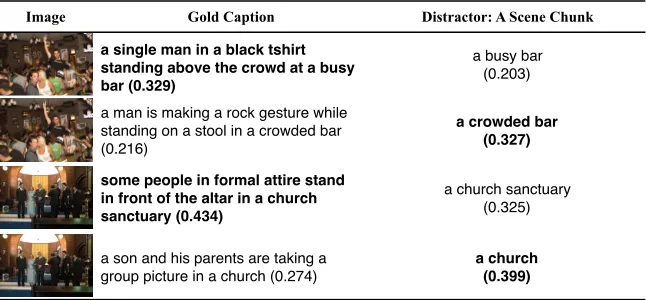
(“man”, “woman”). We also note that identifying when the additional information is correct can be quite difficult. For example, in the second example in Figure 4, the phrase “huddled and having a se-rious discussion” has to be understood in the con-text of soccer. While the dataset contains other im-ages of discussions, there are no other instances of discussions taking place on soccer fields, and the people in those cases tend to occupy a much larger portion of the image. Further analyzing and isolat-ing these examples (and similar ones) is key for fu-ture progress. Figure 7 shows items from the “just scene” task that the BOW model gets right, paired with items for the same image where it makes a mistake. For the first item, it seems that the model associates the terms “crowd” or “crowded” with this image (while not understanding that “busy” is synonymous with “crowded” in this context). The error on the second item may be due to the word “rock” in the correct answer (Flickr30K contains a lot of images of rock climbing), while the error on the fourth item may be due to the use of words like “parents” rather than the more generic “people.”
5.1 Discussion
per-Image Gold Caption Distractor: A Scene Chunk
a single man in a black tshirt standing above the crowd at a busy bar (0.329)
a busy bar (0.203)
a man is making a rock gesture while standing on a stool in a crowded bar (0.216)
a crowded bar (0.327)
some people in formal attire stand in front of the altar in a church sanctuary (0.434)
a church sanctuary (0.325)
a son and his parents are taking a group picture in a church (0.274)
[image:8.612.145.468.65.215.2]a church (0.399)
Figure 7: Items from the “Just Scene” task with the scores from the BOW ranking model in parentheses (bold = the caption preferred by the model).
formed similarly to a comparable LSTM model. The “switch people” results indicate that rank-ing models may not capture subtle semantic differ-ences created by changing the word order of the original caption (i.e. swapping subjects and ob-jects). But although generation models seem to perform much better on this task, their accuracy is only as good as, or even slightly lower than, that of a simple bigram language model that ignores the image. This indicates that generation models may have simply learned to distinguish between plausible and implausible sentences.
The “share person/scene” and “just per-son/scene” results indicate that ranking models may be better at capturing subtle details of the im-age than generation models. But our results also indicate that both kinds of models still have a long way to before they are able to describe images ac-curately with a “human level of detail.”
Our comparison of the LSTM-based model of Kiros et al. (2014) against our bag-of-words base-line model indicates that the former may not be taking advantage of the added representational power of LSTMs (in fact, most of the recent im-provements on this task may be largely due to the use of better vision features and dense word embeddings trained on large corpora). However, RNNs (Elman, 1990) and LSTMs offer convenient ways to define a probability distribution across the space of all possible image captions that cannot be modeled as easily with a bag-of-words style ap-proach. The question remains if that convenience comes at a cost of no longer being able to easily train a model that understands the language to an
acceptable amount of detail. It is also important to note that we were unable to evaluate a model that combines a generation model with a reranker such Fang et al. (2014) and the follow up work in De-vlin et al. (2015). In theory, if the generation mod-els are able produce a significantly enough diverse set of captions, the reranking can make up the gap in performance while still being able to generate novel captions easily.
6 Conclusion
It is clear that evaluation still remains a difficult is-sue for image description. The community needs to develop metrics that are more sensitive than the ranking task while being more directly correlated to human judgement than current automated met-rics used for generation. In this paper, we de-veloped a sequence of binary forced-choice tasks to evaluate and compare different models for im-age description. Our results indicate that gener-ation and ranking-based approaches are both far from having “solved” this task, and that each ap-proach has different advantages and deficiencies. But the aim of this study was less to analyze the behavior of specific models (we simply used mod-els whose performance was close to state of the art, and whose implementations were available to us) than to highlight issues that are not apparent under current evaluation metrics, and to stimulate a discussion about what kind of evaluation meth-ods are appropriate for this burgeoning area. Our data is available,5and will allow others to evaluate
their models directly.
Acknowledgments
This paper is based upon work supported by the National Science Foundation under Grants No. 1205627, 1405883 and 1053856. Any opinions, findings, and conclusions or recommendations ex-pressed in this material are those of the author(s) and do not necessarily reflect the views of the Na-tional Science Foundation.
References
Stanislaw Antol, Aishwarya Agrawal, Jiasen Lu, Mar-garet Mitchell, Dhruv Batra, C. Lawrence Zitnick, and Devi Parikh. 2015. VQA: visual question an-swering. In2015 IEEE International Conference on Computer Vision, ICCV 2015, pages 2425–2433. Adam Coates and Andrew Y. Ng. 2012. Learning
fea-ture representations with k-means. InNeural Net-works: Tricks of the Trade - Second Edition, pages 561–580.
Michael Denkowski and Alon Lavie. 2014. Meteor universal: Language specific translation evaluation for any target language. InProceedings of the EACL 2014 Workshop on Statistical Machine Translation. Jacob Devlin, Hao Cheng, Hao Fang, Saurabh Gupta,
Li Deng, Xiaodong He, Geoffrey Zweig, and Mar-garet Mitchell. 2015. Language models for image captioning: The quirks and what works. In Pro-ceedings of the 53rd Annual Meeting of the Associ-ation for ComputAssoci-ational Linguistics and the 7th In-ternational Joint Conference on Natural Language Processing of the Asian Federation of Natural Lan-guage Processing, ACL 2015, Volume 2: Short Pa-pers, pages 100–105.
John Duchi, Elad Hazan, and Yoram Singer. 2010. Adaptive subgradient methods for online learn-ing and stochastic optimization. Technical Report UCB/EECS-2010-24, EECS Department, Univer-sity of California, Berkeley, Mar.
Desmond Elliott and Frank Keller. 2014. Comparing automatic evaluation measures for image descrip-tion. InProceedings of the 52nd Annual Meeting of the Association for Computational Linguistics (Vol-ume 2: Short Papers), pages 452–457, Baltimore, Maryland, June.
Jeffrey L. Elman. 1990. Finding structure in time. Cognitive Science, 14(2):179–211.
Hao Fang, Saurabh Gupta, Forrest N. Iandola, Ru-pesh Srivastava, Li Deng, Piotr Doll´ar, Jianfeng Gao, Xiaodong He, Margaret Mitchell, John C. Platt, C. Lawrence Zitnick, and Geoffrey Zweig. 2014. From captions to visual concepts and back. CoRR, abs/1411.4952.
Sepp Hochreiter and J¨urgen Schmidhuber. 1997. Long short-term memory. Neural Computation, 9(8):1735–1780, November.
Micah Hodosh, Peter Young, and Julia Hockenmaier. 2013. Framing image description as a ranking task: Data, models and evaluation metrics.Journal of Ar-tifical Intellegence, 47:853–899.
Micah Hodosh. 2015. Natural language image de-scription: data, models, and evaluation. Ph.D. the-sis, University of Illinois.
Ryan Kiros, Ruslan Salakhutdinov, and Richard S. Zemel. 2014. Unifying visual-semantic embed-dings with multimodal neural language models. CoRR, abs/1411.2539.
Girish Kulkarni, Visruth Premraj, Sagnik Dhar, Siming Li, Yejin Choi, Alexander C. Berg, and Tamara L. Berg. 2011. Baby talk: Understanding and gener-ating simple image descriptions. InProceedings of the 2011 IEEE Conference on Computer Vision and Pattern Recognition (CVPR), pages 1601–1608. Tsung-Yi Lin, Michael Maire, Serge Belongie, James
Hays, Pietro Perona, Deva Ramanan, Piotr Doll´ar, and C. Lawrence Zitnick. 2014. Microsoft COCO: Common objects in context. InEuropean Confer-ence on Computer Vision (ECCV).
Chin-Yew Lin. 2004. Rouge: A package for auto-matic evaluation of summaries. In Stan Szpakowicz Marie-Francine Moens, editor,Text Summarization Branches Out: Proceedings of the ACL-04 Work-shop, pages 74–81, Barcelona, Spain, July.
Junhua Mao, Wei Xu, Yi Yang, Jiang Wang, and Alan L. Yuille. 2014. Deep captioning with mul-timodal recurrent neural networks (m-rnn). CoRR, abs/1412.6632.
Kishore Papineni, Salim Roukos, Todd Ward, and Wei-Jing Zhu. 2002. Bleu: a method for automatic evaluation of machine translation. InProceedings of 40th Annual Meeting of the Association for Com-putational Linguistics (ACL), pages 311–318, July. Jeffrey Pennington, Richard Socher, and Christopher
Manning. 2014. Glove: Global vectors for word representation. In Proceedings of the 2014 Con-ference on Empirical Methods in Natural Language Processing (EMNLP), pages 1532–1543, Doha, Qatar, October. Association for Computational Lin-guistics.
Bryan A. Plummer, Liwei Wang, Chris M. Cervantes, Juan C. Caicedo, Julia Hockenmaier, and Svetlana Lazebnik. 2015. Flickr30k Entities: collecting region-to-phrase correspondences for richer image-to-sentence models. InThe IEEE International Con-ference on Computer Vision (ICCV), December. K. Simonyan and A. Zisserman. 2014. Very deep
Ramakrishna Vedantam, C. Lawrence Zitnick, and Devi Parikh. 2015. CIDEr: Consensus-based im-age description evaluation. InIEEE Conference on Computer Vision and Pattern Recognition, CVPR 2015, pages 4566–4575.
Oriol Vinyals, Alexander Toshev, Samy Bengio, and Dumitru Erhan. 2015. Show and tell: A neural im-age caption generator. InIEEE Conference on Com-puter Vision and Pattern Recognition, CVPR 2015, pages 3156–3164.
Kelvin Xu, Jimmy Ba, Ryan Kiros, Kyunghyun Cho, Aaron C. Courville, Ruslan Salakhutdinov, Richard S. Zemel, and Yoshua Bengio. 2015. Show, attend and tell: Neural image caption generation with visual attention.CoRR, abs/1502.03044. Peter Young, Alice Lai, Micah Hodosh, and Julia