Do not do processing, when you can look up: Towards a
Discrimina-tion Net for WSD
Diptesh Kanojia
IIT Bombay
[email protected]
Pushpak Bhattacharyya
IIT Bombay
Raj Dabre
IIT Bombay
[email protected]
Siddhartha Gunti
IIT Bombay
Manish Shrivastava
IIT Bombay
Abstract
The task of Word Sense Disambiguation (WSD) incorporates in its definition the role of ‘context’. We present our work on the devel-opment of a tool which allows for automatic acquisition and ranking of ‘context clues’ for WSD. These clue words are extracted from the contexts of words appearing in a large mono-lingual corpus. These mined collection of con-textual clues form a discrimination net in the sense that for targeted WSD, navigation of the net leads to the correct sense of a word given its context. Utilizing this resource we intend to develop efficient and light weight WSD based on look up and navigation of memory-resident knowledge base, thereby avoiding heavy computation which often prevents in-corporation of any serious WSD in MT and search. The need for large quantities of sense marked data too can be reduced.
1
Introduction
Word Sense Disambiguation (WSD) is formally defined as the task of computationally identify-ing senses of a word in a context. Chatterjee et al. (2011) showed that contextual evidence is the predominant parameter for human (and hence machine) sense disambiguation process.
Joshi et al. (2013) had conducted experiments on eye tracking for sense disambiguation in which they studied the cognitive aspects of hu-man sense disambiguation. They demonstrated that annotators do not focus on sentential struc-ture but look for specific words that help identify the domain of the word and narrow down the number of senses.
Kanojia et al. (2012) had developed a basic WordNet navigation and clue selection tool, “Sense Discrimination Tool”, which we have studied and improved upon. We realized that this tool can be improved to include many useful functionalities, the most important being auto-mated clue word acquisition using word context (see section 2) and clue ranking based on the rel-ative importance of a clue word. Thus, to utilize context efficiently we have developed a tool which can help mark clues for each word sense along with providing weights indicating their importance. It can also automatically generate clue word suggestions from large monolingual corpus; leading to the development of a new re-source for context based WSD. This tool will later evolve into a memory resident knowledge base whose look up and navigation can perform high quality, light weight WSD. This would avoid the need for sense marked data which it is expensive to create. Such a static WSD system will essentially amount to look up and navigation to discriminate amongst word senses, thereby avoiding expensive computation.
2
Clue Marker Tool
1“Sense Discrimination Tool” developed by Ka-nojia et al. (2012) provided simple functionality of allowing lexicographers to traverse WordNet senses and annotate them with clues which were added manually during this process.
The Clue Marker Tool which we present here has embedded within it a number of
1http://www.cfilt.iitb.ac.in/~diptesh/admin/l
ties which transcend beyond mere marking words with clues. It is language independent and we plan to expand it to many other languages later. For now we describe our work on Hindi. Refer to snapshots attached for each subsection. The tool allows for the following actions:
2.1 Centralized User Management
In order to track what work was done by which lexicographer we created a registration/login mechanism (Snapshot 1). This ensures that no one can tamper with the data and also determines how much work was done by a particular person. After the first registration the request is sent to the admin who can regulate the tool usage by the person.
2.2 Phonetic Typing and Devanagari Key-board
We integrated the Google Transliterate API into our tool which simplifies the task of data entry. For people who find the phonetic typing difficult we have also incorporated a visual Devanagari keyboard.
2.3 WordNet Synsets Navigation
Wordnets have emerged as crucial resources for Natural Language Processing (NLP). They are lexical structures composed of synsets and se-mantic relations (Fellbaum, 1998). Our tool al-lows one to navigate through the complete Hindi WordNet (Narayan et al., 2002). One can pro-ceed in a sequential manner by viewing previous or next synsets. If one wishes to view any arbi-trary synset they can just type its ‘id’ in a search box and get redirected to it. One can also search for a word and the tool will display all the synsets that contain that word and the user can select any one.
2.4 Add Clues
Synset words, Gloss and Example are possible clue sources. We have provided a mechanism so that if a user selects any text on the page, it can be added to the clues box with a “add”/“add to clues” button (Snapshot 2). After the lexicogra-pher is sure, she can “submit” the clues to make sure they are finally added to the database. Add-ing clues only from synset words, gloss or exam-ple can be quite restrictive and thus we incorpo-rated a corpus search mechanism known as the concordancer search.
2.5 Concordancer Search
The concordancer is a tool in which, given a cor-pus and any word to be searched, it returns a set of sentences which contain the word (Snapshot 3). We provided mechanisms to control the num-ber of sentences to be displayed for lexicogra-pher’s convenience. Any word from the sentenc-es returned by the concordancer search rsentenc-esults can also be added to the clue word list by the “add to clues” button. The corpus we used, ini-tially, consisted of around 0.22 million sentences from tourism, health and BBC news corpus2. We then considered incorporating 0.45 million lines of Wikipedia corpus and 0.97 million lines of crawled news data. Thus we collated a total of approximately 1.4 million lines of monolingual corpus for Hindi.
2.6 Generate Clues automatically
Even with the above concordancer, the lexicog-raphers still have to go through a large number of sentences to decide on the clue words. The pri-mary feature of this tool is being able to generate clues automatically from concordancer sentences (Snapshot 4). To alleviate this problem we de-veloped a mechanism to automatically generate candidate clue words. The lexicographer can click on the “search for possible clues” button to get a set of words which the tool proposes to be prominent clues. The procedure to generate the clue words is given below:
1. Select N sentences (N=10 for the results reported here) from the concordancer search results by using the first word of the synset as a search term.
2. Run the Hindi part of speech CRF tagger3 on these sentences.
3. Select the nouns and verbs from the tagged words.
4. Remove stop words, noise and duplicates. We select nouns and verbs because the lexicog-raphers determined that they are the best candi-dates for clues. These are, however, not ordered by relative importance, which was the objective of developing the tool. We thus made investiga-tions on the association between the clue words and the synset words leading to some interesting
2www.cfilt.iitb.ac.in/wsd/annotated_corpus/ 3
results and insights which are given in the next section.
For each word in the list returned, we calcu-lated a score and sorted the list based on this score. The result is a reordered list of clues pre-sented to the lexicographers who reject the wrong ones. Since the best clues are at the top the lexicographers found their task much simpler than before.
3
Clue Words Ranking
We considered a set of 80 synsets and studied them to form an idea of the basis of ranking the clue words. We used Hindi Synsets for our study. For each synset:
1. Generate the set of possible/candidate clue words by corpus searching, POS tag-ging and filtering as described in section 2.6.
2. For each clue word generate scores 3. Sort list of scored clues in descending
or-der and consior-der top 10 clues.
Scoring techniques which include the co-occurrence factor between two words seemed intuitive since they would rate the clues statisti-cally. We studied some prominent scoring mech-anisms such as contingency table measure and PMI given by Terra et al. (2003) amongst which PMI fared better.
3.1 Pointwise Mutual Information
PMI, a concept from information theory, is in-dicative of the degree of association between two words, in this case: the current synset member and the potential clue word. The formulae used are:
( ) ( ) ( ) ( )
… (3.1)
( ) ( ) ( )
… (3.2)
( ) ( ) ( )
… (3.3)
For words that are independent, then PMI is 0. 3.2 Results with PMI
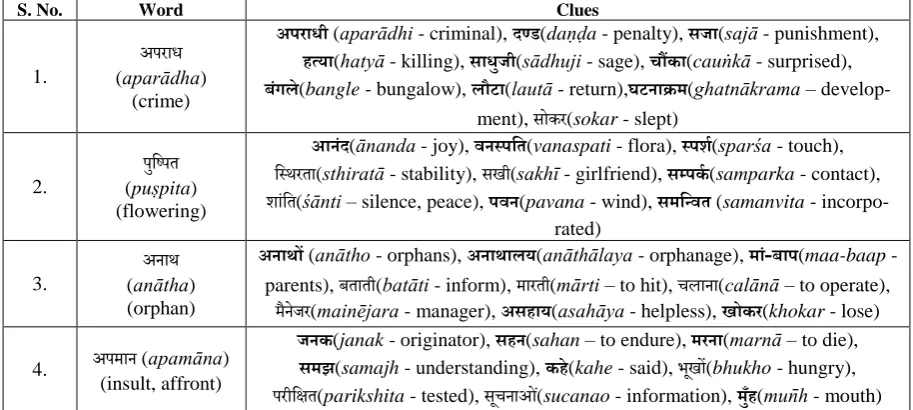
We present in Table 1 above, four synsets for which there were strong clues after PMI based ranking. The clues in bold are relevant ones. Over the complete set of 80 words studied, an average of 5 relevant clue words occurred in the top 10 after PMI ranking. This situation freed the lexicographers from looking for clue words manually, by reading sentences from the con-cordancer search.
4
Synset reinforced clue ranking
In PMI based ranking, we would only consider the first word of a synset to retrieve clues which led the tool to produce the same set of clues for all synsets which had this word as the first word. We solved this problem by reinforcing the clues using other members of the given synset. We also use a different metric for clue word selection and ranking.
This modified clue acquisition mechanism, in-stead of using just the first word of the synset, uses the first three words of the synset. Using more members of the same synset helps in
high-S. No. Word Clues
1.
अपराध
(aparādha) (crime)
अपराधी(aparādhi - criminal), दण्ड(daṇḍa - penalty), सजा(sajā - punishment),
हत्या(hatyā - killing), साधुजी(sādhuji - sage), चौंका(cauṅkā - surprised),
बंगले(bangle - bungalow), लौटा(lautā - return),घटनाक्रम(ghatnākrama – develop-ment), सोकर(sokar - slept)
2.
पुष्पपत
(puṣpita) (flowering)
आनंद(ānanda - joy), वनस्पति(vanaspati - flora), स्पर्श(sparśa - touch),
ष्थिरता(sthiratā - stability), सखी(sakhī - girlfriend), सम्पकश(samparka - contact),
शाांष्त(śānti – silence, peace), पवन(pavana - wind), समतववि (samanvita - incorpo-rated)
3.
अनाि
(anātha) (orphan)
अनाथों (anātho - orphans), अनाथालय(anāthālaya - orphanage), मां-बाप(maa-baap -
parents), बताती(batāti - inform), मारती(mārti – to hit), चलाना(calānā – to operate),
मैनेजर(mainējara - manager), असहाय(asahāya - helpless), खोकर(khokar - lose)
4. अपमान (apamāna) (insult, affront)
जनक(janak - originator), सहन(sahan – to endure), मरना(marnā – to die),
समझ(samajh - understanding), कहे(kahe - said), भूखों(bhukho - hungry),
[image:3.595.64.521.37.242.2]परीष्ित(parikshita - tested), सूचनाओां(sucanao - information), मुुँह(mun h - mouth)
lighting those clues which are more important for a given synset.
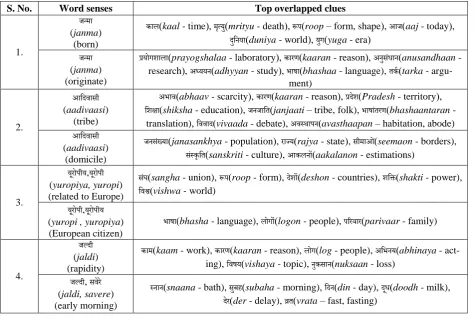
As before, we retrieve the sets of candidate clue words for each of the 3 synset words and then perform further processing. Instead of just top 10 clues we now consider as many as possi-ble to ensure coverage. We find clue word over-laps between the three different sets of clues ob-tained. Those candidate clues which are present in more than one set are obviously good indica-tors of sense and are given a higher ranking. This added metric counters polysemy, even when first synset word is same for different senses, since having clues which are generated from members of the given synset would help greatly in disam-biguating using the overlapping clues. Such clue overlaps would be able to help us distinguish between fine grained word senses and eliminate the unrelated sense, thus improving our accuracy. Table 2 presents such cases where clue overlaps are able to distinguish specifically between the different senses for the same word.
5
Error Analysis
For every wrong clue generated we studied the sentences from the concordancer which lead to its coming up. We believe that these wrong clues appear due to the following reasons:
5.1.1 Chance co-occurrence
Consider for अनाथ (anātha) (orphan) the clue word मैनेजर (manager). Here अनाथ mostly oc-curred with अनाथालय (orphanage) (a strong clue) which has an association with मैनेजर; but मैनेजर can occur with any organization like banks, companies and so on. Similarly, Proper nouns can also occur by chance without giving any in-formation about the senses.
5.1.2 Lack of Context
Retrieval of relevant clue words is greatly affect-ed by the sentences that are chosen to get the context. Currently, we are using 10 sentences from the concordancer output to get a list of po-tential clues. Using more sentences can help in some cases by providing more relevant clues. We have refrained from increasing this number to avoid runtime computation time. We expect to reduce pre-processing time to enable us to in-clude more sentences.
5.1.3 Absence of word in corpus
The tool cannot provide any clues if the word is not present in the monolingual corpus. This can happen for two reasons: if the word is rare or if the word is not matched by the concordancer due to corpus tokenization errors. We realized that 1.4 million domain specific sentences can be
re-S. No. Word senses Top overlapped clues
1.
जन्मा (janma)
(born)
काल(kaal - time), मृत्यु(mrityu - death), रूप(roop – form, shape), आज(aaj - today), दुष्नया(duniya - world), युग(yuga - era)
जन्मा (janma) (originate)
प्रयोगशाला(prayogshalaa - laboratory), कारण(kaaran - reason), अनुसांधान(anusandhaan - research), अध्ययन(adhyyan - study), भाषा(bhashaa - language), तकक(tarka -
argu-ment)
2.
आष्दवासी (aadivaasi)
(tribe)
अभाव(abhaav - scarcity), कारण(kaaran - reason), प्रदेश(Pradesh - territory), ष्शिा(shiksha - education), जनजाष्त(janjaati – tribe, folk), भाषाांतरण(bhashaantaran -
translation), ष्ववाद(vivaada - debate), अवथिापन(avasthaapan – habitation, abode) आष्दवासी
(aadivaasi) (domicile)
जनसांख्या(janasankhya - population), राज्य(rajya - state), सीमाओ ां(seemaon - borders), सांथकृष्त(sanskriti - culture), आकलनों(aakalanon - estimations)
3.
यूरोपीय,यूरोपी (yuropiya, yuropi) (related to Europe)
सांघ(sangha - union), रूप(roop - form), देशों(deshon - countries), शष्ि(shakti - power), ष्वश्व(vishwa - world)
यूरोपी,यूरोपीय (yuropi , yuropiya) (European citizen)
भाषा(bhasha - language), लोगों(logon - people), पररवार(parivaar - family)
4.
जल्दी (jaldi) (rapidity)
काम(kaam - work), कारण(kaaran - reason), लोग(log - people), अष्भनय(abhinaya - act-ing), ष्वषय(vishaya - topic), नुकसान(nuksaan - loss)
जल्दी, सवेरे (jaldi, savere) (early morning)
[image:4.595.65.540.47.366.2]थनान(snaana - bath), सुबह(subaha - morning), ष्दन(din - day), दूध(doodh - milk), देर(der - delay), व्रत(vrata – fast, fasting)
strictive. We are currently in the process of col-lecting more, clean and good quality, corpus from the web.
6
Discrimination Net
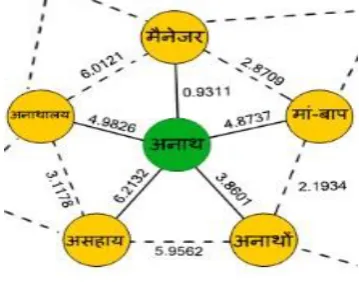
The tool is expected to produce a structured net (Figure 1) with the synset words (green) con-nected to the clues (yellow), as neighbors, with weighted edges given by the scoring mechanism, which for now is PMI. Using wordnet sematic relations, relevant clues can be brought closer to the sense that they indicate. This structured net will be further augmented by inclusion of seman-tic relations from WordNet to result in a Dis-crimination Net. To disambiguate a word using this net, we will calculate a score for all the sens-es of the word and select the sense with highsens-est score based on its clues.
6.1 Scoring mechanism and sample
The score for a particular possible sense will be progressively calculated by traversing from clue words of the given synset in the net, while mov-ing towards the sense word. We are in the pro-cess of developing a more efficient scoring mechanism than PMI which will help us in as-signing relevant weightage to edges in the dis-crimination net and improve the potential clue score.
7
Conclusions and Future work
We have described the Clue Marker Tool for word senses which allows lexicographers to se-lect relevant clues from a set of ranked candidate
clues to disambiguate the sense of the word un-der consiun-deration. This tool, in addition to being a wordnet browser, is also a corpus browser by way of concordancer based searching. In order to generate high quality clues, we applied PMI based clue ranking and observed its efficacy. The tool is language independent, since by adding synsets of another language to the database and the POS tagger, the clue gathering process can be adapted for the new language. In future we plan to study better measures for clue ranking based on established statistical methods, along with augmenting the corpus to get improvements in generated clues. Finally, we plan to devise effi-cient and light weight WSD methods that will use the discrimination net, hopefully, bringing about a newer understanding of WSD.
References
Pushpak Bhattacharyya, Debasri Chakrabarty, Dipak Narayan and Prabhakar Pande. 2002. An Experi-ence in Building the Indo WordNet- a WordNet for Hindi, International Conference on Global Word-Net (GWC 02), Mysore, India.
Pushpak Bhattacharyya, Arindam Chatterjee, Salil Joshi, Diptesh Kanojia and Akhlesh Meena. 2011. A Study of Human Sense annotation process: Man v/s Machine. Global WordNet Conference, Matsue, Japan.
Pushpak Bhattacharyya, Arindam Chatterjee, Salil Joshi and Diptesh Kanojia. 2012. Discrimination Net for Hindi. COLING, Mumbai, India.
Pushpak Bhattacharyya, Salil Joshi and Diptesh Ka-nojia. 2013. More than meets the eye: Study of Human Cognition in Sense Annotation. NAACL HLT 2013, Atlanta, USA.
Charles Clarke and Egidio Terra. 2003. Frequency Estimates for Statistical Word Similarity Measures. NAACL HLT 2003, Edmonton, Canada.
[image:5.595.84.264.455.596.2]Christiane Fellbaum. 1998. WordNet: An Electronic Lexical Database.Cambridge, MA: MIT Press.