A Report on the First Native Language Identification Shared Task
Joel Tetreault∗, Daniel Blanchard†and Aoife Cahill†
∗
Nuance Communications, Inc., 1198 E. Arques Ave, Sunnyvale, CA 94085, USA [email protected]
†
Educational Testing Service, 660 Rosedale Road, Princeton, NJ 08541, USA {dblanchard, acahill}@ets.org
Abstract
Native Language Identification, or NLI, is the task of automatically classifying the L1 of a writer based solely on his or her essay writ-ten in another language. This problem area has seen a spike in interest in recent years as it can have an impact on educational ap-plications tailored towards non-native speak-ers of a language, as well as authorship pro-filing. While there has been a growing body of work in NLI, it has been difficult to com-pare methodologies because of the different approaches to pre-processing the data, differ-ent sets of languages iddiffer-entified, and differdiffer-ent splits of the data used. In this shared task, the first ever for Native Language Identification, we sought to address the above issues by pro-viding a large corpus designed specifically for NLI, in addition to providing an environment for systems to be directly compared. In this paper, we report the results of the shared task. A total of 29 teams from around the world competed across three different sub-tasks.
1 Introduction
One quickly growing subfield in NLP is the task of identifying the native language (L1) of a writer based solely on a sample of their writing in an-other language. The task is framed as a classifica-tion problem where the set of L1s is knowna priori. Most work has focused on identifying the native guage of writers learning English as a second lan-guage. To date this topic has motivated several pa-pers and research projects.
Native Language Identification (NLI) can be use-ful for a number of applications. NLI can be used in
educational settings to provide more targeted feed-back to language learners about their errors. It is well known that speakers of different languages make different kinds of errors when learning a lan-guage (Swan and Smith, 2001). A writing tutor system which can detect the native language of the learner will be able to tailor the feedback about the error and contrast it with common properties of the learner’s language. In addition, native language is often used as a feature that goes into authorship pro-filing (Estival et al., 2007), which is frequently used in forensic linguistics.
Despite the growing interest in this field, devel-opment has been encumbered by two issues. First is the issue of data. Evaluating an NLI system re-quires a corpus containing texts in a language other than the native language of the writer. Because of a scarcity of such corpora, most work has used the International Corpus of Learner English (ICLEv2) (Granger et al., 2009) for training and evaluation since it contains several hundred essays written by college-level English language learners. However, this corpus is quite small for training and testing statistical systems which makes it difficult to tell whether the systems that are developed can scale well to larger data sets or to different domains.
Since the ICLE corpus was not designed with the task of NLI in mind, the usability of the corpus for this task is further compromised by idiosyncrasies in the data such as topic bias (as shown by Brooke and Hirst (2011)) and the occurrence of characters which only appear in essays written by speakers of certain languages (Tetreault et al., 2012). As a result, it is hard to draw conclusions about which features
actually perform best. The second issue is that there has been little consistency in the field in the use of cross-validation, the number of L1s, and which L1s are used. As a result, comparing one approach to another has been extremely difficult.
The first Shared Task in Native Language Identifi-cation is intended to better unify this community and help the field progress. The Shared Task addresses the two deficiencies above by first using a new cor-pus (TOEF11, discussed in Section 3) that is larger than the ICLE and designed specifically for the task of NLI and second, by providing a common set of L1s and evaluation standards that everyone will use for this competition, thus facilitating direct compar-ison of approaches. In this report we describe the methods most participants used, the data they eval-uated their systems on, the three sub-tasks involved, the results achieved by the different teams, and some suggestions and ideas about what we can do for the next iteration of the NLI shared task.
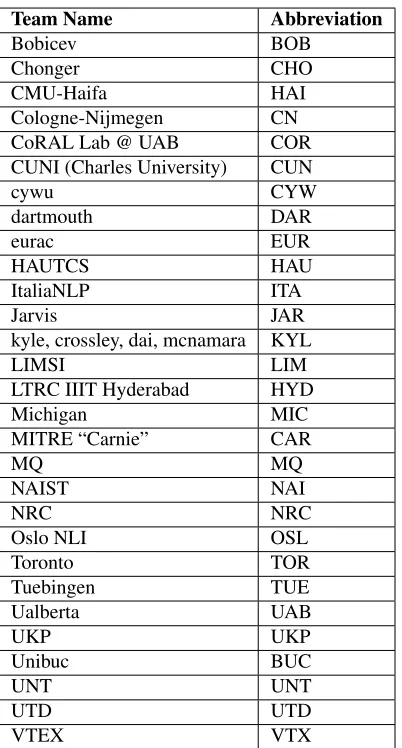
In the following section, we provide a summary of the prior work in Native Language Identification. Next, in Section 3 we describe the TOEFL11 cor-pus used for training, development and testing in this shared task. Section 4 describes the three sub-tasks of the NLI Shared Task as well as a review of the timeline. Section 5 lists the 29 teams that partici-pated in the shared task, and introduce abbreviations that will be used throughout this paper. Sections 6 and 7 describe the results of the shared task and a separate post shared task evaluation where we asked teams to evaluate their system using cross-validation on a combination of the training and development data. In Section 8 we provide a high-level view of the common features and machine learning methods teams tended to use. Finally, we offer conclusions and ideas for future instantiations of the shared task in Section 9.
2 Related Work
In this section, we provide an overview of some of the common approaches used for NLI prior to this shared task. While a comprehensive review is out-side the scope of this paper, we have compiled a bibliography of related work in the field. It can be
downloaded from the NLI Shared Task website.1 To date, nearly all approaches have treated the task of NLI as a supervised classification problem where statistical models are trained on data from the different L1s. The work of Koppel et al. (2005) was the first in the field and they explored a multitude of features, many of which are employed in several of the systems in the shared tasks. These features included character and POS n-grams, content and function words, as well as spelling and grammati-cal errors (since language learners have tendencies to make certain errors based on their L1 (Swan and Smith, 2001)). An SVM model was trained on these features extracted from a subsection of the ICLE corpus consisting of 5 L1s.
N-gram features (word, character and POS) have figured prominently in prior work. Not only are they easy to compute, but they can be quite predictive. However, there are many variations on the features. Past reseach efforts have explored different n-gram windows (though most tend to focus on unigrams and bigrams), different thresholds for how many n-grams to include as well as whether to encode the feature as binary (presence or absence of the partic-ular n-gram) or as a normalized count.
The inclusion of syntactic features has been a fo-cus in recent work. Wong and Dras (2011) explored the use of production rules from two parsers and Swanson and Charniak (2012) explored the use of Tree Substitution Grammars (TSGs). Tetreault et al. (2012) also investigated the use of TSGs as well as dependency features extracted from the Stanford parser.
Other approaches to NLI have included the use of Latent Dirichlet Analysis to cluster features (Wong et al., 2011), adaptor grammars (Wong et al., 2012), and language models (Tetreault et al., 2012). Ad-ditionally, there has been research into the effects of training and testing on different corpora (Brooke and Hirst, 2011).
Much of the aforementioned work takes the per-spective of optimizing for the task of Native Lan-guage Identification, that is, what is the best way of modeling the problem to get the highest system ac-curacy? The problem of Native Language
tion is also of interest to researchers in Second Lan-guage Acquisition where they seek to explain syn-tactic transfer in learner language (Jarvis and Cross-ley, 2012).
3 Data
The dataset for the task was the new TOEFL11 corpus (Blanchard et al., 2013). TOEFL11 con-sists of essays written during a high-stakes college-entrance test, the Test of English as a Foreign Lan-guage (TOEFLR). The corpus contains 1,100
es-says per language sampled as evenly as possible from 8 prompts (i.e., topics) along with score lev-els (low/medium/high) for each essay. The 11 na-tive languages covered by our corpus are: Ara-bic (ARA), Chinese (CHI), French (FRE), German (GER), Hindi (HIN), Italian (ITA), Japanese (JAP), Korean (KOR), Spanish (SPA), Telugu (TEL), and Turkish (TUR).
The TOEFL11 corpus was designed specifically to support the task of native language identifica-tion. Because all of the essays were collected through ETS’s operational test delivery system for the TOEFLR test, the encoding and storage of all
texts in the corpus is consistent. Furthermore, the sampling of essays was designed to ensure approx-imately equal representation of native languages across topics, insofar as this was possible.
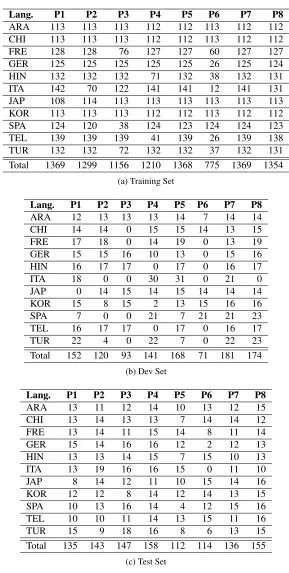
For the shared task, the corpus was split into three sets: training (TOEFL11-TRAIN), development (TOEFL11-DEV), and test (TOEFL11-TEST). The train corpus consisted of 900 essays per L1, the de-velopment set consisted of 100 essays per L1, and the test set consisted of another 100 essays per L1. Although the overallTOEFL11 corpus was sampled as evenly as possible with regard to language and prompts, the distribution for each language is not ex-actly the same in the training, development and test sets (see Tables 1a, 1b, and 1c). In fact, the distri-bution is much closer between the training and test sets, as there are several languages for which there are no essays for a given prompt in the development set, whereas there are none in the training set, and only one, Italian, for the test set.
It should be noted that in the first instantiation of the corpus, presented in Tetreault et al. (2012), we usedTOEFL11 to denote the body of data consisting
of TOEFL11-TRAIN and TOEFL11-DEV. However, in this shared task, we added 1,100 sentences for a test set and thus use the termTOEFL11 to now de-note the corpus consisting of the TRAIN, DEVand TEST sets. We expect the corpus to be released through the the Linguistic Data Consortium in 2013.
4 NLI Shared Task Description
The shared task consisted of three sub-tasks. For each task, the test set wasTOEFL11-TESTand only the type of training data varied from task to task.
• Closed-Training: The first and main task was the 11-way classification task using only theTOEFL11-TRAINand optionallyTOEFL 11-DEVfor training.
• Open-Training-1: The second task allowed the use of any amount or type of training data (as is done by Brooke and Hirst (2011)) exclud-ingany data from theTOEFL11, but still evalu-ated onTOEFL11-TEST.
• Open-Training-2: The third task allowed the use of TOEFL11-TRAIN and TOEFL11-DEV combined with any other additional data. This most closely reflects a real-world scenario.
Additionally, each team could submit up to 5 dif-ferent systems per task. This allowed a team to ex-periment with different variations of their core sys-tem.
The training data was released on January 14, with the development data and evaluation script re-leased almost one month later on February 12. The train and dev data contained an index file with the L1 for each essay in those sets. The previously unseen and unlabeled test data was released on March 11 and teams had 8 days to submit their system predic-tions. The predictions for each system were encoded in a CSV file, where each line contained the file ID of a file in TOEFL11-TEST and the corresponding L1 prediction made by the system. Each CSV file was emailed to the NLI organizers and then evalu-ated against the gold standard.
5 Teams
Lang. P1 P2 P3 P4 P5 P6 P7 P8
ARA 113 113 113 112 112 113 112 112 CHI 113 113 113 112 112 113 112 112
FRE 128 128 76 127 127 60 127 127
GER 125 125 125 125 125 26 125 124
HIN 132 132 132 71 132 38 132 131
ITA 142 70 122 141 141 12 141 131
JAP 108 114 113 113 113 113 113 113 KOR 113 113 113 112 112 113 112 112 SPA 124 120 38 124 123 124 124 123
TEL 139 139 139 41 139 26 139 138
TUR 132 132 72 132 132 37 132 131
Total 1369 1299 1156 1210 1368 775 1369 1354
(a) Training Set
Lang. P1 P2 P3 P4 P5 P6 P7 P8
ARA 12 13 13 13 14 7 14 14
CHI 14 14 0 15 15 14 13 15
FRE 17 18 0 14 19 0 13 19
GER 15 15 16 10 13 0 15 16
HIN 16 17 17 0 17 0 16 17
ITA 18 0 0 30 31 0 21 0
JAP 0 14 15 14 15 14 14 14
KOR 15 8 15 2 13 15 16 16
SPA 7 0 0 21 7 21 21 23
TEL 16 17 17 0 17 0 16 17
TUR 22 4 0 22 7 0 22 23
Total 152 120 93 141 168 71 181 174
(b) Dev Set
Lang. P1 P2 P3 P4 P5 P6 P7 P8
ARA 13 11 12 14 10 13 12 15
CHI 13 14 13 13 7 14 14 12
FRE 13 14 11 15 14 8 11 14
GER 15 14 16 16 12 2 12 13
HIN 13 13 14 15 7 15 10 13
ITA 13 19 16 16 15 0 11 10
JAP 8 14 12 11 10 15 14 16
KOR 12 12 8 14 12 14 13 15
SPA 10 13 16 14 4 12 15 16
TEL 10 10 11 14 13 15 11 16
TUR 15 9 18 16 8 6 13 15
Total 135 143 147 158 112 114 136 155
[image:4.612.160.449.49.622.2](c) Test Set
Table 1: Number of essays per language per prompt in each data set
teams, along with their abbreviations, can be found in Table 2.
6 Shared Task Results
Team Name Abbreviation
Bobicev BOB
Chonger CHO
CMU-Haifa HAI
Cologne-Nijmegen CN CoRAL Lab @ UAB COR CUNI (Charles University) CUN
cywu CYW
dartmouth DAR
eurac EUR
HAUTCS HAU
ItaliaNLP ITA
Jarvis JAR
kyle, crossley, dai, mcnamara KYL
LIMSI LIM
LTRC IIIT Hyderabad HYD
Michigan MIC
MITRE “Carnie” CAR
MQ MQ
NAIST NAI
NRC NRC
Oslo NLI OSL
Toronto TOR
Tuebingen TUE
Ualberta UAB
UKP UKP
Unibuc BUC
UNT UNT
UTD UTD
[image:5.612.87.288.54.428.2]VTEX VTX
Table 2: Participating Teams and Team Abbrevia-tions
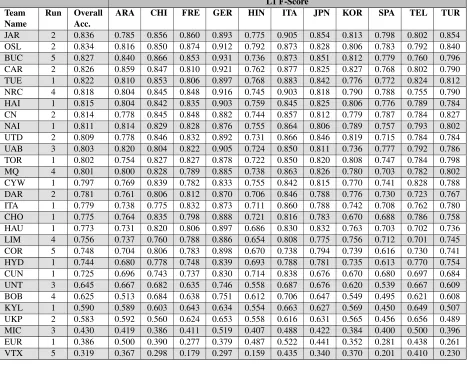
top submission for each team and its performance by overall accuracy and by L1.2
Table 3 shows results for the Closed sub-task where teams developed systems that were trained solely onTOEFL11-TRAINandTOEFL11-DEV. This was the most popular sub-task with 29 teams com-peting and 116 submissions in total for the sub-task. Most teams opted to submit 4 or 5 runs.
The Open sub-tasks had far fewer submissions. Table 4 shows results for the Open-1 sub-task where teams could train systems using any training data ex-cludingTOEFL11-TRAINandTOEFL11-DEV. Three teams competed in this task for a total of 13
sub-2For those interested in the results of all submissions, please contact the authors.
missions. Table 5 shows the results for the third sub-task “Open-2”. Four teams competed in this sub-task for a total of 15 submissions.
The challenge for those competing in the Open tasks was finding enough non-TOEFL11 data for each L1 to train a classifier. External corpora com-monly used in the competition included the:
• ICLE: which covered all L1s except for Ara-bic, Hindi and Telugu;
• FCE: First Certificate in English Corpus (Yannakoudakis et al., 2011): a collection of essay written for an English assessment exam, which covered all L1s except for Arabic, Hindi and Telugu
• ICNALE: International Corpus Network of Asian Learners of English(Ishikawa, 2011): a collection of essays written by Chinese, Japanese and Korean learners of English along with 7 other L1s with Asian backgrounds.
• Lang8: http://www.lang8.com: a social net-working service where users write in the lan-guage they are learning, and get corrections from users who are native speakers of that lan-guage. Shared Task participants such as NAI and TOR scraped the website for all writng samples from English language learners. All of the L1s in the shared task are represented on the site, though the Asian L1s dominate.
The most challenging L1s to find data for seemed to be Hindi and Telugu. TUE used essays written by Pakastani students in the ICNALE corpus to sub-stitute for Hindi. For Telugu, they scraped mate-rial from bilingual blogs (English-Telugu) as well as other material for the web. TOR created cor-pora for Telugu and Hindi by scraping news articles, tweets which were geolocated in the Hindi and Tel-ugu speaking areas, and translations of Hindi and Telugu blogs using Google Translate.
L1 F-Score Team
Name
Run Overall Acc.
ARA CHI FRE GER HIN ITA JPN KOR SPA TEL TUR
[image:6.612.74.542.70.436.2]JAR 2 0.836 0.785 0.856 0.860 0.893 0.775 0.905 0.854 0.813 0.798 0.802 0.854 OSL 2 0.834 0.816 0.850 0.874 0.912 0.792 0.873 0.828 0.806 0.783 0.792 0.840 BUC 5 0.827 0.840 0.866 0.853 0.931 0.736 0.873 0.851 0.812 0.779 0.760 0.796 CAR 2 0.826 0.859 0.847 0.810 0.921 0.762 0.877 0.825 0.827 0.768 0.802 0.790 TUE 1 0.822 0.810 0.853 0.806 0.897 0.768 0.883 0.842 0.776 0.772 0.824 0.812 NRC 4 0.818 0.804 0.845 0.848 0.916 0.745 0.903 0.818 0.790 0.788 0.755 0.790 HAI 1 0.815 0.804 0.842 0.835 0.903 0.759 0.845 0.825 0.806 0.776 0.789 0.784 CN 2 0.814 0.778 0.845 0.848 0.882 0.744 0.857 0.812 0.779 0.787 0.784 0.827 NAI 1 0.811 0.814 0.829 0.828 0.876 0.755 0.864 0.806 0.789 0.757 0.793 0.802 UTD 2 0.809 0.778 0.846 0.832 0.892 0.731 0.866 0.846 0.819 0.715 0.784 0.784 UAB 3 0.803 0.820 0.804 0.822 0.905 0.724 0.850 0.811 0.736 0.777 0.792 0.786 TOR 1 0.802 0.754 0.827 0.827 0.878 0.722 0.850 0.820 0.808 0.747 0.784 0.798 MQ 4 0.801 0.800 0.828 0.789 0.885 0.738 0.863 0.826 0.780 0.703 0.782 0.802 CYW 1 0.797 0.769 0.839 0.782 0.833 0.755 0.842 0.815 0.770 0.741 0.828 0.788 DAR 2 0.781 0.761 0.806 0.812 0.870 0.706 0.846 0.788 0.776 0.730 0.723 0.767 ITA 1 0.779 0.738 0.775 0.832 0.873 0.711 0.860 0.788 0.742 0.708 0.762 0.780 CHO 1 0.775 0.764 0.835 0.798 0.888 0.721 0.816 0.783 0.670 0.688 0.786 0.758 HAU 1 0.773 0.731 0.820 0.806 0.897 0.686 0.830 0.832 0.763 0.703 0.702 0.736 LIM 4 0.756 0.737 0.760 0.788 0.886 0.654 0.808 0.775 0.756 0.712 0.701 0.745 COR 5 0.748 0.704 0.806 0.783 0.898 0.670 0.738 0.794 0.739 0.616 0.730 0.741 HYD 1 0.744 0.680 0.778 0.748 0.839 0.693 0.788 0.781 0.735 0.613 0.770 0.754 CUN 1 0.725 0.696 0.743 0.737 0.830 0.714 0.838 0.676 0.670 0.680 0.697 0.684 UNT 3 0.645 0.667 0.682 0.635 0.746 0.558 0.687 0.676 0.620 0.539 0.667 0.609 BOB 4 0.625 0.513 0.684 0.638 0.751 0.612 0.706 0.647 0.549 0.495 0.621 0.608 KYL 1 0.590 0.589 0.603 0.643 0.634 0.554 0.663 0.627 0.569 0.450 0.649 0.507 UKP 2 0.583 0.592 0.560 0.624 0.653 0.558 0.616 0.631 0.565 0.456 0.656 0.489 MIC 3 0.430 0.419 0.386 0.411 0.519 0.407 0.488 0.422 0.384 0.400 0.500 0.396 EUR 1 0.386 0.500 0.390 0.277 0.379 0.487 0.522 0.441 0.352 0.281 0.438 0.261 VTX 5 0.319 0.367 0.298 0.179 0.297 0.159 0.435 0.340 0.370 0.201 0.410 0.230
Table 3: Results for closed task
L1 F-Score Team
Name
Run Overall Acc.
ARA CHI FRE GER HIN ITA JPN KOR SPA TEL TUR
TOR 5 0.565 0.410 0.776 0.692 0.754 0.277 0.680 0.660 0.650 0.653 0.190 0.468 TUE 2 0.385 0.114 0.502 0.420 0.430 0.167 0.611 0.485 0.348 0.385 0.236 0.314 NAI 2 0.356 0.329 0.450 0.331 0.423 0.066 0.511 0.426 0.481 0.314 0.000 0.207
Table 4: Results for open-1 task
L1 F-Score Team
Name
Run Overall Acc.
ARA CHI FRE GER HIN ITA JPN KOR SPA TEL TUR
TUE 1 0.835 0.798 0.876 0.844 0.883 0.777 0.883 0.836 0.794 0.846 0.826 0.818 TOR 4 0.816 0.770 0.861 0.840 0.900 0.704 0.860 0.834 0.800 0.816 0.804 0.790 HYD 1 0.741 0.677 0.782 0.755 0.829 0.693 0.784 0.777 0.728 0.613 0.766 0.744 NAI 3 0.703 0.676 0.695 0.708 0.846 0.618 0.830 0.677 0.610 0.663 0.726 0.688
was a mismatch in the genre of corpora (for exam-ple, tweets by Telugu speakers are different in com-position than essays written by Telugu speakers). TUE and TOR were the only two teams to partic-ipate in all three sub-tasks, and their Open-2 sys-tems outperformed their respective best syssys-tems in the Closed and Open-1 sub-tasks. This suggests, un-surprisingly, that adding more data can benefit NLI, though quality and genre of data are also important factors.
7 Cross Validation Results
Upon completion of the competition, we asked the participants to perform 10-fold cross-validation on a data set consisting of the union ofTOEFL11-TRAIN and TOEFL11-DEV. This was the same set of data used in the first work to use any of the TOEFL11 data (Tetreault et al., 2012), and would allow another point of comparison for future NLI work. For direct comparison with Tetreault et al. (2012), we provided the exact folds used in that work.
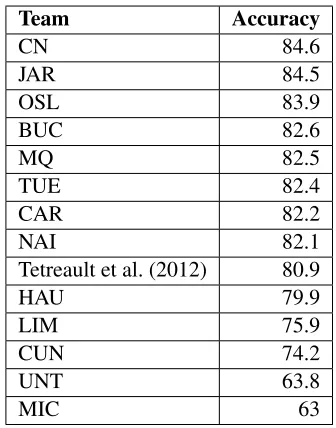
The results of the 10-fold cross-validation are shown in Table 6. Two teams had systems that per-formed at 84.5 or better, which is just slightly higher than the best team performance on the TOEFL 11-TESTdata. In general, systems that performed well in the main competition also performed similarly (in terms of performance and ranking) in the cross-validation experiment. Please note that we report results as they are reported in the respective papers, rounding to just one decimal place where possible.
8 Discussion of Approaches
With so many teams competing in the shared task competition, we investigated whether there were any commonalities in learning methods or features be-tween the teams. In this section, we provide a coarse grained summary of the common machine learning methods teams employed as well as some of the common features. Our summary is based on the in-formation provided in the 24 team reports.
While there are many machine learning algo-rithms to choose from, the overwhelming majority of teams used Support Vector Machines. This may not be surprising given that most prior work has also used SVMs. Tetreault et al. (2012) showed that one could achieve even higher performance on the NLI
Team Accuracy
CN 84.6
JAR 84.5
OSL 83.9
BUC 82.6
MQ 82.5
TUE 82.4
CAR 82.2
NAI 82.1
Tetreault et al. (2012) 80.9
HAU 79.9
LIM 75.9
CUN 74.2
UNT 63.8
MIC 63
Table 6: Results for 10-fold cross-validation on TOEFL11-TRAIN+TOEFL11-DEV
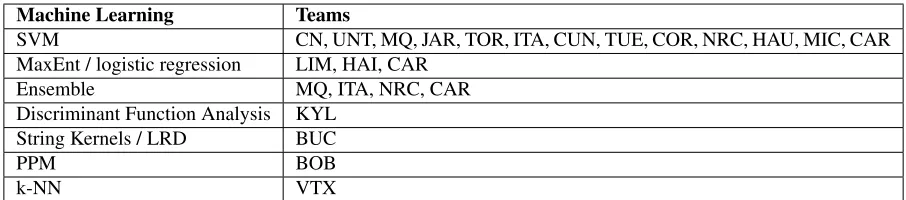
task using ensemble methods for combining classi-fiers. Four teams also experimented with different ways of using ensemble methods. Three teams used Maximum Entropy methods for their modeling. Fi-nally, there were a few other teams that tried differ-ent methods such as Discriminant Function Analysis and K-Nearest Neighbors. Possibly the most distinct method employed was that of string kernels by the BUC team (who placed third in the closed compe-tition). This method only used character level fea-tures. A summary of the machine learning methods is shown in Table 7.
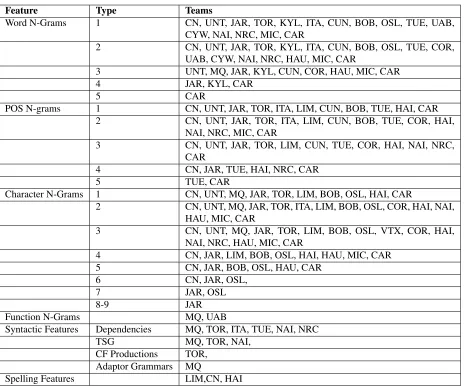
A summary of the common features used across teams is shown in Table 8. It should be noted that the table does not detail the nuanced differences in how the features are realized. For example, in the case of n-grams, some teams used only the top k
most frequently n-grams while others used all of the n-grams available. If interested in more information about the particulars of a system and its feature, we recommend reading the team’s summary report.
[image:7.612.342.510.55.269.2]Machine Learning Teams
SVM CN, UNT, MQ, JAR, TOR, ITA, CUN, TUE, COR, NRC, HAU, MIC, CAR MaxEnt / logistic regression LIM, HAI, CAR
Ensemble MQ, ITA, NRC, CAR
Discriminant Function Analysis KYL String Kernels / LRD BUC
PPM BOB
[image:8.612.78.531.56.156.2]k-NN VTX
Table 7: Machine Learning algorithms used in Shared Task
and some, such as OSL and JAR, went as high 7 and 9 respectively in terms of character n-grams.
Syntactic features, which were first evaluated in Wong and Dras (2011) and Swanson and Char-niak (2012) were used by six teams in the competi-tion, with most using dependency parses in different ways. Interestingly, while Wong and Dras (2011) showed some of the highest performance scores on the ICLE corpus using parse features, only two of the six teams which used them placed in the top ten in the Closed sub-task.
Spelling features were championed by Koppel et al. (2005) and in subsequent NLI work, however only three teams in the competition used them.
There were several novel features that teams tried. For example, several teams tried skip n-grams, as well as length of words, sentences and documents; LIM experimented with machine translation; CUN had different features based on the relative frequen-cies of the POS and lemma of a word; HAI tried several new features based on passives and context function; and the TUE team tried a battery of syn-tactic features as well as text complexity measures.
9 Summary
We consider the first edition of the shared task a success as we had 29 teams competing, which we consider a large number for any shared task. Also of note is that the task brought together researchers not only from the Computational Linguistics com-munity, but also those from other linguistics fields such as Second Language Acquisition.
We were also delighted to see many teams build on prior work but also try novel approaches. It is our hope that finally having an evaluation on a com-mon data set will allow researchers to learn from
each other on what works well and what does not, and thus the field can progress more rapidly. The evaluation scripts are publicly available and we ex-pect that the data will become available through the Linguistic Data Consortium in 2013.
For future editions of the NLI shared task, we think it would be interesting to expand the scope of NLI from identifying the L1 of student essays to be able to identify the L1 of any piece of writing. The ICLE andTOEFL11 corpora are both collections of academic writing and thus it may be the case that certain features or methodologies generalize better to other writing genres and domains. For those in-terested in robust NLI approaches, please refer to the TOR team shared task report as well as Brooke and Hirst (2012).
In addition, since theTOEFL11 data contains pro-ficiency level one could include an evaluation by proficiency level as language learners make ent types of errors and may even have stylistic differ-ences in their writing as their proficiency progresses. Finally, while this may be in the periphery of the scope of an NLI shared task, one interesting evalua-tion is to see how well human raters can fare on this task. This would of course involve knowledgeable language instructors who have years of experience in teaching students from different L1s. Our think-ing is that NLI might be one task where computers would outperform human annotators.
Acknowledgments
Feature Type Teams
Word N-Grams 1 CN, UNT, JAR, TOR, KYL, ITA, CUN, BOB, OSL, TUE, UAB, CYW, NAI, NRC, MIC, CAR
2 CN, UNT, JAR, TOR, KYL, ITA, CUN, BOB, OSL, TUE, COR, UAB, CYW, NAI, NRC, HAU, MIC, CAR
3 UNT, MQ, JAR, KYL, CUN, COR, HAU, MIC, CAR
4 JAR, KYL, CAR
5 CAR
POS N-grams 1 CN, UNT, JAR, TOR, ITA, LIM, CUN, BOB, TUE, HAI, CAR 2 CN, UNT, JAR, TOR, ITA, LIM, CUN, BOB, TUE, COR, HAI,
NAI, NRC, MIC, CAR
3 CN, UNT, JAR, TOR, LIM, CUN, TUE, COR, HAI, NAI, NRC, CAR
4 CN, JAR, TUE, HAI, NRC, CAR
5 TUE, CAR
Character N-Grams 1 CN, UNT, MQ, JAR, TOR, LIM, BOB, OSL, HAI, CAR
2 CN, UNT, MQ, JAR, TOR, ITA, LIM, BOB, OSL, COR, HAI, NAI, HAU, MIC, CAR
3 CN, UNT, MQ, JAR, TOR, LIM, BOB, OSL, VTX, COR, HAI, NAI, NRC, HAU, MIC, CAR
4 CN, JAR, LIM, BOB, OSL, HAI, HAU, MIC, CAR 5 CN, JAR, BOB, OSL, HAU, CAR
6 CN, JAR, OSL,
7 JAR, OSL
8-9 JAR
Function N-Grams MQ, UAB
Syntactic Features Dependencies MQ, TOR, ITA, TUE, NAI, NRC
TSG MQ, TOR, NAI,
CF Productions TOR, Adaptor Grammars MQ
[image:9.612.75.539.53.439.2]Spelling Features LIM,CN, HAI
Table 8: Common Features used in Shared Task
In addition, thanks goes to the BEA8 Organizers (Joel Tetreault, Jill Burstein and Claudia Leacock) for hosting the shared task with their workshop. Fi-nally, we would like to thank all the teams for partic-ipating in this first shared task and making it a suc-cess. Their feedback, patience and enthusiasm made organizing this shared task a great experience.
References
Daniel Blanchard, Joel Tetreault, Derrick Higgins, Aoife Cahill, and Martin Chodorow. 2013. TOEFL11: A Corpus of Non-Native English. Technical report, Ed-ucational Testing Service.
Julian Brooke and Graeme Hirst. 2011. Native language detection with ‘cheap’ learner corpora. InConference
of Learner Corpus Research (LCR2011), Louvain-la-Neuve, Belgium. Presses universitaires de Louvain. Julian Brooke and Graeme Hirst. 2012. Robust,
Lexical-ized Native Language Identification. InProceedings of COLING 2012, pages 391–408, Mumbai, India, De-cember. The COLING 2012 Organizing Committee. Dominique Estival, Tanja Gaustad, Son Bao Pham, Will
Radford, and Ben Hutchinson. 2007. Author profiling for English emails. InProceedings of the 10th Con-ference of the Pacific Association for Computational Linguistics, pages 263–272, Melbourne, Australia. Sylviane Granger, Estelle Dagneaux, and Fanny Meunier.
2009. The International Corpus of Learner English: Handbook and CD-ROM, version 2. Presses Universi-taires de Louvain, Louvain-la-Neuve, Belgium. Shin’ichiro Ishikawa. 2011. A New Horizon in Learner
Cor-pora and Language Technologies in Teaching, Learn-ing and Research. University of Strathclyde Publish-ing.
Scott Jarvis and Scott Crossley, editors. 2012. Approach-ing Language Transfer Through Text Classification: Explorations in the Detection-based Approach, vol-ume 64. Multilingual Matters Limited, Bristol, UK. Moshe Koppel, Jonathan Schler, and Kfir Zigdon. 2005.
Determining an author’s native language by mining a text for errors. In Proceedings of the eleventh ACM SIGKDD international conference on Knowledge dis-covery in data mining, pages 624–628, Chicago, IL. ACM.
Michael Swan and Bernard Smith, editors. 2001. Learner English: A teacher’s guide to interference and other problems. Cambridge University Press, 2 edi-tion.
Benjamin Swanson and Eugene Charniak. 2012. Na-tive Language Detection with Tree Substitution Gram-mars. InProceedings of the 50th Annual Meeting of the Association for Computational Linguistics (Vol-ume 2: Short Papers), pages 193–197, Jeju Island, Ko-rea, July. Association for Computational Linguistics. Joel Tetreault, Daniel Blanchard, Aoife Cahill, and
Mar-tin Chodorow. 2012. Native tongues, lost and found: Resources and empirical evaluations in native language identification. In Proceedings of COLING 2012, pages 2585–2602, Mumbai, India, December. The COLING 2012 Organizing Committee.
Sze-Meng Jojo Wong and Mark Dras. 2011. Exploiting Parse Structures for Native Language Identification. In Proceedings of the 2011 Conference on Empiri-cal Methods in Natural Language Processing, pages 1600–1610, Edinburgh, Scotland, UK., July. Associa-tion for ComputaAssocia-tional Linguistics.
Sze-Meng Jojo Wong, Mark Dras, and Mark Johnson. 2011. Topic Modeling for Native Language Identifi-cation. InProceedings of the Australasian Language Technology Association Workshop 2011, pages 115– 124, Canberra, Australia, December.
Sze-Meng Jojo Wong, Mark Dras, and Mark Johnson. 2012. Exploring Adaptor Grammars for Native Lan-guage Identification. InProceedings of the 2012 Joint Conference on Empirical Methods in Natural guage Processing and Computational Natural Lan-guage Learning, pages 699–709, Jeju Island, Korea, July. Association for Computational Linguistics. Helen Yannakoudakis, Ted Briscoe, and Ben Medlock.