Reflections on Infrastructure
Policy and Institutional
Developments in the UK
NESC Secretariat Papers
Paper No. 12
Reflections on Infrastructure Policy and
Institutional Developments in the UK
Dr Damian Thomas
Dr Rory O’Donnell
September 2017
The NESC Secretariat Papers provide analysis of economic, social or environmental evidence and policy. The views are those of the authors and do not represent the collective view of the Council.
Table of Contents
Executive Summary 2
Chapter 1 : Introduction 6
1.1 Why the UK? 7
1.2 Part II 8
1.3 Methodology 9
Chapter 2 : The Changing Context and Nature of Infrastructure Policy 10
2.1 Introduction 10
2.2 International Trends in Infrastructure Thinking and Policy 10
2.3 The Challenge of Infrastructure Policy 13
2.4 The Lure of Independent Infrastructure Bodies 15
2.5 The Relationship between Analysis, Societal Engagement and
Politics in the Real World 17
Chapter 3 : Overview of Developments in UK Infrastructure Policy 21
3.1 Introduction 21
3.2 Changing Institutional, Policy and Analytical Landscape 22
3.3 Devolution, City Deals and Greater Manchester 23
3.4 Four Lessons from the Delivery of Major Infrastructure
Projects in the UK 24
3.5 The National Infrastructure Commission 26
Chapter 4 : Reflections on the UK Approach 30
4.1 Introduction 30
4.2 The National Infrastructure Commission as Part of a
Wider Set of Developments 30
4.3 The Commission’s Approach to Linking Analysis, Political
Actors and Societal Engagement 33
4.4 Implications for Irish Infrastructural Policy 38
Chapter 5 : Changing Institutional, Policy and Analytical Landscape
in the UK 42
5.1 Introduction 42
5.2 Infrastructure Investment in the UK 43
5.3 Overview of Key Reports on Infrastructure 44
5.4 Overview of Institutional Developments 47
5.5 Conclusion 51
Chapter 6 : Devolution and Local Action on Infrastructure 54
6.1 Introduction 54
6.2 Revival of National Spatial Planning in Scotland 55
6.3 The City Deals Programme 56
6.4 Devolution Deals 2014—2016 59
6.5 Greater Manchester Combined Authority 61
6.6 Conclusion 68
Chapter 7 : Insights from Major Capital Projects in the UK 71
7.1 Introduction 71
7.2 Substantial Public-Sector Involvement is Needed to Enable
Private-Sector Delivery 72
7.3 Major Capital Programmes Require New Ways of Working
7.4 Collaborative contracting methods help mitigate risk
and improve efficiency 76
7.5 Projects and New Ways of Working Require much Enhanced
Public-Sector Capability 78
Chapter 8 : The National Infrastructure Commission 81
8.1 Introduction 81
8.2 Establishment and Governance Structure 81
8.3 The Commission’s Mandate and Analytical Functions 85
8.4 The Political Dimension and the NIC’s ‘Independence’ 94
8.5 Coordinative Capacity and Societal Consensus 97
8.6 Conclusion 100
Chapter 9 : New Approaches to the Analysis of Infrastructure
Needs and Projects 102
9.1 Introduction 102
9.2 ‘Planning Curses’—Reflections on Problems in the UK System
of Appraisal and Decision-Making 103
9.3 Evaluating Infrastructure: A Complex Challenge 106
9.4 Incorporating Wider Economic Benefits in Transport Appraisal 108
9.5 A System of Systems Modelling Framework 112
List of Figures
Figure 1: Understanding the Infrastructural Policy Challenge 3 Figure 2.1: Understanding the Infrastructural Policy Challenge:
An Analytical Framework 14
Figure 5.1: General Government Gross Fixed Capital Formation (% GDP) 43 Figure 5.2: UK Infrastructural Developments and Key Policy
Reports, 2009-2016 52
Figure 9.1: The Effects of a Transport Improvement 109
Figure 9.2: Overview of Analysis Framework 114
Figure 9.3: Overview of the System-of-Systems Modelling Framework 115
List of Tables
Table 5.1: Key Reports on UK Infrastructure Policy, 2009 to 2015 44 Table 5.2: Overview of Institutional Developments—2010 to date 48 Table 6.1: Selected Policy Areas Devolved to the GMCA 2014-17 63 Table 8.1: The Case for an Independent Infrastructure Assessment 86 Table 8.2: The National Infrastructure Assessment Process 88
List of Boxes
Box 6.1: City Deals—An Overview 61
Box 6.2: Core Powers Devolved or Made Available to 60
Combined Authorities 60
Box 6.3: Earn-Back Model 64
Box 7.1: Heathrow Terminal 5 73
Box 7.2: London Underground 74
Box 7.3: HS2—A Bespoke Delivery Organisation 80
1
Executive Summary
This paper describes and reflects on the evolution of the UK’s approach to
infrastructure policy and
planning. The purpose is to help inform the development of Irish infrastructure policy as we return to higher levels of investment. The paper focuses on institutional and governance issues: how infrastructure plans are formulated, and how policy decisions are made, responded to by stakeholders, implemented, maintained and evaluated.Understanding the infrastructural policy challenge
Investment in infrastructure is increasingly seen as critical to sustainable economic, social and environmental development. Across the world, the institutional landscape has become more complex because of privatisation, internationalisation, technological innovation and changes in finance. While the state remains a key actor in infrastructure, it faces a more challenging policy task. All this is reflected in the growing emphasis on infrastructure as a ‘system of systems’ and recognition of the complexity, uncertainty and ambiguity that are inherent in infrastructure policy.
As a result, there is growing interest in examining the way in which political actors make decisions on strategic and critical infrastructure; the limitations of standard analytical techniques and the need for new ones, and the importance of societal engagement and support.
Internationally, one of the most prominent responses to these challenges is a call for the establishment of an independent infrastructure advisory body or commission to undertake analysis and depoliticise infrastructure policy—an idea that has also been advanced in Ireland. Analytical and empirical considerations suggest that this call often reflects a ‘naïve institutionalism’ which assumes that a new institution could provide a totally objective assessment of infrastructure needs and projects, insulated from political and societal pressures.
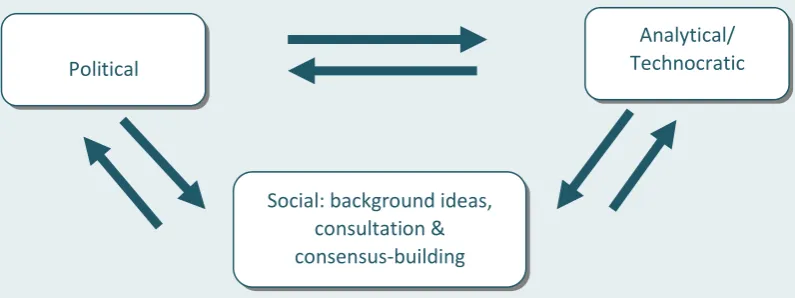
Figure 1: Understanding the Infrastructural Policy Challenge
To help thinking about these relationships, the report draws on international research on the relationship between knowledge, expertise and policy. This highlights that, as the degrees of complexity, uncertainty and ambiguity increase, it becomes less feasible to formulate expert advice in isolation from stakeholders, practitioners and political actors. The relevant data and cause-effect relationships become more uncertain, subject to divergent understandings, and contested. Consequently, effective expert analytical work requires a careful combination of ‘boundary work’ and ‘coordination’, suited to the nature of the policy area being addressed (Bijker et al., 2009). This includes identifying areas of analysis that can be effectively undertaken by those with technical expertise and areas where involvement of various sets of stakeholders is necessary, as well as coordination between the two.
The changing institutional, policy and analytical landscape in the UK
Over the last eight to 10 years, the question of how to do infrastructural policy has received considerable attention in the UK (Chapter 5). This reflected an increasing consensus that the approach to infrastructure policy and investment was problematic in a number of important ways. In response, there has been a number of developments in the landscape of UK infrastructure policy. Among these are:
Political
Social: consultation & consensus-building
devolution to city-regions and Scotland linked to infrastructure planning and investment (described in Chapter 6),
the execution of major infrastructure projects, such as the Channel Tunnel, Crossrail, Heathrow Terminal 5 and the London Olympics (described in Chapter 7),
changes to the technical, analytical and contractual approaches created in the heyday of privatisation and New Public Management—which did not succeed in passing risk to the private sector and which was vulnerable to litigation—moving to a more collaborative partnership approach (described in Chapter 7),
institutional change within the government system, including the creation of the Infrastructure and Projects Authority within the Treasury and, in 2016, the establishment of the National Infrastructure Commission (NIC) (described in Chapter 8), and
debate on and adaptation of methods of infrastructure appraisal, reflecting the limits of conventional cost-benefit analysis of individual projects, consideration of wider economic impacts, and framing technical work as an input to deliberation, consensus and decision-making (described in Chapter 9).
Reflections on the UK approach
These changes have greatly altered the policy landscape in the UK. The establishment of the NIC is certainly an important development, and some would place most emphasis on it. However, our analysis underlines the degree to which the establishment of the commission should be seen in the context of a wider set of changes in the overall system of infrastructure governance. Indeed, the NIC itself does not fit the standard characterisation: independent from political influence and solely reliant on objective analytical tools. The NIC would seem to be combining analysis, engagement and political decision-making, or links to decision-making, attuned to the complexity, uncertainty and ambiguity that characterises infrastructure policy.
with political actors, aiming to build high-level consensus on infrastructure issues. Meaningful engagement with the public is a key consideration for the NIC, though this area seems underdeveloped relative to both analytical work and political engagement.
Implications and challenges for Ireland
The analysis of the UK story, using the analytical framework set out above, helps us to identify the right questions about Ireland’s approach—although we do not answer them here. To what degree does Ireland effectively combine technical analysis, political decision-making and societal engagement? To answer this requires some detailed discussion of the current policy approach, the degree of coordination among key public bodies, the analytical techniques, and the means of engaging experts and societal interests. Infrastructure cannot be fully depoliticised, but neither can the risks associated with political decision-making be ignored. As well as having an unavoidable political and societal dimension, infrastructure must be the subject of sophisticated analysis.
The issue, then, is how relations between the political, the analytic/technocratic and the societal are structured, institutionalised and conducted in Ireland and how they might be reconfigured and enhanced.
Chapter 1: Introduction
This paper focuses on infrastructure policy with a view to prompting reflection on Ireland’s approach to infrastructure. It is designed to inform discussion of whether certain changes in process or institutions might support a more ambitious and integrated approach to identifying Ireland’s infrastructure needs in the coming decades, devising integrated programmes, funding and delivery, and building societal engagement and support.
Chapter 2 outlines the changing institutional and policy landscape of infrastructure internationally, and the challenges associated with infrastructure policy. It highlights the temptation to see the establishment of an independent infrastructure commission or body as a panacea, allowing an untrammelled application of technical analysis and a depoliticisation of decision-making on infrastructure. The complexity, uncertainty and ambiguity of infrastructure policy casts doubt on the wisdom—and, indeed, the feasibility—of that approach. It is more productive to focus on the configuration of relationships and how this achieves a balance between analytical, political and societal dimensions and capabilities. To help thinking about this, we summarise some international research on the knowledge/policy relationship and the role of expert advisory bodies.
In Chapter 3, we provide a brief synopsis of the evolution of infrastructure policy and thinking in the UK. This is a summary of what is detailed in five chapters in Part II.
In Chapter 4, we offer a tentative interpretation of the UK story, complex though it is. We see it as a reconfiguration of the relationships between the three dimensions: analysis, political decision-making and societal engagement. We argue that its most obvious feature, the establishment of the ‘independent’ National Infrastructure Commission, should be seen in the context of a wider set of changes, including significant institutional and procedural innovations within the core executive of the UK. Drawing on this reading of the UK story, we identify some of the questions that arise for discussion in Ireland.
1.1
Why the UK?
It is important at the outset to consider why we should look in detail at the UK. There are a number of similarities and differences between the UK and Ireland. One similarity, of relevance to infrastructure policy, is that the UK shares with Ireland a number of basic institutional characteristics, such as a common-law system and a parliamentary form of government in which the executive is dependent on ongoing parliamentary support. A third common characteristic is that both the UK and Ireland have traditionally been relatively centralised states.
The most prominent difference is the size of the two countries. Other differences in the politics and policy of the two countries that are relevant to infrastructure policy also need to be taken into account in reflecting on the UK story. One is the scale of defence spending, which accounts for a much greater share of public capital investment in the UK, a factor that is significant in periods of fiscal retrenchment or constraint.
In considering the interesting and complex evolution of the UK approach to infrastructure over the past decade or so, it is worth noting the background against which this occurred. Three related features of UK politics, policy and administration in the period from the late 1970s to the mid-1990s are relevant:
fiscal conservatism, reflecting a desire to limit the role of the state, which saw UK investment in infrastructure fall below the levels in key comparator countries,
widescale privatisation of public utilities, which constitute major spheres of infrastructure investment, and
adoption of the New Public Management approach, characterised by separation of purchaser and provider, contractualisation of relations between entities (public or private) performing public functions, and a more rules-based approach to both ex ante and ex post assessment of public expenditure programmes and proposals.
Reflecting these factors, the policy landscape for infrastructure in the UK became considerably more complex over the last three decades. The strong privatisation agenda pursued since the early 1980s contributed to the emergence of a more heterogeneous network of public and private actors—government ministries, local government bodies, executive and regulatory agencies and private companies— involved in the planning, delivery and regulation of key infrastructure services.
1.2
Part II
Chapter 5 provides an overview of the changing institutional and policy landscape in the UK, and a summary of the sequence of reports, analytical contributions and institutional changes that drove and characterise the evolution of UK policy.
Chapter 6 describes a particular aspect of the evolution of UK infrastructure policy: the process of devolution through City Deals, devolution agreements, the devolved assemblies and the Northern Powerhouse agenda. We focus particularly on the Greater Manchester Combined Authority (GMCA), since it has played a strong role in both the formation and delivery of a city-region development plan in which new urban transport infrastructure has been a central feature. The UK devolution story is an interesting example of the reconfiguration of the conduct of technocratic analysis and planning, political decision-making and social engagement.
In Chapter 7 we summarise interesting developments in the way in which the UK organises the planning and delivery of major infrastructure projects. These developments are, in large part, a response to increased complexity and some disappointment with the approaches put in place in the heyday of neo-liberal privatisation and New Public Management. Those methods—sometimes characterised as ‘hands off, eyes on’—were intended to pass a significant portion of risk to the private sector, via contracting and outsourcing, and create a more rules-based public-sector decision-making system. We draw heavily on a paper by the Infrastructure Projects Authority to outline changes in the way the UK public sector plans, commissions and monitors the delivery of infrastructure projects. This highlights the need for enhanced public-sector capabilities and the creation of partnership arrangements to ensure a collaborative, rather than a litigious, approach.
seem to be creating an interesting combination of a more sophisticated and integrated analytical approach to identifying long-term infrastructure needs, networking with the core government system, regional entities and sectoral regulators, and, to some degree, communication with, and engagement of, civil society.
In Chapter9we report on some interesting and influential UK thinking on the way that technical appraisal of infrastructure projects has been carried out and the relationship between this and the processes of public consultation and political decision-making. Some experienced and respected British economists have been critical of conventional economic models and cost-benefit analysis, and the way in which these are used in the overall decision-making process. Indeed, they see this combination as an important factor in the UK’s under-investment in infrastructure. An interesting insight is that the attempt to make ‘objective’ technical economic analysis the key determinant of decisions on infrastructure has the paradoxical effect of making decisions more political (Rosewell, 2010). This reflects the complexity, uncertainty and ambiguity discussed above. Related to these critiques, a number of British economists have done innovative work on developing analytical approaches that can go some way to taking account of the wider economic, societal and environmental costs and benefits of infrastructure investment. Another influential analytical development in the UK can be found in work inspired by the ‘system of system’ concept. The IRTC, based in Oxford University, has designed a process for identifying long-term cross-sectoral infrastructure needs using scenario-based modelling and expert stakeholder dialogue. To some degree, this is informing current work on the UK’s infrastructure needs, as undertaken by the Institute of Civil Engineers and the National Infrastructure Commission.
1.3
Methodology
Chapter 2: The Changing Context and
Nature of Infrastructure Policy
2.1
Introduction
This chapter outlines the changing institutional and policy landscape of infrastructure internationally. It is structured as follows:
Section 2.2: International trends in infrastructure thinking and policy
Section 2.3: The challenge of infrastructure policy
Section 2.4: The lure of independent infrastructure bodies
Section 2.5: The relationship between analysis, societal engagement and politics in the real world
2.2
International Trends in Infrastructure Thinking
and Policy
Internationally, there are important trends in thinking about infrastructure and the understanding of the infrastructure policy challenge.
These changes are characterised, first and foremost, by a renewed recognition that investment in infrastructure is critical for economic, social and environmental development. This is reinforced by the strengthening commitment to making the transition to a low-carbon economy and society.
transport, water, waste and housing—which are key infrastructural sectors. Another is European integration and globalisation, which has increased the cross-border dimension and brought supranational bodies, such as the EU Commission, EIB and even ECJ, into the picture. As explained well in an important paper for the Dutch government:
These two developments (change of actor constellation and shift towards multiple decision making levels) taken together result in a splintered transaction chain in the sense that investment decisions are often made in bilateral and discrete relations (for example between the regulator and network manager) and in some cases between actors with quite different interests (WRR, 2008: 2).
A third element of contemporary thinking is increased focus on infrastructure as a system. Each infrastructure—electricity, water, telecoms, transport—is a system. While these were once unconnected structures, they are now interconnected and place demands on one another. Together they are a ‘system of systems’—a key concept in infrastructure research and policy, initiated by research at MIT. An increasing body of research in the ‘system of systems’ paradigm explores infrastructure as a complex network of physical artefacts, processes, resources and services (iBUILD, 2015, Hall et al., 2013). The ‘system of systems’ characteristic of infrastructure has profound implications for the approaches adopted in planning, appraising, funding and delivering infrastructure.
Related to these perspectives, there is increased recognition of the degree of uncertainty in the area of infrastructure. For example, the economic effects of infrastructure investments are not always clear, especially if we move from the direct effects of single projects towards the systems effects of wider strategies that combine investment projects of various kinds. There are also uncertainties and risk associated with political and regulatory change, potential societal opposition and maintenance costs. Many of the associated benefits and returns are long-term and uncertain in nature.
There is also growing recognition of the dilemmas and challenges associated with how governments and others traditionally make decisions on strategic and critical infrastructure (Anheier & Alter, 2016a, 2016b). To a degree, these reflect the uncertainty and ambiguity associated with infrastructure. The challenges include:
the tendency to focus on new, high-profile, highly visible projects over necessary investment in maintaining and/or enhancing existing infrastructure stock (Coelho
et al., 2014),
political prevarication and an unwillingness when faced with highly contentious infrastructure investments, and
the increased contestation and social opposition that has been a feature of infrastructure developments in many countries.
There is also greater awareness of the difficulties associated with estimating future infrastructure requirements and making robust and climate-resilient investment decisions (Marshall, 2013). Forecasting future need, for example, requires making broad assumptions about economic growth, population change, technology and climate change.
Another significant trend is a renewed recognition, especially in neoliberal countries, that the state has an enduring role since the market on its own cannot be relied on to deliver key public utilities and services (Helm, 2013; WRR, 2008).
Internationally, there is also an active search for alternative and innovative ways of funding long-term investment in public infrastructure. Since the global financial crisis, more attention has focused on attracting increased institutional and capital market resources into infrastructural investment (Department of Finance, 2013; European Commission, 2014).
2.3
The Challenge of Infrastructure Policy
The trends noted above, particularly the increased number of actors involved, have drawn attention to governance and institutional issues: how infrastructure ideas and plans are formulated, and how investment decisions are made, responded to by stakeholders, implemented, maintained and evaluated.
As Anheier and Alter put it:
Rather than considering the mobilisation of resources as the primary bottleneck for infrastructure investment, the governance perspective suggests that heightened attention be paid to the decision making and administrative processes involved, and that this be done in the context of macroeconomic conditions that vary across countries and may involve different trade-offs (Anheier & Alter, 2016a: 16).
It is relatively easy to identify many of the elements that are necessary for effective design, decision and delivery of infrastructure:
Political leadership and coordination: to create a high-level strategy, underpinned by robust research and analysis.
Administrative coordination: at central and other levels, in particular in the UK with cities.
Appraisal: Systematic macro-analysis of how the individual elements of any capital investment plan fit together.
Integrated land-use planning and delivery: Strategic infrastructure investment embedded within an effective spatial planning framework and settlement pattern, which requires an effective combination of spatial and ‘sectoral’ perspectives and plans.
Financing: New approaches to financing infrastructure, given the changes in both public finance and the global financial system.
But the challenge is to identify how these elements can be achieved and aligned. What institutional and procedural arrangements are effective in the changed context outlined above?
[image:21.595.137.535.365.514.2]One way to characterise this challenge is to simplify the six elements identified above into three—political, analytic/technocratic and social—and to think about how these are conducted and combined in effective approaches to infrastructure (Figure 2.1).
Figure 2.1: Understanding the Infrastructural Policy Challenge: An Analytical Framework
What capabilities procedures are required within each of these three spheres? What relationships between the political, analytical and social dimensions are most effective? Experience suggests that there can be good and bad versions of these interrelationships.
One pattern, observed in the UK over several decades, is a combination that leads to indecision and insufficient investment. Another possibility might be this: infrastructure plans are developed within the technical system but political actors ‘interfere’ with these in capricious ways. But, reflecting the interplay of the three spheres—and the need to include all three—this political activism might arise partly in response to the fact that technical plans were drawn up with relatively little societal engagement and consensus-building. When one set of actors is excluded from the process of infrastructure policy development in a sustained way, it usually
Political
Social: background ideas, consultation & consensus-building
finds a means to insert and assert itself later in the process. This way of conducting policy seems problematic.
The challenge is clearly a complex one, since the three requirements—analysis and expert administration, societal engagement and buy-in, and high-level political leadership and decision-making—can seem to point in different directions. Additionally, efforts to achieve one can seem to undermine the other two.
2.4
The Lure of Independent Infrastructure Bodies
In recent times, one of the most influential responses to the governance challenge is the idea that governments lack the tools and procedures to make good infrastructure plans and decisions. It is commonly argued that countries need comprehensive cross-sectoral infrastructure strategies and that the key to achieving this and good decisions is the creation of an independent infrastructure advisory body or commission. Such bodies, it is argued, can deliver a combination of independence from political influence and the use of analytical tools such as cost-benefit analysis that allow the decoupling of infrastructure decision-making from short-sighted and politicised decision-making. In other words, the promise of such expert bodies is the depoliticisation and thus rationalisation of decision-making about infrastructure (Hammerschmid & Wegrich, forthcoming 2017: 22).
Reflecting these ideas, a number of countries—such as Australia, Canada and the UK—have established ‘independent’ infrastructure bodies. The Australian body, Infrastructure Australia, has been praised by international organisations, such as the OECD and World Economic Forum, as a leading example. Marshall notes that the countries most eager to create independent infrastructure bodies tend be those that have been at the forefront of privatisation and liberalisation of infrastructure sectors (Marshall, 2013: 14).
These developments reflect what Roberts calls ‘the logic of discipline’—the idea of using institutional design to insulate economic policy-making from political influence (Roberts, 2010). This is evident in the international trend towards independent central banks. As Hammerschmid and Wegrich (forthcoming 2017) point out, in the field of infrastructure governance, the logic of discipline is combined with renewed confidence in long-term planning and related models of decision making.
depoliticising infrastructure policy is questionable. It ignores the core characteristics of infrastructure policy: complexity, uncertainty and ambiguity, which severely limit the possibility of generating and relying entirely on objective, independent analysis:
Basing a strategy for infrastructure investment on a technical analysis of the costs, benefits, and potential side-effects of investments in the different subfields of infrastructure imposes information processing requirements that are extremely difficult to meet. The complexity of the field results in substantial uncertainties in the sense of unknown or incomplete information. For example, the economic effects of infrastructure investments are not always clear, especially if we move from the direct effects of single projects towards the systems effects of wider strategies that combine investment projects (Hammerschmid & Wegrich, forthcoming 2017: 27).
Furthermore, complexity and uncertainty ensure that infrastructure policy challenges are characterised by ambiguity. The goals, evidence and cause-effect relationships relevant to infrastructure policy are the subject of conflicting meanings and equally plausible interpretations. Consequently, although good information is key to good decision-making, it is generally contested or negotiated knowledge that informs infrastructure strategies (de Bruijn & Leijten, 2008). It is, therefore, not easy to shut out political influence in fields of policy which are contested and have a significant redistributive dimension. The scale of resources associated with infrastructure, allied to the potential benefits and costs associated with major projects, ensures that this is a policy domain in which the primacy of politics is particularly evident. Political actors, especially government ministers with a democratic mandate, will invariably reassert their prerogative, and they are, probably correctly, unwilling to cede decision-making on major economic and social infrastructure to technical bodies or experts.
Reflecting these factors, application of the ‘logic of discipline’ to policy domains such as infrastructure—characterised by complexity, uncertainty and ambiguity— has been described as ‘naïve institutionalism’ (Roberts, 2010). Hammerschmid and Wegrich see three major shortcomings or misunderstandings in the dominant debate about independent expert advisory bodies in the field of infrastructure governance:
The debate frames the challenge of infrastructure governance as a problem of generating knowledge about the costs and benefits of infrastructure investments. While knowledge is important, the high level of complexity will not result in the elimination of uncertainties or the ambiguity that follows from the diverse selective perceptions of a range of equally legitimate political, administrative, and societal actors. More knowledge will not resolve the ambiguity.
This debate considers formally-independent expert bodies as politically neutral— both by considering formal legal independence as an effective means of depoliticisation and by assuming that the preparation of decisions within expert bodies can be completely separated from a final political decision. However, in a field of (re)distributive policy-making, political influence will not be easily shut out when decisions are about who gets what and when.
As a consequence of the previous two points, the debate does not explore how political influence would be exerted within a system in which independent expert bodies play an important role (Hammerschmid & Wegrich, forthcoming 2017: 39).
In short, they say, the institutional design debates are limited to the parameters of naïve institutionalism. ‘This debate is not trying to make the political process smarter but is rather trying to replace it with analysis—or technocracy’ (ibid.: 39).
2.5
The Relationship between Analysis, Societal
Engagement and Politics in the Real World
fit’ (ibid.: 37). They suggest that four capacities or abilities of the national administrative system are particularly relevant in shaping the impact of the establishment of an infrastructure body:
the capacities to coordinate actors across boundaries and levels of government,
the capacity to regulate societal actors,
the capacity to implement and deliver policies, and
the ability to deploy analytical capacities for addressing complex policy challenges.
These are all institutional traits of governmental systems, but they also require skills and competencies on the part of the individuals working in government (ibid.: 36). One view—which figures on the British discussion and is discussed in Chapters 4 & 8—is that an attempt to make infrastructure decisions subject to tight technical and analytical rules and procedures, applied by experts, has the paradoxical effect of making actual decision-making more overtly political in a narrow sense (Rosewell, 2010). Indeed, in the international literature it is argued that, if the contested character of information is denied, this tends to turn decision-making into a ‘straight political fight in which the role of information is devalued rather than strengthened’ (de Bruijn & Leijten, 2008).
A cross-country analysis of infrastructure policy approaches suggests that, of the four capacities or abilities listed above, coordinative capability and analytical capability tend to be relatively weak in contrast with regulatory capability:
Whereas the field of infrastructure seems dense in terms of rules and regulations for procurement, technical specifications and administrative requirements, and over-sight more generally, it seems less populated with institutions that properly address the governance challenge of coordination (Anheier & Alter, 2016b: 179).
government but also extend to coordination with business and civil society as well’ (ibid.: 180).
Analytical capacity, which is also relatively scarce, is closely related to the coordination challenge. Anheier and Alter argue that efficient and effective coordination is more likely to happen if actors have the capacity to provide sufficient data and have adequate knowledge and expertise for project planning, risk assessment and implementation, especially under conditions of political, financial or technical uncertainty. ‘Unfortunately, analytical capacity that is both encompassing and strategic, politically savvy and astute, and technically and economically sound seems all too rare’ (ibid.: 181).
Complexity, uncertainty and ambiguity clearly have implications for how to conduct and combine analysis, societal engagement and political decision-making. In thinking about how these are, and can be, combined in infrastructure policy, we find it helpful to draw on insights in the international research on the relationship between knowledge and expertise, on the one hand, and policy on the other. This is a huge field, which begins from the finding that the idea of technical rationality, in which expert knowledge informs policy in a linear one-directional way, is rarely an accurate account. Owens argues that within this area of research the most promising framework for the analysis of expert advice would seem to be one that combines the ‘cognitive’ and ‘co-productionist’ models of knowledge-policy relations (Owens, S., 2015). The cognitive perspective allows for the possibility that knowledge is sometimes (if rarely) used ‘rationally’ or strategically, and it recognises that knowledge will have a greater or lesser effect depending on circumstance. But the co-productionist idiom brings much-needed critical attention to scientific/expert knowledge itself and to the possibility (and the practices) of its separation from politics. Consequently, ‘combining these perspectives enables us to see how an advisory body might perform different, and sometimes multiple, roles, such that careful examination of its work in specific contexts might help illuminate both the functioning of expert advice and relations between knowledge and policy more broadly defined’ (ibid.: 17).
Research in this area shows that effective expert analytical work requires a careful combination of ‘boundary work’ and ‘coordination’, suited to the nature of the policy area being addressed (Bijker et al., 2009). This includes identifying areas of analysis that can, to a degree, be effectively undertaken by those with technical expertise and areas where involvement of various sets of stakeholders is necessary, as well as careful coordination between the two. It also involves a skilled combination of ‘frontstage’ articulation of the state of knowledge among analysts, on the one hand, and ‘backstage’ generation of useful knowledge in areas where the relevance and meaning of diverse data, as well as key cause-effect relationships, are contested even among experts. But this overall perspective recognises that determining the current level of knowledge among experts is generally a much more complicated matter than is assumed in the standard model of science, the linear-rational concept of the knowledge-policy relationship and conventional perpsective on ‘evidence-based policy’. Even in areas of relatively hard science, this perspective ‘assumes an advisory process in which the practices to which the advice applies are already taken into account in the process of generating and articulating that particular advice’ (ibid.: 44). This is likely to be even more so in a policy area, such as infrastructure, where knowledge and cause-effect relationships are contested, and professional and other practices are highly influential.
Similar thinking generated within the study of infrastructure policy specifically leads Anheier and Alter to reject as naive and unrealistic the idea that infrastructure can be ‘policies without politics and technocratic implementation without broader political considerations’ (Anheier & Alter, 2016b). The focus needs to be on increasing the ‘quality’ of political decision-making rather than seeking to replace politics with technocratic analysis or expert decision-making (Hammerschmid and Wegrich, 2016.) Translating knowledge and analysis into effective action actually requires political will and authority (NESC, 2016). An effective and ambitious infrastructure strategy requires not ‘less’ politics but rather different politics in which political authority, energy and commitment are channelled into the pursuit of longer-term public values and goals.
Chapter 3: Overview of Developments
in UK Infrastructure Policy
3.1
Introduction
The key purpose of this paper is to provide a reflection on the UK approach to infrastructure that can help inform the evolution of Irish infrastructure policy. This reflection is based on a detailed examination of the UK approach (provided in Part II). However, to help the reader this chapter provides a brief synopsis of each of the chapters in Part II. It is structured as follows:
Section 3.1 provides an overview of the changing institutional, policy and analytical landscape in the UK over the last decade.
Section 3.2 describes the devolution in the UK and, in particular, the City Deals programme and the experiences within the Greater Manchester Combined Authority.
Section 3.3 summarises four key insights from a major review of a number of recent high-profile capital projects in the UK.
Section 3.4 describes the recently established National Infrastructure Commission.
3.2
Changing Institutional, Policy and Analytical
Landscape
Chapter 5 describes how, over the last eight to 10 years, the question of how to do institutional policy has received considerable attention in the UK. It shows that this has resulted in two major policy developments: the National Infrastructure Commission and the Infrastructure and Projects Authority. These are summarised below and elaborated upon in Chapter 5 and 8.
These two developments build on a number of earlier ones:
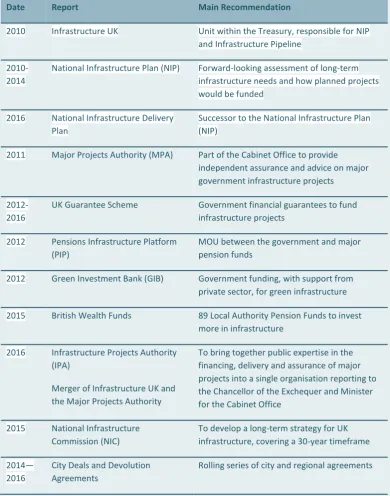
Infrastructure UK (2010 to 2014): a unit within the Treasury, responsible for National Infrastructure Plans.
The Major Projects Authority (2011-2016): part of the Cabinet Office, which provides independent assurance and advice on infrastructure projects.
The Green Investment Bank: providing government funding, with support from the private sector, for green infrastructure.
In 2016, Infrastructure UK and the Major Projects Authority were merged to form the Infrastructure and Projects Authority.
Since 2011, the UK government has overseen a process of devolution. This has meant that responsibility for substantial infrastructure projects was given to devolved bodies such as the Greater Manchester Combined Authority.
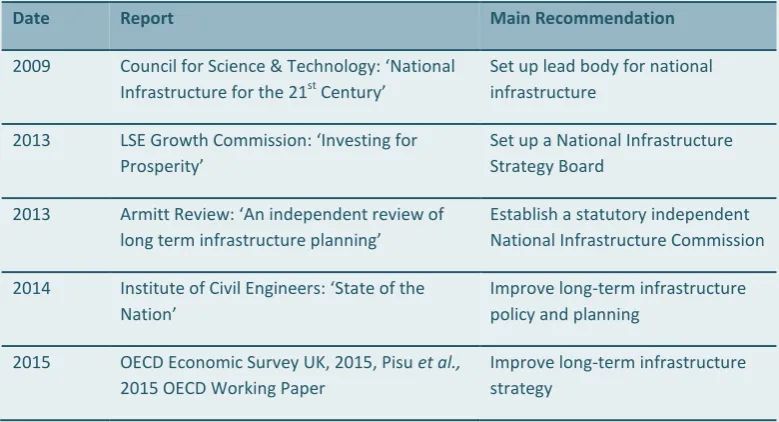
The institutional changes underway in the UK have been informed and shaped by a number of key reports. These reports noted the need to increase investment but also ways in which decision-making could be enhanced. The reports include:
Council for Science & Technology, National Infrastructure for the 21st Century (2009).
LSE Growth Commission, Investing for Prosperity (2013).
The changing landscape also reflects questions raised by economists and planners in the UK about the effectiveness of analytical tools in the face of the uncertainty and ambiguity associated with many aspects of major infrastructural projects— questions that we summarise in Section 3.5 and discuss in more detail in Chapter 9.
3.3
Devolution, City Deals and Greater Manchester
Chapter 6 shows that an important element of UK infrastructure and policy has been the devolution programme, which has been progressed since 2014.
It briefly describes how the evolution of the Scottish devolved administration since 1998 has been characterised by an increased focus on national spatial planning and infrastructure policy. Between 2003 and 2015, three National Planning Frameworks were published, representing the spatial expression of the Scottish government’s economic policy and infrastructure investment strategy. The 2015 National Planning Framework included 14 large-scale capital projects identified as being key to achieving economic, social and environmental policy goals.
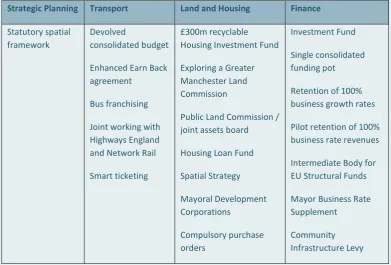
In parallel, there was significant process of devolution in England. This involved the formulation of ‘city deals’ between the UK government and regional cities. Thirty-four such deals were agreed between 2011 and 2016. These were introduced to incentivise coalitions of local actors to develop strategies—in the areas of infrastructure, skills and business support—to unlock economic development. Each deal was a negotiated bespoke package of funding and devolved powers. A focus on infrastructure investment, including innovative funding initiatives, and the adoption of a more robust ex ante evaluation and appraisal of how infrastructure schemes can contribute to national policy objectives, in particular economic growth, were a feature of some City Deals (O’Brien & Pike, 2015). A number of cities also developed single appraisal frameworks to enable them to more effectively prioritise investments (NAO, 2015).
The UK Government sought to build on the City Deals programme by enabling combined authorities to gain additional devolved powers through the negotiation of devolution agreements. Since 2014, 19 Devolution Deals have been agreed with 11 combined authorities and one unitary authority. The core powers that have been made available to most combined authorities include:
the capacity to facilitate development through the establishment of public land commissions and mayoral development corporations, and
new revenue-raising powers.
Devolution in England is most developed within the Greater Manchester Combined Authority (GMCA). Chapter 6 shows that the GMCA, through the negotiation of City Deals and devolution agreements, has acquired greater responsibility for aspects of transport, regional spatial planning, housing, business support, business rates, training and public-sector reform. A strong focus on developing ‘transformative’ transport infrastructure has been a particular feature of the GMCA’s integrated economic strategy. The powers given to the GMCA under devolution agreements have substantially enhanced its capacity to plan, finance, fund and deliver infrastructure investment.
The devolution process also includes the UK Government’s articulation of the Northern Powerhouse agenda, which aims to create a more innovative and highly productive northern economy centred on the five main cities. Northern Powerhouse is an overarching policy framework incorporating existing and new policy initiatives, with a strong focus on devolution, transport infrastructure and investment in science and innovation.
3.4
Four Lessons from the Delivery of Major
Infrastructure Projects in the UK
Chapter 7 draws on a paper by the Infrastructure and Projects Authority (IPA) to highlight four lessons emerging from an examination of recent high-profile major capital programmes and projects. These include: Channel Tunnel, Crossrail, the Thames Tideway Tunnel, Heathrow Terminal 5, London Olympics and London Underground.
Significant public-sector involvement is needed to enable private-sector delivery: In recent major capital programmes, the role of the public sector has been substantial, as sponsor, client and sometimes partner in the delivery organisation. Indeed, the public sector has been required to take on some of the roles that, under previous arrangements, it had attempted to transfer to the supply chain. The scale, risk, complexity and danger of supply-side power and the national importance of many projects has meant that deeper public-sector involvement was necessary to create the conditions under which the private sector will deliver effectively.
Major capital programmes require new ways of working in the centre of government: In some cases—notably the London Olympics, Crossrail and HS2— a much more collaborative approach to managing government’s role as sponsor has been developed, which has included the Treasury taking a more active approach to project management. This allows the public sector to manage financial risk differently, including assuming ultimate financial liability in a number of projects. There is also evidence of the need for greater flexibility in terms of how decisions are sequenced and in the scope to allow resources to move between years.
Collaborative contracting methods help mitigate risk and improve efficiency: Enabling and incentivising successful private-sector delivery has required the public sector to create and manage a sophisticated commercial and project control environment. This includes more collaborative, alliance-orientated and disaggregated approaches to commercial arrangements, the design of more sophisticated programme control architectures, and the involvement of the public sector in ensuring that private-sector capability and skills are in place. This has helped address some inefficient practices within the supply chain and reduce the costs associated with litigation that arises in traditional approaches.
3.5
The National Infrastructure Commission
Chapter 8 focuses on the National Infrastructure Commission (NIC), established in October 2015. It provides an account of its establishment, mandate and functions, including its approach to analysis, its evolving political engagement, its coordinative capacity and its effort to build societal engagement.
The aim of the NIC is to enable long-term strategic decision-making for infrastructure in the UK. The NIC has been formally established as an executive agency of the Treasury and will have close ties with the latter, especially those working in the Infrastructure and Projects Authority.
The NIC is managed by a board of commissioners chaired by Lord Adonis, the former Labour Minister for Transport. Sir John Armitt serves as deputy chair. All the commissioners were appointed by government, and the reputation, status and expertise of this grouping is viewed as a key organisational asset for this newly established body. The NIC has a core staff of around thirty people.
The mission of the NIC is to:
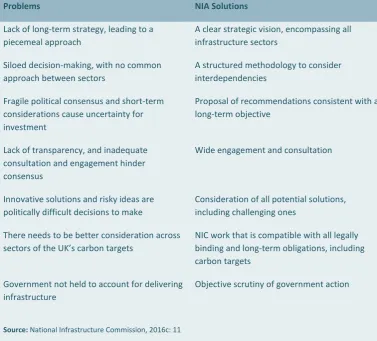
develop a clear long-term strategic vision, encompassing all infrastructure sectors,
develop a structured methodology to consider interdependencies,
consider all potential policy solutions and propose recommendations consistent with long-term objectives and a fiscal remit set down by government,
have wide engagement and consultation to help capture the expertise and opinions of a wide range of stakeholders,
work objectively to scrutinise government action, and
ensure that infrastructure projects are compatible with all legally binding and long-term obligations, including carbon targets.
Chapter 8 provides an overview of the products and services which the NIC has been mandated to provide. These are:
publication of a National Infrastructure Assessment (NIA), including recommendations, once in every parliament, the first by 2018.
High-priority policy studies: The NIC has also been given the role of undertaking, at the request of the government, studies of high-priority infrastructure policy issues. These examine pressing and significant infrastructural issues. To date, the NIC has published three reports—‘High Speed North’, ‘Transport for a World City’ (London) and ‘Smart Power’—and work is ongoing in two areas: 5G deployment and the Cambridge-Milton Keynes-Oxford corridor.
Annual monitoring: The NIC publishes an annual monitoring report taking stock of the government’s progress in areas where it has committed to taking forward NIC recommendations.
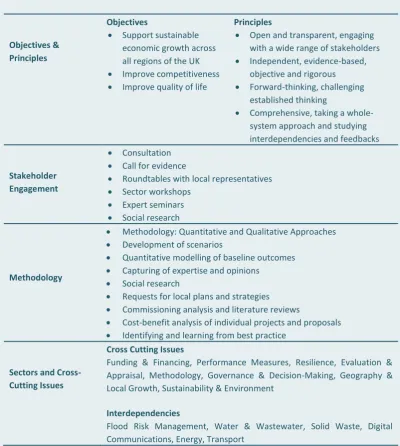
The Commission will use a range of methodologies, including the development of scenarios, quantitative modelling, evidence-gathering with a wide range of stakeholders, deliberative techniques and survey data, expert roundtables, cost-benefit analysis, commissioned research and international best practice. It will be assisted by two high-level expert advisory groups: a Technical Panel (containing industry actors and academics) and an Analytical Panel (composed mainly of academics).
The UK Government has committed to issuing a formal response to the NIC’s recommendations, including reasons and alternatives when it does not adopt the commission’s recommendations as government policy.
3.6
New Approaches to Evaluation and Analysis
Chapter 9 highlights that a feature of the UK infrastructure story has been the emergence of influential ideas about the evaluation of infrastructure projects and assessment of infrastructure needs.
An overreliance on conventional economic forecasting despite the fact that the experience of infrastructure investment and academic analysis challenges the assumptions underpinning these models.
An overt focus in transport on cost-benefit analysis (CBA) measuring time-based welfare benefits that detaches analysis from the real economic and social impact of infrastructure investment.
The assumption that economic growth is independent of infrastructure investment—reflected in adopting a projected rate of growth into appraisal calculations—which reinforces the prominence of short-term political considerations.
The use of technocratic analysis in the political and planning systems, which ensures an inadequate decision-making processes in which there are no mechanisms to debate and resolve differences of opinions and interests.
Rosewell proposes that infrastructure projects should be primarily evaluated on the basis of their contribution to the real economy and that the business case for projects should be articulated in a way that is relevant for businesses and communities. In making the case for a new approach to evaluation, Rosewell stresses the uncertain nature of social scientific evidence. The role of evaluation tools in the decision-making process is, therefore, not to provide ‘right answers’ but rather to generate evidence that can be used to support debate and consensus-building.
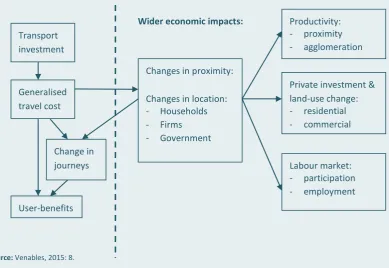
Concern over the limitations of the focus on time-based user benefits, in conventional appraisal in transport, has also stimulated attempts to develop an evaluation framework that incorporates a wider set of potential beneficial economic impacts. These wide impacts include enhanced productivity, increased private investment, land-use change and increases in employment.
comparing the marginal gains or losses associated with a particular intervention. It does not have the tools to assess the overall system—of transport, energy or housing—that a society needs or wants. This is a prior question that requires a much wider tool kit and set of methodologies.
In the UK, the result is a growing sense of the need to embrace a more diverse set of quantitative and qualitative methodologies that would improve the capacity to identify and capture a wider range of economic, social and environmental impacts associated with infrastructure investment. It is recognised that all such methodologies are underpinned by assumptions that are open to discussion (OECD, forthcoming 2017).
Chapter 4: Reflections on the UK
Approach
4.1
Introduction
This chapter sets out our reflections on the UK approach to infrastructure. It argues first that the establishment of the National Infrastructure Commission (NIC) must be placed in context: it is part of a wider set of institutional and other developments. We then analyse how the NIC undertakes its work and seeks to link analysis, political actors and societal interests.
This leads us to argue that how to effectively link analysis, politics and wider stakeholder and societal interests is the key question that must be asked in an Irish context. It suggests that the next steps would be detailed discussion on the current policy approach, the degree of coordination, procedures and analytical techniques and the means of engaging experts and societal interests.
The chapter is structured as follows:
Section 4.2: NIC as part of a wider set of developments.
Section 4.3: NIC’s approach to lining analysis, political actors and societal engagement.
Section 4.4: Conclusion (for Ireland).
4.2
The National Infrastructure Commission as Part of
a Wider Set of Developments
Infrastructure Commission (NIC), are relatively recent and are still taking shape. Beyond that, the UK evolution—and, indeed, the role and work of the NIC—can be interpreted in a number of somewhat different ways, as discussed below.
One interpretation of the developments in UK infrastructure policy places major emphasis on the establishment of the NIC and its role in preparing an integrated long-term National Infrastructure Assessment (NIA). This interpretation reflects what is probably a dominant view in international commentary and, indeed, popular opinion on infrastructure governance in recent years. As noted in Chapter 2, this view sees as exemplary a combination of independence from political influence and the use of analytical tools such as cost-benefit analysis that allow a decoupling of infrastructure decision-making from short-sighted and political considerations.
In our view, an interpretation that centres on the NIC and its supposed independence is not sufficient. First, it takes insufficient account of changes in the overall system of infrastructure policy in the UK. These changes are substantial, and they have greatly altered the landscape within which the recently created Infrastructure Commission sits. Second, focusing predominantly on the establishment of an ‘independent’ commission does not fully fit the evidence on the nature and activities of the NIC, as uncovered in our research (outlined in Chapter 8 and discussed further below).
A better first step in interpreting the UK story is to see the establishment and work of the NIC as part of a wider change in the overall system of infrastructure governance. Among the elements of this wider change are:
A protracted and sustained process of analysis, argument and change reflecting an increasing consensus that the UK’s prevailing approach was problematic as regards the scale, sophistication and delivery of infrastructure investment.
Some major UK infrastructure projects, such as the Channel Tunnel, Crossrail, the Thames Tideway Tunnel, Heathrow Terminal 5, London Olympics, London Underground, and major defence and nuclear projects.
Institutional change within the government system, including the creation of new units in the Treasury and other departments.
to national policy objectives, in particular economic growth (O’Brien & Pike, 2015). A number of cities also developed single appraisal frameworks to enable them to more effectively prioritise investments (NAO, 2015).
Modifications to the somewhat rigid technical, analytical and contractual approaches created in the heyday of privatisation and New Public Management. This has involved enhanced state capabilities, a move from the ‘hands off, eyes on’ doctrine—with its highly contractual mode of delivery and attempt to transfer bulk risk to private-sector suppliers—to collaborative partnership approaches designed to handle uncertainty and complexity.
A wider perspective on methods of infrastructure appraisal, moving beyond conventional cost-benefit analysis to consider wider economic, social and environmental effects of infrastructural investment and seeing technical assessment as an input to a more inclusive deliberation on desirable and feasible patterns of development.
Creation of a new infrastructure institution, the National Infrastructure Commission, which has a strong role in conducting analysis, dialogue and communication.
Some examples of innovation in funding, such as the Earn Back mechanism used in financing the Manchester metropolitan transport system.
Recognition of the need to improve the level and quality of engagement of non-state actors, although generating social buy-in and support for infrastructural investment continues to be a challenge.
Within the context of the wider set of changes in the UK approach to infrastructure, it is, of course, important to ascertain the nature and role of the National Infrastructure Commission.
4.3
The Commission’s Approach to Linking Analysis,
Political Actors and Societal Engagement
The National Infrastructure Commission (NIC) is undoubtedly an interesting institutional initiative. On the surface, its establishment looks like an attempt to create an ‘independent’ body with the characteristics noted above: independence from political influence and unqualified reliance on objective analytical tools. Indeed, it is undoubtedly the case that, in the UK infrastructure policy debate, there are those who seem to focus primarily on the NIC and the importance of making sure that it is ‘independent’. This is reflected in some of the discussion of its statutory status, the status of its recommendations to government and the inappropriateness of it being instructed to do its work within the parameters of a fiscal envelope set by the Treasury.
However, there is evidence that the NIC might not entirely fit this characterisation and, thus, that it may not display the limits of the naïve institutionalist approach noted in Chapter 3. It seems to be helping to create an interesting combination of analysis, engagement and political decision-making attuned to complexity, uncertainty and ambiguity. Its work involves a careful combination of boundary work and coordination. This includes identifying areas of analysis that can be effectively undertaken by those with technical expertise, and areas where involvement of various sets of stakeholders is necessary, as well as careful coordination between the two. It also involves a skilled combination of ‘frontstage’ articulation of the state of knowledge among analysts, on the one hand, and ‘backstage’ generation of useful knowledge in areas where the relevance and meaning of diverse data, as well as key cause-effect relationships, are contested even among experts.
Rosewell’s understanding of the nature and role of technical infrastructure assessment and its place in the overall deliberative and decision-making system (summarised above and outlined in Chapter 9),
the integrated cross-sectoral scenario-based exploration of long-term infrastructure policy needs, as developed by Hall and others at the IRTC, working within the system-of-systems approach (outlined in Chapter 9), and
the conduct of detailed exploratory studies of key infrastructure policy priorities identified by government.
Indeed, the approach to each of these types of analysis, and the relationships between them, may warrant more detailed exploration and description. It is too early to say exactly how the types and strands of analytical work listed above will fit together and how each will involve sets of stakeholders. We are of the view that, while the preparation of a comprehensive Infrastructure Needs Assessment for the UK is the most prominent role of the NIC, its conduct of a number of specific studies (such as that on Crossrail 2 and the Oxford-MK-Cambridge corridor) might turn out to be the most influential aspect of its work. There are a number of reasons for this statement.
First, when a particular issue is designated by the UK Government as a priority area for study by the NIC, itcreates an opportunity to put in place a process whereby key sectoral players must demonstrate how their specific sectoral strategies relate to the achievement of the goals of the priority area.
Third, engaging with current government policy priorities gives the NIC an ‘immediate’ role and a degree of relevance within the policy system. It is certainly noteworthy that all of its recommendations in the first three completed reports, and also the interim report on the Oxford-Milton Keynes-Cambridge corridor, have been endorsed by the government.
Fourth, the policy recommendations in the individual reports are effectively the building blocks of the NIC’s long-term vision for UK infrastructure and, as such, they may provide a bridge between current and medium-to-long-term policy actions. Overall, requests for NIC reports on specific infrastructure issues, and the commission’s preparation and delivery of these, enables the NIC’s thinking to be brought to bear on current policy issues and, vice versa, brings prevailing concerns into the arena of the commission’s longer-term analysis.
However, despite its technical and analytical starting point, the NIC also emphasises links with political actors, aiming to build a high-level consensus on infrastructure issues. The political stature of the commissioners is important, as is their intention to actively network with political actors, and the emphasis on adopting a pragmatic iterative approach and commitment to work through the formal channels into the administrative and parliamentary systems. This includes being given a formal role in monitoring and reporting annually on the government’s progress in delivering endorsed NIC policy recommendations.
These analytical and political strengths, if they materialise, are likely to enhance the NIC’s ability to perform another critical function in infrastructure policy: coordination. As noted in Chapter 2, international research suggests that the two most scarce elements in infrastructure policy tend to be analytical capacity and ‘institutions that properly address the governance challenge of coordination’ (Anheier & Alter, 2016b). Indeed, Anheier and Alter see a link between these two, arguing that ‘analytical capacity gives the institution the voice needed to discharge its coordination tasks legitimately and with authority in the context of policy decisions made or contested’ (ibid., 183).