Proc. of the Joint Workshop on Automatic Knowledge Base Construction & Web-scale Knowledge Extraction (AKBC-WEKEX), pages 25–30,
Relabeling Distantly Supervised Training Data for
Temporal Knowledge Base Population
Suzanne Tamang and Heng Ji
Computer Science Department and Linguistics Department Graduate Center and Queens College, City University of New York
New York, NY 10016, USA
[email protected], [email protected]
Abstract
We enhance a temporal knowledge base pop-ulation system to improve the quality of dis-tantly supervised training data and identify a minimal feature set for classification. The approach uses multi-class logistic regression to eliminate individual features based on the strength of their association with a temporal label followed by semi-supervised relabeling using a subset of human annotations and lasso regression. As implemented in this work, our technique improves performance and results in notably less computational cost than a par-allel system trained on the full feature set.
1 Introduction
Temporal slot filling (TSF) is a special case of Knowledge Base Population (KBP) that seeks to au-tomatically populate temporal attributes orslotsfor people and organizations that occur in national and international newswire sources, and less formal dig-ital publications such as forums or blogs. Typi-cal facts in a knowledge base (KB) contains are at-tributes for people such astitle,residence, orspouse
and for organizations, top employees, or members. We describe work that extends traditional KBP in that not only are relations extracted, but the time for which the relation is valid is also populated, requir-ing a automated system to construct a timeline for time dependent slot fills.
For many new learning tasks such as TSF, the lack of annotated data presents significant challenges for building classifiers. Distant supervision is a learn-ing paradigm that exploits known relations to extract
contexts from a large document collection and au-tomatically labels them accordingly. The distance supervision assumption is that whenever two enti-ties that are known to participate in a relation appear in the same context, this context is likely to express the relation. By extracting many such contexts, dif-ferent ways of expressing the same relation will be captured and a general model may be abstracted by applying machine learning methods to the annotated data.
Although the distance supervision assumption is generally true, it is considered a weak labeling ap-proach. Recent work in relation extraction has re-ported challenges using Freebase to distantly su-pervise training data derived from news documents (Riedel et al., 2010) and TAC’s standard slot-filling task (Surdeanu et al., 2010). While extending this framework to TSF, we encounter additional chal-lenges: (1) time normalization results can result in additional errors that proliferate in consequent pipeline steps, (2) Web data is more likely to con-tradict Freebase facts, and (3) the size of the feature set required to express the rich contexts for a large set of temporal instances can be prohibitively large to learn supervised models efficiently.
were implemented in our experiments. Section 4 presents the experimental results and Section 6 con-cludes the paper and sketches our future work.
2 Task and System Overview
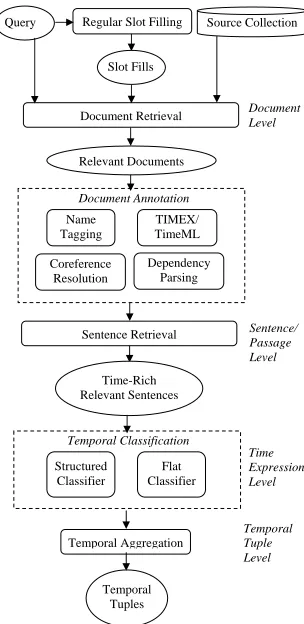
The temporal KBP slot filling task posed by NIST Text Analysis Conference (TAC) (Ji et al., 2010; Ji and Grisham, 2011) uses a collection of Wikipedia infoboxes as a rudimentary knowledge representa-tion that is gradually populated as new informarepresenta-tion is extracted from a document collection. This source corpus consists of over one million documents that have been collected from a variety of national and international newswire sources and less formal dig-ital publications. The CUNY TSF system shown in 2 ran several parallel submissions, two that varied only in how the classifier is trained. The methods used to develop the system are described in more detail in previous work (Li et al., 2012).
In order to obtain a large amount of data to train a classifier for labeling temporal instances, we ex-tended a general distance supervision framework for relation extraction (Mintz et al., 2009) and modify the assumption to consider the value of a tempo-ral expression that additionally cooccurs. That is, for a known query, q, attribute, a, and time range,
[tbegin, tend], sentences in a corpus where q,a, and
a temporal expression t co-occur can be automati-cally labeled with the classesstart, end, hold, range
orirrelevantfor training purposes using a mapping
based on the following heuristic rules and on the value oft:
coocurq,a,t =
t=tbegin, start
t=tend, end
tbegin> t < tend, hold
t=tbegin∧tend, range
(t < tbegin)∨(t > tend), irr.
As indicated in Figure 2, the system begins with a regular slot filling component to extract slot fills for the given query. Then, document retrieval is performed based on the query and attribute indi-cated in Freebase. The next step, sentence retrieval, considers the time expression indicated in Freebase, namely that the sentence should include the query, slot fills, as well as candidate time expressions. The
remaining processing can be decomposed into two problems: (1) the classification of any temporal ex-pression in the extracted query and slot fill contexts; and (2) temporal aggregation to form a temporal tu-ple for each query’s slot fills. The motivation for this work was to improve classification performance by improving the quality of that data used to generate the classification model.
Query Regular Slot Filling Source Collection
Document Level
Document Retrieval
Sentence/ Passage Level
Time Expression Level
Flat Classifier
Temporal Tuples Slot Fills
Coreference Resolution
Time-Rich Relevant Sentences
TIMEX/ TimeML Name
Tagging
Dependency Parsing
Document Annotation
Sentence Retrieval Relevant Documents
Temporal Classification
Temporal Aggregation
Temporal Tuple Level
Structured Classifier
Figure 1: CUNY Temporal KBP System
[image:2.612.351.503.186.498.2]3 Methods
Category Type Total Start End Holds Range Others Manual 28 10 3 15 0 9 Spouse
Automatic 10,196 2,463 716 1,705 182 5,130 Manual 461 69 42 318 2 30 Title
Automatic 14,983 2,229 501 7,989 275 3,989 Manual 592 111 67 272 6 146 Employment
Automatic 17,315 3,888 965 5,833 403 6,226 Manual 91 2 9 79 0 1 Residence
[image:3.612.72.298.71.151.2]Automatic 4,168 930 240 727 18 2,253
Table 1: Number of human and distantly supervised train-ing instances by dataset
implied information. We used a variety of lexical and syntactic features after document annotation and sentence retrieval to generate a feature set for super-vised learning.
3.1 Relabeling
The temporal class labels, start, end, hold, range
andirrelevant, are used to inform the final
aggrega-tion that is done for each entity in the KB. In order improve the accuracy and of the training instances and incorporate local context that distance supervi-sion does not capture, we usedself-training, a semi-supervised learning method that has been used to la-bel data for tasks such as parsing (Mcclosky et al., 2006). Using a small set of human annotations, or
seed examples, we iteratively labels the partitioned unlabeled set, retaining only the confident labels for retraining the classifier in each round. However, the size of the training dataset resulted in a prohibitively large, sparse feature space. We perform two step in order to generate a more parsimonious classification model that can be used for self-training: (1)feature
eliminationto identify a minimal set of model
fea-tures, followed by (2)relabelingusing the reduced feature set and a lasso regression classifier.
Feature elimination: First, for each of the M features in the setF = {f1, ...fM}extracted from
the training data we test the independence of each feature given each class label, inserting only those features that meet a thresholdp-value into the min-imal feature set F0. Although this approach tests each feature uniquely, many of the features already express conjunctive combinations of tokens.
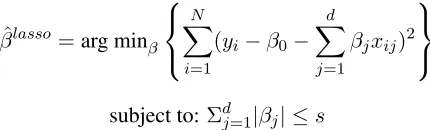
Self-training: To relabel the instances using the reduced feature set F0, we annotated a small set of training data by hand and used lasso (least ab-solute shrinkage and selection operator) regression,
which has the benefit of shrinking the coefficients of features towards zero so that only the subset of features with the strongest effects are incorporated into the classifier (Ng, 2004; Li et al., 2005). The shrinkage parameter (s > 0) is tuned using cross-validation. For a collection ofN training instances, D = {(x1, y1), ...,(xN, yN)}, ofddimensions the
lasso coefficientsβˆare calculated as follows:
ˆ
βlasso=arg minβ
N X
i=1
(yi−β0−
d X
j=1
βjxij)2
subject to:Σdj=1|βj| ≤s
Lasso regression limits the expression of extrane-ous information and as a result provides additional feature selection properties. The lasso minimizes the residual sum of squares with the constraint that the absolute value of the regression coefficients must be less than a constant,s, that functions as a tuning pa-rameter and is used for shrinkage. Whensis large enough, there is no effect on the solution, but when it shrinks it has the effect of reducing some model coefficients close or equal to zero. We used cross-validation to determine the best values forsin our experiments.
In our experiments, we used .005%-.101% of training instances from distant supervision data as the initial labeling seeds for self-training. We used the agreement between classification results for two different values ofs, the regularization parameter for the model. As the new data portion is labeled, those retained for retraining are instances for which there is an agreement reached by multiple classifiers.
4 Results
[image:3.612.318.533.189.254.2]improvements are obtained for the per:spouse
slot (7.12% absolute F-Measure gain) which also came the closest to that of human performance.
countries_of_residence stateorprovinces_of_residence
cities_of_residenceemployee_of member_of
title spouse top_members/employees
all
0.00 0.05 0.10 0.15 0.20 0.25 0.30 0.35 0.40 0.45 0.50
F-Measure
[image:4.612.329.520.80.229.2]Before After
Figure 2: Impact of feature selection and relabeling
To more closely examine the effects of relabeling on classification, we compared the accuracy of the labels before and after relabeling for the spouse slot type using development data. Since the set of all in-stances would entail considerable work for a human annotator, we selected 1000 instances at random, eliminating all instances where the labels agreed be-tween the two systems and were left with 83% of all labeled training data. Then, for those instances remaining, a human annotator assigned astart,end,
hold, range or irrelevant label that was used as a
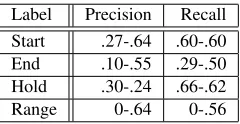
gold standard. Figure 3 shows the distribution of labels. Compared with human annotation or after relabeling, the system without relabeling shows a notably higher proportion of irrelevant labels and relatively few range labels. Table 2 further details performance post relabeling, reporting the pre-cision, recall.
5 Discussion
The lack of training data for supervised learning is a bottleneck to improving automated KBP sys-tems and distant supervision offers an attractive
[image:4.612.97.274.123.263.2]ap-Label Precision Recall Start .27-.64 .60-.60 End .10-.55 .29-.50 Hold .30-.24 .66-.62 Range 0-.64 0-.56
[image:4.612.126.246.639.701.2]Table 2: Pre-post relabeling preformance
Figure 3: Distribution of class labels
proach to expediting the labeling of training data at low cost. Not surprisingly, using heuristics to label temporal instances leads to the introduction of erro-neous annotations. Some common causes of error are: coreference results match the wrong named en-tities in a document, temporal expressions are nor-malized incorrectly, temporal information with dif-ferent granularities has to be compared (e.g., we know John married Mary in 1997, but not the exact day and month. Should the time expression Septem-ber 3, 1997 be labeledstart?), and information of-fered by the KB is incorrect or contradictory with information found on the Web documents.
To address these challenges, we develop a sim-ple but effective techniques to relabel temporal in-stances. Noise is a major obstacle when extending distant supervision to more complex tasks than tra-ditional IE, and our techniques focuses on refining the feature set so that more meaningful features are expressed, and spurious features are removed, or ig-nored. We perform two steps: using multi-class lo-gistic regression as the basis for eliminating features followed by relabeling with a lasso regression which has additional feature selection properties.
dimension-ality and sparsity was associated with the feature space. Feature reduction with multi-class logistic re-gression was most dramatic in first development sys-tem, which was also the noisiest, averaging 96.2% feature elimination. The classifiers trained on our final system showed an average of 89% feature re-duction for the temporal slots, resulting in a more parsimonious classification model.
Relabeling: the procedure described in this work resulted in slightly increased performance on the TSF task. Temporal labels are initially assigned us-ing distant supervision assumptions, which in some cases result in inaccurate labels that could be better informed by local context. For example, the tempo-ral instance below was returned by distant supervi-sion given the query Jon Voight, the slot value for the spouse, Marcheline Bertrand, and the relevant date range, 1971-1978. Caps are used to show the normalization with the substituted text in brackets:
“According to former babysitter late mother TARGET ATTRIBUTE [Marche-line Bertrand] virtually abandoned her baby daughter after a painful TARGET DATE [1976] split from husband TAR-GET ENTITY [Jon Voight].”
Since the date 1976 is between the range indicated by Freebase it was labeled a target date, and distance supervision heuristics assigned aholdlabel, indicat-ing that the relation was true for 1976, but that it was not the beginning or end. However, the context sup-ports the labeling of this instance more accurately labeled as theendof the spouse relation.
Similarly, the following sentence has a date de-tected that was within the valid range and was also mislabeled, this time asirrelevant:
“TARGET ATTRIBUTE [Shirley] has one daughter, 54, with her TARGET EN-TITY [Parker], who she split from in TARGET DATE [1982].”
In this example, a different date was indicated for theendof the relation spouse in Freebase. Although supporting text can be used to infer the end of a rela-tion, the simplicity of the distant supervision causes it to fail in this case. Relabeling provided the correct assignment in both of these examples, and it abil-ity to correctly label the instances is likely due to
a strong association of the feature ‘split from’ with theendlabel.
6 Conclusion
To address the challenges associated with noisy, heuristically labeled Web data for training a clas-sifier to detect the temporal relations, we develop a method with several important characteristics. First, it achieves state-of-the-art performance for TSF, slightly improving on a parallel system that was trained on the full feature set without relabel-ing. Second, it dramatically reduces the size of the feature space used for labeling temporal instances. Lastly, it can be used to identify which model fea-tures are more significant for predicting temporal as-pects of a query attribute relation.
Our future work will continue to develop tech-niques for addressing the challenges posed by ex-tending distant supervision to new types of IE tasks, and the refinement of our techniques. Specifically, it is still unclear how the number of seed instances for semi-supervised relabeling impacts TSF perfor-mance and why slot level perforperfor-mance is variable when the number of seed examples is similar. Also, we used a random set of seed examples for self-training and it is possible that learning from certain types of instances may prove more beneficial and that more iterations in the self-training process may continue to improve the accuracy of training labels and overall system performance.
7 Acknowledgements
References
Qi Li and Javier Artiles and Taylor Cassidy and Heng Ji. 2012. Combining Flat and Structured Approaches for Temporal Slot Filling or: How Much to Compress?
Lecture Notes in Computer Science, 2012.
Heng Ji and Ralph Grishman. 2011. Knowledge Base Population: Successful Approaches and Challenges.
Proc. of ACL2011, June:1148–1158.
Heng Ji and Ralph Grishman and Hoa Trang Dang. 2011. An Overview of the TAC2011 Knowledge Base Population Track. Proc. Text Analytics Conference (TAC2011), 2011.
Heng Ji and Ralph Grishman and Hoa Trang Dang and Kira Griffitt and Joe Ellis. 2010. An Overview of the TAC2010 Knowledge Base Population Track. Proceedings of the Third Text Analysis Conference, November, 2010.
Mihai Surdeanu and David McClosky and Julie Tibshi-rani and John Bauer and Angel Chang and Valentin Spitkovsky and Christopher Manning. 2010. A Sim-ple Distant Supervision Approach for the TAC-KBP Slot Filling Task. Proceedings of the Third Text Anal-ysis Conference, November, 2010.
Sebastian Riedel and Limin Yao and Andrew McCallum. 2010. Modeling Relations and Their Mentions with-out Labeled Text. ECML/PKDD, (3),2010:148–163. David Mcclosky and Eugene Charniak and Mark
John-son. 2006. Effective self-training for parsing. In Proc. N. American ACL (NAACL), 2006:152–159.
Andrew Y. Ng. 2004. Feature selection, L1 vs. L2 regu-larization, and rotational invariance. In ICML, 2004. Fan Li and Yiming Yang and Eric P. Xing. 2006. From
Lasso regression to Feature vector machine. NIPS, 2005.