Proceedings of the 6th Linguistic Annotation Workshop, pages 129–133,
Developing Learner Corpus Annotation for Korean Particle Errors
Sun-Hee Lee Wellesley College
Markus Dickinson Indiana University
Ross Israel Indiana University
Abstract
We aim to sufficiently define annotation for post-positional particle errors in L2 Korean writing, so that future work on automatic par-ticle error detection can make progress. To achieve this goal, we outline the linguistic properties of Korean particles in learner data. Given the agglutinative nature of Korean and the range of functions of particles, this annota-tion effort involves issues such as defining the tokens and target forms.
1 Introduction and Motivation
One area of analyzing second language learner data is that of detecting errors in function words, e.g. prepositions, articles, and particles (e.g., Tetreault and Chodorow, 2008; De Felice and Pulman, 2008; de Ilarraza et al., 2008; Dickinson et al., 2011; Tetreault et al., 2010; Han et al., 2006), as these tend to be problematic for learners. This work has developed much, but it has mostly been for En-glish. We thus aim to further the development of methods for detecting errors in functional elements across languages, by developing annotation for post-positional particles in Korean, a significant source of error for learners (Ko et al., 2004; Lee et al., 2009) and an area of interest for computer-assisted language learning (CALL) (Dickinson et al., 2008). As there is at present very little work on annotated learner corpora for morphologically-rich languages, this represents a significant step forward.
There have been some efforts for annotating par-ticle errors in Korean, but they have not directly linked to automatic error detection. The corpus in Lee et al. (2009) is made up of college student
essays; is divided according to student level (be-ginner, intermediate) and student background (her-itage, non-heritage);1and is hand-annotated for par-ticle errors. This corpus, however, does not contain gold standard segmentation, requiring users to semi-automatically determine particle boundaries. In ad-dition to segmentation, to make particle error detec-tion a widespread task where real systems are devel-oped, we need to outline the scope of particle errors (e.g., error types, influence of other errors) and in-corporate insights into an annotation scheme.
Selecting the correct particle in Korean is compli-cated by many factors. First, particles combine with preceding words in written Korean, as opposed to being set apart by white space, as in English. Thus, segmentation plays an integrated role. Secondly, selecting a particle for annotation is not a simple question, as they are sometimes optional, influenced by surrounding errors, and can be interchangeable. Thirdly, Korean particles have a wide range of func-tions, including modification and case-marking. An-notation, and by extension the task of particle error detection, must account for these issues.
We focus on the utility of annotation in evaluating particle error detection systems, ensuring that it can support the automatic task of predicting the correct particle (or no particle) in a given context. Given that other languages, such as Japanese and Arabic, face some of the same issues (e.g., Hanaoka et al., 2010; Abuhakema et al., 2008), fleshing them out for error annotation and detection is useful beyond this one situation and help in the overall process of “developing best practices for annotation and
evalu-1Heritage learners have had exposure to Korean at a young age, such as growing up with Korean spoken at home.
ation” of learner data (Tetreault et al., 2010).
2 Korean particles
Korean postpositional particles are morphemes2that appear after a nominal to indicate a range of linguis-tic functions, including grammalinguis-tical functions, e.g., subject and object; semantic roles; and discourse functions. In (1), for instance,ka marks the subject (function) and agent (semantic role).
(1) Sumi-ka
Sumi-SBJ
John-uy
John-GEN
cip-eyse
house-LOC
ku-lul
he-OBJ
twu two sikan-ul
hours-OBJ
kitaly-ess-ta. wait-PAST-END
‘Sumi waited for John for (the whole) two hours in his house.’
Similar to English prepositions, particles can have modifier functions, adding meanings of time, loca-tion, instrument, possession, etc., also as in (1). Note here thatul/lulhas multiple uses.3
Particles are one of the most frequent error types for Korean language learners (Ko et al., 2004).
3 Defining particle error annotation
3.1 Defining the tokens
Korean is agglutinative: words are generally formed by attaching suffixes to a stem. Particles are written without spaces, making token definitions non-trivial. In the next three sections, we discuss a three-layered annotation, where the output of one layer is used as the input for the next.
Spacing errors Given the differences in word
for-mation and spacing conventions (e.g., compounds are often written without spaces), spacing errors are common for learners of Korean (Lee et al., 2009). As particles are word-final entities, correcting spac-ing errors is necessary to define where a particle can be predicted. This is similar to predicting a preposi-tion between two words when those words have been merged. Consider (2). To see where the particle-lul
is to be inserted, as in (2b), the original merged form in (2a) must be split.4
2The exact linguistic status of particles—e.g., as affixes or clitics—is a matter of some debate (see, e.g., Yoon, 2005), but is not crucial for our annotation.
3
Ul/lul,un/nun, etc. differ phonologically. 4
We useOto refer to a original form andCto its correction.
(2) a. O: yey-tul-myen example-take-if
‘if (we) take an example’
b. C: yey-lul example-OBJ
tul-myen take-if
We also correct words which have incorrectly been split, often arising when learners treat parti-cles as separate entities. Additionally, we perform standard tokenization on this layer, such as splitting words separated by hyphens or slashes, making the tokens compatible with POS taggers.
Spelling errors Following the idea that a full
sys-tem will handle spacing, punctuation, or spelling er-rors (e.g., Tetreault and Chodorow, 2008), we cor-rect spelling errors, in a second tier of annotation. As with spacing errors, when spelling errors are not corrected, the correct particle cannot always be de-fined. Correct particles rely on correct segmenta-tion (secsegmenta-tion 3.1), which misspellings can mask. In (3), for instance, kimakes it hard to determine the boundary between the stem and suffix.
(3) a. O: kalpi rib
maskilonun ???
b. C: kalpi rib
mas-ulo-nun taste-AUX-TOP
‘as for rib taste’
Segmentation To know whether a particle should
be used, we have to define the position where it could be, leading to the correct segmentation of particle-bearing words (i.e., nominals). This anno-tation layer builds upon the previous two: we ment corrected forms since we cannot reliably seg-ment learner forms (cf. (3)). With segseg-mentation, one can propose evaluating: 1) against the full cor-rect form, or 2) against the corcor-rect particle. Note also that the important segmentation is of nominals, as we are interested in particle error detection.
3.2 Defining the target form(s)
Defining grammaticality We follow the principle of “minimal interaction,” (e.g., Hana et al., 2010): the corrected text does not have to be perfect; it is enough to be grammatical (at least for particles). One complication for defining the target particle is that particles can be dropped in spoken and even written Korean. As we focus on beginning learners who, by and large, are required to use particles, the corrected forms we annotate are obligatory within a very specific definition ofgrammaticality: they are particles which beginning learners are taught to use. Our decision captures the minimum needed for par-ticle prediction systems and is consistent with the fact that particles are usually not dropped in formal Korean (Lee and Song, 2011).
Determining the correct particle As with
En-glish prepositions and articles, there are situations where more than one particle could be correct. In these cases, we list all reasonable alternates, allow-ing for a system to evaluate against a set of correct particles. There are no clear criteria for selecting one best particle out of multiple candidates, and we find low interannotator agreement in a pilot experi-ment, whereas we do find high agreement for a set of particles (section 4.2).
The influence of surrounding errors While
many learner errors do not affect particle errors, some are relevant. For example, in (4), the verb ( uy-cihanta, ‘lean on’) is wrong, because it requires an animate object andsihem(‘exam’) is inanimate. If we correct the verb to tallyeissta (‘depend’), as in (4b), the correct particle is ey. If we do not cor-rect the verb, the learner’s particle is, in a syntac-tic sense, appropriate for the verb, even if the verb’s selectional restrictions are not followed.
(4) a. O: nay my
insayng-i life-SBJ
i this
sihem-ul
exam-OBJ
uycihanta lean-on
b. C: nay my
insayng-i life-SBJ
i this
sihem-ey
exam-ON
tallyeissta depend
‘My life depends on this exam’
It is important to clearly designateat what point
in the process the particle is correct. Our current an-notation does not deal with word choice and related semantic issues, and we thus annotate the particle at the point before any such errors are corrected. In (4),
we do not correct it to (4b). Previous work has cor-rected sets of errors (Rozovskaya and Roth, 2010), eliminated sentences with nested or adjacent errors (Gamon, 2010), or built multiple layers of annota-tion (Hana et al., 2010; Boyd, 2010). Our decision makes the particle-selection task for machine learn-ing more attainable and is easily extendible with multi-layered annotation (section 4.1).
3.3 Classifying particles
For every particle in the learner corpus, error or not, we mark its specific category, e.g.,GOAL. This
cate-gorization helps because learners can make different kinds of mistakes with different kinds of particles, and systems can be developed, evaluated, or opti-mized with respect to a particular kind of particle.
4 Putting it together
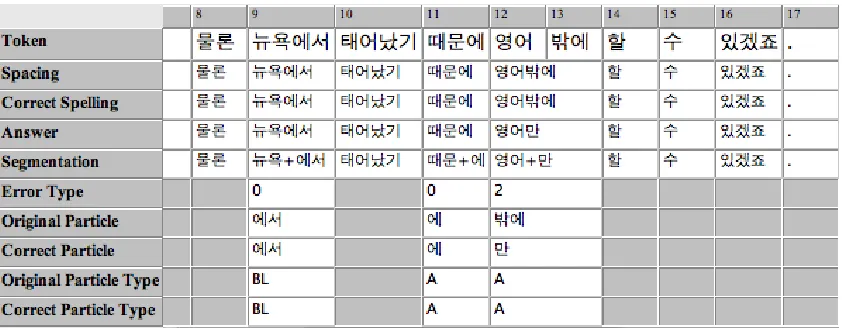
The previous discussion outlines the type of anno-tation needed for evaluating Korean particle errors made by learners. As the purpose is at present to demonstrate what annotation is needed for particle error detection evaluation, we have added annotation to a small corpus. An example of full annotation is given in figure 1, for the sentence in example (5).
In the figure, positions 12 and 13 are merged to correct the spelling, as the particle (pakkey) was originally written as a separate token. There is a substitution error (‘2’ on theError Typelayer), with both original and correct particles noted and en-coded as auxiliary particles (‘A’).
4.1 Annotating a corpus
We have obtained 100 learner essays from American universities, composed of 25 heritage beginners, 25 heritage intermediates, 25 foreign beginners, and 25 foreign intermediates.5 While this is a small amount of data, it allows us to properly define the annotation scheme and show how it helps evaluation.
Table 1 provides information about the 100 es-says.6 Following previous multi-layer annota-tion for learner language (L¨udeling et al., 2005;
5
The data and annotation will be available for research pur-poses at:http://cl.indiana.edu/˜particles/
6
Figure 1: Corpus annotation for (5), using the PartiturEditor of EXMARaLDA (Schmidt, 2010)
(5) a. O: New New
York-eyse York-IN
thayenass-ki born-NML
ttaymwun-ey reason-FOR
yenge
English
pakkey
ONLY
hal speak
swu iss-keyss-cyo. be able to-FUT-END
‘Since (I) was born in New York, I was able to speak only in English. ’
b. C: ttaymwun-ey reason-FOR
yenge-man
English-ONLY
hal speak
... ...
Boyd, 2010), we use EXMARaLDA for encoding (Schmidt, 2010).
Beginner Intermediate
F H F H
Sentences 360 376 373 297 Raw ecels 1601 2278 3483 2676 Corrected ecels 1582 2245 3392 2613 Nominals 647 949 1404 1127 Raw particles 612 808 1163 923 Corrected particles 647 887 1207 979 Omission 43 45 57 61 Substitution 60 29 47 41
Extraneous 8 8 13 5
Ordering 0 2 1 0
Table 1: Corpus Statistics (F= foreign,H= heritage)
4.2 Interannotator agreement
To gauge the reliability of the annotation, we had two experienced annotators annotate the correct par-ticle and the error type on the heritage intermedi-ate subcorpus, and we report the agreement on both tasks. Given the high number of times they both gave no particle to a word (in 1774 ecels), we re-moved these cases when calculating agreement, so as not to overly inflate the values. When either
an-notator used more than one particle for an instance (occurring 9 times), we only count full agreement.
The agreement rate was 94.0% for the error type (Cohen’s kappa=79.1%), and 92.9% (kappa=92.3%) for specific particles. The high values can be ex-plained by the fact that these annotators were highly-trained and were using a relatively stable set of guidelines under development for over a year (based on Lee et al. (2009)). Kappa for particle agreement is high because of the fact that there are over 30 par-ticles, with no overwhelming majority categories, so it is unlikely for annotators to agree by chance. Pre-vious work (Lee et al. (2009)), which did not allow multiple particles per position, had a lower agree-ment rate (e.g., kappa for particle value = 62%), likely due to less well-articulated guidelines.
Multiple particles To gauge how difficult it is to
References
Ghazi Abuhakema, Reem Farajand, Anna Feldman, and Eileen Fitzpatrick. 2008. Annotating an Ara-bic learner corpus for error. In Proceedings of LREC 2008. Marrakech.
Adriane Boyd. 2010. EAGLE: an error-annotated corpus of beginning learner German. In Proceed-ings of LREC-10. Malta.
Rachele De Felice and Stephen Pulman. 2008. A classifier-baed approach to preposition and deter-miner error correction in L2 English. In Proceed-ings of COLING-08. Manchester.
Arantza D´ıaz de Ilarraza, Koldo Gojenola, and Maite Oronoz. 2008. Detecting erroneous uses of complex postpositions in an agglutinative lan-guage. In Proceedings of COLING-08. Manch-ester.
Markus Dickinson, Soojeong Eom, Yunkyoung Kang, Chong Min Lee, and Rebecca Sachs. 2008. A balancing act: How can intelligent computer-generated feedback be provided in learner-to-learner interactions.Computer Assisted Language Learning, 21(5):369–382.
Markus Dickinson, Ross Israel, and Sun-Hee Lee. 2011. Developing methodology for Korean par-ticle error detection. In Proceedings of the 6th Workshop on Innovative Use of NLP for Building Educational Applications. Portland, OR.
Michael Gamon. 2010. Using mostly native data to correct errors in learners’ writing. InProceedings of HLT-NAACL-10, pages 163–171. Los Angeles, California.
Na-Rae Han, Martin Chodorow, and Claudia Lea-cock. 2006. Detecting errors in English article usage by non-native speakers. Natural Language Engineering, 12(2).
Jirka Hana, Alexandr Rosen, Svatava ˇSkodov´a, and Barbora ˇStindlov´a. 2010. Error-tagged learner corpus of Czech. In Proceedings of the Fourth Linguistic Annotation Workshop, pages 11–19. Uppsala, Sweden.
Hiroki Hanaoka, Hideki Mima, and Jun’ichi Tsu-jii. 2010. A Japanese particle corpus built by example-based annotation. In Proceedings of LREC 2010. Valletta, Malta.
S. Ko, M. Kim, J. Kim, S. Seo, H. Chung, and S. Han. 2004. An analysis of Korean learner cor-pora and errors. Hanguk Publishing Co.
Sun-Hee Lee, Seok Bae Jang, and Sang-Kyu Seo. 2009. Annotation of Korean learner corpora for particle error detection. CALICO Journal, 26(3).
Sun-Hee Lee and Jae-Young Song. 2011. Particle el-lipsis in korean corpora. InThe 10th Conference for the American Association for Corpus Linguis-tics. Atlanta, GA.
Anke L¨udeling, Maik Walter, Emil Kroymann, and Peter Adolphs. 2005. Multi-level error annotation in learner corpora. InProceedings of Corpus Lin-guistics 2005. Birmingham.
Alla Rozovskaya and Dan Roth. 2010. Annotating ESL errors: Challenges and rewards. In Proceed-ings of the Workshop on Innovative Use of NLP for Building Educational Applications, pages 28– 36. Los Angeles.
Thomas Schmidt. 2010. Linguistic tool develop-ment between community practices and technol-ogy standards. In Proceedings of the Workshop on Language Resource and Language Technology Standards. Malta.
Joel Tetreault and Martin Chodorow. 2008. The ups and downs of preposition error detection in ESL writing. InProceedings of COLING-08. Manch-ester.
Joel Tetreault, Elena Filatova, and Martin Chodorow. 2010. Rethinking grammatical error annotation and evaluation with the Ama-zon Mechanical Turk. In Proceedings of the Workshop on Innovative Use of NLP for Building Educational Applications, pages 45–48. Los Angeles.