OFDMA Uplink Frequency Offset Estimation with
Multi-Access Interference Mitigation
*
Zhongshan Zhang, Jian Liu, Keping Long#
Advanced Network Technologies and New Services, University of Science and Technology Beijing (USTB), Beijing, China Email: [email protected], [email protected], #[email protected]
Received May 11,2012; revised June 15, 2012; accepted July 13, 2012
ABSTRACT
In this paper, we consider the frequency offset estimation for Orthogonal Frequency-Division Multiple Access (OF- DMA) uplink (UL) transmissions. We first analyze the negative effect of Multi-Access-Interference (MAI) on OFDMA UL, and then propose two interference reduction/elimination methods, i.e., the Reduced-Rank-Projector (RRP) and Shift-Sampling-Projector (SSP) methods, to eliminate/reduce the heavy MAI due to the frequency offsets. Finally, we propose a new training sequence group named the Round-Robin Training Sequence Group (RRTSG), which has a high interference mitigation capabilities for OFDMA UL transmission. The Cramer-Rao Lower Bound (CRLB) for an unbi- ased frequency offset estimator in a Multiple Access (MA) system is also derived. Numerical results show that the pro- posed methods are suitable to eliminate/mitigate the effect of the frequency offset on OFDMA UL transmission.
Keywords: Synchronization; Timing Offset; Frequency Offset; OFDMA
1. Introduction
Orthogonal Frequency-Division Multiple Access (OF- DMA) is an effective Multiple Access (MA) scheme that divides the total signal bandwidth into multiple orthogo- nal subcarrier groups, with each group being allocated to one user [1]. In uplink (UL) transmission, different users have different frequency offsets and result an interfer- ence-limited system [2]. Multi-Access Interference (MAI) may appear between neighboring users due to the fre- quency offsets.
The Bit Error Rate (BER) of Orthogonal Frequency- Division Multiplex (OFDM) systems impaired by the frequency offset is analyzed in [3]. The effect of the fre- quency offset on OFDM/OFDMA has been analyzed considerably (see [4-6]). Performance improvement of OFDMA UL transmission through cooperative relaying is studied in [7,8], with either ergodic or outage infor- mation rate is analyzed in the presence of the frequency offset.
Although several classical frequency offset estimators [9-13] are proposed, their performance will degrade in an
interference-limited environment. Since the frequency offset estimations are imperfect, MAI arises between different users. MAI cancelation in an OFDMA system is discussed in [14], where MAI can be eliminated correctly based on the perfect knowledge of the frequency offset of each user. A conventional estimator, such as that used in [15], is considered as a candidate for the frequency offset estimation for each user. Carrier Frequency Offset and I/Q Imbalances compensations in OFDM Systems by considering subcarrier allocation are studied [16]. Syn- chronization in OFDMA considering the effect of MAI has been studied [17-22]. OFDMA UL synchronization by exploiting the statistical character of the frequency offset is studied in [23], where the frequency offsets can be modeled as either uniform or Gaussian distributed random variables (RVs). For more references about OFDMA synchronization, please refer to, e.g., [24-26].
In this paper, we consider OFDMA UL frequency off- set estimation based on the proposed training sequence. Subcarrier allocation for one user need not be contiguous in the frequency-domain. The MAI introduced by the non-zero frequency offset is analyzed first. The Re- duced-Rank-Projector (RRP) and Shift-Sampling-Pro- jector (SSP) methods are proposed to eliminate/reduce MAI due to the frequency offset. A new training se- quence group named the Round-Robin Training Se- quence Group (RRTSG) is also proposed for interference randomization. The quasi-synchronized transmission of *This work was supported by the National Basic Research Program of
China (2012CB315905), the National Natural Science Foundation of China under Grand No. 61172050, National Key Projects (2012ZX 03001029-005 and 2012ZX03001032-003), Beijing Science and Tech-nology Program under Grand No. 2009ZX03006-004, Chang Jiang Scholars Program of the Ministry of Education of China, and Program for New Century Excellent Talents in University.
#Corresponding author.
accessing users is considered in this paper; i.e., both the time and frequency of these users have been aligned to the base station. Perfect timing synchronization is con- sidered, and only UL frequency offset estimation is dis- cussed in this paper.
The remainder of this paper is organized as follows. Section 2 proposes the OFDMA UL signal model. MAI analysis is provided in Section 3. Sections 4 and 5 dis- cuss the interference elimination/reduction methods, where the heavy MAI elimination/reduction methods are proposed in Section 4, and an interference randomization method is introduced in Section 5. Section 6 analyzes the proposed schemes and discusses some numerical results. Finally, Section 7 concludes the paper.
Notation: ( )T and ( )H
1 ( )
denote transpose and con- jugate transpose of a matrix, respectively. repre- sents the inverse of a matrix. The imaginary unit is
1
j .
x , and
x*
( ) are the real and imaginary
part of $x$, respectively. denotes complex conju- gate. A circularly symmetric complex Gaussian variable with mean m and variance 2 is denoted by
2
~ m,
z CN . x
i represents the -th element of ijvector x.
ij represents the -th element of matrix .A j
A
N
means “Mod ”. The identity ma- trix is N , and the all-zero matrix is
N N
NN
I N ON .
and Var
E x
x denote the mean and the varianceof
x
, respectively.2. OFDMA UL Signal Model
In OFDMA, each user is modulated by complex data symbols from a signal constellation, e.g., phase-shift keying (PSK) or quadrature amplitude modulation (QAM). In a frequency-selective fading channel, the received signal at the base station can be represented as
k k
k
w
Φx w
k
k
k k k k k k k
m
v
y y E F H
, (1)
where
P i: G
k
g i:
k k k
diag k
Φ i k represents the power
allocation to each subcarrier of user , dia H iG
i
with Hk denoting the channel attenuation at the -th
subcarrier, and k stands for the subcarriers allocated to user . Note that
i G k G k k
1
and 0,1,
G N
k ,
k
,
1
,
k k
j N N
2π 2πdiag j k, j k N k ,
k e e e
E , (2)
with k and k representing the initial phase and normalized frequency offset of user , respectively. k denotes the Inverse Discrete Fourier Transform (IDFT) matrix for the -th user (where only the subcarriers allocated to user are modulated). is the Discrete
Fourier Transform (DFT) length. k is the transmit vector of user , and without loss of generality, we as- sume that k F k k x k N
k are independent and identically dis-
tributed (i.i.d.) complex RVs with zero mean and unit variance. k represents the time-domain transmit training of user , in (1) is a vector of additive white Gaussian noise (AWGN) with
m
x m
k w
2
[ ] ~i CN 0,w
w
w k
y
, and k represents the additive noise added to user .
UL synchronization for each user can be performed based on the received training sequence . Without loss of generality, we assume that the frequency offsets of different users are i.i.d. RVs. For an OFDMA UL with
M users accessing a base station, the Fisher Informa-
tion Matrix (FIM) ΓM
1 1 1 M M H MM M MM
is given by
Γ b Γ b Γ 1 M
, (3)
where Γ represents the northwestern
M 1
M 1
sub-matrix of ΓM, and bM1 is a
M 1 1
vector. The CRLB of user M is given by
1
1 1 1 1 1 CRLB . M H
M MM M MM M M
M Γ Γ b Γb
ˆk (4)
From Appendix I, for an unbiased estimator , the CRLB is derived as
1 1 2 2 , , 2 21 , , 1 , ,
2 2
ˆ Var
1
1 1 1 ,
SNR
SNR SIR
k l
k kk kk
k i l i
N N
k k
i l k j
k i k i l j l j
k k
k k k k
z z z
Γ Γ , (5)where k i and zk i, are defined as in Appendix I, k, k
and k are constants specified by the structure of the training sequence used by user and SN k and
k stand for the Signal-to-Noise-Ratio (SNR) and Signal-to-Interference-Ratio (SIR) of user , respec- tively. (5) suggests that MAI will degrade the estimation performance of the UL synchronization, and the MAI elimination/reduction is critical in increasing the fre- quency offset estimation accuracy.
k R
SIR
k
3. Interference Analysis in OFDMA UL
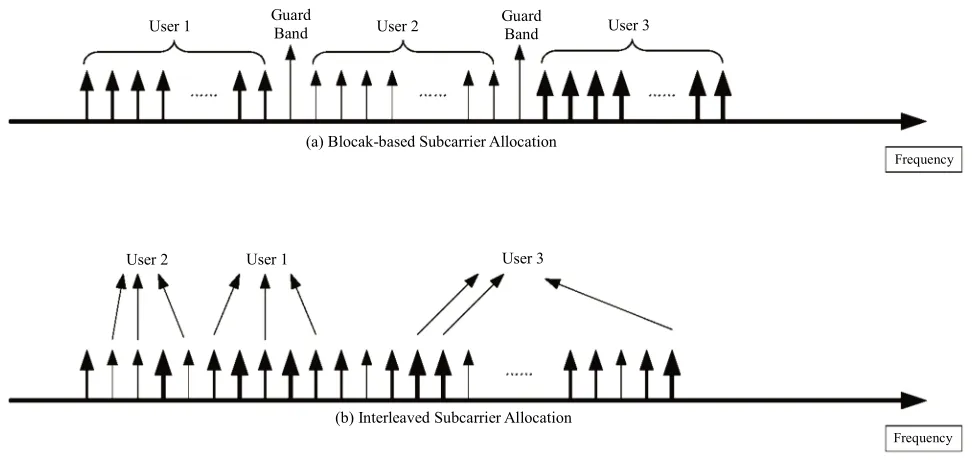
Note that in an OFDMA UL, the subcarrier groups allo- cated to different users are orthogonal, and this allocation eases the decomposing of the transmitted signal of each user. We consider two types of subcarrier allocation schemes: Block-based and Interleaved, as illustrated inFigures 1(a) and (b).
CN
User 1 User 2 User 3
User 3 User 1
User 2
Guard
Band GuardBand
Frequency
Frequency
[image:3.595.54.540.84.317.2](b) Interleaved Subcarrier Allocation (a) Blocak-based Subcarrier Allocation
Figure 1. Subcarrier allocation in OFDMA.
Copyright © 2012 SciRes.
pre-demodulates the signal of each user, and only signals projected into the signal space of interest will be de- modulated. Since the pre-demodulation improves the effective Signal-to-Interference-plus-Noise Ratio (SINR), an optimum CRLB for the -th user is achieved as
k
2 , 2 , , 1 . k i kk i zk i
, l
l l l l k
k
vr P y P E F HΦx P w P w 1 ˆ Var k k N i
(6)The pre-demodulation of each user’s signal can be performed as
k k k l l
k k k l l k
P v P
v
1(7)
where P F F FH FH H
k k l
l k
P v
k
k k k k F Fk k and
represents the interference from other users, i.e., MAI. In order to analyze the MAI contributed by users other than user (the user of interest), we first assume that
M users access the base station, and then we make
some presuppositions:
1) 1
M
G Gm n m
m 1 m m
and M G
0,1, ,N1
, mG
m m
N N Nm
k
where represents the set of subcarriers allocated to user .
2) , where represents the cardinality of .
m
The average SINR of user can be represented as
G
2 2 2 SINR k H k k k H k l k k k n GE
E n n E
F v F w
, (8) where
, sin π π sin k k ik i k k
i G i n k
i n
n P i H
i n N N
x n k
is the interference of the subcarrier contributed by the other subcarriers of user (ICI), and
sin ππ
(
)sin
l
l i
k l i l l
l k i G l
i n
n P i H
i n N N
xn k
1
represents the interference of the subcarrier contrib- uted by the users other than .
When l , the average SINR of user can be k simplified as
2 2 2 2 1 sin π π sin SΙNR ( ) k k n kn k k
n G k
k
M
H
l l k
n G l
E P n H E
N N
E n E
,
x F w (9)
where l n
is a random variable (not necessarilyFor a system with all the users running at the tracking phase (the frequency offset acquisition has been per- formed, and the remaining frequency offset is small), it is reasonable to assume that m for each is an i.i.d. RV uniformly distributed in
m
,
, where 01 [23]. The averaged SINR of user k can be further ap- proximated as2 2 4 4
π π
,
9 180
2 2
SINR 1
π 1
9 k k
k
(10)
where
2n kn E K
k
0.1
is used to represent the average
received SNR of user .
The SINR reduction due to MAI is shown in Figure 2. A considerable MAI of one user will be contributed by the interfering users because of their non-zero frequency offsets. For example, when , the averaged SINR loss at the objective user may be up to 36.7%.
4. Heavy MAI Elimination
In Section 3, we analyzed the MAI introduced by inter- fering users. Since a new accessing user’s instantaneous
frequency offset may contribute a heavy MAI to its neighbors, the base station should first perform UL syn- chronization for that user before its totally access. The accessing user will then correct its synchronization errors based on the feedback information from the base station.
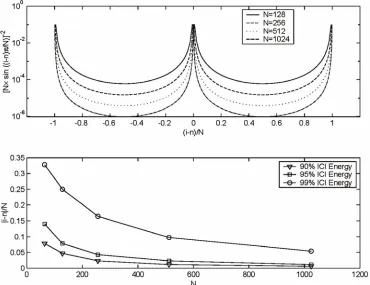
In order to illustrate the distribution ofInter-Carrier- Interference (ICI) with respect to the distance between the object subcarrier (subcarrier ) and the interfering subcarrier (subcarrier ), we define
n i
ICI
2 2 1 ,
π sin F n i
i n N
N
i n
i
as the “ICI factor” between subcarriers and , and we know that the ICI between subcarrier and n is proportional to FICI
n i,
,. The upper figure in Figure 3
shows the distribution of FICI n i as a function of
in
N, from which we know that the ICI factor di-minishes as
N inN N
[image:4.595.53.287.178.263.2]increases. The lower figure in
Figure 3 illustrates the concentration of ICI energy, and it shows that most of the ICI energy added to one subcar- rier is concentrated within a small range around the sub- carrier. For a given ICI energy, the ratio of the concen- tration range to becomes smaller as increases.
[image:4.595.104.492.397.719.2]Figure 3. Inter-carrier-interference factors in OFDMA systems.
k 1
4.1. Heavy MAI Elimination in
Block-Based Subcarrier Allocation Scheme
In the Block-based allocation scheme, user is allo- cated a set of contiguous subcarriers, i.e., k, and its marginal subcarriers suffer most of the MAI. If we opti- mize k of user to demodulate only its less-inter- fered subcarriers (the marginal subcarriers of heavy MAI are left un-demodulated, or in other method, we leave wide enough guard band between neighboring users), most of its MAI can be eliminated. Based on this prince- ple, we propose a method named the Reduced-Rank- Projector (RRP) method, i.e., . In order to maximize the SINR of user k, we have
k G k
P
k P
2 2, k k
k l k l k
P v
P v P w
arg max
k
k
P P
(11)
where H
k k k . k here is defined as follows: with-
out loss of generality, we first assume that the central frequency of is higher than that of k1 and lower than that of k . We also assume that user is inter- fered by user
P F F F
k
G G
1
G k
k1
k1
L k
F
and user with its left- most k and right-most Uk subcarriers, respectively. k can be derived by deleting the left-most k col- umns and the right-most columns from . Here,
we also assume that the guard band between user
L
F
k U
and user is k subcarriers, and that between user and user
k Bk1,
k
k1
is Bk k, 1 subcarriers. Therefore,
†1 1,
ˆ 1
k k k k
L B and
†1 , 1
ˆ 1
k k k k
U B ,
x, and
x
where means the maximum integer part of
†
max ,0
x x .
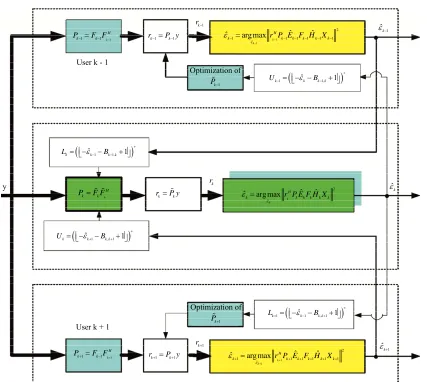
Figure 4 illustrates the frequency offset estimation with the help of the RRP method. Three frequency-do- main neighbors, i.e., user
k1
, user and user k
k1
, have instantaneously large frequency offsets.Since user suffers the highest MAI, we perform a synchronization for user
k
k1
and user
k1
first.At that time, the signals of user
k1
and user
k1
are demodulated by using projectors Pk11 k
and
P , respectively. Using the estimation results ˆk1 and 1
k ˆ
, k and Uk can be derived to optimize . Af- ter that, k
L Pk
ˆ
is used to calculate Uk1 and Lk1, and then Pk1 and Pk1 are optimized. The optimized Pk1 and Pk1
1 ˆk
then can then be used to further improve the erformance of ˆk1
1.
p and
1This kind of operation can be applied in the scenario of multiple users transmitting and receiving jointly, e.g., multiuser Multiple-Input Multi-ple-Output (MIMO).
User k - 1
1
1 1 k
H
k k
P F F
y
User k + 1
1 1
k k
r P y 1
1
2
1 1 1 1 1 1
ˆ
ˆ ˆ ˆ arg max
k k
H
k r P E F Hk k k k Xk
Optimization of
1
k
P 1
1,
ˆ 1
k k k k
U B
1
k r
k r
1
k r
1
ˆk
ˆk
1
ˆk
ˆ1 1, 1
k k k k
L B
k
H
k k
P F F
1
1 1 k
H
k k
P F F
k k
rP y
1 1
k k
r P y
2
ˆ
ˆ ˆ ˆ arg max
k k
H
k r P E F H Xk k k k k
1 1
2
1 1 1 1 1 1
ˆ
ˆ ˆ
ˆ arg max
k k
H
k r P E F Hk k k k Xk
Optimization of
1
k
P
1 ˆ1 , 1 1
k k k k
L B
ˆ 1 , 1 1
k k k k
[image:6.595.88.515.78.460.2]U B
Figure 4. Interference elimination and frequency offset estimation in block-based subcarrier allocation scheme by using RRP method.
4.2. Heavy MAI Elimination in Interleaved Subcarrier Allocation Scheme
l l
H
k k k k l
In Interleaved subcarrier allocation scheme (as illustrated in Figure 1(b)), there is no enough guard band to sepa- rate the different users, and the frequency offset immune capability will be degraded as a result. In this case, without loss of generality, we assume user to be the user of interest and that user acts as an interfering user to it. We also assume that the frequency offset esti- mation result of user is l l l l ,
where l
k
l
0 0.5
lˆ
and l represent the integer part and the fractional part of ˆl, respectively. Here, we assume that
l
has already been corrected and that MAI is contrib- uted only by l. In order to eliminate this kind of MAI, we propose a method named the Shift-Sampling-Projec- tor (SSP) method. We first perform the frequency offset estimation for user l to obtain l . The Shift-Sam- pling-Projector for user k can be represented as
P F F P
l
H H k k l
,
where
F F
and
2π 2π 1
diag 1, j l N, , j l N N
l e e
ˆ
,
as illustrated in Figure 5. Note that kl in Figure 5 is given by (2) with k
E
being replaced by ˆkl. If ˆl is accurate enough, the interference from user l can be eliminated. The estimation result, i.e., ˆk, then will be used to optimize l in order to further increase the ac- curacy of l
P
ˆ
. By using the SSP method, the variance error of ˆk will satisfy
1 2
2 ˆ
Var l
l
k k k
k k
P v
[image:6.595.307.504.508.589.2]y
H l l l
PF F rlP yl
2
ˆ
ˆ ˆ ˆ arg max
l l
H
l r PE F H Xl l l l l
Optimization of l P l l r ˆ l 2 ˆ l
k kH Xk k
ˆk
ˆ
ˆ ˆ arg max
l k l
kl
H
k r P Ek F
l k k
r Py
l l
H
k k k
P F F
l
H H
k k l
F F Θ
Frequency Offset Compensa
k
r
Frequency Offset Comp
ˆ ˆ
l
k k l
tion
ensation
[image:7.595.86.512.85.243.2]
Figure 5. Interference elimination and frequency offset estimation in interleaved subcarrier allocation scheme by using SSP method.
5. Frequency Offset Estimation with
MAI Reduction/Randomization
As mentioned earlier, instantaneously heavy MAI intro- duced by frequency-domain neighboring users should be eliminated before a user totally access the base station. In this section, we first discuss interference elimination by using the Successive Interference Cancellation (SIC) method, and then propose a frequency offset estimation algorithm based on an interference reduction scheme.
5.1. SIC with MAI Elimination
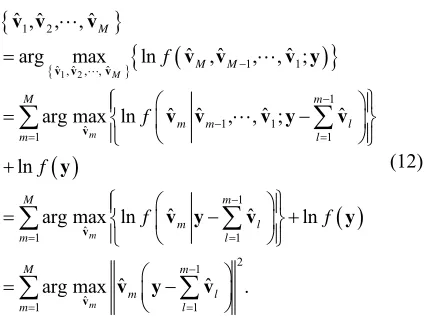
Let us assume that M users access a base station, and that 1 1, 2 2, , M M are perfectly known at the receiver (base station). Based on the joint PDF of and , i.e., M M1 1 , (as well as ) can be jointly estimated as
H x H x H x
y f
v vˆ ,ˆ , , ; v yˆ
, , , M
v v1, ,2,vM1 2
1 1 , , 1 1 1 ˆ 1 1 1 ˆ 1 1 1 ˆ 1 ˆ ˆ ˆ ˆm , ;
ˆ ˆ ˆ ˆ
arg max ln , , ;
ln
ˆ ˆ
arg max ln ln
ˆ ˆ arg max M m m m M m
m m l
m l M m m l m l m m l l f f f f
v v v v yv v v y v
y
v y v y
v y v
1 2 1 2 ˆ arg v v ˆ ˆ , , v v ˆ , , ˆ
ax ln , ,
M M M f v v v v 2 1 . M m
y l (12)(16) provides a feasible way to estimate the sig- nal/frequency offset of each user: the signals of different users can be estimated one by one based on . After performing a synchronization for the first users, user
l1
vl11 ˆ l m m
v ˆ ˆ, , ,ˆ
v v v v , , v
ˆ ,ˆ , ,ˆ
v v v vˆ
ˆ
v
. In will estimate based on
theory, if 1 2 l are accurate enough, l1 M can be estimated successfully2. However, if one previous user has a large estimation error, it will propagate to
1 2
l l M ; i.e., the estimation accuracy of m depends on the estimation accuracy of l m v. For a large M , estimation performance by using the SIC
method will degrade because of the error propagation.
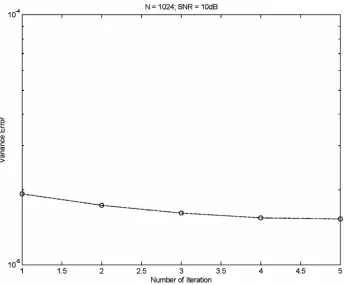
Figure 6 shows the SIC-based frequency offset estima- tion performance. In this figure, a total of 16 users access a base station simultaneously. In order to reduce the error propagation in SIC, more than one iteration is required when performing MAI elimination, and the algorithm converges after 5 iterations.
5.2. RRTSG for MAI Randomization
The SIC-based method aforementioned requires both CSI and initial phase information, and in addition, more in- terfering users imply more iterations being required. Therefore, SIC is inefficient in a multiuser environment. Some differential algorithms that are independent of the initial phase and the wireless channel provide a new way for a solution [9,15]. In these differential algorithms, the training sequence contains repetition information, and the frequency offset can be estimated at the receiver by esti- mating the phase rotations between these repetitions. However, these conventional algorithms were originally proposed for DL synchronization, and they are not im- mune to MAI.
In this section, a new training sequence group named the Round-Robin Training Sequence Group (RRTSG) is proposed to perform OFDMA UL synchronization. A total of training sequences are included in RRTSG, with each training sequence being composed of two
N
2SIC algorithm requires a knowledge of channel state information (CSI) at the base station, and the CSI information can be obtained through channel estimation (please refer to, e.g., [26]), which is beyond the scope of this paper.
y
[image:7.595.76.288.492.651.2]Figure 6. Frequency offset estimation with MAI elimination by using SIC.
training symbols, where the second symbol is generated by copying data from the first one (but at a different or- der). When generating the second training symbol of the -th ( ) training sequence, we simply copy data from the already generated first symbol with its last $d$ samples shifted to the front. After padding each symbol with its corresponding CP, the -th training sequence is generated as:
d 0 d N 1
d
2 2
1 1
,
1 T k
T
T T
d k k mbol
x N
x N
D x
1
,T
d
1 2 2π
2π 2π
diag j dk N, j dk N, , j dkNk N,
d
k e e e
D
k
d
1 1
2
: 1 ,
: 1 ,
1 0
1 1
1 0
T
d k k k
symbol CP
d
k k k k
CP sy
CP symbol
CP
s N L N
N L N
x N L x N x
x N L d x N d
x N d x N x
F x F x
F D x F
2 symbol
L
(13)
where represents the CP length, and
is a pre-coding matrix for user in generating the -th training sequence.
RRTSG can randomize MAI when performing UL synchronization, and an unbiased frequency offset esti- mator is always achieved, provided that each user is al- located a unique training sequence. A Best Linear Unbi- ased Estimator (BLUE) of k based on the -th training sequence is provided by:
d
1 1
ˆ ,
T d d k d T
d
1 Λ ε
1 Λ 1 (14)
where
1 2
, ,
ˆ ˆ
diag Var ,Var ,
d k d k d
Λ
1 2 , ,
1 1
, ,
0 0
ˆ ,ˆ
arg arg
, ,
2π 2π
T d k d k d
T
N d d
d z d z
z z
N N
N L d L d
ε
11T
1 *
, 2
d z rk L z r Nk L d z
, ,
*
, 2
d z rk N L d l r Nk L l
and k represents the element of k. We can easily prove that the BLUE estimator provided by (18) is conditionally unbiased, and that its CRLB is found to be
r n n r
1 |
2 2 2 2 ˆ
Var
4π
k d
N
N L d NL
2 Nd SINRk.
(15)
Among all the training sequences in the proposed RRTSG, the minimum CRLB is achieved when
2
d N
.
In order to make the estimator work properly, 2πk N L d π
N
d
d
should be satisfied for each , and this requires the normalized frequency offset estimation range of the
-th estimator to be limited within
,
2 N L d 2
N N
N L d
3 10
.
6. Numerical Results
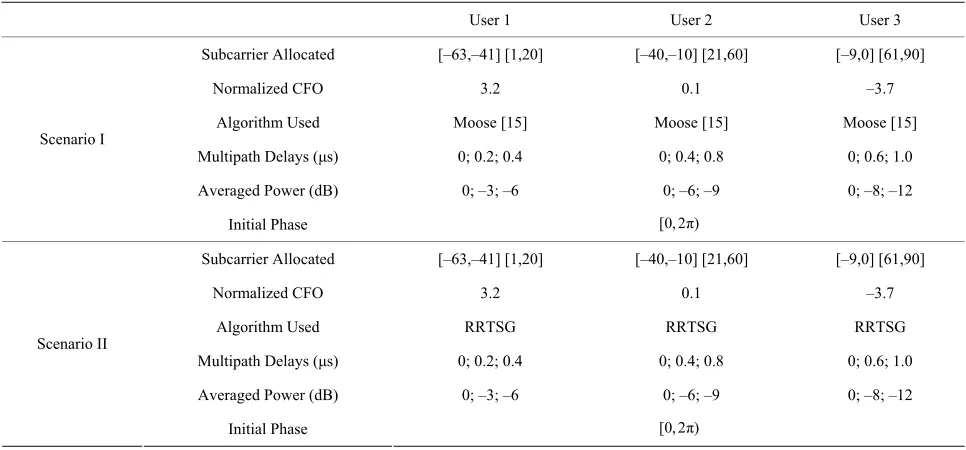
[image:9.595.310.536.327.467.2]In our simulation, an OFDMA UL transmission with a bandwidth of 10 MHz and DFT length of 1024 is consid- ered. A length-64 cyclic-prefix is padded to the front of each symbol or training sequence. Wireless channel pa- rameters are defined in Tables 1 and 2.
Figure 7 illustrates the performance improvement
achieved in RRP by eliminating the instantaneously heavy MAI. In this simulation, we assume that 10 users
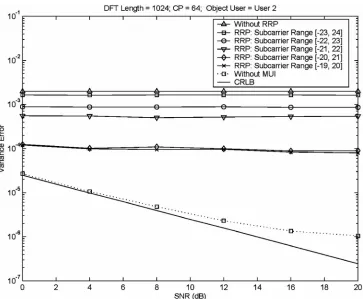
access a base station simultaneously, and users #1, #2 and #3 are assumed to have instantaneously large fre- quency offsets. The frequency offsets for the other 6 us- ers are assumed to have already been estimated and cor- rected, and their residual frequency offsets are assumed to be uniformly distributed within (–0.01, 0.01). This simulation parameters for users #1, #2 and #3 are pre- sented in Table 1. User #2 is assumed to be the user of interest. The frequency offset estimation can be im- proved by using the RRP method. At low SNR, a vari- ance error of less than (or ) can be obtained if we reduce the demodulated subcarrier range to [–22, 23] (or [–20, 21]).
4 10
Although the RRP method can achieve a considerable performance improvement with respect to MAI elimina- tion, this method is not applicable in the Interleaved
Table 1. Subcarrier allocation of heavy-interference users in block-based subcarrier allocation scheme (bandwidth = 10 MHz, DFT length = 1024, CP = 64).
User 1 User 2 User 3
Subcarrier Allocated [–63,–25] [–24,25] [26,64]
Normalized CFO 3.2 0.1 –3.7
Algorithm Used Moose [15] Moose [15] Moose [15]
Multipath Delays (μs) 0; 0.2; 0.4 0; 0.4; 0.8 0; 0.6; 1.0
Averaged Power (dB) 0; –3; –6 0; –6; –9 0; –8; –12
Guard Band No
[image:9.595.56.539.506.731.2]Initial Phase [0, 2π)
Table 2. Performance comparison between RRTSG-based scheme and Moose’s algorithm (bandwidth = 10 MHz, DFT length = 1024, CP = 64; No guard band between different users).
User 1 User 2 User 3
Subcarrier Allocated [–63,–41] [1,20] [–40,–10] [21,60] [–9,0] [61,90]
Normalized CFO 3.2 0.1 –3.7
Algorithm Used Moose [15] Moose [15] Moose [15]
Multipath Delays (μs) 0; 0.2; 0.4 0; 0.4; 0.8 0; 0.6; 1.0
Averaged Power (dB) 0; –3; –6 0; –6; –9 0; –8; –12 Scenario I
Initial Phase [0, 2π)
Subcarrier Allocated [–63,–41] [1,20] [–40,–10] [21,60] [–9,0] [61,90]
Normalized CFO 3.2 0.1 –3.7
Algorithm Used RRTSG RRTSG RRTSG
Multipath Delays (μs) 0; 0.2; 0.4 0; 0.4; 0.8 0; 0.6; 1.0
Averaged Power (dB) 0; –3; –6 0; –6; –9 0; –8; –12 Scenario II
Initial Phase [0, 2π)
Figure 7. Frequency offset estimation with the help of heavy MAI elimination by using RRP.
subcarrier allocation scheme, which relies on the SSP method. Table 3 illustrates the parameters of this simula- tion. The simulation results are illustrated in Figure 8. Without using SSP, the variance error will always be higher than 3 1 , no matter how high the SNR is. When the SSP method is applied, a considerable per- formance improvement can be obtained, even with im- perfect frequency offset estimation in the interfering us- ers. For example, at an SNR of 16dB, when the SSP method is applied with a 30% compensation error being assumed in the interfering user, a variance error smaller than can be obtained. The variance error can be further reduced to about 1 1 if the compensation error is reduced to 20%.
4 0
5 3 10
5 0
4 8 10
3 1 10
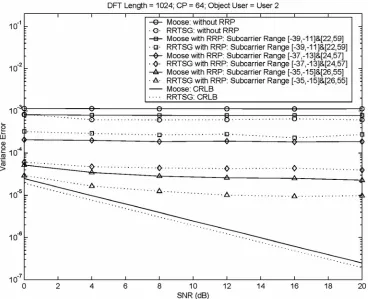
When the number of accessing users is large, MAI elimination is impractical to perform. As a feasible MAI reduction scheme, MAI randomization is usually utilized. The proposed RRTSG has a high ability in performing MAI randomization in OFDMA UL transmission. Figure 9 illustrates the performance comparison between Moose’s algorithm and the proposed RRTSG-based algorithm. The simulated environment is defined by Table 2. The simulation results show that the proposed RRTSG-based algorithm outperforms Moose’s algorithm with respect to interference mitigation capability. Without using any heavy MAI elimination method (e.g., RRP or SSP), a biased frequency offset estimator is obtained by using
Moose’s algorithm, so that its variance error is much larger than that of the proposed RRTSG-based algorithm. For example, a variance error of can be achiev- ed at a high SNR by using the proposed RRTSG-based algorithm, as compared to the variance error of
obtained in Moose’s algorithm. The proposed MAI elimination methods proposed can improve the perform- ance of both algorithms considerably. When most of the heavy MAI is eliminated by using RRP, e.g., the subcar- riers ranging from
35, 15
6 9 10
& [26,55] are demodu- lated, a variance error of about is achieved by using the proposed RRTSG-based algorithm at an SNR
Table 3. Subcarrier allocation of heavy-interference users in interleaved subcarrier allocation scheme (bandwidth = 10 MHz, DFT length = 1024, CP = 64; no guard band between different users).
User 1 User 2
Subcarrier Allocated Even Numbered Odd Numbered
Normalized CFO 0.1 –0.2
Algorithm Used Moose [15] Moose [15]
Multipath Delays (μs) 0; 0.2; 0.4 0; 0.4; 0.8
Averaged Power (dB) 0; –3; –6 0; –6; –9
[image:10.595.309.538.614.735.2]Figure 8. Frequency offset estimation with the help of heavy MAI elimination by using SSP.
Figure 9. Performance comparison between Moose algorithm and the proposed RRTSG-based algorithm in heavy MAI environment.
[image:11.595.115.483.408.707.2]of 15 dB. This error is still much smaller than that achieved by using Moose’s algorithm, i.e., 3 10 5.
7. Conclusion
This paper discussed OFDMA UL frequency offset esti- mation and showed that the performance improvement in estimation benefits from MAI elimination/reduction re- sults in improved estimation accuracy. Two MAI elimi- nation/reduction methods, i.e., the RRP method and the SSP method, were proposed for a Block-based subcarrier allocation scheme and interleaved subcarrier allocation scheme, respectively. In order to randomize the MAI contributed by the other synchronized users (because of their non-zero residual frequency offsets), a new training sequence group named the RRTSG was also proposed. Numerical results proved that the proposed RRTSG- based algorithm outperforms the conventional algorithm considerably in terms of frequency offset estimation ac- curacy because of its MAI randomization/mitigation ca- pability.
REFERENCES
[1] S. Pietrzyk and G. Janssen, “Performance Evaluation of Bit Loading, Subcarrier Allocation, and Power Control Algorithms for Cellular OFDMA Systems,” International Conference on Personal Wireless Communications, Delft, Netherlands, 2004, pp. 349-363.
doi:10.1007/978-3-540-30199-8_29
[2] I. Koffman and V. Roman, “Broadband Wireless Access Solutions Based on OFDM Access in IEEE 802.16,” IEEE Communications Magazine, Vol. 40, No. 4, 2002, pp. 96-103. doi:10.1109/35.995857
[3] L. Rugini and P. Banelli, “BER of OFDM Systems Im-paired by Carrier Frequency Offset in Multipath Fading Channels,” IEEE Transactions on Wireless Communica-tions, Vol. 4, No. 5, 2005, pp. 2279-2288.
doi:10.1109/TWC.2005.853884
[4] Z. Zhang and C. Tellambura, “The Effect of Imperfect Carrier Frequency Offset Estimation on an OFDMA Up-link,” IEEE Transactions on Communications, Vol. 57, No. 4, 2009, pp. 1025-1030.
doi:10.1109/TCOMM.2009.04.070246
[5] H.-C. Wu, “Analysis and Characterization of Intercarrier and Interblock Interferences for Wireless Mobile OFDM Systems,” IEEE Transactions on Broadcasting, Vol. 52, No. 2, 2006, pp. 203-210. doi:10.1109/TBC.2006.872989 [6] J. Zheng and Z. Wang, “ICI Analysis for FRFT-OFDM
Systems to Frequency Offset in Time-Frequency Selec-tive Fading Channels,” IEEE Communications Letters, Vol. 14, No. 10, 2010, pp. 888-890.
doi:10.1109/LCOMM.2010.072910.100562
[7] Z. S. Zhang, C. Tellambura and R. Schober, “Improved OFDMA Uplink Transmission via Cooperative Relaying in the Presence of Frequency Offsets—Part I: Ergodic Information Rate Analysis,” European Transactions on
Telecommunications, Vol. 21, No. 3, 2010, pp. 224-240. [8] Z. Zhang, W. Zhang and C. Tellambura, “Improved
OFDMA Uplink Transmission via Cooperative Relaying in the Presence of Frequency Offsets—Part II: Outage Information Rate Analysis,” European Transactions on Telecommunications, Vol. 21, No. 3, 2010, pp. 241-250. [9] Z. Zhang, W. Jiang, H. Zhou, Y. Liu and J. Gao, “High
Accuracy Frequency Offset Correction with Adjustable Acquisition Range in OFDM Systems,” IEEE Transac-tions on Wireless CommunicaTransac-tions, Vol. 4, No. 1, 2005, pp. 228-237. doi:10.1109/TWC.2004.840201
[10] H. Minn, V. Bhargava and K. Letaief, “A Robust Timing and Frequency Synchronization for OFDM Systems,” IEEE Transactions on Wireless Communications, Vol. 2, No. 4, 2003, pp. 822-839.
doi:10.1109/TWC.2003.814346
[11] Z. Zhang, K. Long, M. Zhao and Y. Liu, “Joint Frame Synchronization and Frequency Offset Estimation in OFDM Systems,” IEEE Transactions on Broadcasting, Vol. 51, No. 3, 2005, pp. 389-394.
doi:10.1109/TBC.2005.851702
[12] F. Gao, T. Cui and A. Nallanathan, “Scattered Pilots and Virtual Carriers Based Frequency Offset Tracking for OFDM Systems: Algorithms, Identifiability, and Per-formance Analysis,” IEEE Transactions on Wireless Communications, Vol. 56, No. 4, 2008, pp. 619-629. [13] F. Gao and A. Nallanathan, “Blind Maximum Likelihood
CFO Estimation for OFDM Systems via Polynomial Rooting,” IEEE Signal Processing Letters, Vol. 13, No. 2, 2006, pp. 73-76. doi:10.1109/LSP.2005.861583
[14] D. Huang and K. Letaief, “An Interference-Cancellation Scheme for Carrier Frequency Offsets Correction in OFDMA Systems,” IEEE Transactions on Communica-tions, Vol. 53, No. 7, 2005, pp. 1155-1165.
doi:10.1109/TCOMM.2005.851558
[15] P. Moose, “A Technique for Orthogonal Frequency Divi-sion Multiplexing Frequency Offset Correction,” IEEE Transactions on Communications, Vol. 42, No. 10, 1994, pp. 2908-2914. doi:10.1109/26.328961
[16] H. Lin and K. Yamashita, “Subcarrier Allocation Based Compensation for Carrier Frequency Offset and I/Q Im-balances in OFDM Systems,” IEEE Transactions on Wireless Communications, Vol. 8, No. 1, 2009, pp. 18-23. doi:10.1109/T-WC.2009.071007
[17] J.-J. van de Beek, P. Borjesson, M.-L. Boucheret, D. Landstrom, J. Arenas, P. Odling, C. Ostberg, M. Wahlq- vist and S. Wilson, “A Time and Frequency Synchroniza-tion Scheme for Multiuser OFDM,” IEEE Journal on Se-lected Areas in Communications, Vol. 17, No. 11, 1999, pp. 1900-1914. doi:10.1109/49.806820
[18] S. Barbarossa, M. Pompili and G. Giannakis, “Chan-nel-Independent Synchronization of Orthogonal Fre-quency Division Multiple Access Systems,” IEEE Jour-nal on Selected Areas in Communications, Vol. 20, No. 2, 2002, pp. 474-486. doi:10.1109/49.983375
2001, pp. 988-999. doi:10.1109/26.930629
[20] Z. Cao, U. Tureli and Y.-D. Yao, “Deterministic Multi-user Carrier-Frequency Offset Estimation for Interleaved OFDMA Uplink,” IEEE Transactions on Communica-tions, Vol. 52, No. 9, 2004, pp. 1585-1594.
doi:10.1109/TCOMM.2004.833183
[21] M. Morelli, “Timing and Frequency Synchronization for the Uplink of an OFDMA System,” IEEE Transactions on Communications, Vol. 52, No. 2, 2004, pp. 296-306. doi:10.1109/TCOMM.2003.822699
[22] M.-O. Pun, M. Morelli and C.-C. Kuo, “Maximum-Like- lihood Synchronization and Channel Estimation for OFDMA Uplink Transmissions,” IEEE Transactions on Communications, Vol. 54, No. 4, 2006, pp. 726-736. doi:10.1109/TCOMM.2006.873093
[23] Z. Zhang, W. Zhang and C. Tellambura, “Robust OF-DMA Uplink Synchronization by Exploiting the Variance of Carrier Frequency Offsets,” IEEE Transactions on
Ve-hicular Technology, Vol. 57, No. 5, 2008, pp. 3028-3039. doi:10.1109/TVT.2007.912596
[24] J. Zeng and H. Minn, “A Novel OFDMA Ranging Method Exploiting Multiuser Diversity,” IEEE Transac-tions on CommunicaTransac-tions, Vol. 58, No. 3, 2010, pp. 945- 955. doi:10.1109/TCOMM.2010.03.070473
[25] M. Movahhedian, Y. Ma and R. Tafazolli, “Blind CFO Estimation for Linearly Precoded OFDMA Uplink,” IEEE Transactions on Signal Processing, Vol. 58, No. 9, 2010, pp. 4698-4710. doi:10.1109/TSP.2010.2050063 [26] K. J. Kim, M.-O. Pun and R. A. Iltis, “Joint Carrier Fre-
quency Offset and Channel Estimation for Uplink MIMO- OFDMA Systems Using Parallel Schmidt Rao-Black- wellized Particle Filters,” IEEE Transactions on Commu-nications, Vol. 58, No. 9, 2010, pp. 2697-2708.
doi:10.1109/TCOMM.2010.080310.090053
Appendix
Derive the FimFrom [15], the -th element of FIM can be repre- sented as
kl Γ
trace 1 1 , k l C CΓ C C
(16)
where H
E
C y m y m
k.k
, H H Hk k k k k k l l
k k l
k k
k k l k
E E E
y m y m y m y m y m
C Z
kl E k k l l
Z y m y m
k l
kl N k l
Z O C
,and m m
Note that
C y m
k kl
C
Z(17)
where
H
k E k k k k
C y m y m
k
H
represents the covariance matrix of user , and
is the MAI matrix of user contributed by user . For the non-zero frequency offsets, we have .
is decomposed as
Hk k
k k
C C Z U DkD Uk (18)
where U is a NN Unitary matrix,
,1 , , , , k, ,0
k
k k k N
G 0, diag , k i D
with representing the -th eigenvalue of i Ck, and
,1 , 0, , , , k, ,0
k
k k k N
G
diag z z
D
z i Zk
with k i, representing the -th eigenvalue of . Therefore, we also have
, , ,1 ,1 , , ,1 ,1diag 0, , , , , 0
diag 0, , , , , 0 .
k k
k
l l
l
k N k N
k k
k k l l H
l k
k k k k k
G l N l N
l l H
l k k k
G z z z z
C Z C Z
C U U U U (19)
From the above discussion,
, ,
,1 ,1
, , , k , 0 diag 0, , , , l , 0 .
k l
k N l N
k H l
diag 0, H
k l
l k l k
k k k k k k k
G G z z
C Z CU U U U
lk
(20)
when , the kl-th element in FIM can be repre-
sented as
, , , , k ll j l j k i k i
N N
k l l k
z z z z z 2 2 1 1 , , , , 2 , 2 1 , , , n kl i j
k i k i l j l j n p
N
k l n k p
n p n p
z
Γ kk
(21)and the -th element in FIM is given by
2 2 , , 2 2 1 1 , , , , . k l l j k i N N k k kki l k j
k i k i l j l j
z z z