46
LEACH-C Variants using Different Optimization
Techniques: A Survey
Nidhi Saini
M.Tech scholar
DAVIET
Kabir Nagar, Jalandhar
Rajeev Kumar
Assistant Professor (IT)
DAVIET
Kabir Nagar, Jalandhar
Reeta Bhardwaj
Assistant Professor (IT)
DAVIET
Kabir Nagar, Jalandhar
ABSTRACT
Low Energy Efficient Clustering Hierarchy-Centralised (LEACH-C) protocol is one of the most pivotal parts of Wireless Sensor Networks (WSN). LEACH-C protocol employs Simulated Annealing algorithm, which is an optimization technique for cluster-head (CH) selection as well as cluster formation. A number of LEACH-C variants came into consideration that uses different optimization techniques in place of Simulated Annealing for CH selection, cluster formation and data transmission also. This paper provides an insight to such LEACH-C based protocols and also compare their performance in terms of network lifetime, stability period and energy consumption in a tabular form. Network lifetime is compared by evaluating the number of nodes dead with respect to the rounds.
Keywords
Cluster; Cluster-head; data transmission; energy consumption; LEACH-C; network lifetime; optimization; simulated annealing; stability period; Wireless Sensor Networks
1. INTRODUCTION
WSN is one of the most explored research subjects in the field of computer science. WSN makes use of sensor nodes which are small sized devices deployed at remote locations without any physical connection for collecting the information from their surroundings and transmit it for the purpose of evaluation and generating required data. These sensor nodes are capable of detecting variety of physical parameters such as light, sound, temperature, air, pressure, any activity taking place in the surroundings, attributes of an object such as height, size, speed and many more. Sensor nodes are mostly battery-operated, which gets consumed up at a very fast rate. Faster power consumption of the sensor nodes is the most alarming issue in WSN. A huge count of improvisions is made and protocols are built for WSN. These sensor nodes consume less power, have low cost, small in size, battery powered and are multifunctional nodes that can be deployed anywhere easily.[1] WSN is often used in the civilian as well as military field for the purpose of monitoring far away locations like border areas, battlefield, remote sensing, intelligent guiding, protection of confidential places like military headquarters, nuclear plants and many more.
Low Energy Adaptive Clustering Hierarchy (LEACH) [2] protocol has proved to be a milestone in the field of WSN, which was further improved by its authors and they proposed another protocol LEACH-C [3]. In LEACH-C protocol, Simulated annealing [4] algorithm is used for the purpose of cluster formation and CH selection and provides much better results as compared to the former protocol. Optimization is the technique used for selecting the best solution among the given set of candidate solutions. It gives brilliant results for NP-hard problems.
There are large number of problems related to optimization in computer science which needs to be solved as efficiently as possible. Some of these problems are Travelling Salesman Problem (TSP) [5], knapsack problem [6], vehicle routing and n-Queen problem. In global optimization, solution must have minimum value for the objective function of the problem. Enormous strategy and tactics have been proposed till now to solve these NP-hard problems with efficiency to get the best possible results. Most of the optimization techniques are inspired from the nature and also tend to provide best results.
The remaining paper is organised as follows: Section 2 illustrates the related work, Section 3 consists of detailed information about the LEACH-C variants using optimization techniques, Section 4 compares the protocols, Section 5 gives the results of the comparisons and Section 6 concludes the paper.
2. RELATED WORK
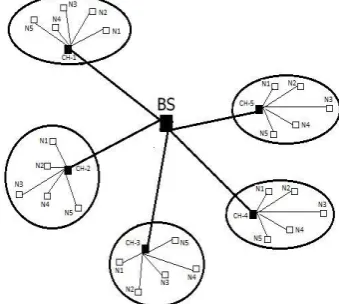
[image:1.595.340.510.588.740.2]LEACH (Low Energy Adaptive Clustering Hierarchy) is a protocol architecture developed by Wendi Heinzelman, Anantha Chandrakasan and Hari Balakrishnan in 2000 [2]. In a network of nodes capable of sensing the environment and collecting the data, the data collected is often inter-related. There is a BS in the network to which this data should be transmitted. If each node will send data individually to the BS, this will result in the heavy traffic in the network. Also the data collected by these nodes is co-related, the BS may get same data from different nodes which are located near to each other. Such situations can be avoided by using LEACH protocol architecture. LEACH protocol solves this problem by forming the clusters of existing nodes and each cluster consists of a CH. All the nodes are distributed into different clusters. The CH acts like a BS for the particular cluster. All the nodes present in a cluster will send their data to this CH. Further operations on the data will be made by this CH only. Fig. 1 illustrates the formation of clusters using sensor nodes in LEACH in WSN.
47 Optimization means selecting the best solution from the given set
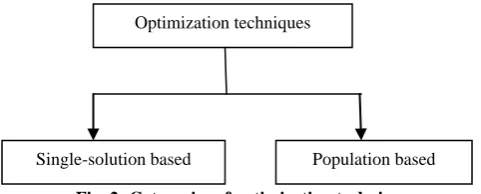
of candidate solutions. A number of meta-heuristics are proposed for this purpose. Optimization techniques are categorized into two kinds as mentioned in fig 2. First, single solution based algorithms are based on the technique of selecting a random candidate solution and then improving it step by step, like Simulated annealing and Simulated Raindrop algorithm [7]. On the other hand, population based meta-heuristics depends upon exploring the best solution from the given set of solutions.
3. LEACH-C AND ITS VARIANTS USING
OPTIMIZATION TECHNIQUE
A number of LEACH-C variants are proposed that make use of optimization techniques.
3.1 Low Energy Adaptive Clustering
Hierarchy-Centralized (LEACH-C)
LEACH-C is a protocol architecture developed by Wendi Heinzelman, Anantha Chandrakasan and Hari Balakrishnan in 2002 [3]. It is an improved version of LEACH protocol architecture. It is application specific protocol architecture for Wireless Microsensor networks. [1] It is quite similar to LEACH protocol. It also consists of same phases. In fact, there is no change in the steady-state phase. The only change took place is in set-up phase to form clusters.
The major difference between LEACH and LEACH-C protocol architecture is the method used for forming clusters. In LEACH, distributed algorithm is used for this purpose while LEACH-C makes use of simulated annealing algorithm. This approach has given better results. This central clustering technique gives better results due to formation of better clusters and CH nodes are dispersed throughout the network. Moreover, in LEACH there is no guarantee of the placement or number of CHs in the network. CHs may be close to each other, which limits the quality of the results.
LEACH-C also performs its functions in the set of rounds, like LEACH. Each round consists of two phases, namely, set- up phase and steady-state phase.
Set up phase: In the set up phase of LEACH-C, each node needs to transmit information about their location to the BS of the network. The information about the location of node is determined by using Global positioning system (GPS) receiver in each round. Next step is to form the clusters of these nodes, which is referred to as a hard problem. The most reliable method of solving NP-hard problems is to use approximation algorithms to determine optimal solution of the problem in polynomial time [8]. In LEACH-C protocol architecture, simulated annealing algorithm [4] is used, which is based on the principle of thermodynamics. This algorithm will form clusters for LEACH protocol by determining whether a node will belong to the current cluster being formed or not. This algorithm makes use of probabilistic
functions to determine the optimal result for NP-hard problem. The first step is to ensure that all the nodes in the network have approximate equal energy. To ensure this, average node energy is calculated and then compared with the individual nodes. In case, any node have lesser energy than the average it cannot be the CH in the present round. Number of optimal clusters is found by using equation 1 [3].
koptimized = N 2π∗
ϵfs εmp∗
M
dtoBS2 (1) where kopt is optimal number of clusters, N is number of sensor nodes in the network, M is region of network, dtoBS is average distance to base station from sensor nodes, Efs is energy consumed by using free-space model and Emp is energy consumed for transmission by using multipath model.
Now simulated annealing algorithm will determine the probability of the nodes to become CH in the network using equation 2 [8] and then associates them to their respective clusters. CHs are selected such that they are dispersed in the network and the nodes in the cluster are too close to them. Thus, the squared distance between CHs and nodes is kept minimum which also results in the lesser energy consumption of the non CH nodes to transmit collected data to the CHs.
pk= e −(f(C 1)−f(C ))
a k
1
f C1 ≥ f(C)
f C1 < 𝑓(𝐶) (2)
f C = N min d2(i, c)
i=1 (3) After the formation of both CH nodes and clusters, this information is broadcast to all the nodes by the BS. The BS broadcasts a message consisting of the CH ID. Each node checks this ID and compares with their own ID. If the ID matches, that node takes up the responsibility of the CH. This TDMA schedule consists of different slot for each node in the cluster when it can send its data. All non CH nodes will determine their TDMA schedule to transmit data to CH and goes to the sleep state. This prevents unnecessary loss of energy of non CH nodes.
Steady-state phase: The steady-state phase of LEACH-C is exactly identical to that of LEACH protocol. All the nodes in the network sense their environment and record various events taking place. The nodes will send this collected data to their respective CHs in the TDMA slot assigned to them. The receiver of non CH nodes activate only during this allocated time slot to conserve the energy of the nodes. If a node is unable to send its complete data in one slot, it can resume it the next time on arriving its slot. The receiver of CH always remains on in this phase to get data from different nodes. The operations of the CHs require more energy and also their energy is consumed too fast. But this energy consumption is less as compared to that in LEACH because of the lesser distance between CH and non CH nodes. After receiving the data, the CH evaluates it and determine the required information which is to be sent to the BS by compressing into a single signal. This prevents unnecessary traffic in the network as only few nodes have to send data to the BS.
3.2
Balanced
Clustering
Energy
Efficient
Hierarchical Routing (BCEE)
BCEE [9] is a protocol proposed by Cui and Liu. It makes use of k-means clustering algorithm for forming clusters in the WSN and Ant Colony Optimization (ACO) [10] for routing data from sensor nodes to the CH. This algorithm works in two phases. The first phase includes the formation of balanced clusters in the network though sensor nodes are not positioned exactly but they made use of RSSI (Received Signal Strength Indicator). The second phase includes routing the data from CH nodes to base station by Optimization techniques
[image:2.595.32.273.185.282.2]Single-solution based Population based
48 optimizing the power consumption during the process. ACO is one
of the best population-based optimization techniques that provide the best results for routing. This protocol has given significant improvement in energy efficiency in comparison to LEACH-C protocol. The lifespan of the sensor nodes has also enhanced to the great extent. This protocol was enhanced further using modified ACO algorithm in LEACH-C.
3.3 Particle Swarm Optimization-Centralized
(PSO-C)
Latiff et al. has proposed an Energy aware clustering protocol [11] that makes use of Particle Swarm Optimization (PSO) [12] technique for creation of clusters in WSN. The BS employs PSO to determine CH nodes which minimizes the cost function mention in equation 4.
𝑓 = 𝛼 ∗ 𝑓1+ 1 − 𝛼 ∗ 𝑓2 (4) Where α is the control parameter, f1 is the function that determines
maximum average Euclidean distance between node and the CH node and f2 is the total initial energy in network to the total energy
of CH nodes in the current round.
Apart from this cost function, rest of the working of the protocol is similar to [3]. This protocol have much better performance as compared to former LEACH-C protocol especially in the terms of network lifetime and successful data packet transmission to the BS. The clusters are well-formed due to evenly positioning of CH nodes in the network which also reduces the energy consumption of the energy consumption of the nodes.
3.4 Low Energy Adaptive Clustering
Hierarchy-Genetic Algorithm (LEACH-GA)
Liu et al. has proposed a new protocol named LEACH-GA [13] in 20011 that uses of optimization based Genetic Algorithm [14] for CH selection in the network. It consists of three phases. First phase is the preparation phase which determines the possible CH nodes in the network. In subsequent rounds there are only two phases, namely, set-up phase and steady-state phase. Firstly, every node in the network determines whether it is a possible CH node by performing a CH selection process defined in this protocol. The probability to become a CH node is evaluated using the equation 5.
𝑝 𝑖 =
𝑘𝑜𝑝𝑡𝑖𝑚𝑖𝑧𝑒𝑑𝑛 (5) Where koptimized is the number of clusters to be formed in the
network and n signifies the number of rounds.
The node transmits their respective message to the Base Station (BS) in the network along with their node ID and position details. The BS performs an optimization to calculate probability of that node to be CH by Genetic Algorithm method, which aims to decline energy consumption of sensor nodes. The BS again broadcast an advertisement message to all the nodes [15] along with their probability so that they can form the clusters. The other two phases are performed in the same way as that in LEACH protocol. There are some other optimization techniques that give much better results as compared to Genetic algorithm.
3.5 Particle Swarm Optimization-Semi distributed
(PSO-SD)
Singh et al. make use of PSO [12] technique to make selection of CH nodes in the network. A novel fitness function is determined
for execution of cluster based PSO which is based on the distance, degree of node, energy and head count of the sensor nodes in a cluster [15]. This fitness function defines the optimized location of CH. The results provided by this approach are much better than LEACH and some other comparatives on the basis of lifetime of nodes and energy consumption. They have proposed a fitness function as mentioned in equation 6 [15].
𝑓 𝑥𝑖 𝑡 = 𝑜𝑝𝑡𝑖𝑚𝑖𝑧𝑒 (𝛽1𝑋1+ 𝛽2𝑋2+ 𝛽3𝑋3+ (1 − 𝛽1−
𝛽2− 𝛽3) 𝑋4) (6) Where f(xi(t)) is the fitness function for i
th
node, β1, β2, β3 are the
control parameters used to provide weightage to different factors used to determine fitness function. X1 denotes the mean distance
of the node from other member nodes of the cluster. X2 signifies
the remaining energy of the node in comparison to other member nodes in the cluster. X3 denotesthe node degree [15].
PSO-SD is semi-distributed protocol and hence provides better results in comparison to former protocols.
3.6 Low Energy Adaptive Clustering
Hierarchy-Modified Ant Colony optimization (LEACH-MA)
In this paper, Varha Gupta and Shashi Kumar Sharma [16] has used Modified Ant Colony Optimization algorithm in collaboration with LEACH protocol. Here, ACO was used to make selection of CHs in the network of sensor nodes. The pheromone value is determined for each node in the network based on its energy and the probability and determines probability based on the pheromone and distance from the CH node. Update the final CHs selected along with their pheromone values. This CH generates TDMA schedule for its member nodes for transmitting their collected data. Then the CH with maximum probability in the network is selected as CH Leader. Each CH sends data to this CH Leader which again transmits it to the BS. This approach gives an improved result in terms of energy consumption of nodes and lifetime of the network as compared to LEACH protocol. The probability of a node to become CH is computed using equation 7.
𝑝 𝑖 =
𝑑 𝑖 ∗𝛼+𝑝ℎ𝑖 𝑡 ∗𝛽𝑑 𝑖 ∗𝛼+𝑝ℎ𝑖 𝑡 ∗𝛽 𝑛
𝐼=1
(7)
𝑝ℎ
𝑖𝑡 =
𝑇𝑖𝑗𝛼∗𝑛𝑖(𝑡)𝛽 𝑇𝑖𝑗𝛼∗𝑛𝑖(𝑡)𝛽 𝑛
𝐼=1
(8)
𝑛
𝑖𝑡 =
1𝐼𝑒−𝑒 (9)
Where di is the distance of node from BS, α and β are control
parameters, i is the CH node, j is the next node to be chosen as CH, Tij is the pheromone intensity and ni is the heuristic function as
defined in equation 9 [16] in which Ie is the initial energy level of the node and e is the actual energy level of the same node.
4. COMPARISON
49
Table 1: Comparison of LEACH-C variants using optimization techniques
Year Protocol Modification Motivation Energy
efficiency
Data transmission
Clustering method
2002 LEACH-C CH selection (energy efficiency)
Simulated Annealing Algorithm
High Single hop Centralised
2007 PSO-C Cluster formation Particle Swarm Optimization
Very High Single-hop Centralised
2009 BCEE Data transmission Ant Colony Optimization and K-means clustering
strategy
Very High Multi-hop Centralised
2011 LEACH-GA CH selection Genetic Algorithms High Single-hop Distributed 2013 PSO-SD CH selection using
and forming clusters
Particle Swarm Optimization technique
is used to select CHs and form energy-aware
clusters.
Very high Single-hop Semi-distributed
2015 LEACH-MA CH selection
Modified ACO
technique is used to
select the CHs.
High Single-hop Centralised
5. RESULTS
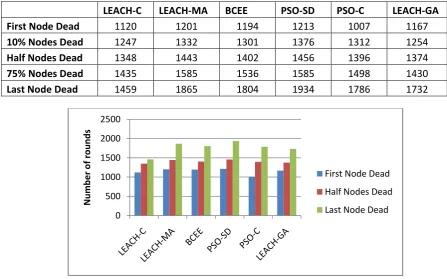
The protocols are compared on the basis of network lifetime by using the following parameters. Furthermore, these protocols are compared on the basis of their network lifetime. Table 2 provides statistics for LEACH-C, PSO-C, BCEE, LEACH-GA,
[image:4.595.73.521.437.716.2]PSO-SD and LEACH-MA for the first node dead, 10% nodes dead, 50% nodes dead and all nodes dead with respect to number of rounds for which protocols are run. nodes in the network for different LEACH based protocols at different rounds.
Table 2: Number of nodes alive w.r.t. the rounds
LEACH-C
LEACH-MA
BCEE
PSO-SD
PSO-C
LEACH-GA
First Node Dead
1120
1201
1194
1213
1007
1167
10% Nodes Dead
1247
1332
1301
1376
1312
1254
Half Nodes Dead
1348
1443
1402
1456
1396
1374
75% Nodes Dead
1435
1585
1536
1585
1498
1430
Last Node Dead
1459
1865
1804
1934
1786
1732
Fig 2: Number of rounds vs. Number of alive nodes
0
500
1000
1500
2000
2500
Numb
er
of r
oun
ds
First Node Dead
Half Nodes Dead
50
6. CONCLUSION
In this paper, different LEACH-C based protocols have been analyzed that made use of different optimization techniques. The use of these techniques in the field of WSN and especially for LEACH has improved the performance of the networks to a great extent. Most of them are used for the purpose of CH selection and cluster formation. They provide better positioning of the CH nodes in the network which helps a lot in reducing the energy consumption of the sensor nodes. From these protocols PSO-SD provides the best results because it is semi-distributed protocol.
Latest optimization techniques like Simulated Raindrop Algorithm and Intelligent Water-drop Algorithm can be used to obtain better results. These techniques can be utilized for solving the NP-hard problems. Apart from this, Simulated Raindrop Algorithm can be replaced by Simulated Annealing in LEACH-C protocol which may result into a much efficient LEACH-C variant.
7. REFERENCES
[1] Jun Zheng and Abbas Jamalipour. Wireless Sensor Networks – A Networking Perspective. IEEE, Book, A John Wiley & Sons INC. Publication.
[2] Wendi Rabiner Heinzelman, Anantha Chandrakasan and Hari Balakrishnan. 2000. Energy Efficient Communication Protocol for Wireless Microsensor Networks. IEEE– Proceedings of the 33rd Hawaii International Conference on System Sciences.
[3] Wendi Rabiner Heinzelman, Anantha Chandrakasan and Hari Balakrishnan. 2002. An Application-Specific Protocol Architecture for Wireless Microsensor Networks IEEE– IEEE Transactions on Wireless Communications, Vol. 1, No. 4, pp. 660-670.
[4]
S
cott Kirkpatrick. 1984. Optimization by Simulated Annealing: Quantitative Studies. Journal of Statistical Physics, Vol. 4, No. 5/6.[5]
S
. Lin. 1965. Computer Solutions of the Travelling Salesman Problem. Bell Syst. Journal, vol. 44, pp. 2245-2269[6] H. Shah-Hosseini. 2008. Intelligent water drops algorithm: a new optimization method for solving the multiple knapsack proble. Int. Journal of Intelligent Computing and Cybernetics, Vol. 1, No. 2, pp. 193-212, 2008a.
[7] Amin Ibrahim, Shahryar Rahnamayan and Miguel Vargas Martin. 2014. Simulated Raindrop Algorithm for Global Optimization. IEEE – 27th Canadian Conference on Electrical and Computer Engineering, pp. 1-8.
[8] Wendi Beth Heinzelman. 2000. Application-Specific Protocol Architecture for Wireless Networks. Thesis, MIT.
[9] Cui Xiaoyan, Liu Zhao. 2009. BCEE: a balanced-clustering, energy-efficient hierarchical routing protocol in wireless sensor networks. Proceedings of IC-NIDC2009. IEEE, 2009. p. 26–30
[10]Marco Dorigo, Christian Blum. 2005. Ant Colony Optimization Theory: A Survey. Theoretical Coimputer Science 344 pp. 243-278.
[11]N.M. Abdul Latiff, C.C. Tsimenidis, B.S. Sharif. 2007. Energy-Aware Clustering for Wireless Sensor Networks using ParticleSwarm Optimization. The 18th Annual IEEE International Symposium on Personal, Indoor and Mobile Radio Communications (PIMRC'07)
[12]Russell Eberhart, James Kennedy. 1995. A new optimizer using Particle Swarm Theory. IEEE Sixth International Symposium on Micro Machine and Human Science.
[13]Jenn-Long Liu and Chinya V. Ravishankar. 2011. Genetic Algorithm-Based Energy-Efficient Adaptive Clustering Protocol for Wireless Sensor Networks”, International Journal of Machine Learning and Computing, Vol. 1, No. 1, pp. 79-85.
[14]J.H. Holand. 1992. Adaptation in natural and artificial systems: an introductory analysis with applications to biology, control, and artificial intelligence. MIT Press.
[15]Buddha Singh and Daya Krishan Lobiyal. 2012. A Novel-Energy Aware cluster head selection based on particle swarm optimization for wireless sensor networks. Springer- Human Centric Computing and Information Sciences.
[16]Varsha Gupta and Shashi Kumar Sharma. 2015. Cluster Head Selection using Modified ACO. Proceedings of 4th International Conference on Soft Computing for Problem Solving, Advances in Intelligent systems and Computing, Springer, 2015.