Optimization of protease production by
1
Veerabadran, V.,
2Bhuvana Madhesh,
1
Department of Plant Biology and Plant Biotechnology, Loganatha Narayanasamy Government College,
2
Department of Microbiology, Nehru Arts and Science College, Coimbatore, T
3Department of Biotechnology, Aarupadai Veedu Institute of Technology,
4
CAS in Botany, University of Madras, Guindy Campus, Chennai, T
ARTICLE INFO ABSTRACT
This study evaluated the feasibility of easily available substrates in solid state fermentation (SSF) for the production of protease by
against incubation period, moisture content, initial p
and metal salts sources and optimum temperature of enzyme activity. It was found that green gram husk, 96 h, 30% moisture, 50
production. C
The optimized media was subjected to purification process which yielded a specific activity of 3506 U mg
-INTRODUCTION
Proteases are one of the most important commercial enzymes constituting 60-65% of the global enzyme market (
2007). They are widely used in food processing, detergents, diary industry and leather making (Priyanka
Proteases are produced by a wide range of microorganisms including bacteria, moulds and yeasts. In bac
is produced mainly by many members belonging to genus Bacillus especially, B. licheniformis, B. horikoshii, B. sphaericus, B. furmis, B. alcalophilus, B. subtilis
al., 2002). At present, the overall cost of enzyme production very high (due to high cost of substrate and medium used) and therefore, development of novel processes to increase the yield of proteases with increasing the production cost is highly appreciable from the commercial point of view. To achieve these goals, during the recent years, effects have been directed to expose the means to reduce the protease production costs through improving the yield, and the use of either cost free of low cost feed stocks or agricultural by products as substrates for protease production (Kuberan et al., 2010).
solid-state fermentation (SSF) involving growth of microbes on moist solid substrate(s) in the absence of free flowing water, has gained a tremendous momentum owing to certain advantages over the conventional submerged fermentation
*Corresponding author: [email protected]
ISSN: 0975-833X
Article History:
Received 19th December, 2011
Received in revised form 04th January, 2011
Accepted 17th February, 2011
Published online 31st March, 2012
Key words:
Solid state fermentation,
Bacillus sp.,
Green gram husk, Arabinose, Beef extract.
RESEARCH ARTICLE
Optimization of protease production by
Bacillus sp
. MPTK 712 under solid state fermentation
using green gram husk
Bhuvana Madhesh,
3Rakul, R. and *
4Mukesh Kumar
Department of Plant Biology and Plant Biotechnology, Loganatha Narayanasamy Government College,
Ponneri, Tamilnadu, India
Department of Microbiology, Nehru Arts and Science College, Coimbatore, T
iotechnology, Aarupadai Veedu Institute of Technology, Chennai, Tamilnadu
CAS in Botany, University of Madras, Guindy Campus, Chennai, Tamilnadu
ABSTRACT
This study evaluated the feasibility of easily available substrates in solid state fermentation (SSF) for the production of protease by Bacillus sp. MPTK 712. The production parameters were optimized against incubation period, moisture content, initial pH, extraction medium, various carbons, nitrogen, and metal salts sources and optimum temperature of enzyme activity. It was found that green gram husk, 96 h, 30% moisture, 50C, arabinose, beef extract and ferrous sulphate influenced protease production. Considerable increase in protease production was noticed after the optimization process. The optimized media was subjected to purification process which yielded a specific activity of 3506
-1
after Q-sepharose chromatography.
Copy Right, IJCR, 2012, Academic Journals
Proteases are one of the most important commercial enzymes global enzyme market (Chi et al., . They are widely used in food processing, detergents,
Priyanka et al., 2010). Proteases are produced by a wide range of microorganisms including bacteria, moulds and yeasts. In bacteria, this enzyme is produced mainly by many members belonging to genus B. licheniformis, B. horikoshii, B. sphaericus, B. furmis, B. alcalophilus, B. subtilis (Ellaiah et ., 2002). At present, the overall cost of enzyme production is very high (due to high cost of substrate and medium used) and therefore, development of novel processes to increase the yield of proteases with increasing the production cost is highly appreciable from the commercial point of view. To achieve s, during the recent years, effects have been directed to expose the means to reduce the protease production costs through improving the yield, and the use of either cost free of low cost feed stocks or agricultural by products as substrates ., 2010). In recent years, state fermentation (SSF) involving growth of microbes on moist solid substrate(s) in the absence of free flowing water, has gained a tremendous momentum owing to certain
nal submerged fermentation
(SmF), like low production cost, saving of water and energy, less waste effluent problem and stability of the product due to less dilution in the medium (Pandey, 2003, Holker and Lenz, 2005). Therefore, SSF has found several potential applications in the industrial production of value added products, such as industrially important microbial enzymes, bioinsecticides, secondary metabolites and pharmaceuticals (Robinson 2001, Pandey, 2003). This study was aimed to evaluate the feasibility of easily available substrates in SSF for the production of protease by B
production parameters were optimized against incubation period, moisture content, initial pH, extraction medium, various carbons, nitrogen, and metal salts sources and optimum temperature of enzyme activity. After the optimization process, protease was purified from the production medium by chromatography and its molecular weight was determined by SDS
MATERIALS AND METHODS
Bacterial strain
The test isolate Bacillus sp. MPTK 712 Aavin industry dairy effluent
Chennai, Tamil Nadu.
International Journal of Current Research Vol. 4, Issue, 03, pp.281-286, March,2012
INTERNATIONAL
. MPTK 712 under solid state fermentation
Mukesh Kumar, D.J.
Department of Plant Biology and Plant Biotechnology, Loganatha Narayanasamy Government College,
Department of Microbiology, Nehru Arts and Science College, Coimbatore, Tamilnadu, India
Chennai, Tamilnadu, India
amilnadu, India
This study evaluated the feasibility of easily available substrates in solid state fermentation (SSF) for . The production parameters were optimized H, extraction medium, various carbons, nitrogen, and metal salts sources and optimum temperature of enzyme activity. It was found that green gram C, arabinose, beef extract and ferrous sulphate influenced protease onsiderable increase in protease production was noticed after the optimization process. The optimized media was subjected to purification process which yielded a specific activity of 3506
, Academic Journals. All rights reserved.
(SmF), like low production cost, saving of water and energy, less waste effluent problem and stability of the product due to less dilution in the medium (Pandey, 2003, Holker and Lenz, 2005). Therefore, SSF has found several potential applications ndustrial production of value added products, such as industrially important microbial enzymes, bioinsecticides, secondary metabolites and pharmaceuticals (Robinson et al., 2001, Pandey, 2003). This study was aimed to evaluate the ilable substrates in SSF for the Bacillus sp. MPTK 712. The production parameters were optimized against incubation period, moisture content, initial pH, extraction medium, various carbons, nitrogen, and metal salts sources and timum temperature of enzyme activity. After the optimization process, protease was purified from the production medium by chromatography and its molecular weight was determined by SDS-PAGE.
MATERIALS AND METHODS
MPTK 712 was isolated from industry dairy effluent located at Shozhlinganallur,
Substrates
The substrate used in this study namely Rice bran, Wheat bran, Soya bean meal, Ground nut cake, Green gram husk and Coconut oil cake was obtained from a local market in Chennai.
Solid state fermentation
In an attempt to choose a potential substrate for SSF which supports protease production, various substrates namely Rice bran, Wheat bran, Soya bean meal, Ground nut cake, Green gram husk and Coconut oil cake were screened individually. SSF was carried out by taking 3 g of dry substrate in a 100 mL Erlenmeyer flask to which distilled water was added to adjust the required moisture level. The contents of the flasks were mixed and autoclaved at 121°C for 15 min. Flasks with inoculated were shaken at 150 rpm at 37°C for 144 h. The contents of the flasks were harvested and assayed every 24 h.
Enzyme extraction
The enzyme from the fermented media was extracted twice with tap water. The slurry was squeezed through damp cheesecloth. Extracts were pooled and centrifuged at 4°C for 15 min at 10,000 rpm to separate small particles of different substrates, cells and spores. The brown, clear supernatant was used in enzyme assays.
Protease assay
Protease activity was determined using sulphanilamide azocasein according to the method of Leighton et al. (1973). The reaction mixture containing 250 μL 1% (w/v) substrate in 0.1M Tris/HCl buffer (pH 9.0) and 150 μl of enzyme solution was incubated for 30 min at 37°C. After incubation, the enzyme was inactivated by addition of 1.2 mL trichloroacetic acid solution (10%, v/v) and then the solution was neutralized using 800 μL of 1.8 N NaOH solution. The absorbance was read at 420 nm. One unit of proteolytic enzyme activity was defined as the amount of azocasein that hydrolyzed during 30 min incubation at 37°C for millilitre of solution of extract. All experiments were conducted in triplicate.
Effect of moisture content
To check the influence of moisture on protease activity during SSF, Green gram husk was moistened with different amounts of distilled water (20%, 30%, 40%, 50%, 60% and 70%) prior to fermentation.
Effect of incubation time, pH and temperature
The effect of incubation time (24-144 h) was studied in different time intervals with the optimized pH and temperature of the production medium inoculated with the test isolate. The production medium with the optimized substrate was adjusted at various levels of pH by NaOH solution (4, 5, 6, 7, 8, 9, 10 and 11) and the effect of initial pH on protease production was studied. To study the effect of incubation temperature on protease production, the flasks with the production medium were inoculated and incubated at various temperatures ranging from 35-65°C for 24 h.
Effect of carbon and nitrogen sources
Mannose, xylose, lactose, sucrose, fructose, galactose, glucose, and arabinose were used as co-carbon sources at 1% along with the optimized substrate. The carbon sources were inoculated with the MPTK 712 strain for enzyme production. Organic and inorganic nitrogen sources like Beef extract, Casein, Yeast extract, Peptone, Urea, NH4Cl, (NH4)2SO4 and
NaNO3 were amended to the production medium at 1% along
with the test isolate and optimized substrate for enzyme production.
Effect of metal ions
The effect of several metal ions (FeSO4, MnSO4, CuSO4,
ZnSO4 and MgCl2) on the enzyme production of the isolate
was determined. The enzyme solution was stored for 1 h at 30°C in the presence of 1 mM of various ions prior to the respective enzyme assays for remaining activity.
Purification of protease
The crude extract of the fermentation medium was subjected to 85% ammonium sulphate precipitation by continuous stirring. The saturated solution was kept undisturbed overnight at 4°C. It was then centrifuged and the precipitate was dissolved in a small amount of 50 mM glycine–NaOH buffer (pH 10.5) and dialyzed for 24 h. Two ml of dialyzed protein was loaded on Q-Sepharose column, (1.5 cm X 12 cm) pre-equilibrated with glycine–NaOH buffer. The flow rate was adjusted to 30 ml/h and 2 ml fractions were collected and analyzed for the protease activity. The fractions with maximum activity were pooled, concentrated, and then used as source of protease for further characterization of enzyme. Total amount of protein throughout the experiment was measured according the method of Lowry et al. (1951) using Bovine serum albumin (BSA) as standard. The purity of the alkaline protease was checked using 10% denaturing sodium dodecyl sulfate-polyacrylamide gel electrophoresis (SDS-PAGE) under reducing conditions. The polyacrylamide gel was prepared by the method of Laemmli (1970). The staining was done with Coomassive brilliant blue staining.
RESULTS AND DISCUSSION
Coconut oil cake were screened for protease production by SSF. It was found that green gram husk recorded highest protease activity (252 U/ml) after 96 h of incubation (Fig. 1). Since green gram husk produced highest protease activity, further optimization of process parameters was done using this natural substrate.
Fig. 1. Screening of best substrate for protease production by SSF
[image:3.595.40.283.138.290.2]It is very essential to detect the optimum incubation time at which an organism exhibit highest enzyme activity since organisms show considerable variation at different incubation periods. It was noted that a high protease activity (252 U/ml) by the test isolate with green gram husk was obtained at 96 h of incubation time (Fig. 2). The decline in enzyme activity observed after 120 h of incubation might be due to denaturation and/or decomposition of protease as a result of interactions with other compounds in the fermented medium (Uyar and Baysal, 2004). The findings of the study fall in line with others on Bacillus sp. (Studdert et al., 1997; Ferreri et al., 1996; Takii et al., 1990). Protease production nearly corresponded maximum in early stationary phase (Kuberan et al., 2010).
Fig. 2. Effect of incubation time on protease production by
Bacillus sp. MPTK 712 with green gram husk as substrate
The initial moisture content significantly influence hydrolytic enzyme production in SSF. This is important for microbial growth and enzyme production under solid state fermentation using a particular substrate, moisture level (content)/water activity is one of the most critical factors. Because, SSF processes are different from submerged fermentation culturing, since microbial growth and product formation occurs at or near the surface of the solid substrate particle having low moisture contents (Pandey et al., 2000). It was
[image:3.595.306.557.383.522.2]found that 30% moisture content facilitated highest protease activity by the test strain (Fig. 3).
Fig. 3. Effect of moisture content on protease production by
Bacillus sp. MPTK 712
The pH is an important factor which affects the growth and enzyme production during solid-state fermentation (Ellaiah et al., 2002). From figure 4 it was noted that an alkaline pH 9 favoured maximum lipase production (278 U/ml). The enzyme activity decreased after pH 9 indicating the test strain was alkalophilic in nature. This report was in accordance with the findings of Akcan and Uyar (2011) who found the optimum pH of 9 for protease activity by Bacillus sp. in a lentil husk supplemented SSF.
Fig. 4. Effect of pH on protease production by Bacillus sp.
MPTK 712
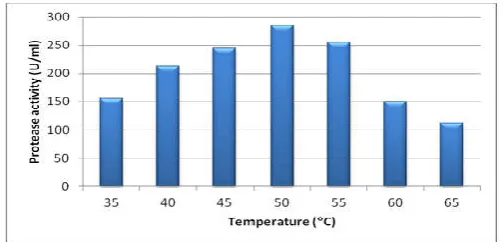
Incubation temperature plays an important role in SSF. To study the effect of temperature on enzyme production, the SSF was carried out at different temperatures 35-65°C. It was noted that a high temperature about 50C exhibited highest protease activity (285 U/ml) indicating the thermotolerant nature of the enzyme (Fig. 5).
Fig. 5. Effect of temperature on protease production by Bacillus
[image:3.595.46.274.489.635.2] [image:3.595.309.561.623.744.2]Fig. 6. Effect of carbon source on protease production by Bacillus
sp. MPTK 712
[image:4.595.38.290.48.205.2]Among the various carbon sources tested, arabinose was found to be the best support protease production with a concentration of 1% (Fig. 6). In addition, good protease activity was also observed in the media supplemented with lactose, galactose, and fructose. Carbon sources like mannose and xylose recorded low protease activity. This may be due to the total repression of enzyme synthesis described a complete inhibition of the extracellular protease production (Joo et al., 2002).
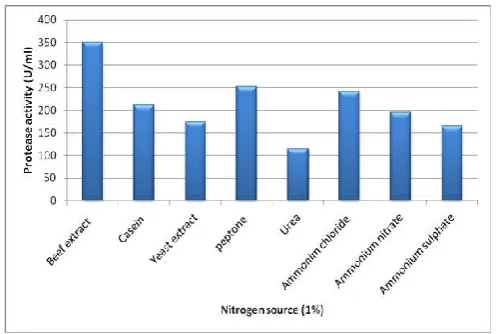
Fig. 7. Effect of nitrogen source on protease production by
Bacillus sp. MPTK 712
The culture environment has a dramatic influence on enzyme production especially nitrogen sources play a crucial role in enzyme induction in bacteria (Elibol and Ozer, 2001). The effect of various organic and inorganic nitrogen sources on protease production is shown in figure 7. Beef extract recorded maximum protease production compared to all other nitrogen sources employed. It has been reported that beef extract increased protease production by B. subtilis DM-04 (Mukherjee et al. 2008). Yang et al. (2000) found that protease production by B. subtilis Y-108 was repressed by most of the nitrogen sources employed by SSF. Effect of metal ions on protease production by Bacillus sp. MPTK 712 was investigated. It was found that FeSO4 and MnSO4 influenced
protease production (Fig. 8). The addition of ZnSO4 repressed
protease production by Bacillus sp. MPTK 712 there are various reports recording positive effects of metal cations on protease production (Wang et al., 2005; Haddar et al., 2009; Uyar et al., 2011).
Fig. 8. Effect of metal ion protease production by Bacillus sp.
[image:4.595.312.551.233.382.2]MPTK 712
Fig. 9. Protease activity recorded before and after enzyme optimization
[image:4.595.41.290.358.525.2] [image:4.595.304.561.702.774.2]There was a considerable and high increase in the enzyme activity depicted by Bacillus sp. MPTK 712 after the SSF process. The test isolate recorded an enzyme activity of 252 U/ml before the SSF process. The enzyme activity rose to 375 U/ml after the SSF process (Fig. 9). Thus, this optimized fermentation medium was further employed for the purification process. In SSF process, the crude extracts contain different mixtures of proteins and undesirable products as organic acids and other metabolites. So that purification of the required favourable product must be take place by different purification methods. In most enzyme purification the precipitation of the crude total proteins after separating the culture from the fermentation broth by filtration or centrifugation and the culture supernatant is concentrated by salting out by solid ammonium sulphate as a precipitation agent (Kumar et al., 2002) and followed by another purification procedure as ion exchange and gel filtration chromatography. This study used ammonium sulphate as a precipitation agent recording 1141 U mg-1 of specific activity and 3506 U mg-1 after the Q-sepharose chromatography (Table 1).
Table 1. Purification scheme of protease from Bacillus sp. MPTK 712 by SSF
Steps Total protein
(mg)
Total activity (U)
Specific activity (U mg-1)
Crude enzyme 2200 856000 390
Ammonium sulphate perception (85%)
540 616000 1141
Many researchers used SDS-PAGE to detect the homogeneity and molecular weight of alkaline proteases produced by bacteria and actinomycetes (Rao and Narasu, 2007). The homogeneity of the purified protease from Bacillus sp. MPTK 712 was detected by using SDS-polyacrylamide gel and showed that one only band within the gel electrophoresis (Fig. 10), which indicate that the purified protease is homogenous, also have a molecular weight equal to 26,000 Daltons.
Fig. 10. Photographic representation of SDS-PAGE Gel (Lane 1, Marker Proteins; Lane 2 showing Protease single band after
Q-Sepharose)
Conclusion
This study evaluated the feasibility of easily available substrates in SSF for the production of protease by Bacillus sp.MPTK 712.The production parameters were optimized against incubation period, moisture level, initial pH, extraction medium, various carbon, nitrogen, and metal salts sources and optimum temperature of enzyme activity. It was found that green gram husk, 96 h, 30% moisture, 50C, Arabinose, Beef extract and ferrous sulphate influenced protease production. Considerable increase in protease production was noticed after the optimization process. The optimized media was subjected to purification process which yielded a specific activity of 3506 U mg-1 after Q-sepharose chromatography. To conclude, this study confirmed that cultural environment plays a vital role in protease production by Bacillus sp. MPTK 712 under SSF. The purified enzyme may be further exploited towards various industrial applications in near future.
REFERENCES
1. Chi Z, Ma C, Wang P, Li HF (2007) Optimization of medium and cultivation conditions for alkaline protease production by the marine yeast Aureobasidium pullulans. Biores. Tech. 98, 534.
2. Elibol M, Ozer D (2001) Influence of oxygen transfer on lipase production by Rhizopus arrhizus. Proc. Biochem. 36, 325-329.
3. Ellaiah P, Srinivasulu B, Adinarayana K (2002) A review on microbial alkaline proteases. J. Sci. Ind. Res. 61, 690 -704.
4. Ferrari E, Jarnagin AS Sehmit BF (1996) Commercial production of extracelluar enzymes. In: Thermostable alkaline protease producing bacteria from Visakhapatnam soil(eds. Sonenshein, Hoch AL, Ferrero MA, Cartro GR, Abate CM, Baigori MD & Sineriz F) pp. 173 – 175. Ind. J. Microbiol.
5. Haddar A, Bougatef A, Agrebi R, Sellami-Kamoun A, Nasri M (2009) A novel surfactant-stable alkaline serine-protease from a newly isolated Bacillus mojavensis A21. Purification and characterization. Proc. Biochem. 44, 29-35.
6. Holker U, Lenz J (2005) Solid-state fermentation-are there any biotechnological advantages? Cur. Opn. Microbiol. 8, 301-306.
7. Joo HS, Kumar CG, Park GC, Kim KT, Paik SR, Chang CS (2002) Optimization of the production of an extra cellular alkaline protease from Bacillus horikoshii. Proc. Biochem. 38, 155-159.
8. Kuberan T, Sangaralingam S, Thirumalai Arasu V (2010) Isolation and optimization of Protease producing Bacteria from Halophilic soil. J. Bio sci. Res. 1(3), 163-174.
9. Kumar A, Sachdev A, Balasubramanyam SD, Saxena AK, Lata A (2002). Optimization of conditions for production of neutral and alkaline protease from species of Bacillus and Pseudomonas. Ind. J. Microbiol. 42, 233-236.
10. Laemmli UK (1970) Cleavage of structural proteins during the assembly of the head of bacteriophage T4. Nature, 227, 680-685.
11. Leighton TJ, Doi RH, Warren RAJ, Kelln RA (1973) The relationship of serine protease activity to RNA polymerase modification and sporulation in Bacillus subtilis. J. Mol. Biol. 76, 103-22.
12. Lowry OH, Rosebrough NJ, Farr AL, Randall RJ (1951) Protein measurement with the folin phenol reagents. J. Biol. Chem. 48, 17-25.
13. Mukherjee AK, Adhikari H, Rai SK (2008) Production of alkaline protease by a thermophilic Bacillus subtilis under solid-state fermentation (SSF) condition using Imperata cylindrica grass and potato peel as low-cost medium: Characterization and application of enzyme in detergent formulation. Biochem. Eng. J. 39, 353-361. 14. Nurullah Akcan, Fikret Uyar (2011) Production of
extracellular alkaline protease from Bacillus subtilis RSKK96 with solid state Fermentation. Eurasia. J. Biosci. 5, 64-72.
15. Pandey A (2003) Solid-state fermentation. Biochem. Eng. J. 13, 81-84.
16. Pandey A, Soccol CR, Mitchell D (2000) New developments in solid state fermentation. Bioprocesses and products. Proc. Biochem. 35, 1153-1169.
17. Rao K, Narasu ML (2007) Alkaline protease from Bacillus firmus 7728. Afr. J. biotechnol. 6, 2493-2496. 18. Robinson T, Singh D, Nigam P (2001) Solid-state
fermentation: a promising microbial technology for secondary metabolite production. Appl. Microbiol. Biotech. 55, 284-289.
by Aspergillus oryzae in submerged and solid-state fermentation. Proc. Biochem. 40, 2689-2694.
20. Studdert CA, De Castro RE, Herrera Seitz K, Sanchez JJ (1997) Detection and preliminary characterization of extracellular proteolytic activities of the haloalkaliphilic archaeon Natroococcus occultus. Arch. Microbiol., 168, 532–535.
21. Takii Y, Kuriyama NY, Suzuki Y (1990) Alkaline serine protease produced from citric acid by Bacillus alkalophilus sub sp. halodurans kp 1239. Appl. Microbiol. Biotechnol. 34, 57-62.
22. Usha Priyanka D, Kanakaraju, Sumanjali A, Dwaraka K, Meena V (2010) Intnl. J. Chem. Sci. 8.
23. Uyar F, Baysal Z (2004) Production and optimization of process parameters for alkaline protease production by a newly isolated Bacillus sp. under solid state fermentation. Proc. Biochem. 39, 1893-1898.
24. Uyar F, Porsuk I, Kizil G, Yilmaz EI (2011) Optimal conditions for production of extracellular protease from newly isolated Bacillus cereus strain CA15. EurAsian J. BioSci. 5, 1-9.
25. Wang S, Chen Y, Wang C, Yen Y, Chern M (2005) Purification and characterization of a serine protease extracellular produced by Aspergillus fumigatus in a shrimp and crab shell powder medium. Enz. Microbiol. Tech. 36, 660-665.
26. Yang JK, Shih IL, Tzeng YM, Wang SL (2000) Production and purification of protease from a Bacillus subtilis that can deproteinise crustacean wastes. Enz. Microbiol. Tech. 26, 406-413.