DENDRIGEL: PREPARATION, OPTIMIZATION AND
CHARACTERIZATION
*Amanjot, Shalu Rani, Harjaskaran, Lovepreet Singh, Surya Prakash Gautam and Sukhbir Kaur
Department of Pharmaceutics, CT institute of Pharmaceutical Sciences, Shahpur, Jalandhar.
ABSTRACT
The preparation of dendrigel, using dendrimers as drug carrier. Dendrimers were prepared by divergent method and was loaded in varying proportion in carbapol 940. To this mixture itraconazole drug was added and the formulation of dendrigel was evaluated. Dendrimers was prepared by divergent growth method. Evaluation parameter such as colour test, UV spectroscopy, FT-IR. Evaluation parameters for dendrigel were pH, spreadability, viscosity, drug content, antifungal activity and in vitro release studies. The prepared dendrigel having better antifungal activities than other conventional delivery system because dendrimers were enhance the solubility of drug which results in increase in penetration of drug in the skin.In the present study attempt was made to develop dendrimers containing itraconazole as a drug so as to increase the solubility and penetration of the drug through the skin using novel delivery system for better antifungal activity.This will help to increase the solubility and penetration of drug. It increases the antifungal activity of formulation.
KEYWORDS: PAMAM, dendrimer, dendrigel, nanoparticles, FT-IR, UV spectroscopy.
1 INTRODUCTION
Mycosis is a common fungal infection affecting human skin and causes different dermatophyte infections. Fungal infection of skin can be treated with topical creams, gels as well as prescription drugs. There are three types of fungal infections, i.e. superficial, cutaneous and Systemic fungal infection[1, 2]. Fungal infection is a common infection which affects the maximum of population among the world[3]. Many antifungal drugs are available for treatment of fungal infection like Miconazole, Ketoconazole etc. Itraconazole is topically
Volume 5, Issue 8, 1143-1155. Research Article ISSN 2277– 7105
*Corresponding Author
Amanjot
Department of
Pharmaceutics, CT
institute of Pharmaceutical
Sciences, Shahpur,
Jalandhar. Article Received on 07 June 2016,
Revised on 28 June 2016, Accepted on 18 July 2016
active antifungal agent with a broad spectrum of activity and effective against several fungal strains such as Candida topicalis, C. albicans which are responsible for topical candidiasis[4].
[image:2.595.115.478.312.485.2]Itraconazole1-(butan-2-yl)-4-{4-[4-(4-{[(2R,4S)-2-(2,4-dichlorophenyl)-2-(1H-1,2,4-triazol- 1-ylmethyl)-1,3-dioxolan-4-yl]methoxy}phenyl)piperazin-1-yl]phenyl}-4,5dihydro-1H-1,2,4-triazol-5-one is an azole-type antifungal agent (Fig. 1) that is known to have topical activity against pathogenic dermatophytes and yeasts[5,6]. Itraconazole having very low water solubility and having log P value 6.5 which indicate high permeability through membrane and it is beneficial for topical delivery. General side effects can be overcome by its topical delivery. For topical delivery semisolid preparations are widely established over liquid and solid dosage forms[7].
Figure 1: Chemical Structure of Itraconazole
pharmaceutical activity (anticancer, anti-inflammatory, antimicrobial), providing the opportunity for combination therapy in which the dendrimers serve as the drug carrier and simultaneously as an active part of the therapy[16].
2 MATERIALS AND METHODS
The following materials were used: Itraconazole, Egg membrane, Methyl acrylate form Loba Chemical Pvt.Ltd.Mumbai,India., Methanol and Ethylenediamine form Loba Chemical Pvt.Ltd.Mumbai,India., Carbopol 940 from Qualikems fine chem,New delhi,India., Triethanoamine from S.D Fine chem laboratory,Ambala,India., Glycerine from Avarice laboratory reagent,Ghaziabad,India., Tween80, Benzyl alcohol from Loba Chemical Pvt.Ltd.Mumbai,India. All reagents used were of analytical grade.
Intstruments: UV/VIS spectrophotometer (UV-1800, Shimadzu Corporation, Japan), FTIR-spectrometer (Alpha, Bruker Optics, Germany), pH meter (Hanna instruments,Italy), Brookfield viscometer(Brookfield engineering laboratories, USA), Digital Weighing Machine (Ohaus Instruments, Switzerland).
Synthesis of PAMAM Dendrimer[17]
PAMAM dendrimers were synthesized by the divergent growth method. Ethylene diamine (EDA) acts as originator core starting the synthesis of dendrimer by attaching four acrylate moieties on each amino group of EDA. The resultant compound denoted to as generation -0.5 PAMAM tetra ester. Then 0G, 0.5G, 1G, 1.5G, 2G PAMAM dendrimers were synthesized by this method. 2G was used in preparation of dendrigel formulations.
Synthetic procedure
Table 1: Theoretical details of the reactants and product for synthesis of PAMAM dendrimers
S. No. Dendrimers generation
Theoretical Molecular weight
Free NH2 / COO
-groups
1. -0.5 G 405 4
2. 0.0G 517 4
3 0.5 G 1,205 8
4. 1.0G 1,430 8
5. 1.5 G 2,807 16
6. 2.0G 3,256 16
Evaluation of PAMAM dendrimers
Color Test
PAMAM dendrimers and acetylated derivatives were treated with aqueous solution of copper sulphate (1%w/v) [18].
Ultraviolet Spectroscopy
0.01%w/v concentration of PAMAM dendrimers was scanned in the range of 200nm to 500nm against distilled water. The changes in λmax values were analysed [19-20].
Infra-red spectroscopy
IR analysis, dendrimer was scanned in the wave number 4000-600 cm-1 by using Bruker FT-IR by ATR technique [21].
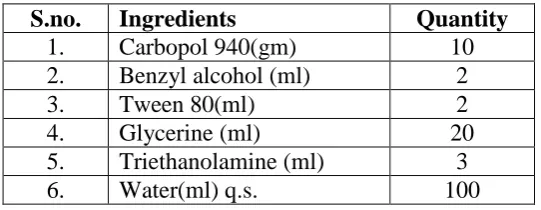
Preparation of gel base [22]
Carbopol 940 and purified water were taken in a beaker and allowed to soak for 24 hours. carbopol 940 was than neutralized with sufficient quantity of triethanolamine. Glycerine as a moistening agent and Tween 80 as a penetration enhancer and benzyl alcohol as a preservative added with continuous stirring until the homogenous gel was formed.
Formula and Method
Table no.2 formulation of gel base
S.no. Ingredients Quantity
[image:4.595.163.434.622.727.2]Preparation of dendrigel
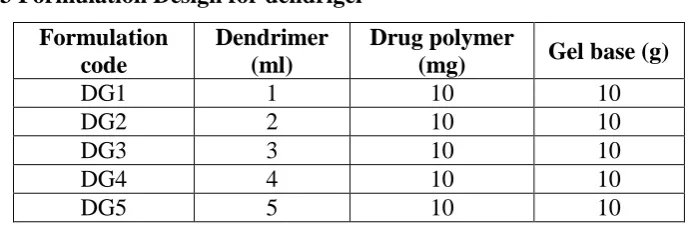
1% of dendrimer( 1g of generation 2 dendrimers were diluted to 10 ml with distilled water in order to make 1% of dendrimer) in varying proportion (1-5 ml) was mixed with 10mg itraconazole drug and kept for 24 hours to make the Dendrimer drug complex. Then it is loaded into the gel for the dendrigel formulation as per the table no. 3.
[image:5.595.123.468.199.313.2]
Table no. 3 Formulation Design for dendrigel Formulation
code
Dendrimer (ml)
Drug polymer
(mg) Gel base (g)
DG1 1 10 10
DG2 2 10 10
DG3 3 10 10
DG4 4 10 10
DG5 5 10 10
Evaluation of dendrigel
The prepared Itraconazole dendrigel formulations were inspected visually for their colour, homogeneity, consistency, spreadability, viscosity and pH [23].
pH: The pH values of 1% aqueous solutions of the prepared dendrigel were measured by a pH meter (Digital pH meter, Hanna instruments,Italy).
Spreadability: Spreadability is expressed in terms of time in seconds taken by two slides to slip off from dendrigel and placed in between the slides under the direction of certain load[24].
Viscosity: The viscosity of gel formulation was determined at 37ºC using a brook field viscometer (Brookfield DV‐E viscometer, Brookfield engineering laboratories, USA). 6 no spindle was used and rpm set at 10.
Drug Content Determination: Itroconazole content in gel was measured by dissolving known (10g) quantity of dendrigel in solvent (water) by Sonication. Absorbance was measured after suitable dilution at 269 nm in UV/VIS spectrophotometer (UV-1800, Shimadzu Corporation, Japan)[25].
Drug Loading and In Vitro Release[26]
prepared Acetate buffer solutions (pH 5.5) solution to solubilize the drug. The samples were collected at suitable time intervals of 15min. Samples were analyzed for drug content by UV visible spectrophotometer at 269 nm after appropriate dilutions.
Antifungal activity of dendrigel[27]
The antifungal activity of dendrigel formulation was checked by using agar medium plates. 5g of nutrient agar powder Suspended in 200ml distilled water. Heat this mixture while stirring to fully dissolve all components. Autoclave the dissolved mixture at 121ºC for 15min. Once the nutrient agar has been autoclaved, allow it cool but not solidify. Pour nutrient agar into each plate and leave plates on sterile surface until agar has solidified. Then four wells were made in each petri plate, and in first well dendrigel, second well formulation of clotrimazole, third well gel base were filled in these wells and the remaining one well was blank. Place the plates into incubator for 7 days.
Stability study
The dendrigel formulation was kept in tightly closed glass vials. The sample were kept in dark (in amber colours vials) and light (in colourless vials) at 0°c, Room temperature (25°-30°c) and 45°c for a periods of seven weeks. The samples were analysed initially and periodically after every week for up to seven weeks for change in viscosity, pH, colour and consistency. The data obtained was used for the analysis of any physical or chemical degradation, the required storage condition and the precaution required for storage.
3 RESULTS AND DISCUSSION
Physical State and organoleptic properties of dendrimers
The dendrimers were evaluated for their physical characteristic such as appearance, viscosity and odour.
Table 4: Physical characteristic of PAMAM dendrimers generation S.
No.
Generation of Dendrimers
Colour as
Concentrated Physical state
Identification by CuSo4 test
1. 2 G Light Reddish
Identification of dendrimers
The dendrimers were distinguished as half generation or full generation by reaction with freshly prepared 1% w/v aqueous solution of copper sulphate with 0.1% w/v dendrimers solution.
Copper Sulphate Test
10 drops of 10% Copper sulphate [CuSO4] reagent was taken in a small test tube and 2 drops
[image:7.595.136.462.245.419.2]of dendrimers was added to it.
Figure 2: PAMAM dendrimers generations Copper Sulphate Test
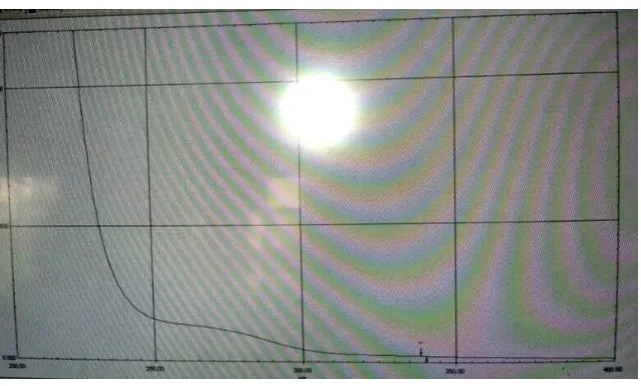
Identification of Dendrimers by UV-Spectroscopy 1. UV spectroscopy of 2 G PAMAM dendrimer
[image:7.595.139.460.501.694.2]FT-IR Spectroscopy
[image:8.595.124.469.105.330.2]1. FT-IR spectroscopy of 2 G
Figure 4: FT-IR spectra of PAMAM Dendrimers 2 G
Table no 5: FTIR Spectrum of 2 G PAMAM Dendrimers showing different wave number with Assignment
Sr.No
IR Absorption Band (cm-1)
(Experimental)
IR Absorption Band
(cm -1) (Literature)
Functional Groups
1. 3358 3366 (O-H stretching),
2. 2857 2942 Aliphatic C-H stretching 3. 1598 1575 (Aromatic C=N
stretching) 4. 1043 1031 C-O stretching
Pharmaceutical evaluation of dendrigel
[image:8.595.87.509.411.525.2]Table no 6: Evaluation of formulated dendrigel dendrigel
code Appearance viscosity pH Drug content
% commulative Release DG1 Light yellow 11235 5.6 78.56 86.67±0.49
DG2 Light yellow 8623 5.4 82.74 89.55±0.71
DG3 Light yellow 10250 5.2 87.56 91.58±0.16
DG4 Light yellow 9500 5.3 90.11 92.74±0.19
DG5 Light yellow 13200 5.5 94.30 94.55±0.81
[image:9.595.75.523.75.437.2]Figure 5: In Vitro Release of drug form dendrigel in ABS 5.5 pH Antifungal Activity of Dendrigel
Table no 7: Antifungal activity (zone of inhibition) of itraconazole in dendrigel and gel base compared with standard drug clotrimazole
Formulation Agar plates dendrigel Standard Gel base Blank
F1 0.9±0.81cm 0.8±0.21cm 0.7±0.08cm 0.7±0.05cm
F3 1.1±0.36cm 0.8±0.21cm 0.6±0.04cm 0.4±0.15cm
F4 1.2±0.19cm 0.8±0.21cm 0.6±0.05cm 0.5±0.12cm
F5 1.4±0.54cm 0.8±0.21cm 0.7±0.08cm 0.5±0.12cm
[image:10.595.48.551.67.303.2]Stability Studies
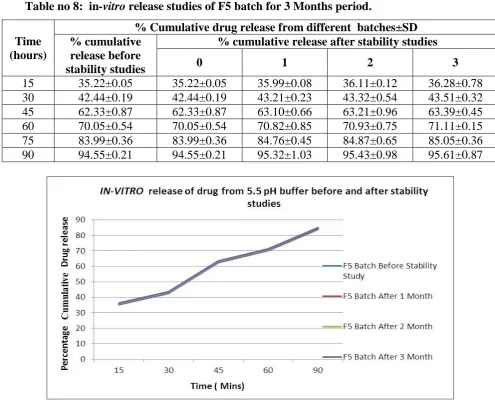
Table no 8: in-vitro release studies of F5 batch for 3 Months period. Time
(hours)
% Cumulative drug release from different batches±SD % cumulative
release before stability studies
% cumulative release after stability studies
0 1 2 3
[image:10.595.47.543.338.742.2]DISCUSSION
Poor water dissolvability of itraconazole presents a block for the nearby accessibility of itraconazole and limits the successful antifungal treatment[28]. Topical use of the drug at the affected site offers potential preference of delivering the drug directly to the site of action. PAMAM dendrimers with uniform particle size and shape having well-known interest in biomedical applications because of their capacity to cross cell membranes. Non-polar cavities in PAMAM dendrimers in combination with their hydrophilic exterior surface make them accomplished of encapsulating hydrophobic drug molecules. These noncovalent incorporations offer a alteration of physicochemical advantages over the free drug molecules including the possibility of enhanced water solubility and drug stability. Dendrimers enhance the solvency of hydrophobes due to hydrophobic interactions, electrostatic co-operation between terminal practical gatherings of the dendrimers and hydrophobes[29-31]. The present work deals with the formulation and evaluation of Itraconazole topical dendrigel using gelling agent like carbapol 940.the dendrimers were used as drug carrier in the formulation. Optimized batch F5 shows yellow colour in appearance. pH of all five batches was found between 5 - 5.6. pH of optimized batch F5 was found 5.5 which lies in normal PH of skin. Viscosity is important parameter for characterizing the gels as it affect spreadability, extrudability and release of the drug, all the formulated batches should increase viscosity as the concentration of gelling agent increased optimized batch F5 show ideal viscosity.
All the prepared groups indicate consistency in drug content. Optimized batch F5 shows 94.3 % drug content which show uniform drug dispersion in dendrigel. In vitro realease studies were carried out by using acetate buffer PH 5.5 realease of Itraconazole from all prepared dendrigel formulations was found to be satisfactory. In optimized batch F5 drug diffusion occurs through the fluid phase and hence they offer little resistance to drug diffusion and realese.
ACKNOWLEDGMENT
Authors are grateful to the Department of pharmaceautics, CT institute of pharmaceutical sciences, shahpur, Jalandhar, Punjab for providing necessary facilities to complete this work.
REFERENCES
1. Marcon MJ, Powell DA. Epidemiology, diagnosis, and management of Malassezia furfur systemic infection. Diagn Microbiol Infect Dis 1987; 7: 161–75.
3. Deveda P, Jain A, Vyas N.Gellified emulsion for sustain delivery of Itraconazole for topical fungal diseases.Int. J. of Pharm. and Pharm. Sci 2010; 104-112.
4. Jain A, Jain S, Rawat S.Emerging fungal infections among children: A review on its clinical manifestations, diagnosis, and prevention. J of Pharm & Bioallied sci. 2010; 314-320.
5. Sawyer PR, Brogden RN, Pinder RM, Speight T M, Avery G S. Drugs 1975; 9: 424-447. 6. Ellepola AN, Samaranayake LP, Martin MV, Samaranayake LP, MacFarlane TW.
Antifungal Agents. Wright Butter worth and Co. U.K.1990.
7. Sailesh.Topical Drug Delivery Systems: A Review.Pharmaceutical information & blog. 2008.
8. Milhem OM, Myles C, McKeown N B, Attwood D, D’Emanuele A. Int. J. Pharm 2000; 197: 239-241.
9. Chauhan AS, Jain NK, Diwan P V, Khopade AJ. J Drug Target 2004; 12: 575—583. 10. Devarakonda B, Hill RA, Liebenberg W, Brits M, de Villiers MM. Int. J. Pharm 2005;
304: 193-209.
11.Jain K, Mehra NK, Jain NK. Potentials and emerging trends in nanopharmacology. Curr Opin Pharmacol 2014; 15: 97-106.
12. Kolhe P, Misra E, Kannan RM, Kannan S, Lieh-Lai M. Int. J. Pharm 2003; 259: 143-160.
13.Bagre AP, Jain K, Jain NK. Alginate coated chitosan core shell nanoparticles for oral delivery of enoxaparin: in vitro and in vivo assessment. IntJ Pharm 2013; 456: 31-40. 14.Blattes E, Vercellone A, Eutamène H, Turrin CO, Théodorou V, Majoral JP, Caminade
AM, Prandi J, Nigou J, Puzo G. Mannodendrimers prevent acute lung inflammation by inhibiting neutrophil recruitment. Proc Natl Acad Sci: USA 2013; 110: 8795-8800.
15. Kesharwani P, Jain K, Jain NK. 2014. Dendrimer as nanocarrier for drug delivery.Prog Poly Sci 2013; 39: 268–307.
16. Tulu M, Aghatabay N M, Senel M, Dizman C, Parali T, Dulger B. Eur. J. Med. Chem 2009; 44: 1093-1099.
17.Tomalia DA, Naylor AM, Goddard WA. III Starburst Dendrimers: Molecular-Level Control of Size, Shape,Surface Chemistry, Topology, and Flexibility from Atoms to Macroscopic Matter. Angew Chem Intl Edit 1990; 29: 138-175.
19.Erk N. Application of first derivative UV spectrophotometry and ratio derivative spectrophotometry for the simultaneous determination of candesartan cilexetil and hydrochlorothiazide. Phmz 2003; 58(11): 796-800.
20. Ronald CH, Bauer BJ, Paul SA, Franziska G, Eric A. Templating of inorganic nanoparticles by PAMAM/PEG dendrimer star polymers. Polymer 2002; 43: 5473-5481. 21. Pesak DJ, Moore JS. Columnar liquid crystals from shape persistent dendritic molecules.
Angew. Chem. Int. Ed. Engl 1999; 36: 1636-1639.
22.Bharat Parashar, Atul Kabra, Ajay Chandel. Formulation and Evaluation of Gel Containing Miconazole Nitrate an Antifungal Agent. International Journal of Pharma Research & Review, June 2013; 2(6): 18-28.
23.Kshirsagar N A. Drug Delivery Systems. Ind. J. Pharmacol 2000; 32: S54- S61.
24.Asmit Kamble, Rahul Adnaik, Mangesh Bhutkar. Formulation and evaluation of itraconazole emulgel for topical drug delivery. International Journal of Universal Pharmacy and Bio Sciences 2014:3(5).
25.Rashmi M. Topical gel: A review august vol. 2008; available from http://www.pharmainfo.com
26.Sharma S. Topical preparations are used for the localized effects at the site of their application by virtue of drug penetration into the underlying layers of skin or mucous membranes. Pharmaceutical reviews 2008; 6: 1.
27.McFarland standards. Technical data sheet #500. Rev.2, PML Microbiologicals.
28.Parag Patel, Mansi A Monpara, S N Mandal, Nikita Patel, Rajesh KS. Formulation and Evaluation of Microemulsion Based Gel of Itraconazole. PHARMAGENE 2013; 1:3 2-36.
29.Devarakonda B, Hill RA, de Villiers MM, Int. J. Pharm. 2004; 284: 133-140.
30. Ma M, Cheng Y, Xu Z, Xu P, Qu H, Fang Y, Xu T, Wen L. Eur. J. Med. Chem 2007; 42: 93-98.
31. Gupta U, Agashe HB, Asthana A, Jain NK. Biomacromolecules2006; 7: 649-658.