Head First PMP
by Jennifer Greene, PMP and Andrew Stellman, PMP
Copyright © 2007 O’Reilly Media, Inc. All rights reserved. Printed in the United States of America.
Published by O’Reilly Media, Inc., 1005 Gravenstein Highway North, Sebastopol, CA 95472.
O’Reilly Media books may be purchased for educational, business, or sales promotional use. Online editions are also available for most titles (safari.oreilly.com). For more information, contact our corporate/institutional sales department: (800) 998-9938 or [email protected].
Series Creators:
Kathy Sierra, Bert BatesSeries Editor:
Brett D. McLaughlinAcquisitions Editor:
Mary O’BrienDesign Editor:
Louise BarrCover Designers:
Louise Barr, Steve FehlerProduction Editor:
Sanders KleinfeldIndexer:
Julie HawksPage Viewers:
Quentin the whippet and Tequila the pomeranianPrinting History:
March 2007: First Edition.
The O’Reilly logo is a registered trademark of O’Reilly Media, Inc. The Head First series designations, Head First PMP, and related trade dress are trademarks of O’Reilly Media, Inc.
PMP and PMBOK are registered marks of Project Management Institute, Inc.
Many of the designations used by manufacturers and sellers to distinguish their products are claimed as trademarks. Where those designations appear in this book, and O’Reilly Media, Inc., was aware of a trademark claim, the designations have been printed in caps or initial caps.
While every precaution has been taken in the preparation of this book, the publisher and the authors assume no responsibility for errors or omissions, or for damages resulting from the use of the information contained herein.
No dogs, rabbits, or bears were harmed in the making of this book. Okay, maybe one bear… but he’ll get over it. ISBN-10: 0-596-10234-8
you are here 4
509
project risk management
How you deal with risk
When you’re planning your project, risks are still uncertain: they haven’t happened
yet. But eventually, some of the risks that you plan for
do
happen. And that’s when
you have to deal with them. There are four basic ways to handle a risk:
Avoid
The best thing that
you can do with a
risk is avoid it—if
you can prevent it
from happening,
it definitely won’t
hurt your project.
1
1
Mitigate
If you can’t avoid the
risk, you can mitigate it.
This means taking some
sort of action that will
cause it to do as little
damage to your project
as possible.
2 2
Transfer
One effective way
to deal with a risk
is to pay someone
else to accept it
for you. The most
common way to
do this is to buy
insurance.
3
3
Accept
When you can’t avoid, mitigate, or transfer a risk,
then you have to accept it. But even when you accept
a risk, at least you’ve looked at the alternatives and
you know what will happen if it occurs.
4 4
The easiest way to avoid
this risk is to walk away
from the cliff… but that
may not be an option on
this project.
If you can’t avoid the risk, and there’s
nothing you can do to reduce its
impact, then accepting it
is your only choice.
Looks like falling is
520
Chapter 11Where to look for risks
A good way to understand risks for the exam is to know where they
come from. If you start thinking about how you find risks on your
project, it will help you figure out how to handle them.
Here are a few things to keep in mind when you’re looking for risks:
These areas are a good start, but there are plenty of other places on your
project where you can find risks. Can you think of some of them?
find all the risks
You can’t always depend on all the
resources you were promised.
Have you ever been promised a person,
equipment, conference room, or some other
resource, only to be told at the last minute that
the resource you were depending on wasn’t
available? What about having a critical team
member get sick or leave the company at the
worst possible time? Check your list of resources.
If a resource might not be available to you when
you need it, then that’s a risk.
1
1
The critical path is full of risks.
Remember the critical path method from
the Time Management chapter? Well, an
activity on the critical path is a lot riskier
than an activity with plenty of float,
because any delay in that activity will delay
the project.
2 2
”When you assume...”
Have you ever heard that old saying about what
happens when you assume? At the beginning of
the project, your team had to make a bunch of
assumptions in order to do your estimates. But
some of those assumptions may not actually be
true, even though you needed to make them for
the sake of the estimate. It’s a good thing you
wrote them down—now it’s time to go back and
look at that list. If you find that some of them
that are likely to be false, then you’ve found a
risk.
3
3
Look outside your project.
Is there a new rule, regulation or law being
passed that might affect your project? A
new union contract being negotiated?
Could the price of a critical component
suddenly jump? There are plenty of things
outside of your project that are risks—and
if you identify them now, you can plan for
them and not be caught off guard.
4 4
If an activity that’s not on the cr
itical
path has a really small float, that means
a small problem could easily cause i
t to
become critical—which could lead t
o big
delays in your project.
532
Chapter 11Calculate the Expected Monetary Value of your risks
Okay, so you know the probability and impact of each risk. How does
that really help you plan? Well, it turns out that if you have good numbers
for those things, you can actually figure out how much those risks are
going to cost your project. You can do that by calculating the
Expected
Monetary Value
(or EMV) of each risk:
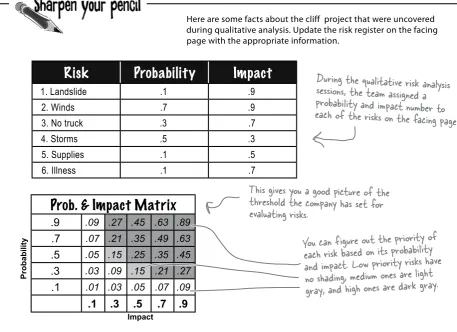
Start with the probability and impact of each risk.
1 1
Risk
Probability
Impact
High winds 35% cost $48 to replace equipment
Mudslide 5% lose $750 in damage costs
Wind generator is usable 15% save $800 in battery costs Truck rental unavailable 10% cost $350 for last-minute rental
Take the first risk and multiply the probability by the impact. For opportunities,
use a positive cost. For threats, use a negative one. Then do the same for the
rest of the risks.
2 2
High winds: 35% x - 48 = - 16.80
Mudslide: 5% x - 750 = - 37.50
Wind generator: 15% x 800 = 120.00
Truck rental: 10% x - 350 = - 35.00
Now that you’ve calculated the EMV for each of the risks, you can add
them up to find the total EMV for all of them.
3 3
EMV = - 16.80 + - 37.50 + 120.00 + - 35.00 = - 30.70
The wind generator risk is an
opportunity because you’ll save
money if it happens. So when you
do the EMV calculation, you use
a positive number for the impact.
Even though the
impact of a mud
slide is big, the
probability is
low so the EMV
is small.
If you add $30.70 to the budget,
then it should be enough to account
for these risks.
You can find these
in your risk register.
ix
table of contents
Table of Contents (Summary)
Intro xxiii
1 Introduction: Why Get Certified? 1
2 Projects, Processes and Projects: How You Do the Job 19 3 The Process Framework: It All Fits Together 43 4 Integration Management: Getting the Job Done 69 5 Scope Management: Doing the Right Stuff 139 6 Time Management: Getting it Done on Time 211 7 Cost Management: Watching the Bottom Line 299 8 Quality Management: Getting it Right 365 9 Human Resource Management: Getting the Team Together 417 10 Communications Management: Getting the Word Out 461 11 Risk Management: Planning for the Unknown 507 12 Procurement Management: Getting Some Help 567 13 Professional Responsibility: Making Good Choices 617 14 A Little Last-Minute Review: Check Your Knowledge 631
Table of Contents (the real thing)
Your brain on PMP.
Here you are trying to learn something, while here your brain is doing you a favor by making sure the learning doesn’t stick. Your brain’s thinking, “Better leave room for more important things, like which wild animals to avoid and whether naked snowboarding is a bad idea.” So how do you trick your brain into thinking that your life depends on knowing enough to get through the PMP exam?Intro
Who is this book for? xxiv
We know what you’re thinking xxv
Metacognition xxvii
Bend your brain into submission xxix
Read me xxx
The technical review team xxxii
table of contents
Why get certified?
1
Tired of facing the same old problems?
If you’ve worked on a lot of projects, you know that you face the same problems, over and over again. It’s time to learn some common solutions to those problems. There’s a whole lot that project managers have learned over the years, and passing the PMP exam is your ticket to putting that wisdom into practice. Get ready to change the way you manage your projects forever.Introduction
Do these problems seem familiar? 2
Projects don’t have to be this way 4
Your problems... already solved 5
Let’s start with the areas of responsibility 12 A PMP certification is more than just passing a test 16 Here’s what happens to a certified PM 17
(Keeping) In good company
If you want something done right… better hope you’re in the
right kind of organization.
All projects are about teamwork—but how your team works depends a lot on the type of organization you’re in. In this chapter, you’ll learn about the different types of organizations around—and which type you should look for the next time you need a new job.Organizations, processes, and projects
A day in Kate’s life 20
Kate wants a new job 21
Three types of organizations 24
Kate takes a new job 29
What a project IS... 30
Back to Kate’s maintenance nightmare 32
Managing cost, quality, scope, and schedule 34
Kate makes some changes… 38
2
The Boss’s delivery date
When the project will actually be done
Scope
Cost Time
xi
table of contents
3
Here’s where you put all the information you need to do your work (like project needs, guides for doing the work—that kind of thing).
All the project work happens here. The tools and techniques take the inputs and turn them into outputs.
All the things you make during your project are outputs— documents, plans, schedules, budgets, and the actual product that you’re building.
It All Fits Together
All of the work you do on a project is made up of processes.
Once you know how all the processes in your project fit together, it’s easy to remember everything you need to know for the PMP exam. There’s a pattern to all of the work that gets done on your project. First you plan it, then you get to work. While you are doing the work, you are always comparing your project to your original plan. When things start to get off-plan, it’s your job to make corrections and put everything back on track. And theprocess framework—the process groups and knowledge areas—is the key to all of this happening smoothly.
The process framework
Cooking up a project 44
Projects are like recipes 46
Break it down 48
Anatomy of a process 51
Combine processes to complete your project 54
Knowledge areas organize the processes 55
The benefits of successful project management 61
Exam Questions 63
ii
table of contents
4
Time to book a trip 70
These clients are definitely not satisfied 72 The day-to-day work of a project manager 73 The seven Integration Management processes 74 Start your project with the Initiating processes 77 Integration management and the process groups 78
The Develop Project Charter process 80
Choose your project with project selection methods 82
A closer look at the project charter 84
Enterprise Environmental Factors and Organizational Process Assets 87 The “Develop Preliminary Scope Statement” process 91 The preliminary scope statement: a closer look 93 Question clinic: The “Just-The-Facts-Ma’am” Question 94 The Develop Project Management Plan process 96 The project management plan lets you plan ahead for problems 97 A quick look at all those subsidiary plans 99 Executing the project includes repairing defects 104 Sometimes you need to change your plans 107
Look for changes and deal with them 108
Make only the changes that are right for your project 109
Changes, defects, and corrections 110
How the processes interact with each other 111 Control your changes: use change control 112
Preventing or correcting problems 114
The Close Project process 116
So why INTEGRATION management? 118
Exam Questions 128
Exam Answers 134
Enterprise
Environmental Factors
Organizational Process Assets
Manage the work so it gets done efficiently.
Monitoring and Controlling
Executing
Direct and manage project eecution Monitor and control project work Integrated change control
Getting the Job Done
Want to make success look easy?
It’s not as hard as you think. In this chapter, you’ll learn about a few processes you can use in your projects every day. Put these into place, and your sponsors and
stakeholders will be happier than ever. Get ready for Integration Management.
xiii
table of contents
5
Updates Project Scope Statement Work Breakdown Structure Project Management PlanDoing the Right Stuff
Confused about eactly what you should be working on?
Once you have a good idea of what needs to be done, you need to track your scope
as the project work is happening. As each goal is accomplished, you confirm that all of the work has been done and make sure that the people who asked for it are satisfied with the result. In this chapter, you’ll learn the tools that help your project team set its goals and keep everybody on track.
scope management
Out of the frying pan... 140
It looks like we have a scope problem 145
The five Scope Management processes 149
The Scope Planning process 151
Inside the scope management plan 153
Define the scope of the project 154
Build on the preliminary scope 155
How do you define the scope? 156
The scope isn’t preliminary anymore 158
Question Clinic: The “Which-is-BEST” Question 162
The Create WBS process 164
Breaking down the work 166
Decompose deliverables into work packages 168
Templates are a useful shortcut 169
Inside the work package 174
The baseline is a snapshot of the plan 176
The outputs of the Create WBS process 178
Why scope changes 181
The Scope Control process 183
Anatomy of a change 184
A closer look at the Change Control System 186 More Scope Control tools & techniques 187
The Scope Verification process 191
The stakeholders decide when the project is done 192
Exam Questions 199
iv
table of contents
6
Getting it Done on Time
Time management is what most people think of when they
think of project managers.
It’s where the deadline is set and met. It starts with figuring out the work you need to do, how you will do it, what resources you’ll use, and how long it will take. From there, it’s all about developing and controlling that schedule.time management
Reality sets in for the happy couple 212
Time management helps with aggressive time lines 214 The Time Management processes [time magnets solution] 216
The Activity Definition process 219
Rolling wave planning lets you plan as you go 220
Activity Definition Outputs 223
The Activity Sequencing process 225
Diagram the relationship between activities 226
More tools for sequencing 230
Leads and lags 231
Create the network diagram 233
Rob and Rebecca have resource problems 234
The Activity Resource Estimation process 235
[image:12.588.135.517.195.622.2]Estimating the resources 236
Figuring out how long the project will take 238
Estimation tools and techiques 241
The Activity Duration Estimating process 242
The Schedule Development process 244
Question Clinic: The “Which-Comes-Next” Question 246 Use the Critical Path method to avoid big problems 249 How to find the critical path: Using the Critical Path Method 250
Crash the schedule 266
Fast-tracking the project 267
Influence the factors that cause change 274
The Schedule Control process 275
Measuring and Reporting Performance 277
Exam Questions 289
Exam Answers 294
If the caterers come too early, the food will sit around under heat lamps! But too late and the band won’t have time to play. I just don’t see how we’ll
ever work this all out!
xv
table of contents
7
Watching the Bottom Line
Every project boils down to money.
If you had a bigger budget, you could probably get more people to do your project more quickly and deliver more. That’s why no project plan is complete until you come up with a budget. But no matter whether your project is big or small, and no matter how many resources and activities are in it, the process for figuring out the bottom line is always the same!cost management
Time to expand the Head First Lounge 300
Introducing the Cost Management processes 303
The Cost Estimation process 304
Tools and techniques used only in Cost Estimation 307
Let’s talk numbers 308
The Cost Budgeting process 310
What you need to build your budget 311
Cost Budgeting: How to build a budget 312
The Cost Control process 318
A few new tools and techniques 321
Question Clinic: The Red Herring 322
Earned value tells you how you’re doing 324 Look at your schedule to figure out your budget 325
How to calculate planned value (PV) 326
How to calculate earned value (EV) 328
Put yourself in someone else’s shoes 330
Is your project behind or ahead of schedule? (SV and SPI) 332
Are you over budget? (CV and CPI) 334
The Performance Measurement Analysis formulas 335 Interpret CPI and SPI numbers to gauge your project 338 Forecast what your project will look like when it’s done 340 Once you’ve got an estimate, you can calculate a variance!
(EAC, ETC and VAC) 341
Finding Missing Information 344
Exam Questions 354
Exam Answers 359
$
$
$
vi
table of contents
8
Getting It Right
It’s not enough to make sure you get it done on time and under
budget.
You need to be sure you make the right product to suit your stakeholders’ needs. Quality means making sure that you build what you said you would and that you do it as efficiently as you can. That means trying not to make too many mistakes and always keeping your project working toward the goal of creating the right product!quality management
What is quality? 366
You need more than just tests to figure out quality 367 Once you know what the product is supposed to do, it’s easy to tell which tests
pass and which fail 368
Quality up close 369
“An ounce of prevention...” 372
The Quality Planning process 375
How to plan for quality 376
The quality management plan gives you what you need to manage
quality 378
The Perform Quality Control process 381
Use the planning outputs for Perform Quality Control 382
The seven basic tools of quality 383
Pareto charts, flowcharts and histograms 384
Run charts and scatter charts 385
Question Clinic: The “Which-One” Question 390 Quality control means finding and correcting defects 392
Trouble at the Black Box 3000™ factory 395
The Perform Quality Assurance process 396
A closer look at some tools and techniques 397
More ideas behind quality assurance 398
Exam Questions 408
Exam Answers 412
The Black Box 3000
TM.
Lisa also inspected the
blue prints for the black
box when they were
designed.
She looked
for defects
in the parts
as they were
xvii
table of contents
9
Getting the Team Together
Behind every successful project is a great team.
So how do you make sure that you get—and keep—the best possible team for your project? You need to plan carefully, set up a good working environment, and negotiate for the best people you can find. But it’s not enough to put a good team together… If you want your project to go well, you’ve got to keep the team motivated and deal with any conflicts that happen along the way. Human resource management gives you the tools you need to get the best team for the job and lead them through a successful project.human resource management
Mike needs a new team 418
The Human Resource Management processes 420
The Human Resoucre Planning process 422
The staffing management plan 426
The Acquire Project Team process 428
The Develop Project Team process 432
Develop the team with your management skills 433 Lead the team with your management skills 434 Motivate your team [theories of motivation] 436
How’s the team doing? 438
The Manage Project Team process 440
Conflict management up close 441
How to resolve a conflict 442
Question Clinic: The “Have-a-Meeting” Question 448
Exam Questions 454
Exam Answers 458
Staffing
viii
table of contents
10
Getting the Word Out
Communications management is about keeping everybody
in the loop.
Have you ever tried talking to someone in a really loud, crowded room? That’s what running a project is like if you don’t do get a handle on communications. Luckily, there’s Communications Management, which is how to get everyone talking about the work that’s being done, so that they all stay on the same page. That way everyone has the information they need to resolve any issues and keep the project moving forward.communications management
Party at the Head First Lounge! 462
Anatomy of a phone call 464
The Communications Management processes 466 The Communications Planning process [exercise solutions] 470
The Information Distribution process 472
Get the message? 474
More information distribution tools 476
The Performance Reporting process 479
Take a close look at the work being done 480
Now you can get the word out 483
People aren’t talking 485
The Manage Stakeholders process [exercise solutions] 488
Count the lines of communication 490
Question Clinic: The Calculation Question 494
Exam Questions 500
Exam Answers 503
When there are
three people
on the project,
there are
three lines of
communication
But add three more people
to the project, and you
add a LOT of potential
communication to the project!
How do you get a handle on it?
Don’t forget to count
xix
table of contents
11
Planning for the Unknown
risk management
What’s a risk? 508
How you deal with risk 509
The Risk Management Planning process 510
Use a risk breakdown structure to categorize risks 512 Anatomy of a Risk [the Risk Management processes] 514
The Risk Identification process 516
Information gathering techniques for Risk Identification 517
More risk identification techniques 518
Where to look for risks 520
Now put it in the risk register 521
The Qualitative Risk Analysis process 522 Examine each risk in the risk register 523
Qualitative vs. quantitative analysis 528
The Quantitative Risk Analysis process 529 First gather the data... then analyze it 530 Calculate the Expected Monetary Value of your risks (EMV) 532 Decsion tree analysis uses EMV to help you make choices 534 Update the risk register based on your quantitative analysis results 536
The Risk Response Planning process 538
You can’t plan for every risk at the start of the project 543 The Risk Monitoring and Controlling process 546 Question Clinic” The “Which-os-NOT” Question 552
Exam Questions 557
Exam Answers 562
Even the most carefully planned project can run into trouble.
No matter how well you plan, your project can always run into unexpected problems. Team members get sick or quit, resources that you were depending on turn out to be
table of contents
12
Getting Some Help
procurement management
Victim of her own success 568
Calling in the cavalry 569
The Procurement Management processes 574
The Plan Purchases and Acquisitions process 575
The decision is made 581
Types of contracts 582
More about contracts 585
[image:18.588.59.536.189.626.2]The Plan Contracting process 586
Figure out how you’ll sort out potential sellers 588
The Request Seller Responses process 590
The Select Sellers process 592
Two months later... 598
The Contract Administration process 599
Stay on top of the seller 600
Close the contract when the work is done 604
Question Clinic: BYO Questions 607
Exam Questions 611
Exam Answers 614
Contract
Closed Contracts
Some jobs are just too big for your company to do on its own.
Even when the job isn’t too big, it may just be that you don’t have the expertise or equipment to do it. When that happens, you need to use Procurement Management to find another company to do the work for you. If you find the right seller, choose the right kind of relationship, and make sure that the goals of the contract are met, you’ll get the job done and your project will be a success.
xxi
table of contents
13
Making Good Choices
It’s not enough to just know your stuff. You need to
make good choices to be good at your job.
Everyone who has the PMP credential agrees to follow the PMP Code of Professional Conduct, too. The Code helps you with ethical decisions that aren’t really covered in the body of knowledge—and it’s a big part of the exam. Most of what you need to know is really straightforward, and with a little review, you’ll do well.professional responsibility
Doing the right thing 618
Keep the cash? 620
Fly business? 621
New software 622
Shortcuts 623
A good price or a clean river? 624
We’re not all angels 625
Exam Questions 626
Exam Answers 628
ii
table of contents
14
Check Your Knowledge
a little last-minute review
Process Magnets 632
Processcross 634
Exercise 636
Sharpen Your Pencil 637
Great job! It looks like you’re almost ready. 638
1 2 3 4
5 6 7 8 9 10
11 12 13 14 15
16 17
18 19 20
21 22
23 2425 26 27 28
29
30 31
32 33 3435 36 37 38 39 40 41 42 43 44 45 46 47 48 49 50 51 52 53 54 55 56 57 Across
2. In the ___________ Risk Analysis process, you assign numerical values to your risks in order to more accurately assess them. 4. In the Plan _________ and Acquisitions process, you decide what work you'll want to contract out to a seller. 6. The ___________ process group is where the team does the project work.
Down
1. The __________ and Controlling process group is concerned with finding and dealing with changes.
2. The _____________ Risk Analysis process is where you categorize each risk. 3. The Close __________ process is where you make sure all your procurement activities are finished.
Wow, you sure covered a lot of ground in the last
13 chapters!
Now it’s time to take a look back and drill in some ofthe most important stuff that you learned. So let’s go back and cover some of the hardest stuff in the book. That’ll keep it all fresh, and give your brain a final workout for exam day!