Pattern-Oriented Software Architecture, Patterns for Concurrent and
Networked Objects, Volume 2
by Douglas Schmidt, Michael Stal, Hans Rohnert and Frank Buschmann
ISBN: 0471606952
John Wiley & Sons
© 2000 (633 pages)Table of Contents
Pattern-Oriented Software Architecture—Patterns for
Concurrent and Networked Objects, Volume 2
Foreword
About this Book
Guide to the Reader
Chapter 1
- Concurrent and Networked Objects
Chapter 2
- Service Access and Configuration Patterns
Chapter 3
- Event Handling Patterns
Chapter 4
- Synchronization Patterns
Chapter 5
- Concurrency Patterns
Chapter 6
- Weaving the Patterns Together
Chapter 7
- The Past, Present, and Future of Patterns
Chapter 8
- Concluding Remarks
Glossary
Notations
References
Index of Patterns
Index
Pattern-Oriented Software
Architecture—Patterns for
Concurrent and Networked Objects,
Volume 2
Douglas Schmidt
University of California, Irvine
Michael Stal
Siemens AG, Corporate Technology
Hans Rohnert
Siemens AG, Germany
Frank Buschmann
Siemens AG, Corporate Technology
John Wiley & Sons, Ltd
Chichester · New York · Weinheim · Brisbane · Singapore · Toronto
Copyright © 2000 by John Wiley & Sons, Ltd
Baffins Lane, Chichester,
West Sussex PO19 1UD, England
National 01243 779777
International (+44) 1243 779777
e-mail (for orders and customer service enquiries):
Visit our Home Page on http://www.wiley.co.uk or http://www.wiley.com
Neither the author nor John Wiley & Sons, Ltd accept any responsibility or liability for loss or damage occasioned to any person or property through using the material, instructions, methods or ideas contained herein, or acting or refraining from acting as a result of such use. The author and publisher expressly disclaim all implied warranties, including merchantability or fitness for any particular purpose.
Designations used by companies to distinguish their products are often claimed as
trademarks. In all instances where John Wiley & Sons, Ltd is aware of a claim, the product names appear in initial capital or all capital letters. Readers, however, should contact the appropriate companies for more complete information regarding trademarks and registration.
Other Wiley Editorial Offices
John Wiley & Sons, Inc., 605 Third Avenue,
New York, NY 10158-0012, USA
Weinheim • Brisbane • Singapore • Toronto
British Library Cataloguing in Publication Data
A catalogue record for this book is available from the British Library. ISBN 0-471-60695-2
For Sonja, Mom, and Dad
Douglas C. Schmidt
For Gisela
Michael Stal
For Regine, Anja, Sandro, and Nicolas
Hans Rohnert
For Bebé[1]and Martina
Frank Buschmann
About The Authors
Douglas C. Schmidt
Dr. Douglas Schmidt is an Associate Professor in the Electrical and Computer Engineering department at the University of California, Irvine, USA. He is also serving as a Program Manager in the Information Technology Office (ITO) at DARPA, leading the national research effort on middleware. Before this he was an Associate Professor and Director of the Center for Distributed Object Computing in the Department of Computer Science at Washington University in St. Louis, Missouri. His research focuses on design patterns, optimization principles, and empirical analyses of object-oriented techniques that facilitate the development of high-performance and real-time distributed object computing middleware running over high-speed networks and embedded system interconnects.
Doug is an internationally-recognized expert on distributed object computing patterns, middleware frameworks, real-time CORBA, and open-source development. He has
Report magazine for several years and has co-edited several popular books on patterns [PLoPD1] and frameworks [FJS99a] [FJS99b]. In addition to his academic research, Doug has led the development of ACE and TAO, which are widely-used open-source middleware frameworks that contain a rich set of reusable components implemented using the patterns presented in this book.
In his 'spare' time, he enjoys ballroom dancing with his wife Sonja, weight-lifting, guitar playing, world history, and Chevrolet Corvettes.
Michael Stal
Michael Stal joined the Corporate Technology department of Siemens AG in Munich, Germany in 1991. In his previous work he gained extensive experience developing software for compilers and computer graphics. He worked on runtime type information for C++ and served on the C++ standardization group X3J16. Since 1992 Michael's work has focused on the development of concurrent and distributed object-oriented systems using Sockets, CORBA, COM, and Java. Michael is Siemens' primary contact on CORBA at the OMG and is head of the Distributed Object Computing Group at Siemens's Corporate Technology department. He co-authored the first POSA volume A System of Patterns.
Michael's main research interests focus on methods for developing distributed systems efficiently and on patterns for describing the architecture of middleware platforms. In this context he has published articles in many magazines and given talks at many conferences. In addition, he is Editor-in-Chief of Java Spektrum, the major German magazine on the Java platform, as well as a columnist and member of the advisory board for Objektspektrum, the major German magazine on object technology.
In his spare time Michael attends soccer matches, supports his favorite team Bayern München, visits Munich beer gardens, tries to prevent his cats from destroying his
apartment, watches movies, and reads books on physics, philosophy and humor. He is fan of Douglas Adams, Scott Adams, and Terry Pratchett.
Hans Rohnert
Dr. Hans Rohnert is a Senior Software Engineer at the Communication Devices business unit of Siemens AG in Munich, Germany. His primary aims are exploiting promising software technologies and introducing them into new products, such as next-generation mobile phones. His professional interests are software architecture, design patterns, and real-world programming. He has presented numerous talks on subjects ranging from dynamic graph algorithms to embedded Java virtual machines.
Hans is currently a member of the expert groups defining the small footprint KVM Java virtual machine and its libraries for use in small devices. His programming projects have included server-side modules for embedded servers, work flow in C++, base support for ATM switching, Java GUI front-ends for CORBA clients, and HTTP clients. He is also a co-author of the first POSA volume A System of Patterns and a co-editor of the fourth book in the PLoPD series [PLoPD4]. As a graduate student he performed original research on combinatorial algorithms, publishing and lecturing on them early in his career.
Hans is an ambitious tennis player, with more matches lost than won. He also enjoys exploring the nearby mountains, rock-climbing, and cross-country skiing. His most important 'hobby', however, is his family, most notably a new baby born during the hectic final phase of writing this book.
Frank Buschmann is Principal Senior Software Engineer at Siemens Corporate Technology in Munich, Germany. His research interests include object technology, software architecture, frameworks, and patterns. He has published widely in all these areas, most visibly in his co-authorship of the first POSA volume A System of Patterns. Frank was a member of the ANSI C++ standardization committee X3J16 from 1992 to 1996. Frank initiated and organized the first conference on patterns held in Europe, EuroPLoP 1996, and is also a co-editor of the third book in the PLoPD series [PLoPD3]. In his development work Frank has led design and implementation efforts for several large-scale industrial software projects, including business information, industrial automation, and telecommunication systems.
When not at work Frank spends most of his time enjoying life with his wife Martina, watching the time go by in Munich beer gardens, having fun biking, skiing, and horse-riding, getting excited when watching his favorite soccer team Borussia Dortmund, dreaming when listening to a performance at the Munich opera, and relaxing with rare Scotch single malts before bedtime.
This book has been written by the award-winning team responsible for the first POSA
volume A System of Patterns, joined in this volume by Douglas C. Schmidt from University of California, Irvine (UCI), USA.
[1]
Pattern-Oriented Software Architecture—Patterns for Concurrent and Networked
Objects, Volume 2
... 3
Foreword
... 10
About this Book
... 12
Intended Audience
... 13
Structure and Content
... 13
Acknowledgments
... 14
Guide to the Reader
... 17
Introduction to Patterns
... 17
Structure and Content
... 17
Pattern Form
... 18
Background Reading
... 19
Chapter 1: Concurrent and Networked Objects
... 20
Overview
... 20
1.1 Motivation
... 20
1.2 Challenges of Concurrent and Networked Software
... 22
Challenge 1: Service Access and Configuration
... 24
Challenge 2: Event Handling
... 27
Challenge 3: Concurrency
... 29
Challenge 4: Synchronization
... 31
Other Challenges for Networked Software
... 32
1.3 A Case Study: Designing a Concurrent Web Server
... 33
Overview of the JAWS Framework
... 35
Applying Patterns to Resolve Common Design Challenges in JAWS
... 36
Encapsulating Low-level Operating System APIs
... 36
Decoupling Event Demultiplexing and Connection Management from
Protocol Processing
... 37
Scaling Up Server Performance via Multi-threading
... 38
Implementing a Synchronized Request Queue
... 40
Minimizing Server Threading Overhead
... 40
Leveraging Asynchronous I/O Effectively
... 42
Enhancing Server Configurability
... 44
Other Patterns Used to Implement JAWS
... 45
1.4 Wrapping Up
... 46
Chapter 2: Service Access and Configuration Patterns
... 47
Overview
... 47
Wrapper Facade
... 48
Example
... 48
Problem
... 52
Component Configurator
... 76
Interceptor
... 101
Extension Interface
... 125
Chapter 3: Event Handling Patterns
... 153
Overview
... 153
Reactor
... 154
Proactor
... 181
Asynchronous Completion Token
... 218
Acceptor-Connector
... 235
Chapter 4: Synchronization Patterns
... 268
Overview
... 268
Scoped Locking
... 268
Strategized Locking
... 276
Thread-Safe Interface
... 287
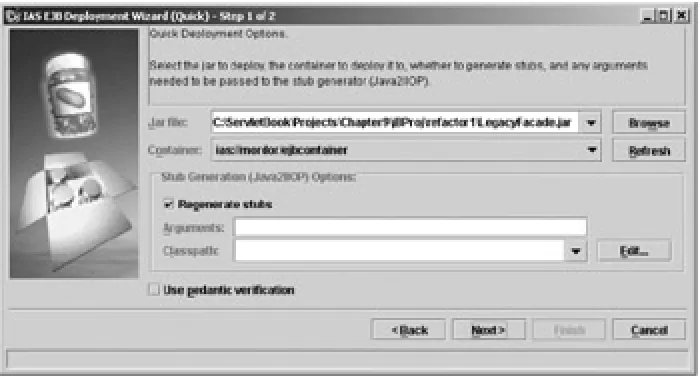
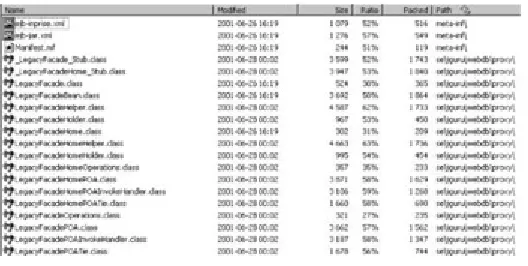
The LegacyFacade EJB Component Deployment Descriptor
... 293
Deployment Descriptors for the EJB 2.0 Specification
... 294
Deployment Descriptors for the EJB 1.1 Specification
... 300
Deploying the EJB JAR into the Application Server
... 305
Double-Checked Locking Optimization
... 306
Chapter 5: Concurrency Patterns
... 317
Overview
... 317
Active Object
... 318
Monitor Object
... 343
Half-Sync/Half-Async
... 363
Leader/Followers
... 379
Thread-Specific Storage
... 400
Chapter 6: Weaving the Patterns Together
... 426
6.1 From Individual Patterns to Pattern Languages
... 426
No Pattern is an Island
... 426
Towards Pattern Languages
... 427
6.2 A Pattern Language for Middleware and Applications
... 428
The Pattern Language in Detail
... 429
A Discussion of the Pattern Language
... 435
6.3 Beyond Concurrency and Networking
... 436
Graphical User Interfaces
... 436
Components
... 437
General Programming
... 437
6.4 Pattern Languages versus Pattern Systems
... 437
7.1 What Has Happened in the Past Four Years
... 441
Patterns
... 441
Pattern Systems and Pattern Languages
... 442
Methods and Tools
... 442
Algorithms and Data Structures
... 443
Formalizing Patterns
... 443
7.2 Where Patterns are Now
... 443
7.3 Where Patterns are Going
... 444
Patterns
... 444
Pattern Languages
... 446
Experience Reports, Methods, and Tools
... 447
Pattern Documentation
... 447
Formalizing Patterns and Pattern Languages
... 448
Software Development Processes and Organizations
... 448
Education
... 448
Our Long-Term Vision
... 449
7.4 A Parting Thought on Predicting the Future
... 449
Chapter 8: Concluding Remarks
... 451
Notations
... 452
Class-Responsibility-Collaborator Cards
... 452
UML Class Diagrams
... 452
UML Sequence Diagrams
... 454
UML Statechart Diagrams
... 455
Foreword
Middleware is the set of services, protocols, and support utilities providing the 'plumbing' that makes modern distributed systems and applications possible—the infrastructure that
underlies web services, distributed objects, collaborative applications, e-commerce systems, and other important platforms. Not long ago, the term middleware was rarely heard, and middleware developers were rarer still. But over the past decade, the term, the research and practice, and its impact have become ubiquitous. Yet, until now, there has not been a book describing how to construct networked and concurrent object-oriented (OO) middleware, so its design has remained something of a black art. This book demystifies middleware construction, replacing the need to have an expert looking over your shoulder with well-reasoned, empirically-guided accounts of common design problems, forces, successful solutions, and consequences.
As is true for most concepts, nailing down the boundaries of middleware is hard.
Conventionally, it consists of the software needed to build systems and applications, yet is not otherwise an intrinsic part of an operating system kernel. But it is not always possible to find middleware where you first look for it: middleware can appear in libraries and
frameworks, operating systems and their add-ons, Java virtual machines and other run-time systems, large-grained software components, and in portions of end-products such as web services themselves.
This book is not a textbook surveying middleware or the types of applications and distributed system architectures you can devise using middleware. It instead presents a pattern
language that captures the design steps leading to the construction of the OO
communication support involved in most middleware. Many of the patterns described in this book also have utility in both higher-level and lower-level systems and applications that are not based directly upon middleware.
This book emphasizes practical solutions over theoretical formalisms. The basic ideas behind many presented patterns are well-known to experienced system developers—for example, dispatching, demultiplexing, callbacks, and configuration—and are sometimes variants of more general OO patterns—for example, proxies, adapters, and facades. This book's main contribution centers on in-depth engineering solutions based upon these ideas. Middleware developers must resolve a wide range of forces including throughput,
responsiveness, dependability, interoperability, portability, extensibility, and accommodating legacy software. The diversity and severity of these forces accounts for the complexity of middleware patterns, as opposed to those seen in smaller-scale OO applications and concurrent programming.
The multitude of such forces, combined with years of engineering experience, often lead to a multitude of design considerations and engineering trade-offs separating an idea from its expression in middleware frameworks. The pattern description format used in this book helps to simplify this process by presenting solutions as series of concrete design steps. Many of these steps in turn invoke additional patterns. Together they form a pattern language, enabling developers to traverse from pattern to pattern while designing services and applications.
As mentioned by the authors, some of the ideas and techniques discussed in this book are complementary to those seen for example in W. Richard Stevens's pioneering books (e.g., [Ste98]) on network programming. The main point of departure is the unrelenting focus on higher-level design issues. Rather than, for example, discussing the ins and outs of the Unix
One of the implicit themes of this book is how to apply the bits and pieces of functionality dealing with I/O, threading, synchronization, and event demultiplexing offered by
contemporary platforms as the foundation for constructing higher-level frameworks and components. The primary emphasis on C/C++ on Unix and Microsoft operating systems does not detract from this theme. For example, Java programmers will find a few minor disconnects in cases where Java already directly implements some of the patterns
discussed in this book, for example, Scoped Locking, or provides frameworks structured in accord with particular implementations of patterns, such as the JavaBeans framework's support of configurable components, as well as a few where Java lacks access to underlying system mechanisms, such as synchronous event demultiplexing.
However, readers most familiar with Java, Smalltalk, and other OO programming languages will still profit from the central ideas conveyed by the patterns, can better appreciate how and why some became directly supported in language features and libraries, and will be able to construct useful components based upon other patterns. As an example, until the advent of
java.nio, Java did not provide access to system constructs useful for asynchronous I/O. However, after referring to a description of the Proactor pattern described in this book, I once put together a Java version that simulated the demultiplexing step via a simple spin-loop thread that checked for I/O availability across multiple channels. This was less efficient, but was perfectly adequate within its intended usage context.
Over the years, some of the accounts in this book, such as Reactor, have evolved from descriptions of design inventions to design patterns. Everyone constructing portable OO middleware has written or used at least one Wrapper Facade. But early presentations of several other patterns now contained in this book also discussed novel contributions about their design. It was at first a bit uncertain whether such descriptions should be considered as patterns, which must be time-proven, independently (re)discovered solutions. However, over time, the authors and the OO middleware community have become more and more
confident that the patterns in this book do indeed capture the essence of key forces and design issues, and have witnessed the described solutions being used over and over again across diverse usage contexts.
I invite you to share in this phenomenon. By reading—and especially, using—the material in this book, you'll see why pattern names such as Reactor and Proactor have become as common among OO middleware developers as have Decorator and Observer among OO GUI developers.
Doug Lea
About this Book
Patterns have taken the software development community by storm. Software developers have been enthusiastic about patterns ever since the seminal work Design Patterns - Elements of Reusable Object-Oriented Software [GoF95]. Its successors, such as the Pattern Languages of Programming Design (PLoPD) series [PLoPD1] [PLoPD2] [PLoPD3] [PLoPD4] and A System of Patterns [POSA1][1] have further fanned the burning interest in patterns kindled originally by earlier work on software idioms [Cope92], patterns for building architectures [Ale79] [AIS77], and patterns for cultural anthropology [Bat97].
This book, Patterns for Concurrent and Networked Objects, is the second volume in the Pattern-Oriented Software Architecture (POSA) series. Like its predecessor, A System of Patterns [POSA1], it documents patterns and best practices that represent concrete, well-proven and useful techniques for building industrial-strength software systems. These patterns and best practices can and have been applied to applications in a wide range of domains, including telecommunications and data communications, financial services, medical engineering, aerospace, manufacturing process control, and scientific computing. They also form the basis of popular distributed object computing middleware, such as CORBA [OMG98c], COM+ [Box97], Java RMI [WRW96], and Jini [Sun99a].
Moreover, all the patterns in this book build on the same solid conceptual foundation as those in the first POSA volume. For example, we use the same pattern categorization schema, the same pattern description format, and present examples and known uses in multiple programming languages, including C++, Java, and C.
Patterns for Concurrent and Networked Objects thus follows the same philosophy and path as A System of Patterns and has the same 'look and feel'.
In contrast to A System of Patterns, however, which covered a broad spectrum of general-purpose patterns, this book has a more specific focus: concurrency and networking. All the patterns in this book center on these two areas, allowing us to discuss many topics related to concurrency and networking in more depth than would be possible if the book contained patterns from many unrelated domains. The patterns in this book therefore complement the general-purpose patterns from A System of Patterns in these increasingly important areas of software development.
Yet we focus on general, domain-independent patterns for concurrent and networked applications and middleware. Our goal is to increase the likelihood that the patterns in this book will help projects in your daily work. Therefore, we do not cover patterns in this book that are specific to a particular application domain, such as those in [DeBr95] [Mes96] [ACGH+96], which address networking aspects that pertain to the telecommunication domain.
By focusing on general domain-independent patterns for concurrency and networking, this book also complements existing literature in concurrent network programming and object-oriented design:
§ Literature on concurrent network programming generally focuses on the syntax and semantics of operating system APIs, such as Sockets [Ste98], POSIX Pthreads [Lew95], or Win32 threads [Ric97], that mediate access to kernel-level communication frameworks, such as System V STREAMS [Ris98] [Rago93], available on popular operating systems. In contrast, this book describes how to use these APIs effectively in the design and programming of high-quality concurrent and networked systems.
Another way in which Patterns for Concurrent and Distributed Objects differs from A System of Patterns is that its patterns constitute more than just a catalog or system of patterns. Instead, they augment each other synergistically, providing the foundation of a pattern language for concurrent and networked software. When combined with patterns from other patterns literature, we describe how this pattern language can and has been used to build sophisticated concurrent and networked software systems and applications, web services, and distributed object computing middleware, as well as the underlying operating system networking protocols and mechanisms.
Yet we separate the description of the individual patterns from the discussion of how they form a pattern language. The patterns themselves are first described in a self-contained manner, so that they can be applied in the context that is most useful. A subsequent chapter then describes how the patterns interact and how they are complemented by other patterns.
It is important to note, however, that many patterns in this book can be applied outside the context of concurrency and networking. To illustrate the breadth of their applicability we present known uses from other domains, such as component-based or interactive software systems. In addition, we give examples of how these patterns apply to situations
experienced in everyday life.
Some patterns may be familiar, because preliminary versions of them were published in the PLoP book series [PLoPD1] [PLoPD2] [PLoPD3] [PLoPD4], and the C++ Report magazine. In this book, however, we have improved upon the earlier versions considerably:
§ This is the first time they have been woven into a single document, which helps to emphasize the pattern language they express.
§ We have rewritten and revised these patterns substantially based on many
suggestions for improvement we received at conferences and workshops, via e-mail, as well as from intensive internal reviewing and reviews provided by our shepherds.
§ The patterns have been converted to the POSA pattern format and have a consistent writing style.
Intended Audience
Like our earlier book A System of Patterns, this volume is intended for professional software developers, particularly those who are building concurrent and networked systems. It helps these software professionals to think about software architecture in a new way and supports them in the design and programming of large-scale and complex middleware and
applications.
This book is also suitable for advanced undergraduates or graduate students who have a solid grasp of networking and operating systems, and who want to learn the core principles, patterns, and techniques needed to design and implement such systems effectively.
[1]
We reference A System of Patterns as [POSA1] rather than by author. The same is true for this book, which we reference as [POSA2]. We use this convention to avoid a particular POSA volume being associated with a single author in reader's minds, in particular the first name on the book's cover.
Structure and Content
The first chapter, Concurrent and Networked Objects, presents an overview of the
challenges facing developers of concurrent and networked object-oriented applications and middleware. We use a real example, a concurrent Web server, to illustrate key aspects of these domains, including service access and configuration, event handling, synchronization, and concurrency.
Chapters 2 through 5 form the main part of the book. They contain patterns, the 'real things' [U2], that codify well-established principles and techniques for developing high-quality concurrent and networked systems. We hope these patterns will be useful role models for developing your own concurrent and networked applications, and for documenting patterns that you discover.
Chapter 6, Weaving the Patterns Together, discusses how the patterns in Chapters 2 through 5 are interconnected. We also show how they can be connected with other patterns in the literature to form a pattern language for concurrent networked systems and
middleware. As mentioned earlier, some patterns are also applicable outside the context of concurrent and networked systems. For these patterns we summarize the scope of their applicability.
Chapter 7, The Past, Present, and Future of Patterns, revisits our 1996 forecast on 'where patterns will go', published in the first volume of the Pattern-Oriented Software Architecture series. We discuss the directions that patterns actually took during the past four years and analyze where patterns and the patterns community are now. Based on this retrospection, we revise our vision about future research and the application of patterns and pattern languages.
The book ends with a general reflection on the patterns we present, a glossary of frequently used terms, an appendix of notations, an extensive list of references to work in the field, a pattern index, a general subject index, and an index of names that lists all persons who helped us shaping this book
Supplementary material related to this book is available on-line at
http://www.posa.uci.edu/. This URL also contains links to the ACE and TAO source code that contains C++ and some Java examples for all the patterns in this book.
There are undoubtedly aspects of concurrent and networked object systems that we have omitted, or which will emerge over time when applying and extending our pattern language in practice. If you have comments, constructive criticism, or suggestions for improving the style and content of this book, please send them to us via electronic mail to
<[email protected]>. We also welcome public discussion of our entire work on patterns. Please use our mailing list, <[email protected]>, to send us feedback, comments, and suggestions. Guidelines for subscription can be found on the patterns home page. Its URL is http://hillside.net/patterns/. This link also provides an important source of information on many aspects of patterns, such as available and forthcoming books, conferences on patterns, papers on patterns, and so on.
Acknowledgments
It is a pleasure for us to thank the many people who supported us in creating this book, either by sharing their knowledge with us or by reviewing earlier drafts of its parts and providing useful feedback.
colleagues. They spent much of their valuable time helping to review the manuscript in the countless writer's workshops we ran, thus helping us to polish and shape the final content of this book. Similarly, we are grateful to members of the Distributed Object Computing (DOC) group—Tim Harrison, Prashant Jain, Carlos O'Ryan, and Irfan Pyarali—who co-authored initial versions of six patterns in this book. Together with the four lead authors, these
researchers form the POSA team at Siemens in Munich, Washington University in St. Louis, and the University of California, Irvine.
We also owe most grateful thanks to Peter Sommerlad, Chris Cleeland, Kevlin Henney, and Paul McKenney, Peter, our shepherd, reviewed all our material in depth, focusing on its correctness, completeness, consistency, and quality. Chris, Kevlin, and Paul, our peer reviewers, provided us with additional detailed feedback. All four contributed significantly to improving Patterns for Concurrent and Networked Objects.
We are also grateful to the Software Architecture Group at University of Illinois at Urbana Champain, including Federico Balaguer, John Brant, Brian Foote, Alejandra Garrido, Peter Hatch, Ralph Johnson, Dragos Manolescu, Brian Marick, Hiroaki Nakamura, Reza Razavi, Don Roberts, Les Tyrrell, Joseph W. Yoder, Wanghong Yuan, Weerasak Witthawaskul, and Bosko Zivaljevic, who ran writer's workshops on many POSA2 patterns. They sent
comments that helped us improve the correctness and comprehensibility of the book.
Many others from around the world provided feedback on earlier versions of the book, including Giorgio Angiolini, Brad Appleton, Paul Asman, David Barkken, John Basrai, Joe Bergin, Rainer Blome, Don Box, Martina Buschmann, Tom Cargill, Chuck and Lorrie Cranor, James O. Coplien, Ward Cunningham, Gisela Ebner, Ed Fernandez, Erich Gamma, Sonja Gary, Luciano Gerber, Bob Hanmer, Neil Harrison, Michi Henning, David Holmes, Tom Jordan, Fabio Kon, Bob Laferriere, Greg Lavender, Doug Lea, John MacMillan, Mittal Monani, Duane Murphy, Jaco van der Merwe, Michael Ogg, Bill Pugh, Dirk Riehle, Linda Rising, Wolfgang Schroeder, Richard Toren, Siva Vaddepuri, John Vlissides, Roger Whitney, and Uwe Zdun. The Credits section of our patterns outline how their valuable contributions helped us polish this book.
We are also heavily indebted to all members, past and present, of the DOC group at Washington University in St. Louis, the University of California, Irvine, Object Computing Inc., and Riverace, who reified, refined, and optimized all the patterns presented in this book into components and frameworks in the ACE and TAO middleware projects. This
inspirational group includes Everett Anderson, Alex Arulanthu, Shawn Atkins, Darrell Brunsch, Luther Baker, Matt Braun, Chris Cleeland, Angelo Corsaro, Sergio Flores-Gaitan, Chris Gill, Pradeep Gore, Andy Gokhale, Priyanka Gontla, Myrna Harbison, Tim Harrison, Shawn Hannan, John Heitmann, Joe Hoffert, James Hu, Steve Huston, Prashant Jain, Vishal Kachroo, Ray Klefstad, Yamuna Krishnamurthy, Michael Kircher, Fred Kuhns, David Levine, Ebrahim Moshiri, Michael Moran, Sumedh Mungee, Bala Natarjan, Ossama Othman, Jeff Parsons, Kirthika Parameswaran, Krish Pathayapura, Irfan Pyarali, Carlos O'Ryan, Malcolm Spence, Marina Spivak, Naga Surendran, Selcuk Uelker, Nanbor Wang, Seth Widoff, and Torben Worm. We would also like to acknowledge the substantial contribution of the thousands of ACE and TAO users around the world who have applied and enhanced the patterns and framework components described in this book over the past decade. Without their support, constant feedback, and encouragement we would never have written this book.
We are also grateful for the support from colleagues and sponsors of our research on patterns and the ACE and TAO middleware frameworks, notably the contributions of Ron Akers (Motorola), Al Aho (Lucent), Steve Bachinsky (SAIC), Detlef Becker (Siemens), Jim Blaine (Washington University), John Buttitto (Motorola), Becky Callison (Boeing), Wei Chiang (Nokia), Russ Claus (NASA), Joe Cross (Lockheed Martin), Bryan Doerr (Boeing), Karlheinz Dorn (Siemens), Sylvester Fernandez (Lockheed Martin), Andreas Geisler (Siemens), Helen Gill (DARPA), Trey Grubbs (Raytheon), Jody Hagins (ATD), Andy Harvey (Cisco), Thomas Heimke (Siemens), Kalai Kalaichelvan (Nortel), Arvind Kaushal (Motorola), Steve Kay (Tellabs), Chandra Kintala (Lucent), Gary Koob (DARPA), Sean Landis
(Motorola), Rick Lett (Sprint), Joe Loyall (BBN), Mike Masters (NSWC), Ed Mays (US Marine Corps), John Mellby (Raytheon), Dave Meyer (Virtual Technology), Eileen Miller (Lucent), Stan Moyer (Telcordia), Russ Noseworthy (Object Sciences), Guru Parulkar (Cisco), Dan Paulish (Siemens), James Plamondon (Microsoft), Dieter Quehl (Siemens), Lucie Robillard (US Air Force), Allyn Romanow (Cisco), Rick Schantz (BBN), Steve Shaffer (Kodak), Dave Sharp (Boeing), Naval Sodha (Ericsson), Brian Stacey (Nortel), Paul Stephenson (Ericsson), Umar Syyid (Hughes), Dave Thomas (OTI), Lothar Werzinger (Krones), Shalini Yajnik (Lucent), and Tom Ziomek (Motorola).
Very special thanks go to Steve Rickaby, our copy editor, for enhancing our written material. In addition, we thank our editor, Gaynor Redvers-Mutton, and everyone else at John Wiley & Sons who made it possible to publish this book. This is the second book fostered by Gaynor and Steve. Their support has been superb and we look forward to working with them on forthcoming POSA volumes.
Guide to the Reader
"Cheshire-Puss will you tell me, please, which way I ought to go from here?"
"That depends a good deal on where you want to get to," said the Cat.
"I don't much care where—," said Alice.
"Then it doesn't matter which way you go," said that cat.
"—so long as I get somewhere" Alice added as an explanation.
"Oh, you're sure to do that," said the Cat, "if you only walk long enough."
Louis Carroll, "Alice in Wonderland"
This book is structured so you can read it cover-to-cover. If you know where you want to get to, however, you may want to choose your own route through the book. In this case, the following hints can help you decide which topics to focus upon and the order in which to read them.
Introduction to Patterns
If this book is your initial exposure to patterns, we suggest you first read the introduction to patterns in [POSA1] and [GoF95], which explore the concepts and terminology related to patterns for software architectures and designs. In particular, all the patterns presented in this book build upon the conceptual foundation for patterns specified in [POSA1]:
§ The definition of patterns for software architectures
§ The categorization of these patterns into architectural patterns, design patterns, and idioms[1] and
§ The pattern description format
Moreover, the implementations of many patterns in this book are enhanced by using patterns from [POSA1] and [GoF95]. To guide the application of the patterns in production software development projects we therefore suggest you keep all three books handy.
[1]
See the Glossary for a definition of these pattern categories.
Structure and Content
The first chapter in this book, Concurrent and Networked Objects, describes the key challenges of designing concurrent and networked systems. It also outlines the scope and context for the patterns we present. Finally, it presents a case study that applies eight patterns in this book to develop a concurrent Web server.
Sixteen pattern descriptions and one idiom form the main part of this book. We group them into four chapters, corresponding to key problem areas—service access and configuration,
event handling, synchronization and concurrency—in the development of concurrent and networked middleware and applications. The order in which you read this material is up to you. One approach is to read important core patterns first:
§ The Wrapper Facade design pattern (47)[2]
§ The Reactor architectural pattern (179)
§ The Active Object design pattern (369)
The other twelve patterns and one idiom in the book are arranged to minimize forward references. You can read them in any order of course, and we provide page numbers for following references to other patterns within the book. This material completes and
complements the concepts defined by the four patterns listed above and covers a range of issues relevant to designing and implementing concurrent and networked objects effectively.
You can also use this book to find solutions to problems you encounter in your projects. Use the overview of our patterns in Chapter 6, Weaving the Patterns Together, to guide your search, then locate in Chapters 2 through 5 the detailed descriptions of the patterns you select as potential solutions.
No pattern is an island, completely separated from other patterns. Therefore, Chapter 6, Weaving the Patterns Together, also describes how all the patterns in this book can be woven together to form a pattern language for building networked applications and
middleware. If you want an overall perspective of the patterns in this book before delving into the individual patterns, we recommend you skim the pattern language presentation in
Chapter 6 before reading the patterns in Chapters 2 through 5 in depth.
Chapter 7, The Past, Present, and Future of Patterns and Chapter 8, Concluding Remarks complete the main content of this book. The remainder of the book consists of a glossary of technical terms, an overview of the notations used in the figures, references to related work, and an index of patterns, topics, and names.
[2]
We adopt the page number notation introduced by [GoF95]. (47) means that the corresponding pattern description starts on page 47.
Pattern Form
All patterns presented in this book are self-contained, following the [POSA1] pattern form. This form allows us to present both the essence and the key details of a pattern. Our goal is to serve readers who simply want an overview of the pattern's fundamental ideas, as well as those who want to know how the patterns work in depth.
Each section in our pattern form sets the stage for the subsequent section. For instance, the Example section introduces the Context, Problem, and Solution sections, which summarize a pattern's essence. The Solution section foreshadows the Structure and Dynamics section, which then present more detailed information about how a pattern works, preparing readers for the Implementation section.
The Example Resolved, Variants, Known Uses, Consequences and See Also sections complete each pattern description. We include extensive cross-references to help you to understand the relationships between the patterns in this book and other published patterns.
To anchor the presentation of a pattern's implementation activities to production software systems, much of the sample code is influenced by components provided in the ACE framework [Sch97]. If you first want to get an overview of all the patterns you may therefore want to skip over the Implementation sections on your initial pass through the book and come back to them when you need to know a particular pattern's implementation details.
In the diagrams that explain the structure and behavior of our patterns we tried to follow standard UML whenever possible. In few cases, however, UML did not allow us to express ourselves precisely enough. Thus we 'extended' the standard notation slightly, as specified in the Notations chapter.
Background Reading
Many patterns, particularly Reactor (179), Proactor (215), Half-Sync/Half-Async (423), and Leader/Followers (447), assume you are familiar with the following topics:
§ Object-oriented design techniques, such as patterns [GoF95] [POSA1] and idioms [Cope92], UML notation [BRJ98], and the principles of structured programming, specifically encapsulation and modularity [Mey97].
§ Object-oriented programming language features, such as classes [Str97], inheritance and polymorphism [AG98], and parameterized types [Aus98]. Many examples in this book are written in C++, though we present Java known uses for most of the patterns.
§ Systems programming concepts and mechanisms, such as process and thread management [Lew95] [Lea99a] [Ric97], synchronization [Ste98], and interprocess communication [Ste99].
§ Network services and protocols, such as client-server computing [CoSte92] and the Internet protocols [Ste93] [SW94].
Chapter 1: Concurrent and Networked Objects
Overview
"With the exception of music, we have been trained to think of patterns as fixed affairs. It's easier and lazier that way, but, of course, all nonsense. The right way to begin to think of the pattern which connects is to think of a dance of interacting parts, pegged down by various sorts of limits."
Gregory Bateson — Cultural Anthropologist
This chapter introduces topics related to concurrent and networked objects. We first motivate the need for advanced software development techniques in this area. Next, we present an overview of key design challenges faced by developers of concurrent and networked object-oriented applications and middleware. To illustrate how patterns can be applied to resolve these problems, we examine a case study of an object-oriented framework and a high-performance Web server implemented using this framework. In the case study we focus on key patterns presented in this book that help to simplify four important aspects of concurrent and networked applications:
§ Service access and configuration
§ Event handling
§ Synchronization and
§ Concurrency
1.1 Motivation
During the past decade advances in VLSI technology and fiber-optics have increased computer processing power by 3–4 orders of magnitude and network link speeds by 6–7 orders of magnitude. Assuming that these trends continue, by the end of this decade
§ Desktop computer clock speeds will run at ~100 Gigahertz
§ Local area network link speeds will run at ~100 Gigabits/second
§ Wireless link speeds will run at ~100 Megabits/second and
§ The Internet backbone link speeds will run at ~10 Terabits/second
Moreover, there will be billions of interactive and embedded computing and communication devices in operation throughout the world. These powerful computers and networks will be available largely at commodity prices, built mostly with robust common-off-the-shelf (COTS) components, and will inter-operate over an increasingly convergent and pervasive Internet infrastructure.
To maximize the benefit from these advances in hardware technology, the quality and productivity of technologies for developing concurrent and networked middleware and application software must also increase. Historically, hardware has tended to become smaller, faster, and more reliable. It has also become cheaper and more predictable to develop and innovate, as evidenced by 'Moore's Law'. In contrast, concurrent and networked software has often grown larger, slower, and more error-prone. It has also become very expensive and time-consuming to develop, validate, maintain, and enhance.
§ Inherent and accidental complexities. There are vexing problems with concurrent and networked software that result from inherent and accidental complexities. Inherent complexities arise from fundamental domain challenges, such as dealing with partial failures, distributed deadlock, and end-to-end quality of service (QoS) requirements. As networked systems have grown in scale and functionality they must now cope with a much broader and harder set of these complexities.
Accidental complexities arise from limitations with software tools and development techniques, such as non-portable programming APIs and poor distributed debuggers. Ironically, many accidental complexities stem from deliberate choices made by developers who favor low-level languages and tools that scale up poorly when applied to complex concurrent and networked software.
§ Inadequate methods and techniques. Popular software analysis methods [SM88] [CY91] [RBPEL91] and design techniques [Boo94] [BRJ98] have focused on constructing single-process, single-threaded applications with 'best-effort' QoS requirements. The development of high-quality concurrent and networked systems— particularly those with stringent QoS requirements, such as video-conferencing—has been left to the intuition and expertise of skilled software architects and engineers. Moreover, it has been hard to gain experience with concurrent and networked software techniques without spending considerable time learning via trial and error, and wrestling with platform-specific details.
§ Continuous re-invention and re-discovery of core concepts and techniques. The software industry has a long history of recreating incompatible solutions to problems that are already solved. For example, there are dozens of non-standard general-purpose and real-time operating systems that manage the same hardware resources. Similarly, there are dozens of incompatible operating system encapsulation libraries that provide slightly different APIs that implement essentially the same features and
services.
If effort had instead been focused on enhancing and optimizing a small number of solutions, developers of concurrent and networked software would be reaping the benefits available to developers of hardware. These developers innovate rapidly by using and applying common CAD tools and standard instruction sets, buses, and network protocols.
No single silver bullet can slay all the demons plaguing concurrent and networked software [Broo87]. Over the past decade, however, it has become clear that patterns and pattern languages help to alleviate many inherent and accidental software complexities.
A pattern is a recurring solution schema to a standard problem in a particular context [POSA1]. Patterns help to capture and reuse the static and dynamic structure and collaboration of key participants in software designs. They are useful for documenting recurring micro-architectures, which are abstractions of software components that experienced developers apply to resolve common design and implementation problems [GoF95].
When related patterns are woven together, they form a 'language' that helps to both
§ Define a vocabulary for talking about software development problems [SFJ96] and
Until recently [Lea99a] patterns for developing concurrent and networked software existed only in programming folklore, the heads of expert researchers and developers, or were buried deep in complex source code. These locations are not ideal, for three reasons:
§ Re-discovering patterns opportunistically from source code is expensive and time-consuming, because it is hard to separate the essential design decisions from the implementation details.
§ If the insights and rationale of experienced designers are not documented, they will be lost over time and thus cannot help guide subsequent software maintenance and enhancement activities.
§ Without guidance from earlier work, developers of concurrent and networked software face the Herculean task [SeSch70] of engineering complex systems from the ground up, rather than reusing proven solutions.
As a result many concurrent and networked software systems are developed from scratch. In today's competitive, time-to-market-driven environments, however, this often yields non-optimal ad hoc solutions. These solutions are hard to customize and tune, because so much effort is spent just trying to make the software operational. Moreover, as requirements change over time, evolving ad hoc software solutions becomes prohibitively expensive. Yet, end-users expect—or at least desire—software to be affordable, robust, efficient, and agile, which is hard to achieve without solid architectural underpinnings.
To help rectify these problems, this book documents key architectural and design patterns for concurrent and networked software. These patterns can and have been applied to solve many common problems that arise when developing object-oriented middleware frameworks and applications. When used as a documentation aid, these patterns preserve vital design information that helps developers evolve existing software more robustly. When used as a design aid, the patterns help guide developers to create new software more effectively.
Of course, patterns, objects, components, and frameworks are no panacea. They cannot, for example, absolve developers from responsibility for solving all complex concurrent and networked software analysis, design, implementation, validation, and optimization problems. Ultimately there is no substitute for human creativity, experience, discipline, diligence, and judgement.
When used properly, however, the patterns described in this book help alleviate many of the complexities enumerated earlier. In particular, the patterns
§ Direct developer focus towards higher-level software application architecture and design concerns, such as the specification of suitable service access and configuration, event processing, and threading models. These are some of the key strategic aspects of concurrent and networked software. If they are addressed properly, the impact of many vexing complexities can be alleviated greatly.
§ Redirect developer focus away from a preoccupation with low-level operating system and networking protocols and mechanisms. While having a solid grasp of these topics is important, they are tactical in scope and must be placed in the proper context within the overall software architecture and development effort.
1.2 Challenges of Concurrent and Networked Software
In theory, developing software applications that use concurrent and networked services can improve system performance, reliability, scalability, and cost-effectiveness. In practice, however, developing efficient, robust, extensible, and affordable concurrent and networked applications is hard, due to key differences between stand-alone and networked application architectures.
to it. In contrast, in networked application architectures, interactive presentation, application service processing, and data resources may reside in multiple loosely-coupled host
computers and service tiers connected together by local area or wide area networks.
A network of X-terminals and 'thin client NetPCs' is an example of a networked system architecture. In this environment, user interface presentation is handled by a display service on end-user hosts. The processing capabilities are provided by host computer(s) on which all or part of application services run. Access to persistent resources is mediated by one or more network file servers. Other services, such as naming and directory services, time services, HTTP servers, and caches and network management services, can run in the network and provide additional capabilities to applications.
There are three common reasons to adopt a networked architecture:
§ Collaboration and connectivity. The explosive growth of the Web and e-commerce exemplify one of the most common reasons for networking: the ability to connect to and access vast quantities of geographically-distributed information and services. The popularity of the instant messaging and 'chat rooms' available on the Internet underscores another common networking motivation: staying connected to family, friends, collaborators, and customers.
§ Enhanced performance, scalability, and fault tolerance. The performance and scalability of a networked architecture may be enhanced by taking advantage of the parallel processing capabilities that are available in a network. For example, multiple computation and communication service processing tasks can be run in parallel on different hosts. Similarly, various application services can be replicated across multiple hosts. Replication can minimize single points of failure, thereby improving the system's reliability in the face of partial failures.
§ Cost effectiveness. Networked architectures yield decentralized and modular applications that can share expensive peripherals, such as high-capacity file servers and high-resolution printers. Similarly, selected application components and services can be delegated to run on hosts with specialized processing attributes, such as high-performance disk controllers, large amounts of memory, or enhanced floating-point performance.
Although networked applications offer many potential benefits, they are harder to design, implement, debug, optimize, and manage than stand-alone applications. For example, developers must address topics that are either not relevant or are less problematic for stand-alone applications in order to handle the requirements of networked applications. These topics include:
§ Connection establishment and service initialization
§ Event demultiplexing and event handler dispatching
§ Interprocess communication (IPC) and network protocols
§ Primary and secondary storage management and caching
§ Static and dynamic component configuration
These topics are generally independent of specific application requirements, so learning to master them helps to address a wide range of software development problems. Moreover, in the context of these topics many design and programming challenges arise due to several inherent and accidental complexities associated with concurrent and networked systems:
§ Common inherent complexities associated with concurrent and networked systems include managing bandwidth [ZBS97], minimizing delays (latency) [SC99] and delay variation (jitter) [PRS+99], detecting and recovering from partial failures [CRSS+98], determining appropriate service partitioning and load balancing strategies [IEEE95], and ensuring causal ordering of events [BR94]. Similarly, common inherent complexities found in concurrent programming include eliminating race conditions and avoiding deadlocks [Lea99a], determining suitable thread scheduling strategies [SKT96], and optimizing end-system protocol processing performance [SchSu95].
§ Common accidental complexities associated with concurrent and networked systems include lack of portable operating system APIs [Sch97], inadequate debugging support and lack of tools for analyzing concurrent and networked applications [LT93],
widespread use of algorithmic—rather than object-oriented—decomposition [Boo94], and continual rediscovery and reinvention of core concepts and common components [Kar95].
In this section, we therefore discuss many of the design and programming challenges associated with building concurrent and networked systems. Yet the patterns in this book do not address all the aspects associated with concurrency and networking. Therefore, Chapter 6, Weaving the Patterns Together, relates the patterns in this book with others from the literature that handle many of these aspects. The remaining challenges constitute open issues for future patterns research, as described in Chapter 7, The Past, Present, and Future of Patterns.
Challenge 1: Service Access and Configuration
Components in a stand-alone application can collaborate within a single address space by passing parameters via function calls and by accessing global variables. In contrast, components in networked applications can collaborate using:
§ Interprocess communication (IPC) mechanisms, for example shared memory, pipes, and Sockets [Ste98],[1] which are based on network protocols like TCP, UDP and IP [Ste93], or ATM [CFFT97].
§ Communication protocols [Ste93], such as TELNET, FTP, SMTP, HTTP, and LDAP, which are used by many types of services, for example remote log-in, file transfer, email, Web content delivery, and distributed directories, to export cohesive software components and functionality to applications.
§ Remote operations on application-level service components using high-level communication middleware, such as COM+ [Box97] and CORBA [OMG98c].
Designing effective APIs for accessing these communication mechanisms is important, because these are the interfaces programmed directly by application, component, and service developers.
For infrastructure networking or systems programs, such as TELNET or FTP, service access traditionally involved calling
§ Concurrency service access APIs, such as UNIX processes [Ste99], POSIX Pthreads [IEEE96], or Win32 threads [Sol98], to manage concurrency and
§ IPC service access APIs, such as UNIX- and Internet-domain Sockets [Ste98], to configure connections and communicate between processes co-located on a single host and on different hosts, respectively.
Several accidental complexities arise, however, when accessing networking and host services via low-level operating system C APIs:
§ Excessive low-level details. Building networked applications using operating system APIs requires developers to have intimate knowledge of many low-level details. For instance, developers must carefully track which error codes are returned by each system call and handle these problems in the application code itself. UNIX server developers, for example, who use the wait() system call must distinguish between return errors due to no child processes being present and errors from signal interrupts. In the latter case, the wait() must be reissued. Forcing application developers to address these details diverts their attention from more strategic issues, such as a server's semantics and its software architecture.
§ Continuous rediscovery and reinvention of incompatible higher-level programming abstractions. A common remedy for the excessive level of detail with operating system APIs is to define higher-level programming abstractions. For example, many Web servers create a file cache component to avoid accessing the file system for each client request [HPS99]. However, these types of abstractions are often discovered and re-invented independently by each developer or team. This ad hoc software programming process can actually hamper productivity if it diverts application developers from meeting their customer's requirements. It can also create a plethora of incompatible components that are inadequately documented and debugged, and therefore not readily reusable within and across projects.
§ High potential for errors. Programming to operating system APIs is tedious and error-prone due to their lack of type-safety and their subtlety. For example, many networked applications are programmed with the Socket API [MBKQ96], which is defined in C. However, socket endpoints are represented as untyped handles. These handles increase the potential for subtle programming mistakes and run-time errors [Sch92]. In particular, operations can be applied incorrectly, such as invoking a data transfer operation on a passive-mode handle that is only supposed to establish connections.
incompatible timing-related bugs that cause sporadic failures when performing non-blocking connections.
§ Steep learning curve. Due to the excessive level of detail, the effort required to master operating system APIs can be very high. For example, it is hard to learn how to program with POSIX asynchronous I/O [POSIX95] correctly. It is even harder to learn how to write a portable application using asynchronous I/O mechanisms, because they differ so widely across operating system platforms.
§ Inability to scale up to handle increasing complexity. Operating system APIs define basic interfaces to mechanisms, such as process and thread management, interprocess communication, file systems, and memory management. However, these basic
interfaces do not scale up gracefully as applications grow in size and complexity. For example, a typical UNIX process allows a backlog of only ~7 pending connections [Ste98]. This number is completely inadequate for heavily accessed e-commerce servers that must handle hundreds or thousands of simultaneous clients.
Key design challenges for infrastructure networking or system programs thus center on minimizing the accidental complexities outlined above without sacrificing performance.
For higher-level distributed object computing applications, service access often involves invoking remote operations on reusable components that define common services, such as naming [OMG97a], trading [OMG98b], and event notification [OMG99c]. Many component models, such as Enterprise JavaBeans [MaHa99], COM+ [Box97], and the CORBA
component model [OMG99a], allow components to export different service roles to different clients, depending on factors, such as the version expected by the client or the authorization level of the client. A key design challenge at this level therefore centers on ensuring that clients do not access invalid or unauthorized component service roles.
Resolving this challenge is important: networked applications are more vulnerable to security breaches than stand-alone applications, because there are more access points for an intruder to attack [YB99]. For example, many shared-media networks, such as Ethernet, Token Ring, and FDDI, provide limited built-in protection against cable tapping and 'packet snooping' tools [Ste93]. Similarly, networked applications must guard against one host masquerading as another to access unauthorized information. Although some network software libraries, such as OpenSSL [OSSL00], support authentication, authorization, and data encryption, a single API to access these security services has not been adopted universally.
Supporting the static and dynamic evolution of services and applications is another key challenge in networked software systems. Evolution can occur in two ways:
§ Interfaces to and connectivity between component service roles can change, often at run-time, and new service roles can be implemented and installed into existing components.
§ Distributed system performance can be improved by reconfiguring service load to harness the processing power of multiple hosts.
Ideally these component configuration and reconfiguration changes should be transparent to client applications that access the various services. Another design challenge therefore is to ensure that an entire system need not be shut down, recompiled, relinked, and restarted simply because a particular service role in a component is reconfigured or its load is redistributed.
Many modern operating systems and run-time environments provide explicit dynamic linking APIs [WHO91] that enable the configuration of applications on-demand:
§ UNIX defines the dlopen(), dlsym(), and dlclose() API that can be used to load a designated dynamically linked library (DLL) into an application process explicitly, extract a designated factory function from the DLL, and unlink/unload the DLL,
respectively [Ste98].
§ Win32 provides the LoadLibrary(), GetProcAddr(), and CloseHandle() API
that perform the same functionality as the UNIX DLL API [Sol98].
§ Java's Java.applet.Applet class defines init(), start(), stop(), and
destroy() hook methods that support the initializing, starting, stopping, and terminating of applets loaded dynamically.
However, configuring services into applications on-demand requires more than dynamic linking mechanisms—it requires patterns for coordinating (re)configuration policies. Here the design challenges are two-fold. First, an application must export new services, even though it may not know their detailed interfaces. Second, an application must integrate these services into its own control flow and processing sequence transparently and robustly, even at run-time.
Chapter 2, Service Access and Configuration Patterns, presents four patterns for designing effective programming APIs to access and configure services and components in stand-alone and networked software systems and applications. These patterns are Wrapper Facade (47), Component Configurator (75), Interceptor (109), and Extension Interface (141).
Challenge 2: Event Handling
As systems become increasingly networked, software development techniques that support event-driven applications have become increasingly pervasive. Three characteristics differentiate event-driven applications from those with the traditional 'self-directed' flow of control [PLoPD1]:
§ Application behavior is triggered by external or internal events that occur
asynchronously. Common sources of events include device drivers, I/O ports, sensors, keyboards or mice, signals, timers, or other asynchronous software components.
§ Most events must be handled promptly to prevent CPU starvation, improve perceived response time, and keep hardware devices with real-time constraints from failing or corrupting data.
§ Finite state machines [SGWSM94] may be needed to control event processing and detect illegal transitions, because event-driven applications generally have little or no control over the order in which events arrive.
§ At the bottom layer are event sources, which detect and retrieve events from various hardware devices or low-level software device drivers that reside within an operating system.
§ At the next layer is an event demultiplexer, such as select() [Ste98], which waits for events to arrive on the various event sources and then dispatches events to their corresponding event handler callbacks.
§ The event handlers, together with the application code, form yet another layer that performs application-specific processing in response to callbacks—hence the term 'inversion of control'.
The separation of concerns in this event-driven architecture allows developers to concentrate on application layer functionality, rather than rewriting the event source and demultiplexer layers repeatedly for each new system or application.
In many networked systems, applications communicate via peer-to-peer protocols, such as TCP/IP [Ste93], and are implemented using the layered event-driven architecture outlined above. The events that are exchanged between peers in this architecture play four different roles [Bl91]:
§ PEER1, the client initiator application, invokes a send operation to pass a request event to PEER2, the service provider application. The event can contain data necessary for PEER1 and PEER2 to collaborate. For example, a PEER1 request may contain a CONNECT event to initiate a bidirectional connection, or a DATA event to pass an operation and its parameters to be executed remotely at PEER2.
§ The PEER2 service provider application is notified of the request event arrival via an indication event. PEER2 can then invoke a receive operation to obtain and use the indication event data to perform its processing. The demultiplexing layer of PEER2 often waits for a set of indication events to arrive from multiple peers.
original event and returning any results. For example, PEER2 could acknowledge the CONNECT event as part of an initialization 'handshake', or it could acknowledge the
DATA event in a reliable two-way remote method invocation.
§ The PEER1 client initiator application is notified of a response event arrival via a completion event. At this point it can use a receive operation to obtain the results of the request event it sent to the PEER2 service provider earlier.
If after sending a request event the PEER1 application blocks to receive the completion event containing PEER2's response, it is termed a synchronous client.
[2]
In contrast, if PEER1 does not block after sending a request it is termed an asynchronous client. Asynchronous clients can receive completion events via asynchrony mechanisms, such as UNIX signal handlers [Ste99] or Win32 I/O completion ports [Sol98].
Traditional networked applications detect, demultiplex, and dispatch various types of control and data events using low-level operating system APIs, such as Sockets [Ste98], select()
[Ste98], poll() [Rago93], WaitForMultipleObjects(), and I/O completion ports [Sol98]. However, using these low-level APIs increases the accidental complexity of event-driven programming. Programming with these low-level APIs also increases code duplication and maintenance effort by coupling the I/O and demultiplexing aspects of an application with its connection and concurrency mechanisms.
Chapter 3, Event Handling Patterns, presents four patterns that describe how to initiate, receive, demultiplex, dispatch, and process various types of events effectively in networked software frameworks. The patterns are Reactor (179), Proactor (215), Asynchronous Completion Token (261), and Acceptor-Connector (285).
Challenge 3: Concurrency
Concurrency is a term that refers to a family of policies and mechanisms that enable one or more threads or processes to execute their service processing tasks simultaneously [Ben90]. Many networked applications, particularly servers, must handle requests from multiple clients concurrently. Therefore, developers of concurrent networked software often need to become proficient with various process and thread management mechanisms.
A process is a collection of resources, such as virtual memory, I/O handles, and signal handlers, that provide the context for executing program instructions. In earlier-generation operating systems, for example BSD UNIX [MBKQ96], processes had a single thread of control.
A thread is a single sequence of instruction steps executed in the context of a process [Lew95]. In addition to an instruction pointer, a thread consists of resources, such as a run-time stack of function activation records, a set of registers, and thread-specific data.
The use of single-threaded processes simplified certain types of concurrent applications, such as remote logins, because separate processes could not interfere with each other without explicit programmer intervention. It is hard, however, to use single-threaded processes to develop networked applications. For example, single-threaded BSD UNIX servers cannot block for extended periods while handling one client request without
degrading their responsiveness to other clients. Although it is possible to use techniques like signal-driven Socket I/O or forking multiple processes to work around these limitations, the resulting programs are complex and inefficient.
systems the processes serve as units of protection and resource allocation within hardware-protected address spaces. Similarly, the threads serve as units of execution that run within a process address space shared by other threads:
Popular thread programming models, such as POSIX Pthreads [IEEE96] and Win32 threads [Sol98], offer four benefits:
§