www.wjpr.net Vol 4, Issue 1, 2015 783
ISOLATION, SCREENING AND IDENTIFICATION OF
BACTERIOCIN PRODUCING LAB FROM CURD
*Sarah Sharmila Samuel1 and Sangeeta Shukla2
1
Ph.D. Scholar, Warner School of Food and Dairy Technology, Sam Higginbottom Institute of Agriculture Technology and Sciences, Allahabad.
2
Assistant Professor, Warner School of Food and Dairy Technology, Sam Higginbottom Institute of Agriculture Technology and Sciences, Allahabad.
ABSTRACT
The aim of the investigation was to isolate and identify Lactic acid bacteria (LAB) from curd, and also to study the Inhibitory activity of the bacteriocin against selected pathogens. A total of 180 bacterial isolates were randomly selected. Out of these, 130 isolates were identified as Lactobacillus spp. (72.22%), others were identified as
Bacillus spp. 40 (22.22%) and Streptococcus spp. 10 (5.56%). The screening of inhibitory activity revealed, only 24 isolates were able to give inhibition zone of 1 mm. Out of these 24 isolates, 5 were selected for further study of inhibitory activity of the bacteriocin. Results showed that the highest inhibition was reported in the strain 31 against
B. cereus (21 mm) and S. typhi (22 mm). While 78 revealed highest results against S. aureus (24 mm) and E. coli, (21 mm). Highest inhibition zone was reported in case of 112 against S. dysenteriae (19.2 mm). The other two strains 28 and 143 had revealed least inhibitory zone against the test organisms. Thus, the isolates of Lactobacillus spp. found effective against the test microorganisms can be further studied and their probiotic and antibacterial properties could be utilized in therapeutic and food applications.
KEYWORDS: Curd, LAB, Lactobacillus spp., bacteriocin, inhibitory activity.
INTRODUCTION
Fermented milk products like curd contain active Lactic acid bacteria (LAB) which improves the quality of internal microflora of gut and also helpful in improving the digestion and cures
Volume 4, Issue 1, 783-793. Research Article ISSN 2277– 7105
Article Received on 07 Nov 2014,
Revised on 02 Nov 2014, Accepted on 27 Dec 2014
*Correspondence for Author
Sarah Sharmila Samuel
Ph.D. Scholar, Warner
School of Food and Dairy
Technology, Sam
Higginbottom Institute of
Agriculture Technology
www.wjpr.net Vol 4, Issue 1, 2015 784 intestinal disorders such as constipation, diarrhea and dysentery. This suggests that it might have some anti-pathogenic properties that offer protection from these disorders. LAB have the ability to produce a number of antimicrobial substances, such as organic acids, free fatty acids, ammonia, diacetyl, H2O2 and bacteriocin which have the capacity to inhibit growth of
variety of food-borne spoilage and pathogenic organism (Jack et al., 1995, Vandenbergh 1993).
Lactic acid bacteria are a group of related bacteria that produce lactic acid as a result of carbohydrate fermentation. These bacteria are widely distributed in nature. This group includes representatives of the genus Lactobacillus, Lactococcus, Pediococcus and Leuconostoc. They could be isolated from soils, waters, plants, silages, waste products, and also from the intestinal tract of animals and humans (Tserovska et al., 2002). Lactic acid bacteria occur naturally as indigenous micro flora in fermented foods.
Most lactic acid bacteria (LAB) produce substances that inhibit pathogenic, non-pathogenic and spoilage organism in fermenting foods and beverages (Gilliland et al., 1975). Pal et al.,
(2004) reported that lactic acid bacteria (LAB) commonly used as starter culture in food are known to produce microbial substances such as bacteriocin, having great potential as food bio preservative.
Innovative approaches have been tried as alternative to antibiotics in treating gastrointestinal diseases and these include live biotherapeutic agent such as bacterial isolates (Daly et al.,
1998: Soomro et al., 2002: Oyetayo etal., 2003).
MATERIAL AND METHODS 1. Sample Collection
Forty samples of fresh and frozen curd were collected from the different regions of Allahabad in pre-sterilized vials (autoclavable) and transported to the laboratory in refrigerated condition for further study and Stored at 40C till analyzed.
2. Isolation of Lactic Acid Bacteria from Curd
www.wjpr.net Vol 4, Issue 1, 2015 785 colonies of LAB were streaked again and again on the selective media to propagate until pure cultures obtained.
3. Identification of LAB isolates/ Lactobacillus spp.
For the identification of LAB isolates following characteristics were observed like colony characteristics (shape, size, colour and texture), morphology, culture characteristics etc. Isolates of LAB were identified on the basis of colony and culture characteristics, gram’s staining techniques, motility and biochemical tests were carried out. The results observed were analyzed with the Bergey’s manual of systematic bacteriology (Williams, 1989).
4. Screening of LAB for Antimicrobial Activity
For studying the antibacterial activity of the Lactobacillus isolates against selected spoilage causing and pathogenic bacteria was observed using agar well diffusion method. Spoilage causing and pathogenic bacteria was isolated from food and dairy samples. One percent of an overnight culture of each isolate grown in MRS broth at 370C was used to inoculate MRS broth. After incubation at 370C for 24 hours, cells were removed by centrifugation. The pH of supernatant was adjusted to 7.0 then the inhibitory activity was evaluated by agar well diffusion method. Positive results were recorded when the zone of inhibition of atleast 1mm around the wells was observed. (Arokiyamary and Sivakumar, 2011).
5. Extraction of Bacteriocin
For extraction of bacteriocin the Lactobacillus isolates were propagated each in 250ml MRS broth with pH adjusted to 6.8. Culture supernatants (Cell free extract) were obtained by centrifuging (6,000 rpm for 30 mins at 40C). The cell free solution was precipitated with ammonium sulphate (40% saturation). The mixture was rotated for 2 hours at 40C and later centrifuged at (10,000 rpm for 20 mins). The precipitates were obtained and resuspended in 10ml of 0.05 M potassium phosphate buffer (pH 7.0). (Arokiyamary and Sivakumar, 2011)
6. Detection of Antibacterial Activity by Agar Well Diffusion Method
Agar well diffusion method was employed for detection of antibacterial activity of LAB isolates as described by Klaenhammer was used with some modifications. An overnight culture of spoilage causing and pathogenic bacteria including were Bacillus cereus,
www.wjpr.net Vol 4, Issue 1, 2015 786 A lawn of an indicator strain was made by spreading the cell suspension over the surface of Brain Heart Infusion agar plates with a cotton swab. The plates were allowed to dry and a sterile cork borer of diameter 7.0 mm was used to cut uniform wells in the agar plates. Each well was filled with 70 µl of supernatant.
7. Statistical Analysis
The results thus obtained during the present investigation were analyzed statistically and interpretation was drawn accordingly. (Fisher and Yates, 1969)
RESULTS AND DISCUSSION
1. Isolation, Identification of LAB Isolates
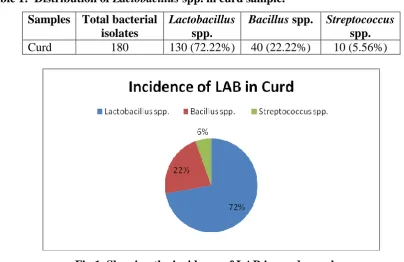
A total of 180 bacterial isolates were randomly isolated. Further identification was carried out on the basis of cultural, morphological and biochemical characteristics. Out of 180 bacterial isolates, 130 isolates were identified as Lactobacillus spp. On the basis of following characteristics - small, circular, creamy white colour, convex, opaque colonies. Microscopic examination revealed them to be gram positive, rod shaped and non spore forming (endospore). Biochemical characteristics included following test results carbohydrate fermentation positive, non motile, catalase and oxidase negative etc. While the other bacterial isolates randomly selected from the MRS agar plates of curd samples were identified as
Bacillus spp. and Streptococcus spp.
Table 1: Distribution of Lactobacillus spp. in curd sample. Samples Total bacterial
isolates
Lactobacillus spp.
Bacillus spp. Streptococcus spp.
[image:4.595.86.491.495.757.2]Curd 180 130 (72.22%) 40 (22.22%) 10 (5.56%)
www.wjpr.net Vol 4, Issue 1, 2015 787 Collado and Hernandez (2007) identified 13 Lactobacillus strains, 13 Streptococcus and 13
Bifidobacterium strains isolated from fermented milk products. Further these were identified upto species level by genus- and species – PCR.
In a study conducted by Patil et al. (2008) revealed isolation of 50 colonies from curd and cucumber. Out which 14 were further selected for study revealing 5 to be coccus and 9 to be rod shaped. Among these nine, four were identified as Lactobacillus spp.
Hoque et al. (2010) reported isolating bacterial isolates of which identified as Lactobacillus
spp. on the basis on colony morphology, physiological and some biochemical tests. While in an experiment performed by Bhattacharya and Das, 2010 revealed isolation of five isolates of
Lactobacillus spp. from curd as reported. From fermented foods like Idli and Dosa samples three and two Lactobacillus isolates were isolated respectively.
Azadnia et al. (2011) isolated a total of 220 Lactobacillus spp. from 15 yoghurt samples which were further divided into two subgroups.
1) Mesophilic faculatative hetero fermentative Lactobacillus spp. (144 isolates) 2) Mesophilic obligate hetero fermentative Lactobacillus spp. (76 isolates).
In a similar study conducted by Bhardwaj et al., 2012 reported isolation of 78 isolates of
Lactobacillus spp. out of the several isolates, isolated from 40 curd samples. These were further identified upto species level.
Bassyouni et al., 2012 reported isolation of fifty four isolates from different dairy products in Egypt. A total of nine isolates were identified as Lactobacillus spp. While in another study by Kermanshi and Peymanfar (2012) isolated and identified Lactobacilli from cheese, yoghurt and silage by 16S rDNA Gene.
Mohammed and Ijah (2013) isolated Lactobacillus spp. and Streptococcus spp. from yoghurt samples.
2. Screening LAB Isolates for Antibacterial Activity
The screening of LAB isolates for antibacterial activity revealed that 24 out of the total 130
www.wjpr.net Vol 4, Issue 1, 2015 788 bacteriocins. The testing of the Cell Free Supernatant or extract for Antibacterial activity of LAB isolates revealed the following results.
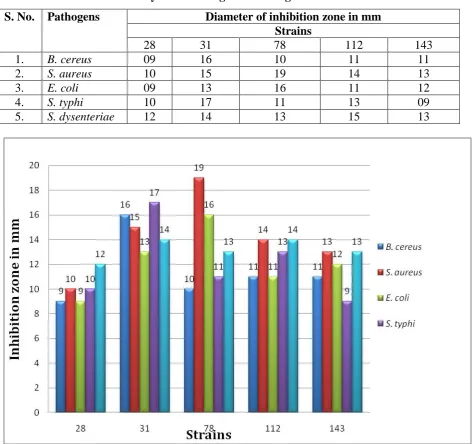
Table 2: Antibacterial activity of isolates against test organisms.
S. No. Pathogens Diameter of inhibition zone in mm Strains
28 31 78 112 143
1. B. cereus 09 16 10 11 11
2. S. aureus 10 15 19 14 13
3. E. coli 09 13 16 11 12
4. S. typhi 10 17 11 13 09
5. S. dysenteriae 12 14 13 15 13
Fig 2. Showing the Antibacterial activity of LAB isolates.
www.wjpr.net Vol 4, Issue 1, 2015 789 1) The inhibitory activity of bacteriocin producing Lactobacillus isolates revealed that the maximum inhibition zone was observed in case of isolate 31 (16 mm) against B. cereus followed by isolate 112 and isolate 143 (11 mm) and while least was observed in isolate 28 (09 mm).
Mohammed and Ijah, 2013 reported the inhibition zone 3 – 6mm in diameter in their study.
2) Similarly in the case of S. aureus, maximum inhibition zone was observed for isolate 78 (19 mm), followed by isolate 31 (15 mm) while the least was in isolate 28 (10 mm).
Bhattacharya and Das (2010) reported the diameters of the inhibition zones ranged from 9 -12 mm. The highest diameter (12mm) was recorded for the culture supernatants of C2 and F2 on
S. aureus and the smallest of 9 mm for E1 and F3 on S. aureus.
Similarly, Bassyouni et al. (2012) reported inhibition of 14 – 25 mm by Lactobacillus spp. against the clinical isolate of Staphylococcus spp.
Mohammed and Ijah, 2013 study the inhibition zone exhibited range from 3- 6 mm. The inhibition zone ranged exhibited against ranged from 9-14mm as reported by Adejumo (2014).
3) In case of E. coli, LB 78 (16 mm) gave maximum inhibition zone, followed by isolate 31 (13 mm) and while least was observed in isolate 28 (09 mm).
Similarly Kermanshi and Peymanfar, 2012 also reported the isolated bacteria were effective against isolated E. coli from cheese, yoghurt and silage. However, they were not able to produce bacteriocin.
Bassyouni et al. (2012) reported the inhibition zone of the 13 – 21 mm against E. coli
exhibited by the isolates.
In a study the isolates were from milk of Buffalo, Cow, and Goat. It was observed that the inhibition was between 18 – 19 mm; 17 – 19 mm and 17 – 19 mm in Buffalo milk, Cow milk, and Goat milk respectively. (Tambekar and Bhutada, 2009).
www.wjpr.net Vol 4, Issue 1, 2015 790 4) In case of S. typhi maximum inhibition zone was reported for isolate 31 (17 mm),
followed by isolate 112 (13 mm), and least was in isolate 143 (09 mm).
Bassyouni et al., (2012) reported an inhibition zone range from 9- 20 mm exhibited by the isolates.
Tambekar and Bhutada (2009) reported inhibition zone of 23mm; 23mm-25 mm and 24 – 25mm against the pathogen by the isolates from Buffalo milk; cow milk and Goat milk respectively.
Inhibition from the bacteriocin of LAB was reported to be 6mm. (Mohammed and Ijah, 2013) Adejumo (2014) conducted a study on evaluating the antimicrobial activity of LAB isolated from the fermented milk products, showing the zone of inhibition to be between 8-19mm.
5) Maximum inhibition zone was observed in case of isolate 112 (15 mm) against Shigella
spp., followed by isolate 31 (14 mm) and isolate 78 (13 mm), and least was observed in isolate 28 (12 mm).
Inhibition zone of 19 -21 mm; 20 -22 mm and 20 -24 mm was reported against Shigella flexneri by the isolates from Buffalo milk; cow milk and Goat milk respectively. (Tambekar and Bhutada, 2009).
According to the study by Mohammed and Ijah, (2013) inhibition from the bacteriocin of LAB ranged from 3 –6 mm.
Adejumo (2014) reported antimicrobial activity with inhibition zone ranging from 6 –10 mm exhibited by LAB isolated from fermented milk products.
Apart from the above tested pathogens the inhibition zone was also reported against the
Enterobacter aerogenes, Klebsiella pneumoniae, and Proteus vulgaris. (Tambekar and Bhutada, 2009)
Bassyouni et al., 2012 in their study also reported that the inhibition zone against
www.wjpr.net Vol 4, Issue 1, 2015 791 CONCLUSION
The present study was conducted to isolate, screen and identify bacteriocin producing LAB present in the curd samples and also to evaluate its inhibitory activity against selected pathogens. The results thus obtained revealed that LAB which are generally used as Starter culture for manufacturing the fermented food products, also possess some additional beneficial effects by producing bacteriocin which inhibits the growth of pathogens that renders the food unsafe for human consumption. Thus, the isolates of Lactobacillus spp. found effective against the test microorganisms can be further studied for their probiotic activity as well as inhibitory activity that could be utilized in therapeutic and food applications.
DECLARATION
The authors have no conflicts of opinion.
ACKNOWLEDGEMENT
The authors would like to extend their heartfelt gratitude and thanks to Most Rev. Prof. (Dr.) R.B. Lal, Vice Chancellor, SHIATS and Prof. (Dr.) Ramesh Chandra, Dean, WSFDT, for his kind support, guidance and motivation, without which the present investigation and publication would be impossible.
REFERENCES
1. Adejumo TO. Antimicrobial activity of lactic acid bacteria isolated from fermented milk products. African journal of food science, 2014; 8(10): 490-496.
2. Arokiyamary A, Sivakumar PK. Antibacterial activity of Bacteriocin producing
Lactobacillus spp., isolated from traditional milk products. Current Botany, 2011; 2(3): 05-08.
3. Azadnia P, Kamimi JM, Ghasemi MSA, Babaki AK, Zamani MH, Taarof N. Isolation and identification of Mesophilic Lactobacilli from traditional yoghurts of Tribes of Kazerum. Journal of Animal and Veternary Advances, 2011; 10(4): 528- 531.
4. Bassyouni RH, Abdel– all WS, Fadi MG, Abdel – all S, Kamel Z. Characterization of Lactic acid bacteria isolated from Dairy products in egypt as a probiotic. Life Science Journal, 2012; 9(4): 2924 -2933.
www.wjpr.net Vol 4, Issue 1, 2015 792 6. Collado MC, Hernandez M. Identification and differentiation of Lactobacillus, Streptococcus and Bifidobacterium species in fermented milk products with Bifidobacteria. Microbiological research, 2007; 162: 86- 92.
7. Daly C, Davis R. The biotechnology of lactic acid bacteria with emphasis on application in food safety and human health. Agri. and Food Sci., Finland, 1998; 7: 251-264.
8. Enamuel V, Adrian V, Ovidiu P, Gheorghe C. Isolation of Lactobacillus plantarum strain used for obtaining a product for the preservation of fodders. African Journal of Biotechnolgy, 2005; 4: 403-408.
9. Gilliland SE, Speck ML. Inhibition of psychotropic bacteria by lactobacilli and pediococci in non-fermented refrigerated foods. J. of FoodSci., 1975; 40: 903.
10.Harun-un-Rashid M, Togo K, Ueda M, Miyamoto T. Identification and characterization of dominant lactic acid bacteria isolated from traditional fermented milk Dahi in Bangladesh. World j. microbial Biotechnol., 2007; 23: 125-133.
11.Hoque MZ, Akter F, Hossain KM, Rahman MSM, Billah MM Islam KMD. Isolation, identification and Analysis of Probiotic properties of Lactobacillus spp. from selective regional yoghurts. World journal of Dairy and Food Sciences, 2010; 5(1): 39 – 46.
12.Jack RW, Tagg JR, Ray B. Bacteriocins of gram-positive bacteria. Microbial Res., 1995; 59: 171-200.
13.Kermanshahi KK, Peymanfar S. Isolation and identification of Lactobacilli from cheese, yoghurt and Silage by 16S rDNA gene and study of bacteriocin and Biosurfactant production. Jundishapur journal of Microbiology, 2012; 5(4): 528-532.
14.Mohammed SSD, Ijah UJJ. Isolation and screening of Lactic acid bacteria from fermented milk products for bacteriocin production. Annals Food Science and Technology, 2013; 14(1): 122 – 128.
15.Oyetayo VO, Adetuyi FC, Akinyosoye FA. Safety and protective effect of Lactobacillus acidophilus and Lactobacillus casei used as probiotic agent in vivo. Afr. J. Biotech, 2003; 2: 448-452.
16.Patil MM, Pal A, Anand T, Ramana KV. Isolation and characterization of lactic acid bacteria from curd and cucumber. Indian journal of Biotechnology, 2010; 9: 166-172. 17.Soomro AH, Masud T, Anwaar K. Role of lactic acid bacteria (LAB) in food preservation
and Human health. Pak. J. Nutr., 2002; 1: 20-24.
18. Tambekar D, Bhutada S. Studies on antimicrobial activity and characteristics of Bacteriocin produced by Lactobacillus strains isolated from Milk of Domestic animals.
www.wjpr.net Vol 4, Issue 1, 2015 793 19.Tserovska L, Stefanova S, Yordanova T. Identification of lactic acid bacteria isolated
from katyk, goat’s milk and cheese. J. of culturecollections, 2002; 3: 48-52.
20.Vandenbergh PA. Lactic acid bacteria, their metabolic products interference with microbial growth. FEMS Microbial Rev, 1993; 12: 221-238.