MINIMIZING RISK OF POSTMENOPAUSAL OSTEOPOROSIS
THROUGH SHATAVARI – A CLINICAL STUDY
*Jasmine Ritesh ujarathi1, Ritesh Ashok Gujarathi2 1
Dept. of Prasuti tantra & Stri roga, G. J. Patel Institute of Ayurvedic Studies & Research, New Vallabh Vidyanagar, Anand, Gujarat, India.
2
Dept. of Basic principles, G. J. Patel Institute of Ayurvedic Studies & Research, New Vallabh Vidyanagar, Anand, Gujarat, India.
ABSTRACT
The postmenopausal period is associated with significant increase in the incidence of age related medical conditions like cardiovascular diseases and osteoporosis. Postmenopausal Osteoporosis is a condition of major health importance because of its association with fractures. Bone loss is only partly reversible. Hence treatment is aimed at minimizing the bone loss after the age of 40. Postmenopausal osteoporosis is a disease of ageing. Rasayana can provide better alternative in increasing quality of life. Shatavari (Asparagus racemosus) is a well-known female rejuvenative. Its beneficial effect on women during fertile i.e. reproductive life is well established. In the present clinical study Shatavari was administered
in perimenopausal and menopausal women; 6gms / day in two divided doses with milk for 10 weeks. At the end of the study it showed highly significant (P<0.001) changes in biochemical markers of bone formation and bone resorption.
Key words :- Postmenopausal osteoporosis, Bone loss, Rasayana, Shatavari.
INTRODUCTION
Old age is vulnerable time for both men and women - but for women it is even more so. The aftermath of ageing strikes women twice, because in addition to process of senility, women suffer simultaneously from the inevitable scars of menopause. Statistical data reveal that osteoporotic fractures are four times more common than cardiovascular stroke and can lead to Article Received on
28 November 2012,
Revised on 16 December 2012, Accepted on 29 December 2012
*Correspondence for Author:
*Dr. Jasmine Ritesh ujarathi
Assistant Professor
Dept. of Prasuti tantra & Stri
roga, G. J. Patel Institute of
Ayurvedic Studies & Research.
New Vallabh Vidyanagar,
Anand, Gujarat. India.
permanent disability and hence can even be life threatening, thus becoming a significant cause of morbidity and mortality.[1,2]s
World Health Organization defines osteoporosis as a “progressive systemic skeletal disease characterized by low bone mass and micro architectural deterioration of bone tissue, with a consequent increase in bone fragility and susceptibility to fracture”[3]. Osteoporosis is a metabolic disorder, where there is imbalance between bone formation and bone resorption. Estrogen, during the reproductive phase, prevents bone loss by conserving calcium and inhibiting activity of osteoclasts. Beginning at the age of 30 to 40, women lose about 10% of their bone mass per decade; with age and reduced estrogen levels, there is an increased risk of progressive loss of bone strength.[4] Thus post menopausal osteoporosis is one of the most common and disabling disease affecting women.
During the past decade, it has increasingly been perceived as serious disabling disease needing substantial involvement of all medical sciences to develop and assess potential treatments.
The disease postmenopausal osteoporosis is a disease of Aging and prevailing specially in women, drug Shatavari (Asparagus racemosus) was selected to analyze its role in decreasing bone loss and hence minimizing the risk of postmenopausal osteoporosis.
AIMS AND OBJECTIVES
1. To study the disease postmenopausal osteoporosis – as per Ayurveda and modern concept.
2. To assess the effect of Shatavari in minimizing bone loss. 3. To see for any adverse effects of the same during the study.
4. To compare the efficacy of Shatavari with Kukkutanda twak bhasma.(bhasma prepared from egg shell)
MATERIALS AND METHODS Clinical Study
Patients : For clinical study, patients attending OPD and IPD of I. P. G. T & R.A. hospital presenting risk factors for developing the disease were registered.
PLAN OF STUDY
CRITERIA OF SELECTION
1. Women of age group 40 -60 years (perimenopausal and postmenopausal age group)
2. Presenting one or more risk factors for developing osteoporosis.
CRITERIA OF EXCLUSION
1. Hyperparathyroidism 2. Chronic diseases
INVESTIGATIONS
Routine blood, urine and stool examinations.
Biochemical bone markers
Urine – 24 hour urine calcium , Urine creatinine
Serum – Serum calcium, Serum alkaline phosphatase, Serum acid phosphatase
X-ray spine
CRITERIA OF ASSESSMENT Subjective criteria
Results of the treatment were assessed on the basis of relief in Asthikshayatmaka lakshana (symptoms of Asthi Dhatu Kshaya) with the help of specific scoring pattern as recorded in research proforma.
Objective criteria
To assess the effect of treatment on bone loss, biochemical bone markers were used before
treatment (BT) and after treatment (AT) to detect any change in rate of bone formation and bone resorption.
Table I- Grouping
GROUP A GROUP B GROUP C
DRUG Kukkutanda
Twak bhasma
Shatavari Moola churna
Placebo (Wheat flour) DOSE 500 mg / day
in 2 divided doses
6 gm / day in 3 divided doses
Table II - Observations
Group No. Of Patients
Total Registered Lama Completed
A 14 04 10
B 15 01 14
C 14 03 11
TOTAL 43 08 35
1. Maximum no. of patients – 62.79% belonged to the age group of 40-45 years.
2. 55.81% of patients were postmenopausal, whereas 44.81% fell into perimenopausal age group.
3. 83.72% of patients registered had natural menopause whereas 16.27% underwent hysterectomy.
4. 34.88% of patients had age of menopause between 40-45 and 45-50 years.
5. 67.44% of patients did not perform any exercise in their daily routine.
6. Vata dominant Prakriti was found maximum number of patients with combination of
Pitta (58.13%) and Kapha (32.55%)
7. 95.34% of patients had low life time calcium intake as risk factor, 69.76% presented small body frame as well as inactive life style whereas 48.83% were underweight and 34.88% of patients had early menopause as risk factor for developing osteoporosis.
8. Bone pain and low back pain was observed in 95.34%, extreme fatigue and cramps in legs in 90.69%, difficulty in walking in 88.37%, premature graying of hair in 67.44% and pain at symphysis pubis was observed in 60.46% of patients.
9. Radiological findings indicated established osteoporosis in 18.60% of patients. Loss of normal lumber lordosis was found in 23.25% of patients.
RESULTS
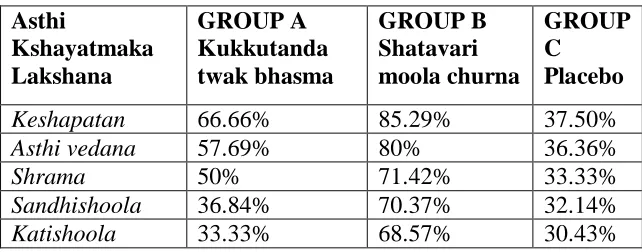
Table III – Subjective Parameters
Asthi
Kshayatmaka Lakshana
GROUP A Kukkutanda twak bhasma
GROUP B Shatavari moola churna
GROUP C
Placebo
Keshapatan 66.66% 85.29% 37.50%
Asthi vedana 57.69% 80% 36.36%
Shrama 50% 71.42% 33.33%
Sandhishoola 36.84% 70.37% 32.14%
[image:4.595.137.458.618.744.2]Table IV – Objective Parameters
BIOCHEMICAL BONE MARKERS
GROUP A GROUP B GROUP C
Bone Formation Non significant Highly significant
( P < 0.01)
Non significant
Bone resorption Significant (P < 0.05)
Highly significant ( P < 0.01)
Highly significant ( P < 0.01)
TOTAL EFFECT OF THERAPY
In group A, marked improvement was found in 10% of patients, 30% of patients were moderately improved and 60% patients showed mild improvement in lakshana of asthi kshaya. No patient remained unchanged in this group.
In group B, marked improvement was found in 50% patients. 42.85% patients were moderately improved, 7.14% showed mild improvement and none of the patient remained unchanged.
In group C, 22.85% of patients presented marked improvement, 28.57% patients exhibited moderate improvement, mild improvement was demonstrated in 54.54% patients and 36.26% of patients remained unchanged after administration of therapy.
DISCUSSION
Reviewing all the available literatures related to Asthi Dhatu, the final diagnosis of the disease was given as ‘Asthi Saushirya.’ Anga bhanga- fractures can be considered as
Pratyatma lakshana of this disease. Gambhira dhatu, Svabhavabalapravritta Vyadhi and
Bhedawastha make this disease Asadhya. This disease can become Yapya by intervention at proper level, following Pathyapathaya and Rasayana Therapy.
Maximum patients registered had early menopause and had less than 2 years as duration of menopause which supports the fact that age of menopause is declining and that the bone loss is accelerated in the first few years of menopause. Low life time calcium intake and inactive life style were the risk factors found in maximum number of patients which serves as Nidana
Effect of Shatavari on Asthi Ksayatmakalakshana was better over that of KTB and placebo. The effect of Shatavari on bone markers indicates that it enhances bone formation as well as decreases bone resorption. Shatavari acts on both ways and balances bone remodeling and hence can prevent bone loss and help in increasing bone mass. The mode of action of
Shatavari can also be explained with the help of its active chemical constituent – Steroidal Saponins which fall under Phytoestrogens. Phytoestrogens stimulate osteoblastosis and suppress osteoclastosis and thus help in preventing bone loss.
CONCLUSION
Postmenopausal osteoporosis is a disabling disease which renders women a bedridden life. Hormone replacement therapy- only known therapy in prevention and management of postmenopausal osteoporosis has got major risks than benefits.
The effect of Shatavari on Asthi Kshayatmaka lakshana was better over Kukkutanda twak bhasma and placebo. Shatavari provided encouraging results on bone metabolism by preventing bone loss and enhancing bone formation.
Additional studies by combining Shatavari with calcium supplements and life style planning are needed to improve the quality of life of postmenopausal women.
REFERENCES
1. Melton L J, Chrischilles E A, Cooper C, Lane A W, Riggs B L. How many women have osteoporosis ? J Bone Miner Res; 7 : 1005-1010, 1992
2. Riggs BL, Melton LJ III. Involutional Osteoporosis. N Engl J Med ; 314:1676-86,1986. 3. World Health Organisation. Assessment of fracture risk and its application to screening
for postmenopausal osteoporosis. Geneva : WHO, 1994. (Technical report series 843) 4. Heaney RP, Recker RR, Savile PD. Menopausal changes in bone remodeling. J Lab Clin