Acta Cryst.(2001). E57, o939±o940 DOI: 10.1107/S1600536801014799 William Erringtonet al. C13H11ClO4
o939
organic papers
Acta Crystallographica Section E Structure Reports Online
ISSN 1600-5368
7-Acetoxy-4-(1-chloroethyl)coumarin
William Errington,a* Virinder S. Parmar,bAmarjit Singhband Ishwar Singhb
aDepartment of Chemistry, University of
Warwick, Coventry CV4 7AL, England, and
bDepartment of Chemistry, University of Delhi,
Delhi 110 007, India
Correspondence e-mail: [email protected]
Key indicators
Single-crystal X-ray study T= 200 K
Mean(C±C) = 0.003 AÊ Rfactor = 0.042 wRfactor = 0.118
Data-to-parameter ratio = 12.2
For details of how these key indicators were automatically derived from the article, see http://journals.iucr.org/e.
#2001 International Union of Crystallography Printed in Great Britain ± all rights reserved
The title compound, C13H11ClO4, a previously unknown
coumarin, has the acetoxy and chloroethyl substituents aligned at angles of 65.76 (7) and 63.52 (9), respectively,
from the plane of the coumarin rings.
Comment
Coumarins are of considerable general importance (Campbell, 1959) and are prominent in natural products chemistry (Dean, 1963; Murrayet al., 1982). They have been found to possess a wide variety of uses in the perfumery industry, as ¯avour enhancers, sunscreens, laser dyes (Khalfanet al., 1987) and in the pharmaceutical industry (Hooper et al., 1982; Morris & Russell, 1971). Our recent work showed pronounced activity of 4-methylcoumarins against Herpes simplex and vascular stomatitis viruses (Parmaret al., 1996). Encouraged by these ®ndings, we have synthesized a series of coumarins for struc-ture±activity studies. This paper reports the synthesis and structure of the new coumarin, 7-acetoxy-4-(1-chloroethyl)-coumarin, (I).
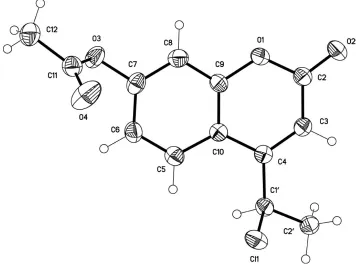
The molecular structure of (I) is illustrated in Fig. 1. All bond lengths and angles are largely unremarkable. The incli-nations of the planes of the acetoxy and chloroethyl substi-tuents (de®ned by the O3/C11/O4/C12 and Cl1/C10/C20atoms)
with respect to the coumarin ring system are 65.76 (7) and 63.52 (9), respectively.
Experimental
The previously unknown 4-(1-chloroethyl)-7-hydroxycoumarin, (II), was prepared by the addition of resorcinol (25.41 g, 0.231 mol) and ethyl 2-(2-chloropropionyl)-2-ethoxycarbonyl acetate (58.0 g, 0.231 mol) to ice-cooled concentrated H2SO4(45 ml). The reaction mixture was maintained at room temperature for 20 h and ice-cooled water was added. (II) precipitated out, was ®ltered off and crystal-lized from alcohol as colourless needles (16.5 g, 32% yield), m.p. 429± 431 K. The title compound (I) (560 mg, 91% yield) was obtained by
the acetylation of (II) (500 mg, 0.228 mol) using acetic anhydride and pyridine. It crystallized from ethyl acetate/petroleum ether as colourless needles, m.p. 410 K.
Crystal data
C13H11ClO4
Mr= 266.67
Triclinic,P1
a= 4.1204 (6) AÊ
b= 10.7106 (17) AÊ
c= 13.842 (2) AÊ
= 97.450 (4)
= 94.291 (4)
= 97.184 (4)
V= 598.39 (16) AÊ3
Z= 2
Dx= 1.480 Mg mÿ3
MoKradiation Cell parameters from 1852
re¯ections
= 1.5±25.1
= 0.32 mmÿ1
T= 200 (2) K Plate, colourless 0.400.240.06 mm
Data collection
Siemens SMART CCD area-detector diffractometer
!scans
Absorption correction: multi-scan (SADABS; Sheldrick, 1996)
Tmin= 0.882,Tmax= 0.981
2931 measured re¯ections
2010 independent re¯ections 1570 re¯ections withI> 2(I)
Rint= 0.017 max= 25.1
h=ÿ4!4
k=ÿ8!12
l=ÿ16!13
Re®nement
Re®nement onF2
R[F2> 2(F2)] = 0.042
wR(F2) = 0.118
S= 1.00 2010 re¯ections 165 parameters
H-atom parameters constrained
w= 1/[2(F
o2) + (0.0746P)2]
whereP= (Fo2+ 2Fc2)/3
(/)max< 0.001
max= 0.27 e AÊÿ3
min=ÿ0.22 e AÊÿ3
Table 1
Selected torsion angles ().
C11ÐO3ÐC7ÐC8 ÿ116.4 (2) C7ÐO3ÐC11ÐO4 0.1 (4) C7ÐO3ÐC11ÐC12 178.8 (2)
C10ÐC4ÐC10ÐC20 167.4 (2)
C10ÐC4ÐC10ÐCl1 ÿ69.7 (2)
The temperature of the crystal during the X-ray diffraction experiment was controlled using an Oxford Cryosystems Cryostream Cooler (Cosier & Glazer, 1986). H atoms were added at calculated positions and re®ned using a riding model. Anisotropic displacement parameters were used for all non-H atoms; H atoms were given isotropic displacement parameters equal to 1.2 (or 1.5 for methyl H atoms) times the equivalent isotropic displacement parameter of their parent atoms.
Data collection:SMART(Siemens, 1994); cell re®nement:SAINT
(Siemens, 1995); data reduction: SAINT; program(s) used to solve structure:SHELXTL/PC(Siemens, 1994); program(s) used to re®ne structure: SHELXL97 (Sheldrick, 1997); molecular graphics:
SHELXTL/PC; software used to prepare material for publication:
SHELXTL/PC.
We wish to acknowledge the use of the EPSRC's Chemical Database Service at Daresbury Laboratory (Fletcher et al., 1996) for access to the Cambridge Structural Database (Allen & Kennard, 1993).
References
Allen, F. H. & Kennard, O. (1993).Chem. Des. Autom. News,8, 1, 31±37. Campbell, N. (1959).Chemistry of Carbon Compounds, Vol. IVB, edited by E.
H. Rodd, pp. 809±1002, New York: Elsevier.
Cosier, J. & Glazer, A. M. (1986).J. Appl. Cryst.19, 105±107.
Dean, F. M. (1963).Naturally Occurring Oxygen Ring Compounds. London: Butterworths.
Fletcher, D. A., McMeeking, R. F. & Parkin, D. (1996).J. Chem. Inf. Comput. Sci.36, 746±749.
Hooper, D. C., Wolfson, J. S., McHugh, G. L., Winters, M. B. & Swartz, M. N. (1982).Antimicrob. Agents Chemother.22, 662±671.
Khalfan, H., Abuknesha, R., Rond-Weaver, M., Price, R. G. & Robinson, R. (1987).Chem. Abstr.106, 63932.
Morris, A. & Russell, A. D. (1971).Prog. Med. Chem.8, 39±59.
Murray, R. D. H., Medez, J. & Brown, S. A. (1982).The Natural Coumarins. New York: John Wiley and Sons.
Parmar, V. S., Bisht, K. S., Jain, R., Singh, S., Sharma, S. K., Gupta, S., Malhotra, S., Tyagi, O. D., Vardhan, A. & Pati, H. N. (1996).Indian J. Chem. B,35, 220±232.
Sheldrick, G. M. (1996).SADABS. University of GoÈttingen, Germany. Sheldrick, G. M. (1997).SHELXL97. University of GoÈttingen, Germany. Siemens (1994). SMART and SHELXTL/PC (Version 5.0). Siemens
Analytical X-ray Instruments Inc., Madison, Wisconsin, USA.
Siemens (1995).SAINT. Version 4.021. Siemens Analytical X-ray Instruments Inc., Madison, Wisconsin, USA.
Figure 1
supporting information
sup-1
Acta Cryst. (2001). E57, o939–o940supporting information
Acta Cryst. (2001). E57, o939–o940 [doi:10.1107/S1600536801014799]
7-Acetoxy-4-(1-chloroethyl)coumarin
William Errington, Virinder S. Parmar, Amarjit Singh and Ishwar Singh
S1. Comment
Coumarins are of considerable general importance (Campbell, 1959) and are prominent in natural products chemistry
(Dean, 1963; Murray et al., 1982). They have been found to possess a wide variety of uses in the perfumery industry, as
flavour enhancers, sunscreens, laser dyes (Khalfan et al., 1987) and in the pharmaceutical industry (Hooper et al., 1982;
Morris & Russell, 1971). Our recent work showed pronounced activity of 4-methylcoumarins against Herpes simplex and
Vascular stomatitis viruses (Parmar et al., 1996). Encouraged by these findings, we have synthesized a series of
coumarins for structure–activity studies. This paper reports the synthesis and structure of the new coumarin,
7-acet-oxy-4-(1-chloroethyl)coumarin, (I).
The molecular structure of (I) is illustrated in Fig. 1. A l l bond lengths and angles are largely unremarkable. The
inclinations of the planes of the acetoxy and chloroethyl substituents (defined by the O3/C11/O4/C12 and Cl1/C1′/C2′
atoms) with respect to the coumarin ring system are 65.76 (7) and 63.52 (9)°, respectively.
S2. Experimental
The previously unknown 4-(1-chloroethyl)-7-hydroxycoumarin, (II), was prepared by the addition of resorcinol (25.41 g,
0.231 mol) and ethyl 2-(2-chloropropionyl)-2-ethoxycarbonyl acetate (58.0 g, 0.231 mol) to ice-cooled concentrated
H2SO4 (45 ml). The reaction mixture was maintained at room temperature for 20 h and ice-cooled water was added. (II)
precipitated out, was filtered off and crystallized from alcohol as colourless needles (16.5 g, 32% yield), m.p. 429–431 K.
The title compound (I) (560 mg, 91% yield) was obtained by the acetylation of (II) (500 mg, 0.228 mol) using acetic
anhydride and pyridine. It crystallized from ethyl acetate/petroleum ether as colourless needles, m.p. 410 K.
S3. Refinement
The temperature of the crystal during the X-ray diffraction experiment was controlled using an Oxford Cryosystems
Cryostream Cooler (Cosier & Glazer, 1986). H atoms were added at calculated positions and refined using a riding
model. Anisotropic displacement parameters were used for all non-H atoms; H atoms were given isotropic displacement
parameters equal to 1.2 (or 1.5 for methyl H atoms) times the equivalent isotropic displacement parameter of their parent
Figure 1
View of the title molecule showing the atomic numbering. Displacement ellipsoids are drawn at the 50% probability level
for non-H atoms. H atoms are shown as spheres of arbitrary radii.
4-(1-Chloroethyl)coumarin-7-yl acetate
Crystal data
C13H11ClO4
Mr = 266.67 Triclinic, P1
a = 4.1204 (6) Å
b = 10.7106 (17) Å
c = 13.842 (2) Å
α = 97.450 (4)°
β = 94.291 (4)°
γ = 97.184 (4)°
V = 598.39 (16) Å3
Z = 2
F(000) = 276
Dx = 1.480 Mg m−3
Mo Kα radiation, λ = 0.71073 Å Cell parameters from 1852 reflections
θ = 1.5–25.1°
µ = 0.32 mm−1
T = 200 K Plate, colourless 0.40 × 0.24 × 0.06 mm
Data collection
Siemens SMART CCD area-detector diffractometer
Radiation source: normal-focus sealed tube Graphite monochromator
Detector resolution: 8.192 pixels mm-1
ω scans
Absorption correction: multi-scan (SADABS; Sheldrick, 1996)
Tmin = 0.882, Tmax = 0.981
2931 measured reflections 2010 independent reflections 1570 reflections with I > 2σ(I)
Rint = 0.017
θmax = 25.1°, θmin = 1.5°
h = −4→4
k = −8→12
supporting information
sup-3
Acta Cryst. (2001). E57, o939–o940Refinement
Refinement on F2
Least-squares matrix: full
R[F2 > 2σ(F2)] = 0.042
wR(F2) = 0.118
S = 1.00 2010 reflections 165 parameters 0 restraints
Primary atom site location: structure-invariant direct methods
Secondary atom site location: difference Fourier map
Hydrogen site location: inferred from neighbouring sites
H-atom parameters constrained
w = 1/[σ2(F
o2) + (0.0746P)2]
where P = (Fo2 + 2Fc2)/3
(Δ/σ)max < 0.001
Δρmax = 0.27 e Å−3
Δρmin = −0.22 e Å−3
Special details
Experimental. Spectroscopic data: UV (MeOH) λmax(nm): 317, 284 and 202; IR(KBr) νmax/cm-1: 2925, 2372, 1780, 1725,
1618, 1375, 1267, 1208, 1135, 1008, 879, 722, 652 and 608; 1H NMR (300 MHz, CDCl
3): δ 1.91 (3H, d, J = 6.7 Hz,
C-2′H), 2.34 (3H, s, OCOCH3), 5.26 (1H, q, J = 6.7 Hz, C-1′H), 6.59 (1H, s, C-3H), 7.11 (1H, dd, J = 8.7 Hz, J = 2.2 Hz,
C-6H), 7.16 (1H, d, J = 2.2 Hz, C-8H) and 7.75 (1H, d, J = 8.7 Hz, C-5H); 13C NMR (75 MHz, CDCl
3): δ 21.52 (C-2′),
23.97 (CH3CO), 51.76 (C-1′), 111.37, 113.24, 118.73 and 125.61 (C-3, C-6, C-8, and C-10), 153.64, 154.16 and 155.03
(C-4, C-5, C-7 and C-9), 160.77 (C-2) and 169.03 (CH3CO); EIMS, m/z (% rel. int.): 267 [M+](10), 224 (24), 196 (11),
189 (18), 161 (100), 149 (4), 139 (4), 131 (16), 115 (14), 103 (32), 89 (15), 77 (37), 63(250 and 51 (31).
Geometry. All e.s.d.'s (except the e.s.d. in the dihedral angle between two l.s. planes) are estimated using the full covariance matrix. The cell e.s.d.'s are taken into account individually in the estimation of e.s.d.'s in distances, angles and torsion angles; correlations between e.s.d.'s in cell parameters are only used when they are defined by crystal symmetry. An approximate (isotropic)
treatment of cell e.s.d.'s is used for estimating e.s.d.'s involving l.s. planes.
Refinement. Refinement of F2 against ALL reflections. The weighted R-factor wR and goodness of fit S are based on F2,
conventional R-factors R are based on F, with F set to zero for negative F2. The threshold expression of F2 > σ(F2) is used
only for calculating R-factors(gt) etc. and is not relevant to the choice of reflections for refinement. R-factors based on F2
are statistically about twice as large as those based on F, and R- factors based on ALL data will be even larger.
Fractional atomic coordinates and isotropic or equivalent isotropic displacement parameters (Å2)
x y z Uiso*/Ueq
C11 0.3726 (6) 0.7071 (2) −0.12457 (17) 0.0355 (6) C12 0.4652 (7) 0.7363 (3) −0.22172 (18) 0.0429 (7) H12A 0.4231 0.6585 −0.2691 0.064* H12B 0.6990 0.7701 −0.2166 0.064* H12C 0.3344 0.7996 −0.2435 0.064* C1′ 0.4119 (5) 0.6784 (2) 0.39946 (16) 0.0281 (5) H1′A 0.6398 0.6650 0.3845 0.034* C2′ 0.4116 (6) 0.7044 (2) 0.50969 (16) 0.0332 (6) H2′A 0.5541 0.7841 0.5346 0.050* H2′B 0.4934 0.6345 0.5391 0.050* H2′C 0.1873 0.7114 0.5267 0.050*
Atomic displacement parameters (Å2)
U11 U22 U33 U12 U13 U23
Cl1 0.0396 (4) 0.0272 (4) 0.0482 (4) 0.0074 (3) 0.0032 (3) 0.0050 (3) O1 0.0395 (9) 0.0274 (9) 0.0290 (10) 0.0105 (8) 0.0046 (7) 0.0050 (7) O2 0.0588 (12) 0.0343 (11) 0.0387 (10) 0.0221 (9) 0.0111 (9) 0.0037 (8) O3 0.0516 (11) 0.0362 (10) 0.0238 (9) −0.0028 (8) 0.0074 (8) 0.0022 (7) O4 0.0863 (16) 0.0591 (15) 0.0378 (12) −0.0275 (13) −0.0014 (10) 0.0054 (10) C2 0.0342 (13) 0.0251 (13) 0.0301 (13) 0.0034 (11) 0.0034 (10) 0.0008 (10) C3 0.0308 (12) 0.0317 (13) 0.0243 (12) 0.0050 (11) 0.0027 (10) 0.0043 (10) C4 0.0204 (11) 0.0270 (13) 0.0283 (12) 0.0024 (10) −0.0001 (9) 0.0032 (10) C5 0.0311 (12) 0.0294 (14) 0.0314 (14) 0.0059 (11) 0.0005 (10) 0.0033 (10) C6 0.0349 (13) 0.0334 (14) 0.0284 (13) 0.0062 (11) 0.0052 (10) −0.0007 (11) C7 0.0323 (13) 0.0356 (15) 0.0256 (13) −0.0039 (11) 0.0027 (10) 0.0016 (11) C8 0.0367 (13) 0.0268 (13) 0.0294 (13) 0.0028 (11) −0.0001 (10) 0.0048 (10) C9 0.0262 (12) 0.0247 (12) 0.0287 (13) 0.0035 (10) 0.0003 (9) 0.0000 (10) C10 0.0232 (11) 0.0272 (13) 0.0252 (12) 0.0029 (10) −0.0010 (9) 0.0028 (10) C11 0.0444 (15) 0.0304 (15) 0.0308 (15) 0.0070 (12) 0.0022 (11) 0.0002 (11) C12 0.0577 (17) 0.0417 (17) 0.0290 (14) 0.0082 (14) 0.0069 (12) 0.0005 (12) C1′ 0.0260 (12) 0.0299 (13) 0.0296 (13) 0.0073 (10) 0.0028 (10) 0.0045 (10) C2′ 0.0403 (13) 0.0377 (15) 0.0249 (13) 0.0149 (12) 0.0008 (10) 0.0083 (11)
Geometric parameters (Å, º)
supporting information
sup-5
Acta Cryst. (2001). E57, o939–o940C5—C6 1.375 (3) C2′—H2′A 0.980 C5—C10 1.405 (3) C2′—H2′B 0.980 C5—H5A 0.950 C2′—H2′C 0.980
C2—O1—C9 121.49 (18) C8—C9—C10 122.7 (2) C11—O3—C7 118.12 (19) C9—C10—C5 116.7 (2) O2—C2—O1 117.1 (2) C9—C10—C4 117.6 (2) O2—C2—C3 125.3 (2) C5—C10—C4 125.7 (2) O1—C2—C3 117.6 (2) O4—C11—O3 122.4 (2) C4—C3—C2 122.4 (2) O4—C11—C12 127.1 (2) C4—C3—H3A 118.8 O3—C11—C12 110.5 (2) C2—C3—H3A 118.8 C11—C12—H12A 109.5 C3—C4—C10 119.1 (2) C11—C12—H12B 109.5 C3—C4—C1′ 121.4 (2) H12A—C12—H12B 109.5 C10—C4—C1′ 119.45 (19) C11—C12—H12C 109.5 C6—C5—C10 121.8 (2) H12A—C12—H12C 109.5 C6—C5—H5A 119.1 H12B—C12—H12C 109.5 C10—C5—H5A 119.1 C4—C1′—C2′ 116.3 (2) C5—C6—C7 118.5 (2) C4—C1′—Cl1 108.00 (15) C5—C6—H6A 120.7 C2′—C1′—Cl1 109.01 (17) C7—C6—H6A 120.7 C4—C1′—H1′A 107.7 C8—C7—C6 122.2 (2) C2′—C1′—H1′A 107.7 C8—C7—O3 117.1 (2) Cl1—C1′—H1′A 107.7 C6—C7—O3 120.5 (2) C1′—C2′—H2′A 109.5 C7—C8—C9 118.0 (2) C1′—C2′—H2′B 109.5 C7—C8—H8A 121.0 H2′A—C2′—H2′B 109.5 C9—C8—H8A 121.0 C1′—C2′—H2′C 109.5 O1—C9—C8 115.5 (2) H2′A—C2′—H2′C 109.5 O1—C9—C10 121.8 (2) H2′B—C2′—H2′C 109.5