The influence of social values on consumer perceptions of
food risks
GIOVE, Samantha
Available from Sheffield Hallam University Research Archive (SHURA) at:
http://shura.shu.ac.uk/17099/
This document is the author deposited version. You are advised to consult the publisher's version if you wish to cite from it.
Published version
GIOVE, Samantha (2001). The influence of social values on consumer perceptions of food risks. Doctoral, Sheffield Hallam University.
Copyright and re-use policy
SHEFFIELD HALLAM UNIVERSITY LEARNING CENTRE CITY CAMPIUS, HOWARD STREET
SHEFFIELD S11WB
1 0 1 6 2 4 1 7 9 8
pines are cl i n e d at 50p pe hot
The Influence of Social Values on
Consumer Perceptions of Food Risks
Samantha Giove
A thesis submitted in partial fulfilment of the requirements
of Sheffield Hallam University for the degree of Doctor of
Philosophy
ABSTRACT
Consumers in the twenty-first century present many challenges for managers within the food industry. Consumers are everyday bombarded with choices, making decisions in respect of these involves an element of risk taking. Whilst the consequences of 'bad' choices infrequently prove to be life threatening, the values which collectively constitute a consumer's lifestyle, are potentially threatened by these day to day
decisions. Consumers can both support and reinforce their lifestyle and values through selection and rejection of the products and services offered by the food industry.
This research recognises that consumers' lifestyles and values differ and investigates the implications of these differences for consumer perceptions of food risk and risk
relieving / avoiding strategies for a homogeneous sample o f 215 women. An eclectic approach was adopted using both quantitative and qualitative research methods.
Taylor Nelson's British based Social Value Groups as reported by MacNulty (1985) were selected as the most appropriate framework for value segmentation. A screening instrument was constructed and used to identify members of the Sustenance driven, Outer directed and Inner directed social value groups described by MacNulty (1985). The relationships between these identified social values and perceptions of food risk and risk relieving / avoiding strategies were investigated.
The findings support the view that consumers' food risk perceptions and risk avoiding strategies are influenced by their social values. Each of the three groups o f consumers presented a specific portfolio of food risk perception and risk avoiding strategies. The perceptions o f all three groups are important to understanding consumers' food choices. The Inner directed consumers do however present a set of values and perceptions predicted to increase. Furthermore the Inner directed values question the likely future success of traditional management and marketing strategies in the food industry.
This research is the first to provide an insight into how social values influence food risk perceptions and risk avoiding strategies. It provides a platform for beginning to develop strategies for the management of consumers' food risk perceptions. The findings
identify the need for further research into Inner directed values, particularly in the context of their implications for the management of food risk perceptions in the future. Similarly findings in respect of risk avoiding strategies need to be explored further.
LIST OF CONTENTS
LIST OF CONTENTS
LIST OF TABLES
1
LIST OF FIGURES
™ACKNOW LEDGEMENTS V
CHAPTER 1 INTRODUCTION
1
1.1 Aims and Objectives of the Research 2
1.2 Structure of the Thesis 3
1.3 Research Process 5
CHAPTER 2 LITERATURE REVIEW
6
2.1 Social Values, Variables Influencing Consumer Perceptions 6
2.2 Social Value Segmentation 8
2.3 Taylor and Nelson’s Social Value Groups 12 2.3.1 Social Value Group's Elements of Social Life I5
2.3.1.1 Family 15
2.3.1.2 Work and Leisure 16
2.3.1.3 Attitudes Towards Authority 17
2.4 Consumer Perceptions 18
2.5 Risk and Risk Perception 19
2.5.1 Definitions of Risk 19
2.5.2 Risk, 'Types' and Contexts 20
2.5.3 Risk Perception Consumer Selection 22
2.6 Risk Relieving Strategies 24
2.7 R isk and T ru st 25
LIST OF CONTENTS
2.9 Summary 35
CHAPTER 3 RESEARCH METHODOLOGY AND DESIGN
37
3.1 Part One Methodological Review 37
3.1.1 Research Paradigms 37
3.1.2 The Qualitative Paradigm 38
3.1.2.1 Qualitative Methodology 38
3.1.2.2 Qualitative Methods 39
3.1.2.2.1 In-Depth Interviews 39
3.1.2.3 Strengths and Weaknesses of Qualitative Methods 41
3.1.3 The Quantitative Paradigm 41
3.1.3.1 Quantitative Methodology 41
3.1.3.2 Quantitative Methods 42
3.1.3.2.1 Questionnaires 42
3 .1.3.2.2 Response Format - Forced Choice Using Attitude Scales 44
3.1.3.3 Strengths and Weaknesses of Quantitative Methods 45
3.1.4 Quantitative Vs. Qualitative Paradigms 46
3.1.5 Triangulation 48
3.2 Part Two Research Design and Process 50 3.2.1 Social Value Group (SVG) Screening Instrument (PartTwo o f 52
the Questionnaire)
3.2.1.1 Design of the Screening Instrument 52
3.2.1.2 Use o f the Screening Instrument to Categorise Respondents into 53
Social Value Groups
3.2.2 Interview One 54
3.2.3 Results of Piloting the (SVG) Screening Instrument (Part Two 56
o f the Questionnaire) and Interview One
3.2.4 Food Risk Perception and Risk Relieving Strategy 57
Questionnaires (Part Three and Part Four of the Questionnaire)
3.2.5 Design of Food Risk Perception Questionnaire (Part Three of the 58
Questionnaire)
3.2.6 Design of Risk Relieving Strategy Questionnaire (Part Four of 59
the Questionnaire)
LIST OF CONTENTS
3.2.8 Results of Piloting Part Three and Part Four o f the 61
Questionnaire and Interview Two
3.2.9 Main Study 62
3.2.9.1 The Sample 62
3.2.9.2 Distribution of the Questionnaire and Covering Letter 64
3.2.9.3 Questionnaire Response Rate 65
3.2.9.4 Results of the Main Study 65
3.2.10 Interview Three 66
CHAPTER 4 QUANTITATIVE ANALYSIS
68
4.1 Techniques o f Analysis 69
4.1.1 Pearson Correlation 69
4.1.2 Analysis o f Variance 69
4.1.3 Significance Levels 70
4.1.4 Factor Analysis 70
4.2 Analysis o f the Screening Instrument (Part Two of the Questionnaire) 71
4.2.1 Pearson Correlation Results 71
4.2.1.1 Sustenance Driven Social Value Variables Significant Correlations 72
(215 respondents)
4.2.1.2 Outer Directed Social Value Variables Significant Correlations 74
4.2.1.3 Inner Directed Social Value Variables Significant Correlations 77
4.2.1.4 Summary of Analysis of the Screening Instrument 80
4.2.2 Generation of Social Value Score Profiles for Homogeneous 80
Sample
4.2.2.1 Conditions for the Identification of Dominantly Sustenance Driven, 82
Outer Directed and Inner Directed Respondents
4.3 Analysis of Food Risk Perception Questionnaire (Part Three of the 85 Questionnaire)
4.3.1 Examination o f Food Risk Perception Mean Scores 85
4.3.2 One Way Analysis o f Variance (Independent Groups) 87
4.3.3 Factor Analysis 90
LIST OF CONTENTS
4.3.4 Investigation of the Relationship Between Social Value 93
Variables and Food Risk Perception Variables
4.3.4.1 Investigation of the Relationship Between Social Value Group 97
Scores and Food Risk Perceptions Variables (215 respondents)
4.4 Analysis Risk Relieving Strategies Questionnaire (Part Four of the 99 Questionnaire)
4.4.1 Examination of Means 99
4.4.2 One Way Analysis o f Variance (Independent Groups) 101
4.4.3 Factor Analysis 103
4.4.3.1 Results of the Factor Analysis 103
4.4.3.2 Results of the Analysis of Variance for Factor Scores for the 105
Dominant Sample of 54 (18 Sustenance Driven, 18 Outer Directed
and 18 Inner Directed)
4.4.4 Investigation of the Relationship Between Social Value 106
Variables and Risk Relieving Strategy Variables
4.4.4.1 Investigation of the Relationship Between Social Value Group 109
Scores and Risk Relieving Strategy Variables (215 respondents)
4.5 Summary 111
CHAPTER 5 QUALITATIVE ANALYSIS
114
5.1 Analysis of Qualitative Interviews 115 5.2 Interview One Social Values and Social Life / Lifestyle 117
5.2.1 Family 117
5.2.1.1 Sustenance Driven Respondents 118
5.2.1.2 Outer Directed Respondents 119
5.2.1.3 Inner Directed Respondents 120
5.2.2 Work and Leisure 121
5.2.2.1 Sustenance Driven Respondents 121
5.2.2.2 Outer Directed Respondents 122
5.2.2.3 Inner Directed Respondents 123
5.2.3 Attitudes Towards Authority, Experts and Convention I24
Explored- Through an Examination of Health
5.2.3.1 Sustenance Driven Respondents 124
LIST OF CONTENTS
5.2.4 Organisational Structures (Working Environment) 127
5.2.4.1 Sustenance Driven Respondents 128
5.2.4.2 Outer Directed Respondents 129
5.2.4.3 Inner Directed Respondents 130
5.2.5 What Might Improve Their Lifestyle 131
5.2.5.1 Sustenance Driven Respondents 131
5.2.5.2 Outer Directed Respondents 132
5.2.5.3 Inner Directed Respondents 132
5.2.6 What Makes Them Feel Good About Themselves 132
5.2.6.1 Sustenance Driven Respondents 133
5.2.6.2 Outer Directed Respondents 133
5.2.6.3 Inner Directed Respondents 133
5.3 Interview Responses to Food Risk Perception Questionnaire 134
5.3.1 Technology as a Perceived Risk 135
5.3.1.1 Sustenance Driven Respondents 135
5.3.1.2 Outer Directed Respondents 136
5.3.1.3 Inner Directed Respondents 136
5.3.2 High Cost as a Risk 138
5.3.2.1 Sustenance Driven Respondents 138
5.3.2.2 Outer Directed Respondents 139
5.3.2.3 Inner Directed Respondents 140
5.3.3 Nutrition as a Risk 140
5.3.3.1 Sustenance Driven Respondents 140
5.3.3.2 Outer Directed Respondents 141
5.3.3.3 Inner Directed Respondents 141
5.3.4 Misleading Information 142
5.3.4.1 Sustenance Driven Respondents 142
5.3.4.2 Outer Directed Respondents 142
5.3.4.3 Inner Directed Respondents 143
5.3.5 Cheap / Poor Image as a Risk 143
5.3.5.1 Sustenance Driven Respondents 143
5.3.5.2 Outer Directed Respondents 144
5.3.5.3 Inner Directed Respondents 145
LIST OF CONTENTS
5.3.7 U n fam iliar as a R isk I49
5.3.7.1 Sustenance Driven Respondents 149 5.3.7.2 Outer Directed Respondents 150 5.3.7.3 Inner Directed Respondents 150
5.3.8 N o n O rg an ic 15I
5.3.8.1 Sustenance Driven Respondents 151 5.3.8.2 Outer Directed Respondents 152 5.3.8.3 Inner Directed Respondents 152
5.4 Interview Responses to Food Risk Relieving Strategies 153
Questionnaire
5.4.1 Societal A ccep tance / E nd o rsem en t 154
5.4.1.1 Sustenance Driven Respondents 154 5.4.1.2 Outer Directed Respondents 155 5.4.1.3 Inner Directed Respondents 155
5.4.2 L o w C o st I 56
5.4.2.1 Sustenance Driven Respondents 156 5.4.2.2 Outer Directed Respondents 156 5.4.2.3 Inner Directed Respondents 157
5.4.3 B ran d in g (P ro d u ct O rientation / C on fidence) 157
5.4.3.1 Sustenance Driven Respondents 157 5.4.3.2 Outer Directed Respondents 158 5.4.3.3 Inner Directed Respondents 159
5.4.4 H igh C o st / E xp ensive and Im age A sso ciatio n 159
5.4.4.1 Sustenance Driven Respondents 159 5.4.4.2 Outer Directed Respondents 159 5.4.4.3 Inner Directed Respondents 160
5.4.5 A uth oritarian R eassu ran ce l 60
5.4.5.1 Sustenance Driven Respondents 160 5.4.5.2 Outer Directed Respondents 161 5.4.5.3 Inner Directed Respondents 162
5.5 Qualitative Analysis Summary I63
CHAPTER 6
DISCUSSION
164
6.1 Discussion of the Research Methodology ' i64
LIST OF CONTENTS
6.1.2.1 A Convenience Sample 165
6.1.2.2 Linguistic Ambiguity 166
6.1.2.3 Selection of Parametric Tests for Quantitative Analysis 166
6.1.2.4 Social Value Group Membership 167
6.1.3 Market / Consumer Segmentation I67
6.1.3.1 Social Value Group Segmentation 168
6.2 Summary of Social Value Groups General World View 469
6.2.1 Sustenance Driven Consumers I69
6.2.2 Outer Directed Consumers 169
6.2.3 Inner Directed Consumers 169
6.3 Social Values and their Correlation with Risk Relieving Strategies I7® and Risk Perceptions
6.3.1 Sustenance Driven Consumers 170
6.3.2 Outer Directed Consumers 171
6.3.3 Inner Directed Consumers 171
6.3.4 Summary 172
6.4 Consumer Strategies for Limiting Exposure to Perceived R isk I73
(Risk Avoiding Strategies)
6.5 Risk Perception and Risk Avoiding Strategy Portfolios 175
6.6 Trust and Responsibility 175
6.6.1 Social Value Groups - Who do they 'trust'? 180
6.6.1.1 Sustenance Driven and Outer Directed Consumers 180
6.6.1.2 Inner Directed Consumers 180
6.7 Recommendations to the Food Industry in Light of the Research 181 Findings
CHAPTER 7 CONCLUSION
184
7.1 Findings of the Research l 84
LIST OF CONTENTS
APPENDICES
APPENDIX 1.
APPENDIX 2.
APPENDIX 3.
APPENDIX 4. APPENDIX 5.
APPENDIX 6.
APPENDIX 7.
APPENDIX 8. APPENDIX 9.
Consumer Perceptions of Food Risk Questionnaire and Variable Codes
Correlation Matrix (Dominant Sample o f 54)
Correlation Matrix
(Total Homogeneous Sample of 215)
Interview Guides
Social Value Score Profiles for Total Homogeneous Sample of 215
Tables to Illustrate the Relationships between Social Value Variables and Food Risk Perception Variables for the Total Homogeneous Sample of 215
Tables to Illustrate the Relationships between Social Value Variables and Risk Relieving Strategy
Variables for the Total Homogeneous Sample o f 215 Sample for Qualitative Interviews
LIST OF TABLES
LIST OF TABLES
Table 2.1
t
Summary o f Social Value Group Value's
(Adapted from MacNulty (1985: 332-347))
14
Table 2.2 Mitchell and McGoldrick (1996) Risk Relieving Strategies 33
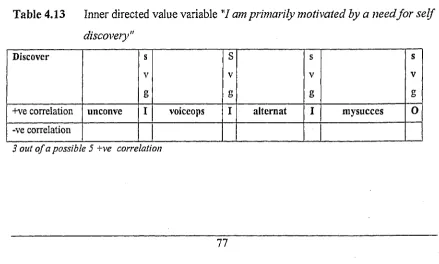
Table 4.1 Sustenance Driven value variable "I am primarily motivated by a need to fe e l secure"
72
Table 4.2 Sustenance Driven value variable "I am keen not to seek change"
72
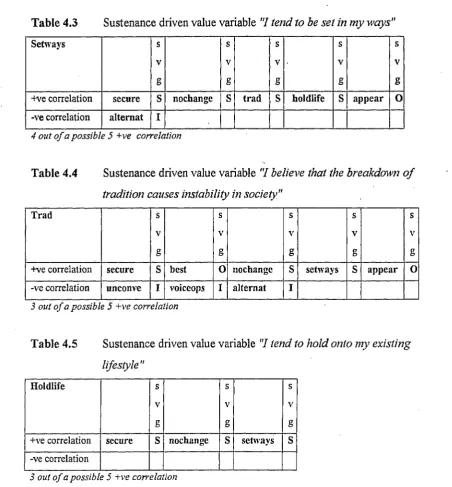
Table 4.3 Sustenance Driven value variable "I tend to be set in my ways" 73
Table 4.4 Sustenance Driven value variable ”1 believe that the breakdown o f tradition causes instability"
73
Table 4.5 Sustenance Driven value variable "I tend to hold onto my existing lifestyle "
73
Table 4.6 Sustenance Driven value variable "I invest relatively little time in making new contacts/friends"
73
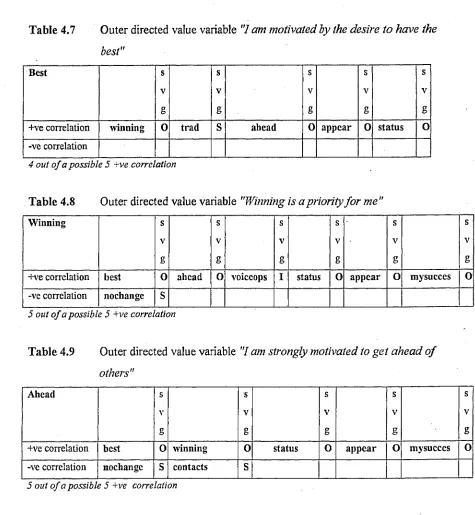
Table 4.7 Outer Directed value variable "I am motivated by the desire to have the best"
75
Table 4.8 Outer Directed value variable "Winning is a priority fo r me " 75
Table 4.9 Outer Directed value variable "I am strongly motivated to get ahead o f others"
75
Table 4.10 Outer Directed value variable "I'm motivated by a desire to improve my status"
75
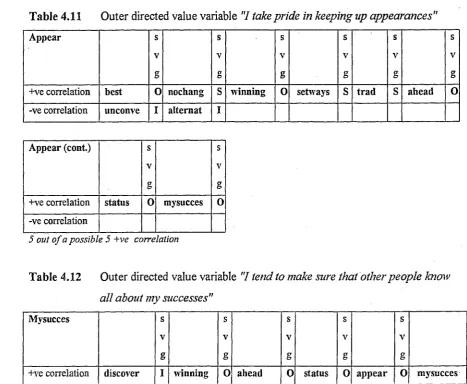
Table 4.11 Outer Directed value variable "I take pride in keeping up appearances"
76
Table 4.12 Outer Directed value variable ”1 tend to make sure that other people know all about my successes"
76
LIST OF TABLES Table 4.15 Table 4.16 Table 4.17 Table 4.18 Table 4.19 Table 4.20 Table 4.21 Table 4.22 Table 4.23 Table 4.24 Table 4.25 Table 4.26 Table 4.27 Table 4.28 Table 4.29 Table 4.30 Table 4.31 Table 4.32 Table 4.33 Table 4.34
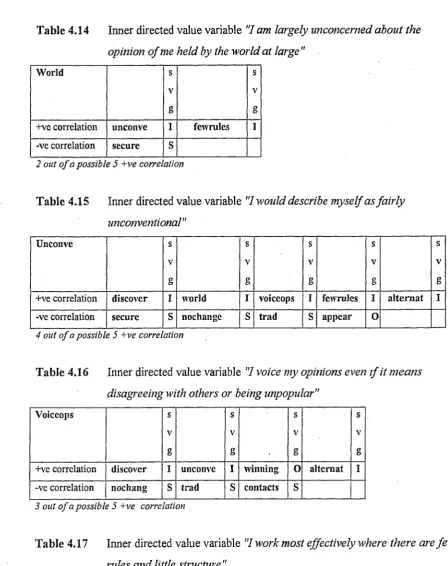
Inner Directed value variable "I would describe m yself as fa irly 78
unconventional"
Inner Directed value variable "I voice my opinions even i f it 78
means disagreeing with others or being unpopular"
Inner Directed value variable "I work most effectively where 78
there are few rules and little structure"
Inner Directed value variable "I believe groups with alternative 78
values and lifestyles are a positive force in society"
Means and Standard Deviations for Social Group Profile Scores 82
for Homogeneous Group of 215
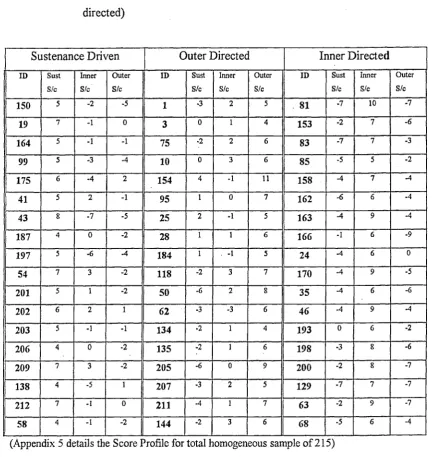
Social Value Score (SVG) Profiles for Dominant Groups 84
(Sample of (54) 18 Sustenance driven, 18 Outer directed, 18 Inner directed)
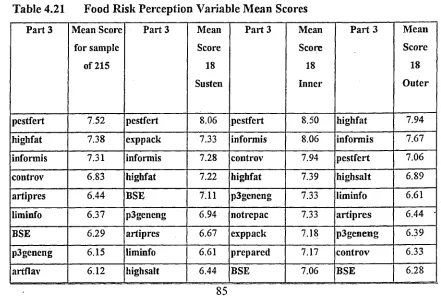
Food Risk Perception Variable Mean Scores 85
Results of Analysis of Variance for Food Risk Perception 87
Questionnaire
Summary Table: Results of the Analysis of Variance for Food 89
Risk Perception Questionnaire. Significant Differences Only
(Data extracted from Table 4.22)
Nine Factor Solution for Food Risk Perception Variables 91
Results of the Analysis of Variance for Factor Scores for the 92
Dominant Sample o f 54
(18 Sustenance driven, 18 Outer directed, 18 Inner directed)
Factor 1 Technology (man made additions to food stuffs) Risks 94
Factor 2 High Cost as a Risk 94
Factor 3 Nutritional Risks 95
Factor 4 Cheap (Image Associated) Risks 95
Factor 5 Ecological (conservationalist / environmental) Risks 96
Factor6/7 Unfamiliarity as Risk 96
Results of Pearson Correlation for Social Value Group (SVG) 98
Score and Food Risk Variable Score for sample of 215
Risk Relieving Strategy Variable Mean Scores 100
Results of the Analysis o f Variance for food Risk Relieving
LIST OF TABLES
Table 4.35 Summary o f Results for the Analysis of Variance for Food Risk
Relieving Strategies (Significant differences only)
102
Table 4.36 Five Factor Solution for Food Risk Relieving Strategy
Variables
104
Table 4.37 Results o f the Analysis o f Variance for the Factor Scores for
the Dominant Sample of 54
(18 Sustenance driven, 18 Outer directed, 18 Inner directed)
105
Table 4.38 Factor 1 Social Acceptance / Endorsement 107
Table 4.39 Factor 2 Low Cost 107
Table 4.40 Factor 3 Branding (Product Orientation) 108
Table 4.41 Factor 4 High Cost (Image) 108
Table 4.42 Factor 5 Authoritarian Reassurance 109
Table 4.43 Results o f Pearson Correlation for Social Value Group (SVG) 110
Score and Risk Relieving Strategy Variable Score for sample o f
LIST OF FIGURES
LIST OF FIGURES
[image:17.565.49.521.4.795.2]ACKNOWLEDGEMENTS
I would like to express my thanks to the following people without whom the task of completing this thesis would have been considerably more difficult.
I would firstly like to thank my director of studies, Ms Loma Daly for her support and guidance throughout the duration of my PhD. In particular, I would like to thank her for her unstinting enthusiasm and patience. I would also like to thank Ms Kate Drew for her inspiration at the outset of the research.
The support I have received from colleagues at Sheffield Hallam University has been immense. Firstly I would like to thank all 1216 members of staff who completed and returned my questionnaire, particularly those who further contributed by participating in interviews.
Secondly and on a more personal level I would like to say how much I have appreciated the sustained support o f the many colleagues and friends I have, within the School of Sport and Leisure Management.
Introduction
CHAPTER ONE
INTRODUCTION
The past fifteen years have presented many challenges for the British Food Industry.
Understanding consumers' risk perceptions are amongst the most fundamental challenges
of all.
The need to explain consumer risk perceptions has been recognised by many, including
more recently the Institute of Food Research Reading, MAFF (1997), the Department of
Health (1998) and the Food Standards Agency (2000) not least as a means o f finding
ways to alleviate the fears that consumers exhibit and which ultimately cause turbulence
in food markets.
These most recent attempts at explaining food risk perceptions have several limitations.
Firstly like those preceding them, they focus for the most part on food safety issues, as
such they fail to demonstrate the diversity of consumer food risk perceptions. Secondly
they fail to investigate the role that risk relieving strategies play in risk perception,
furthermore a sequential ordering of risk perception and risk relief is assumed. Thirdly
they are limited in their ability to address the different food risk perceptions o f groups o f
consumers with different values and lifestyles.
The potential of these insights for exploring food risk perceptions can be seen in other
and related academic fields. Within the fields of marketing and consumer behaviour
Mitchell and Boustani (1992), Foxall and Goldsmith (1994) support the belief that
consumers perceive a variety of risks associated with the purchasing and consuming of
food. Consumers recognise that a risk may challenge not only their physical well being,
but just as importantly their psychological, economic or spiritual well being.
Mitchell and McGoldrick (1996: 1), in the context of retailing, identify that the area of
Introduction
From a background of Anthropology, Douglas teams up with Wildavsky (1982a, 1982b)
suggesting that people do not focus on particular risks simply in order to protect health
or safety. Fundamentally they suggest that consumers' choices also reflect beliefs and
values. Douglas and Wildavsky (1982a) proposed that individuals choose what to fear
and how much to fear it, in order to support and reinforce their way of life.
An examination of the literature highlights that despite its cost there is an increased
enthusiasm within marketing and related fields for the use o f value and lifestyle
segmentation (Gunter and Fumham 1992). Recognising that no one strategy will serve
all consumers, marketers acknowledge the diversity of consumers and the relationship
between consumers personal characteristics and their perceptions and behaviour. The
value and importance of value segmentation for investigating and increasing
understanding of consumer perceptions and behaviour has few critics in marketing.
Despite this, researchers of risk have not yet engaged in its use.
Where value and lifestyle segmentation has been used by researchers in a British context
the tendency has been to use American value typologies to do so despite there being a
British alternative in Taylor Nelson’s Social Value Groups. Taylor Nelson's Social Value
Group typologies offer an alternative that are based on a longitudinal empirical study of
British consumers' values and lifestyles.
This piece of research proposes to address these gaps and limitations.
1.1 AIMS AND OBJECTIVES OF THE RESEARCH
The overall aim of the research is to investigate and clarify how social values, as
identified by Taylor Nelson and reported by MacNulty (1985), influence consumer
Introduction
More specifically the research has the following
objectives:-1. to critically evaluate existing theoretical and empirical research, in the areas of
perception of risk in general and more specifically food risk;
2. to identify members of Taylor Nelson’s three Social Value Groups, ‘Sustenance
driven’, ‘Outer directed’ and ‘Inner directed’;
3. to investigate the food risk perceptions o f ‘Sustenance driven’, ‘Outer directed’ and
‘Inner directed’ consumers;
4. to investigate the risk relieving strategies o f ‘Sustenance driven’, ‘Outer directed’
and ‘Inner directed’ consumers;
5. to make recommendations to the food industry, in light of the research findings.
This research aimed to be the first to use Taylor Nelson's Social Value Group typologies,
as reported by MacNulty (1985), to investigate the relationship between and differences
in consumers' social values and their food risk perception and food risk avoiding
strategies.
1.2 STRUCTURE OF THESIS
The thesis consists of seven chapters. Chapter One provides an introduction to the
research. Chapter Two presents a critical review of existing theoretical and empirical
research relating to consumers' social values and consumer perceptions o f food risk. The
review develops an integrated knowledge and understanding o f the research area in
question. Gaps in and limitations of the published literature are identified, a theoretical
framework is set, boundaries are defined and fundamentally a frame of reference for
Introduction
Chapter Three is in two parts. Part One is a methodological review focusing
predominantly on those broad approaches, methods and techniques adopted in the
research. Part Two details the research design and process for both the pilot and the
main study (see Fig 1 for an overview of the Research Process). Chapters Four and Five
present the results of the research. In Chapter Four, statistical analysis of consumers'
responses to the survey questionnaire is used to test the relationships between
respondent's social values, food risk perceptions and risk avoiding strategies and
identifies differences between consumers with differing social value group membership.
In Chapter Five analysis of the qualitative interviews provides an in-depth understanding
of the findings o f the quantitative results to include the motivational factors involved.
Chapter Six presents an in-depth discussion of the findings in the context of the literature
reviewed in Chapter Two. Limitations of the research are also reviewed in this chapter.
Chapter Seven concludes the thesis by discussing the findings in the context o f the
objectives set in Chapter One and outlining a number of recommendations for further
Introduction
1.3 RESEARCH PROCESS
(Fig 1)
CHAPTERPilot
The Screening InstrumentPilot
Food Risk Perception and Risk Relieving Strategy QuestionnairesFilter
To Obtain Sample for Main StudyMain
Study
Undertaken on the Homogeneous Sample of 215 respondentsDesign, Construct and Administer (pilot sample of 19).
Social Value Group Screening Instrument, (based on the findings o f Taylor Nelson's ‘Monitor’ as reported by MacNulty (1985).
Latterform ing P a rt Two o f the main study questionnaire
Interview One (sample same 19 as above)
Qualitative interviews to validate the Screening Instrument and develop an in-depth understanding of the Social Value Groups.
Design, Construct and Administer (sample as above)
Food Risk Questionnaire (Part Three o f the Main Study Questionnaire).
Food Risk Relieving Questionnaire (Part F our o f the M ain Study Questionnaire).
Additional sections were p ilo ted a t this stage (but not taken fo rw a rd into main study ).
Interview Two (sample comprised 9 from the pilot sample:- 3 Inner directed, 3 Outer directed, 3 Sustenance driven)
To review questionnaire responses with respect to the relationships between social values and food risk perceptions.
Administer whole questionnaire to all staff at Sheffield Hallam University.
1216 returned and completed questionaires (62%).
Part One of the questionnaire was used to select members of an homogenous group. 215 respondents meet the criteria for the homogeneous sample.
Female, 25 - 45ye a rs ofage, in fu ll time employment,household income >£12, OOOpa, no dependent children
Analysis of results of Part Two of the Questionnaire
Quantitative analysis of the screening instalment (Part Two of the questionnaire). The results of this analysis determined the categorisation of the respondents into Sustenance driven, Outer directed, Inner directed and non dominant.
The analysis also provided a test o f the robustness o f the screening instrument.
Analysis of results of Part Three of the Questionnaire
Quantitative analysis of the relationships and differences between the food risk perceptions of Sustenance driven, Outer directed and Inner directed respondents.
Analysis of results of Part Four of the Questionnaire
Quantitative analysis of the relationships and differences between the risk relieving strategies of Sustenance driven, Outer directed and Inner directed respondents.
Interview Three (sample comprised 14 from homogeneous group, 6 Sustenance driven, 4 Inner directed, 4 Outer directed)
Qualitative Interviews focused on Part Three and Part Four of the questionnaire.
Literature Review
CHAPTER TWO
LITERATURE REVIEW
The following chapter critically reviews both theoretical and empirical research relating
to consumers' social values and consumers' perceptions of food risk. The review seeks to
develop an integrated knowledge and understanding of the research area, and to generate
a frame of reference for identifying the questions to be addressed in the proposed
research.
Gaps and limitations in the research literature suggest that the influence o f social values
on the consumer perception o f food risk is an area in need o f further exploration,
investigation and development. This is in the context of the following questions, what
food risks are perceived, by whom and why, and finally how do consumers manage those
risk perceptions.
The review focuses on the following key areas. Firstly the influence o f social values on
consumers' perceptions is examined, with an in-depth exploration of Taylor Nelson’s
Social Value Group typologies. The review continues with an examination o f the
concept of risk. Risk perceptions and risk relieving strategies are then explored as an
integral part of consumer’s decision making processes. This exploration is initially non
specific before focusing on food.
2.1 SOCIAL VALUES, VARIABLES INFLUENCING
CONSUMER PERCEPTIONS
___________________________________________________________Literature Review
psychographic (values and lifestyles) and geographic profiles have been examined to
ascertain how they may contribute to our understanding o f consumer perceptions,
behaviour and decision making processes.
The intangible subjectivity of social values and attitudes means that they are open to
interpretation and are much more complex to use as independent variables in
investigation and statistical analysis than more tangible data such as age and gender.
Social values are however increasingly recognised as fundamental to understanding
consumers.
Mitchell (1983: vii) believes that values and lifestyles help to explain practical and
diverse questions such as, “why we support some issues and oppose others; why some
people are strong leaders and others weak; why we trust some people and are suspicious
of others and why some products attract us and others don’t”.
"By the term ‘values’ one mean’s the entire constellation of a person’s attitudes,
beliefs, opinions, hopes, fears, prejudices, needs, desires and aspirations that,
taken together govern how one behaves. One’s interior set of values - numerous,
complex, overlapping, and contradictory though they are - finds holistic
expression in a lifestyle" (Mitchell 1983: vii).
All definitions of value derive from the Latin word, 'valere', meaning ‘to be w orth’ or ‘to
be strong’. Social scientists' concept o f value most closely allies itself with the worth
conception, a principle, standard, course o f action or quality considered useful or
worthwhile. Values are central to people's lives in that they relate highly to what they
prize, hold in esteem and nurture, because of this importance, “values also influence
behaviour” (Kahle 1983: 14). Rokeach (1973: 79) has provided one of the most
influential definitions by a social scientist, “value is an enduring belief that a specific
mode of conduct or end state of existence is personally or socially preferable to an
opposite or converse mode of conduct or end state of existence. A value system is an
enduring organisation o f beliefs concerning preferable modes of conduct or end - states
Literature Review
Values are a type of social cognition. That is, values help us to know and understand
our interpersonal worlds. "As primarily learned or acquired conceptions, a social
cognition tells a great deal about the people that hold them" (Kahle 1983: 14).
Rokeach (1973: 76) defined values as, “desirable and enduring end states that influence
both perceptions and behaviour. As desired ends, values transcend specific situations”
this is supported by Kahle (1983). They provide a structural framework for existing
knowledge, a basis for interpreting and incorporating new information and an abstract set
of guiding principles.
There is a substantial body of theory that predicts that values shape perceptions and
behaviours. The link between values and attitudes, and wants and needs has been
recognised Rose et al (1994: 1504) recognised that, “social values influence the need for
affiliation, which ultimately influences the relative importance attached to the display
dimensions o f clothing (e.g. style, brand name), versus the utilitarian properties o f a
garment (e.g. ease of care, durability)”.
Consumers' values vary according to many factors, these include; their dominant cultural
beliefs, personal experiences, integration into social organisations / institutions. Values
are the result of a multitude of variables combining fundamental elements o f the
consumer’s life. As a result they provide a base from which to develop an understanding
of consumer perceptions. Any attempt to understand consumers without exploring their
values would be to ignore a fundamental element of what motivates their decision
making and their lifestyle.
2.2 SOCIAL VALUE SEGMENTATION
Demographic and socio-economic descriptors have been commonly used in research as a
Literature Review
large scale consumer surveys). Despite this Bowles (1987) highlights that an increasing
dissatisfaction with demographic classifications, as the sole way o f describing target
audiences, increasingly exists, and that their still dominant use is due to their
commonality rather that their value.
Yankelovich (1964: 83); a respected author in the field of market segmentation, stated
“differences in buyer attitudes, motivations, and values are more crucial to marketing
objectives than demographics”. Velzhoffer and Ascheberg (1999: 47) claimed that “in
everyday life the same socio-economic life conditions evidently produce unequal worlds”
questioning the reliability of socio-economic segmentation, this is supported by Brown
(1993).
Psychographic segmentation, broadly defined as the study of values and lifestyles, is
increasingly recognised as an important tool when attempting to understand, predict and
even modify consumers perceptions and behaviour. Hatton (2000: 2) claims that “today,
psychographic and lifestyle segmentation based approaches, are more likely to yield
segments with a unique common need, which organisations can work towards
satisfying”. Psychographic variables are frequently used alongside more traditional
segmentation variables such as demographics in attempts to adopt a multi-segmentation
approach. Psychographic variables seek to describe the characteristics o f consumers
such as self concept, attitudes, interests, opinions, beliefs and values that may influence
the manner in which consumers react to situations, products and even advertising /
communication efforts (Perri 1990).
Much literature and research supports segmentation based on consumer values (Scott
and Lamont 1970, Cunningham and Crissy 1972, Vinston et al 1977a, Vinston at al
1977b, Henry 1976, Munson 1979, Atlas 1984, Leach 1987, Goldsmith et al 1997,
Bainbridge 1999, Kahle et al 1999, Dolliver 2000). Its use and application however still
remains limited, this is despite its potential to offer much in the way of an explanation
and understanding of consumer perceptions and decision making processes.
Literature Review
purported to yield enduring psychological constructs which define the broadest consumer
populations, but which also predict idiosyncratic behaviour" (Gunter and Fumham 1992:
26).
Theories, methods and typologies of values and lifestyles used in consumer research
include Riesman's ‘Theory on Social Character’, ‘The Value and Lifestyle Survey’
(VALS) / Mitchell’s ‘The Nine American Lifestyles’, The List o f Values (LOV)
developed in Michigan and Taylor Nelson’s ‘Social Value Groups’.
Riesman (1950) presents a theory o f ‘social character’ which has had a great impact on
value and lifestyle research. The theory asserts that, in general, human beings can be
grouped into three major types of social character, ‘Tradition-directed’; ‘Inner-directed’;
and Other-directed’.
Mitchell’s ‘The Nine American Lifestyles’ (1983), developed at Stanford Research
Institute, California was strongly influenced by Riesman’s work. Mitchell used a survey
to analyse and systematise the values and lifestyles (VALS) of Americans in such a way
as to yield insights into why people believe and act as they do. VALS attempts to
provide a way of looking at the dynamics o f individual and societal change. The system
is foremost a conceptual scheme based on the findings of developmental psychology, but,
as established in field research, the approach has practical applicability. The VALS
typology comprises four groups that are sub-divided into nine lifestyles. The four groups
were labelled Need- Driven', 'Outer- Directed', 'Inner Directed' and 'Combined Outer and
Inner Directed'. The nine lifestyles were given the labels; 'Survivor', 'Sustainer',
'Belonger', 'Emulator', 'Achiever', 'I Am Me', 'Experiential', 'Societally Conscious',
'Integrated'.
The List of Values (LOV) was developed by researchers at the University o f Michigan
Survey Research Centre (Kahle 1983; Veroff et al 1981). LOV was developed from the
theoretical base o f Feather’s (1975), Maslow’s (1970) and Rokeach’s (1973) work on
values in order to assess adaptation to various roles through value fulfilment and
Literature Review
subdivided values into two dimensions: Internal and External. This division was
theoretically based on the work of Rotter (1966).
With the exception of Taylor Nelson’s Social Value Groups these typologies have all
been designed and developed according to the values of American consumers living in
the USA. In contrast Taylor Nelson Ltd, a British based company, used empirical
research to identify Social Value Groups based on the contrasting values and attitudes of
British consumers.
Taylor Nelson’s Social Value Groups do however bear a strong resemblance to the
‘Social Characters’ described by Riesman in ‘The Lonely Crowd’ (1950), in so far as
they comprise three Social Value Groups, ‘Sustenance driven’, ‘Inner directed’ and
‘Outer directed’. The characteristics o f Taylor Nelson’s Social Value Groups are
detailed in Table 2.1.
Fundamental to all of these value typologies is Motivation theory. Acknowledged in all
of these typologies is Maslow’s 'Hierarchy of Needs' (Maslow 1970). As a fundamental
theory of motivation, Maslow’s ‘Hierarchy of needs’ has been extensively cited and used
as a frame of theoretical reference for value segmentation.
Maslow (1970) proposed that the individual has seven levels o f need, he/she is motivated
by these needs and must satisfy the more basic needs before he/she can give his/her
attention to those higher in the hierarchy. According to Maslow, when struggling for
bare survival the individual has a narrow perspective; his/her demands are for food and
shelter. With industrial wealth guaranteeing economic well-being, the individual is
motivated to satisfy their need for personal expression and personal freedom. At a more
developed stage o f the economy, the individual can afford the luxury o f a social
conscience; at this point altruistic concerns come to the surface.
Using Maslow’s Hierarchy of Needs, MacNulty (1985) positions Taylor Nelson’s three
Social Value Groups, Sustenance driven, Outer directed and Inner Directed at ascending
stages of the hierarchy. However, whilst Maslow’s hierarchy implies that individuals
Literature Review
o f values from more than one group. Despite this, Taylor Nelson's Social Value Groups
clearly share Maslow’s belief in the fundamental importance of motivation in
understanding consumer decision making and behaviour.
MacNulty (1985: 335) reviewing Taylor Nelson's Social Value Groups stresses the
importance of motivation. He suggests that consumers in different social value groups
might behave in a similar ‘fashion’, for example “choosing to eat less”, however,
fundamentally their motivation is very different. The Sustenance driven consumer for
example eats less because “food is so expensive”, the Outer directed consumer in
contrast eats less because they “want to look good” and the Inner directed consumer eats
less “to feel better”. This insight underlines the importance not only of exploring the
perceptions of different groups but also of exploring the motivations that lie beneath
them.
Taylor Nelson’s typology of Social Value Groups has already been recognised as a useful
conceptual tool in understanding consumer behaviour in the fields of leisure (Gratton and
Taylor 1991) and Tourism (Dalen 1989). Other areas of application have included
product innovation, purchasing, branding, advertising, food consumption (Nelson 1986,
Skelly and Nelson 1966, Caulkin 1987, Laurence 1989), new product development
(Nelson 1986), management strategy (Tame 1993), retailing (Powderly and MacNulty
1990) and organisational structures / dynamics (MacNulty 1985).
2.3 TAYLOR NELSON'S SOCIAL VALUE GROUPS
By the beginning of the 1970’s it was clear to Taylor Nelson Associates, a British based
International Market Research Group, that their clients required additional information
beyond traditional economic, technological and market research data. They needed to
know how people behaved in the market place and work place, but also and perhaps
Literature Review
In 1973, with an aim of meeting this need, Taylor Nelson Ltd started ‘The M onitor’, a
longitudinal survey aimed at investigating the structure and dynamics o f British society
via 15,000 interviews. The programme was based on an annual survey o f a national,
stratified, random sample of the UK population. The survey contained questions relating
to the choices and concerns o f the respondents. Subsequent analysis of the data enabled
the examination o f attitudes and values of the population in terms of 36 trends derived
from more than 160 variables which have been identified in British society (MacNulty
1985). One objective was that the Monitor system would help companies respond to
changes in social values taking place across Britain at any given period of time.
The results of the monitor indicate that the British population holds values and attitudes
which divide into seven groups. These groups were given the labels; ‘Aimless’;
‘Survivors’; ‘Belongers’; ‘Conspicuous Consumers’; ‘Social Resisters’,
‘Experimentalists’; ‘Self Explorer’, these in turn were aggregated into three major
classifications labelled as: ‘Sustenance driven consumers’; ‘Outer directed consumers’
and ‘Inner directed consumers’ (MacNulty 1985). Fundamentally members o f every
socio-economic level were found within each Social Value Group. After examining the
results of the Monitor, Laurence (1989: 123) observed that “there is almost no
correlation between social value groups and the social class groups traditionally used in
market research. The social value groups are equally represented in each o f the
A,B,C1,C2,D,E categories”. MacNulty (1985) described each o f the three Social Value
Groups by highlighting their values and characteristic traits. These are detailed in Table
Literature Review
Table 2.1 Summary o f Social Value Group Value’s (Adapted from MacNulty(1985: 332-347))
Sustenance Driven
- Clannish
- Motivated by the need for security
- Cling to an existing lifestyle, set in their ways, resistant to change
- Have a great respect for tradition
- Concerned to maintain the status quo, looking for tradition and stability
- Perceive change as a threat
- Lead fearful and constrained lives, risk aversive
- Class conscious
- Relatively limited in the scope of their behaviour
- Tend to have somewhat narrow horizons both mentally and physically
Outer Directed
- Motivated by the search for esteem and status
- The criteria by which they measure their success are external to themselves
- They want to be seen to live in the "right part o f town", drive the "right car", etc.
- Concerned about their appearance and position
- Materialistic
- Seek to improve their position in financial and social terms
- Motivated by acquisition, competition and getting ahead, being / having the best
- Traditional
- Pro-authority, support law and order
- Pushy
- Require social mobility to enjoy their lifestyles
Inner Directed
- Motivated by self - realisation / actualisation
- Individualistic
- Largely unconcerned about the opinion of them held by the world at large
- Their criteria for success and the standards of their behaviour are within themselves
- They usually have a broad horizon,
- A good understanding of the world's events
- Altruistic
- Concerned with social issues such as peace, ecology, social responsibility, and democratic processes
Literature Review
MacNulty (1985) illustrated the contrasting values of the members o f the Social Value
Groups further by examining fundamental elements of their social life, these included the
family, work, leisure and attitudes towards authority.
2.3.1 SOCIAL VALUE GROUP’S ELEMENTS OF SOCIAL LIFE
2.3.1.1 FAMILY
MacNulty (1985) identified Sustenance driven consumers as
“conservative, traditional, conventional, pragmatic and devoted to his family,
which he places above other things and for which he makes substantial self
sacrifice” (: 333).
“He tends to be against change and his interest in the future is to ensure his
family’s security” (: 333).
MacNulty suggested that because
“horizons are constrained by orientation to the family, one also tends to be
worried, pedantic and rule following” (: 333).
They believe the family unit supports their need for security and stability. Resistant to
change he describes them as “clannish” (: 332). In contrast the Outer directed
consumer’s priority is that the family be “a credit to them” (: 333).
“They are interested in their family’s appearance and behaviour....” (: 333).
MacNulty (1985) suggested that Inner directed consumers are
“highly individualistic”(: 334,342)
“autonomous behaviour will be a principal factor. Individual family members will
tend to develop their own interests and friends outside the rather loosely defined
family context. Friendship and common interests will be considered more
important than (or certainly equally important as) blood relationships” (: 342)
“They reject traditional authority and established procedures, and are a powerful
Literature Review
2.3.1.2 W ORK AND LEISURE
MacNulty (1985) suggested that Sustenance driven consumers
“are motivated by the need for security”(: 332)
they were frequently economically disadvantaged but even when this was not the case
the Sustenance driven consumer would still remain thrifty. There is a suggestion that
they perceive work as a necessity and leisure very much a luxury. MacNulty (1985)
suggests that the Sustenance driven consumer will commonly,
“follow the Protestant work ethic and are deeply concerned about
unemployment”(: 334)
"motive is to get along and their attitudes are those which we call 'working class
values'"(: 332)
“They believe that society should provide employment”(: 336).
“They associate their employment with the notion o f producing goods”(: 336).
Outer directed consumers are described by MacNulty as
“materialistic, pushy and motivated by seeking to improve their position in
financial and social terms”(: 333).
This being the case, both work and leisure time would be fundamental to their self
identity. In sharp contrast MacNulty (1987) suggested that the Inner directed
consumers had a very different work/ leisure ethic, emphasising the attitudes o f
“ caring, autonomous behaviour and self realisation^- 334)”
“individualistic, empathetic, tolerant and non-exploitative” (: 342)
Work perhaps a mechanism through which they can self express and self realise rather
than just economic / material necessity or status.
“The economy will be designed to support a society which places value
on... work as a means of personal fulfilment (rather than for economic
necessity), and the creative use of leisure time for individual growth” (: 341)
More emphasis is placed on the experience and less on status. Leisure emphasises self
development and individual growth which may take the form o f educational activities as
Literature Review
2.3.1.3 ATTITUDES TOWARDS AUTHORITY
MacNulty (1985) suggested that Sustenance driven consumers are
“conservative, traditional and conventional” (: 333)
MacNulty suggested that we might expect this group
“to be relatively limited in the scope of their behaviour”(: 333).
“Alternative courses of action and imaginative responses to new situations will be
difficult” (: 333).
Outer directed consumers are described as respecting and trusting experts and authority
but being motivated by
“status and acquisition" (: 333).
MacNulty (1985) indicates that Inner directed consumers exhibit autonomous behaviour.
They are further described as “less orthodox”(: 334), as having “little trust for traditional
authority and importantly, very likely to be concerned with spiritual values”.
MacNulty (1985) described the Inner directed consumers as
"has broad horizons" (: 333).
“... .likely to reject doctrinaire solutions in favour of the moral holistic view that
change is an organic process" (: 334).
“broadest horizons, the highest tolerances and the largest propensity to solve
problems on a global scale. They also have a tendency to hold spiritual values”
(: 334).
MacNulty (1985) suggests that up until the 1970’s the two classifications Sustenance
driven and Outer directed represented a fair picture o f British society. Believing that the
major institutions in UK society are based on this kind of model, MacNulty (1985)
presumes that there were members of the Inner directed group about, but that they were
probably so few as to be statistically undetectable. That situation has now changed and
the Inner directed group is regarded as being o f significant importance. Taylor Nelson’s
findings revealed the increasing existence o f ‘Inner directed’ consumers. In fact Inner
directedness was identified as the set of social values set most likely to be dominant in
Literature Review
The social values of the Inner directed group can also be identified in the work o f
Giddens (1991). Giddens (1991: 109) describes a ‘universe o f high modernity’, in which
many o f the values described as 'Inner directed' by MacNulty (1985) are identified. The
highly reflexive Inner directed consumer is evident in Giddens (1991) work, actively
‘reskilling’ i.e. reacquiring both knowledge and skills. For these individuals the 'reflexive
project of the self generates programmes of actualisation and mastery, typically
aspirations of the Inner directed consumer.
2.4 CONSUMER PERCEPTIONS
As stated earlier in this review, Rose et al (1994) reports that there is a substantial body
of theory that predicts that values shape perceptions. Consumers perceptions in turn are
fundamental to understanding consumers' attitudes and behaviour.
However, despite this Foxall and Goldsmith (1994: 50) suggest that
“as with so many of the terms encountered in the social sciences, perception is
used rather vaguely in eveiyday discourse, but must be understood more
precisely if it is to be useful in explaining aspects of human behaviour”.
Harrell (1986: 7029) understands perception to mean “the process o f recognising,
selecting, organising, and interpreting stimuli, in order to make sense of the world
around us” . “Perception of goods and services depend in part, on the stimuli to which
consumers are exposed, and in part on the ways these stimuli are given meaning by
consumers”. Foxall and Goldsmith (1994: 50) proposed that “Our different perceptions
of products can account for different attitudes and behaviours towards products”.
Foxall and Goldsmith (1994: 51) suggest that
“two facets of perception are of special interest. First, people become aware of
Literature Review
depends on the socio-psychological meaning the individual attaches to the object
perceived”
The perceptual process of food choice is complex, personal and highly selective. Foxall
and Goldsmith (1994: 50) recognise this process as selective and suggest that
“consumers pay attention to and interpret stimuli that reinforce and enhance their views
of their world, of themselves and the goods and services that they buy”. This
understanding of the way in which consumers construct and reinforce ‘world views’
through the selective perception of risk is discussed and explored further, later in this
chapter.
2.5 RISK AND RISK PERCEPTION
2.5.1 DEFINITIONS OF RISK
A number of authors have highlighted the centrality of risk to modern life. Lupton
(1999: 3) argues that “In contemporary western societies, where control over one’s life
has become increasingly viewed as important, the concept o f ‘risk’ is now widely used
to explain deviations from the norm, misfortune and frightening events”
Giddens (1991: 3) proposed that risk is a fundamental element in modern society. "The
concept of risk becomes fundamental to the way both lay actors and technical specialists
organise their social world”. “To live in the universe of high modernity is to live in an
environment of chance and risk”. Giddens (1991: 324) highlights a characteristic of high
modernity as plurality of choice, he suggests that, “to act in and to engage with a world
of plural choices is to opt for alternatives. This system inevitably presents an increased
number of decisions to be made and consequently potential risks”.
Numerous attempts have been made to define risk. Beck (1992: 21) defines risk as "a
systematic way o f dealing with hazards and insecurities induced and introduced by
Literature Review
this factor has political potential since "averting and managing these can include a
reorganisation of power and authority".
Other authors including Short (1984: 712) suggest that “risk is the probability o f some
future event” similarly Lowrance (1976: 7027) defined risk as, “the likelihood, or
probability, of some adverse effect of a hazard”. Interestingly Hohenemser et al (1983:
378) suggested that “hazards are a special kind of environmental event that pose threats
to humans and to the things that humans value” .
2.5.2 RISK, ’TYPES' AND CONTEXTS
From the broadest of contexts, it is fair to suggest that when a consumer perceives that
something they value is threatened they perceive risk. This is supported by Kates and
Kasperson (1983: 7027) when they suggest that “hazards are threats to people and what
they value and risks are measures of hazards”. Risk is about perceived loss which may
fall into any of the categories, "'physical', 'psychological', 'social', 'finance' or
'performance'" (Kaplan, et al 1974: 289). Mitchell and Boustani (1992: 17) suggest that
there are "several different types of risk which might affect consumers' purchasing habits.
These include physical risk, financial risk, social risk, psychological risk and time risk".
Foxall and Goldsmith (1994: 57) present ‘performance /functional', ‘financial’, ‘physical’,
‘psychological’, ‘social’ and ‘time’ as types of perceived risk.
Consumer perception of risk has been investigated and reported extensively in the
academic literature. Contributions to the understanding of risk perception have been
informed by theoretical insights from one or more paradigms including, Sociology
(Giddens 1990, 1991, Beck 1992, Lupton 1999); Anthropology (Douglas and Wildavsky
1982a 1982b); Psychology (Weinstein 1983, 1984, 1987, McKenna 1993, Hoorens and
Bunk 1993, Langer 1975); Political Science (Wildavsky and Dake 1990, Dake 1991);
Literature Review
Areas o f application have included:- nuclear power, industrial chemicals, natural
disasters, medical and biological intervention and health (Slovic, et al 1979, Sparks et al
1992, Baxter 1990). Within this body of work there is a dominant interest in
technological hazards and physical risk, on the whole these are analysed objectively with
an aim to their quantification. By and large the 'victims' of such risks appear to be largely
observed as an homogeneous 'public'. Such an approach for the most part ignores the
fundamental need to recognise differences amongst the masses.
Decision theorists define ‘risk’ as the situation where a decision maker has a prior
knowledge of both the consequences of alternatives and their probabilities o f occurrence.
The concept o f perceived risk used by consumer researchers, however, bears a closer
relationship to the concept of partial ignorance (where neither the consequences of
alternatives nor their probabilities of occurrence are accurately known). In this view
partial ignorance may led to dread or/and hysteria (Slovic et al 1982, 1979) on one hand
or optimistic bias (Weinstein et al 1988) on the other.
Bauer (1960: 389), proposed consumer behaviour as an, “instance of risk taking”, he
suggested that:
“consumer behaviour involves risk in the sense that, any action o f a consumer
will produce consequences which he cannot anticipate with anything
approximating certainty, and some of which at least, are likely to be unpleasant”
(Bauer 1960: 390).
Understanding perceived risk is at the heart of understanding consumers' behaviour,
Bauer (1967), strongly emphasised that he, and consumer behaviour research, is
concerned only with the subjective (perceived) risk and not ‘real world’ or ‘objective
risk’. This approach is particularly appropriate for the investigation of food risk
perceptions, where an intimate and deeply personal relationship exists between the
consumer and food choice. Mitchell (1998) suggests that perceived risk is not only
present in the highly visible food scares, but also motivates and helps to explain
consumers' daily and weekly food purchasing. Consumer perceptions of food risks
Literature Review
justified, or not. The importance of understanding why consumers perceive what they
perceive cannot be understated.
2.5.3 RISK PERCEPTION CONSUMER SELECTION
Risk perception is increasingly recognised as an integral part o f a consumer’s social
world. In this context Mary Douglas, a British anthropologist, and Aarron Wildavsky,
an American political scientist (1982a, 1982b) examined the question: ‘Why do people
emphasise some risks while ignoring others?’ They focused on technological risks such
as the perils of nuclear waste and carcinogenic chemicals. Douglas and Wildavsky
believe that societies selectively choose particular risks for attention. They suggest that
societies have their own distinctive portfolio of risks, equally they suggest that each
society institutionalises means for controlling / managing some risks and not others.
Douglas and Wildavsky (1982a, 1982b) claim that people do not focus on particular
risks simply in order to protect health, safety or the environment. "Their choice also
reflects their beliefs, values, social institutions, nature, and moral behaviour. Risks are
exaggerated or minimised according to the social, cultural, and moral acceptability o f the
underlying activity" (Douglas and Wildavsky (1982b: 12). They believed that what
societies chose to call ‘risky’ is largely determined by social and cultural factors, not
nature.
Viewing individuals as the active organisers of their own perceptions, Wildavsky and
Dake (1990, 1991), as other cultural theorists have, proposed that individuals choose
what to fear and how much to fear it, in order to support their way of life. In this
perspective,
"selective attention to risk, and preferences among different types o f risk taking
or avoiding, correspond to cultural biases, that is, to world views or ideologies
Literature Review
Combinations of cultural biases and social relations are referred to in this theoiy as ‘ways
of life’. More specifically, then, 'hierarchical', 'hermit', 'fatalist', 'egalitarian', or
'individualist' forms of social relations, together with the cultural biases that justify them,
are each hypothesised to engender distinctive representations of what constitutes a
hazard and what does not. Among all possible risks, those selected for worry or
dismissal are functional, in the sense that they strengthen one of these ‘ways o f life’, and
weaken the others. Wildavsky and Dake (1990: 44) suggest that "since cultural biases
are forms o f ideology, there should be high correlations between certain biases and
corresponding ideologies".
Accordingly, from the perspective of cultural theory, risk is not an objective reality;
instead, “the perception of risk is a social process” (Douglas and Wildavsky 1982a: 50,
1982b). Each culture, each set of shared values and supporting social institutions, is
biased toward highlighting certain risks and downplaying others.
Douglas and Wildavsky focus largely on differences between societies and not on the
differences between groups within those societies, Wildavsky and Dake (1990) however
designed a questionnaire to focus on differences between groups within society and more
specifically within American society. From a cultural theory perspective, and in relation
to risks associated with, social deviance, nature and technology Wildavsky and Dake
(1990) and Dake (1991) have successfully used this approach, as a basis for
understanding risk perception within the United States of America. Crucially as part of
this research Wildavsky and Dake (1990) tested five risk perception theories on their
ability to predict and explain what kinds o f people will perceive which sorts o f hazards,
and how dangerous they might be. The theories examined were: 'knowledge theory';
'personality theory'; 'economic theory'; 'political theory' and 'cultural theory'. Their
results confirmed that whilst there is value in all the five theories, cultural theory
provides the best predictions of a broad range of perceived risk.
Wildavsky and Dake (1990) present enlightening and inspirational research. However,
there are questions as to whether or not this approach can readily be transposed, to
Literature Review
2.6 RISK RELIEVING STRATEGIES
Consumers are frequently presented with situations where they are required to make
assessments, judgements and ultimately decisions. Giddens (1991) suggests that
members of today’s society will have an increasing number of decisions to make.
Consumers will inevitably adopt strategies aimed at effectively managing their exposure
to potential risks. Bauer (1960: 390) suggests that
"consumers characteristically develop decision strategies and ways o f reducing
risk, this enables them to act with relative confidence and ease in situations where
their information is inadequate and the consequences of their actions are in some
meaningful sense incalculable".
Knowledge of consumer's perceived risks and effective risk relieving strategy is
particularly valuable in the food industry, where perceived risk can lead at worst to the
failure of a product / service, and at best to the decline in sales or a damaged brand /
company reputation.
“Buyers often face the dilemma of wanting to purchase a product, and yet they hesitate
to buy, because it involves taking the risk of suffering some type o f loss”, (Roselius
1971: 56). When a buyer perceives risk in a purchase situation Roselius (1971) believes
he / she will pursue one of four different strategies of risk resolution,
“reduce perceived risk by either decreasing the probability that the purchase will
fail, or by reducing the severity of real or imagined loss suffered if the purchase
does fail; shift from one type of loss to one for which he has tolerance; postpone
the purchase, in which case he would be shifting from one general risk type to
another; make the purchase and absorb the unresolved risk” (Roselius 1971: 56).
Mitchell and McGoldrick (1996: 1-3) as a result of an intensive review of the published
research into consumers' risk reduction strategies, note that much research has focused
Literature Review
risk and the strategies they employ to reduce it”. They believe that this area has been
given “little attention” and describe it as “neglected”.
The orientation of published research into risk reliving strategies is on th