warwick.ac.uk/lib-publications
A Thesis Submitted for the Degree of PhD at the University of Warwick
Permanent WRAP URL:
http://wrap.warwick.ac.uk/80019
Copyright and reuse:
This thesis is made available online and is protected by original copyright.
Please scroll down to view the document itself.
Please refer to the repository record for this item for information to help you to cite it.
Our policy information is available from the repository home page.
M
A E
G
NS I
T A T MOLEM
U N
IV
ER
SITAS WARWICE
NS
IS
The Design and Performance Analysis of Diffusive
Molecular Communication Systems
by
Xiayang Wang
Thesis
Submitted to the University of Warwick
for the degree of
Doctor of Philosophy
School of Engineering
Contents
List of Tables v
List of Figures vi
Acknowledgments ix
Declarations x
List of Publications xi
Abstract xii
Abbreviations xiii
Chapter 1 Introduction 1
1.1 Basic elements for nano-communications systems . . . 2
1.2 Molecular communications systems . . . 3
1.2.1 MC system transportation modes . . . 3
1.2.2 Diffusive MC systems . . . 5
1.2.3 Comparisons between CC systems and diffusive MC systems 8 1.2.4 Recent advancements in diffusive MC systems . . . 9
1.3 The aim and specifically divided tasks of the Ph.D. project . . . 10
1.4 Contributions to drive the entire thesis . . . 13
1.5 The organisation of the thesis . . . 14
Chapter 2 The Design of MC System Model-I and Its Performance Analysis 18 2.1 Introduction . . . 18
2.3 Performance analysis of MC system Model-I . . . 25
2.3.1 Bit Error Rate analysis . . . 26
2.3.2 Capacity analysis . . . 29
2.3.3 A refined design of the decision variable . . . 30
2.4 Numeral results . . . 31
2.4.1 Channel performance whenPtx= 0.5 . . . 32
2.4.2 Channel performance with differentPtx . . . 36
2.5 Conclusions . . . 37
Chapter 3 An Algorithmic Distance Estimation Scheme Based on System Model-I 38 3.1 Introduction . . . 38
3.2 Diffusion-Based MC System Structure . . . 40
3.3 Distance estimation scheme . . . 43
3.3.1 The Distance Estimation Scheme in Unsynchronised Conditions 44 3.3.2 The Distance Estimation Scheme in Synchronised Conditions 45 3.3.3 Parameter Optimisation Methods . . . 46
3.4 Numeral results . . . 47
3.4.1 Distance Estimation Scheme in Unsynchronised Condition . . 48
3.4.2 Distance Estimation Scheme in Synchronised Condition . . . 52
3.5 Conclusions . . . 53
Chapter 4 Communication Protocols: SW-ARQ schemes in MC sys-tems 54 4.1 Introduction . . . 54
4.2 System transmission structure . . . 56
4.3 SW-ARQ schemes . . . 58
4.3.1 Scheme 1 . . . 58
4.3.2 Scheme 2 . . . 60
4.3.3 Scheme 3 . . . 61
4.3.4 Scheme 4 . . . 62
4.3.5 Scheme 5 . . . 63
4.4 Numeral results . . . 63
4.4.1 Results for Scheme 1 and 2 . . . 64
4.4.2 Results for Scheme 3 . . . 65
4.4.3 Results for Scheme 4 . . . 66
4.4.4 Results for Scheme 5 . . . 68
Chapter 5 The Design of MC System Model-II and The Performance
Analysis 71
5.1 Introduction . . . 71
5.2 The diffusion-based MC system model based on molecular concentra-tions . . . 73
5.3 Performance analysis of MC system Model-II . . . 78
5.3.1 Bit Error Rate analysis . . . 79
5.3.2 Capacity analysis . . . 81
5.4 Numeral results . . . 82
5.4.1 The concentration with different emission durations . . . 83
5.4.2 Performance analysis for Model-II at one distance . . . 84
5.4.3 Performance analysis for Model-II at different distances . . . 87
5.5 Conclusions . . . 89
Chapter 6 Distance estimation schemes based on system Model-II 91 6.1 Introduction . . . 91
6.2 Concentration-Based MC System Structure . . . 93
6.3 Distance estimation schemes . . . 94
6.3.1 Using the peak time to estimate the distance . . . 94
6.3.2 Using the energy to estimate the distance . . . 96
6.3.3 Applying the estimated distance to decode messages . . . 97
6.4 Numeral results . . . 99
6.4.1 Using the peak time to estimate the distance . . . 100
6.4.2 Using the energy to estimate the distance . . . 102
6.4.3 System BER analysis with distance estimation scheme applied 104 6.5 Conclusions . . . 105
Chapter 7 Performance analysis of the relaying MC system based on Model-II 106 7.1 Introduction . . . 106
7.2 Relaying system structure . . . 108
7.3 Relay channel analysis . . . 110
7.3.1 BER for ‘Relay-1’ . . . 110
7.3.2 BER for ‘Relay-2’ . . . 114
7.3.3 An alternative way to obtain the system BER . . . 115
7.4 Numeral results . . . 116
Chapter 8 Conclusions and Future Work 120
8.1 Conclusions . . . 120
List of Tables
1.1 Differences between CC and MC . . . 8
2.1 Model-I: error patterns and their probabilities for ISI length I = 2. . 28
2.2 Parameters assignment for the analysis of Model-I . . . 32
2.3 The comparison between theoretical and simulated BER with m =
5×10³, and I=20 . . . . 35
3.1 Parameters for simulating the distance estimation scheme for Model-I 48
4.1 Simulation parameters for the investigation of the SW-ARQ schemes 63
4.2 Time cost and energy consumption for Scheme 4 and Scheme 3 at
d= 3µm. . . 67
4.3 Time cost and energy consumption for Scheme 5 atd= 3µm. . . . 68
4.4 Time cost and energy consumption for all five schemes atd= 3µm. 69
5.1 Model-II: error patterns and their probabilities for ISI lengthI = 2. 81
5.2 Parameter assignment to analyse the performance of Model-II . . . . 82
6.1 Parameters to simulate the distance estimation schemes for Model-II. 99
List of Figures
1.1 The block diagram of nano-communications systems. . . 2
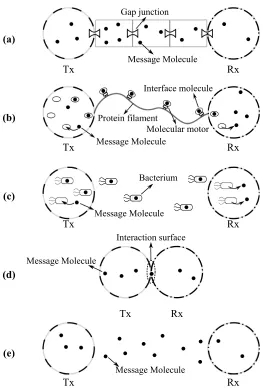
1.2 Five different MC architectures. . . 4
1.3 The outline of the MC system incorporating nano-machines. . . 5
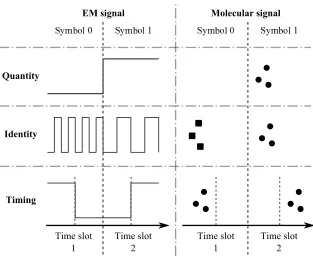
1.4 Three ways to encode messages into molecular signals. . . 6
2.1 The structure of the MC system. . . 20
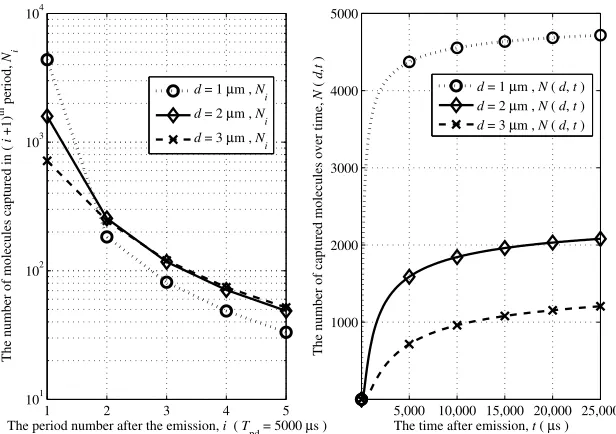
2.2 The number of captured molecules vs time with m= 104. . . 23
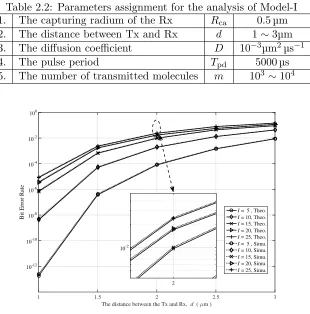
2.3 BER vs. distances for different I withm= 5×10³. . . . 32
2.4 BER vs. distances for different m withI = 20. . . 33
2.5 Channel capacity vs. distances for different mand I. . . 33
2.6 BER vs. Ptx for different m and dwithI = 20. . . 36
2.7 Channel capacity vs. Ptx for different m anddwith I = 20. . . 37
3.1 The structure of the MC system. . . 40
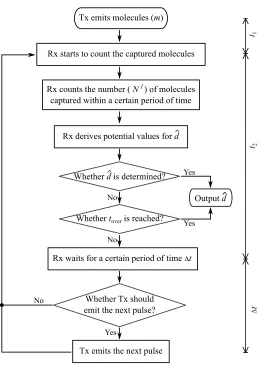
3.2 The flow chart illustrating the estimation scheme. . . 44
3.3 P0,t1→t1+t2 within t2 = 500µs at d= 1µm. . . 47
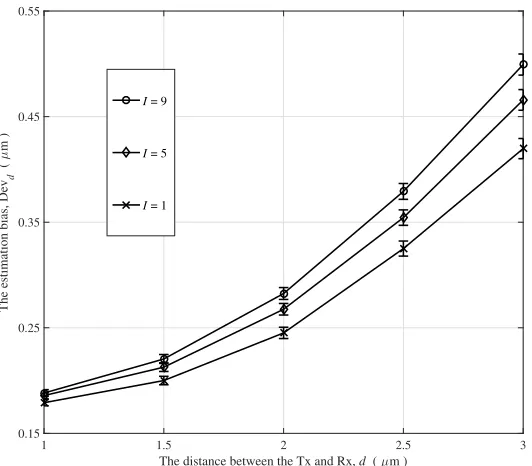
3.4 Unsynchronised, Devd vs d for different I with m = 5×10³ and D= 5×10⁻³µm2µs−1. . . . 49
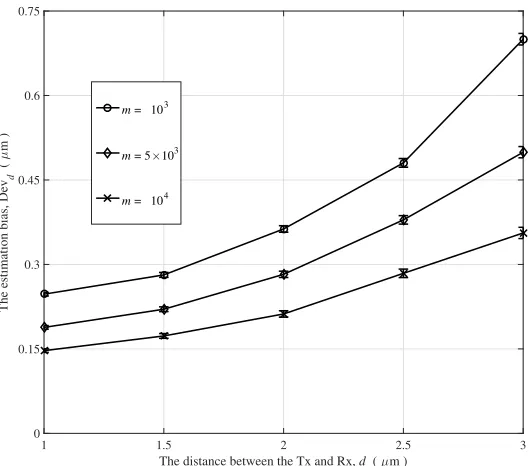
3.5 Unsynchronised, Devd vs d for different m with I = 9 and D = 5×10⁻³µm2µs−1. . . . 50
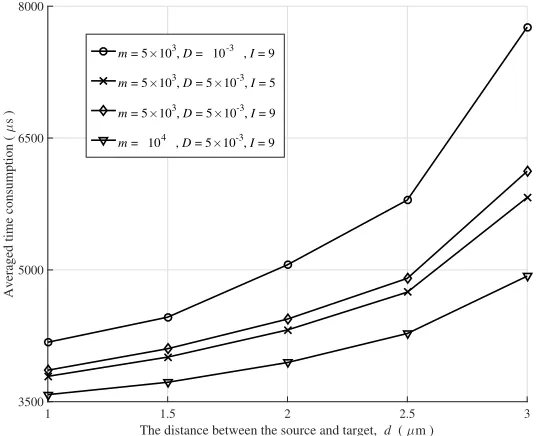
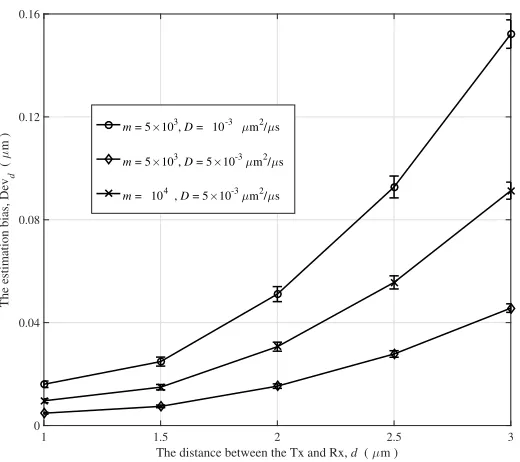
3.6 Unsynchronised, Devdvsdfor differentDwithI = 9 andm= 5×10³. 51 3.7 Unsynchronised, Time consumption vsdfor different I,m and D. . 51
3.8 Synchronised, Devd vsdfor different m and D. . . 52
3.9 Synchronised, time consumption vsdfor differentm and D. . . 53
4.1 The structure of the MC system. . . 57
4.2 The structures of the packets and ACKs in the MC system. . . 57
4.4 The time and energy required for a successful duplex transmission
using Scheme 1 and Scheme 2 (ς = 1 represents the results for Scheme
1) . . . 64
4.5 The time and energy required for a successful duplex transmission
using Scheme 3 atd= 3µm (Note: ρ= 1 is also Scheme 1). . . 65
4.6 The number of copies transmitted χ changes with each transmitted
packet for Scheme 4 at d = 3µm. Results only show the fist 1000
packets. . . 66
4.7 The distribution of the occurrence times for each value ofχfor Scheme
4 atd= 3µm. The amount of successively transmitted packets is 105. 67
4.8 The distribution of the occurrence times for each value of χ at d=
3µm for Scheme 5. The amount of successively transmitted packets
is 105. (Note: ς = 1 represents the results for Scheme 4.) . . . 68
5.1 The structure of the MC system. . . 73
5.2 The changing concentration over time for differentTem atd= 1.5µm
withm= 5×10³. . . 83
5.3 BER vs. m for differentTem atd= 1.5µm with I = 20. . . 84
5.4 Capacity and SNR vs. m for different Tem atd= 1.5µm withI = 20. 85
5.5 BER vs. m for differentI atd= 1.5µm with Tem = 1000µm. . . 85
5.6 Capacity and SNR vs. m for different I at d = 1.5µm with Tem =
1000µm. . . 86
5.7 The corresponding difference of BER, capacity, and SNR for
increas-ingI atd= 1.5µm withTem= 1000µm. . . 86
5.8 BER vs. dfor different mwith Tem = 1000µm and I = 20. . . 88
5.9 Capacity and SNR vs. d for different m with Tem = 1000µm and
I = 20. . . 88
5.10 BER vs. SNR for differentm,d,I, and Tem. . . 89
6.1 The structure of the MC system. . . 93
6.2 The peak concentration time illumination at different distances with
Tem = 103µs andTem= 5×10³µs. . . 95
6.3 Using peak time, Devd vs. dfor differentm withTem = 1000µs. . . 100
6.4 Using peak time, Devd vs. d for different A and Tem with m =
A×Tem= 5×10³. . . 100
6.5 Using peak time, Devd vs. dfor original and simplified schemes with
m=A×Tem= 104. . . 101
6.7 Using energy, Devdvs. dfor differentAandTemwithm=A×Tem=
5×10³. . . 103
6.8 Using energy, Devd vs. d for original and simplified schemes with m=A×Tem= 104. . . 103
6.9 BER and Devd vs. dwithm= 1000. . . 104
6.10 BER and Devd vs. dwithm= 5000. . . 105
7.1 The structure of the MC relay system. . . 108
7.2 BER andd23 vs. d12 forθ= 20◦. . . 117
Acknowledgments
Firstly, I would like to express my sincere gratitude towards my supervisors, Dr
Matthew D. Higgins and Dr Mark S. Leeson. It is my greatest fortune and pleasure
to have their guidance during my Ph.D. journey.
Secondly, I am grateful to my parents who have shown their full support
throughout my education life. Even when I was not sponsored by the scholarship,
they spared no effort to strengthen my faith and motivate me to pursue my study.
There is no words that could express my love to them.
Thirdly, I would like to thank my friends, especially Hu Yuan. He is such an
enthusiastic friend, as well as a mentor in my life. Every time I met with troubles,
he would be always standing besides me, calming me down and backing me up. I
have learnt quite a lot from him. I really value our friendship established during
this tough period.
Last but not the least, my sincere thanks also goes to my examiners Dr
Declarations
I herewith declare that this thesis contains my own research performed under the
supervision of Dr Matthew D. Higgins and Dr Mark S. Leeson, without assistance of
third parties, unless stated otherwise. No part of this thesis was previously published
List of Publications
Journals
• X. Wang, M. D. Higgins, and M. S. Leeson, “Relay Analysis in
Molecu-lar Communications with Time-Dependent Concentration”, IEEE Commun.
Lett., vol. 19, pp. 1977-1980, 2015.
• X. Wang, M. D. Higgins, and M. S. Leeson, “Distance Estimation Schemes for
Diffusion Based Molecular Communication Systems”,IEEE Commun. Lett.,
vol. 19,. pp. 399-402, 2015.
• X. Wang, M. D. Higgins, and M. S. Leeson, “Simulating the Performance of
SW-ARQ Schemes within Molecular Communications”,Simulation Modelling
Practice and Theory (SIMPAT), vol. 42, pp. 178-188, 2014.
Conferences
• X. Wang, M. D. Higgins, and M. S. Leeson, “An Algorithmic Distance
Es-timation Scheme for Diffusion Based Molecular Communication Systems”, in
Proc. IEEE Int. Commun. Conf. (ICC), pp. 2737-2742, 2015.
• X. Wang, M. D. Higgins, and M. S. Leeson, “Stop-and-Wait Automatic
Re-peat reQuest Schemes for Molecular Communications, in Proc. IEEE Int.
Abstract
Molecular Communications (MC) is an increasingly attractive technique to enable the networking of nano-machines by utilising molecules as the information carrier. The molecular diffusion can be described by either the movement of indi-vidual molecules or the molecular concentration. Accordingly, two kinds of diffusive MC systems have been modelled in previous literature. On the basis of these stud-ies, the aim of this Ph.D. is to refine these two models, to implement functional transmission techniques and technologies, and to investigate the corresponding sys-tem performance. To fulfil this target, the whole Ph.D. is divided into two stages. During each stage, specific tasks have been accomplished, each contributing to the overarching research field of diffusive MC systems.
In the first stage, an MC system model, named as the Model-I, is established and enhanced by focusing on the motion of individual molecules. The performance has been evaluated by both deriving mathematical expressions and implementing MATLAB simulations. Based on the Model-I, a distance estimation scheme has been proposed. Compared with existing methods, this new scheme is more accurate and less time-consuming. Moreover, five Stop-and-Wait Automatic Repeat reQuest (SW-AQR) protocols have been implemented on the Model-I. Results reveal that all these SW-ARQ schemes work well and can be beneficial under different circum-stances.
Abbreviations
1. Abbreviations in the text
ACK, Acknowledgment
AMT, Active Molecular Transportation BER, Bit Error Rate
CC, Conventional Communications CDF, Cumulative Distribution Function Dev, Estimation bias
DF, Decode-and-Forward EM, Electromagnetic
ISI, Inter-Symbol Interference
MC, Molecular Communications MLC, Memory Limited Channel MSE, Mean Square Error
PMT, Passive Molecular Transportation RN, Relay Node
Rx, Receiver
SF, Sense-and-Forward Tx, Transmitter
SW-ARQ, Stop-and-Wait Automatic Repeat reQuest HOP1, The first hop in a relay system
HOP2, The second hop in a relay system
Model-I, The system model by focusing on the individual molecules movement Model-II, The system model by focusing on the molecular concentration Relay-1, The relay system with single kinds of molecules utilised
Relay-2, The relay system with two kinds of molecules utilised
Scheme 1, The SW-ARQ scheme 1 Scheme 2, The SW-ARQ scheme 2 Scheme 3, The SW-ARQ scheme 3
Scheme 4, The SW-ARQ scheme 4 Scheme 5, The SW-ARQ scheme 5
2. Abbreviations in subscripts or superscripts
ac, ACK ca, Capture em, Emission
me, Message pa, Packet pd, Period pk, Peak proc, Process s1, Scheme 1 s2, Scheme 2 s3, Scheme 3
s4, Scheme 4 s5, Scheme 5 sa, Sampling se, Sensing si, Simplified sy, Synchronised (1), Relay-1 (2), Relay-2
3. Symbols denotations
ak−i, The binary value for the (k−i)th symbol
{ak−i}, The transmitted messages sequence within the ISI for the kth symbol
ˆ
ak−i, The binary value for the estimated (k−i)th symbol
{ˆak−i}, The estimated messages sequence within the ISI for the kth symbol
A, The emission rate
Bme, The message length in bits
Bin, The index length in bits
c(d, t), The molecular concentration after an impulse
d, The distance between a couple of nano-machines
d12, The distance between the Tx and RN
d13, The distance between the Tx and Rx
d23, The distance between the RN and Rx
ˆ
d, The estimated distance
ˆ
dsi, The estimated distance using simplified scheme
Devd, The deviation for distance d
D, The diffusion coefficient
E(·), The expected value
h(t), The impulse response for the diffusion channel
I, The ISI length
j, The Error patten index
k, Thekth symbol from the beginning of transmission
l1, The pre-designed criterion for symbol ‘1’
l0, The pre-designed criterion for symbol ‘0’
L, The judgment condition for the Rx
m, The number of molecules emitted per pulse
N, The number of molecules captured
Nac, The overall numbers of the released molecules for ACKs
Npa, The overall numbers of the released molecules for packets
P, Probability
Pca, The capture probability
Per, The error probability
Pes, The escape probability
Ps1, The probability for a complete duplex transmission using Scheme 1
Ps2(ς), The probability for a complete duplex transmission using Scheme 2
Ps3(ρ), The probability for a complete duplex transmission using Scheme 3
Ps4(χ), The probability for a complete duplex transmission using Scheme 4
Ps5(χ, ς), The probability for a complete duplex transmission using Scheme 5
Psy(d, t2), The capture probability withint2 for synchronised situations
Ptx, The probability of ‘1’ transmitted
Q,Qvalues ranges from 0 tot1
r(d, t), The Rx sensed concentration
Rca, The capture range in Model-I
Rse, The sensing range in Model-II
s(t), The rectangular wave
t, Time
△t, The time interval between each counting process
t1, The delay between the Tx emission and Rx reception
t2, The counting duration
Tem, The emission duration
Tout, The waiting time before re-transmission
Tover, The overall time for Rx in Model-I to estimate the distance
Tpd, The signal period
Tpk, The peak time
Tproc, The processing time
Tsa, The sampling time
u(d, t), The concentration after a rectangular pulse
¯
ui−1, The averaged concentration within the Tx for the previous (i−1)th symbol
Wn, The noise power
Wu, The signal power
X, The binary input vector
Y, The binary output vector
N, Normal distribution
I, Mutual information
∇2, Laplacian operator
α, The angle between d12 and d23
θ, The angle betweend12 and d13
̺j, The number of ‘1’s within the ISI length for error patten ‘j’
ς, The number of copies of the ACK corresponding to one packet
ψ, The ratio of the length of the packets to the length of the ACKs
ρ, The initial number of copies of the packet and ACK
γ, The fluctuation number for Scheme 4
χ, The adaptive number of copies of packets (or ACKs)
Φ(·), The CDF of the standard normal distribution
Ω, The concentration energy
4. Symbols used as substitutions
Chapter 1
Introduction
The issue of accomplishing the information transmission over a distance has always
played a vital role in the process of human civilisations. Historically, engineers
and researchers have tried to solve this problem by means of utilising electrical or
electromagnetic (EM) forms of communications. However, there still remain many
aspects in which these traditional technologies cannot be implemented
appropri-ately. For example, in extremely tiny dimensions, such as in the micrometer or
even the nanometre scale, it is almost impossible to deploy the Conventional
Com-munications (CC) techniques due to restrictions like the size, the wave length, and
the energy budget [1]. The communications in such dimensions is named as
“nano-communications”.
To expand the application range of communications, the concept of
nano-technology was introduced by the Nobel-laureate physicist Richard Feynman during
his famous speech entitled “There’s Plenty of Rooms at the Bottom” (transcribed in
[2]). Since then, attention has been drawn on the extreme miniaturisation and
re-lated research activities have been carried out to explore the idea of nano-technology.
With the help of the remarkable development in manufacture techniques, the
ad-vancement in this field began to accelerate in the early 2000s, which lays the
Information
Source Encoder
Channel Memory
Decoder Information
Sink
Channel Noise
Transmitter (Tx)
Receiver (Rx)
Channel
Figure 1.1: The block diagram of nano-communications systems.
1.1, similar to CC systems, a typical nano-communications system is also formed
by three functional blocks, namely, the transmitter (Tx), the receiver (Rx), and the
channel with the information carrier to achieve message exchange in between.
1.1
Basic elements for nano-communications systems
Within nano-communications systems, nano-machines are implemented to serve as
the Tx and Rx. Nano-machines, regarded as the most basic functional units, are
defined as the devices that “consist of nano-scaled components (ranging from 1
to 100 nanometers) and are able to performance a specific task at the nano-level,
such as communicating, computing, data storing, sensing and/or actuation” [3, 4].
Due to their own functionality, nano-machines with different architectures can be
deployed to fulfil tasks of both the Tx and Rx. There are three potential methods
to fabricate nano-machines, i.e. the top-down approach by down-scaling current
micro-devices [5, 6, 7, 8], the bottom-up approach by assembling elementary
nano-components [3, 9, 10, 11], and the bio-hybrid approach by considering the living
organisms as nano-machines [12, 13, 14]. The development of the manufacture
limits the implementation of the first two methods, but natural systems, such as
cells or bacterium, can be utilised as nano-machines.
where accordingly EM, acoustic, or molecular signals are used. The transmission
from a micro-device to a nano-machine can be accomplished by taking advantage of
EM [15] or ultrasonic waves [16]. These waves propagate with minimal losses, which
can help to establish a reliable communication channel. Thus, it is required that
either radio-frequency transceivers or ultrasonic transducers should be integrated in
nano-machines. However, due to the size and current complexity of nano-machines,
this integration cannot be easily realised [17]. In addition, even if the integration
was possible, the energy budget of nano-machines may not be sufficient to undertake
these objectives [16].
Alternatively, message symbols can be expressed by molecular signals, which
is named as Molecular Communications (MC). MC can be observed among
liv-ing cells [18], bacterias [14], and even social insects [19]. Accordliv-ingly, unlike the
other two technologies, the integration process of molecular transceivers in
nano-machines is more feasible due to the bio-compatibility [1]. To communicate, the Tx
makes a physical change to its environment and this change must be measurable
at the Rx [20]. Similar to the change of the EM field in CC, the change in MC
must be molecular: the Tx emits molecules into a shared environment, and these
molecules propagate to (and are detected by) the Rx. In this way, information can
be transmitted from a nano-machine to a micro-device or among nano-machines,
which therefore provides a potential method to enable the networking of deployed
nano-machines [16]. Due to its own superiority, the MC is regarded as the most
promising method to solve the problems of nano-communications [21].
1.2
Molecular communications systems
1.2.1 MC system transportation modes
Inspired by the biological systems found in nature, five MC system architectures have
Tx Rx
Tx Rx
Interface molecule
Molecular motor
Tx Rx
Bacterium
Tx Rx
Interaction surface (a)
(b)
(c)
(d)
(e)
Tx Rx
Gap junction
Message Molecule
Message Molecule
Message Molecule
Message Molecule
[image:22.595.189.452.101.489.2]Message Molecule
Figure 1.2: Five different MC architectures.
can be grouped into two types, namely the Active Molecular Transporting (AMT)
and Passive Molecular Transportation (PMT) [22]. The AMT can be accomplished
by four techniques shown in Figs. 1.2 (a) to (d), namely the gap junction channels by
taking advantage of the gap junctions between cells [23, 24], the interface molecule
carrier channels by using the protein filaments and molecular motors [25, 26], the
self-propelling mechanism by embedding message molecules into bacteria [27, 28],
and the contact-dependent inter-cellular communications via molecular collisions
[29]. To deploy the AMT, the connectivity between nano-machines requires to be
Transmitter (Tx) Receiver (Rx) Information
source
Information sink
1. Encoding 2. Emitting
3. Propagating
4. Receiving
5. Decoding Molecules
Figure 1.3: The outline of the MC system incorporating nano-machines.
Another transportation mode, the PMT, is achieved by molecular random
walk, or free diffusion, in the environment. As is illustrated in the Fig. 1.2 (e), MC
systems with the diffusion-based architecture take advantage of the free diffusion of
information molecules without guided by any intermediate system. When receiving
message molecules, the Rx can be either an absorber to capture molecules and
to remove them from the environment [31, 32], or an observer to sense, rather
than affecting, the concentration by means of binding a ligand-receptor [33, 34].
Compared with the AMT, the implementation of the PMT requires little effort
to establish the MC systems. Therefore, this architecture is a feasible solution to
realise the communications between nano-machines, and hence becomes increasingly
attractive [35].
1.2.2 Diffusive MC systems
As is shown in the Fig. 1.1, a diffusive MC systems, belonging to nano-communications
systems, consist of three main blocks, i.e. the Tx, the diffusive channel, and the Rx.
The outline of a typical diffusive MC system is illustrated in the Fig. 1.3 [36]. The
capability of the Tx is to generate, encode, and emit information molecules. The
Rx is able to receive these molecules and to decode the attached messages.
Gener-ated by the information source, information is represented by a sequence of symbols
Quantity
Identity
Timing
Time slot
1
Time slot 2 Time slot
1
Time slot 2
[image:24.595.163.476.107.365.2]EM signal Molecular signal
Figure 1.4: Three ways to encode messages into molecular signals.
released by the Tx, message molecules start to propagate towards the Rx. After
receiving these molecules, the Rx can decode corresponding information symbols
according to certain pre-designed decoding algorithms.
In order to convey information by molecular signals, a unique patten of
phys-ical change should be designed for each message symbol, which should also be able
to be detected by the Rx. Motivated by EM signals in CC, three encoding methods
are utilised in diffusive MC systems [20]. As is illuminated in the Fig. 1.4,
differ-ent information symbols are expressed by differdiffer-ent amounts of emitted molecules,
different species of emitted molecules, or different emission time.
Molecules encoded with messages will diffuse independently in the
environ-ment. The propagation mechanism of these molecules has been investigated from
two angles of views. On one hand, researches are carried out from the micro-scope by
focusing on each individual molecule. The movement of each molecule is a random
the Rx or move to the infinity. Given this capture probability obtained, the
propa-gation of all these molecules can be treated as a Bernoulli process. In this way, the
propagation mechanism can be addressed from the micro level. On the other hand,
when dealing with the molecular diffusion, attention is paid on the molecular
con-centration. No matter how every single molecule moves, they will gradually form
a certain concentration distribution in the environment, which provides another
method to describe the molecular propagation procedure.
After these message molecules arrive at the Rx, they will trigger the receiving
function of the Rx so that these information symbols can be decoded
correspond-ingly. As is also explained in Section 1.2.1, two receiving strategies can be applied.
The Rx can be either an active absorber, which is able to capture molecules and
remove them from the environment, or an passive observer, which can sense the
concentration without affecting the distribution of molecules. The selection of these
two kinds of Rx should be made depending on different scenarios. Referring to
all the research published, when the molecular propagation is modelled by the
mo-tion of individual molecules, the Rx is generally regarded as an absorber; whereas
the propagation is characterised by the molecular concentration, the Rx is often
considered as an observer.
Similar to the situation in CC systems, there are various types of channel
noise in diffusive MC systems. The noise source could be the propagation
random-ness, the transmitter emission noise, the feature of the environment (such as the
temperature and pH level), or even the reactions between molecules. As a
conse-quence, although plenty of effort has been put aiming to illuminate the impact of
the channel noise [37, 38, 39, 40, 41, 42, 43, 44, 45, 46, 47], it still remains an open
challenge to discover a proper way to model the noise in MC systems.
Another factor influencing MC systems is the channel memory. As is
men-tioned previously, it is impossible to predict the exact arrival time of message
Table 1.1: Differences between CC and MC
Features CC MC
Device Artificial machines Bio-hybrid nano-machines
Information carrier EM waves Molecules
Type of information Digital Chemical or physical
Propagation speed Light (3×10⁸ m/s) Extremely low
Propagation range m∼km nm∼µm
Medium Air or cables Aqueous
Noise source EM fields and signals The medium, Tx and Rx
ISI source Multi-path Unpredictable arrival time
Energy consumed Electrical, high Chemical, low
molecules remaining in the environment will not vanish until they move to the
infinity (only if the time is infinite). Hence, some of messages molecules may reach
the Rx in future time slots, and these molecules will cause a form of interference
to the detection of that corresponding symbol when they arrive. This is denoted
as the Inter-Symbol Interference (ISI) of MC systems, which can seriously degrade
the channel reliability. To mitigation the ISI, a wide range of solutions have been
proposed, such as implementing advanced modulation schemes [48, 49, 50, 51, 52],
applying the Mean Square Error (MSE) decoding algorithm [53, 54], optimising the
decoder of the Rx [45, 55, 56], and using Error Control Coding schemes [57, 58].
1.2.3 Comparisons between CC systems and diffusive MC systems
With all preceding explanation on diffusion-based MC systems, it can be summarised
that diffusive MC, as a promising form of nano-communications, is not a simple
ex-tension of CC networks at the nano-scale. The comparisons between CC and MC
are presented in Table 1.1 [1, 20]. Given such many differences between these two
communications domains, it can be deduced that existing communication
technolo-gies may not suit for the diffusive MC systems and innovative networking techniques
are required for the unique characteristics of nano-machines and the molecular
1.2.4 Recent advancements in diffusive MC systems
The first research on the diffusive MC systems can be tracked back to a 2005 paper
entitled as “Molecular Communication” [59], since when, work on MC systems has
accelerated. MC is an increasingly attractive topic, and there is a rapid growth in
theoretical and simulation-based analysis within this field. The main three themes
of contemporary literature are respectively modelling and analysing the MC
chan-nel, investigating performance enhancement techniques, and developing simulation
tools. Even though the laboratory experiment on MC systems, compared with the
theoretical and simulation-based advancements, is still in its infancy due to the great
expense and high difficulty, there have been several heuristic experiments
implemen-tations to explore the practicality of MC systems [46, 60, 61].
(1). Channel modelling and analysing
Based on two different propagation mechanisms described in Section 1.2.2,
the diffusive MC channel can be divided into two broad categories, i.e., the discrete
model with information expressed by the molecular amount, and the continuous
model with information expressed by the molecular concentration. Discrete
chan-nel models with no ISI or simplified ISI (only one previous bit considered) were
established in [38, 62, 63, 64]. In [65], Atakan took a general form of the ISI into
account and built the MC system. For continuous models, the first research was
present in [66] and expanded in [39] by considering the continuous emission of the
Tx. However, there is no widely accepted general channel model or noise model
for MC systems. Depending on different scenarios, researchers had to introduce
their own specific assumptions of the noise. Hence, it still remains to be an open
challenge.
(2). Performance enhancement techniques
Due to the severe attenuation and great randomness, MC channels tend to
suffer from a higher Bit Error Rate (BER) and a lose of the capacity. To solve
re-liability. Several examples of such technologies, like novel modulation schemes,
MSE decoding algorithms, or error control coding schemes, have been explained
in Section 1.2.2. Apart from these, transmission protocols, like those introduced in
[27, 53, 67, 68, 69, 70] can bring in benefit by compensating the attenuation of
molec-ular signals. Specifically, in [27], a hybrid communication system is established,
where short range communications is achieved by diffusion molecules, medium range
communications is accomplished by the bacteria transportation mechanism, and
long range communications is realised by using pheromones. Other transmission
strategies, such as the Stop-and-Wait Automatic Repeat reQuest (SW-ARQ)
tech-niques [67], the TCP/IP structure [68], and relaying schemes [53, 69, 70], can also
enhance the performance. In addition, chemical methods by taking advantage of
enzymes can be beneficial as well [71, 72].
(3). Simulation tools
Lacking of reliable experiment platforms, research activities have to rely on
simulations to verify the accuracy of the theoretical analysis of MC systems and
to evaluate the gain of performance enhancement techniques. Aiming to fulfil this
target, several simulators have been developed, such as eMCS [73], NanoNS [74],
N3Sim [75], BINS [76], and MUCIN [77]. These simulators all have their own
superiority and drawbacks. Hence, researchers should select the proper simulator
according to the specific requirement of their MC systems.
1.3
The aim and specifically divided tasks of the Ph.D.
project
Molecular Communications (MC) is an increasingly attractive nano-communications
technology to accomplish the information exchange among nano-machines, where
messages symbols are expressed by molecular signals. The goal of this Ph.D. project
to evaluate their performance through both mathematical calculations and
simula-tions. Previous researchers have built the basic MC system models based on
dif-ferent propagation mechanisms of diffusing molecules, and introduced protocols to
complete certain tasks. However, their system models should be further improved
to be more accurate and closer to the reality. Meanwhile, enhanced transmission
approaches need to be proposed to optimise the communication performance.
There-fore, aiming to solve these problems, the Ph.D. project has been separated into the
following specific tasks with corresponding objectives.
(1). Understanding molecular propagation mechanisms and the MC
sys-tem models established accordingly
To carry out research on the MC system, it is essential to have a knowledge on
how molecules diffuse in the surrounding environment. By assuming each molecule
moving independently, studies on describing the propagation mechanism can be
classified into two categories. The first classification is to analyse the movement
of individual molecules. In this case, molecules reaching the Rx will be absorbed
and removed from the channel, and the probability whether or not this molecule
will be captured has already been derived by previous researchers. According to
this propagation mechanism, an MC system model, represented as Model-I, is
de-signed with information expressed by the number of captured molecules. The second
category of researches is to characterise the propagation by investigating the
molec-ular concentration distribution of these message molecules. Under this situation,
the capability of the Rx is to sense the concentration around without affecting the
distribution. Existing literature has formulated the molecular distribution in the
aqueous medium. By taking advantage of the molecular concentration, a different
MC system model, represented as Model-II, is established with messages symbols
conveyed by the molecular concentrations.
(2). Enhancing both the system models and evaluating their performance
algo-rithm, which is a method to alleviate the ISI. As to the system Model-II, not only
can the MSE decoding algorithm be utilised, but also can the emission process of
the Tx be taken into consideration. Based on these two refined system models, an
information theoretical approach should be developed to evaluate the system
perfor-mance with two features, namely, the BER and the channel capacity. Simulations
should also be designed to verify these formulations and to assess the impact of
different parameters. Moreover, even though the ISI has been mitigated, it will still
influence the channel properties. Thus, further analysis with respect to the ISI needs
to be carried out. For theoretical derivations, the ISI length should be regarded as
an arbitrary value to maximise the generality. For simulations, the value of ISI
length should be sufficiently large such that results are of as a high precision as is
reasonably practical.
(3). Proposing distance estimation schemes for each model with a high
accuracy and less time consumption
From previous research on measuring the system performance, it can be
noticed that the distance between a couple of nano-machines is a vital parameter for
both the Tx and Rx. As a consequence, it is highly required to find an appropriate
method to estimate the distance. Existing schemes either cost too much time, or
cannot provide an sufficiently accurate result. Hence, there is a clear and timely
demand for the continued development of distance estimation schemes that are
shown to be both accurate and fast. According to these two different system models,
distance estimation schemes should be respectively proposed. Simulations should
be also conducted to evaluate and compare the performance of these schemes by
obtaining the estimation deviation and the time consumption.
(4). Applying transmission schemes to improve the MC system
perfor-mance
Due to the high randomness and server attenuation of the molecular
To assure the reliable message transmission, communications techniques, such as
the SW-ARQ schemes and system relaying schemes, should be implemented in the
MC systems. Considering the unique characters of MC, these transmission
tech-niques should be proven to suit for the special conditions in MC systems via both
theoretical analysis and simulations. The performance gain needs to be illustrated
by numerical results, and it should also be presented how relevant parameters can
affect the corresponding system performance.
1.4
Contributions to drive the entire thesis
The following contributions have been produced through the Ph.D. project and will
be explained in detail throughout Chapter 2 to Chapter 7.
(1). The MSE decoding algorithm has been deployed to enhance MC system models
with information expressed by either the number of absorbed molecules
(Model-I) or molecular concentration (Model-I(Model-I).
(2). The emission process of the Tx has been considered to improve the system
model Model-II.
(3). Theoretical expressions of the BER and capacity have been derived for both
enhanced MC system models.
(4). The impact of the channel memory has been further investigated by both
the-oretical derivations and simulations for these two system models.
(5). An algorithmic distance estimation scheme and two parameter optimisation
methods have been proposed for the Model-I.
(6). 2 distance estimation schemes have been proposed for the Model-II.
(8). Decode-and-Forward (DF) relaying schemes have been designed to be deployed
on the Model-II aiming to improve the system performance.
1.5
The organisation of the thesis
The entire thesis is organised with 8 chapters. Apart from the first chapter as
the introduction chapter and the last chapter summarising the thesis and
provid-ing future research suggestions, the rest 6 chapters will describe each individual
task accomplished. The highlights of these 6 chapters are respectively presented as
follows.
Chapter 2
(1). The system model, Model-I, is established with information conveyed by the
number of absorbed molecules.
(2). This model is refined by applying the MSE decoding method.
(3). An information theoretical approach is developed to measure the system
per-formance with regards to the BER and capacity.
(4). Simulations are conducted to prove the derived expressions of the BER and
capacity.
(5). Investigation is carried out to analyse how the system performance can be
influenced by different parameters assignment.
(6). The impact of the channel memory on the properties of the channel is further
explored.
Chapter 3
(1). An algorithmic distance estimation scheme for Model-I is proposed, which can
(2). Two parameter optimisation methods, i.e. using more molecules and using
molecules with larger diffusion coefficient, are introduced to enhance the
dis-tance estimation scheme.
(3). Simulations are provided to show the accuracy and time consumption of this
estimation scheme and two optimisation methods.
(4). Performance comparisons are also presented with different parameters
assign-ment.
Chapter 4
(1). 5 SW-ARQ schemes are proposed to be implemented on the Model-I.
(2). The performance is evaluated by the averaged time and energy utilisation.
(3). Scheme 1 benefits communications between adjacent nano-machines.
(4). Schemes 2 and 3 exhibit performance benefits for longer range communications.
(5). Schemes 4 and 5 suit for MC systems with unknown or varying channels.
Chapter 5
(1). The system model, Model-II, is built with messages expressed by molecular
concentrations.
(2). The model is enhanced by considering the Tx emission process and utilising
the MSE to decode information symbols.
(3). Theoretical formulations are derived to analyse the system BER and channel
capacity.
(4). Simulations are designed to verify these mathematical expressions of the BER
(5). The changes of channel properties with different parameters assignment is
ex-plored.
(6). The investigation on the influence of the channel memory on the system
per-formance is expanded.
Chapter 6
(1). Two distance estimation schemes for Model-II are proposed by taking advantage
of either the concentration peak time or the concentration energy.
(2). These two schemes are simplified by assuming molecules emitted
simultane-ously.
(3). Using energy to measure the distance will have a better accuracy at the cost of
more energy and higher complexity.
(4). Simulations are carried out to show the performance of these two schemes and
their simplification methods.
(5). Improvement of the estimation accuracy by optimising parameters is presented
as well.
(6). An MC system without any pre-knowledge of distance is also analysed through
both theoretical derivations and simulations.
Chapter 7
(1). Based on the Model-II, two DF relaying schemes are implemented.
(2). Theoretical expressions of the system BER are provided for both DF relaying
schemes.
(3). If two different kinds of molecules are utilised respectively by the Tx and Relay
(4). Simulations are provided to illuminate the system performance enhancement
by deploying these two DF relaying schemes.
(5). Through simulations, the optimal position of the RN is obtained to achieve the
Chapter 2
The Design of MC System
Model-I and Its Performance
Analysis
2.1
Introduction
In Chapter 1, the definition of Molecular Communications (MC) was introduced,
which is to use specific molecules to enable the networking of nano-machines. Molecules,
encoded by the transmitter (Tx), spread out in the environment and gradually
propagate to the receiver (Rx) to accomplish the exchange of information. In this
chapter, it is assumed that each molecule diffuses independently. The movement of
individual molecules is investigated based on this assumption. Whether or not the
message molecules will be absorbed is a random process, whose probability
distri-bution will be presented. According to the analysis of the motion of each molecule,
the MC system model is established with information symbols expressed by the
numbers of captured molecules. This model is named as Model-I.
In order to carry out further research based on this model, it is essential
this performance can be influenced by different parameters. The channel reliability
and the reliable transmission rate are two keys features to describe the properties
of the channel. The former can be investigated by the Bit Error Rate (BER),
and the latter can be characterised by the channel capacity. Deriving theoretical
expressions of these two features provides an intuitive approach to measure the
system performance and the impact of relevant parameters.
The first attempt to analyse these two channel features in diffusive MC
sys-tems was presented in [62], and expanded in [44, 78, 79] by taking the channel
memory into consideration. In [37, 50, 52, 64, 80, 81, 82], research that focused on
modulation schemes and/or noise modelling, also provided theoretical approaches to
evaluate the performance of MC systems. In these studies, molecules were assumed
to move independently, and information was decoded by comparing the number of
captured molecules to a pre-designed threshold. However, due to the existence of
the Inter-Symbol Interference (ISI), such a threshold may be either too large or too
small that results in a high error probability. Thus, to achieve the optimisation
of the system performance, the threshold should be adaptive, which may exceed
the capability of nano-machines. Under this situation, another decoding method by
calculating the Mean Square Error (MSE) should be implemented. By taking
ad-vantage of previous symbols to assist the decoding procedure of the Rx, the system
performance can be enhanced due to the mitigation of the ISI influence.
In this chapter, the system Model-I is introduced based on the motion of
individual molecules. To measure the system performance, expressions for the BER
and channel capacity are derived. Simulation results are also provided to verify the
accuracy of these formulations and to illuminate the performance variation caused
by different designs of relevant parameters. Moreover, the influence of the channel
memory is further investigated even though it has been alleviated. For theoretical
derivations, the ISI length has been regarded as an arbitrary value to maximise the
Rca
Molecule
d
x z
y
Figure 2.1: The structure of the MC system.
high precision as is reasonably practical.
The remainder of this chapter is organised as follows. The system Model-I, as
well as relevant parameters, is described in Section 2.2. In Section 2.3, The channel
performance in terms of the BER and capacity is studied for MC systems Model-I.
Numerical results are provided in Section 2.4. Finally in Section 2.5, this chapter is
concluded.
2.2
The diffusion-based MC system model based on the
motion of individual molecules
The first MC system model, denoted as Model-I, is built according to the study on
the movement of every single molecule. The system structure is illustrated in the
Fig. 2.1. As is shown here, the MC system consists of two nano-machines in a 3D
environment, one of which serves as the transmitter (Tx) with the other acting as the
receiver (Rx). Information is conveyed by a sequence of symbols in consecutive time
slots. In each time slot, to transmit symbol ‘1’, the Tx releases a certain amount of
molecules; to transmit ‘0’, the Tx releases nothing. Within one time slot, molecules
are assumed to be sent out simultaneously. At the destination end, the Rx captures
molecules and removes them from the environment. By counting the number of
to the Fig. 2.1, the distance from the Tx to the centre of the Rx is represented by
d, the size of Tx is negligible compared with the relative distance between these two
nano-machines, and the radius of the capturing spherical surface of the Rx isRca.
In a 3D space, molecules ongoing Brownian Motion have a chance to escape to
the infinity rather than being absorbed by the Rx. The escape probability,Pes(d, t),
obeys the following backward difference equation at timet, that is[83]:
∂Pes(d, t)
∂t =D∇
2P
es(d, t), (2.1)
where∇2 is the Laplacian operator, andDis the diffusion coefficient (inµm2µs−1).
The value of D depends on the various factors, such as the temperature, the
sur-rounding fluid, and the radius of the molecules. Correspondingly, the initial
condi-tion and boundary condicondi-tions are given as [57, 84]:
Pes(d, t= 0) = 1, ∀d > Rca, (2.2)
Pes(d=Rca, t) = 0, (2.3)
Pes(d→ ∞, t) = 1, (2.4)
where (2.2) means at the time 0 the molecule is not captured by the Rx, (2.3)
means the molecule will be absorbed as soon as entering the capture range of the
Rx, and (2.4) means Rx is not able to capture the molecule if the distance between
the molecule and Rx is infinite.
The capture probability, Pca(d, t), is more of interest, and can be derived
by Pca(d, t) = 1−Pes(d, t). Thus, considering (2.1) through (2.4), the capture
probability can be obtained as [57, 84, 85]:
Pca(d, t) = Rca
d erfc
d−R
ca
√
4Dt
. (2.5)
symbol transmitted is denoted as Tpd. Thus, Pca,0, which donates the probability
for one molecule to be absorbed by the Rx within one signal period, can be derived
as:
Pca,0 =Pca(d, t=Tpd) =
Rca
d erfc
d−Rca
p
4DTpd
!
. (2.6)
In the current time slot, the number of molecules received by the Rx for the
current symbol signal is represented as N0. It can be deduced that N0 follows a
binomial distribution given as [37, 78]:
N0 ∼ B(m, Pca,0), (2.7)
where m is the number of molecules emitted by the Tx for one symbol. If m is
sufficiently large, the binomial distributed N0 can be approximated as a normal
distribution expressed as:
N0∼ N
mPca,0, mPca,0(1−Pca,0)
=N
η0, ζ0
, (2.8)
where it is denoted thatη0 =mPca,0 and ζ0 =mPca,0(1−Pca,0).
However, molecules will not vanish within one period Tpd. The remaining
molecules may reach the Rx in the next several time slots, or escape to the infinity.
The late-arriving molecules will cause the InterSymbol Interference (ISI) at the
Rx. The existence time for newly emitted molecules can be expressed as (I +
1)×Tpd, where I is called the ISI length. After (I + 1)×Tpd, newly emitted
molecules are considered to be unable to reach the Rx anymore. If I is infinite,
the molecules released in the first symbol time slot will result in the ISI to all the
symbols followed; ifIis finite, the channel is defined as the Memory Limited Channel
(MLC) [86]. It is further assumed that the reception of molecules belonging to
1 2 3 4 5 101
102 103 104
The period number after the emission, i ( T
pd = 5000 µs )
The number of molecules captured in (
i
+1)
th period, Ni
d = 1 µm , N
i
d = 2 µm , N
i
d = 3 µm , N
i
5,000 10,000 15,000 20,000 25,000 1000
2000 3000 4000 5000
The time after emission, t ( µs )
The number of captured molecules over time,
N
(
d,t
)
d = 1 µm , N ( d, t )
d = 2 µm , N ( d, t )
[image:41.595.165.473.119.336.2]d = 3 µm , N ( d, t )
Figure 2.2: The number of captured molecules vs time withm= 104.
to be independent [52, 58, 87]. For i = 1,2,3, ..., I, if it is denoted that Pca,i =
Pca(d,(i+ 1)×Tpd), then, the number of received molecules for the previous ith
symbol in the current time slot, represented asNi, can be derived as [52, 58, 87]:
Ni∼ N
mPca,i, mPca,i(1−Pca,i)
− N
mPca,i−1, mPca,i−1(1−Pca,i−1)
=N
mPca,i−mPca,i−1, mPca,i(1−Pca,i) +mPca,i−1(1−Pca,i−1)
=N
ηi, ζi
, (2.9)
where it is denoted that ηi = mPca,i − mPca,i−1, and ζi = mPca,i(1−Pca,i) +
mPca,i−1(1−Pca,i−1). The Fig. 2.2 is an example showing the number of captured
molecules over time, N(d, t), and the number of captured within different periods,
Ni, where the number of molecules released per pulse ism= 104. It can be noticed
that with the distance between nano-machines increasing, the distribution gradient
ofNi becomes gentler, and the tail of the distribution gets larger. Thus, with other
MC system tends to suffer more from the impact of the channel memory, i.e. ISI.
Given (2.8) and (2.9), the overall number of molecules received in one time
slot,NI, can be computed as:
NI =
I X
i=0
ak−iNi
∼
I X
i=0
ak−iN
ηi, ζi
(2.10)
where k represents the kth symbol from the beginning of transmission, the set
{ak−i, i= 0,1, ..., I} is the transmitted binary messages sequence, and the element
ak−i represents the binary value of each symbol. Within this thesis, the diffusion
coefficientDis assumed to remain constant.
The ISI is a factor that has significant impact on the MC system performance.
To reduce this influence, the Rx is designed to determine information bits by means
of calculating the Mean Square Error (MSE) [88]. The decision variable,L, can be
expressed as:
L= MSE1−MSE0= [NI −l1]2−[NI−l0]2, (2.11)
where NI is given by (2.10), and l1 and l0 are pre-designed criteria for the Rx to
determine the current message bit. The expressions ofl1 and l0 are:
l1=
I X
i=1
ˆ
ak−iNˆi+ ˆN0, (2.12)
l0=
I X
i=1
ˆ
ak−iNˆi, (2.13)
where the set {ˆak−i, i= 1,2, ..., I} is previously decoded bits within the ISI length
I, and ˆN0 and ˆNi are respectively the corresponding estimated values of N0 and
distribution, which are respectively represented as:
ˆ
N0 ∼ N
η0, ζ0
, (2.14)
ˆ
Ni ∼ N
ηi, ζi
. (2.15)
It can be noticed from (2.12) and (2.13) that the design of l1 and l0 has taken the
influence of previous symbols into consideration, which is a method to mitigate the
ISI.
For theoretical derivations, it is assumed that previously decoded bits will
not affect the decoding of the current bit. Thus, in this case, it is assumed that
ˆ
ak−i =ak−i for i= 1,2, ..., I. By substituting (2.10), (2.12) and (2.13) into (2.11),
the decision variableL can be rewritten as:
L= (NI −l1)2−(NI−l0)2
= (akN0+
I X
i=1
ak−iNi−
I X
i=1
ˆ
ak−iNˆi−Nˆ0)2−(akN0+
I X
i=1
ak−iNi−
I X
i=1
ˆ
ak−iNˆi)2
= [ I X
i=1
ak−i(Ni−Nˆi) +akN0−Nˆ0]2−[
I X
i=1
ak−i(Ni−Nˆi) +akN0]2
=−2 ˆN0[
I X
i=1
ak−i(Ni−Nˆi) +akN0−
1
2Nˆ0]. (2.16)
Thus, the value of L could be computed via (2.16). When L ≥ 0, ‘0’ is decided;
otherwise, ‘1’ is decided. In this way, the information bits can be determined.
2.3
Performance analysis of MC system Model-I
The MC system Model-I is described in Section 2.2. The decision variable for the
Rx to decode messages is derived as (2.16), whereN0,Ni, ˆN0, and ˆNi are normally
easier to follow,L in (2.16) is rewritten as:
L=−2 ˆN0[
I X
i=1
ak−i(Ni−Nˆi) +akN0−1
2Nˆ0],
=−2 ˆN0̟. (2.17)
Sinceakrepresents the binary value of thekth symbol after the transmission starts,
it can be deduced that a2k = ak. Similarly, a2k−i = ak−i for i = 1,2, ..., I. Thus,
according to properties of the normal distribution, it can be derived that:
Ni−Nˆi∼ N
0,2ζi
, (2.18)
akN0 ∼ N
akη0, akζ0
, (2.19)
1
2Nˆ0 ∼ N
1
2η0,
1
4ζ0
, (2.20)
wherem is the number of molecules emitted per pulse, ζ is expressed in (2.9), and
Pca,0 can be calculated by (2.6). Given (2.18), it can be further obtained that:
I X
i=1
ak−i(Ni−Nˆi)∼ N
0,2
I X
i=1
ak−iζi
. (2.21)
Considering (2.19) and (2.20), the distribution of̟in (2.17) can be deduced as:
̟=
I X
i=1
ak−i(Ni−Nˆi) +akN0−
1
2Nˆ0
∼ N
(ak−
1
2)η0,2
I X
i=1
ak−iζi+ (ak+
1
4)ζ0
. (2.22)
2.3.1 Bit Error Rate analysis
Error occurs only when ‘0’ is transmitted but ‘1’ is received (named as ak=0
but ˆak=1), or when ‘1’ is transmitted but ‘0’ is received (named as ak=1 but
ˆ
{ak−i, i = 1,2, ..., I} will result in different error patterns. Each error pattern will
be corresponding to a certain permutation of values of {ak−i, i = 1,2, ..., I}. With
the ISI length equal to I, there will be 2I error patterns. In this chapter, ‘j’ is
de-noted as the error pattern index, where j= 1,2,3, ...,2I. For the error pattern ‘j’,
the permutation of values of{ak−i, i= 1,2, ..., I}is denoted as{a(kj−)i, i= 1,2, ..., I},
the number of ‘1’s within{a(kj−)i, i= 1,2, ..., I}is denoted as̺j, and accordingly, the
number of ‘0’s is (I−̺j). The probability of ‘1’ transmitted is denoted asPtx, and
the probability of ‘0’ transmitted is (1−Ptx).
(1) ak=0, but aˆk=1
With ak = 0 and ˆN0 > 0, to obtain the condition L < 0 in (2.17), it is required
that:
̟ >0. (2.23)
Given the distribution of̟expressed as (2.22), the probability for the error pattern
‘j’ can be derived by calculating the probability of̟ >0, that is:
Per0j =Ptx̺j(1−Ptx)I−̺j
Z +∞
0
1
√
2π
1 σ0j
exp
− (̟−ϑ)
2
2σ20j
d̟
=P̺j
tx(1−Ptx)I−̺j
" 1− Z 0 −∞ 1 √ 2π 1 σ0j
exp
−(̟−ϑ)
2
2σ02j
d̟
#
=P̺j
tx(1−Ptx)I−̺j
"
1−Φ
0−ϑ
σ0j
#
=P̺j
tx(1−Ptx)I−̺jΦ
ϑ
σ0j
, (2.24)
whereϑ=−1
2η0,σ0j =
s
2PI
i=1
a(kj−)iζi+14ζ0, and Φ(·) is the cumulative distribution
Table 2.1: Model-I: error patterns and their probabilities for ISI lengthI = 2.
Index ISI Variance Probability of each error pattern
j ak−2 ak−1 σ
2
0j σ12j
Per0j Per1j
(ak=0, ˆak=1) (ak=1, ˆak=0)
1 0 0 0 5ζ0
4 0 (1−Ptx)
2
·Φ( ϑ
σ11)
2 0 1 ζ1+η0
4 ζ1+
5ζ0
4 Ptx(1−Ptx)·Φ(
ϑ
σ02) Ptx(1−Ptx)·Φ(
ϑ σ12)
3 1 0 ζ2+η0
4 ζ2+
5ζ0
4 Ptx(1−Ptx)·Φ(
ϑ
σ03) Ptx(1−Ptx)·Φ(
ϑ σ13)
4 1 1 P2
i=1 ζi+η
0 4
2 P
i=1 ζi+5ζ
0
4 P
2
tx ·Φ(σϑ04) P
2
tx ·Φ(σϑ14)
(2) ak=1, but aˆk=0
With ak = 1 and ˆN0 > 0, to obtain the condition L ≥ 0 in (2.17), it is required
that:
̟≤0. (2.25)
Given (2.22), the probability for the error pattern ‘j’ can be obtained as:
Per1j =Ptx̺j(1−Ptx)I−̺j
Z 0 −∞ 1 √ 2π 1 σ0j
exp
−
̟−(−ϑ)2
2σ2
0j
d̟
=P̺j
tx(1−Ptx)I−̺jΦ
ϑ
σ1j
, (2.26)
whereσ1j =
s
2PI
i=1
a(kj−)iζi+54ζ0.
(3) Bit Error Rate
The BER can be derived as:
Per= (1−Ptx)Per0+PtxPer1
= (1−Ptx)
2I
X
j=1
Per0j+Ptx
2I
X
j=1
Table 2.1 is an example showing the probability of each error pattern forI = 2.
2.3.2 Capacity analysis
The binary input vector of the system is denoted asX={X1, X2, ..., Xk}, and the
corresponding binary output vector is denoted as Y = {Y1, Y2, ..., Yk}. Thus, the
capacity for the memory channel can be calculated by[64, 89]:
Capacity = lim k→∞
max Ptx
k X
i=1
1
kI(Xi;Yi), (2.28)
whereI(Xi;Yi) is the mutual information defined as [64]:
I(Xi;Yi) =H(Yi)−H(Yi|Xi)
=H
(1−Ptx)(1−Per0) +PtxPer1
−PtxH(1−Per1)−(1−Ptx)H(1−Per0), (2.29)
whereH(·) is named as theShannon entropy representing the averaged information
contained in each message, andH(ξ) =−ξlog2ξ−(1−ξ) log2(1−ξ). If the channel
is a memory unlimited channel with an infinite ISI length I, the capacity can be
calculated by substituting (2.24), (2.26), (2.27) and (2.29) into (2.28).
For a Memory Limited Channel (MLC) with finite ISI lengthI, after theith
symbol (i > I+ 1), the newly emitted molecular signal will be affected by the same
amount (equal toI) of previous signals. Referring to (2.24) through (2.27), it can
be deduced that the average error probability stays constant after the ith symbol
(i > I+ 1). Thus, withPtx fixed and values of Per0 and Per1 being constant, it can
be proven from (2.29) that:
Thus, for the MLC, the capacity calculation can be simplified as:
Capacity = lim k→∞maxPtx
k X
i=1
1
kI(Xi;Yi)
= lim k→∞ max Ptx I X i=1 1
kI(Xi;Yi) +
k X
j=I+1
1
kI(Xj;Yj)
= lim k→∞maxPtx
( I
X
i=1
1
kI(Xi;Yi)
)
+ lim k→∞maxPtx
k−I
k I(XI+1;YI+1)
= 0 + max Ptx {I
(XI+1;YI+1)}
= max Ptx {I
(XI+1;YI+1)}. (2.31)
By substituting (2.24), (2.26), (2.27) and (2.29) into (2.31), the capacity for MLC
can be obtained.
2.3.3 A refined design of the decision variable
The BER of the MC system can be further reduced by applying a new decision
variable given as:
L=NI −
I X
i=1
ak−iNi−
η0
2 , (2.32)
where NI, Ni, and eta0 are respectively given in (2.8) to (2.10). Thus, L can be
re-written as:
L=
I X
i=0
ak−iNi−
I X
i=1
ak−iNi−
η0
2 =akN0−
η0
2 , (2.33)
whereN0is given in (2.8). If L <0, symbol ‘0’ is determined; otherwise, symbol ‘1’
is determined. Similar to the derivation in Section 2.3.1, the MC system BER can
Per= (1−Ptx)Per0+PtxPer1 = (1−Ptx) 2I
X
j=1
Per0j+Ptx
2I
X
j=1
Per1j
= (1−Ptx)
2I
X
j=1
P̺j
tx(1−Ptx)I−̺jΦ
ϑ
σ0j + Ptx 2I X j=1
P̺j
tx(1−Ptx)I−̺jΦ
ϑ
σ1j
(2.34)
where̺j represents the number of ‘1’s within the previous bits{ak(j−)i, i= 1,2, ..., I}
for error pattern ‘j’,σ0j =
s
2PI
i=1
a(kj−)iζi,σ1j = s
2 PI
i=1
a(kj−)iζi+ζ0, andζi is given in
(2.9). Compared with the expression of the system BER shown in (2.24) and (2.26),
it can be noticed that the values of σ0j and σ1j have been decreased, leading to a
smaller error probability for each error pattern ‘j’. Consequently, the overall system
BER has been reduced.
2.4
Numeral results
In this section, numerical results for both theoretical derivations and simulations
are presented. During simulations, the Tx emits molecules periodically, and these
molecules spread out in the environment. The Rx can capture these molecules,
count the number of absorbed molecules, and determine whether ‘1’s or ‘0’s are
transmitted. The times of simulation trials are based on the theoretically derived
results. For example, if the theoretical BER is 10−4, then 108 successive bits are
utilised to carry out the corresponding simulations, so that confidence level will
be sufficiently large. All results are presented with a common set of parameters
assigned in Table 2.2. These values agree with the research in [44, 45, 79].
It should be noticed that when the ISI lengthI increases, not only the
com-putation of the BER and capacity increases exponentially, but also simulations will