http://wrap.warwick.ac.uk/
Original citation:Cullen, Stephen Michael, Cullen, Mairi Ann, Lindsay, Geoff and Strand, Steve. (2013) The parenting early intervention programme in England, 2006-11 ; a classed
experience? British Educational Research Journal, Volume 39 (Number 6). pp. 1025-1043.
Permanent WRAP url:
http://wrap.warwick.ac.uk/38940
Copyright and reuse:
The Warwick Research Archive Portal (WRAP) makes this work of researchers of the University of Warwick available open access under the following conditions. Copyright © and all moral rights to the version of the paper presented here belong to the individual author(s) and/or other copyright owners. To the extent reasonable and practicable the material made available in WRAP has been checked for eligibility before being made available.
Copies of full items can be used for personal research or study, educational, or not-for-profit purposes without prior permission or charge. Provided that the authors, title and full bibliographic details are credited, a hyperlink and/or URL is given for the original metadata page and the content is not changed in any way.
Publisher statement:
This is the accepted version of the following article which has been published in Cullen, Stephen Michael, Cullen, Mairi Ann, Lindsay, Geoff and Strand, Steve. (2013) The parenting early intervention programme in England, 2006-11 ; a classed experience? British Educational Research Journal, Volume 39 (Number 6). pp. 1025-1043. final form at http://dx.doi.org/10.1002/berj.3020
A note on versions:
The version presented here may differ from the published version or, version of record, if you wish to cite this item you are advised to consult the publisher’s version. Please see the ‘permanent WRAP url’ above for details on accessing the published version and note that access may require a subscription.
1
The Parenting Early Intervention Programme in England, 2006-11; a classed
experience?
Stephen M. Cullen*
Mairi-Ann Cullen
Geoff Lindsay
2 Abstract:
Family policy was a key component of the ‘New’ Labour government’s family, social, and
education policy, and a range of family focused initiatives and interventions designed to
‘support’ families and improve individual, family, and social outcomes were introduced. The
post-May 2010 coalition government’s family policy exhibits elements of policy continuity.
There have been class-based critiques of this approach to social policy, which have argued
that policies were informed by a project to recreate the working class. One family policy
initiative, the Parenting Early Intervention Programme (PEIP) ran from September
2006-March 2011. The evaluation of the PEIP was a large scale combined methods study of the
implementation of parenting programmes in all local authorities in England, and forms the
evidential base of this article which was built upon the completion, by participating parents,
of three standardized pre and post course questionnaires (N = 4446). A sample of 133
participating parents was also interviewed using semi-structured interview schedules. The
evidence from the evaluation showed the heterogeneous class nature of the PEIP cohorts,
which over the roll-out of the initiative, incorporated a larger number of middle-class parents.
The qualitative data indicated that parents had positive participant perceptions of PEIP
courses, characterised by ‘mutual reach’, and did not experience the courses in classed
terms. The evidence from the data collected for the national evaluation suggests that it is
difficult to conceptualise the PEIP, in class terms – such an approach requires, at the least,
major qualification.
3 Introduction
Labour governments, 1997-2010, and family ‘support’
Family policy was a key component of the British Labour government’s domestic agenda
from the election of the first ‘New’ Labour government in 1997 to its defeat in May 2010. The
1997 Labour Party manifesto set out the overall approach to family policy that characterised
its thirteen years in power:
‘Labour does not see families and the state as rival providers for the needs of our
citizens. […] But families cannot flourish unless government plays its distinctive role:
[…] Society, through government, must assist families to achieve collectively what no
family can achieve alone.’ (Labour Party 1997).
The Labour government subsequently introduced a wide range of family focused initiatives
and interventions designed to ‘support’ families and improve individual, family, and social
outcomes. The variety of policy initiatives were matched by important government reports
and legislation, such as Every Child Matters (H M Government 2003), the 2004 Children Act,
and the Children’s Plan (DCSF 2007).
This UK approach was reflected by European developments. In particular, the Council of
Europe commissioned important work in respect of positive parenting and the role of
governments and parents in family life. For example, Daly (2007) addressed key issues
relating to parenting and parents’ entitlement to support from the state in carrying out their
role as parents; and in 2006, the Committee of Ministers of the Council of Europe
recommended that member states should adopt a range of measures to ‘promote positive
parenting as an essential part of the support provided for parenting’ (Council of Europe
2006). The universal applicability of parenting programmes has also been stressed by the
United Nations (UN), with recent publications funded by the United Nations Office on Drugs
4
2010). The UN produced a compilation of family skills training programmes which highlighted
the evidence base of thirteen programmes, stressing that these programmes were:
‘based on a vast body of scientific research that has undergone peer review to
ensure the results are safe and beneficial to those targeted by such programmes […]
research [that] not only shows that evidence-based programmes are effective and
have a positive impact but also indicates how these results are achieved.
Evidence-based programmes […] offer the assurance that positive results will be obtained, that
the programme will benefit those targeted and that close adherence to the
programme structure and content will ensure that implementation has no negative
effects’ (UN 2010, 4).
2010-2012 Continuities
The change of UK government in May, 2010, saw the Labour government replaced by the
Conservative – Liberal-Democrat coalition. Despite this change, and the over-arching
demands of austerity, the policy debate continues to be dominated by a stress on early
intervention. The coalition government’s first Child Poverty Strategy, A New Approach to
Child Poverty: Tackling the Causes of Disadvantage and Transforming Families’ Lives
(DWP, DFE 2011), set out the government’s approach to tackling poverty, indicating the
direction of that policy, and its goals, up to 2020. The background to A New Approach to
Child Poverty was the coalition government’s Child Poverty Act 2010, which ‘established
income targets for 2020 and a duty to minimise socio-economic disadvantage’ (DWP, DFE
2011, 8). The Child Poverty Strategy has as one of its core elements the declared policy aim
of addressing the contexts of poverty and early intervention, including parenting support.
The background to A New Approach to Child Poverty was a number of recent reviews and
reports to government. Foremost among these were those by Field (2010), Allen (2011a),
5
reinforced key aspects of the Coalition government’s Child Poverty Strategy (see Lindsay,
Cullen, and Wellings 2011 for a review). Field’s review of poverty and life chances, The
Foundation Years: preventing poor children becoming poor adults (2010), focused on
poverty as an explanatory influence on the life chances of children, but also addressed other
influences, and proposed the establishment of the ‘Foundation Years’ covering a child’s life
from conception to five years. In terms of the key drivers of outcomes in childhood and
young adulthood, parents and parenting were seen by Field to be crucial (2010, 39). Field
argued that the consistent factor throughout a child’s development is the role of parents and
families, and: ‘There is now a significant consensus amongst academics and professionals
that factors in the home environment – positive parenting, the home learning environment
and parents’ level of education – are the most important’ (Field 2010, 38). The Field
Review’s recommendations included a call for support for better parenting, and support for a
good home learning environment (Field 2010, 7), policies that can be seen to be a
continuation of the Labour approach.
The early intervention argument was also forcefully delivered by Allen in his two reports,
Early Intervention: The Next Steps (2011a), and Early Intervention: Smart Investment,
Massive Savings (2011b). Allen’s first report argued for the centrality of early years life
experiences to future outcomes, and outlined the negative impact, on individuals, society
and the economy of failing to adopt a uniform national policy of Early Intervention. Allen
called for a strong cross-party commitment to prioritising Early Intervention. The report
recommended the widespread adoption of evidence-based Early Intervention parenting
programmes, based on rigorous standards of evidence, and offered an initial list of
programmes that have been shown to be cost-effective methods of intervention. The central
thrust of the report was that Early Intervention should aim to ‘provide a social and
emotional bedrock for the current and future generations of babies, children and young
people by helping them and their parents (or other main caregivers) before problem arise’
6
young people and families, and recognition that ‘late intervention’ was characterised by high
costs and outcomes that were often limited in effectiveness. Finally, the Coalition
government’s continued commitment to early intervention has been highlighted by the pilot
of universal parenting class provision in High Peak (Derbyshire County Council),
Middlesbrough and Camden under the CANparent Trial (2012 – 2014) which seeks to
develop parenting support aimed at, and accessed by, all parents and carers (see:
http://www.canparent.org.uk/).
The Parenting Early Intervention Pathfinder and Programme, and evaluation
The Parenting Early Intervention Pathfinder ran from September 2006-March 2008,
providing £7.6 million of central government funding to 18 Local Authorities (LAs) in England
to implement one of three evidence-based parenting programmes for parents of children
aged 8-13. Following an evaluation which demonstrated that the Pathfinder had been
effective (Lindsay et al, 2008; Lindsay, Strand & Davis, 2011), the pathfinder was followed,
in 2008-2011, by the Parenting Early Intervention Programme (PEIP) - across all English
LAs in two roll outs, Wave 2 (from 2008) and Wave 3 (from 2009), with two further
evidence-based programmes added to the original three. The PEIP programmes were: Triple P;
Incredible Years (school age) (IY); Families and Schools Together (FAST); and the
Strengthening Families Programme 10-14 (SFP10-14); all of which were identified as
strongly evidence-based by the UNODC (UNODC 2010), together with Strengthening
Families, Strengthening Communities (SFSC). The PEIP had a particular focus on parents of
children at risk of anti-social behaviour, although LAs were given the freedom to establish
particular roll out strategies and target groups. In some cases, LAs made universal offers of
PEIP parenting courses, for example through schools, while in others, LAs utilised a variety
of referral routes to target particular parents and families, focusing largely on the ‘at risk’
7
A national evaluation of the three stages of the PEIP roll out was carried out by the Centre
for Educational Development, Appraisal and Research (CEDAR), the University of Warwick.
The evaluation of the first stage – Wave 1 – was reported on in 2008 (Lindsay et al
2008).The evaluation of Wave 2 (2008-11) and Wave 3 (2009-11) was reported on in May,
2011 (Lindsay et al. 2011). The evaluations adopted a combined methods approach, using
quantitative and qualitative methods.
Critiques of government family ‘support’ and learning policy
The effectiveness of evidence-based group parenting programmes has been established by
a number of systematic reviews (e.g., Barlow and Stewart-Brown 2000; Patterson et al.
2002). There is strong evidence to suggest that such programmes are an effective and
cost-effective way of improving parenting, parents’ mental health, and the social and emotional
development of their children. However, most of this work has been conducted outside
Europe, with parents of children who already have problems or are at high risk of developing
those (Patterson et al. 2002). For governments, the attraction of evidence-based parenting
courses is that they present an opportunity to intervene at the individual level with the aim of
impacting upon problems that have a high political profile, and significant societal costs
(Allen 2011b). Emotional and behavioural problems are common in children (Bone and
Meltzer 1989), with a prevalence of 10-20%, depending on such variables as
socio-economic status, parental educational levels, and single parenting (Green, McGinnity et al.
2005; Patterson et al. 2002). Such problems have important implications for adult mental
health (Broidy et al. 2003; Robins and Rutter 1990), delinquency and costs to society (Scott,
Knapp et al. 2001). Parents have a key role in children’s development generally and the
appearance of problems (Gerhardt 2004).
There is extensive evidence that parenting programmes can have positive effects on both
parent outcomes (e.g. improving parenting skills and parents well-being) and that these are
8
evidence are available (UNODC 2010) as are systematic reviews of studies (Coren and
Barlow 2000; Barlow and Stewart-Brown 2000; National Institute for Health and Clinical
Excellence 2005). This body of research continues to be built upon, and continues to inform
policy, for example, the research report from the Allen Inquiry into early intervention (Allen
2011a) also reviewed parenting programmes and other methods of early intervention, and
provided useful indications of the quality of the evidence available for each programme.
Despite the evidence of the effectiveness of parenting programmes, their employment by
government has been seen as problematic, particularly in terms of classed policy. The
adoption of parenting programmes as a strategy to improve parental mental health, for
example, and to act indirectly on manifestations of social fragmentation such as children’s
anti-social behaviour, has been seen to be part of a broader policy shift away from tackling
fundamental inequalities in social and economic life, towards locating responsibility for these
issues at the level of the individual. From the beginning of the Labour Party’s thirteen year
tenure, it was argued by some critics that the intention was to continue with the neo-liberal,
conservative agenda of reframing welfare provision, and the state’s relationship with the
individual (Gewirtz 2001; Vincent 2001; Gillies 2005a, 2005b, 2008, 2010).
Despite the Labour government’s rhetoric of a New Deal, and a Third Way, some argued
that, at base, it was a project to establish a moral order for the provision of welfare, and in
the relationship between state and individual (Heron and Dwyer 1999). That recasting would
shift the burden of addressing socio-economic problems from the state, operating at a
systemic level, to the individual responding to moral imperatives identified and enforced by
the state. It was argued that this approach continued to underpin the Labour government’s
policies in a range of areas – crime and justice, social welfare, housing, and education. As a
result, it was possible for critics of the Labour government to argue that it had managed to
change the foundations of welfare policy from one that was characterised by the concept of
9
was from a position defined by need and entitlement to one where ‘rights are conditional on
the acceptance of attendant individual responsibilities’ (Dwyer 2004, 282). This trend, of
course, was not confined to the UK, but could be seen as part of a policy shift in a variety of
areas common to many mature economies, with similar changes being identified in, for
example, Canada (Robson 2010), and the USA (Mayer 2008).
Gewirtz (2001), Vincent (2001), Gillies (2005a, 2005b, 2008, 2010) and Klett-Davies (2010)
have all questioned the class basis of government discourses of ‘support’ and ‘inclusion’ in
family education policy, arguing that such discourses represent the attempted
re-construction of the working class by the state. For example, Gewirtz argued that the Labour
government’s overarching strategy was to undertake a programme of the re-socialization of
the working class based upon the values of a fraction of the middle class, which she termed
‘cloning the Blairs’ (Gewirtz 2001). This critique has, more recently, been applied to
government sponsored parental involvement with their children’s schooling, which Diane
Reay has argued is nothing less than part of a hegemonic project that has ‘sedimented and
augmented middle-class advantage in the educational field’ (Reay 2008, 647). Within the
government’s strategy, parenting programmes for parents, specifically from the working
class, who did not share particular middle-class values and aspirations, were one element of
a two-pronged approach – the other element being the reform of schools to reflect similar
ambitions and targets. The fundamental aim of this strategy, it was argued, was ‘the
eradication of class differences by reconstructing and transforming working-class parents
into middle-class ones. Excellence for the many is to be achieved, at least in part, by making
the many behave like the few’ (Gewirtz 2001, 366). In this analysis, parenting programmes
are a tool for locating personal and social issues arising from systemic causes at the level of
the individual and the family, whereby participating parents are to be reconciled to social and
10
Gillies has written extensively on classed policy in relation to parents and parenting. Most
recently, utilising interesting qualitative research focused on 73 young people (24 young
women and 49 young men) at risk of exclusion from school, and 22 of their parents (19
mothers and three fathers) Gillies has focused on parenting programmes (2010). Examining
the strength of relations between parents and children in her sample, Gillies argued that
these relationships were characterised by high levels of concern and care. The difficulties
faced by these parents and young people were, she argued, economic, social and systemic.
In this context, Gillies’ research revealed ‘little evidence to support the claim that better
parenting could produce more positive outcomes’, and that ‘parenting classes in the context
of these kinds of problems tended to provide reassurance rather than any practical help or
solutions’ (Gillies 2010, 58). With this research, Gillies appears to have identified serious
issues relating to school leadership questions in the three schools she worked with,
particularly in relation to Special Educational Needs (SEN) education, and exclusions policy.
However, parenting programmes do not normally address these issues (it is not clear which
parenting programmes the parents in Gillies’ sample attended), and neither do they aim to
address structural issues. By imputing these aims to parenting programmes, Gillies
effectively set up a convenient straw person. In addition, no attempt is made to engage with
the extensive academic research into the efficacy and effectiveness of evidence-based
parenting programmes, as outlined above. At times, Gillies’ characterisation of the purposes
of evidence-based parenting programmes, and government policy that, for instance,
produced the PEIP, amounts to a significant distortion of both. For example, Gillies
concludes:
‘The notion that childrearing is a “skill” that can be practised independently from
social context bears little analysis. This formulaic “parenting by numbers” approach
fails to engage with the reality of life for many parents and children. The families
taking part in our research faced dilemmas and challenges that rarely trouble those
11
ensures their struggles go largely unnoticed, while their childrearing decisions and
practices are judged through the distorting lens of middle-class privilege’ (2010, 59).
PEIP evidence-based parenting programmes: their aims and objectives
The PEIP programmes make clear their aims and objectives. The central concern of all the
programmes is to improve relationships between parent/s and their child/children as an aim
in itself, and as a pathway to promote children’s development, and parental well-being. For
example, Triple P’s general aims are:
‘To enhance the knowledge, skills, confidence and resourcefulness of parents.
To promote a nurturing, safe, engaging, non-violent and low conflict environment for
children.
To promote all aspects of children’s development and prevent behavioural, emotional
and developmental problems’ (Lindsay et al. 2011, Appendix 2)
The two PEIP programmes that explicitly incorporate community building intentions – FAST
and SFSC – have general aims and goals that reflect theoretical models which identify the
importance of social capital and the role of community in building individual and family
resilience. SFSC, for example, seeks to develop within its participants an understanding of
community and the benefits accruing from familial involvement in community. Similarly,
FAST aims to increase family support networks, develop social capital with other local
parents, increase parent leadership over time in their community and empower parents to
effectively access appropriate support services. FAST and SFSC therefore directly address
social and economic contexts of parenting, but, nonetheless, their core aims also revolve
12
‘To increase protective factors for the child and especially the parent-child
relationship and parent involvement at school.
To improve parents’ ability to listen and communicate with their children, to give clear
commands and follow-through, and to use support from others.
To increase children’s well-being across domains at home, at school and in the
community.
To increase the family social network of support, including developing social capital
with other local parents, increasing parent involvement with school staff, increasing
parent leadership over time in the community, and knowing community agencies for
specialist services and appropriate referral.
To increase academic achievement of children, increase attention span and social
skills, and reduce stress.
To reduce bullying and aggression in school, and prevent child mental health
problems, juvenile delinquency, violence, addiction and school dropout.
To enhance family functioning and reduce family conflict.’ (Lindsay et al. 2011,
Appendix 2)
So,although FAST’s aims specifically include empowering parents in their communities, and
in relation to schools and specialist services, key elements of the programme aim to improve
parent-child relationships and promote stable and nurturing family life. As will be shown, it is
this aim that frequently motivated parents to attend PEIP courses, and it was this desire that
was common to parents across classes, even among those parents who benefitted from
‘middle-class privilege’ in terms of access to resources and choices.
The question of the definition of class is, of course, complex and contested. The foundations
of class encompass economic conditions, cultural norms and expectations, status, and
lifestyle, and can be both subjectively and objectively determined, but no single definition
13
government’s family policies have conceptualised class in socio-economic terms in relation
to the lack of, or access to, resources and in cultural terms, particularly with reference to the
values of a fraction of the middle class (for example, Gewirtz 2001). However, the precise
delineation of what constitutes the cultural norms of either the middle or working classes is
unclear, in the work of the critics of parenting policy (for example, Gillies 2010). As
Klett-Davies has noted, ‘we can agree that “class” is broadly about inequality, but recent social
change has made a precise definition harder’ (Klett-Davies 2010, 10).
The argument here is that although two of the PEIP parenting programmes (FAST and
SFSC) do, in part, address structural socio-economic issues, the primary aim of these two
PEIP programmes, and Triple P, Incredible Years, SFP10-14 is to improve parent-child
relationships and the stability and nurturing quality of family life. Questions of
socio-economic disadvantage are, therefore, encompassed by two of the PEIP programmes, but,
overall, in terms of the PEIP, the greater stress is on familial relationships. (Further, the data
available from the FAST programmes to the PEIP evaluation was limited, due to the slow
progress of the roll out of FAST as part of PEIP, and, in consequence, FAST is not reported
on here (Lindsay et al 2011, 24)). In this context, the relevance, or otherwise, of class must
be in relation to the norms that characterise the daily lives of individual families (however
constituted), their attitudes and aspirations. In this sense, ‘class’ is a matter of culture, and
as Cannadine noted, ‘class is best understood as being what culture does to inequality and
social structure’ (Cannadine 2000, 188). The degree to which the PEIP programmes were
experienced by parents and families as a classed experience is, therefore, central to the
question of the PEIP as a classed policy.
Classed policy, and PEIP parents
The perception of the parent experiences of the PEIP programmes as a classed experience
is of interest to the further examination of the question of the classed parenting support
14
programmes. Findings indicated that the majority experience of completing a parenting
course resulted in a range of well-being and self-efficacy benefits. In addition, it is argued
that the programmes were experienced in generally positive terms by participating parents.
There were no indications that parents experienced PEIP courses in a negative, classed,
fashion; rather, parents reported that the PEIP courses had general applicability to all
families.
Method
Design
The research comprised two combined methods studies over two consecutive periods: The
Parenting Early Intervention Pathfinder (2006-8) in 18 English local authorities (LAs)
followed by the Parenting Early Intervention Programme (2008-11) in all 150 LAs. Drawing
on the results of the evaluation of the Pathfinder (Lindsay et al, 2008), the Department for
Children, Schools and Families (DCSF), later renamed the Department for Education (DfE)
in 2010 when the Coalition Government was formed, made the decision to roll out the
Parenting Early Intervention Programme (PEIP) nationally, to every English local authority.
The DCSF selected three evidence-based, manualised parenting programmes for the
Pathfinder on the basis of a review by Moran, Ghate and van der Werwe (2004). Eighteen
English LAs, which had prior experience of parenting support, were funded to implement one
of the three programmes (six per LA). Once the Parenting Early Intervention Programme
(PEIP) was begun the Pathfinder was renamed Wave 1. In the first year of the PEIP (2008)
23 Wave 2 LAs were funded in addition to continuing funding of the 18 (renamed) Wave 1. In
2009 the remaining LAs (Wave 3) began to receive funding in addition to Waves 2 and 3.
The basic design of the two research studies was identical with quantitative data collected
from parents to examine changes associated with attendance at a parenting group and
15
respect to intervention and the experiences of both parents and those involved in the
delivery of the programmes.
The programmes
The Wave 1 (Pathfinder) implemented three parenting programmes namely Incredible Years
(Webster-Stratton and Reid 2003), Triple P (Positive Parenting Programme: Sanders 1999)
and Strengthening Families Strengthening Communities (SFSC: Steele et al, 2000). For
Waves 2 and 3, two additional programmes were authorised by the DCSF to be eligible for
use through the funded programme: Strengthening Families Programmes 10-14 (Molgaard
and Kumpfer, 1993) and Families and Schools Together (McDonald, 1993)
All programmes had evidence for their efficacy from trials. In all cases except SFSC the
evidence was from randomized control trials; for SFSC there were two pre- versus
post-course comparison trials (For details see Lindsay et al. 2008; 2011).
Each of the five programmes was designed to be delivered to groups of parents, the focus of
the PEIP study. Triple P comprises five levels of intervention from a universal
community-wide level 1 to an intensive 1-1 intervention at level 5: it was level 4 group work that was
funded in the PEIP. All of the programmes are designed to enhance positive parenting with a
particular emphasis on improving children’s behaviour as a consequence. The components
of these programmes include not only parental management of child behaviour but also
support of parents’ own development and well-being so that they are better able to deal with
relationships and their own problems. Programmes had additional elements, which varied,
for example both FAST and SFSC had a particular focus on the development of
communities; SFSC also addressed spirituality.
In all cases the programme had theoretically driven, carefully designed manuals and training
16
by the programmes as part of the PEIP. The manualisation of these evidence-based courses
was an important element in their selection for the PEIP. A high premium was placed upon
the training and accreditation of course facilitators. In addition, fidelity in delivery was also a
valued element of the programmes, a stress that was designed to ensure the uniform
delivery of the core elements of each programme to all parents. The different programmes
had different methods of training and accrediting facilitators, and ensuring fidelity, but these
were issues addressed by all the PEIP programmes. Course length varied in line with each
programme’s specification: for example, Incredible Years was longest at about 17 weekly
two-hour sessions; Triple P comprised five two-hour weekly sessions followed by three
sessions on the telephone. The location of the PEIP parenting courses varied widely, with a
range of LA, and third sector providers offering courses in a wide variety of settings. FAST
differed in running all its sessions as family groups in the children’s schools; other
programmes were run as parent groups in a variety of community locations including
schools, voluntary and community service resources and clinics.
Participants
A total of 2207 (Wave 1) and 6143 (Waves 2 and 3) parents (total N = 8350) provided data
in response to questionnaires at the start of their course, Demographic data were
comparable for each phase (Wave 1 versus Waves 2 and 3) as shown by Table 1. Most
participating parents were female (86.7% Wave 1, 85.4% Waves 2 and 3). Most of those
specifying their ethnicity were White British (76.1%, 83.3%) compared with 92.1% in the
2001 Census, indicating a higher proportion of parents from a minority ethnic background,
especially in Wave 1, than England as a whole. The other participants registered a wide
range of minority ethnic backgrounds reflecting the variation in England.
Educational levels were skewed to low attainment: 46.9% of Wave 1 parents left school at
16 or earlier and 53.8% of Waves 2 and 3 parents reported having either no qualifications
17
(GCSE), the national examination in England at the end of compulsory education at 16 years
of age. (N.B. The categories differed for Wave 2/3 to gain more precise data). On the other
hand, 13.3% of Wave 1 parents had attended university comparable to 28% of Waves 2/3
parents who had been educated to Higher Education
In Wave 1 parents were asked for income data: of those that responded over half (52.3%)
reported income of less than £200 per week, compared with the median gross weekly
income of £489 per week for full-time employees in the UK for the year ending April 2009.
This question was changed in Waves 2 and 3, as almost one in five Wave 1 parents had
declined to respond, to a question on accommodation: 32.1% owned their own property and
62.6% rented, about 2.5 times the national average of 27% (ONS, 2001).
A total of 4446 parents completed standardised measures, pre and post-parenting course. A
sample of 133 parents were interviewed from across the three Waves, with parents
interviewed twice to examine changes in views. The parents were selected by the LAs’
operational lead officers to reflect the range of programmes and of parents supported by the
LA’s groups.
Measures
Parents in all Waves completed three standardized questionnaires which are commonly
used to evaluate parenting programmes at pre- and post-course. Parental mental well-being
was examined through the Warwick-Edinburgh Mental Well-being Scale (WEMWBS:
Tennant et al, 2000). Parenting style was examined by the Parenting Scale (Irvine, Biglan
and Smolkowski, 1999). This comprises two scales of less effective parenting styles:
Over-reactivity and Laxness. Parents were asked to think of their target child and to rate his/her
behaviour using the Strengths and Difficulties Questionnaire (SDQ: Goodman, 1997). This
provides scores for Conduct Problems, Hyperactivity, Emotional Symptoms, and Peer
18
Parents in all Waves also completed a demographic questionnaire at pre-course, and a
questionnaire designed for the study, How was your group? at post-course which examined
parents’ views of the group facilitator’s style (for example, whether they felt respected) and
the helpfulness of attending the course. Parents’ sense of satisfaction as a parent was
examined in Wave 1 by the Being a Parent scale (Johnston and Marsh, 1989) which
comprises two scales Parental Satisfaction and Parental Efficacy. Being a Parent was
omitted from Waves 2 and 3 to reduce the time needed to collect data during the parent
groups.
Semi-structured interviews were designed to address different stages of the studies. In each
case, main questions were supplemented by probes to explore issues not raised
spontaneously. This method provides a balance between the benefits of relatively informal
‘conversations’ which encourages flow and the need to ensure consistent coverage of the
themes under investigation at this time. Interviews were recorded, fully transcribed and
analysed by thematic analysis. The interview transcriptions were coded individually against
pre-determined themes (deductive analysis), and emergent themes revealed by analysis of
transcripts (inductive analysis). The development of the coding system was a recursive
(iterative) process.
Procedure
Pre-course questionnaires were administered by the group facilitators at or just prior to the
first session; post-course questionnaires were administered during the final session. About a
quarter of parents failed to complete their programmes and for a similar number there were
administrative errors by the LAs resulting in the questionnaire either not being administered
or completed questionnaires not being returned. Consequently, analysis of improvement is
based on 49.3 per cent Wave 1 and 53.5 per cent Waves 2/3 parents. The issue of those
19
was interrogated to investigate the degree to which this was a reflection of socio-economic
differences (Lindsay et al, 2011). Parents who were reported to have dropped out of the
programme were not significantly more socio-economically disadvantaged, or less
educationally qualified than the other non-response groups. They were, however, more likely
to be single parents (51%, the highest of any group and compared to the whole group
average of 44%). The most distinctive factor about parents who were identified as dropping
out was their lower average mental well-being at pre-course, their higher average parenting
laxness and their single parent status. There were no significant differences in any of the
standardised measures at pre-parenting class between those that completed their series of
parenting classes and those that did not.
Interviews were conducted one to one with parents, either face to face or by telephone, or in
small groups of parents from the same parent group, according to the parents’ preferences.
Interviews were recorded with parents informed consent and field notes taken. All parents
were assured of confidentiality and non-identification. The study was approved by the
University of Warwick Humanities and Social Sciences Research Ethics Committee.
Results
Parenting course outcomes
The demographic data reported above indicate that the samples as a whole were similar in
Wave 1 compared with Waves 2/3. The samples were largely female, and skewed towards
lower levels of educational achievement and poorer socioeconomic circumstances. Prior to
participation in parenting courses, parents overall had significantly lower levels of mental
well-being than the general population, median scores of 43 for both Wave 1 and Waves 2/3,
compared with the national median of 51. 75 per cent of parents scored below the national
median. PEIP parents also had a substantially higher proportion of children with SDQ scores
rated ‘abnormal’ than the national sample: 58.3 per cent (Wave 1) and 56.7 (Waves 2/3)
20
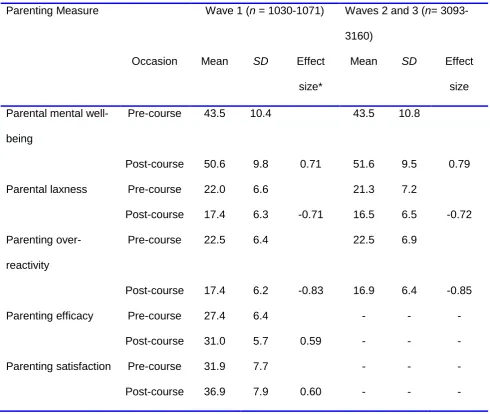
There were highly significant (p < .0005) improvements on all parenting measures following
parents’ attendance at one of the parenting programmes. Table 1 shows the pre- and
post-course means for each measure at Wave 1 and Waves 2/3. Parents’ mental well-being
increased such that the median for both Wave 1 (50.6) and Waves 2/3 (51.6) were
comparable to the national median of 51. Effect sizes (Cohen’s d) ranged from 0.59 to 0.85
indicating medium to large effects across the measures. These effects were broadly similar
across the four programmes for which pre- vs post-course data were available. Furthermore,
the children’s behaviour, as rated by their parent, had also improved significantly (p < .0005),
although effect sizes were lower, for example 0.57 Wave 1 and 0.45 Waves 2/3 for SDQ
total difficulties (Lindsay et al 2008, 2010).
<Table 1 here>
Family issues
In their accounts of family life prior to undertaking a PEIP course, a common theme among
parents was their realization that their family lives were affected by disharmony. For
example, a father explained, ‘It was just like a free-for-all, really, in my house. The kids were
doing what they wanted, not listening when you tell them to do something’ (P1/LA C160).
Parents frequently described family life as involving a repeated pattern of interactions that
they were unhappy with, such as their children not responding to reasonable requests, or
frequent occurrences of shouting between parents and children. There was a sense that, for
many parents, they felt that in their relations with their children they had reached an impasse
and one that was having a negative effect on them as well as their children. One mother
explained why she decided to go on a PEIP course by saying, ‘To be honest the reason I
21
Similarly, ‘There were a couple of interesting bullet points [on the information leaflet] that
caught my attention, but, again, I also felt that I was in a crisis where I needed help
desperately’ (P2/LA C343). Another commented:
‘At the time I was contacted I was at the end of the road, I had looked at so many
different places for help, and this fell on my doorstep and I just thought, “anything I
can do to get help and information has got to be a good thing”; so I thought it would
be an opportunity to go and learn, perhaps not where I had been going wrong, but
how to put things right’. (P3/LA C123)
The parents wanted to address the problems that they recognised in their family lives, and
wanted to improve their relationships with their children. They were concerned that other
families were not like their own, and they were worried about attending PEIP courses where
their ‘dirty washing’ might be on public display. Despite these reservations, parents accepted
places on PEIP courses, and, even when referred, were willing to try the courses, in the
hope that they might help in rebuilding relationships.
Parenting courses as educational processes
The interview data indicated that undertaking a parenting course was an educative process.
Parents argued that the PEIP courses enabled them to acquire new knowledge and skills,
which impacted positively on the culture of family life, interpersonal relations between adults
and children, and between adults in the same household.
Parents identified a number of elements in the educative experience of completing a PEIP
course. For the overwhelming majority of parents, the key transformative understanding was
the acceptance of the knowledge that parent behaviour is of primary importance in
parent-child relationships, and that parents need to change their own behaviour as a first step to the
22
‘I was raising my voice willy nilly and I didn’t realize, I wasn’t present enough to see how
that was masking him feel, how threatening that was, and some of the role plays and
some of the things we did here made me see … I was shouting and screaming and
everything, but now, just the fact that I don’t raise my voice now has changed everything.
I’m mummy and he’s safe, and he feels safe, and he gives that off. It’s completely
different’. (P2/LA C321)
The process of acting upon the new insights around the central part played by the adult’s
behaviour in parent-child relationships, and the rewards from that, helped parents gain new
confidence in their parenting skills. In consequence, they were more capable of establishing
or re-establishing appropriate parent and child roles, which, in turn, led to improved
parent-child relationships, as identified, for example, by this parent:
‘It’s made me more confident in my parenting. It’s made me more able to set boundaries
with my daughter. It’s made me more confident in challenging her when she’s being
disruptive. She knows when I mean business now. It’s kind of ingrained in me now, and I
can see, even when things are happening, and I’m not referring to the book, I can see
myself thinking and afterwards I think, “I did that because of that course”. It’s changed
the way I react to her reactive behaviour. It’s just completely changed both of us, I think,
in our outlook to each other as well. We’re enjoying each other’s company now. We’re
not just arguing constantly. It’s changed our lives. It really has given me my daughter
back’. (P1/LA C434)
The parents also provided accounts of the ways in which they had learned, through the PEIP
courses, to devote specific time to their children, and, in that way they had learned how to
23
‘I now actually stop what I am doing and listen to them or say things like “let me just
finish this washing up and I’m all yours”. They ask you something while you’re
washing up … it’s always, “just a minute”. I think more about how they are feeling
and not just what I’ve got to do. That has improved a lot in my relationship with my
daughter’. (P4/LA C544)
Improved parent-child relationships, child-centred time given by parents, boundaries for
children, and appropriate parent and child roles all contributed to the improved quality of
family life.
Discussion: the PEIP and classed policy
This paper presents an unusually large data set of quantitative and qualitative data on PEIP
parenting courses, and these data can add to the discourse about classed policies and
parenting classes. The presentation of the data does not pretend to answer the complexity of
this issue, which goes beyond government policy. Rather, this study can enrich the
discussion, as it is firmly grounded in empirical data from parents. The national focus of the
PEIP was on families and children at risk of anti-social behaviour. Within that overarching
target group, LAs were, nonetheless, free to decide on local priorities and referral pathways.
In consequence, there were a range of referral mechanisms, from universal offers to all
parents to court order referrals for individual parents, a small minority. The national focus on
‘at risk’ groups might suggest that, as critics of parent ‘support’ strategies argue,
programmes like the PEIP are part of an attempt by the government to re-create the working
class. There are problems with this approach in itself, with, for example, the inference that
anti-social behaviour is a marker of class. The LAs operated under guidelines from the
DCSF which stated:
‘Parents targeted by the PEIP should include those that have been identified by
24
aggression, substance misuse, anti-social behaviour including children & young
people involved in knife-crime, violence, and/or gangs) and those with parental risk
factors (substance misuse, parental offending, parental mental health difficulties etc.’
(DCSF, 2009, 9).
If these target groups are taken, by inference, to represent the working class, or a particular,
classed culture, as implied by, for example, Gewirtz (2001), Vincent (2001), and Gillies
(2005a, 2005b, 2008), then characterisation of the working class is wholly negative;
assuming that knife crime, substance misuse, and gang membership, for example, are
accepted as being problematic for the individual and society. But even in the narrower
context of the PEIP evaluation findings, there are additional difficulties with the critique that
such initiatives represent a project the aim of which is the re-socialization of the working
class by a fraction of the middle-class – the ‘cloning the Blairs’ project (Gewirtz 2001).
Firstly, the class base of the PEIP parent cohort was not class specific. Although the parent
sample was skewed, comprising a high proportion from disadvantaged backgrounds, there
was also substantial variation. For example, pf the Waves 2 and 3 sample 11.3% had
degrees and a further 19.3% had a higher education experience below degree level, a total
of 30.9%, which compares with an overall UK percentage of 29% (ONS 2001) of the
population having received Higher Education. There is a more class focused aspect of the
PEIP cohorts in terms of housing (measured for Waves 2 and 3) with 32.1% of parents being
owner occupiers, while 62.6% rented housing (for the UK population in general, in 2001,
68% were owner occupiers, 32% rented housing; ONS 2001). Similarly, even given the
problems associated with generating accurate returns regarding income, the PEIP cohort
reflects higher proportions of lower income parents. Nonetheless, there is, again,
heterogeneity across the cohort, with 18.6% of the parental income being above £351 per
week, with 33.2% having an income of less than £150 per week, and a range between those
25
this did not, in terms of the PEIP cohort, translate into a straightforward class based
intervention. The cohort exhibited a range of education, income, and housing backgrounds.
Secondly, in terms of the qualitative evidence generated by the parent interviews, there was
no evidence that the parents regarded their participation as a classed experience. By
contrast, parents explained that the experience of the parenting course was one that was
characterised by non-judgemental respect. In addition, the delivery of PEIP courses was
such that parents did not feel that they were in a formalised or hierarchical learning situation.
Parents were highly positive about the group experience. Responses to the post-course
questionnaire question, ‘How was your group’ for Waves 2 and 3 showed that over 98% of
parents were positive about most aspects of group leader style, and over 95% were positive
about most aspects of programme helpfulness (Lindsay et al, 2011, 50-52). As one father
explained:
‘It was the way it was delivered. It was not like a classroom setting, it was just like …
your mates, a bit like a bunch of friends. Just like … down the pub with your mates or
something. It was just … it was not, like, dictated to you like if you was at school, like,
your teacher … this, this, this and this. It wasn’t said, this is how you do it, this … it
was suggested this is how you do it. It was never put forward, this is how you must
do it. It was … these are only suggestions, you can take them on board if you like’.
(P2/LA C160)
This account was typical of that provided by parents, and matches Warin’s (2009)
description of parents and professionals working in partnership in a fashion that she has
described as exhibiting ‘mutual reach’. This is characterised not by a one-way, top-down flow
26
Further, the priority of the parents was to improve their relationships with their children. In
some cases, there was an awareness that their children had been identified, by, for
example, schools, youth workers, or police, as presenting with anti-social behaviour, but
these issues were still seen in the light of their own relationship with their child. Nonetheless,
a minority of parents were referred onto the PEIP courses, some by social workers, others
by court orders. In these cases, there was an element of compulsion, the impact of which in
terms of parental engagement and perception of course attendance needs further research.
It was a common belief among parents who had undertaken a PEIP course that all families
would benefit from such courses, regardless of background. Interestingly, one father who
had been referred onto a PEIP course by his social worker, argued that:
‘If you knock on ten doors round this place, and people say, “yes, I’ve got the perfect
family” … what liars! There is no such thing on this planet as the perfect family that
social services have made it out to be.’ (P1/LA C160)
In this case, the father was using his life experience, and his experience of the PEIP course,
as a way of subverting what he saw as his neighbours’ and social workers’ myths of ‘perfect
families’. Other parents were enthusiastic about the PEIP courses and the impact of their
new parenting knowledge, and thought that the courses should be universally available.
They were also aware that many parents were wary of participating, fearing that the courses
were a means of control. An example is the commentary made by a mother who had
attended a school organised PEIP course. The school had offered the course to all the
parents of its pupils (the majority of whom came from a London borough with unusually low
levels of social deprivation), and, following a successful participation in the course, the
27
‘We’ve been trying very hard to promote [the course] but I think most parents at the
school are too busy or on the other hand they are very suspicious of it, they see it as
something else. Once you’ve done it and you realise you get so much from it but
originally you were “oh this is going to be like the school interfering or it’s for bad
children”, so I think the difficult thing is that maybe it’s you struggle to get other
parents to see the benefits from it.’ (P2/LA C248)
Neither of these women met any criteria of social deprivation, both were married,
home-owning, middle-class, women with husbands in professional occupations. Their belief that
the PEIP courses should be made more widely available, so that more parents could access
the support, was one that was typical of all parents interviewed, regardless of class
background. Parents also argued that groups should be run at a range of times and
locations to suit different work patterns. In addition, parents suggested that parents should
have access to groups when their children were young and problems were less severe.
Conclusions
The large-scale evaluation of the PEIP in England indicated that the dominant parental
experience of undertaking an evidence-based PEIP course was characterised by improved
mental well being, and self-efficacy measurements, as revealed by four standardised
instruments. Further, the qualitative data generated indicated that parents experienced the
PEIP programmes in a generally positive fashion, and that the parenting courses led to
improved parent-child relationships, and happier family life. Government sponsored parent
and family education interventions have been subject to class based critiques, and
characterised in negative terms. The PEIP initiative falls squarely into that group of policies
that have been subjected to class based critique. However, the evidence from the PEIP
evaluation suggests that such critiques need to be revisited given, firstly, the heterogeneous
class nature of the PEIP cohorts, which, despite being skewed to comprise a high proportion
28
experience of higher education. . In addition, the qualitative data indicate that parents had
largely positive participant perceptions of PEIP courses, and experienced positive
improvements in familial relationships. These changes can be characterised by the concept
of ‘mutual reach’, and suggest that parents did not experience the courses in classed terms.
Further, there was a belief that such courses should be made available more widely,
irrespective of the class background of parents. These findings add to our understanding of
class issues and government sponsored parenting support. It is the case that the
class-based critique of such policy needs to be re-engaged with, and that further work is needed to
extend our understanding of parenting support policy, which has an increasing prominence
29 References
Allen, G. (2011a) Early Intervention: the next steps; an independent report to Her Majesty’s
Government (London, HM Government).
Allen, G. (2011b) Early Intervention: smart investment, massive savings. The second
independent report to Her Majesty’s Government (London, HM Government).
Barlow, J., & S. Stewart-Brown. (2000) Behaviour problems and group based parenting
education programmes, Developmental and Behavioural Paediatrics, 21, 356-370.
Bone, M., & H. Meltzer. (1989) The prevalence of disability among children; OPCS Surveys
of Disability in Great Britain; Report 3 (London, HMSO).
Broidy, L., D. Nagin, R. Tremblay, J. Bates, B. Brame, K. Dodge, K. (2003) Developmental
trajectories of childhood disruptive behaviours and adolescent delinquency: a six site,
cross-national study, Developmental Psychology, 39, 222-245.
C4EO. (2010) Grasping the Nettle: early intervention for children, families and communities;
a practice guide to the challenges and opportunities in supporting children, families and
communities through early intervention, based on effective local, national and international
practice (London, C4EO).
Cannadine, D. (2000) Class in Britain (Harmondsworth, Penguin Books).
Coren E, and J. Barlow. (2000) Individual and group-based parenting
programme for improving psychosocial outcomes for teenage parents and their
children (Cochrane protocol) (Oxford, The Cochrane Library) Issue 3.
Council of Europe. (2006) Recommendation Rec (2006)19 of the Committee of Ministers to
member states on policy to support positive parenting (Strasbourg, The Council of Europe).
Daly, M. (ed.). (2007) Parenting in contemporary Europe: a positive approach (Strasbourg,
Council of Europe).
Department of Children, Schools and Families. (2009) Parenting Early Intervention
30
Department of Work and Pensions (DWP)/ Department for Education (DFE). (2011) A new
approach to child poverty: tackling the causes of disadvantage and transforming families’
lives (London, HM Government).
Dwyer, P. (2004) Conditionality in the UK: From Welfare Rights to Conditional Entitlements?.
The Canadian Journal of Sociology, 29, 265-287.
Field, F. (2010) The Foundation Years: preventing poor children becoming poor adults. The
report of the Independent Review on Poverty and Life Chances. London: HM Government.
Gerhardt, S. (2004) Why Love Matters; how affection shapes a baby’s brain (Hove,
Brunner-Routledge).
Gewirtz, S. (2001) Cloning the Blairs: New Labour’s programme for the re-socialization of
working-class parents, Journal of Education Policy, 16, 365-378.
Gillies, V. (2005a) Meeting parents’ needs? Discourses of “support” and “inclusion” in family
policy, Critical Social Policy, 25, 70-90.
Gillies, V. (2005b) Raising the “Meritocracy”: parenting and the individualization of social
class, Sociology, 39, 835-853.
Gillies, V. (2008) Perspectives on Parenting Responsibility: contemporary values and
practices, Journal of Law and Society, 35, 95-112.
Gillies, V. (2010) Is poor parenting a class issue? Contextualising anti-social behaviour and
family life. In Is Parenting a Class Issue? M. Klett-Davies, 44-61 (London, Family and
Parenting Institute).
Green, H., McGinnity, A., Meltzer, H., Ford, T., Goodman, R. (2005). The Mental Health of
Children and Young People in Great Britain, 2004. (Basingstoke, Palgrave MacMillan).
Heron, E., P. Dwyer. (1999) Doing the Right Thing: Labour’s Attempt to Forge a New
Welfare Deal Between the Individual and the State, Social Policy and Administration, 33,
91-104.
HM Government. (2003) Every Child Matters. Green Paper (Nottingham, DfES).
31
Labour Party. (1997) New Labour Because Britain Deserves Better (London, The Labour
Party).
Klett-Davies, M. (2010) Is Parenting a Class Issue? (London, Family and Parenting Institute).
Lindsay, G., S. Strand, H. Davis. (2011) A comparison of the effectiveness of three parenting
programmes in improving parenting skills, parent mental well-being and children’s behaviour
when implemented on a large scale in community settings in 18 English local authorities: the
Parenting Early Intervention Pathfinder (PEIP). BMC Public Health, 11, 962-987.
Lindsay, G., S. Cullen, C. Wellings. (2011) Bringing Families and Schools Together; giving
children in high-poverty areas the best start at school. London, Save the Children UK).
Lindsay, G., H. Davis, S. Band, MA. Cullen, S. Cullen, S. Strand, C. Hasluck, R. Evans, S.
Stewart-Brown. (2008) Parenting Early Intervention Pathfinder Evaluation. (London, DCSF
Research Report DCSF-RW054).
Lindsay, G., S. Strand, MA. Cullen, S. Cullen, S. Band, H. Davis, G. Conlon, J. Barlow, R.
Evans. (2011) Parenting Early Intervention Programme Evaluation. (London, Department for
Education, Research Report DFE-RR121(a)).
Mayer, V. (2008) Crafting a New Conservative Consensus on Welfare Reform: Redefining
Citizenship, Social Provision, and the Public/Private Divide, Social Politics: International
Studies in Gender, State and Society, 15, 154-181.
McDonald, L. (1993) Families and Schools Together (FAST) (Washington, U.S. Department
of Health and Human Services)
Munro, E. (2011) The Munro Review of child protection: final report; a child-centred System.
London: Department for Education, Cm 8062.
Molgaard, V., Kumpfer, K., (1993) Strengthening Families Program 10-14 (Ames, Iowa State
University).
National Institute for Heath and Clinical Excellence (NIHCE). (2005)
Parent-training/education programmes in the management of children with conduct disorders
32
Office for National Statistics (ONS). (2001) http://www.statistics.gov.uk/census2001/op.asp,
accessed, 16th August 2010.
Patterson, J., C. Mockford, J. Barlow, C. Pyper, C., and S. Stewart-Brown. (2002) Need and
demand for parenting programmes in general practice, Archives of Disease in Childhood, 87,
472-477.
Reay, D. (2008) Tony Blair, the promotion of the “active” educational citizen, and
middle-class hegemony, Oxford Review of Education, 34, 639-650.
Robson, K. (2010) Good, Responsible Parenting: Child-Support Guidelines in an Era of
Neo-liberalism, Canadian Journal of Law and Society, 25, 129-148.
Scott, S., M. Knapp, J. Henderson, and B. Maughan. (2001) Financial cost of social
exclusion; follow up study of antisocial children into adulthood, British Medical Journal, 323,
194-198.
Tickell, C. (2011) The early years: foundations for life, health and learning; an independent
report on the Early Years Foundation Stage to Her Majesty’s Government (London,
Department for Education).
United Nations Office on Drugs and Crime. (2009) Guide to Implementing Family Skills
Training Programmes for Drug Abuse Prevention,
http://www.unodc.org/pdf/youthnet/family%20based/FINAL_ENGLISH_version%20for%20P
RINTING%20received%20120209.pdf (New York, United Nations Office on Drugs and
Crime).
United Nations Office on Drugs and Crime. (2010) Compilation of Evidence-Based Family
Skills Training Programmes,
http://www.unodc.org/docs/youthnet/Compilation/10-50018_Ebook.pdf (New York, United Nations Office on Drugs and Crime).
Vincent, C. (2001) Social class and parental agency, Journal of Education Policy, 16,
347-364.
Warin, J. (2009) Safeguarding children’s well-being within educational settings: a critical
review of inclusion strategies. In K. Broadhurst, C. Grover, J. Jamieson, (eds), 131-147.
33
Table 1 Pre- and post-course means (SDs) for parenting measures
Parenting Measure Wave 1 (n = 1030-1071) Waves 2 and 3 (n=
3093-3160)
Occasion Mean SD Effect
size*
Mean SD Effect
size
Parental mental
well-being
Pre-course 43.5 10.4 43.5 10.8
Post-course 50.6 9.8 0.71 51.6 9.5 0.79
Parental laxness Pre-course 22.0 6.6 21.3 7.2
Post-course 17.4 6.3 -0.71 16.5 6.5 -0.72
Parenting
over-reactivity
Pre-course 22.5 6.4 22.5 6.9
Post-course 17.4 6.2 -0.83 16.9 6.4 -0.85
Parenting efficacy Pre-course 27.4 6.4 - - -
Post-course 31.0 5.7 0.59 - - -
Parenting satisfaction Pre-course 31.9 7.7 - - -
Post-course 36.9 7.9 0.60 - - -
p < .0005 in all cases