warwick.ac.uk/lib-publications
A Thesis Submitted for the Degree of PhD at the University of Warwick
Permanent WRAP URL:
http://wrap.warwick.ac.uk/80142
Copyright and reuse:
This thesis is made available online and is protected by original copyright.
Please scroll down to view the document itself.
Please refer to the repository record for this item for information to help you to cite it.
Our policy information is available from the repository home page.
U N
IVER
SITAS WARWICEN
SIS
Evaluating Technologies and Techniques for
Transitioning Hydrodynamics Applications to
Future Generations of Supercomputers
by
Andrew Colin Mallinson
A thesis submitted to The University of Warwick
in partial fulfilment of the requirements
for admission to the degree of
Doctor of Philosophy
Department of Computer Science
The University of Warwick
Current supercomputer development trends present severe challenges for
scientific codebases. Moore’s law continues to hold, however, power constraints
have brought an end to Dennard scaling, forcing significant increases in overall
concurrency. The performance imbalance between the processor and memory
sub-systems is also increasing and architectures are becoming significantly more
complex. Scientific computing centres need to harness more computational
resources in order to facilitate new scientific insights and maintaining their
codebases requires significant investments. Centres therefore have to decide
how best to develop their applications to take advantage of future architectures.
To prevent vendor “lock-in” and maximise investments, achieving
portable-performance across multiple architectures is also a significant concern.
Efficiently scaling applications will be essential for achieving improvements
in science and the MPI (Message Passing Interface) only model is reaching its
scalability limits. Hybrid approaches which utilise shared memory programming
models are a promising approach for improving scalability. Additionally PGAS
(Partitioned Global Address Space) models have the potential to address
pro-ductivity and scalability concerns. Furthermore, OpenCL has been developed
with the aim of enabling applications to achieve portable-performance across a
range of heterogeneous architectures.
This research examines approaches for achieving greater levels of
perfor-mance for hydrodynamics applications on future supercomputer architectures.
The development of a Lagrangian-Eulerian hydrodynamics application is
pre-sented together with its utility for conducting such research. Strategies for
im-proving application performance, including PGAS- and hybrid-based approaches
are evaluated at large node-counts on several state-of-the-art architectures.
hy-as an additional technology for implementing a hybrid programming model
and improving performance-portability. To enhance productivity several tools
for automatically hybridising applications and improving process-to-topology
mappings are evaluated.
Power constraints are starting to limit supercomputer deployments,
poten-tially necessitating the use of more energy efficient technologies. Advanced
processor architectures are therefore evaluated as future candidate technologies,
together with several application optimisations which will likely be necessary.
An FPGA-based solution is examined, including an analysis of how e↵ectively
it can be utilised via a high-level programming model, as an alternative to the
The completion of this thesis, and the research work contained within it, was made possible by the support of a number of people. Their academic advice and personal support throughout my time at Warwick, has helped to maintain my research focus.
I would like to thank AWE plc for funding this work. Specifically Andy Herdman and Wayne Gaudin for providing guidance throughout; you have both been a pleasure to work for.
My beloved partner Ruth, to whom I am eternally grateful, deserves huge credit for all her love and support during my Ph.D. without which I would not have been able to complete this work. Additionally, for their continued and invaluable support throughout, I would also like to thank my Mum, Dad, Sister and Brother-in-law.
This thesis is submitted to the University of Warwick in support of the author’s application for the degree of Doctor of Philosophy. It has been composed by the author and has not been submitted in any previous application for any degree.
The work presented (including data generated and data analysis) was carried out by the author except in the cases outlined below:
1. A. C. Mallinson, D. A. Beckingsale, W. P. Gaudin, J. A. Herdman, J. M. Levesque and S. A. Jarvis. CloverLeaf: Preparing Hydrodynamics Codes for Exascale, InProceedings of the Cray User Group 2013 (CUG), Napa Valley, USA, May 2013 [132].
2. A. C. Mallinson, D. A. Beckingsale, W. P. Gaudin, J. A. Herdman and S. A. Jarvis. Towards Portable Performance for Explicit Hydrodynamics Codes, In Proceedings of the International Workshop on OpenCL 2013
(IWOCL), Atlanta, USA, May 2013 [131].
3. W. P. Gaudin, A. C. Mallinson, O. Perks, J. A. Herdman, D. A. Beck-ingsale, J. M. Levesque, M. Boulton, S. McIntosh-Smith and S. A. Jarvis. Optimising Hydrodynamics applications for the Cray XC30 with the ap-plication tool suite, InProceedings of the Cray User Group 2014 (CUG), Lugano, Switzerland, May 2014 [69]. Awarded best research paper.
4. A. C. Mallinson, W. P. Gaudin, J. A. Herdman and S. A. Jarvis. Ex-periences at scale with PGAS versions of a Hydrodynamics Application, InProceedings of the 8th International Conference on Partitioned Global Address Space Programming Models(PGAS2014), Eugene, Oregon, USA, Oct 2014 [133].
The research presented in this thesis was made possible by the support of the
following benefactors and sources:
• UK Atomic Weapons Establishment, under grants:
“The Production of Predictive Models for Future Computing
Requirements” (CDK0660)
“AWE Technical Outreach Programme” (CDK0724)
ADRES Architecture for Dynamically Reconfigurable Embedded Systems
AMD Advanced Micro Devices
API Application Programming Interface
APU Accelerated Processing Unit
ASIC Application Specific Integrated Circuit
AVX Advanced Vector Extensions
AWE Atomic Weapons Establishment, UK
BG/Q Blue Gene Q
BSP Bulk Synchronous Parallel
CAAR Center for Application Acceleration Readiness
CAF Co-array Fortran
CCE Cray Compilation Environment
CFD Computational Fluid Dynamics
CPU Central Processing Unit
CUDA Compute Unified Device Architecture
DARPA Defence Advanced Research Projects Agency
DDR Double Data Rate
DMA Direct Memory Access
DOD Department of Defence
DOE Department of Energy
DRAM Dynamic Random Access Memory
DSP Digital Signal Processor
EDA Electronic Design Automation
ESL Electric System Level
FLOP/s Floating-Point Operations per Second
HDL Hardware Description Language
HMC Hybrid Memory Cube
HMPP Hybrid Multicore Parallel Programming
HPC High-Performance Computing
IB InfiniBand
IBM International Business Machines Corporation
IEEE Institute of Electrical Engineers
IFE Inertial Fusion Energy
LANL Los Alamos National Laboratory
LLC Last Level Cache
LLNL Lawrence Livermore National Laboratory
LLVM Low Level Virtual Machine
LUT Look Up Table
MPI Message Passing Interface
MTTI Mean Time to Interruption
MW Megawatt
NIC Network Interface Card
NIF National Ignition Facility, USA
NOC Network on a chip
NUMA Non-Uniform Memory Access
ORNL Oak Ridge National Laboratory
OS Operating System
PCIe Peripheral Component Interconnect Express
PGAS Partitioned Global Address Space
PGI Portland Group Incorporated
PRAM Parallel Random Access Machine
PTX Parallel Thread Execution
SDK Software Development Kit
SIMD Single Instruction Multiple Data
SMP Symmetric Multi-Processor
SNL Sandia National Laboratories
SOC System on a Chip
SPH Smoothed Particle Hydrodynamics
SPMD Single Program Multiple Data
SSE Streaming SIMD Extensions
TDP Total Power Draw
TLB Translation Lookaside Bu↵er
UPC Unified Parallel C
Collective
Refers to a communication event, within parallel application programming, in
which more than two end-points are involved. Communication of this type can
potentially involve multiple source or destination end-points (or both).
Computational Kernel
A collection of application program code, such as multiple loop-block
struc-tures, which has been logically co-located within the same program function or
subroutine, and collectively performs a particular well-defined task or operation.
Compute Bound
Is a term used to refer to one or a series of operations whose overall runtime is
dominated by the length of time required to process the particular instructions
and associated data-values within the computational device.
Exascale
Is a term which refers to high performance computing systems which are capable
of executing a thousand Petaflops or a quintillion (1018) floating point operations
per second.
Elemental Function
Denotes a function which operates on a scalar argument or single array element
but can also be applied in parallel to a series of, potentially multi-dimensional,
array elements.
Energy to Solution
Refers to the total energy (Joules) consumed by an application during the course
of its execution on a particular processing architecture.
Global Address Space
In parallel programming this relates to the ability of any thread of execution to
The design of parallel applications often involves the decomposition of the overall
problem domain across multiple processors, such that each process is
respon-sible for a distinct subset of the domain. The operations performed by each
processor, however, often require data-values from parts of the problem domain
which are managed by other processes within the overall computation. This
frequently occurs on the boundary between the contiguous domains managed
by di↵erent processes. To minimise the accesses to remote memory locations
on other processes, boundary data cells from logically adjacent processes are
often replicated in a layer of cells around the domain managed by each process.
This additional layer of cells is referred to as a “halo” region and can be of
varying depths depending on the requirements of the algorithm currently being
executed.
Kernel Driver
A program which is able to unit-test a particular computational kernel routine
in terms of both its overall performance and correctness.
Memory Bound
Is a term used to refer to one or a series of operations whose overall runtime
is dominated by the length of time required to load (or store) the particular
instructions and associated data-values from the memory sub-system rather
than to actually process them within the computational device.
Network On a Chip (NOC)
Is a term used to refer to the inclusion of a dedicated interconnection network
between the processing components of a System On a Chip design i.e. within
the same integrated circuit.
Non-Uniform Memory Access (NUMA)
Refers to a particular design of multi-processing system in which the time to
access individual memory locations varies depending on the proximity of the
Parallel Speedup
Is calculated by the time recorded for the execution of the application in serial
divided by the execution time of the application when run in parallel.
S(parallel) = T(serial)
T(parallel) (1)
Petascale
Is a term which refers to high performance computing systems which are capable
of executing one quadrillion (1015) floating point operations per second.
Point-to-Point
Refers to a communication event, within parallel application programming,
between a distinct pair of end-points i.e. with a well-defined source and a
destination.
Portable Performance
Refers to the goal of achieving optimal or acceptable levels of performance
across multiple di↵erent types of system architectures from a single source
code representative of an application, that is without including optimisations or
modifications for specific architectures.
Remote Direct Memory Access (RDMA)
Is a form of communication in which the initiating CPU sends information
regarding the message transfer (length, remote memory address etc) to its local
NIC, which then manages the actual data transfer across the network [22].
Communication is one-sided and consequently the remote CPU is not involved
in the data transmission, the network hardware at the destination handles all of
the processing involved in the receipt of the data and committing it to memory.
Strong Scaling
Solving a fixed problem size by utilising an increasing amount of computational
necessary components required for a computational device within a single chip
substrate.
Wall-clock
A measure of application performance (the actual length of execution time)
recorded by an observer external to the application. This is di↵erent to CPU or
user time which relates to the total amount of time processor devices actually
spend executing applications.
Weak Scaling
In these studies the overall simulated problem size is increased proportionally
Abstract ii
Acknowledgements iv
Declarations v
Sponsorship and Grants vii
Abbreviations viii
Definitions xi
List of Figures xxii
List of Tables xxiii
1 Introduction 1
1.1 Motivations and Problem Statement . . . 3
1.2 Domain . . . 5
1.3 Research Questions and Hypothesis . . . 6
1.4 Research Methodology . . . 7
1.5 Thesis Contributions . . . 10
1.6 CloverLeaf . . . 13
1.6.1 Implementation . . . 13
1.7 Thesis Structure . . . 15
1.8 Project Availability . . . 16
2 Background Information 18 2.1 Hardware Background and Trends . . . 18
2.1.4 Memory Subsystem Technology . . . 23
2.2 Software Background and Trends . . . 24
2.2.1 OpenMP . . . 24
2.2.2 OpenCL . . . 25
2.2.3 CUDA . . . 26
2.2.4 OpenACC . . . 26
2.2.5 VHDL and Verilog . . . 27
2.2.6 BSP Programming Model . . . 28
2.2.7 MPI Programming Model . . . 29
2.2.8 PGAS Programming Model . . . 29
2.2.9 Hybrid Programming Models . . . 32
2.2.10 Current & Future Trends . . . 33
2.3 Hydrodynamics Mathematical Foundations & Applications . . . 34
2.3.1 Euler’s Equations of Compressible Fluid Dynamics . . . . 34
2.3.2 Motivations for Improving the State-of-the-art . . . 36
2.4 Summary . . . 37
3 Intra-Node Performance Optimisations 39 3.1 Related Work . . . 39
3.2 OpenMP-based Optimisations Examined . . . 40
3.2.1 First-touch Memory Placement . . . 40
3.2.2 Array-of-arrays Data Structure . . . 42
3.2.3 Data Alignment & Cache Line Padding . . . 43
3.2.4 High-level OpenMP Parallel Region . . . 43
3.2.5 Duplicating Constant Data per NUMA-region . . . 44
3.2.6 Explicit Loop Schedules . . . 44
3.2.7 Inter-thread Synchronisation Elimination . . . 45
3.2.11 Accelerate Kernel Optimisations . . . 49
3.2.12 Update-HaloKernel Optimisations . . . 49
3.2.13 Automatic Application Hybridisation . . . 51
3.3 Results Analysis . . . 51
3.3.1 Individual Kernel Optimisation Analysis . . . 52
3.3.2 Application Performance Analysis . . . 58
3.4 Summary . . . 63
4 Achieving Efficient Application Execution at Extreme Scale 66 4.1 Related Work . . . 66
4.2 MPI-only Based Versions . . . 68
4.2.1 Optimisations Examined . . . 69
4.2.2 Power Consumption Instrumentation . . . 76
4.3 Hybrid (MPI+OpenMP) Based Versions . . . 77
4.3.1 Optimisations Examined . . . 78
4.4 Results Analysis . . . 80
4.4.1 MPI-only Results Analysis . . . 81
4.4.2 Hybrid (MPI+OpenMP) Results Analysis . . . 95
4.5 Summary . . . 107
5 Evaluating the Utility of PGAS-based Approaches 111 5.1 Related Work . . . 111
5.2 SHMEM Implementation . . . 113
5.3 CAF Implementation . . . 114
5.4 Results Analysis . . . 116
5.4.1 First Strong-scaling Experiment Results Analysis . . . 117
5.4.2 Second Strong-scaling Experiment Results Analysis . . . . 123
6.2 OpenCL Implementation . . . 128
6.2.1 Reduction Operators . . . 130
6.2.2 Optimisations . . . 133
6.3 Results Analysis . . . 139
6.3.1 Optimisations Analysis . . . 140
6.3.2 Single-node Performance Analysis . . . 151
6.3.3 Multi-node Performance Analysis . . . 154
6.4 Summary . . . 159
7 Evaluating FPGAs as Low Power Processing Solutions 162 7.1 Related Work . . . 162
7.2 FPGA Targeted OpenCL Implementations . . . 164
7.2.1 Optimisations Examined . . . 164
7.3 Results Analysis . . . 175
7.3.1 Optimisations Analysis . . . 176
7.3.2 Time to Solution Analysis . . . 184
7.3.3 Energy to Solution Analysis . . . 186
7.4 Summary . . . 188
8 Conclusion 190 8.1 Contributions . . . 191
8.1.1 Mini-app Development and Utilisation . . . 191
8.1.2 Evaluation of PGAS Programming Models . . . 191
8.1.3 Examination of Hybrid Programming Models . . . 192
8.1.4 Development of Application Optimisations . . . 194
8.1.5 Supercomputer Architecture Analysis . . . 195
8.2 Beneficiaries . . . 196
8.3 Limitations . . . 196
8.4.1 Extending the PGAS Language Evaluation . . . 198
8.4.2 Intra-node Programming Models . . . 199
8.4.3 Energy Efficient Processing Technologies . . . 200
Bibliography 202 Appendices 223 A Experimental Platforms/Architectures 224 A.1 Production Supercomputer Platforms . . . 224
A.1.1 HECToR . . . 224
A.1.2 Archer . . . 225
A.1.3 Spruce . . . 225
A.1.4 Mira . . . 226
A.1.5 Titan . . . 226
A.1.6 Vulcan . . . 227
A.2 Test-bed Platforms . . . 227
A.2.1 Teller, Compton & Shannon . . . 227
A.2.2 Chilean Pine . . . 229
A.2.3 Tuck . . . 230
1.1 Staggered grid employed in CloverLeaf . . . 14
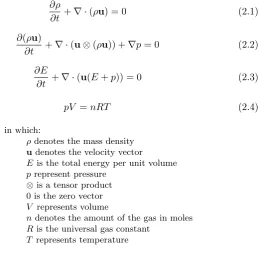
2.1 The Euler equations of compressible flow . . . 35
3.1 The modified “first-touch” memory initialisation approach . . . . 41
3.2 OpenMPpoint-to-point synchronisation approach . . . 46
3.3 The “vectorising” version of the Calc-DT kernel . . . 48
3.4 Optimisations to theCell-Advection kernel . . . 53
3.5 Optimisations to theMomentum-Advection kernel . . . 54
3.6 Optimisations to theAccelerate kernel . . . 55
3.7 Optimisations to theCalc-DT kernel . . . 56
3.8 Optimisations to thePdV kernel . . . 56
3.9 Optimisations to theUpdate-Halo kernel . . . 57
3.10 Optimisations to theField-Summary kernel . . . 58
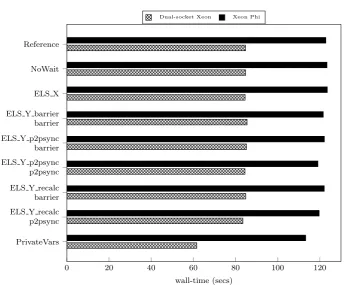
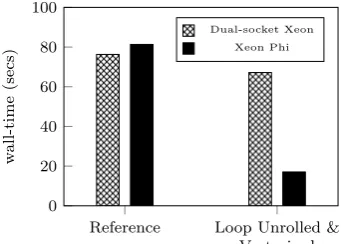
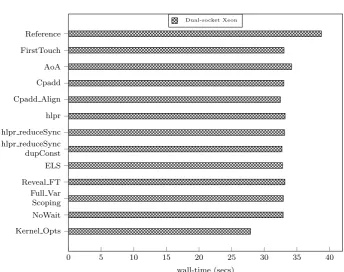
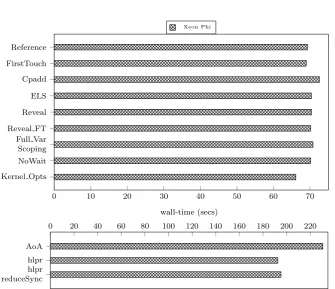
3.11 Application optimisations on the dual-socket CPU architecture . 59 3.12 Application optimisations on the Xeon Phi co-processor . . . 60
4.1 CloverLeaf heap memory consumption per process . . . 69
4.2 Cell calculation order for communication-computation overlap . . 72
4.3 MPI rank reordering strategy . . . 75
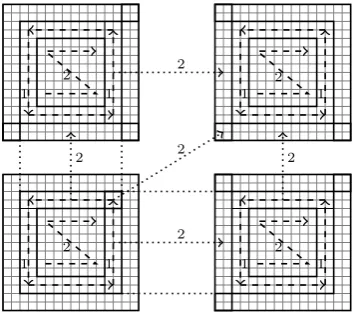
4.4 Vertical decomposition optimisation . . . 78
4.5 Distributed meta-data optimisation performance improvement . . 81
4.6 MPI processes / node configuration options on Vulcan . . . 82
4.7 Huge-pages, hyper-threads and consolidated reduction . . . 83
4.8 Message aggregation and early transmition optimisations . . . . 84
4.9 Performance of MPI-only Optimisations on Vulcan . . . 85
4.13 Performance of MPI v3.0 constructs on Archer . . . 90
4.14 MPI rank reordering on Archer . . . 92
4.15 Performance due to the distributed meta-data optimisation . . . 93
4.16 Energy to solution analysis on Archer(XC30) and Mira(BG/Q) . 94
4.17 Hybrid (MPI+OMP) performance on Archer . . . 96
4.18 Performance of the MPI+OMP implementation on Vulcan . . . . 97
4.19 Message aggregation for the MPI+OMP version on Archer . . . . 99
4.20 Message aggregation for the MPI+OMP version on Vulcan . . . 100
4.21 Optimisations to the hybrid versions on Archer . . . 101
4.22 Optimisations to the hybrid version on Vulcan . . . 102
4.23 Hybrid version produced by Reveal on Archer . . . 105
4.24 Hybrid version produced by Reveal on Vulcan . . . 106
5.1 PGAS implementations: Array- and bu↵er-exchange versions . . 117
5.2 Equivalent MPI, OpenSHMEM and CAF performance . . . 119
5.3 Local & global synchronisation approaches . . . 120
5.4 SHMEM volatile variables & fence/quiet optimisations . . . 121
5.5 CAFpgas defer syncconstruct & communication overlap . . . 122
5.6 SHMEM non-blocking, huge-pages & CAF FTL . . . 123
6.1 Components of the OpenCL version of theIdeal gaskernel . . . 129
6.2 OpenCL Reduction Implmentation for GPUs . . . 131
6.3 OpenCL Reduction Implmentation for CPUs . . . 132
6.4 The new device code for theIdeal gaskernel. . . 134
6.5 Bu↵er packing strong scaling performance (9602cell problem) . . 154
6.6 Strong-scaling performance (15,3602 cell problem) . . . 155
6.7 Speedup, relative to OpenACC, of CUDA and OpenCL . . . 156
7.3 Optimisations to theIdeal-gas kernel on the Altera FPGA . . . . 177
7.4 Optimisations to theAccelerate kernel on the Altera FPGA . . . 180
7.5 Ideal-gas kernel time-to-solution analysis . . . 185
7.6 Accelerate kernel time-to-solution analysis . . . 185
7.7 Power consumption: Ideal-gas kernel . . . 186
6.1 OpenCL optimisations on the Nvidia K20X . . . 140
6.2 OpenCL optimisations on the Intel Xeon E3-2620 . . . 141
6.3 OpenCL optimisations on the Intel Xeon Phi 7120P . . . 142
6.4 OpenCL optimisations on the AMD Opteron 6272 . . . 143
6.5 Optimal work-group sizes for each OpenCL CloverLeaf kernel . . 149
6.6 Runtime of the OpenCL implementation for the 3,8402 problem 152
6.7 Runtime of the OpenCL implementation for the 9602 problem . . 153
7.1 Accelerate kernel profiling statistcs on the Altera FPGA . . . 182
A.1 UK-based experimental platform system specifications . . . 225
A.2 Specifications of platforms located at ORNL, ANL & LLNL . . . 226
A.3 Specifications of the experimental platforms located at SNL . . . 228
A.4 Chilean Pine platform system specifications . . . 229
Introduction
The use of scientific computing / HPC has grown significantly over the last decades and increasingly organisations and national governments are recognising that it is crucial to their competitiveness and future prosperity [153, 11]. The field promises to improve scientific insight and reduce product development cycles by enabling more experiments (higher throughput) to be conducted in significantly reduced time frames and overall operating budgets, whilst reducing the need for more expensive physical tests. Additionally it enables experiments to be conducted, potentially at higher fidelities and which couple multiple di↵erent physics packages, that were previously not possible due to their sheer size, complexity or cost [153, 206]. Increasingly HPC is also being utilised to simulate particular problems which are impossible or extremely impractical to test physically due to either the regulatory environment or safety concerns. This has led to simulation being widely recognised as the third pillar of scientific discovery alongside theory and experimentation [64, 167].
Several scientific “grand challenge” problems have been identified that will require systems capable of delivering exascale levels of computational perfor-mance in order to e↵ectively simulate them and produce the required advances in science [128, 206]. These include the solution of vastly more accurate predictive models to improve scientific understanding within, for example, the fields of: climate/weather forecasting; efficient low-carbon transportation; nuclear and renewable energy; the certification of nuclear stockpiles; materials science; na-tional security; and the advancement of certain biology/medical applications such as e↵ectively simulating the human brain [153, 128, 206].
Historically these systems were exclusively the preserve of large multi-national organisations and government laboratories, primarily due to the costs associated with procuring and operating them. The increasing commoditisation of the technologies used to construct HPC systems has, however, facilitated significant reductions in their overall cost and enabled smaller commercial organisations and universities to gain access to them [11]. This has simultaneously enabled substantially larger, more computationally capable and power-consuming sys-tems to be constructed for organisations at the forefront of the field.
pro-cessor clock speeds, seen over the last decades, have proved to be unsustainable due to their power and cooling requirements [153, 11]. System designers have therefore been forced to significantly increase the amount of parallelism available at all system levels, in order to continue to improve computational performance capabilities. Overall system power consumption continues to become a major concern to large HPC sites as systems become larger [153, 11, 206]. Due to these increased scales, system MTTI (Mean Time to Interruption) is reducing to levels below the time required to perform a check-point and restart operation, resulting in overall system resiliency becoming increasingly problematic. Research into fault resilient programming models for applications is therefore becoming in-creasingly necessary [153, 11, 128]. At the processing chip/device level transistor feature sizes continue to decrease in order to reduce energy requirements and increase the computational capabilities of the associated devices. Similarly advanced architectures such as GPGPUs, which exhibit even larger degrees of parallelism, are increasingly being considered to further improve performance. As the floating-point computational capabilities of processing devices improve in terms of both execution time and power consumption, actually performing these operations is becoming relatively inexpensive, whilst the cost of moving data is becoming extremely expensive [153, 11, 128, 206, 115]. Consequently memory bandwidth/latency and inter-node communication speeds are increas-ingly limiting application performance and accounting for the most significant proportion of overall power consumption [11].
11, 115]. E↵ectively utilising the increased concurrency available will also be vital if existing scientific applications are to harness the increased computational capabilities present within future supercomputer architectures. Additionally, simply maintaining them productively given current limited financial and devel-opment resources also presents challenges and requires significant investments.
Given these trends and the pressing need to improve the performance of key scientific codes on existing and future system architectures this thesis fo-cuses on evaluating the utility of particular newly proposed technologies for the advancement of explicit hydrodynamics applications. In particular it strives to evaluate both software and hardware technologies and techniques that will enable this class of applications to achieve greater overall performance and scalability. Achieving these aims will facilitate improvements in the science which it is possible to accomplish by improving overall scientific throughput (time-to-solution) as well as current simulation resolutions.
1.1
Motivations and Problem Statement
The scientific need to develop more advanced, potentially exascale-class, com-putational facilities is well documented, see Section 1 for more details. Actually achieving the successful construction of future multi-petascale or exascale capa-ble supercomputer systems and developing scientific simulation and modelling applications which are able to e↵ectively take advantage of their capabilities, however, currently presents a number of significant challenges [11].
These include but are not limited to, addressing the overall power efficiency of existing supercomputers to enable future larger and more computationally powerful systems to be constructed [11]. Employing today’s technology to construct a system capable of delivering an exaflop of computation would require more than 1GW of power [153]. The DOE (Department of Energy), in the USA, has set the HPC industry the challenge of delivering an exascale capable solution within an overall power budget of 20MW, necessitating an improvement of
>150⇥in power efficiency over current technology [153]. At the same time some observers do not believe that the 20MW target is achievable [114]. A practical limit of approximately 100MW exists, however, as the largest data-centres currently in existence only have access to this amount of power [48]. Regardless of the exact power budget figure, achieving a solution which lies within this range will still require a huge improvement in computational power efficiency over current technological solutions [153, 79, 10].
new programming paradigms designed to support more fine-grained parallelism and deeper memory hierarchies may, therefore potentially be required [153, 11]. Additionally, it is recognised that achieving the necessary computational power efficiencies will require future systems to use significantly di↵erent processor architectures to current generations of systems [153, 11]. Supercomputer archi-tectures are thus at present experiencing a transitional period. Potential future candidate technologies include the use of accelerator devices such as GPGPUs, many-core CPU devices with lower clock frequencies such as the Intel Xeon Phi or the use of lower-power technologies from the mobile and embedded computing sectors, such as ARM processors or FPGAs (Field Programmable Gate Arrays) [183, 142]. Regardless of which approaches prevail achieving optimal performance for existing applications and software stacks on these advanced architectures will be extremely problematic [153, 11]. Additionally, enabling applications to deliver portable performance across a range of future architectures, which is a requirement of large HPC sites to avoid vendor “lock in”, also presents significant challenges [11].
Furthermore scaling applications and systems to the levels of concurrency which will be required to achieve exascale-levels of computational performance also represents a significant challenge [153, 79, 10, 11]. It has been argued that existing software approaches, mainly based on the MPI-only model of computation, are already starting to reach the limits of their scalability, due to the number of MPI ranks competing for shared interconnect and memory resources, necessitating additional research into alternative programming mod-els and techniques [18, 11]. Additionally, on machines incorporating accelerator technologies, MPI-only is not a viable solution and precludes their use [11]. Hybrid programming models, which are able to make use of accelerators and the shared memory capabilities available within nodes, represent a promising area of research for improving performance by reducing the overall number of MPI ranks involved in the computation. They may also enable applications to be better adapted to future system architectures which are likely to exhibit significant reductions in the memory capacity, memory bandwidth and network bandwidth resources available per processing core [11].
Unlike the MPI model which utilises a two-sided model of communication, PGAS (Partitioned Global Address Space) based approaches such as CAF (Co-array Fortran) or OpenSHMEM rely on a lightweight one-sided communication model and a global memory address space [40, 148]. This model represents another promising area of research for improving the performance and scalability of applications as well as programmer productivity [11]. It may also potentially deliver further performance advantages by facilitating a reduction in the overall memory footprint of applications through, for example, the elimination of com-munication bu↵ers. Historically, e↵ectively utilising a PGAS-based approach often required the use of a proprietary interconnect technology, incorporating explicit hardware support, such as those commercialised in the past by Cray and Quadrics [200]. Although the body of work which examines PGAS-based applications on these technologies is still relatively small, substantially less research exists which examines their performance on systems constructed from commodity-based technologies such as Infiniband. It is likely that this analysis will become increasingly important in the future given that Intel recently pro-cured both the Cray Aries and Qlogic Infiniband interconnect technologies and the potential for these technologies to converge within future Intel SOC (System On a Chip) designs [96, 95]. Research is therefore needed to assess the relative merits of PGAS-based programming models and future hardware evolutions to ensure that the performance of scientific applications is optimised [11].
The task of developing, porting and optimising applications for future gen-erations of HPC systems is becoming increasingly complicated as architectures evolve [153, 11]. Developing and maintaining MPI-only applications is also becoming increasingly problematic due to their complexity and the analysis of legacy applications in order to convert them to hybrid models is non-trivial [11]. Even with an in-depth knowledge of the algorithm and target hardware, extract-ing the maximum concurrency is a difficult, time-consuming task. Improving the tool-suite available to developers which assists with this task will be essential if optimal performance is to be achieved productively [153, 11].
1.2
Domain
(e.g. memory capacity/bandwidth and power/energy consumption) consumed by these applications whilst executing on particular architectures of interest.
Many of the research topics which are examined in this thesis have signif-icantly wider applicability to other application domains within the scientific computing field. The applications utilised within these domains exhibit similar performance characteristics to the hydrodynamics applications examined within this work, and researchers are also pursuing similar directions for improving the current state-of-the-art, e.g. utilising PGAS and hybrid programming models. Additionally other communities, such as the mobile and embedded computing sectors may also potentially benefit from this research, as these fields already extensively utilise several of the technologies examined in this research, e.g. FPGAs. Similarly the research methodology employed in this work has much broader applicability than to just scientific computing applications and tech-nologies. This thesis is, however, deliberately constrained to the advancement of explicit hydrodynamics applications within the scientific computing field in order to adequately explore the applicability of the examined techniques, optimisations and technologies to this domain of interest.
1.3
Research Questions and Hypothesis
The trends and challenges, outlined in Section 1.1 motivate the author’s research and the work presented in this thesis specifically examines the following research questions within the domain documented in Section 1.2:
1. Is it possible to improve the scalability of hydrodynamics applications, and thereby their performance, by enabling these applications to execute more efficiently on larger scale supercomputer resources, through the utilisation of alternative design and implementation approaches. These include utilis-ing optimisation techniques such as overlapputilis-ing the execution of communi-cation and computation constructs; evaluating alternative communicommuni-cation strategies which are not based on the BSP-model; improving the mapping between application processes and the underlying machine interconnect topology; and employing a distributed approach for the management of computational mesh meta-data.
3. Can the utilisation of PGAS-based programming models deliver any per-formance and programmer productivity benefits for these hydrodynamics applications, and if so to establish how this class of scientific applications should be developed in order to maximise any potential benefits from the use of this technology.
4. Determine which prospective supercomputer architectures currently rep-resent the most performant and also energy efficient processing solution for the execution of hydrodynamics applications. In particularly whether x86 CPUs, IBM BG/Q CPUs, AMD APUs (Accelerated Processing Unit), GPU-based accelerators, or the Intel Xeon Phi many-core accelerator, are currently the most optimal choice for these applications.
5. Is it possible to utilise the OpenCL programming model to improve the performance portability of hydrodynamics applications across a range of prospective supercomputer architectures, including platforms based on CPU, GPU, APU or many-core accelerator technologies.
6. Finally, to determine whether FPGAs currently represent a viable pro-cessing technology which could be utilised within future supercomputer systems in order to improve the overall energy consumption of these applications, thus potentially enabling the construction of larger, more computationally capable systems within a fixed power budget.
The primary research hypothesis of this work is that:
The performance of computational hydrodynamics simulations can be improved through the use and implementation of the aforementioned technologies and optimisation techniques on current generations of supercomputer platforms.
The overall objective of this research is therefore to improve the performance of key hydrodynamics simulation applications through the examination of these research questions and the testing of this hypothesis. Thereby potentially facilitating advances in the scientific knowledge which it is currently possible to generate through their use, either by delivering improvements in overall scientific throughput by reducing the time-to-solution of existing simulations, or by enabling larger more sophisticated simulations to be conducted which are not currently feasible.
1.4
Research Methodology
within the domain outlined in Section 1.2.
To enable the research objective of this thesis to be completed in a reasonable time efficient manner an approach based on the use of a mini-application (or mini-app) was employed. Mini-apps are small, self contained programs that embody essential performance characteristics of larger applications, and thus provide a viable way to conduct more rapid experimentation [84]. This work utilises and further develops a simplified but still representative structured, explicit hydrodynamic mini-app known as CloverLeaf (Section 1.6) [132]. At-tempting this work using fully functional legacy production codes has in the past been found to be time consuming and impractical, due to the number of potential solutions available and the time required to port the codebases to the new technologies [84, 11]. A more rapid, lower risk approach for investigating the solution space is therefore extremely desirable. The use of a mini-app enables this rapid development and exploration of new technologies, architectures and techniques, in a manner which is still representative of the main production codebases which CloverLeaf represents.
Evaluating the utility of each of the di↵erent programming models and techniques involved in this research required the development of numerous new versions of CloverLeaf. Each new version examined one particular technique or programming model enhancement, which ensured that changes in results can be accurately attributed to particular modifications within the codebase. During development the functionality and correctness of these additional versions was regularly and frequently validated against the original version of the codebase to ensure that bit-wise identical results, or results to within an acceptable error tolerance, were produced at each stage. These validation tests were frequently executed at small experimental scales (e.g. <64 nodes), however, during each subsequent large-scale experiment the original CloverLeaf codebase was also executed alongside the modified versions, enabling the results produced by all additional versions to be validated at each stage of this work.
this system noise these experiments utilised, whenever possible, experimental platforms in a fully dedicated mode. This ensured that only experiments related to this research had access to the globally shared resources within a particular supercomputing system, thus minimising any system noise caused by other simultaneously executing applications. Additionally each experiment was also repeated several (typically three) times and the results averaged to produce a final value, before any analysis was conducted, thus further limiting the e↵ects of any system noise on the obtained results and conclusions. To mitigate the influence of di↵erent network topologies and node allocations from the batch schedulers managing the various supercomputer platforms examined in this work, experiments at a particular scale were aggregated and executed within the same allocations.
The range of experimental architectures and platforms involved in this re-search were also selected to provide an extensive range of candidate technologies, at both the node and system levels, which could potentially be utilised to construct future generations of systems. Similarly experiments were selected to enable conclusions to be drawn regarding the performance of a particular technology or technique at a range of experimental scales. This included exper-iments which examined performance on 1 node through to the largest job sizes which it was practical to obtain on a particular platform, up to 8,192 nodes (131,072 cores) in certain cases. These large scale experiments were essential in enabling the utility of particular approaches to be accurately assessed as potential candidates for enabling future applications to achieve exascale-levels of computational performance.
mon-itoring research to be conducted without relying on the power/energy consump-tion counters available within some processing devices, which are potentially inaccurate. Additionally, devices which do not contain these built-in monitoring subsystems can also be measured consistently. Whilst this technology is able to accurately measure the power consumption of individual components at the node level it is not able to produce accurate power consumption measurements for large-scale experiments on actual supercomputer platforms. The power monitoring capabilities available natively on the IBM BG/Q [201] and the Cray XC30 [135] platforms were therefore employed in order to conduct this aspect of this research.
1.5
Thesis Contributions
Specifically, to address the challenges and motivations discussed in Section 1.1 and answer the research questions documented in Section 1.3, this thesis makes the following key contributions:
Mini-app Development and Utilisation
It reports on how the CloverLeaf mini-app, which is documented in detail in Section 1.6, was further developed and utilised as part of this work in or-der to conduct the necessary research into potential application optimisations, candidate programming models and prospective supercomputer architecture choices. Additionally, it also documents how the general planning and decision making relating to the future development of scientific applications can be improved through the use of mini-apps. This research contributed significantly to CloverLeaf being accepted as part of the Mantevo mini-applications suite from Sandia National Labs [84], which was recognised as one of the top 100 most technologically significant innovations in 2013 by R&D Magazine [171, 184]. It was also the UK’s only contribution to the initiative and is currently being actively utilised by a large number of HPC centres, vendors and researchers across the world.
Evaluation of PGAS Programming Models
gained during the conversion from the original MPI-based implementation to these models. This included the development of 10 distinct OpenSHMEM- and 8 distinct CAF-based versions, each of which examine alternative implementation approaches.
A performance analysis is presented to provide both a comparison of each programming model and to assess how the communication constructs within each can best be incorporated into existing parallel applications. This examines the performance of these versions, at considerable scale (up to 49,152 cores) under a strong-scaling experimental scenario, on two state-of-the-art system architectures and vendor implementations (SGI and Cray). To assess the utility of these PGAS implementations against the dominant programming paradigm used in existing parallel scientific applications a performance comparison against an equivalent MPI-based implementation of CloverLeaf is presented. This infor-mation will be useful to developers of future OpenSHMEM and CAF applica-tions. Similarly, based on these results, recommendations to improve both the OpenSHMEM specification and potentially future CAF compiler and runtime systems are also identified.
Examination of Hybrid Programming Models
The incorporation of hybrid programming model constructs, based on both OpenMP and OpenCL, into this class of application is examined together with a quantitative assessment of whether these models can deliver benefits in terms of improved application performance or scalability. A detailed description of CloverLeaf’s hydrodynamics algorithm, and its implementation in both OpenMP and OpenCL is presented, together with a description of how both models integrate with the existing MPI-based Fortran code. Comparisons of the per-formance of the MPI+OpenMP and MPI+OpenCL versions of CloverLeaf are presented, relative to the original MPI-only version, at considerable scale on a number of system architectures including, two alternative Cray system ar-chitectures, an SGI ICE-X platform and an IBM BG/Q. A smaller-scale (1 node) analysis is also conducted across a broader range of potential candidate HPC architectures. For both programming models a number of optimisations to improve performance and portability are documented and their e↵ects analysed. The ability of the OpenCL programming model to deliver portable applica-tion performance from a single code base across a broad range of future candi-date supercomputer architectures is assessed. Additionally the viability of both approaches for expressing large scientific codebases and achieving acceptable levels of programmer productivity is also analysed.
The utility of the Reveal software tool from Cray is therefore also evaluated as a technology for achieving this, by automatically hybridising the MPI-only version of CloverLeaf and comparing its performance to that of a hand-optimised MPI+OpenMP implementation.
Development of Application Optimisations
The e↵ect of several candidate optimisation techniques on the performance and scalability of the MPI-only versions of this class of scientific application, are also examined and quantitatively assessed at considerable scale on three candidate system architectures: IBM BG/Q, Cray XC30 and SGI ICE-X. These optimisations include the examination of the e↵ect of: utilising an implementa-tion based on the use of distributed mesh meta-data informaimplementa-tion; overlapping communications and computational operations; several recently standardised MPI v3.0 constructs; as well as several message aggregation and early data transmission communication strategies. Additionally, the e↵ect of optimising the placement of MPI ranks within the supercomputer interconnect fabric is explored together with the e↵ectiveness of employing software tools from Cray in achieving this rank remapping.
Supercomputer Architecture Analysis
As well as assessing candidate technologies in terms of overall performance (time-to-solution), this thesis also examines the power consumption of several of these technologies and presents an analysis of the energy consumed in achieving a solution on a range of di↵erent technologies. This analysis is conducted at both small- (1 node) and large-scale (>2,048 nodes) using a variety of power-measurement solutions.
Furthermore the viability of FPGAs devices from Altera, as candidate tech-nologies to employ in future system architectures, is also examined. This includes an examination of how to optimally express particular explicit hydrody-namics computational kernels in order to maximise performance on these FPGA devices using the OpenCL compiler and runtime systems developed by Altera. A quantitative assessment is also conducted of whether this technology is able to deliver significant reductions in the energy required to achieve a solution, whilst delivering acceptable levels of performance, relative to existing state-of-the-art processing solutions, which are currently commonly utilised for this class of application.
1.6
CloverLeaf
Mini-apps are small, self-contained codes, which emulate key algorithmic com-ponents of much larger and more complex production codes. One of the main contributions of this research was the significant enhancements made to the development of the CloverLeaf mini-application, which was extensively used as a research tool through this work. CloverLeaf was originally developed with the explicit purpose of assessing new technologies and programming models both at the inter- and intra-node system levels. This section provides details of the implementation of the mini-app. Further information on the specific hydrody-namics scheme simulated within the application can be found in Section 2.3.
1.6.1
Implementation
u P,⇢ E
Flow
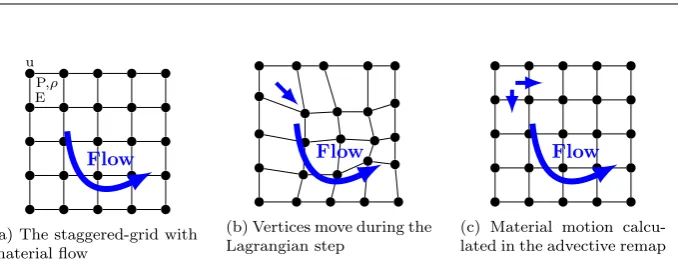
(a) The staggered-grid with material flow
Flow
(b) Vertices move during the Lagrangian step
Flow
[image:38.595.129.469.99.233.2](c) Material motion calcu-lated in the advective remap
Figure 1.1: Staggered grid employed in CloverLeaf
The solution is advanced forward in time repeatedly until the desired end time is reached. Unlike the computational grid, the solution in time is not staggered, with both the vertex and cell data being advanced to the same point in time by the end of each computational step. One iteration, or timestep, of CloverLeaf proceeds as follows (see Figure 1.1):
1. a Lagrangian step advances the solution in time using a predictor-corrector scheme, with the cells becoming distorted as the vertices move due to the fluid flow;
2. an advection step then restores the cells to their original positions and calculates the amount of material which passed through each cell face.
This is accomplished using two sweeps, one in the horizontal dimension and the other in the vertical, using Van Leer advection [199]. The direction of the initial sweep in each step alternates in order to preserve second order accuracy.
The codebase of CloverLeaf is predominantly Fortran based and its com-putational intensive sections are implemented via fourteen individual kernels. In this instance, kernel refers to a self-contained function which carries out one specific step of the overall hydrodynamics algorithm. Eachkernel iterates over the staggered grid, updating the appropriate quantities using the required stencil operation. The kernels contain no subroutine calls and avoid the use of complex features such as Fortran derived types. Twelve of CloverLeaf’s kernels only perform computational operations, with communication operations residing within the overall control code and two other kernels. One of these kernels is called repeatedly throughout each iteration of the application, and is responsible for exchanging thehalo data associated with one (or more) data fields, as required by the hydrodynamics algorithm. The second carries out the global reduction operation required for the calculation of the minimum timestep value. A further reduction is carried out to report intermediate results, but this is not essential to the numerical algorithm.
During the initial development of the code, the algorithm was engineered to ensure that all loop-level dependencies within the kernels were eliminated and data parallelism was maximised. Most of the dependencies were removed by refactoring large loops into smaller parts, adding extra temporary storage where necessary; replacing branches inside loops where possible; replacing atomic operations and critical sections with reduction operations; memory accesses were also optimised to remove all scatter operations and minimise memory stride for gather operations. The computational intensity per memory access in CloverLeaf is low which typically makes the code limited by memory bandwidth and latency speeds.
In the experiments documented in this thesis (Chapters 3 to 7) CloverLeaf was configured to simulate the e↵ects of a small, high-density region of ideal gas expanding into a larger, low-density region of the same gas, which causes a shock-front to form. The configuration can be altered by varying the number of cells employed in the computational mesh; increasing mesh resolution generally increases both the runtime and memory usage of the simulation.
1.7
Thesis Structure
The remainder of this thesis is organised as follows:
Chapter 2 provides background information and a future trends analysis relating to several of the research areas examined in this thesis, including the hardware platforms utilised, the software technologies examined and the explicit hydrodynamics applications on which this work has focused.
perfor-mance of the OpenMP-based versions of the CloverLeaf codebase is presented in Chapter 3, and includes an analysis of their performance at high thread counts on the Intel Xeon Phi architecture. This contributed towards answering research question 2. The work presented in this chapter also extends research documented in publications 1 and 3, as listed in the Declarations section of this thesis.
The research conducted to improve the performance of the CloverLeaf mini-app at extreme scale and thus answer research question 1.7 is documented in Chapter 4. The work presented in this chapter is based on research previously published in papers 1 and 3.
The implementation of the PGAS programming model based versions of CloverLeaf are documented in Chapter 5 together with an analysis of their performance against equivalent MPI-based versions, at significant scale on two candidate system architectures (Section 5.4). This chapter examines research question 3 and the work extends the research previously published in paper 4.
Chapter 6 examines the use of the OpenCL programming model and as-sesses its utility for delivering portable application performance for explicit hydrodynamics applications on a range of current processing architectures. It addresses research question 5 and extends the work previously documented in publications 2 and 5.
The suitability of utilising FPGAs as candidate processing solutions for explicit hydrodynamics applications within future architectures (research ques-tion 6) is examined in Chapter 7.
Chapter 8 presents the conclusions which this thesis has facilitated, together with its key contributions (Section 8.1) and limitations (Section 8.3). It also outlines some potential directions for future research (Section 8.4). Research question 2 is examined by Chapters 3 to 7 but the overall conclusion derived through this work is documented in this chapter.
Finally, Appendix A documents in detail the experimental architectures and platforms utilised throughout this research.
1.8
Project Availability
Background Information
This chapter presents background information on the hardware (Section 2.1) and software (Section 2.2) technologies employed and examined in this research, as well as information on the hydrodynamics applications and algorithms studied (Section 2.3). Historical information is provided together with existing issues and current, as well as likely future, development trends.
2.1
Hardware Background and Trends
This section provides background information on the three major hardware subsystems, within a HPC platform, which the research documented in this thesis interacts most closely with. These include interconnect technologies (Sec-tion 2.1.2) as well as the processor (Sec(Sec-tion 2.1.3) and memory (Sec(Sec-tion 2.1.4) subsystems. It also discusses what many consider to be the single most signifi-cant challenge currently facing the construction of exascale systems, their power consumption (Section 2.1.1).
2.1.1
Power Consumption
It has been widely recognised that power consumption will be the primary constraint governing the design of HPC systems in the future [11, 206, 128]. Several existing large-scale systems are currently consuming of the order of 10MW of power [114], with ORNL’s Titan and Riken’s K computer consum-ing ⇠8MW and ⇠12.6MW respectively, whilst Tianhe-2 in China consumes
research and development, but would potentially deliver considerable financial savings if achieved [153, 79, 10].
2.1.2
HPC Interconnect Technology
The interconnect technology has always been a key component of HPC sys-tems and this trend will only continue as the cost of communication (moving data) starts to dominate performance in future system architectures [11, 196]. Historically HPC systems employed proprietary interconnect technologies from vendors such as Quadrics [161], Cray [9, 31, 65], IBM[41], Fujitsu [3] and Myricom [70]. These technologies generally incorporated proprietary ASICs (Application Specific Integrated Circuits) on dedicated NICs (Network Interface Cards) and delivered improved performance in terms of reduced latencies and higher bandwidth over commodity solutions by o✏oading some of the com-munication processing to the NICs. They often provided support in hardware for operations commonly required by scientific applications, such as collective, atomic and one-sided Remote Direct Memory Access (RDMA) communication operations, which were not generally available in alternative commodity so-lutions. Additionally, they also supported topologies which closely mirrored the communication patterns of scientific applications, or enabled systems to be scaled to larger processor counts, such as 3 [9, 31], 5 [41] and 6 [3] dimensional tori; “fat” trees [161, 70]; and dragonflies [65]. The Quadrics network, for example, o✏oaded the processing of MPI (Message Passing Interface) commu-nications onto the NIC processor via the Elan Tports interface enabling the host processor to undertake additional tasks during communication operations. The QsNetII solution was capable of autonomously completing MPI message match-ing operations, although the performance of the raw RDMA Elan interfaces was shown to be faster [23].
tag matching and flow control.
Cray and IBM have been able to sustain their interconnect product lines, although IBM recently announced that it would be discontinuing production of its Blue Gene series machines [183] and Cray recently sold its interconnect business to Intel [96]. By contrast, Fujitsu recently announced that it would be continuing development of its Tofu interconnect [67].
To reduce power consumption and improve performance there has been a growing trend (although no products have thus far reached general avail-ability) for chip manufacturers to develop SOC designs which incorporate the network interface logic previously located on the dedicated NICs. Intel recently purchased the Cray and Qlogic interconnect technologies [96, 95], whilst IBM announced plans through the OpenPOWER initiative [89] to incorporate Mel-lanox Infiniband technologies onto its Power processor architecture and Fujitsu outlined plans to incorporate its Tofu2 interconnect into its next generation of processors [67].
Future Trends
CPU processing capabilities, memory access latencies and hard disk seek times have gradually improved over time, however, inter-node message latencies across communications interconnects and their associated software overheads have not [22]. Additionally, in future systems the relative cost of data movement will be considerably higher than for floating point operations, as the energy required for the former is not improving at the same rate as for the latter, necessitating the creation of more power efficient interconnect designs [11, 206, 196]. The incorporation of interconnect technologies within future SOC designs should fa-cilitate improvements, although additional technologies such as silicon photonics may still be required. Nevertheless within future systems the interconnect fabric is likely to be increasingly viewed as yet another level of the overall memory hierarchy.
within these chips (networks-on-a-chip). These systems will also be increasingly limited by the communication infrastructure both within and between these nodes, and it is therefore likely that communication will be the main perfor-mance bottleneck at exascale levels of computational perforperfor-mance [11, 128].
2.1.3
Processor Subsystem Technology
After it was originally proposed in 1974 Dennard scaling held for over 30 years and started to breakdown in approximately 2005 [52]. It states that the power density of transistors remains constant as their size is scaled down and therefore the total chip power consumed per unit area remained the same from one man-ufacturing process generation to the next [134]. Post 2005, energy constraints in particular the significant increase in leakage current caused by the reductions in transistor feature sizes, have brought an end to Dennard scaling [11, 196]. Consequently, as the dynamic power consumption of a processor is proportional to its operating frequency, it is no longer possible to realise significant increases in overall CPU clock speeds.
With Moore’s Law continuing to hold and the number of transistors per unit area doubling approximately every 18 months, manufacturers are increasingly being forced to incorporate more parallelism into their chip designs. Over recent years this has manifested itself most noticeably as increases in the number of cores (or explicit parallel processing elements) on a chip, which have been doubling approximately every 18-24 months [11, 206]. Most manufacturers now only o↵er multi-core designs for their processor o↵erings, such as the o↵erings from IBM [74] and Fujitsu [136] for their HPC platforms. Additionally there is a continuing trend to incorporate wider vector processing elements into CPU designs, necessitating applications to be able to use SIMD operations in order to achieve optimal performance [100].
Due to their greater power efficiency accelerator and co-processor solutions, such as GPGPUs from Nvidia [152] and AMD [13] as well as the Intel Xeon Phi [101], are also becoming increasingly utilised within the HPC community. It has also been argued that their use will be crucial in order for exascale systems to be realised [11, 128]. This will also require significant increases in fine-grained parallelism and the use of lightweight threading or task models [11, 206, 128]. GPUs support this style of parallelism particularly well, although they have been recognised as being considerably harder to program than alternative approaches such as the Xeon Phi [50].
line, however, AMD have combined a CPU and GPU onto the same silicon chip [14]. Other manufacturers have also announced plans to produce similar hybrid devices, including project Denver [72] from Nvidia and IBM who are planning to incorporate Nvidia GPU devices onto Power-based processors as part of the OpenPOWER initiative [89]. Intel has also announced that future versions of its Xeon Phi processor will be “self-hosting” and will therefore not require a traditional CPU alongside them [21].
The power consumption of existing processors is also forcing manufacturers and researchers to consider low-power technologies from the embedded and mobile computing sectors, which have evolved to be more power efficient due to the additional power constraints within these environments [195]. These technologies, such as processors based on technologies from ARM [15], are starting to be considered for HPC systems and generally have higher sales volumes enabling their costs to be kept low [142]. ARM are also developing their designs to incorporate 64-bit processors in order to potentially gain additional business from new sectors such as HPC [195].
FPGAs incorporate large collections of generic logic and memory blocks connected via a reconfigurable interconnect fabric. By changing the routing con-figurations of this interconnect they enable customised processor designs to be created which are specifically tailored to implement applications using dedicated logic. This approach potentially delivers significant performance advantages whilst consuming substantially less power. The technology is found throughout the embedded computing sector meaning that the chips are produced in high volumes, which significantly lowers their overall costs.
Historically it has only been possible to “program” FPGAs via low-level ap-proaches such as VHDL [91] and Verilog [90], which require extremely specialist knowledge and takes considerable development resources. More recently compil-ers have been developed to translate high-level languages, such as OpenCL, to these low-level languages, which potentially enables a broader range of scientific applications to be targeted at these devices.
Future Trends
Future processor designs are expected to continue the trend of increasing the number of processing elements which they contain as well as incorporating wider vector units [11, 206, 196]. This will necessitate the exposure of even greater levels of parallelism within applications in order to achieve optimal performance on future system architectures. It has also been recognised that the intra-node parallelism, delivered by the processor and memory sub-systems, will need to increase by 3 orders of magnitude if exascale systems are to be successfully realised, compared to only 1 order of magnitude for inter-node parallelism [206, 11, 196, 115, 128]. Consequently the execution of over 1 billion simultaneous instruction streams will likely be required within future systems in order to achieve exascale levels of computational performance [11, 206, 128].
Additionally, processor chip designs are likely to become increasingly hetero-geneous, potentially incorporating sophisticated interconnects between the pro-cessing elements as well as the functionality historically performed by dedicated NICs. Due to energy constraints it is also becoming increasingly impractical for chip designs to provide uniform memory access bandwidth and latencies between processor elements, necessitating architectures to increase the number of NUMA domains and become more non-uniform [11, 196]. The use of so-called
“dark silicon”, in which specialised components are incorporated into processor designs and only powered-up when required to save energy, is also a potential possibility [191].
Employing a design methodology based on the principles of “co-design” to improve the integration between all of the various hardware and software elements is also likely to be crucial in realising e↵ective exascale systems [206, 11, 115, 128].
2.1.4
Memory Subsystem Technology
mecha-nisms and additional atomic memory operations are also likely to be required in future systems [11].
Additionally it is likely that utilising technologies such as the Hybrid Mem-ory Cube [141] from Micron will be required in order to improve memMem-ory system capacity and performance. This technology also o↵ers the potential to conduct processing closer to the memory subsystem to further improve performance through reductions in data-motion. Fujitsu recently announced plans to sup-port the technology in their forthcoming processor designs [67] and existing implementations which utilise FPGAs already exist [5]. The incorporation of faster and larger memories onto the actual processor die, through the potential utilisation of 3-dimensional stacking technologies, is another direction of poten-tial development which should further reduce data access speeds and the energy consumed by moving data [58].
Again the use of a “co-design” methodology to holistically design the soft-ware, processor and memory sub-systems is likely to be crucial if these technolo-gies are to be utilised optimally within future exascale system architectures [11, 206, 115, 128].
2.2
Software Background and Trends
Background information on each of the programming models examined as part of this research is presented in this section, together with information on existing and likely future trends in their development. The intra-node programming models are examined initially followed by those which can be utilised to imple-ment inter-node parallelism.
2.2.1
OpenMP
OpenMP is an Application Program Interface (API) and has become the de facto standard in shared memory programming [156]. The technology is supported by all the major compiler vendors and is based on afork-joinmodel of concurrency. It consists of a set of pragmas that can be added to existing source code to express parallelism. An OpenMP-enabled compiler is able to use this additional information to parallelise these annotated sections of code.