This is the accepted manuscript version of a chapter subsequently published in
Orr K, Nutley S, Russell S, Bain R, Hacking B and Moran C (eds) (2016)
Knowledge and Practice in Business and Organisations
, London: Routledge
Chapter 16: Concluding reflections - exploring and mapping the knowledge and
practice terrain
Sandra Nutley, Rod Bain, Bonnie Hacking, Clare Moran, Kevin Orr and Shona Russell
Introduction
In writing this book our aim has been to contribute to a continuing conversation about knowledge
and practice. To sum up our contribution to this conversation thus far, after setting the scene in
Chapter 1 (introduction), we have explored the conceptual terrain and some of the key debates
about knowledge and practice (in Part A). We have then provided context-specific examples of
ways of understanding the relationship between knowledge and practice (in Part B). And in Part C,
we have considered different approaches to improving the creation, sharing and use of knowledge,
while also providing some initial reflections on their implications for actions. What emerges are the
rich and varied ways in which we can understand both knowledge and practice and how they relate
to one another.
We could leave it at that. However, as explained in Chapter 1, this writing project has been a
learning journey for the authors and for the broader community of people involved. It therefore
seems appropriate to share some further thoughts and reflections on our expedition and our
emerging map of the knowledge and practice terrain. In offering these reflections, we are not
other ways of interpreting the key messages to emerge from previous chapters. We hope and
anticipate readers will also be drawing and sharing their own conclusions.
This chapter continues by reiterating our diverse points of departure and what we hoped to provide
for ourselves and others by embarking on this expedition – issues introduced in Chapter 1. We then
turn to consider our intermediate points of arrival, in particular our emerging conceptual map of the
knowledge and practice terrain, which identifies the key domains and ‘fault lines’ within this arena
plus their implications. This is followed by some reflections on how we got to this point: our own
knowledge and practice in producing the book, and our approach to moving between and across the
fault lines and perspectives depicted in the conceptual map. Finally, we consider future directions of
travel (for ourselves and others): domains and fault lines that could be explored; ideas and values to
carry with us, and some things we should probably leave behind.
Points of departure
This was a collective writing project, which brought together people who shared a common interest
in broadening and deepening their understanding of knowledge and practice. Despite this shared
interest, there were diverse points of departure for our individual engagement in the project,
including different career histories, disciplinary backgrounds, and areas of research and practice.
There were also differences in epistemological positions and methodological choices, the balance
between explanatory, normative and critical stances, and attitudes to and experience of applied
research and engaged scholarship. It was clear from the outset that we approached, examined,
There were, however, limits to both the diversity of our learning community and our ambitions for
the journey ahead. We were all primarily concerned with studying knowledge and practice in and
between organisations (albeit these included public, private and not-for-profit organisations of
varying scales and scopes). We were all based in the UK and this is reflected in the choice of
settings investigated in Part B. Although many participants had experience of other national
contexts, our focus was on ways of understanding knowledge and practice in organisations and
societies shaped by a western intellectual tradition. We recognised that there would be additional
insights to be gained from studying these issues in other settings and societies but this was a
boundary that we did not plan to cross on this occasion. Nevertheless, through our UK focus we
were joining international debates and conversations about knowledge and practice.
Provisional points of arrival
We did not begin with a guiding map of the knowledge and practice terrain or a clear idea of where
we would arrive at the end of the project. We did, however, decide early on that we would share the
results of our learning with others in the form of an edited collection. Discussing the shape of this
book helped to structure our expedition and specific events organised around the component parts
of the book provided convenient staging posts along the way.
The individual chapters within this book go a long way towards capturing our provisional points of
arrival for the concepts we reviewed (in Part A) and the context-specific examples that we
considered (in Part B). In Part C of the book, we began the process of looking across the chapters
with the specific aim of considering the implications of our investigations for understanding (and
the relationship between knowledge and practice, but it is just one way viewing this relationship. To
more fully capture and map the conceptual landscape covered by the book, we need to think more
broadly than this. The results of this broader analysis are depicted in our emerging conceptual map
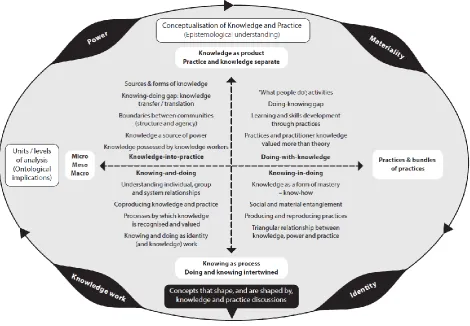
of the knowledge and practice terrain (Figure 16.1).
[Insert Figure 16.1 here]
Figure 16.1: An emerging conceptual map of the knowledge and practice terrain
An emerging conceptual map of the knowledge and practice terrain
Our map of this terrain centres on two dimensions or ‘fault lines’ emerging first in the conceptual
chapters on knowledge (Chapter 2) and practice (Chapter 3), and then revisited and discussed in
subsequent chapters. The first of these fault lines (shown on the vertical axis in Figure 1) concerns
the conceptualisation of knowledge and practice. At the top end of this axis, knowledge is seen as a
product or thing, separate from practice. In terms of Cartesian dualism (see Chapter 3),
mind/thinking and body/action are separated and practice becomes defined as the opposite of theory
or simply what people do. At the bottom end of this fault line, knowing is viewed as a process,
wherein knowing and doing are intertwined. A fracture point in conceptualisation occurs
somewhere between the two ends of this dimension, but we find many authors (in this book and
beyond) cluster around the middle. For example, they may recognise the importance of viewing
knowing as a process but nevertheless still frame much of their discussion in terms of a gap
between knowledge and practice. For this reason it is not always easy to see which side of this
conceptual divide is ultimately driving their thinking and actions.
The second fault line or dimension (the horizontal axis) concerns the unit or level of analysis used
and practice at different levels of granularity (micro, meso and macro levels). The micro level
typically involves considering the knowledge and practice of individuals and/or groups. At the
meso-level the focus is on the knowledge and practice of larger collectives, particularly
organisations. At the macro level the focal point moves to wider systems, inter-organisational
relationships and institutions. The wider level may include, for example, a sector-by-sector analysis
of knowledge and practice, or an analysis of national policy making. At the right-hand side of the
horizontal dimension we find the ‘flat ontology’ of practice theory (see Chapter 3), where the unit
of analysis is practices (and bundles of these). The perspectives of the majority of authors in this
book cluster towards the left-hand side of this horizontal dimension, but three of the conceptual
chapters - Chapters 3 (on practice), 4 (on power) and 6 (on identity) - highlight some of the benefits
of adopting a practice-theory ontology. Two of the context-specific chapters – Chapters 7 (on
sensing bodies) and 8 (on advertising) also demonstrate the insights provided by adopting this
perspective. In addition, the commentary by Blue and Shove in Chapter 15 teases out the
implications of practice theory for developing know-how.
The placement of these two dimensions at right angles to one another produces a figure which
demarcates four perspectives or domains of thought on knowledge and practice. The
characterisation of each of these domains (below) captures the main debates in the field (as
examined by this book). The figure is not intended to depict a desirable progression between the
domains; rather it indicates the differences between them. And it is, of course, only one way of
mapping the terrain. Like all maps, it is selective in what is captured, but we offer it as a potentially
Four domains of thought on knowledge and practice
The summary text provided for each domain in Figure 16.1 indicates how knowledge and practice
tendto be approached and characterised by those adopting the assumptions and unit of analysis
associated with the domain. We use the phrase tendto advisedly because the position of the
boundaries between the domains are porous and there is some cross-over in the language and
images used in each. Nevertheless, the tendencies are sufficient to enable us to characterise the
enquiry focus, types of explanation, and recommendations associated with each.
In the top left-hand domain, knowledge-into-practice, knowledge is viewed as somewhat separate
from practice and the relationship between them is often considered as a problem to be addressed, a
knowing-doing gap (see Chapter 13 on knowledge mobilisation). Different sources and forms of
knowledge are recognised (as outlined in Chapter 2). However, the varying interests, needs and
preoccupations of different epistemic and practice communities (Haas 1992) often mean the value
they place on different forms and sources of knowledge varies. In this way, boundaries develop
between interest groups and communities and this hampers the process of knowledge sharing and
practice development. Boundary spanners are envisaged as key agents in enabling knowledge to
flow across these structures and communities (see Chapter 10 on environmental policy and Chapter
11 on healthcare). A relationship between knowledge and power is frequently recognised. Power
tends to be viewed as a resource: those who have greater power in a system influence which forms
and sources of knowledge have greater voice and traction (see Chapter 9 on accounting).
Knowledge is also viewed as a source of power. In line with this, knowledge workers (Chapter 5),
from this perspective, have greater status due their possession of a valued resource.
In the bottom left-hand domain, knowing-and-doing, the separation between knowledge and
of different forms of knowledge, but these are more likely to be viewed as intertwined strands (see
Chapter 2 on knowledge). The focus is less on different forms of knowledge than on the processes
by which individuals and groups come to know how to do things, and the processes which lead to
certain ways of knowing and doing becoming recognised and valued. This involves understanding
relationships between individuals and groups. It also involves an appreciation of the dynamics of
complex systems (Best and Holmes 2010). The concept of co-production (Chapter 14) is sometimes
used to describe the basis and politics of intertwining relationships, but it is also used in a normative
sense to indicate what are envisaged to be more effective ways of approaching the development of
knowing and doing. The concepts of knowledge work and identity work intersect with these process
explanations. Within this domain both concepts are viewed as processes representing how people
act in the workplace and why this is the case (see Chapter 5 on knowledge work and Chapter 6 on
identity).
In the top right-hand domain, doing-with-knowledge, the focus is on empirically-grounded
descriptions of what people do – the activities they undertake. The extent to which knowing and
doing are viewed as separate activities within this domain varies across studies. As noted in Chapter
3 (on practice), one branch of empirical work adopting a practice-focused approach has tended to
study the detail of practices, unmediated by a priori theoretical frameworks. Such an approach does
not feature strongly in this book and the closest example we provide is the study of advertising
agency practices (Chapter 8). A focus on practices as the unit of analysis is associated with the idea
that learning, knowing and skills are developed through practices. Theorised knowledge may be
viewed as somewhat disconnected from what happens in practice (a doing-knowing gap) leading to
An examination of what people do is also at the forefront of the approach represented in the bottom
right-hand domain, knowing-in-doing. Here practice theorising features more strongly than in
doing-with-knowledge. With this come particular assumptions about the intertwined nature of
knowing and doing. The importance of the material as well as the social world is emphasised, and
both of these are viewed as inseparably entangled. The focus in this domain is on explaining the
production and reproduction of practices, with the promise of greater insights into continuity and
change, and the development of know-how. Chapter 7 (on sensing bodies) provides a good example
of this approach. The perspective represented by this domain is challenging because it suggests that
‘practices survive and thrive through producing and re-producing the appropriately skilled activity
of practitioners’ rather than vice-versa (Blue and Shove, Chapter 15, p x ) That is, practices rather
than people have agency.
Related social science concepts
The social science concepts intersecting most directly with discussions of knowledge and practice
are depicted in the outer circle of Figure 16.1. We have only highlighted those concepts that feature
strongly in the analyses presented in this book; other analyses are likely to reveal a wider range of
intersecting concepts. As already indicated, the way these concepts are interpreted and expressed in
each domain varies. This is illustrated by focusing on just one of the concepts: power. The
approach to power in the knowledge-into-practice domain is more likely to adopt a resource-based
and coercive view of that power. In contrast, in the knowing-and-doing and knowing-in-doing
domains the focus is more likely to be on the productive capacity of power and power as doing (see
Chapter 4 on power). In the doing-with-knowledge domain, the view of power may emphasise its
productive capacity, but power may also be viewed as something which is possessed and exercised
These related social science concepts not only shape approaches and explanations in each of the
domains, but the discussion of these concepts in the context of knowledge and practice also
influences debates about the concepts themselves. For example, Chapter 4 (on power) illustrates the
way in which a practice-theory perspective, knowing-in-doing, can help to refine our
conceptualisation of power. Similarly, Chapter 6 (on identity) discusses the way in which the same
perspective, offers new ways of thinking about identity and identity work.
The concepts are depicted (in Figure 16.1) as somewhat separate and removed from discussions of
knowledge and practice. However, in some analyses, particularly those adopting perspectives
towards the bottom of the figure, concepts such as power and identity are seen as intrinsic to
understanding knowledge and practice. It would be interesting to see what other concepts and
connections might emerge as key from different portfolios of knowledge and practice explorations.
Enquiry goals and methods
Different analytical goals can influence the nature of the approach taken in each domain. The
chapters in this book have varying emphasises on explanation, critical assessment, and more
normative judgements about what needs to change in relation to knowledge and practice. Although
there is a risk of over-generalising, we note (based on the examples in the book) that those operating
from the doing-with-knowledge and knowing-in-doing domains tend to focus on description and
explanation (e.g. Chapters 7 and 8 on sensing bodies and advertising respectively). Whereas those
operating from the knowledge-into-practice and knowing and doing domains have a greater
tendency to critically assess (e.g. Chapter 12 on philanthropy) and provide more normative
judgements (e.g. Chapter 11 on healthcare and Chapter 13 on knowledge mobilisation). These
A combination of analytical goals and ontological perspectives influences the range of enquiry
methods used by researchers operating with or across the domains. Empirical studies reflecting the
two domains on the right-hand side of the figure tend to adopt broadly ethnographic methods. In
contrast, a wider mix of research methods is more evident in studies conducted within the domains
on the left-hand side. These include case studies, surveys, and experimental methods, as well as
more observational methods.
Complementary or incommensurate perspectives
We have used the phrase ‘fault lines’ to characterise the two dimensions depicted in Figure 16.1
because they capture different ontological and epistemological perspectives on knowledge and
practice. This raises the question of whether the domains in Figure 16.1 represent
‘incommensurable paradigms’ that provide alternative rather than complementary world views (see
Burrell & Morgan 1979). Our use of dotted lines to portray the boundaries between the domains
suggests there is some fluidity across the boundaries: some sharing of ideas. However, at their heart,
the domains represent different philosophical positions that cannot be simply disregarded or fully
dissolved. Accordingly, we do not consider it feasible to arrive at an integrated ‘grand theory’ of
knowledge and practice; one that pays due attention to the assumptions and concerns of all domains.
This does not mean researchers or other practitioners necessarily need to confine themselves to
investigations (or other practices) that are shaped by the perspectives of only one domain. On the
contrary, they may profitably choose to offer multiple perspectives on the same phenomenon or act
differently in different situations.
One of our guiding principles in this project has been to value the insights offered by different
practice. However, reflecting on the conclusions drawn in each of the chapters, we realise they tend
to cluster towards the bottom two-thirds of the diagram in Figure 16.1. Hence our instincts to
promote the equal value of all perspectives needs to be qualified by the realisation that, in practice,
we are somewhat sceptical of drawing a sharp distinction between knowledge and practice.
Although many of the chapters still use the language of ‘knowledge’ and ‘practice’, what they
actually say is not far out of line with the ideas of knowing as a process and the intertwined nature
of doing and knowing (knowing-and-doing and knowing-in-doing). In terms of the unit of analysis,
the perspectives taken in this book cluster more towards the left-hand side of figure, but our
learning community could, nevertheless, still see the merits of focusing more on practices (
doing-with-knowledge and knowing-in-doing). The fact that empirical studies adopting these perspectives
are not exemplified more frequently within the book may just reflect happenstance and the
composition of our learning community at the time the book was produced.
While we have argued above that it is not possible to disregard or fully dissolve the differences
between the four domains in our conceptual map, this does not rule out the potential for productive
dialogue across these boundaries. We next discuss how this was achieved during the process of
developing and writing this book.
Reflections on the learning journey
As already indicated, our aim has been to stimulate open and constructive dialogue between people
with different work roles, experiences and perspectives. We did not strive to achieve an overarching
consensus about the nature of knowledge and practice, but we did want to appreciate more fully
are valued and the aim is to foster ‘diverging and converging interactions in a way that recognises
opportunities for collaboration, without losing sight of diverse interests and frames’ (Frame &
Brown 2007:234).
But how could we achieve this? What would be a productive way of working and learning together?
We were not entirely sure at the outset, but over time we established some norms and principles for
working together. These included a norm of constructive rather than confrontational dialogue.
Chapter authors were not expected to defend or justify their draft chapters, but instead take on the
role of active listeners when their chapters were being discussed. There was an expectation of
constructive feedback, underpinned by principles of respect, equality of voice and a duty of care
towards others. There was a strong sense of the need to value the process of working together as
much as the intended product – this book. There was a preference for conducting much of this
interaction through face-to-face dialogue rather than relying mainly on written communication,
because it was felt to be more generative and satisfying for participants.
These ways of working together emerged and developed during a schedule of retreats, workshops
and seminars organised to plan, develop, and review chapters, and to reflect on their relationship to
one another. This process involved extensive and repeated peer reviews of all chapters, which
developed a sense of collective responsibility for the shape and quality of the overall book.
Members of our group had differing levels of involvement in these activities. Some dipped in and
out, but a substantial core of people participated throughout the process. The sense of being part of
a learning community was felt most strongly by core members, indicating the benefits of sustained
particularly in terms of the amount of time devoted to learning together. The need to maintain an
open mind and suspend judgement was also not without its stresses and strains. Nevertheless, it was
an energising and rewarding learning process that developed individual and collective
understandings, and our writing, reviewing and editing skills at the same time.
Future directions of travel
Although the publication of this book is an important landmark for us, this is not the end of our
individual or collective travels. We are also not alone in our explorations: there are many fellow
travellers out there, and our choice of citations and suggestions for further reading, in each of the
chapters, gives some indication of the many people who are inspiring our own academic practices.
A key question is in what directions future explorations should be heading. There are many
possibilities and we reflect on some of these. We hope others will join us in seeking to extend,
revise and refine our conceptual map of the knowledge and practice terrain (Figure 16.1). This will
undoubtedly involve extending the examination of related concepts. It is also likely to involve
further analysis of how the existing and additional concepts intersect with and provide new insights
into knowledge and practice. The domains lying at the centre of our concept map should also be
debated, refined and challenged, particularly in the light of a wider range of context-specific
empirical studies.
There is a need for continuing exploration of knowledge and practice in disciplines and in settings
collaborating with social anthropologists. While extending the scope of our empirical gaze, we need
to consider how insights from such studies can inform our understanding of knowledge and practice
in organisations.
In undertaking future explorations in this terrain, we would recommend that there are some values
and practices to ‘pack’ for the journey: valuing and respecting difference; suspending judgement;
opening up rather than closing down conversations; including a diversity of voices and ensuring
equality of voice. There are also some things that we should probably leave behind: rigid baggage
and frameworks from the past that overly constrain where we can travel in the future and our means
of getting there. We may also wish to jettison unrealistic expectations of quick journeys with clear
and tangible outcomes.
Finally, before heading off in different directions, we should reflect on why we are doing so. There
are potentially many reasons why researchers and other practitioners are interested in the
relationship between knowledge and practice. At least three underpinning motives are evident
across the chapters of this book. First, for some authors the underpinning motive is to enhance
understanding in order to improve opportunities and processes for learning and development (at
individual, group and organisational levels), which in turn has the potential to improve
performance. Second, other authors are primarily driven by a desire to better understand and
challenge evident inequalities of voice, opportunities, resources and rewards in organisations and
societies. Finally, some authors seek to develop and enrich our understanding of continuity and
change (at organisational and societal levels), which in turn can help us to challenge the status quo.
These motives are not mutually exclusive and they are all important. For this and many other
reasons we wish you well on your future travels and we hope to hear from you, in some form or
References
Best, A. & Holmes, B.J. (2010), Systems thinking, knowledge & action: Towards better models & methods, Evidence & Policy, 6(2):145-159.
Burrell, G. & Morgan, G. (1979) Sociological paradigms & organizational analysis. London: Heinemann.
Frame, B. & Brown, J. (2008) Developing post-normal technologies for sustainability, Ecological Economics, 65:225-241.
Haas, P.M. (1992) Epistemic communities & international policy coordination. International Organization. 46(1):1-35.
Mouffe, C. (2013) Agonistics: Thinking the world politically. London: Verso.