1
Mapping long-term temporal change in imperviousness using topographic
1maps
23
James D Miller a,* & Stephen Grebby b 4
5
a Centre for Ecology and Hydrology, Benson Lane, Crowmarsh Gifford, Wallingford, 6
Oxfordshire, OX10 8BB, UK 7
b British Geological Survey, Keyworth, Nottingham, NG12 5GG, UK 8
9
* Corresponding author: Tel: +44 (0)1491 692708; E-Mail: [email protected] 10
11 12 13 14 15
16
17
18
19
Keywords: Imperviousness; Urban; Remote Sensing; Hydrology, Land Use Change 20
2
Abstract
22
Change in urban land use and impervious surface cover are valuable sources of information for 23
determining the environmental impacts of urban development. However, our understanding of 24
these impacts is limited due to the general lack of historical data beyond the last few decades. 25
This study presents two methodologies for mapping and revealing long-term change in urban 26
land use and imperviousness from topographic maps. Method 1 involves the generation of maps 27
of fractional impervious surface for direct computation of catchment-level imperviousness. 28
Method 2 generates maps of urban land use for sub-sequent computation of estimates of 29
catchment imperviousness based on an urban extent index. Both methods are applied to estimate 30
change in catchment imperviousness in a town in the South of England, at decadal intervals for 31
the period 1960–2010. The performance of each method is assessed using contemporary 32
reference data obtained from aerial photographs, with the results indicating that both methods are 33
capable of providing good estimates of catchment imperviousness. Both methods reveal that 34
peri-urban developments within the study area have undergone a significant expansion of 35
impervious cover over the period 1960–2010, which is likely to have resulted in changes to the 36
hydrological response of the previously rural areas. Overall, results of this study suggest that 37
topographic maps provide a useful source for determining long-term change in imperviousness in 38
the absence of suitable data, such as remotely sensed imagery. Potential applications of the two 39
methods presented here include hydrological modelling, environmental investigations and urban 40
planning. 41
3
1. Introduction
45
Accurate estimates of impervious surface coverage (commonly known as 46
imperviousness) within watersheds (catchments) are required for hydrological modelling and 47
urban land use planning because increased imperviousness results in decreases in infiltration and 48
soil storage capacities (Kidd and Lowing, 1979). Furthermore, replacement of natural drainage 49
with artificial conveyance pathways can also reduce catchment response times (Packman, 1980). 50
These impacts can subsequently combine to increase the frequency and magnitude of flood 51
events through increased and more rapid runoff (Huang et al., 2008; Villarini et al., 2009), and 52
lead to disruption of natural groundwater recharge (Shuster et al., 2005; Im et al., 2012). 53
Moreover, the hydrological alterations caused by increasing imperviousness typically give rise to 54
environmental issues, such as degraded water quality, decreased biodiversity in water bodies, 55
and increased stream-bank erosion (Schueler, 1994; Arnold and Gibbons, 1996; Hurd and Civco, 56
2004; Amirsalari et al., 2013). Such impacts can be especially pronounced in peri-urban 57
developments; areas surrounding existing towns, which convert previously permeable rural land 58
into highly impermeable and artificially drained catchments (Tavares et al., 2012).Understanding 59
and modelling the long-term hydrological impacts of increased urban development requires 60
concurrent information on the change in impervious surface coverage. Maps of impervious 61
surfaces can be produced from either field surveys, manually digitising from hard-copy 62
topographic maps, or the use of remote sensing (RS) data. Whereas field surveys and manual 63
digitisation can be time-consuming and laborious, the large continuous areal coverage provided 64
by RS datasets can be exploited using image processing algorithms to rapidly map impervious 65
surfaces for only a fraction of the time and cost. Accordingly, RS is becoming increasingly 66
4
review of the different methodologies employed to map impervious cover from RS data is 68
provided by Weng (2012). To summarise, RS-based approaches to mapping imperviousness 69
generally fall into three broad categories: per-pixel, object-based and sub-pixel. Per-pixel 70
approaches commonly involve producing a binary map by determining whether individual image 71
pixels correspond to either pervious or impervious surfaces, typically through aggregating the 72
classes of an initial land cover classification (Yuan and Bauer, 2006; Im et al., 2012; Amirsalari 73
et al., 2013). In contrast, object-based approaches involved the classification of groups of 74
contiguous image pixels (i.e., objects or regions) by also considering various shape, contextual 75
and neighbourhood information (Benz et al., 2004; Weng, 2012). Classifying an image based on 76
objects helps to overcome the “speckled” effect often encountered with per-pixel classification in 77
urban areas (Van de Voorde et al., 2003), thus enabling improved mapping results (Yuan and 78
Bauer, 2006; Zhou and Wang, 2008). A major limitation of per-pixel approaches is that they 79
assume each pixel comprises a single land use or land cover type. However, pixels containing a 80
mixture of land use or cover types are common in low-to-moderate resolution imagery acquired 81
over complex heterogeneous landscapes such as urban areas (Weng, 2012). Sub-pixel 82
approaches can be used to overcome this to derive accurate estimates of imperviousness because 83
they decompose the pixel spectra into their constituent parts, therefore providing fractional 84
measures of impervious surface area. Popular approaches in this category include unmixing the 85
pixel spectra to determine the fractional abundance of each constituent end-member surface type 86
(Lu et al., 2006), or modelling fractional imperviousness through statistical regression and 87
scaling of spectral vegetation indices (Bauer et al., 2004; Van de Voorde et al., 2011).With the 88
earliest source of RS data comprising panchromatic aerial photograph lacking in sufficient 89
5
decades since the emergence of spectral satellite imagery (e.g., Landsat). Consequently, few 91
studies have assessed long-term land cover change using RS data (e.g., Gerard et al., 2010; 92
Tavares et al., 2012), and even fewer have mapped long-term changes in impervious cover 93
(Weng, 2012). Therefore, our understanding of the hydrological impact and non-stationary 94
flooding trends in relation to impervious surface change is somewhat limited (Ogden et al., 2011; 95
Vogel et al., 2011; Dams et al., 2013). Linking imperviousness to alternative sources of digital 96
geo-information could provide a means of mapping long-term changes in impervious cover. 97
However, such datasets are not usually available at the national scale or comparable over long 98
periods of time. National land cover mapping products such as the UK Land Cover Map (LCM) 99
1990, 2000 and 2007 (Centre for Ecology and Hydrology) cover only a short time period and are 100
inconsistent due to the different processing algorithms applied to derive each product from the 101
RS data (Morton et al., 2011). While methods such as land use trajectory analysis (Verbeiren et 102
al., 2013) could be applied to help improve the consistency of the time-series somewhat, there 103
will still likely be a residual error arising from the use of contrasting algorithms for generating 104
each data product. Physical settlement boundaries and land use change statistics may be a useful 105
alternative source of information (e.g., Bibby, 2009) but can only be loosely regarded as proxies 106
for imperviousness. In most cases, the only consistent and long-term sources are topographic 107
maps produced by national agencies. Within the UK topographic maps have been produced by 108
the Ordnance Survey — the national mapping agency for Great Britain — since the mid-19th 109
century. Despite representing a potentially valuable source for deriving long-term change in land 110
use or land cover, studies assessing the use of such information are scarce (e.g., Hooftman and 111
Bullock, 2012). The aim of this study is to utilise historical topographic maps for semi-112
6
methods are presented that utilise topographic maps to: (i) derive maps of fractional impervious 114
surface for direct computation of catchment-level imperviousness; (ii) derive maps of urban land 115
use for subsequent computation of estimates of catchment-level imperviousness based on an 116
urban extent index. Impervious surface cover estimates computed using these two methods are 117
validated using reference data generated through a RS-based image classification of high-118
resolution aerial photographs. The methods presented herein are employed in an attempt to 119
determine their suitability for indicating change in urban land use and imperviousness — here 120
throughout a 50-year period from 1960 to 2010 in a number of hydrological catchments 121
surrounding a UK town that exemplifies rapid peri-urban development. 122
123 124
2. Study area
125The study area (Fig. 1) encompasses two adjacent small urban stream catchments located 126
to the north of Swindon in the south of England; comprising the Haydon Wick brook and 127
Rodbourne stream, both tributaries of the River Thames (Fig. 1 inset). Swindon was designated 128
as an Expanded Town under the Town Development Act in 1952 which encouraged town 129
development in county districts to relieve over-population elsewhere. The Rodbourne stream 130
catchment has been highly urbanised since the 1950s and comprises a large area of commerce 131
and industry on the northern edge of Swindon town, along with highly urbanised housing 132
developments. The Haydon Wick brook catchment is located further to the north of Swindon and 133
has undergone widespread development since the 1990s, prior to which it was a predominantly 134
agricultural landscape. Within the Haydon Wick catchment a number of distinct catchments (1– 135
7
developments within the area. The Rodbourne catchment, in which development has 137
incrementally expanded since the 1950s, remains one single catchment unit (6) for this study. 138
The focus of this study is to test two methodologies for mapping changes in urban land use and 139
associated imperviousness in each of these six catchments during the period 1960 to 2010.3. 140
[image:7.612.105.516.196.487.2]141
Fig. 1. Map of the study area showing catchment boundaries and location of the study area within 142
the Thames Basin (inset). RGB aerial photography – © UK Perspectives: License Number 143
UKP2006/01. 144
145
8 147
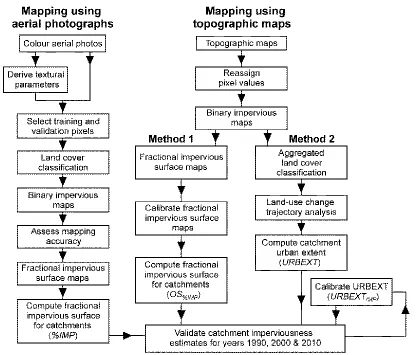
Fig. 2. Overview of methodological approach used to assess the utility of traditional topographic 148
maps for long-term, historical mapping of urban extent and estimation of catchment 149
imperviousness. 150
151
152
3.
Material and methods
153
The ability to utilise traditional topographic maps for long-term, historical mapping of 154
urban extent and estimation of catchment imperviousness is assessed using a three-pronged 155
approach (Fig. 2). The approach involves first estimating contemporary catchment fractional 156
impervious surface area directly from aerial photographs for use as reference data. These 157
[image:8.612.102.520.73.428.2]9
historical change in impervious cover topographic maps. Following validation, a comparison of 159
the two methods is undertaken to assess their relative performance revealing long-term change in 160
catchment impervious cover between 1960 and 2010. More detailed information regarding the 161
methodological approach is provided in the following sub-sections. 162
163
3.1 Deriving catchment imperviousness from aerial photographs 164
Reference data for quantifying the catchment fractional impervious cover were obtained 165
from aerial photographs for three decadal time-slices within the 50-year period of interest — 166
namely 1991, 1999 and 2010 (herein referred to as 1990, 2000 and 2010, respectively). The 167
reference data were generated by first classifying 0.5 m true-colour aerial photographs into 168
pervious land cover classes: grass, trees, bare soil and water; and impervious land cover classes: 169
roads/pavements, commercial buildings and residential buildings. It was anticipated that land 170
cover classes such as bare soil and roofing tiles could be particularly difficult to discriminate 171
using the limited spectral information contained in only the red, green, blue bands of the aerial 172
photographs. Therefore, textural information was also incorporated in the form of the Grey-Level 173
Co-occurrence Matrix (GLCM) parameters of entropy, dissimilarity, second moment and 174
homogeneity (Haralick et al., 1973; Herold et al., 2003). These parameters were derived from the 175
green band in the ENVI 4.8 software package (Research Systems, Inc.) for a 3 × 3pixel (i.e. 1.5 176
m × 1.5 m) window and a co-occurrence window shift of 4 pixels (i.e., 2 m) in both the x- and y-177
direction. This combination of window size and shift was chosen as it maximised visual 178
discrimination of the different land cover classes. Classification of the three time-slices 179
employed a neural network (NN) classification algorithm in conjunction with the seven 180
10
producing better classification results for complex heterogeneous urban areas than their 182
conventional counterparts (e.g., Maximum Likelihood), since they are non-parametric and more 183
robust in handling noisy and non-normally distributed data (Foody, 2002). The NN used in this 184
case was a Multi-Layered Perceptron NN with a back-propagation learning algorithm for 185
supervised learning (Richards and Jia, 2006). Using a three-layered NN (i.e., input, output and 186
one hidden layer), land cover classifications were performed in ENVI 4.8 with the default 187
training parameters confirmed through a set of trial-and-error experiments. Each classification 188
was supervised with the aid of a set of training pixels that were carefully selected in the imagery 189
to represent each of the defined land cover types (∼6000 pixels for each class). Land cover 190
classifications were converted to binary imperviousness maps by collapsing the classes into just 191
two corresponding to pervious or impervious surfaces (Yuan and Bauer, 2006; Im et al., 2012; 192
Amirsalari et al., 2013). The accuracies of the resulting binary imperviousness maps were 193
determined by comparing the true class identities of a sample of validation pixels to the classes 194
assigned through classification. Validation pixels were selected from regions of interest (ROIs) 195
of known pervious or impervious surface class identities that were defined in each time-slice 196
image based on extensive knowledge of the study area. Validation pixels were then selected from 197
the ROIs using a random stratified sampling protocol to ensure each class was represented 198
proportionately, and to avoid spatial autocorrelation within the validation dataset (Chini et al., 199
2008; Pacifici et al., 2009). The minimum validation sample size required to derive statistically 200
valid accuracy estimates for the entirety of each binary map was determined from the normal 201
approximation of the binomial distribution (Fitzpatrick-Lins, 1981). Consequently — based on 202
11
approximately 19,000 validation pixels for each class were selected to determine the accuracy of 204
each binary imperviousness map. 205
Binary imperviousness map accuracies were assessed by way of the overall (OA), user’s 206
(UA) and producer’s (PA) accuracies and the Kappa coefficient (K) derived from a confusion 207
matrix (Congalton, 1991). The overall accuracy is the percentage of all validation pixels 208
correctly classified, whereas the user’s and producer’s accuracies provide information regarding 209
the commission and omission errors associated with the individual classes, respectively. 210
Following validation, the 0.5 m binary impervious maps were aggregated to 50 m grid cells to 211
generate fractional impervious surface maps, with the value for each grid cell corresponding to 212
the proportion of impervious pixels within it. The value of 50 m was selected as it was found to 213
best represent homogeneous scale of urban land use classification (see Section 3.2.2). The 214
imperviousness of each of the six catchments (%IMP) was then computed from these fractional 215
impervious surface maps for use as reference data, using: 216
c n
i
i i
A A IMP IMP
%
% , (1)
217
where %IMPi is the fractional impervious cover for grid cell i, Ai is the area of the grid cell, n is
218
the number of grid cells within the catchment, and Ac is the total catchment area.
219 220
3.2 Deriving estimates of catchment imperviousness using topographic maps 221
As outlined in Fig. 2, estimates of catchment fractional impervious surface cover were 222
derived using two methods. In general, these consist of first generating binary imperviousness 223
12
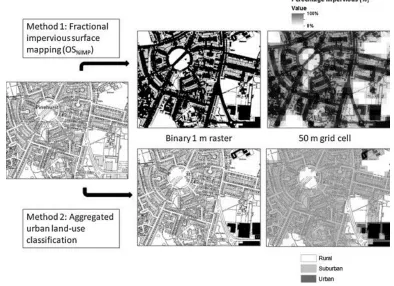
fractional imperviousness maps or urban land use maps — as illustrated in Fig. 3 and described 225
below. 226
227
3.2.1 Data and pre-processing 228
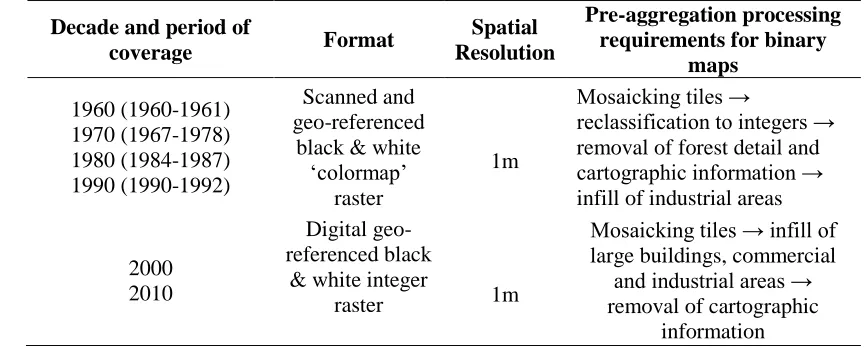
Digital historical topographic maps produced by the UK Ordnance Survey (OS) between 229
1960 and 2010 were obtained in raster format as 25 km × 25 km tiles with a 1 m spatial 230
resolution. For each decade (1960s to 2010s), the most contemporaneous map tiles produced for 231
that decadal time-slice were obtained and mosaicked to produce a seamless image for each 232
decade (Table 1). The primary step for the two methods is to convert the historical topographic 233
maps into simplified and physically representative binary maps of developed (i.e., impervious) 234
and undeveloped (i.e., pervious) pixels. To do this, the original pixel values were reclassified so 235
that a value of 1 was assigned to pixels corresponding to ‘white space’ on the map and a value of 236
2 to all pixels corresponding to mapped features. 237
[image:12.612.84.518.481.655.2]238
Table 1. Ordnance Survey mapping data and pre-processing requirements. 239
Decade and period of
coverage Format
Spatial Resolution
Pre-aggregation processing requirements for binary
maps 1960 (1960-1961) 1970 (1967-1978) 1980 (1984-1987) 1990 (1990-1992) Scanned and geo-referenced
black & white ‘colormap’
raster
1m
Mosaicking tiles →
reclassification to integers → removal of forest detail and cartographic information → infill of industrial areas
2000 2010
Digital geo-referenced black
& white integer
raster 1m
Mosaicking tiles → infill of large buildings, commercial
and industrial areas → removal of cartographic
information 240
13 242
Fig. 3. Illustration of the approach applied in both method 1 and 2 to map impervious cover. 243
Topographic base map – © Crown copyright and Landmark Information Group. 244
245
Due to slight variations in the cartographic style used from 1960 to 2010, a number of 246
steps were required to further improve the consistency and compatibility of each map. The first 247
stage involves developing ‘level-1’ binary maps, in which artefacts and key inconsistencies 248
between maps from each decade are reduced. This was undertaken using the ‘Raster Cleanup’ 249
tool in ArcMap (ArcGIS 10, ESRI) and included the following steps: 250
A rapid ‘clean-up’ of each raster map is undertaken to remove features, such as 251
place names or symbols relating to widespread forest; 252
Reclassifying large concrete or tarmac areas represented by ‘white space’ to 253
[image:13.612.108.502.75.361.2]14
Infilling the roofs of large buildings on raster maps for 2000–2010due to the low 255
density of pixels used to represent such areas on these maps. 256
257
A second pre-processing stage was subsequently applied for the purpose of infilling 258
developed features such roads and buildings to generate a set of ‘level-2’ binary maps. This was 259
undertaken in ArcMap by applying the ‘Boundary Clean’ tool to each raster and then converting 260
them to polygon shapefiles. This conversion enables road segments and buildings to be readily 261
reattributed to alter them from polygons representing pervious (undeveloped) features to 262
impervious (developed) features. Once all relevant polygons have been reassigned, the shapefiles 263
were then converted back to raster format. 264
265
3.2.2 Deriving catchment imperviousness from fractional impervious surface maps 266
The first method (method 1) for deriving catchment imperviousness for the six 267
catchments is relatively straightforward to implement, and is focussed on the generation of 268
fractional impervious surface maps of the study area. To generate these maps, the ‘level-2’ 269
binary maps derived from the topographic maps were aggregated to 50 m grid cells in a similar 270
manner to that used to derive fractional impervious surface maps from the aerial photographs. In 271
this case, the value for each 50 m grid cell is calculated as the proportion of 1 m impervious 272
pixels contained within it. Although pre-processing steps were implemented to improve the 273
compatibility and consistency of the topographic map time series (1960–2010), additional 274
calibration was performed to account for any residual discrepancies between the fractional 275
impervious surface maps. Adopting the approach outlined by Lu et al. (2011), pseudo-invariant 276
15
were selected for pair-wise image calibration via linear regression models. As a result, all 278
fractional impervious surface maps were calibrated to the most recent map (i.e., 2010). Once 279
calibrated, the imperviousness of each of the six catchments (OS%IMP) is computed from these
280
calibrated fractional impervious surface maps using an adaptation of Eq. (1), and compared with 281
the contemporaneous reference data derived from aerial photography (%IMP). 282
283
3.2.3 Deriving catchment impervious cover from urban land use maps 284
The second method (method 2) for deriving catchment imperviousness for the six 285
catchments is based on the generation of urban land use maps from the topographic maps. Maps 286
of urban land use were generated by aggregating the topographic map-derived binary maps for 287
each decade to larger grid cells, and then classifying the cells according to the LCM land 288
use/land cover definitions; mixed development and green space designated as Suburban (e.g., 289
houses with gardens), areas of near continuous development with little vegetation (e.g., industrial 290
estates) designated continuous Urban (Fuller et al., 2002), and all other areas of green and 291
general pervious surfaces referred to as Rural. Following a preliminary evaluation of a number of 292
different grid cell sizes, a cell size of 50 m was identified as the optimum for generating realistic, 293
homogeneous urban land use maps; smaller cell sizes produced maps with the aforementioned 294
‘speckled’ effect that often affects per-pixel classification in urban areas. Additionally, it was 295
found that application of this approach to the ‘level-2’ binary grids resulted in difficulty devising 296
a standard classification which can be used to produce coherent land use maps across the time 297
series. For this reason, the ‘level-1’ binary maps derived from the topographic maps were used to 298
generate the land use maps. This was achieved using ArcMap through the following steps: 299
16
‘Level-1’ binary maps were aggregated using the ‘Aggregate’ function to generate a 301
grid that details the mean value of the pixels contained within each 50 m grid cell. 302
These aggregated values provide an indication of the level of development; 50 m grid 303
cells with a value close to 1 essentially correspond to ‘white space’ (i.e., a rural 304
undeveloped area), whereas a value close to 2 corresponds to a high density of 305
mapped features (i.e., a highly developed area). 306
A threshold-based classification scheme was then applied to the grid in order to 307
assign cells to either the Urban, Suburban or Rural land use class. It was found that 308
cell values of 1–1.35 represented Rural land use, values of 1.35–1.65 corresponded to 309
Suburban, and values above 1.65 represented Urban land use. These thresholds were 310
validated to ensure at least 80% of 50 randomly selected grid cells were correctly 311
classified in decadal map. The output is set of 50 m maps showing Rural, Suburban, 312
and Urban land use (shown in Fig. 3). 313
Potentially erroneous pixel classifications were removed through geospatial proximity 314
analysis, and by applying an urban land use change trajectory demonstrated by Verbeiren et al. 315
(2013) to ensure greater consistency throughout the time series. This is achieved by first 316
combining the ArcGIS ‘Conditional’ tool in the ‘Raster Calculator’ with the ‘Focal Statistics’ 317
tool to identify misclassified Urban and Suburban grid cells based on the classes of neighbouring 318
cells — isolated Suburban or Urban cells were reclassified according to the dominant 319
surrounding class. Following this, each cell was labelled as either 0 (Rural), 1 (Suburban) or 3 320
(Urban) and all trajectories of land use change were recorded throughout the time series using 321
codes (e.g., 00112, 01222, etc.). These were then evaluated according to whether they reflect 322
17
into 6 rationality classes: ‘urban growth’, ‘suburban growth’, ‘urban regeneration’, ‘urban 324
stability’, ‘suburban stability’, and ‘inconsistent’. The ‘inconsistent’ class captures grid cells that 325
do not follow realistic change trajectories — such as a Suburban area changing to Rural then 326
Suburban and back to Rural. Inconsistent cells were corrected using the most likely trajectory for 327
that cell over the 50-year period — based upon surrounding cells. The class ‘urban regeneration’ 328
captures the possibility of Urban areas being demolished and replaced with green space or 329
subsequent re-development. The land use change trajectory rules were implemented using the 330
‘Conditional’ tool in the ArcMap ‘Raster Calculator’. The outcome was as set of coherent urban 331
land use maps revealing the long-term change in land use for the period 1960–2010. 332
For each land use map, the proportions of Urban and Suburban grid cells within each 333
catchment were used to calculate a catchment index of urban extent. As well as measuring the 334
urban extent within a hydrological catchment, the index of urban extent (URBEXT) proposed in 335
the UK Flood Estimation Handbook (FEH) methodology (Institute of Hydrology, 1999) can also 336
provide an estimate of the impervious surface cover. Accordingly, the index of urban extent and 337
estimate of imperviousness for the six catchments (URBEXT) in each land use map is computed 338
using: 339
Suburban
Urban
URBEXT
, (2) 340where Urban and Suburban are the proportions of Urban and Suburban grid cells within each 341
catchment, respectively, and β is the Suburban weighting factor. The suitability of URBEXT for 342
estimating catchment imperviousness is assessed through comparison with the reference data 343
derived from aerial photography (%IMP). For the purpose of this comparison, URBEXT — the 344
weighted value of urban extent within a catchment — is considered to provide a direct estimate 345
18
value of 0.5 to account for the general equal mixture of built-up land and permanent vegetation 347
(Bayliss et al, 2006; Institute of Hydrology, 1999). Urban land use was assigned a weighting of 1 348
because such areas generally have negligible green (pervious) space. In an attempt to improve 349
the accuracy of the catchment imperviousness estimates, an optimal value for β was sought by 350
applying a linear regression model between reference imperviousness (%IMP) and URBEXT 351
across the three decadal time-slices. This provides a refined calibrated value of catchment 352
impervious surface (URBEXTIMP).
353 354 355
4. Results and discussion
3564.1 Imperviousness maps from aerial photography 357
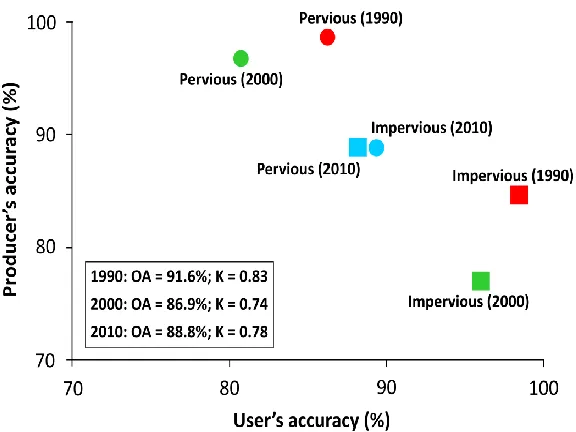
The accuracies of the RS-derived high-resolution (0.5 m) maps of binary imperviousness 358
for 1990, 2000 and 2010 are shown in Fig. 4. High overall accuracies (>86%) were achieved in 359
all three cases and are also confirmed by the corresponding K values (0.74–0.83); interpreted as 360
reflecting a “substantial” to “almost perfect” degree of accuracy (Landis and Koch, 1977). 361
Further corroboration of the classification accuracy is provided by the high user’s (88–99%) and 362
producer’s (77–89%) accuracies associated with both the pervious and impervious classes in all 363
binary imperviousness maps; indicating low commission and omission errors, respectively. The 364
result of this accuracy assessment indicate that the binary imperviousness maps are suitable for 365
deriving reference data for validating the estimates of catchment imperviousness computed using 366
the topographic map-based methods. 367
19 370
371
Fig. 4. Classification accuracies of the binary imperviousness maps derived from aerial 372
photographs for 1990, 2000 and 2010. OA — Overall accuracy; K — Kappa coefficient. 373
374
4.2 Catchment imperviousness from fractional impervious surface maps 375
Catchment imperviousness obtained from topographic map-derived fractional impervious 376
surface maps (OS%IMP) — method 1 — was compared with the reference data (%IMP) derived
377
from the aerial photographs (Fig. 5). A reasonable, but variable level of agreement between 378
OS%IMP and %IMP is observed throughout the three decadal time-slices. Although the correlation
379
for 1990 is greatest (R2 = 0.96), the catchment imperviousness measured using OS%IMP is (with
380
the exception of catchment 3) approximately 10% larger than the reference data. The general 381
overestimation of OS%IMP is most likely attributable to the larger size depictions of features such
382
as roads on the 1990 topographic map, compared to equivalent features on the more recent maps. 383
The correlation between OS%IMP and %IMP is somewhat lower for both 2000 and 2010 (R2 =
384
0.75 and 0.62, respectively), with the data appearing more widely distributed around the 385
[image:19.612.163.451.94.310.2]20
the exact instant in time at which the aerial photographs and corresponding topographic maps 387
capture. Alternatively, this could arise due to the slightly lower accuracies of the 2000 and 2010 388
aerial photography-derived binary imperviousness maps, in comparison to the 1990 map. 389
Nevertheless, the results suggest that estimating catchment imperviousness using fractional 390
impervious surface maps derived from topographic maps (i.e., method 1) is feasible. 391
392
393
Fig. 5. Comparison of catchment imperviousness estimated from aerial photography (%IMP) and 394
topographic map-derived fractional impervious surface cover (OS%IMP) within the six catchments, 395
for years 1990, 2000 and 2010. 396
397
4.3 Mapping urban land use change using topographic maps 398
Urban land use derived from the topographic maps using method 2 reveals the spatio-399
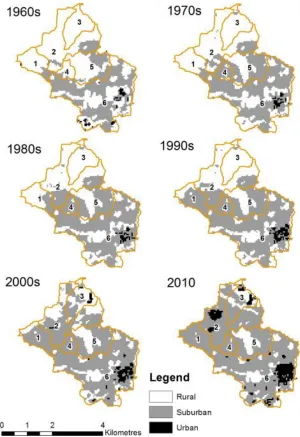
temporal change in Urban, Suburban and Rural land use at a decadal intervals from the 1960s to 400
2010s (Fig. 6). While the highly urban Rodbourne catchment (catchment 6) exhibits a gradual 401
expansion and infilling of Urban and Suburban land use, the Haydon Wick catchments (1–5) 402
exhibit a more dramatic and rapid changes in land use over the 50-year study period. The 403
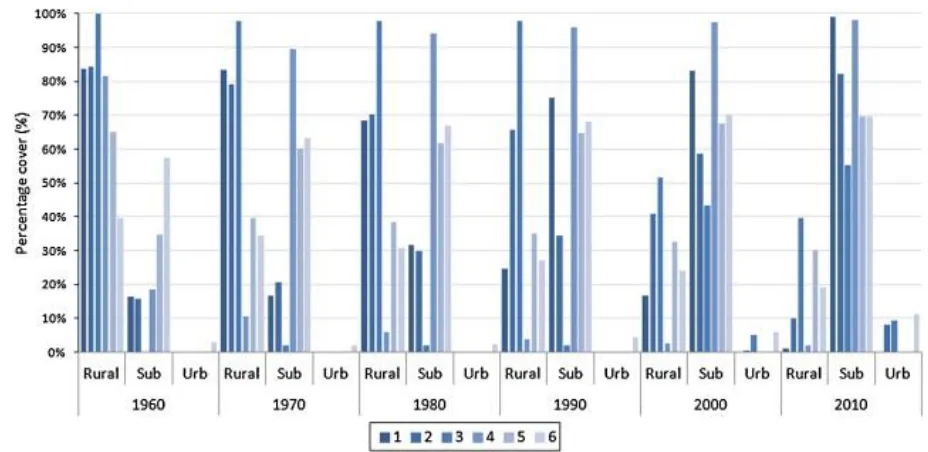
remarkable change from predominantly Rural (agricultural) land use in all Haydon Wick 404
catchments (1–5) to predominantly Suburban land use is clearly illustrated in Fig. 7, as is the 405
[image:20.612.74.544.234.395.2]21
that occurred in catchment 6, which was already over 50% Suburban in 1960, is significantly less 407
than in the peri-urban area of the Haydon Wick catchments (Fig. 7). In all cases, the mapped 408
spatio-temporal changes in Urban land use were found to be consistent with the physical changes 409
observed in the original OS topographic maps. By the 2010s, the relative proportion of 410
developed (i.e., Urban or Suburban) land across all catchments is high and the remaining Rural 411
areas typically represent areas of green space designated for recreation and conservation, along 412
with areas of significant flood risk. 413
414
[image:21.612.72.536.289.515.2]415
22 417
[image:22.612.156.456.90.527.2]418
Fig. 7. Spatio-temporal change in urban land use across the study area. 419
420
421
422
23
Table 2. Change in urban extent index (URBEXT) for the six catchments. 424
Catchment 1960 1970 1980 1990 2000 2010
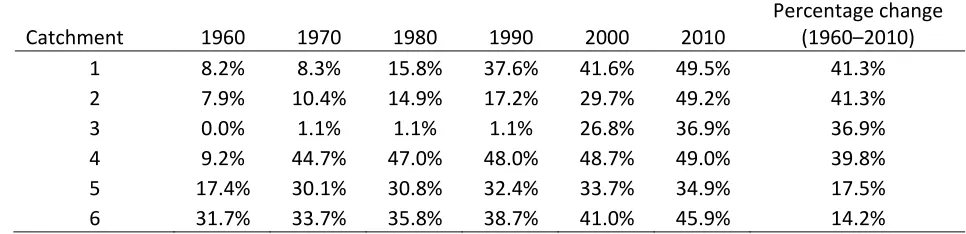
Percentage change (1960–2010) 1 8.2% 8.3% 15.8% 37.6% 41.6% 49.5% 41.3% 2 7.9% 10.4% 14.9% 17.2% 29.7% 49.2% 41.3% 3 0.0% 1.1% 1.1% 1.1% 26.8% 36.9% 36.9% 4 9.2% 44.7% 47.0% 48.0% 48.7% 49.0% 39.8% 5 17.4% 30.1% 30.8% 32.4% 33.7% 34.9% 17.5% 6 31.7% 33.7% 35.8% 38.7% 41.0% 45.9% 14.2% 425
Catchment values of URBEXT computed using the land use maps (Table 2) also show 426
distinct differences between the Haydon Wick catchments (1–5) and Rodbourne catchment (6). 427
During the period 1960–2010, URBEXT values changed little across the Rodbourne catchment, 428
with only a 14.2% increase as a result of small, steady incremental change during each decade. 429
More significant change across the Haydon Wick catchments reflects successive waves of peri-430
urban development during the study period, with an average overall increase in URBEXT of 431
35.4% and significant variation between the catchments (17.5–41.3%). Again, the observed 432
temporal changes in urban extent were found to be consistent with known physical changes that 433
occurred within the period 1960–2010. Therefore, the results demonstrate that the employed 434
method is an effective approach for readily mapping long-term basic land use change and 435
associated catchment-level urban extent from historical topographic maps. A particular important 436
stage in this methodology is the application of land use trajectory analysis (e.g., Verbeiren et al., 437
2013), which was crucial in ensuring a reliable time series dataset from which only genuine land 438
use change is revealed. 439
440
4.4 Catchment imperviousness from urban land use maps 441
To investigate whether a simple index of urban extent (URBEXT) derived from 442
24
comparison with reference imperviousness derived from aerial photography (%IMP) was 444
undertaken (Fig. 8). Overall, a high correlation between URBEXT and %IMP is observed across 445
most catchments during the three decades (R2 = 0.80–0.96), and also when all data is considered 446
collectively (R2 = 0.86). Nevertheless, some notable deviations were observed for specific 447
catchments and time-slices. For example, values of %IMP for catchment 3 were shown to be 448
much higher than URBEXT in all cases due to significant underestimation of Urban areas of 449
gravel and tarmac because of their depiction on topographic maps. Also, for 1990, URBEXT 450
values are clustered around %IMP, while URBEXT consistently underestimates catchment 451
imperviousness for both 2000 and 2010. The general underestimation of catchment 452
imperviousness is likely to relate to the use of the ‘level-1’ binary grids, in which buildings and 453
roads are not infilled. Nonetheless, it is apparent that land use maps generated from topographic 454
maps can be used in conjunction with the urban index, URBEXT, (i.e., method 2) to generate 455
feasible estimates of catchment imperviousness. 456
457
458
Fig. 8. Comparison of catchment imperviousness estimated from aerial photography (%IMP) and 459
topographic map-derived index of urban extent (URBEXT) within the six catchments, for years 460
1990, 2000 and 2010. 461
[image:24.612.71.543.472.636.2]25
A linear regression model between URBEXT and %IMP across the three decadal time-463
slices returned an optimised Suburban weighting factor (β = 0.53). Calibrated values of urban 464
extent (URBEXTIMP) for each catchment were computed for 1990, 2000 and 2010 by using this
465
optimised value for β in Eq. (2). Following a comparison, the overall correlation between 466
URBEXTIMP and %IMP (R2 = 0.84) was actually found to be marginally lower than for URBEXT
467
(R2 = 0.86), indicating that the original preset β (0.5) was more appropriate in this particular case. 468
However, in regions where Suburban land use does not comprise equal mixtures of built-up land 469
and vegetation, the optimal weighting can be determined using the same approach as that used 470
here. 471
472
4.5 Historical change in imperviousness 473
The two methods employed in this paper for computing catchment imperviousness from 474
topographic maps both provide a means of revealing long-term change in imperviousness. As 475
illustrated by Fig. 9, the overall trend in imperviousness change for 1960–2010 is consistent 476
between the two methods. With the exception of catchment 6, which was already highly 477
developed prior to 1960, all catchments experience a somewhat rapid increase in imperviousness 478
during a specific period between 1960 and 2010. For example, catchment 1 sees its biggest 479
increase in imperviousness during 1980–1990, while catchment 3 experiences a rapid rise during 480
1990–2000. The timings of these rapid increases in imperviousness coincide with known 481
episodes of peri-urban expansion within the study area, and reflect the pattern of continuous 482
growth and expansion where as one development finishes another one commences. The less 483
26
suburban housing stock in 1960 and that it also contains a large nature reserve which is protected 485
from development. 486
[image:26.612.73.538.133.337.2]487
Fig. 9. Change in impervious cover determined using two methods across the six study catchments 488
(1960–2010). 489
490
In addition to displaying similar trends, the two methods provide very similar estimates 491
of the total absolute change in catchment imperviousness between 1960 and 2010. The mean 492
difference in the total absolute change estimates between the two methods, for all catchments, is 493
2.9%, with individual catchment estimates varying between a maximum difference of 7.1% and a 494
minimum of 0.4%. The maximum difference is associated with catchment 6, which is arguably 495
the most complex in terms of land use change during 1960–2010 because of gradual expansion 496
of the industrial area in the south-eastern section of the catchment, and regeneration of the 497
railway network to suburban housing in the south-west. As illustrated by Fig. 9, the more rural 498
northern catchments (i.e., 1–4) experienced the most significant total absolute change in 499
27
These estimates clearly reflect the rapid expansion of suburban land use into these previously 501
rural areas as revealed in Fig. 6. 502
Although Fig. 9 illustrates that the methods reveal similar trends and estimates of change 503
in imperviousness across the six catchments for 1960–2010, there are differences in the 504
individual catchment imperviousness estimates. Specifically, all estimates computed using 505
method 1 (OS%IMP) exceed those produced using method 2 (URBEXT), with a mean absolute
506
difference of 7.8% (Table 3). With respect to the time intervals, the largest differences between 507
the methods occurs for the years 1990 and 2000,where OS%IMP estimates are respectively 8.3%
508
and 9.4% greater than the equivalent URBEXT estimates. With respect to catchments, the largest 509
differences between methods are observed for catchments 5 and 6, for which OS%IMP estimates
510
are respectively 9.0% and 9.5% greater than URBEXT estimates. The overall trend of method 1 511
producing higher estimates than method 2 is explained by a combination of the contrasting 512
representation of features such as roads and buildings in the different binary maps (i.e., the level 513
of infilling) incorporated in the two methods, and the somewhat simplistic discrete weighting 514
system employed in method 2. In particular, the infilling of features such as roads in the level 1 515
binary maps used in method 1 can lead to overestimation of impervious cover as the symbology 516
used represent roads does not always reflect the true physical dimensions, and can lead to infill 517
of isolated areas that are not physically developed. Despite the fundamental differences in the 518
two methods, both have been demonstrated to be feasible approaches for computing catchment 519
28
Table 3. Absolute difference (OS%IMP – URBEXT) in estimates of imperviousness cover using two 521
topographic map-based methods. 522
523 524
4.6 Considerations in using topographic maps for estimating imperviousness 525
This paper demonstrates, through two methods, that topographic maps can be used to 526
compute estimates of catchment imperviousness. When contemplating the use, or evaluating the 527
performance, of OS%IMP and URBEXT — or any other topographic map-based method — there
528
are a several aspects that require some consideration: 529
I. Aerial photographs and topographic maps do not necessarily represent the exact same 530
instant in time, since whereas aerial photographs provide a snapshot for a specific 531
date, topographic maps incorporate updates within a given time period (see Table 1). 532
II. Failure to remove place names and symbols (e.g., to represent forests) from the 533
topographic maps will translate to the subsequently derived binary maps and lead to a 534
degree of overestimation of imperviousness – users should ensure some consistent 535
criteria are outlined for any manual interventions. 536
III. Topographic maps do not readily discriminate areas of inland bare ground and 537
concrete/tarmac features, which will subsequently lead to their misrepresentation on 538
derived binary impervious surface maps and result in a degree of underestimation of 539
imperviousness. However, infilling of features such as roads can lead to 540
Year 1 2 3 4 5 6 Mean difference
1960 8.0 8.2 5.5 5.4 9.3 10.4 7.8
1970 4.7 9.1 3.8 6.4 10.2 10.3 7.4
1980 6.3 9.0 4.6 4.3 9.0 11.1 7.4
1990 9.2 8.3 3.4 7.5 9.8 11.6 8.3
2000 12.0 7.4 7.1 11.0 8.7 10.0 9.4
2010 10.3 7.8 3.3 8.3 6.8 3.3 6.6
[image:28.612.62.536.91.219.2]29
overestimation of impervious cover if the symbology used does not directly reflect 541
true physical dimensions. 542
IV. Small-scale features (e.g., minor roads) and minor changes within existing 543
development boundaries (e.g., infilling or ‘urban creep’) shown on aerial photography 544
are not always captured using the discrete land use classification and scale employed 545
in method 2. 546
V. Calibration of the fractional impervious surface maps (as in method 1) and 547
implementation of land use trajectory analysis (method 2) are crucial steps in 548
producing a coherent time series dataset for revealing reliable long-term change in 549
imperviousness. 550
With both methods capable of providing good estimates of catchment imperviousness, 551
the most appropriate method is largely dependent on the purpose of the study and the format of 552
the topographic maps. In general, method 1 can be more readily implemented and provides maps 553
of fractional impervious surfaces, thus describing imperviousness on a continuous scale (Fig. 554
10). On the other hand, despite method 2 providing only a discrete description of imperviousness 555
(see Fig. 10), it does provide maps of general land use that are informative when interpreting 556
changes in imperviousness over time. Although method 1 can be readily applied to any study 557
area, as demonstrated here, method 2 can be calibrated to determine the optimal weighting factor 558
associated with Suburban land use (β). Additionally, if the available topographic maps depict 559
roads and building as infilled features (akin to the ‘level-2’ binary maps) then method 1 would be 560
more suitable. However, if — as in the case of the OS topographic maps used here — such 561
features are not infilled, then method 2 can be applied without the need of additional pre-562
30 564
[image:30.612.192.427.97.493.2]565
Fig. 10. A comparison of impervious surface maps obtained using the two methods. 566
567
5. Conclusions
568This paper demonstrates that it is possible to derive robust long-term estimates of 569
catchment imperviousness from topographic maps using two different contrasting methods. The 570
first method (method 1) generates fractional impervious surface maps from the topographic maps 571
and uses these to estimate catchment imperviousness. The second method (method 2) generates 572
31
imperviousness from these using an index of urban extent. Although some degree of manual 574
intervention is required for both methods, the processing stages employed are largely semi-575
automatic and require significantly less time than manual delineation of impervious surfaces. 576
Such manual intervention will rely on some degree of user subjectivity — related to the format 577
of the topographic maps — that could alter the binary map sand derived impervious cover 578
products. Such interventions are required to produce more consistent mapping products for 579
derivation of binary maps, and it is recommended that users employ transparency in the reporting 580
of such interventions. Through comparison with reference data obtained using aerial 581
photographs, it is demonstrated that both methods are capable of providing accurate estimates of 582
catchment imperviousness and its change over time. With both methods capable of providing 583
good estimates of catchment imperviousness, the most appropriate method beyond this study will 584
be largely dependent on the purpose of the study and the format of the topographic maps. 585
This study demonstrates that both methods show the peri-urban Haydon Wick catchment 586
has undergone a significant change from predominantly rural to highly urban and is now 587
dominated by suburban areas of housing development. Findings from hydrological studies (e.g. 588
Braud et al., 2012; Dams et al., 2013) would suggest that this will have led to a faster catchment 589
response and greater magnitude of flow during storm events — making the area more prone to 590
flooding. Local reports of more frequent flooding would are consistent with this hypothesis but 591
hydrological modelling of the change in storm runoff response would be necessary to validate 592
this assumption. 593
Several issues that may affect derived estimates of catchment imperviousness using 594
topographic maps are highlighted for consideration in future applications of this methodology. 595
32
might not be recognisable as developed surfaces on topographic maps. Conversely, although 597
such surfaces are typically characterised as impervious, they are not always physically 598
impervious per se. For example, gravel cover is not inherently impervious and more modern car 599
parks and roads can employ Sustainable Urban Drainage Systems (SUDS) design principles to 600
enable infiltration of water to the media below. Furthermore, the presence and spatial distribution 601
of both traditional drainage systems and SUDS contribute to the effective impervious area (EIA) 602
— the connectivity to impervious areas — and are shown to be a strong determinant of storm 603
runoff response (Han and Burian, 2009). This highlights the limitation of using simple 604
impervious area estimates in hydrological studies. Also, depending on the maps scale, plot-scale 605
(changes such as housing extensions driving urban creep; Perry and Nawaz, 2008) may not be 606
captured on topographic maps. 607
Further research is required to progress to a more realistic scheme which accounts for 608
varying degrees of imperviousness within individual land use or land cover classes. This would 609
require better characterisation of urban typologies and land cover classes in terms of their natural 610
permeability, association with drainage systems, and additional factors which affect the 611
catchment runoff response. Such information would have to be obtained from auxiliary datasets 612
as this is not readily available on historical topographic maps. Imperviousness maps 613
incorporating information on connectivity and features that influence hydrological response to 614
storm events would be particularly useful in quantifying the impact of historical urbanisation on 615
flooding. 616
617 618
33
Acknowledgements
620
The authors would like to thank Thomas Kjeldsen and France Gerard of the Centre for Ecology 621
and Hydrology and Rachel Dearden of the British Geological Survey for their contributions. We 622
are also thankful to the two anonymous reviewers for their comments and suggestions, which 623
helped to improve the quality of this manuscript. SG publishes with the permission of the 624
Executive Director of the British Geological Survey (NERC). 625
626 627
References
628Amirsalari, F., Li, J., Guan, X., & Booty, W. G. (2013). Investigation of correlation between 629
remotely sensed impervious surfaces and chloride concentrations. International Journal 630
of Remote Sensing, 34, 1507–1525. 631
Arnold, C. L., & Gibbons, C. J. (1996). Impervious Surface Coverage: The emergence of a key 632
environmental indicator. Journal of the American Planning Association, 62, 243–258. 633
Bauer, M. E., Heinert, N. J., Doyle, J. K., & Yuan, F. (2004). Impervious surface mapping and 634
change monitoring using Landsat remote sensing. ASPRS Annual Conference 635
Proceedings, Denver, Colorado, May 2004. 636
Bayliss, A. C., Black, K. B., Fava-Verde, A., & Kjeldsen, T. R. (2006). URBEXT2000 – A new 637
FEH catchment descriptor: Calculation, dissemination and application. Joint Defra/EA 638
Flood and Coastal Erosion Risk management R & D Programme. R&D Technical Report 639
34
Benz, U. C., Hofmann, P., Willhauck, G., Lingenfelder, I., & Heynen, M. (2004). Multi-641
resolution, object-oriented fuzzy analysis of remote sensing data for GIS-ready 642
information. ISPRS Journal of Photogrammetry and Remote Sensing, 58, 239–258. 643
Bibby, P. (2009). Land use change in Britain. Land Use Policy, 26, S2–S13. 644
Braud, I., Breil, P., Thollet, F., Lagouy, M., Branger, F., Jacqueminet, C., Kermadi S, & Michel 645
K. (2012). Evidence of the impact of urbanization on the hydrological regime of a 646
medium-sized periurban catchment in France. Journal of Hydrology, 485, 5–23. 647
Chini, M., Pacifici, F., Emery, W. J., Pierdicca, N., & Del Frate, F. (2008). Comparing statistical 648
and neural network methods applied to very high resolution satellite images showing 649
changes in man-made structures at rocky flats. IEEE Transactions on Geoscience and 650
Remote Sensing, 46, 1812–1821. 651
Congalton, R.G. (1991). A review of assessing the accuracy of classifications of remotely sensed 652
data. Remote Sensing of Environment, 37, 35–46. 653
Dams, J., Dujardin, J., Reggers, R., Bashir, I., Canters, F., & Batelaan, O. (2013). Mapping 654
impervious surface change from remote sensing for hydrological modelling. Journal of 655
Hydrology, 485, 84–95. 656
Fitzpatrick-Lins, K. (1981). Comparison of sampling procedures and data analysis for a land-use and
657
land-cover map. Photogrammetric Engineering and Remote Sensing, 47, 343–351.
658
Foody, G. M. (2002). Hard and soft classifications by a neural network with a non-exhaustively 659
defined set of classes. International Journal of Remote Sensing, 23, 3853–3864. 660
Fuller, R. M., Smith, G. M., Sanderson, J. M., Hill, R. A., Thomson, A. G., Cox, R., Brown, N. 661
J., Clarke, R. T., Rothery, P., & Gerard, F. (2002). Land Cover Map 2000: A Guide to the 662
35
Gerard, F., et al. (2010). Land cover change in Europe between 1950 and 2000 determined 664
employing aerial photography. Progress in Physical Geography, 34, 183–205. 665
Han, W. S., & Burian, S. J. (2009). Determining effective impervious area for urban hydrologic 666
modeling. Journal of Hydrologic Engineering, 14, 111–120. 667
Haralick, R. M., Shanmugan, K., & Dinstein, I. (1973). Textural features for image 668
classification. IEEE Transactions on Systems, Man, and Cybernetics, 3, 610–621. 669
Herold, M., Liu, X., & Clarke, K. C. (2003). Spatial metrics and image texture for mapping 670
urban land use. Photogrammetric Engineering & Remote Sensing, 69, 991–1001. 671
Hooftman, D. & Bullock, J. (2012). Mapping to inform conservation: A case study of changes in 672
semi-natural habitats and their connectivity over 70 years. Biological Conservation, 145, 673
30–38. 674
Hurd, J. D., & Civco, D. L. (2004). Temporal characterization of impervious surfaces for the 675
State of Connecticut. ASPRS Annual Conference Proceedings, Denver, Colorado, May 676
2004. 677
Im, J., Lu, Z., Rhee, J., & Quackenbush, L. J. (2012). Impervious surface quantification using a 678
synthesis of artificial immune networks and decision/regression trees from multi-sensor 679
data. Remote Sensing of Environment, 117, 102–113. 680
Institute of Hydrology. (1999). Flood Estimation Handbook (five volumes). Centre for Ecology 681
and Hydrology, Oxfordshire, UK. 682
Kidd, C. H. R., & Lowing, M. J. (1979). The Wallingford urban subcacthment model. Institute of 683
Hydrology, Report No 60. Wallingford, Oxfordshire, UK. 684
Landis, J. R., & Koch, G. G. (1977). The measurement of observer agreement for categorical 685
36
Lu D., Weng, Q., & Li, G. (2006). Residential population estimation using a remote sensing 687
derived impervious surface approach. International Journal of Remote Sensing, 27, 688
3553–3570. 689
Lu D., Moran, E., & Hetrick, S. (2011). Detection of impervious surface change with 690
multitemporal Landsat images in an urban–rural frontier. ISPRS Journal of 691
Photogrammetry and Remote Sensing, 66, 298–306. 692
Morton, D., Rowland, C., Wood, L., Meek, C., Marston, C., Smith, G., Wadsworth, R., & 693
Simpson, I.C. (2011). Final report for LCM2007 – the new UK land cover map. 694
Countryside Survey Technical Report No 11/07 NERC/Centre for Ecology & Hydrology, 695
112. 696
Ogden, F. L., Pradhan, N. R., Downer, C. W., Zahner, J. A. (2011) Relative importance of 697
impervious area, drainage density, width function, and subsurface storm drainage on 698
flood runoff from an urbanized catchment. Water Resources Research, 47, W12503. 699
Pacifici, F., Chini, M., & Emery, W. J. (2009). A neural network approach using multi-scale 700
textural metrics from very high-resolution panchromatic imagery for urban land-use 701
classification. Remote Sensing of Environment, 113, 1276–1292. 702
Packman, J. (1980). The effects of urbanisation on flood magnitude and frequency. Institute of 703
Hydrology Report No 63, Wallingford, Oxfordshire. 704
Perry, T., & Nawaz, R. (2008). An investigation into the extent and impacts of hard surfacing of 705
domestic gardens in an area of Leeds, United Kingdom. Landscape and Urban Planning, 706
86, 1–13. 707
Richards, J. A., & Jia, X. (2006). Remote Sensing Digital Image Analysis, Fourth edition. Berlin: 708
37
Schueler, T. R. (1994). The Importance of Imperviousness. Watershed Protection Techniques, 1, 710
100–111. 711
Shuster, W. D., Bonta, J., Thurston, H., Warnemuende, E., & Smith, D. R. (2005). Impact of 712
impervious Surface on Watershed Hydrology. Urban Water Journal, 2, 263–75. 713
Tavares, A. O., Pato, R. L., & Magalhães, M. C. (2012). Spatial and temporal land use change 714
and occupation over the last half century in a peri-urban area. Applied Geography, 34, 432– 715
444. 716
Van de Voorde, T., De Genst, W., Canters, F., Stephenne, N., Wolff, E., & Binnard, M. (2003). 717
Extraction of land use/land cover — Related information from very high resolution data 718
in urban and suburban areas. Proceedings of the 23rd Symposium of the European 719
Association of Remote Sensing Laboratories (pp. 237–244). 720
Van de Voorde, T., Jacquet, W., & Canters, F. (2011). Mapping form and function in urban 721
areas: An approach based on urban metrics and continuous impervious surface data. 722
Landscape and Urban Planning, 102, 143–155. 723
Villarini, G., Smith, J.a., Serinaldi, F., Bales, J., Bates, P.D., & Krajewski, W.F. (2009). Flood 724
frequency analysis for nonstationary annual peak records in an urban drainage basin. 725
Advances in Water Resources, 32, 1255–1266. 726
Verbeiren, B., Van De Voorde, T., Canters, F., Binard, M., Cornet, Y., Batelaan, O. (2013). 727
Assessing urbanisation effects on rainfall-runoff using a remote sensing supported 728
modelling strategy. International Journal of Applied Earth Observation and 729
38
Vogel, R.M., Yaindl, C., & Walter, M. (2011). Nonstationarity: Flood Magnification and 731
Recurrence Reduction Factors in the United States. JAWRA Journal of the American 732
Water Resources Association, 47, 464–474. 733
Weng, Q. (2012). Remote sensing of impervious surfaces in the urban areas: Requirements, 734
methods, and trends. Remote Sensing of Environment, 117, 34–49. 735
Yuan, F., & Bauer, M. E. (2006). Mapping impervious surface area using high resolution 736
imagery: A comparison of object-based and per pixel classification. American Society for 737
Photogrammetry and Remote Sensing Annual Conference Proceedings, Reno, Nevada, 738
2006. 739
Zhou, Y. Y., & Wang, Y. Q. (2008). Extraction of impervious, surface areas from high spatial 740
resolution imagery by multiple agent segmentation and classification. Photogrammetric 741