The code document’s structure
and analysis
Stuart Reeves
School of Computer Science & ITUniversity of Nottingham, Jubilee Campus, Wollaton Road, Nottingham, NG8 1BB
April 21, 2006
Introduction
The purpose of this paper is twofold. Firstly it presents a preliminary and ethnomethodologically-informed analysis of the way in which the growing structure of a particular program’s code was ongoingly derived from its ear-liest stages. This was motivated by an interest in how the detailed structure of completed program ‘emerged from nothing’ as a product of the concrete prac-tices of the programmer within the framework afforded by the language. The analysis is broken down into three sections that discuss: the beginnings of the program’s structure; the incremental development of structure; and finally the code productions that constitute the structure and the importance of the pro-grammer’s stock of knowledge. The discussion attempts to understand and describe the emerging structure of code rather than focus on generating ‘re-quirements’ for supporting the production of that structure. Due to time and space constraints, however, only a relatively cursory examination of these fea-tures was possible. Secondly the paper presents some thoughts on the difficul-ties associated with the analytic—in particular ethnographic—study of code, drawing on general problems as well as issues arising from the difficulties and failings encountered as part of the analysis presented in the first section.
The following section discusses briefly the background to the program’s production, which has relevance for the reader’s understanding of the ratio-nale behind the structural decisions that were made.
The program and sittings
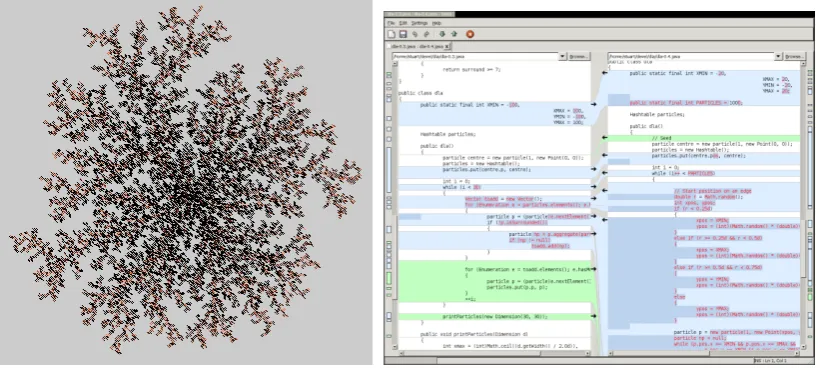
case—are stepped through a random walk, ‘sticking’ to already existing parti-cles within a plane. The process is seeded with a pre-existing particle placed in the centre of the plane from which the two-dimensional, plane-bound image is generated.
Figure 1: Diffusion limited aggregation (left),meldscreenshot (right)
The program was written ‘from scratch’ in Java over the course of couple of weeks or so. Various resources were drawn on during this work, such as con-versations, ‘workings’ in the form of sketches and diagrams (as shown in Fig-ure 2), the Java API documentation, other implementations of DLA available on the internet, and so on. A series of versions (this term is used sparingly for reasons discussed shortly) was kept from the initial attempt to the final work-ing program (0.1through to1.2) along with occasional compiler output and notes that seemed particularly pertinent at the time. In order to examine the way in which the code structure developed, and instead of examining program development in real-time (e.g., by video or screen capture data), the differences between these ‘versions’ were studied as a way to perform some introspective analytical work on a data set that was already known intimately. This analysis was done using the program meld, which is a visual diff-ing tool that pro-vides a graphical representation of differences between two (or three) files (see Figure 1 for a screenshot).
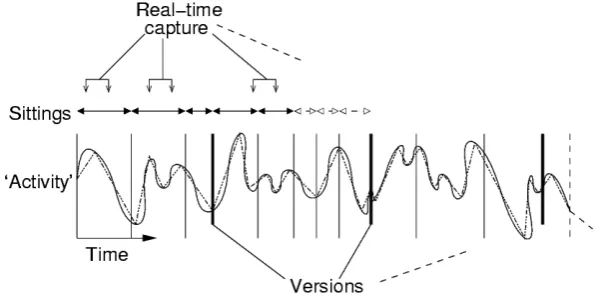
This ‘version numbering’—e.g., the decision and practical work of mov-ing from version0.1to0.2—was iterated according to a particular emerging strategy of capture termed here as ‘sittings.’ A sitting came to be constituted of at least a temporally continuous session of work at the keyboard, or at most a small number of these sessions with minor breaks in between. It is of note at this point, however, that the notion of a sitting is however distinct from the term ‘version,’ as it is used in common software development parlance. A ver-sion of a program’s code in this sense may be the result of many, many sittings and possibly a long development process (see Figure 4 for a graphical illustra-tion of this point).
prob-Figure 2: Two pages of sketches and drawings
[image:3.595.122.421.121.446.2]Beginnings
The notion of the sitting is intimately linked with the programmer’s methods of ‘keeping track’ and using placeholders as part of a concerted effort to maintain the trajectory of the code as it is worked upon. It is these issues that shall be examined here in more detail, but it is also worth highlighting at this point that the analysis delves into some low-level technical detail regarding the issues this paper attempts to draw out, however this itself is an interesting point that will be addressed in a later section.
The first ‘sitting’ resulted in the code that follows in Listing 1 (sitting0.1). The entire listing of this sitting has been reproduced as it contains some inter-esting features that shall be examined. The code contains two classes:particle
anddla. Theparticleclass is notionally correspondent to the ‘particles’ that are randomly walked through the space. It contains a constructor that accepts two arguments, whereas the dlaclass contains a constructor and the main
method (i.e., the entry point for the program). It is of note that this code was not compiled at all during the sitting, and compilation was only performed at the start of the next sitting some time later (and generating multiple compila-tion errors).
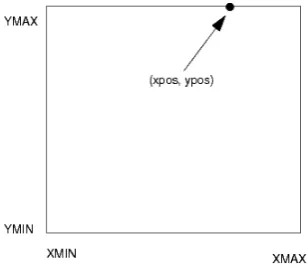
[image:4.595.244.398.523.657.2]The functionality the program attempts to express is as follows. When the entry pointmainis processed, a newdlaobject is created. Thisdlaobject cre-ates a newparticleobject with (unused)diameterandsteparguments set tofloatvalues of1.0and0.0. Theparticleconstructor is called dur-ing this creation, pickdur-ing a random number (r) and filtering this with condi-tional statements through to four possible outcomes, the purpose of which is to choose a random side of a cube to as part of theparticle’s start position. Each outcome (e.g., if (r <= 0.25d && r < 0.5d)) then assigns to the member fieldsxposandyposa value that corresponds with a random plac-ing along the chosen side. This is illustrated in Figure 3. After this selection, theparticle(centre) has its fieldsxposandyposdirectly set to zero. Fi-nally, theVectorobjectparticlesis created and thedlaconstructor exits, leading to the exit point for the whole program.
Figure 3:particlestart points
class particle {
public doublexpos, ypos, xdir, ydir;
doublediameter, step;
publicparticle(double diameter, double step) {
double r = Math.random();
if (r < 0.25d) {
xpos = XMIN;
ypos = Math.random() * (YMAX - YMIN); }
else if (r >= 0.25d && r < 0.5d) {
xpos = XMAX;
ypos = Math.random() * (YMAX - YMIN); }
else if (r >= 0.5d && r < 0.75d) {
ypos = YMIN;
xpos = Math.random() * (XMAX - XMIN); }
else
{
ypos = YMAX;
xpos = Math.random() * (XMAX - XMIN); }
this.diameter = diameter;
this.step = step; }
}
public class dla {
public static final int XMIN = -100, XMAX = 100, YMIN = -100, YMAX = 100; particle centre;
Vector particles;
publicdla() {
centre = new particle(1.0f, 0.0f); centre.xpos = 0;
centre.ypos = 0;
particles = new Vector(); }
public static void main(String[] args) {
dla d = new dla(); }
}
com-ments, formatting and other elements of ‘good practice.’ Thus the programmer is assisted in rapidly being able to reacquaint him/herself with some thing pre-viously written at the next sitting. That the code does not compile is a further indication of this sitting’s work being ‘sketchy.’
As mentioned, major parts of the code at this stage appear to ‘do noth-ing’ and perhaps could be seen as vacuous and insubstantial. This is not nec-essarily the case, however, as the code here exhibits a stage of development where declaration and structure are employed to prospectively ‘scaffold’ the next sitting by furnishing that sitting with ‘placeholders’ for further action. Besides the non-compilable, non-runnable state of the program, this is exhib-ited in logically ‘useless’ material, such as theparticles Vectoror some of the member fields such asparticle centre, thedoublesdiameterand
step, and so forth. These declarations serve no purpose here-and-now, how-ever they each have a prospective dimension for the programmer’s work in that they help orient the next sitting in which the concepts embodied by their declarations may be logically ‘filled out.’ It is obvious that the naming of these declarations is similarly vital for their legibility1as well as their position within the structure of the code (e.g., thatparticlesis declared within thedlaclass rather than within theparticleclass). Given that the future sitting may be temporally distant, certain particulars and intentions developed here-and-now within this sitting may also become fuzzy and indistinct at that later date, and so the programmer, in their ‘tying up of ends’ at the end of the sitting, attempts to provide enough scaffold—cultivated in these ‘useless’ declarations—to en-sure that during the later sitting the code’s trajectory is as legible as possible.
As an example we can trace through the changes made to the ‘useless’
Vectornamedparticles. As written in sitting0.1, it forms a placeholder for some kind of container forparticleobjects. In sitting0.2this container’s type is changed from being aVectorto aHashtableofparticleobjects in-stead. Also during this sitting the constructor of thedlaclass is functionally filled out, in which (as shown in Listing 2)particleobjects areput()into
particlesas part of a nestedforloop (not shown). Thus0.1’s declaration ofparticlesbegins to serve a concrete logical purpose within the context of the rest of the code.
Listing 2: The dla constructor, sitting 0.2
Hashtable particles;
public dla() {
particle centre = new particle(1, new Point(0, 0)); particles = new Hashtable();
particles.put(centre.p, centre);
while (true) {
// ...
particles.put(p.p, p); }
}
Button and Sharrock’s account of programming work has highlighted the “screen practices” of programmers (that is, practices produced from screen-based work). In particular they pointed out that “writing code does not consist
of writing the complete code straight off” and furthermore noted how the pro-grammer may write out the “simplest possible case first” as part of keeping track and not visually—and thus ‘mentally’—“losing sight” of the code’s un-folding development [2]. These screen practices are similar to the sketch-like, “simplest case first” work practice as exhibited here in the first sitting. Rather than write the whole detailed structure out in one pass, the programmer em-ploys the prospective qualities of ‘useless’ declarations in order to avoid losing sight. These prospective declarations provide legibility not just for the imme-diate here-and-now unfolding of the codebut alsofor future sittings and the trajectory of the structure of the entire program. In other words they are self-orienting (‘keeping track’) practices that exhibit and embody for the program-mer the course of the unfolding of code.
Finally, something that is also of note for this first sitting is the nature and role of the commonsense notion of ‘plans’ in writing code. Here Suchman’s observation on the conflict between plans and the actual, lived work of actions carried out ostensibly in support of such plans [7] is of relevance. Whilst large code projects do indeed feature detailed plans in the form of specifications, sketches, more formal diagrams (using, say, UML) and design documents (to name a few), these plans cannot encapsulate the contingencies the program-mer continually encounters. Plans can instead be seen as resources for action, with the coupling between plans and actions having varying degrees of homo-geneity. For example, unlike some forms of activity in which the conflict be-tween plans and situated actions is more extreme and pronounced (e.g., Such-man’s example of the kayaker), the programmer is able to use ‘sketch’ code and ‘thinking out-loud’ code (as exhibited here) to situatedly establish elements of a ‘plan’ as part of the concrete lived work involved in programming. The code thus can be part of the construction of a plan as well as the activity involved in the manifestation of that plan. The development of the sittings in this study foreground the use of plan-like sketch code that establishes and maintains a trajectory, i.e., a plan of sorts, however it is of note that within this particular study there are no explicit commonsense planning features such as specifica-tions or design documents beyond a couple of hand-drawn sketches (mostly owing to the simplicity of the task).
Incrementing
Code is often ever-developing and sometimes seemingly never finished2. Al-though structure is fundamentally addressed by the work of the programmer, and at times is produced ‘en masse’ (e.g., as in the creation of sitting 0.1, where the entire initial structure was produced), incrementally adding features is also a staple everyday practice of programming and creating structure. In-cremental code productions accrue across multiple sittings, slowly modifying the program and enabling the code document’s progression along its trajectory in a closely guided way. Placeholders and otherwise ‘useless’ declarations are prospectively employed over the course of this incremental activity.
In writing a program, the programmer often exploits the modularisation and encapsulation facilities provided by the language’s constructs (such as Java’s object orientation with features like classes, inheritance, polymorphism,
etc.). In spite of the abstraction and separation afforded by such constructs, the actual everyday work of writing code is a highly contingent activity in terms of the way in which that modular structure is produced incrementally. For exam-ple, in order to add an argument to a method, code calling the method must be brought up-to-date with this change; this edit cannot be saved for a ‘later date’ if the programmer wishes to test run the program at the current time. Thus, although the logical structure may be modular and abstracted, the work that goes to make that modularity is most definitely not.
Firstly, and following on from the previous section, we shall examine a sim-ple examsim-ple that illustrates the way in which the placeholder quality of certain declarations is exploited during incremental change. Sitting0.2 introduces a member fieldPoint pinto theparticleclass (see Listing 3). This field was functionally conceived for storing the Cartesian point theparticle ob-ject was located at, meaning that at first it would be set with a chosen starting point (i.e., on an ‘edge,’ see Figure 3), and then used to store the updated po-sition according to the random walk. At this sitting the variablepagain ‘does nothing’; it is merely set in the constructor for theparticleclass. It is only by sitting0.4that this variable is referenced anywhere else in the class (in the
step()method), and, notably during this sitting is relabelled aspos. A rea-son for this is the visual ‘collision’ between anotherparticlevariable, pp, that is used in the samestep()method thatpcomes to be employed in. The placeholder feature ofp, then, is used to denote temporarily some future mem-ber of data and piece of functionality (i.e., theparticle’s current position) that is only employed within theparticle’s functional workings at a later sitting. For the time leading up to this sitting it also does a ‘job of work’ for the programmer in the method that calls the particleconstructor. particle
objects are created in thedlaclass, as seen in Listing 2, enabling the program-mer to structureparticle-creation code in that classas though it were a feature of theparticleclass, regardless of that part of the code ‘doing nothing.’
Listing 3: Placeholder field, sitting 0.2
Point p;
public particle(int diameter, Point p) {
// ...
this.p = p; }
public particle step(Hashtable particles) {
// ...
particle pp = null;
// ...
}
The previous example examined only a few modifications between sittings
0.2and 0.4. Listing 4 illustrates another example of incremental develop-ment, albeit traced over the course ofallthe sittings3. Here the whileloop within thedlaclass constructor begins as a endless loop (0.2). At this stage, the content of the loop iterates through theHashtableof existingparticle
objects, calling the particle’s aggregate()method on each and adding
3The following description of this development may be
diffi-cult to follow, and so the sittings have been made available at
newparticles to theHashtable. By sitting0.3the loop is bounded by a counter and literal value, and the loop’s contents are identical to0.2. Subse-quently in0.4 this loop becomes bounded by a ‘hard-coded’ constant and its contents are modified somewhat. Here in 0.4 a new particle object is being created at the start of each loop, which is itself declared with the edge selection procedure (as in Figure 3). This particular block of code has been moved inside thewhileloop, and a further innerwhileloop has been constructed. This inner while calls the step() method (i.e., to ‘step’ the
particlethrough its random walk) repeatedly on theparticlecreated ear-lier in the loop until conditions determine that it has either been aggregated (i.e., ‘stuck’ to another already-existingparticle), or ‘walked’ outside the bounds of the square’s edges. Sitting0.5 has the (now outer)while loop bounded by an argument (iterations), which, some sittings later is assim-ilated into a newaggregate()method4. By sitting1.0, the loop’s contents have been expanded and has been transformed into aforloop. Given this transformation, there are, however, the vestiges of the edge selection and the inner loop that callsstep()on theparticleobjects repeatedly.
It is important to note that for all of the sittings after0.2, the loop counter variableiis not referenced by any statements within the loop; that is, the vari-able’s use is completely self-contained with respect to the code reproduced here.
Listing 4: Developing the loop
0.2:
public dla() {
// ...
while (true) {
// ...
} }
0.3:
public dla() {
// ...
int i = 0;
while (i < 30) {
// ...
++i; }
}
0.4:
public static final int PARTICLES = 1000;
public dla() {
// ...
int i = 0;
while (i++ < PARTICLES) {
// ...
}
4This naming is potentially confusing. Initially theparticleclass had anaggregate()
}
0.5:
public dla(int iterations, ...) {
// ...
int i = 0;
while (i++ < iterations) {
// ...
} }
...
1.0:
public dla() {
// ...
}
public void aggregate(int iterations, ...) {
// ...
for (int i = 0; i < iterations; ++i) {
// ...
} }
One of the most obvious aspects of this series of code fragments is the way in which the loop develops incrementally across sittings0.2to0.5. There is an apparent ‘slowness’ in this incremental development given the very simple segment of code that is actually being modified. There is no technical rea-son why its final form (i.e., 1.0’s generalised and argument-bounded for
loop) could not have been reached at the first or second sitting. Besides the
iterationsargument that is added,logicallythere are no contingencies de-veloped upon the surrounding code, and yet the loop’s development is ‘slow.’ The gradual changes made to the code in this sequence do notjustderive from the (virtually non-existent) logical contingencies local to the sitting, but also from contingencies upon the way in which the program’s structure unfolds
across sittings. In other words, the surrounding code and the content of the loop’s code has a changing state and functionality that is developed as part of the concerted work involved in the loop itself. The loop is not developed and does not have a trajectory that is in isolation from its local surroundings. This is evident when we examine the loop’s placeholder qualities and its use in the ongoing development of the code.
This sense of the loop as ‘placeholder’ can be seen as part of the program-mer’s attempts in ‘just getting the code to work.’ The initial construction of the
lim-iting output as print statements for debugging are introduced. Subsequently, the loop is altered to enable bounds specified as arguments, which is imple-mented as part of a series of other introductions of arguments into the code. As such, then, the development of the loop is continuously contingent upon the trajectory of the code as a whole.
Structure as a stock of knowledge
The structure of code is constituted from the constructs provided by the lan-guage the code is written in. A program may be structurally and functionally different from all others, and yet at a certain level is created from identical con-structs to other programs. These concon-structs strictly define the basic building blocks of structure, and, typically due to pedagogical instruction, ability and practice, the programmer becomes skilled in expressing computational tasks in this language of constructs. A question here to explore is how repeated (or repetitive) instances of use of constructs across different contexts—which by their nature are highly specific—incrementally inform and build the program-mer’s generalised and adaptable stock of knowledge that is then consulted in later programs.
One of the major jobs of work for the novice programmer is becoming fa-miliar with and competent at producing semantically and syntactically correct code statements. This is part of the novice’s development of a mastery of ‘good practice,’ or appropriate ‘ways to do things’ in code. For example, in Java this would involve obtaining a handle on the essential patterns of structure that can created from basic language constructs likefor,while,if, and their appro-priate context of use, such as understanding when to useswitchstatements instead ofif (...) else if (...) and vice versa. In addition to also cultivating a sense of whitespace and formatting ‘style’, the work might in-volve developing a familiarity with Application Program Interfaces (APIs) and essential tools of the trade (such as the Standard Template Library for C++).
Some elements of this stock of knowledge are exhibited within various sit-tings of the DLA code, such as in the use offorloops. Aforloop is a simple control structure that enables bounded loops to be specified in a compact way, e.g., for (int i = 0; i < 10; ++i) ... Consider the following less typicalforloop that appears in sitting0.2. In essence, the loop here enables the iteration through of all the ‘elements’ of theHashtable, meaning that each value (i.e.,particleobject) of the hash’s key-value pairs is processed:
Listing 5: Loop from sitting 0.2
for (Enumeration e = particles.elements(); e.hasMoreElements(); ) {
particle p = (particle)e.nextElement();
// Do stuff with p ...
}
There are many different ways to extract each value fromHashtables and
Vectors5, however this particular, single technique is one that is repeatedly used over the course of the sittings. Immediately below the code of thefor
5Any Java API classes that support theelements()method can be dealt with in this way, i.e.,
loop that has just been discussed, for example, is another instance of thisfor
loop ‘pattern,’ which in this case is used to process aVector(namedtoadd):
Listing 6: Another loop from sitting 0.2
for (Enumeration e = toadd.elements(); e.hasMoreElements(); ) {
particle p = (particle)e.nextElement();
// Do stuff with p ...
}
By the final sitting these two instances offorloops have been replaced by other constructs, however in two other places within the final sitting6 these kinds of ‘stock’ productions of loops have appeared yet again. Within the DLA program, these characteristic formulations of loops are a product of the pro-grammer working with certain data structures likeHashtables andVectors. What has been established is a certain familiarity with ‘way of doing things,’ which in this case is a ‘way of doing things withforloops andEnumerations,’ and is a doing that is repeatedly employed at different points in the ongoing development of the DLA program’s code document. It is a tried and tested part of the programmer’s stock of knowledge.
Repetivitity is a prime way for the programmer being able to introspectively notice their own patterns, as in the particular use of theforloop. This kind of repetitivity does not imply that programming becomes a drudge7, but is rather an essential part of the construction of the stock of knowledge. This is comparable to many craft and craft-like activities.
As experienced programmers develop their skills further, their stock of kn-owledge can extend beyond including just certain small-scale patterns of lan-guage constructs to favoured large-scale ‘design patterns.’ These are in a crude sense more sophisticated ‘ways to do things’ in code. There is extensive profes-sional recognition of the notion of these extended patterns of structure (at least within object-oriented software design) as evidenced by the popular and well-known account of this within object-oriented software design and construction [6].
Summary
Some of the features highlighted within this brief examination of a relatively small segment of the changing code document have been: the sketch-like qual-ity of the initial sitting, and implications this has for the code’s trajectory and structure; the code’s trajectory as an incremental accomplishment that is main-tained and tended to over the course of a series of sittings; and finally the role of the stock of knowledge in the programmer’s incremental production of structure. The next section examines the analytical issues and problems this analysis has in particular foregrounded for the author.
6ConfigReader.find()anddlac.paintComponent(), as found in1.2. 7Turing presciently noted that
Analytical problems
The text denoted as ‘code’ is a steadilychangingdocument of the programmer’s daily work. Even given the detailed scaffolding that is part and parcel of ev-eryday programming, code requires the vulgar competencies of the reader to make sense of its structure and meaning. The code document is not a ‘syn-opsised’ and peculiarly condensed record of the lived work of its production, but rather the document is instead a synopsis and condensation of theintended purposeof the code at the point it is examined. Typically the code’s synoptic account of ‘work’ will not contain any information regarding the code’s trajec-tory, unfolding structure and thus the concrete work in which it was produced. Furthermore, all code has a context of production, whether this is as a piece of hobbyist work or part of an industrial control program, a context which also will have left potentially few traces within the document itself. This section addresses the legion practical difficulties posed to the analyst when examining the code document and everyday activity of the programmer, with reference to the problems encountered during the analysis presented in the preceding sections.
Vulgar competence
It is often stated or implicitly assumed within ethnographic—particularly eth-nomethodological—studies that “thechallenge for the work analyst is first and foremost to develop vulgar competence in the field of ‘study’ ” (emphasis in original) [3]. Developing this vulgar competence in programming poses inter-esting problems. Programming itself is a rather singular, concentrated craft-like activity. Although programming work is frequently done as a part of a collaborative practice, the essence of the activity still retains strong private components [5]. Extensive private ‘practice’ is required away from the pub-lic collaborative sphere, in a way that is perhaps rather comparable to musical instrument practice and preparation (see Sudnow’s account of piano skill as a reference point [8]).
Analytic roles and collaboration
The context of roles in which vulgar competence is required is also of impor-tance. Broadly speaking there are two roles the analyst may assume: the role of participant in the production of code; or the role of observer to that code production.
The brief investigation and analysis presented here featured the author of this paper as both programmer and as analyst, i.e., as a ‘participant’ in the lived work. This dual role was performed somewhat concurrently (in the sense that ‘sittings’ were established) and mostly post-hoc. The role as programmer and analyst was a strongly private, rather than public and/or collaborative affair. As a result, the comprehensibility of the code document and its various sittings were highly legible, given that the author wrote the code himself. Furthermore, the code was not written in an isolation of accountability, but instead the writ-ing of the code was made accountable to the audience of the study (rather than the audience of co-programmers on a particular project, for example).
In thinking about the analyst as participant, we must also consider a more common scenario that situates the analyst as a participant member of a team of programmers. In this case, understanding the work of co-programmers be-comes a more complex and quite non-trivial issue when compared to the exam-ple of the DLA program study. For any relatively collaborative programming project, comprehension of certain parts of co-programmers’ code is par for the course, however the participating analyst also has the objective of understand-ing programmer’slived workfrom the code document they produce. As a result much time may be spent getting a grasp on another’s code from that member’s perspective.
Analysts that ‘observe’ development in a more traditional fieldwork sense potentially encounter even greater difficulties in understanding the work of the programmers they are examining. The code document, for all its embed-ded legible features (whitespace, comments, structure, etc.), can often be in-scrutable to those that are not direct participants either writing the very code themselves or collaborating in its use in some fashion.
Another and perhaps self-evident point to be made here is that the analysis of field data collected by the analyst might (depending upon the focus of the study) take on aradically low-leveldescriptive turn of character when compared to existing ethnographic analyses of technology, where studying records such as log files and abstract system states in order to make sense of social interac-tion via or around the interface is commonplace. The centrality of understand-ing code in understandunderstand-ing its production will inevitably permeate through any analytic reports, thus somewhat affecting the potential audience due to the additional expertise that may be required in reading (i.e., reading code). Sud-now’s account of piano skill [8] is perhaps a analogous example of the radically low-level description that may be necessitated by any adequate excavation of the work of programmers.
it was not produced with deployment in a real-world situation in mind, and neither was it a prototype. The way in which structure is produced in and as the daily work of the programmer(s) as well as the analysis of that code is contingent upon situation details such as these.
Capturing the lived work of programming
The code document alone is usually ‘not enough’ for the analyst’s work, since it is a transient work-in-progress that continually changes as development pro-gresses. In appreciating this issue, the relationship between the concrete lived work of the programmer and the code document can be considered in terms of the notion of thelebenswelt pair(as suggested in [1]). This expresses the idea that the code document is one half of the pair, and “makes available (in prin-ciple) for actual inspection by the reader, the real world structures of practical action” that form the programmer’s day-to-day, ad-hoc working practices [4]. Even though programmers often are at pains to maintain the accountable fea-tures of their code (e.g., its ‘readability’), which to some extent works in favour of the analyst and their comprehension of the programmer’s work, the code document lacks substantially in the kind of detail of lived work it is the an-alyst’s job to study in the first place. This is a common problem faced in all fields of analysis, namely the analyst’s comprehension of ‘what is really go-ing on’ in the work practice, meango-ing in this case that understandgo-ing ‘what is really going on’ in software development must also address the work sur-rounding the code document itself. So, in order for the analyst to understand what is happening at any moment in the unfolding process of developing code, these unfolding changes need to be recorded in some way. This was borne out during the problems encountered when analysing the DLA program presented here in this study.
Due to practical issues, the data collection performed during the work of writing the DLA program was limited, and did not consist of any screen-based or otherwise real-time capture of the work. Neither did it extensively include debug data and other ‘side effects’ of the work of programming, such as log-files. In practical terms, the major problem for capturing real-time program-ming work (whilst actually programprogram-ming) was the highly disruptive nature of that capture during what is a concentrated activity for the programmer.
Of particular relevance to enhancing the legibility of each sitting would have been the capture of the ‘edit-compile-run’ cycle that is continually en-gaged in and commonly understood as part of ‘normal’ development proce-dure8. Programmers might for example edit a method or function, run the compiler on the program, run the program and inspect the output, and then return to edit informed by this output. The cyclic process ongoingly informs the development of the code across and within sittings and would have be useful for enriching an understanding of the changes between sittings.
The limited capture of sittings in this study also raise the problem of the granularity of capture as it relates to the edit-compile-run cycle of work. The fundamental problem for capture granularity is the scale of software under the analytic lense. Versioning systems such as CVS can provide very high-level
8Indeed, many Integrated Development Environments explicitly recognise and support this as
records of the way in which code has developed, however clearly do not pro-vide any detailed access. In this analysis, ‘sittings’ emerged as a relatively ‘natural’ way to break up the development cycle at a lower level than just ‘ver-sions.’ However, sittings as a collection strategy may be quite artificial for other studies, especially since they can impose order externally on whatever the nat-ural work cycle of others may be. On the other hand, given the extended and time-intensive production of code, ‘low granularity’ techniques such as screen-based capture only permit the collection of a relatively small window of work in terms of scope, whereas some sittings-like technique of capture can span a larger time-frame. However, even with the examination of sittings, only a rela-tively small segment of what was a small program (a mere 838 lines) was actu-ally addressed as part of the analysis. Large-scale software projects may con-sume many ‘man hours.’ Issues such as these become especially pertinent in a world where massive codebases can be easily beyond a single analyst’s com-petent understanding and familiarity. As such, a ‘multi-granular’ approach to capture may permit the analyst to inspect code structures in-the-large as well as the small.
[image:16.595.173.476.359.508.2]Some of these various different kinds of capture are illustrated in Figure 4.
Figure 4: Different points of capture
The challenges that face the analyst have one further interesting facet to them. Typically within more accountable environments (such as a workplace) programmers heavily self-document their own work practices through the ma-intenance of CVS log histories,Changelogs, inline documentation (e.g., using
Summary
It is obvious that writing code involves more than ‘just adding and removing lines of text.’ Various practices are employed by the programmer in order to structure their code. Of particular interest in this paper has been the prospec-tive nature of the way in which code is produced ongoingly, and has particu-larly focussed on the trajectory of the program’s code as part of a series of sit-tings. The paper has also examined some ways in which language constructs and the programmer’s practical experience of those constructs in a variety of settings may build up the programmer’s working stock of knowledge about the language in which they are writing.
The difficulties present in adequately capturing this have also been dis-cussed. One of the most important and challenging tasks presented to the an-alyst is developing a vulgar competence, which in this case means cultivating a deep understanding of programming from the community of programmers’ perspective. Adequately capturing the lived work of the programmer has also been raised as a thorny issue given the quite ‘intense’ and time-consuming work involved in programming.
References
[1] B. Brown. Remarks on the foundations of computer science. In draft, avail-able at http://www.dcs.gla.ac.uk/∼barry/papers/foundations.pdf (veri-fied 24/03/06), 2005.
[2] G. Button and W. Sharrock. The mundane work of writing and reading computer programs. In P. ten Have and G. Psathas, editors,Situated Order: Studies in the Social Organization of Talk and Embodied Activities. University Press of America, Boston, 1995.
[3] A. Crabtree. Methodological issues concerning the practical availability of work-practice to EM & CA. InProceedings of 2nd Workplace Studies Confer-ence, in conjunction with the Language Group of the British Sociological Associa-tion, October 2000.
[4] A. Crabtree. Doing workplace studies: Praxiological accounts — lebenswelt pairs.TeamEthno Online, 1, 2001.
[5] C. R. B. de Souza, D. Redmiles, and P. Dourish. “Breaking the code,” mov-ing between private and public work in collaborative software develop-ment. InGROUP ’03: Proceedings of the 2003 international ACM SIGGROUP conference on Supporting group work, pages 105–114, New York, NY, USA, 2003. ACM Press.
[6] E. Gamma, R. Helm, R. Johnson, and J. Vlissides. Design Patterns: Abstrac-tion and Reuse of Object-Oriented Design. Addison-Wesley, 1995.
[7] L. A. Suchman. Plans and situated actions: The problem of human-machine communication. Cambridge University Press, 1987.