University of Warwick institutional repository:
http://go.warwick.ac.uk/wrap
A Thesis Submitted for the Degree of PhD at the University of Warwick
http://go.warwick.ac.uk/wrap/56117
This thesis is made available online and is protected by original copyright.
Please scroll down to view the document itself.
Categories, Definitions and
Mathematics:
Student Reasoning about
Objects in Analysis
Thesis submitted for the qualification of Ph.D. in Mathematics
Education
August 2001
Lara Alcock
Mathematics Education Research Centre
Contents
Acknowledgements 9
Declaration 9
Abstract 10
PART 1
1. OVERVIEW 12
1.1Introduction 12
1.2 Structure: one study, two parts l3
1.2.1 Part I 13
1.2.2 Part 2 14
• 1.2.3 Part 3 14
1.2.4 Part 4 15
1.2.5 Diagram '" 15
1.3 Theory and literature 17
1.3.1 Part 1 17
1.3.2 Part 2 17
1.3.3Part3 18
1.3.4 Part 4 18
1.3.5Summary 18
2. THE COURSES 19
2.1 Introduction ...•...•....•.•...•..•..••....••...19
2.2 Mathematics at Warwick 19
2.2.1 Being an undergraduate 19
2.2.2 Degree structure 20
2.2.3 Teaching 21
2.3 Background to the innovation · ·· 21
2.3.1 National: university mathematics in the UK · · 21
2.3.2 Local: history of the new course 23
2.4The two courses 25
2.4.1 Material ····..··· 25
2.4.2 Logistics ·..···..··· 26
2.4.3 Students' responsibilities ·..···· · 28
2.5 Main points of chapter 2 33
3. LITERATURE 34
3.1 Introduction 34
3.2 Content 34
3.2.1 Proof 34
3.2.2 Proving 36
3.2.3 Structure, language and logic 40
3.2.4 Definitions 41
3.2.5 Convergence and limits 44
3.3 The role of the learner 47
3.3.1 Approaches to learning mathematics .48
3.3.2 Response to cognitive conflict. 51
3.4 Understanding 53
3.4.1 Usage of the term "understanding" 53
3.4.2 Observing understanding 55
3.5 Main points of chapter 3 56
'0-4. METHODOLOGY 58
4.1 Overview 58
4.2 Investigating understanding: qualitative methods 58
4.3 The pilot study 60
4.3.1 Participants 61
4.3.2 Timing 62
4.3.3 Recording 63
4.3.4 Introductory interview 63
4.3.5 Subsequent interviews 65
4.3.6 A note on anxiety 67
4.3.7 Analysis ··· ··· 68
4.4 Main study data collection 69
4.4.1 Methodological refinements 70
4.4.2 Questions 72
4.5 Main study data analysis 76
4.5.1 Validity and reliability in grounded theory 77
4.5.2 Open coding 80
4.5.3 Axial coding 1: coding all the data · · 83
4.5.4 Axial coding 2: emergence of theoretical distinctions. 83
4.5.5 Selective coding: emergence of the substantive theory ·· 86
PART 2 THEORY 88
Introduction to part 2 88
5. THEORETICAL FRAMEWORK 89
5.1 Overview 89
5.2 Categories and prototypes 90
5.2.1 Categories, prototypes and the thesis 90
5.2.2 Cultural categories 93
5.2.3 Accounting for prototype effects 94
5.2.4 Schemas, frames, image schemata and idealised cognitive models 95
5.3 Origins and use of prototypes 100
5.3.1 Learning by exposure to examples 100
5.3.2 Deduction 101
5.3.3 Generalisation and abstraction 104
5.4 Main points of chapter 5 107
6. ADVANCED MATHEMATICS 109
6.1 Overview •...•...•... 109
6.2 Definitions ..•....•...•...•...••.•.•••..•..•••..•..•....•...•...••...••.••.••.••. 110
6.2.1 Defined categories and the object-property switch 110
6.2.2 Dictionary definitions 112
6.2.3 A communication breakdown 114
6.3 Recontextualising 120
6.3.1 Concept image and limits 120
6.3.2 Proofs and proving 121
6.3.3 Why is Analysis hard? 123
6.4 Main points of chapter 6 125
PART 3 INVESTIGATION 127
Introduction to Part 3 .•...•...•.•...••...···•..." 127
7. TYPES OF UNDERSTANDING ··•···..··..··..···· 130
7.1 Typologies of understanding · · · · 130
7.1.1 Suggested types of understanding 131
7.1.2 The chosen typoJogy ·..· 134
7.2 Manifestations of the types in this study •..···..·• ·· · 137
7.2.1 Relational and instrumental understanding 137
7.2.3 Formal understanding 154
7.2.4 Validity of the distinctions 160
7.3 Main points of chapter 7 161
8. CAUSAL FACTORS 162
8.1 Introduction 162
8.2 Visual and nonvisual reasoning 162
8.2.1 Literature 162
8.2.2 Visual reasoning 166
8.2.3 Nonvisual reasoning 168
8.2.4 Validity of the distinction 171
8.3 Sense of authority 171
8.3.1 Literature 172
8.3.2 External sense of authority 172
8.3.3 Internal sense of authority 176
8.3.4 Validity of distinction 178
8.4 Main points of chapter 8 179
9. COMBINATIONS 180
9.1 Introduction 180
9.1.1 Dependencies 180
9.2 Combinations .•.•...•...•... 181
9.2. I External, nonvisual, lecture course ("episodic") 181
9.2.2 External, nonvisual, lecture course ("semantic") 187
9.2.3 External, visual, lecture course 190
9.2.4 External, visual, new course 196
9.2.5 External, nonvisual, new course 202
9.2.6 Internal/external combination, visual, new course 205
9.2.7 Internal, visual, lecture course 213
9.2.8 Internal, visual, new course 216
9.2.9 Internal, nonvisual, new course · 223
9.3 Summary •.••••...•••.•....•.•.•.•...•.•...•.•...••..•...••...•...••. 228
10. CAUSAL RELATIONSHIPS 230
10.1 Introduction ··· 230
10.2 Visual and nonvisual reasoning ··..·..· 231
10.2.1 Visual reasoning 231
10.2.2 Nonvisual reasoning · ·..· 234
10.3.1 External sense ofauthority 237
10.3.2 Internal sense of authority 242
10.4 The courses 244
10.4.1 The lecture course 245
10.4.2 The new course 248
10.5 Predictions 250
10.5.1 External, nonvisual, new course ("episodic") 251
10.5.2 Internal/external combination 251
10.5.3 Internal, nonvisual, lecture course 252
10.6 Main points of chapter 10 253
11. A GAP IN THE THEORY 254
11.1 Introduction 254
11.2 Reasoning about categories of objects 255
11.3 Abstraction 256
11.4 Why is Analysis hard? (2) 259
11.5 Main points of chapter 11 261
PART
4
CONCLUSIONS 262Introduction to part 4 262
12. REVIEW 263
12.1 Introduction 263
12.2 Significance, precision and rigour 264
12.3 Compatibility with observations 265
12.3.1 Examination scores 265
12.3.2 Examination scripts · 268
12.3.3 Explaining the reality of the situation ··..··· 272
12.4 Generalisability and reproducibility ·..· · 272
12.4.1 Generalisability of grounded theory · · · · 273
12.4.2 Atypicality of the site ·..·· ··· 273
12.5 Extending the research ·..··..·· 275
12.6 Main points of chapter 12 · · ·..·..· 277
13.1 Introduction 278
13.2 Implications 278
13.2.1 The value ofinnovations 279
13.2.2 The link between visual and nonvisual representations 280
13.2.3 Moving towards an internal sense of authority 282
13.3 Conclusion 285
APPENDICES AND REFERENCES 290
Appendix A: Participants 291
Al. Participants' test scores 291
A2. Profiles: reactions to the interview situation 295
Appendix B: Interview questions 298
Bl. Week 2 (introductory interview) 298
B2. Week 3 299
B3. Week 5 300
B4. Week 9 301
Appendix C: Triangulation 302
Cl. Coding manual. 302
C2. Triangulation documents 308
Appendix D: Examples of documents produced during data analysis 310
Dl. Open coding 310
D2. Emergent concepts 311
D3. Categorising emergent concepts 312
D4. Memo summarising interview 313
D5. Summary for Wendy 316
D6. Summary table for Wendy 319
D7. Selective coding for week 5 interview with Wendy 320
Appendix E: Teaching Zoe 324
Appendix F: Examination scores 326
FI. Participants' January and June examination scores ··· · 326
Figures and Tables
Figure 1:Diagram of the thesis 16
Figure 2: Generalisation from a prototype 105 Figure 3: Contrasting Generalisation with abstraction and deduction '" 105
Figure 4:Generalisation 115
Figure 5:Abstraction 115
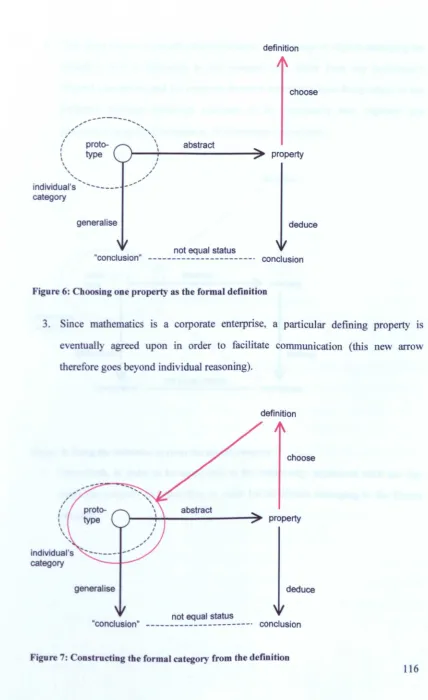
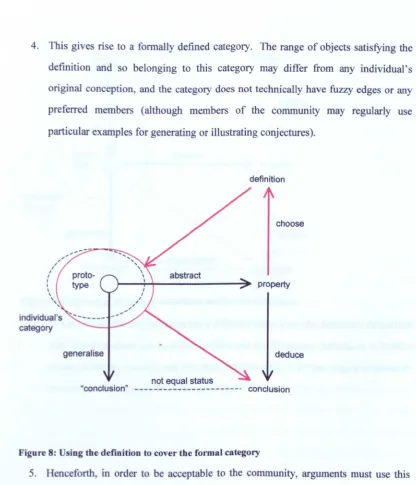
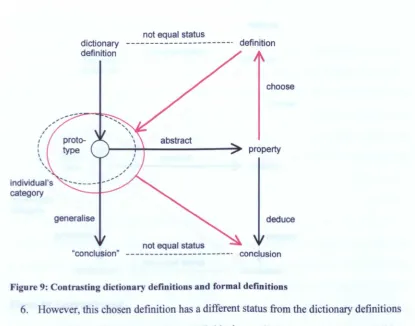
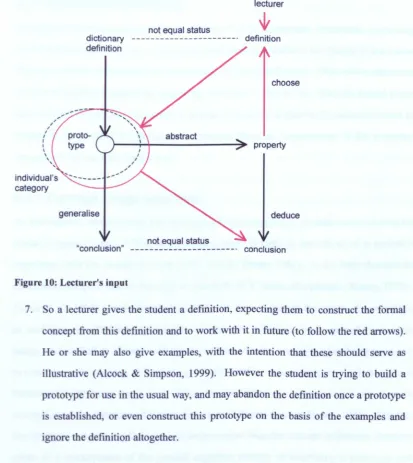
Figure 6: Choosing one property as the formal definition 116 Figure 7:Constructing the formal category from the definition 116 Figure 8: Using the definition to cover the formal category 117 Figure 9: Contrasting dictionary definitions and formal definitions 118 Figure 10: Lecturer's input... 119 Figure 11:Generalisation (self-evidence or an affirmatory intuition) 132
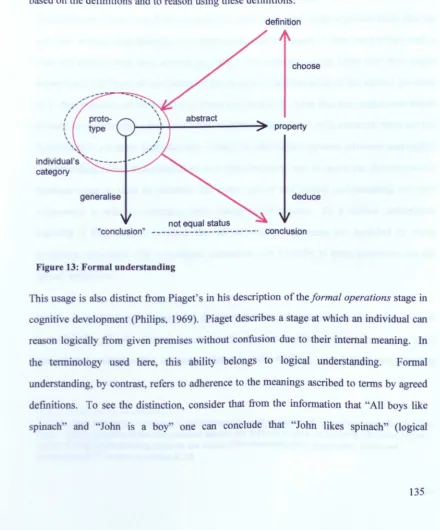
Figure 12:Abstraction and deduction (insightful or reflective understanding) 132 Figure 13:Formal understanding 135 Figure 14: Cary's drawing of convergent sequences 147
Figure 15: Tom's diagram of a limit and bounds 159
Figure 16:Emma's and Fred's pictures for the sequence question 167 Figure 17: Greg's and Hugh's work on the sequence question 170 Figure 18:Relationships between causal and interveningfactors and learning outcomes 181 Figure 19: Cary's partial definition. 211
Figure 20: Cary's diagram to show that a convergent sequence must be bounded 212
Figure 21: Vic's sketch of a convergent sequence 216
Figure 22: Diagram illustrating the theoretical framework. 254
Figure 23:Adam's examination solution 270 Figure 24: Kate's examination solution 270 Figure 25: Xavier's examination solution 271
Figure 26: Zoe's examination solution 271
Figure 27: New course diagnostic test scores 292
Figure 28: Lecture course diagnostic test scores 292
Figure 29: Physics students diagnostic test scores 293
Figure 30: New course January examination scores 293 Figure 31: Lecture course January examination scores 294
Figure 32: Physics students January examination scores 294 Figure 33: Hazel Howat's coding of a transcript excerpt 308 Figure 34: Comparing the coding of three researchers 309
Figure 35: Open coding notes 310
Figure 36:Notes on emergent concepts · 311
Figure 37: Organising emergent concepts ··· 312
Table 1:Material covered in Analysis 1.. 25 Table 2:Logistics of the two courses · · 27 Table 3: Week 7interview questions 73 Table 4. Summary of chapter 9 ·.·.··· 228
Table 5: Week2interview questions 298
Table 6: Week 3interview questions 299
Table 7:Week5interview questions 300 Table 8: Week 9interview questions 301 Table 9:Illustration of coding (manual) 305 Table 10: January and June examination scores 326
Acknowledgements
Thanks to: Adrian Simpson, an excellent supervisor despite (or perhaps because of) his habit
of turning out to be right six weeks after I have originally told him he is wrong; the staff at
the University of Warwick Mathematics Institute for their help and cooperation during this
research; my parents, Eric and Angela Alcock for their support throughout my education,
financial and otherwise; my brother, Keith, and all my friends for support and entertainment;
the SUMINER group at Warwick for always being stimulating and fun.
In addition, the thesis is dedicated to Hazel Howat, whinging partner, and Jane Coleman, for
taking me into her home in the last year of this research; both lovely friends.
Declaration
J,the author, declare that the work herein is my own and has not been submitted for a degree
at any other institution. None of the work has previously been published in this form.
Aspects of the theory presented in part 2 have been published in the following papers:
Alcock, L.J. & Simpson, A.P., (1998), "Definitions in university students' perceptions of
structure", Proceedings of the International Conference on the Teaching of
Mathematics, Samos, Greece, 19-21.
Alcock, L.J. & Simpson, AP., (1999), "The rigour prefix", in O. Zaslavsky (Ed.),
Proceedings of the 23rd International Conference on the Psychology of Mathematics
Education, 2. Haifa. Israel. 17-24.
Alcock, L.J. & Simpson, A.P., (2001a), "Cognitive loops and failure in university
mathematics", Proceedings of the 251h International Conference on the Psychology of
Mathematics Education 2, Utrecht, The Netherlands, 41-48.
Alcock, L.J. & Simpson, A.P .• (2001b). "The Warwick Analysis project: practice and
theory". in D. Holton. (Ed.), The teaching and learning of mathematics at university
Abstract
This thesis has two integrated components, one theoretical and one investigative.
The theoretical component considers human reason about categories of objects. First, it
proposes that the standards of argumentation in everyday life are variable, with emphasis on
direct generalisation, whereas standards in mathematics are more fixed and require
abstraction of properties. Second, it accounts for the difficulty of the transition to university
mathematics by considering the impact of choosing formal definitions upon the nature of
categories and argumentation. Through this it unifies established theories and observations
regarding student behaviours at this level. Finally, it addresses the question of why Analysis
seems particularly difficult, by considering the relative accessibility of its visual
representations and its formal definitions.
The investigative component is centred on a qualitative study, the main element of which is
a series of interviews with students attending two different first courses in Real Analysis.
One of these courses is a standard lecture course, the other involves a classroom-based,
problem-solving approach. Grounded theory data analysis methods are used to interpret the
data, identifying behaviours exhibited when students reason about specific objects and
whole categories. These behaviours are linked to types of understanding as distinguished in
the mathematics education literature. The student's visual or nonvisual reasoning style and
their sense of authority, whether "internal" or "external" are identified as causal factors in
the types of understanding a student develops. The course attended appears as an
intervening factor. A substantive theory is developed to explain the contributions of these
factors. This leads to improvement of the theory developed in the theoretical component.
Finally, the study is reviewed and the implications of its findings for the teaching and
Chapter 1
Overview
1.1 Introduction
This study is about the transition from school to university mathematics, which is known to
be difficult even for those who have had considerable success in school. Specifically, it is
about the learning of Analysis, which is recognised as one of the most difficult subjects
encountered at the beginning of a mathematics degree. The study came about due to the
instigation of an innovative pedagogical approach. Beginning in 1997, the University of
Warwick's Mathematics Institute chose to teach Analysis not by the standard lecture method
but by placing students in a classroom environment in which they worked through a
structured sequence of problems and thereby proved most of the results of the course
themselves. At a time when there is concern about the preparedness of undergraduates
enrolling for university mathematics, this qualitative change represents an interesting
alternative to cutting syllabi or other quantitative changes.
From the perspective of research into the learning of mathematics, the situation is
particularly interesting since a parallel lecture course in the same institution covered the
same material at the same time. This study assesses the effects of these two different
pedagogical strategies on the students' understanding of the material. Through a detailed,
qualitative approach it builds on previously identified misconceptions and difficulties
students have with the material of Analysis, investigates cognitive difficulties involved in
the transition to university mathematics, and ascertains factors which lead to some students,
A personal aim throughout is as follows. I have seen an enormous amount of frustration
while engaged in this research. Students are frustrated by their lecturers' apparent
unwillingness or inability to talk to them on their level. Lecturers are frustrated that despite
their best efforts at clear and fluent exposition, the students don't understand very much and
the educators tell them they're getting it wrong. I hope that the work in this thesis may
improve these groups' understanding of each other and thereby contribute to a reduction in
frustration all round.
1.2 Structure: one study, two parts
For the purposes of reporting, this study is divided into two parallel reports. The first,
appearing in part 2, posits a theoretical framework describing ways in which human beings
reason about categories of objects. Itthen applies this to clarify the particular thinking
required in advanced mathematics, thus characterising reasons for the difficulty of making
the transition. The second, appearing in part 3, investigates factors influencing students'
progress in coping with this transition. Part 1 introduces both reports by describing the
research setting and method, and part 4 reviews and evaluates both and indicates future
directions for the research. All four parts are outlined more fully below; the subsequent
diagram (Figure 1) indicates how they are interrelated.
1.2.1
Part 1
Part 1 consists of this introduction, which goes on to describe the use of existing literature
throughout this thesis, and three more chapters. Chapter 2 describes the setting in which the
innovative course took place and gives detail of the logistics of both this and the lecture
course. In particular it assesses the responsibilities accorded to the students on each as
learners of mathematics. Chapter 3 reviews literature pertaining to the content of both
courses, discussing proofs and proving, definitions, and student reasoning about particular
mathematical concepts including convergence and limits. It also reviews more general
describes the aims of the study and the investigation methods used, in addition to giving
more detail on the theoretical development through the pilot and main studies.
1.2.2
Part 2
Part 2 develops the theoretical framework and its applications to advanced mathematics.
Chapter 5 reviews cognitive psychology literature on human reasoning about categories of
objects. It introduces the idea of a prototype as a theoretical construct and develops a
description of ways in which individuals use prototypes in reasoning according to the
demands of the situation. In chapter 6 this is then compared with the required form of
reasoning in advanced mathematics. Assuming that students continue to reason as would be
appropriate in everyday life, this leads to a unified explanation for a number of known
student behaviours such as those previously discussed in chapter 3.
1.2.3
Part 3
Part 3 develops the investigation, which studies how and why different types of student
make the progress they do toward the new type of reasoning required in advanced
mathematics. Chapter 7 reviews literature on typologies of understanding, relating these to
the theoretical framework and choosing a particular typology on this basis in order to
classify behaviours seen in interview protocols. Chapter 8 introduces the factors found to be
correlated with the type of understanding a student develops, via a reprise of related
literature and illustrations of these emergent distinctions. Chapter 9 examines these
correlations in each combination of these factors and the students' course arising in the
study, suggesting theoretical explanations for the type of understanding developed in each
case. Chapter 10 then gives a different perspective, isolating each factor in tum to examine
its influence and highlight the consistency in these theoretical explanations. As a
consequence of this data analysis, it becomes apparent that the theoretical framework is
inadequate in explaining the behaviour of a subset of the students, and chapter 11 clarifies
the form of this inadequacy and remedies it by returning to the mathematics education
1.2.4 Part 4
Part 4 returns to looking at the study as a whole. Chapter 12 reviews the study, considering
the issues of validity and generalisability and highlighting new questions that arise from the
research. Chapter 13 considers the implications of the findings for the teaching and learning
of Analysis, and of university mathematics in general.
1.2.5
Diagram
..!<:
...
0 ~
Q)
~ e
tt= .g
-«
~ M...
-
..s
---T---C til U
.~
8 Q) ..c:: ~ 8 til c..-eQ) ~ :E
1.0 o ~ til s:: s:: til 0
:> U
.~
"
0-«
Q)-
...
1.0 ~ 0 ~ Q) ~5
tt= ~ ... u f-o .~<
0 ~ 0 ... til Q) f-o...
E5
r/) 00 00 t)
~ s::
~
trl
>
~:.a
~~ 0til
a
~Q) .... til
N M o.tIl>. ...
a
~ ~ f-o-8
r--:
s:: u00'"
-et:: -et:: ::l
'<ii
Q.. Q.. III
.c
-><
.cIII1.3 Theory and literature
Owing to the wealth of literature pertaining to the learning of mathematics at university
level in general and the material of Analysis in particular, it was decided that this study
could best contribute not by investigating one particular domain but by seeking to determine
how different factors interact in these students' developing understanding of Analysis. In
addition, the theoretical framework is applied in an attempt to unify much of this work. The
result is that significant bodies of literature from a number of areas are used, and to avoid
confusion, these are introduced when they are most pertinent. The placement of different
bodies of work and their use is described and summarised below.
1.3.1 Part 1
Chapter 2, on the logistics of the courses, briefly covers literature on pedagogical
approaches and nonstandard teaching styles, to clarify the particular characteristics of the
courses studied. Chapter 3, the most "standard" review, covers literature directly relevant to
the content of the courses and likely student interpretations of this. That is to say, it covers
proofs and proving (including a section on visual justifications), definitions, convergence
and limits, and student beliefs about their role as learners of mathematics. It also contains a
first review of literature on understanding in mathematics, which informs the methodology
in chapter 4. Chapter 4 then discusses opinion on the merits and detractions of qualitative
methods and interviewing.
1.3.2 Part 2
Chapter 5, developing the theoretical framework, uses cognitive psychology literature on
categorisation and reasoning. In chapter 6 this is applied to advanced mathematics by
drawing on the literature on the place of definitions and proofs within mathematical
theories. Chapter 6 also returns to the work covered in chapter 3 to explain how it can be
1.3.3
Part 3
Chapter 7, on the understanding manifested by the students, returns to the literature on
understanding, giving a detailed account of suggested typologies and relating these to the
theoretical framework. Chapter 8, on the causal factors in students' acquisition of
understanding, reviews literature on classification of visual and nonvisual reasoning
approaches and reprises the work on student beliefs about mathematics and their own role as
learners. Chapter 11 covers in more detail the literature on process-object theories and
pseudo-empirical abstraction, using this to further fill out the theoretical framework.
1.3.4
Part 4
Chapter 13 does not introduce substantial new literature, but makes reference to other
theoretical constructs that might be incorporated into future extensions of this research.
1.3.5
Summary
• Chapter 2: pedagogical approaches
• Chapter 3: proof, definitions, limits, beliefs, understanding
• Chapter 4: qualitative methods
• Chapter 5: categorisation, reasoning
• Chapter 6: advanced mathematics
• Chapter 7: typologies of understanding
• Chapter 8: visualisation, reprise of beliefs
Chapter 2
The courses
2. 1
Introduction
This chapter describes the research setting. The first section focuses on the students'
experience as first year mathematics undergraduates. The second describes the
circumstances surrounding the inception of the new course, both nationally, in light of
concern about student competence, and locally, examining the particular circumstances
which prompted the change and made it viable. The third section gives logistical detail of
the new course and the parallel lecture course, examining the demands made of the students
in each. The fourth compares this pedagogical strategy with other non-lecture-based
approaches.
2.2 Mathematics at Warwick
2.2.1 Being an undergraduate
The Mathematics Institute at Warwick is large by UK standards, currently employing 40
full-time faculty, providing for approximately 100 graduate students and admitting around
200 undergraduates per year on to its single honours mathematics degree. These students
are selected solely according to their A-level grades; there is no formal interviewing
process. In 1998, when the main study for this thesis was carried out, the requirement was a
grade A in mathematics, A and B in two other subjects and a grade 2 in a Special or STEP
paper in mathematics. The institute also provides teaching for approximately 150 students
enrolled on degrees titled Physics with Mathematics, Mathematics and Statistics and
for these students are generally slightly lower but still demanding at A in mathematics, and
B in two other SUbjects.
Students taking these degrees join a total of approximately 8500 full time undergraduates at
Warwick. As first years, virtually all will live in campus accommodation, sharing a kitchen
with a "corridor" of around fifteen peers who are likely to form their social group for at least
the first term. Campus life has advantages and disadvantages from the perspective of
teachers wishing their students to study hard. All essential services are easily accessible,
cutting down on the time needed for everyday chores, and travel time to lectures is minimal.
In addition most live near other students on mathematics-related degrees so can collaborate
on homework assignments if they so choose. However "collaborate" can mean different
things according to the student's goals, so this can be a disadvantage to individual thinking.
A student's work might also be disrupted by the large number of active societies and
students' union events on campus.
2.2.2
Degree structure
Students on all of the aforementioned degrees attend a number of common core modules in
their first year, although due to the large numbers involved these are usually taught in
separate lectures/classes for the mathematicians and combined degree students. All attend
modules in Analysis (the courses under investigation here both cover the material of
"Analysis I"; "Analysis II" follows in the second term). They also take modules in Linear
Algebra, "Foundations" (a basic course on sets, functions and groups), differential equations
and geometry. All students are required to take a certain percentage of courses in their
home departments; this includes further core modules for those studying for combined
degrees. Information is provided on which modules form a good basis for work in future
years, but there is considerable flexibility in the system and some take more unusual options
in business, computing or languages. Students usually attend lectures for more modules
Assessment for first year mathematics modules typically comprises some credit for
concurrent weekly assignments (around 15% of the total) with the remainder resting on an
examination in the Summer term. Analysis I and Foundations are the exception; they are
examined together in one 3-hour examination at the beginning of the Spring term.
2.2.3
Teaching
Contact hours for most modules are limited to three f-hour lectures per week. Typically of large pure mathematics courses in the UK, it is not usual for there to be much student
participation in these lectures. In addition to this time, the students have an academic tutor
in their home department who they see for up to an hour per week. The form these tutorials
take is at the discretion of the tutor, who may help the students with their coursework,
introduce them to other mathematics or attend to administrative matters. In a system which
is generally agreed to be one of the teaching strengths of the department, each student is also
assigned to a group of four which meets with a graduate student "supervisor" for one or two
hours per week (one in the case of joint degree students, two for single honours
mathematicians). These supervisions cover the work for core mathematics courses and
some of the options, and the supervisor marks the students' assignments for the core
courses. It is not an infallible system and occasionally students do not feel that supervisions
provide good quality teaching, but it means that students have a specified time when they
can receive help with their mathematics in a small group and with a young teacher.
2.3 Background to the innovation
2.3.1
National: university mathematics in the UK
For a number of years, there has been concern in the UK about the mathematical
competence of students entering university mathematics. In the mid-90s an LMS report
gave the following summary of the ways in which those in higher education found their
I. A serious lack of technical facility - the ability to undertake numerical and algebraic
calculation with fluency and accuracy;
2. A marked decline in analytical powers when faced with simple problems requiring
more than one step;
3. A changed perception of what mathematics is - in particular the essential place
within it of precision and proof.
(London Mathematical Society, 1995)
These weaknesses are attributed largely to a shift in school curricula during the 1990s
(LMS, ibid.). In particular, A-level syllabi changed during this time. Typically this means
that techniques of differentiation and integration are retained in the core but have reduced
importance, complex numbers and vectors are no longer in the core and modules on problem
solving and data handling have been introduced or expanded (SMP, 1990; SEAC, 1993).
Hoyles notes that within the new curricula, proof is often limited to investigation-based
sections. She suggests that this detaches it from the material of mathematics as a whole and
means that it may be learned as part of a social ritual in which particular forms of
presentation are required (Hayles, 1997). Simpson acknowledges the view of some
educators that the newer syllabi may help more students to devleop skills of critical analysis
and explanation which will be useful to them in their different futures (Simpson, 1995). He
suggests that problems now arise for students entering university mathematics because they
face a "broken route" to proof. Whereas an earlier emphasis on sums and techniques led
through proof techniques and on to the predicative and propositional calculus at university,
he suggests that students may now be more prepared for "proof through reasoning", where
formalising appears as a final step after exploring, discovering patterns, explaining and
justifying. He suggests that the emphasis on beginning with formalism at university does
not form a natural continuation of this approach (Simpson, ibid.), as it would have done of
Whatever the benefits and detractions of either approach, universities have felt that there is a
serious problem. In response, some have moved formal Analysis to later in the degree, or
even abandoned it altogether. Warwick's response has been to retain it as a first year, first
term course, but to spread the material out so that it is covered over three terms in two
academic years rather than two terms in one year. As part of a general strategy across all
subjects in the first year it has also expanded the requirement of coursework for credit. This
has been a successful change, dramatically cutting the number of students required to take
resit examinations. However, Analysis is still perceived to be a particularly difficult topic
which students often do not understand well, and specific changes were made to this course
as are outlined below.
2.3.2
Local: history of the new course
With the national situation in the background, the changes to Warwick's Analysis course
came about as a result of a personal initiative by Professor David Epstein, a member of the
department for over thirty years. Professor Epstein had begun to be disheartened with the
lecture method, both because of the recognised passivity of students in lectures and because
repeated attempts to improve his explanations did not lead to improved student performance
in examinations. He first began using novel teaching practices in a second year course in
Metric Spaces in 1989, after being inspired by work by the Geometry Center in
Minneapolis: Bill Thurston, John Conway, Peter Doyle and Jane Gilman were running a
course for talented high school students, who were introduced to abstract mathematical
concepts through group work on practical tasks (Epstein, 1998, personal communication).
Various strategies tried by Professor Epstein met with limited success, but he was keen to
instigate an experiment using a completely different pedagogical style for Analysis for
various reasons.
First, Analysis is recognised to be a difficult subject. Second, the climate was right: an
increased emphasis on improving teaching was taking hold in the department. Third, and
closely on R.P. Bum's "Numbers and Functions - Steps into Analysis" (Bum, 1992), a text
previously used successfully by another department member, Mr. David Fowler, in his
tutorials with first year students. The book consists mainly of questions, with compressed
solution "hints" and a very short summary of the main ideas at the end of each chapter. The
questions develop rationales for the main definitions, lead students to construct proofs of the
theorems and require them to use those theorems in subsequent arguments. The following
question, leading to the formulation of the ratio test for sequences, is typical of the style:
(a) Use a calculator or computer to evaluate terms of the sequence
(n
2/2" ). Calculatethe values forn=l, 2,5, 10,20,50. Would you conjecture that the sequence is null?
(b) Verify that the ratio an+l/an =t(l+l/nY.
(c) Find an integer Nsuch that, if n ~N, then the ratio a,,+I/an <
t·
(d) By considering that aN+1<taN and aN+2<
taN+I'
etc. prove that aN+n<(tt
aN' (e) Why is((t)"
aN) a null sequence?(t) Use the sandwich theorem, qn 28, to show that
(n
2/2")
is a null sequence.(g) What numbers might have been used in place of
t
in part (c) (perhaps with adifferent N)which would still have led to a proof that the sequence was null?
(Bum, 1992, p.49)
The new course was trialled with 26 students in the Autumn term of 1996 (this study and the
researcher's involvement commenced one year later). All of the students joining the
mathematics degree in that year were invited to take the course, and the eventual
participants were randomly selected from the 52 who volunteered. Help was enlisted from
Warwick's Mathematics Education Research Centre: Adrian Simpson and Professor David
Tall advised on the format of the classes, and attended as helpers and interested observers.
The 26 students attended two 2-hour sessions per week during the 10-week term, working
through the material in the relevant chapters ofNumbers and Functions. The remainder of
their peers attended lectures as usual. All were required to submit solutions to the same
covering the material of Analysis I and its second term counterpart Analysis II, which was
taught in lectures as usual.
Data from the assignments and examinations were treated with caution and not assumed to
be conclusive about the merits of the course. The volunteer effect was taken into
consideration those volunteering to attend may be at least more confident and motivated
-and some of those on the experimental course were known to have attended the st-andard
lectures. In the final examination those from the new course had a mean score
approximately 10% higher than that for the whole year, but only 4% different from that of
those who had originally volunteered for the course. However the benefits were deemed
sufficient for a proposal to be put forward to run the course for the entire cohort of single
honours students in the following year.
2.4 The two courses
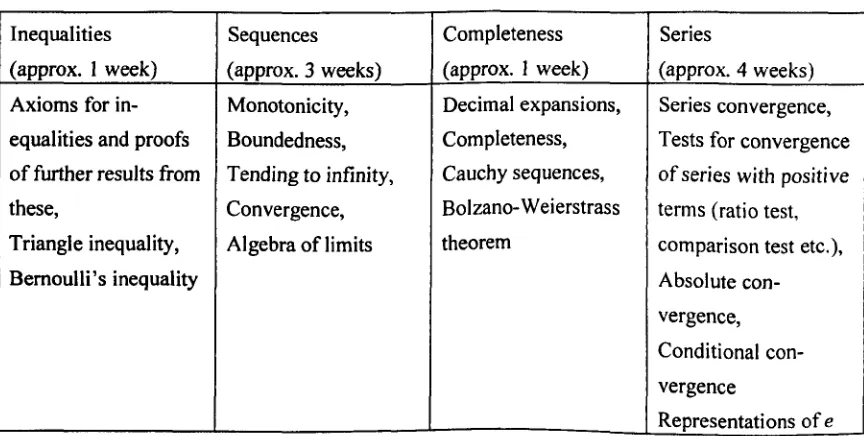
2.4.1 Material
[image:26.527.68.500.471.689.2]The material covered was the same for both courses, and is summarised in the table below.
Table 1: Material covered in Analysis I
Inequalities Sequences Completeness Series
(approx. 1 week) (approx.3 weeks) (approx. 1 week) (approx. 4 weeks)
Axioms for in- Monotonicity , Decimal expansions, Series convergence,
equalities and proofs Boundedness, Completeness, Tests for convergence
of further results from Tending to infinity, Cauchy sequences, of series with positive
these, Convergence, Bolzano- Weierstrass terms (ratio test,
Triangle inequality, Algebra of limits theorem comparison test etc.),
Bernoulli's inequality Absolute
con-vergence,
Conditional
con-vergence
Summarising the philosophy, the syllabus for Analysis as a whole states:
At the beginning of the nineteenth century the familiar tools of calculus, differentiation and integration began to run into problems. Mathematicians were unsure of how to apply these tools to sums of infinitely many functions. The origins of Analysis lie in their attempt to formalise the ideas of calculus purely in the language of arithmetic and to resolve these problems. You will study the ideas of the mathematicians Cauchy, Dirichlet, Weierstrass, Bolzano, D' Alembert, Riemann and others, concerning sequences and series in term one, continuity and differentiability in term two and integration in term one of your second year. By the end of the year you will be able to answer many interesting questions: what do we mean by 'infinity'? How can you accurately compute the value of ,. or eor
..fi?
How can you add up infinitely many numbers, or infinitely many functions? Can all functions be approximated by polynomials? There will be considerable emphasis throughout the module on the need to argue with much greater precision and care than you had to at school. With the support of your fellow students, lecturers and other helpers, you will be encouraged to move on from the situation where the teacher shows you how to solve each kind of problem, to the point where you can develop your own methods for solving problems. You will also be expected to question the concepts underlying your solutions, and understand why a particular method is meaningful and another not so. In other words, your mathematical focus should shift from problem solving methods to concepts and clarity of thought.2.4.2 Logistics
Data collection for the pilot study of this thesis took place in the Autumn of 1997. This was
the first year in which all of the single honours mathematics students attended the new
classes, and the credit structure for the course was rather complicated. The students both
kept portfolios of their answers to questions they were instructed to attempt from the book,
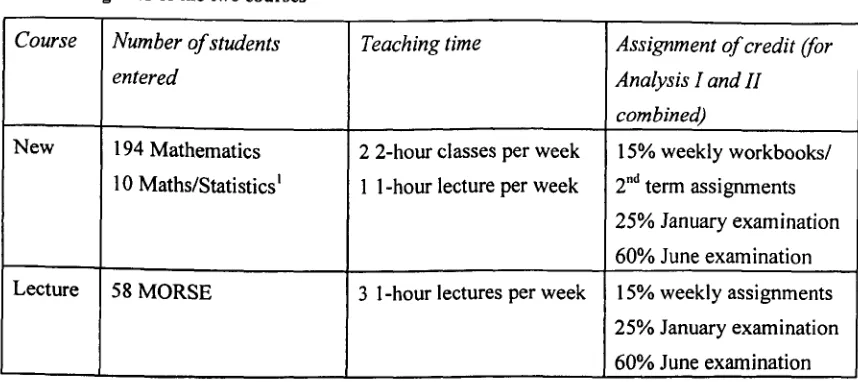
and handed in separate assignments for which the questions were often very similar. The
both courses in the Autumn of 1998 (numbers of students are those who took the
[image:28.527.67.496.162.353.2]end-of-year examination in June):
Table 2: Logistics of the two courses
Course Number of students Teaching time Assignment of credit (for
entered Analysis I and II
combined)
New 194 Mathematics 2 2-hour classes per week 15% weekly workbooks/
IO Maths/Statistics I I I-hour lecture per week 2nd term assignments
25% January examination
60% June examination
Lecture 58 MORSE 3 I-hour lectures per week 15% weekly assignments
25% January examination
60% June examination
Those on the lecture course all attended the standard 30 lectures and submitted assignments
for marking each week as usual. At times the students received handouts covering some of
the material, which the lecturer would go through in class while the students made extra
notes, but in the majority of lecture time the students copied the notes the lecturer wrote on
the board. In keeping with standard practice in the department, attendance at lectures was
not recorded.
Those on the new course attended classes with between 30 and 35 students, and their lecture
served to round up the material covered in the classes and look ahead to future work, rather
than to present new material. In the classes they worked in groups of between 3 and 5 to
answer the questions in their booklets, under the supervision of a teacher (a member of staff
or a graduate student with teaching experience) and one or two "peer tutors". Peer tutors
were second year students who had taken the course the previous year and performed well in
IA total of 33 students studying mathematics and physics also took one or other Analysis course (all
examinations. Prior to the course, both the teachers and peer tutors received an intensive
day's training on teaching in this type of environment. They primarily spent time offering
assistance to groups and to individual students, "teaching" the whole class only when they
felt that the majority were experiencing the same difficulties.
The classes varied in their exact format but for most students the majority of the time was
spent working through their booklets with their classmates. Observations of a number of
classes and conversations with class teachers indicated that students' organisation of their
work varied: some worked together on all problems, others worked individually and used
each other as a resource when they became stuck. A small number of students chose to
work alone; they were encouraged to collaborate with their classmates but were not pushed
into this if it was not their preference. In addition to work on booklet questions, a small
amount of class time each week (perhaps half an hour in one of the classes) was used for
other activities, including student presentations at the board. These were usually
demonstrations of answers to booklet questions, which would be critiqued by the remainder
of the class and commented upon by the teacher. An informal register was taken in the
classes, and this information indicates that the vast majority of students reliably attended.
2.4.3
Students' responsibilities
The underlying didactic contract (Brousseau, 1997) in each course was therefore quite
different. In the lecture course, the student's role was to attend carefully to the lecturer's
presentation and take good notes. An ideal student would write down both the notes the
lecturer makes and their additional helpful comments, read over their notes after the lecture
and seek help with any parts they did not understand. The degree to which the students
adhere to this model was not monitored: there was no requirement to attend the lectures and,
The assignments for these students do not involve proving any of the major results of the
course; this is done by the lecturer. They do involve using these results, sometimes in a
relatively straightforward way, as in these questions about series convergence:
Use the Alternating Series Test to show that the following series are convergent:
(Lecture course, week 8 assignment, question BS)
In other cases, questions require more creativity in the use of known results to derive others,
as in this case:
(-ly+1
Let s
=
1+1.+L+ ...+1. and let t=
1- 1.+1. - ... +-'---'---II 23 n II 23 n
Deduce from [theorem in notes] that t211~ log2 as n ~ 00.
Deduce further that t211+1~ log2 as n ~ 00 •
QC)
{_I)"+1
Hence prove that
I
=
log2. (Hint: use [question from previous sheet]).11=1 n
Each type of question is likely to be more difficult than those which students were exposed
to in school. In this course the student is provided with statements of theorems, but not with
"worked examples" to follow, even in cases like the first. They themselves are responsible
In the new course, class time is spent not listening to a lecturer and taking notes, but
working through booklets and answering questions. The role of the teacher is therefore
quite different. They may occasionally take it upon themselves to go over their version of
an answer, but primarily their role is shifted from "sage on the stage" to "guide on the side"
tcf Davis &Maher, 1997). Hence the students are responsible for proving most of both the
major and minor results of the course. In particular, in addition to "applications" questions
like those received by the lecture class, these students also have many more questions of the
type seen above from Bum's book. This further example, from the week 8 workbook,
requires students to use the definitions of convergence and absolute convergence in order to
establish a general result, rather than to use that result to draw conclusions about specific
series.
A series La" for which
Lla,,1
is convergent is said to be absolutely convergent.The argument used in qn 62 can be generalised to establish that a series which is
absolutely convergent is necessarily convergent. The clue, as we have seen, is to
construct the series formed by the positive terms and the series formed by the
negative terms.
If we define U"
=
t
~a"I
+a,,), what values may u" take?Ifwe define v"
=
t~a"l-
a,,),
what values may v" take?Now use the convergence of
Lla,,1
to prove thatLU"
andLV"
are convergent and hence that~)u"-
v,,)
is convergent. What is U" - v" equal to?To answer these questions the student must become more involved in proving results from
definitions and building up a network of results.
In neither course are the students explicitly required to either memorize the material as they
go along or to attempt to synthesize it. There are no formal closed-book tests during the
course and both groups have either their notes or their previous workbooks available when
at the beginning of the next workbook so the students have access to these despite having
submitted their previous workbook for marking. Further, in both cases, requirements apply
to the student body as a whole. In either course an individual may work essentially alone, or
may submit answers that were produced either cooperatively with others or completely by
others. Also, once work is submitted, both groups may rely on their supervisors to check
their answers and provide final arbitration, although for those on the new course official
marking covers only a subset of their answers and if they require help with reviewing others
they must specifically request it.
2.4.4 Related research
In practical terms, the new course is quite different from a standard lecture course, although
the degree to which this impacts upon any individual student depends upon that person's
decisions in pursuing their own work. This section compares the new course with other
reported pedagogical approaches.
First, note that the focus of the course remains the material of Analysis. Itdoes not, for
example, involve open-ended investigations like the course described by Hirst or
recommended by Bell (Hirst, 1981, Bell, 1976). While the students are required to
formulate answers to questions rather than absorb presented material, they have no say in
the form or detail of these questions and they are not required to pursue any of the work in
directions of their own choosing. Neither are they required to submit evidence of reflection
on the process of developing this type of mathematics, unlike those students enrolled in
Hirst's investigative course or Chazan's geometry course in which inductive and deductive
proofs were specifically contrasted (Hirst, ibid., Chazan, 1993).
Similarly, the course is not about problem solving per se like those discussed by Schoenfeld,
Mason, Burton and Stacey, or Mohammad Yusof and Tall, in which P6lya's heuristics are
adapted and taught (Schoenfeld, 1992 & 1998, Mason, Burton & Stacey, 1982, Mason,
new course will develop strategies which enable them to work more efficiently and solve
different types of problem, such heuristics are not specifically taught and the questions in
the course are short and closed in relation to the type used in such courses.
The new course does have elements in common with "bridging courses", such as those
described by Moore and recommended by Chazan (Moore, 1994, Chazan, 1993). It
provides students with increased direct experience of working with the concepts of the
course, in an environment in which discussion is encouraged. They thus have opportunities
to contribute to the construction of what Yackel and Cobb call sociomathematial norms
(Yackel &Cobb, 1996, Yackel, Rasmussen &King, 2000); they can try out their arguments
and justifications and attempt to refine these if they do not meet the standards imposed by
their peers and the teacher. Hence it may be hoped that they will more quickly become
enculturated into the mathematical community, learning its values by experience more
closely approximating apprenticeship than could be found in a lecture course (cl
Schoenfeld, 1992, Bishop, 1991). This hope is implicit in this extract from the "course
philosophy" as described in a handout given to students at the beginning of the new course:
"In first term Analysis we will teach you very little and help you to learn a lot.
Throughout the course there will be an emphasis on doing mathematics as opposed
to just hearing about it or copying down someone else's notes. You will learn most
of the material through thinking about and solving problems and sharing your
insights with others."
However, as stated above, the focus of discussion in the classes remains on the material of
Analysis rather than on proof itself.
The questions-based pedagogical approach is designed with something of the espoused
philosophies of Movshovitz-Hadar and Leron in mind: Leron argues that proofs given in
(Leron, 1985b). In this course the questions come first, which may contribute to
Movshovitz-Hadar's goal that on learning something new, it is desirable if students not only
are wiser but alsofeel wiser. That is to say, questions are raised in their minds and answers
sought (Movshovitz-Hadar, 1988). It would be misleading to say that the questions in this
course all arouse great curiosity or even necessarily a desire for proof, but they are raised
and the students do seek answers for themselves.
The students' role is discussed further in the next chapter, which continues to relate this
study to existing work by reviewing literature pertinent to the material of Analysis and to
students' own beliefs regarding this role.
2.5 Main points of chapter 2
• Mathematics and mathematics-related students at Warwick usually attend courses
involving three one-hour lectures per week, submit weekly assignments and receive
additional help from a tutor and supervisor.
• The new course began against a background of concern about the standards of
students entering university mathematics, and was made possible by support in the
department and the availability of an appropriate textbook.
• Students on the new course attended two two-hour classes per week, in which they
worked in small groups on a structured sequence of problems.
• Students on the new course had more responsibility than those on the lecture course
for proving, as well as using, the results of Analysis.
• While the new course has elements in common with investigative and
problem-solving-based courses reported in the literature, its focus is the material of Analysis
Chapter3
Literature
3. 1
Introduction
As described in the introduction, this chapter contains the first substantial review of relevant
literature. The ideas covered here provide a basis for the interview questions used in the
investigative study, as described in the next chapter on method. Some of these ideas, such
as the notion ofconcept image and student conceptions of proof, will be revisited in chapter
6. There they wiII be related to the theoretical framework developed through part 2. Others,
such as those referring to the student's interpretation of their role as a leamer, will later
inform the substantive theory developed in part 3. In this chapter, synthesis of the ideas
presented is limited to those which are obviously linked by subject matter.
3.2 Content
This section covers literature related to the material of Analysis. Itcovers proofs, proving
and definitions, then focuses more specifically on convergence and limits since these
concepts will have a central role in the rest of the thesis.
3.2.1 Proof
The centrality of proof in the university curriculum, and the abruptness of the transition to
this type of mathematics, has led to much mathematics education research in this area. This
research can be divided roughly into three areas, each addressing one of Bell's three stated
functions of proof: verification, illumination andsystematisation (Bell, 1976). This section
result for a given audience. Illumination corresponds to explaining in Hersh's assertion that
proving isconvincing and explaining (Hersh, 1993). The next section discusses verification,
that is, what brings conviction for an individual. Systematisation, referring to the role proof
plays in building mathematical theories, is discussed to some degree in the section on
definitions and is expanded upon further in chapter 6.
Various authors discuss the idea that a proof should be not only correct but also
illuminating. Some point out that the debates over the status of computer-assisted and
probabilistic proofs attest to the importance of this aspect for mathematicians: there is
dissatisfaction if a proof must be believed correct without it providing any further insight or
global view of the problem or theorem (Hanna, 1989, Hersh, 1993). Then, naturally, there is
particular concern that proofs should be illuminating to students, from both researchers and
students themselves (Chazan, 1993, Hoyles, 1997). Various types of proof have been
dissected, investigated for their particular inherent difficulty and reformulated in attempts to
make them more accessible.
Leron, for example, notes the cognitive strain associated with working in a "false world" in
a contradiction proof. He advocates alleviating this by performing the appropriate positive
construction first, then considering the negative assumption, at which point the impossibility
of this statement should be obvious (Leron, 1985a). Tall's suggestion that the use of generic
examples can be helpful is based on a similar constructive principle (Tall, 1995). Leron
further advocates the standardisation of good practices in exposition. He suggests that the
presentation proceed in a top-down fashion, first identifying the pivotal required
construction and then moving to more detailed levels in making this construction. This, he
suggests, places the emphasis on the structure of the proof, which is often difficult for
students to identify from a standard presentation (Leron, 1985b).
Tall goes further with the idea of adapting the type of proof to the level of the student,
involving some physical action, visual proofs involving imagined actions or re-focusing
attention, manipulative proofs using algebra andgeneric proofs using a specific statement as
typical of a class of statements. He argues that any of these might be appropriate at different
times for allowing insight into and understanding of a result, so that although they may not
conform to the standards of the mathematical community, they can be appropriate for
learners at different stages of development (Tall, 1995).
3.2.2
Proving
This section discusses Bell's verification, which corresponds to Hersh's convincing (Bell,
1976, Hersh, 1993). What brings conviction or a sense that a result has been verified varies
with the individual and the situation. Itis not fixed even in mathematics; as Thurston points
out, mathematicians do not produce proofs written in formal predicate calculus (Thurston,
1995). In reality, a sense of the authority of the author, the importance of the result and its
sitting well with other known results can influence the acceptance of a proof (Hanna, 1989,
Hanna &Jahnke, 1993).
Here we are interested in what brings conviction to a student and how this leads them to
behave in mathematical situations encountered at beginning undergraduate level, where the
standards are relatively fixed. Harel and Sowder have produced a typology of proof
schemes that a student may hold (Harel & Sowder, 1998). Since this typology is
comparatively exhaustive, this section follows its structure, relating the various schemes to
other research and exploring links between what students offer by way of proof and what
they judge tobe correct when a proof is provided. It also touches on student beliefs, such as the perceived role of authorities; such ideas are discussed in more detail in section 3.3.
The first broad classification Harel and Sowder make is that of external conviction proof
schemes, in which conviction for the student comes from some source other than the content
of the proof itself. In the first such scheme, conviction is derived from the ritual of
which proof appears only in a particular type of investigative work can lead to students
mimicking the standard format more or less meaninglessly when proof is required (Hayles,
1997). Similarly Segal has noted that both students and mathematicians are liable to accept
incorrect proofs which are written in an appropriate style, (Segal, 2000), and Leron gives
this excellent example of "writing nonsense in a mathematical style": asked to prove that the
sets Nand E(the natural and even numbers) are equivalent, a student wrote:
"Define a function f: N ~ E by f(n) EE for all n e N. Thenf is one-to-one since
f(rn);:: f(n) implies m=n. Also, f is onto, for given any eEE let n e N satisfy
f(n)
=
e ;then nis a source for e."(Leron, 1985b)
In the second external conviction scheme, doubts are removed by the word of an authority.
It is recognised that students in all disciplines must liberate themselves from the view that
"right answers" exist and should be provided by authorities (Perry, 1970 & 1988). This is
liable to occur at a delay in mathematics since a curriculum which deals in "truth rather than
reasons for truth" (Hare I & Sowder, 1998) allows students to maintain beliefs that
mathematics is about learning methods to quickly answer a given range of questions
(Skemp, 1976, Schoenfeld, 1992). For students with such beliefs, the external authority has
an essential place as the disseminator of these methods.
In the third external conviction scheme, conviction is derived from symbolic manipulation
according to standard algorithms. Facile symbol manipulation provides vast potential for
compression in mathematics and therefore for alleviation of cognitive load (Harel &Kaput,
1992). However, if the meanings of the symbols used are not sufficiently well understood
this can lead to errors. Harel and Sowder's cite an example of a student who, in working
. x2A2+x3A3+"'+xnAn
with the matrix equation XI AI + ... +xnAn ;::0, wntes XI;::
AI
Harel and Sowder's next set of proof schemes are characterised as empirical. In the first,
conviction is attained inductively; the student considers that evidence from a number of
examples constitutes proof. Fischbein uses the similar term empirical inductive conviction
to describe conviction resting on this type of evidence (Fischbein, 1982). Arguing by
reference to examples is a widely noted phenomenon throughout the literature on
student-produced proof; Balacheff suggests that the student often behaves as practical man rather
than mathematician, seeking only sufficient evidence for a conjecture to be largely true or
useful (Balacheff, 1986). Similarly Galbraith notes that younger children will judge a
conjecture to be "partly right" rather than rejecting it in the face of a counterexample
(Galbraith, 1981). Galbraith, Bell and Chazan all discuss inductive justifications produced
by students, with adequacy ranging from minimal consideration of limited cases to more
sophisticated strategies such as checking a result for every known subclass of the objects
under consideration (Galbraith, 1981, Bell, 1976, Chazan, 1993).
The relationship between empirical evidence and deductive proof also gives rise to
interesting phenomena. Several authors observe that in addition to offering inductive
evidence in place of proof, students are known to continue checking for confirmatory
evidence after a deductive proof has been presented (Chazan, 1993, Fischbein, 1982). This
may even be the case when the student herself is responsible for the original production of
the proof: Duffin and Simpson report on a case in which a girl produces an algebraic
argument but apparently continues to think of the variables used as representing the
particular numbers she started with, later checking for other cases (Duffin & Simpson,
1993). Development towards more sophisticated awareness of the relative status of
inductive and deductive arguments is evident in a study by Segal. She finds that through
their beginning years at university, students increasingly rated inductive arguments as
convincing but not as valid, showing some appreciation of the agreed standards of
Empirical proof schemes also encompass those characterised as perceptual, in which
conclusions are based on observation of static examples. Conviction derived in this way
would be termed intuitive intrinsic by Fischbein, resting as it does on affirmatory intuition
that a statement is self-evident (Fischbein, 1982). Various authors have made the case for
increased value to be accorded to visual argumentation in mathematics, as it already plays a
large role in the investigation of new problems (Dreyfus, 1991, Neubrand, 1989). Dreyfus
however notes that there are problems inherent in this type of reasoning, since standards for
this type of argument have not been so well developed within the community as they have
for algebraic proofs (Dreyfus, 1991). Tall is more specific, pointing out that even an
algebraic argument derived from a diagram may only be valid for the range of examples for
which that diagram is prototypical (Tall, 1995). Presmeg's extensive work on visualisation
in mathematics confirms this observation; she investigates the fact that while visual imagery
has mnemonic advantages and can be used to great effect, students making use of it are
liable to focus on irrelevant detail or show inflexible thinking related to a particular concrete
image (Presmeg, 1986a&b). These issues will be discussed in more detail in chapters 8, 9
and 10, which describe the emergence in this study of an inclination towards visual or
nonvisual reasoning as a causal factor in the development of a student's understanding of
Analysis.
Harel and Sowder term their most sophisticated proof schemes analytic. Proofs generated
within such schemes may rely on images, but in this case these are dynamic rather than
static, resembling Tall's visual proofs involving imagined actions or re-focusing of attention
(Tall, 1995). Presmeg too observes that students who make good use of imagery may use it
in this way (Presmeg, 1986b). Her work suggests that those who use imagery appropriately
will frequently translate back and forth between visual and nonvisual representations, thus
resembling Krutetskii's harmonic thinkers who are able to take advantage of both types of
representation (Presmeg, 1986b, Krutetskii, 1976). In chapter 9 it will be demonstrated that