University of Twente
Faculty of Electrical Engineering, Mathematics and Computer Science (EEMCS)
Master Thesis
Secure & privacy-preserving eID systems with
Attribute-based credentials
Brinda Badarinath Hampiholi s1480197
Graduation Committee: Dr. F.E Kargl (UT)
Abstract
National electronic identification (eID) systems aim to provide universal, unique and reliable identification and authentication mechanisms to the citizens. Many countries in Europe have already introduced or are about to introduce electronic ID cards to their citizens. The increasing number of eID infrastructures and ini-tiatives have been taken to scale the eID systems to support both eGovernment and eCommerce services and this has necessitated security and privacy to be of highest order in all the use-case scenarios. As the ID documents are the carriers of a citizen’s identity and personal data, the outgoing information from the cards must be restricted in order to prevent unwanted data disclosure, subsequent data misuse and loss of the citizen’s privacy. The German eID system (nPA) is by-far the most advanced and privacy-preserving eID solution that has been launched in Europe as it has taken extra measures to protect its citizen’s data and privacy; however some security and privacy threats persist in nPA.
In this thesis, we study the key concepts and security protocols used in nPA and identify its main threats. Furthermore, we explore Attribute-Based Creden-tials (ABC) by studying in detail about I Reveal My Attributes (IRMA), that is a recent technology built upon the principles on ABC. IRMA is a partial im-plementation of Idemix specification and it mainly focusses on enhancing security and privacy of identity management systems. IRMA makes use of zero-knowledge protocols to prove the validity of certain attributes of the eID cardholder while al-lowing the selective disclosure of attributes and supporting unlinkability features. We elaborate on the advantages of such ABCs that could be used to address the threats identified in nPA and propose a specific scheme that integrates IRMA au-thentication with nPA. Our proposal shows how to use IRMA in eID systems like nPA in order to overcome the its prevalent shortcomings. The IRMA authenti-cation provides better privacy, security and flexibility for the eID infrastructure. Finally, we discuss the performance of smart-card implementation of IRMA cre-dentials and present some use-cases that would benefit from the proposed eID scheme.
Acknowledgements
Being a masters student in the EIT ICT Labs Master School, I conclude my sec-ond year of Master of Science, Security & Privacy course at University of Twente (UT), The Netherlands, with this master thesis work. It was a great journey and learning experience at UT with excellent faculty members. I would like to sincerely thank all my Professors at UT for sharing their knowledge and sowing the seed of research in me during my study at UT. I would like to extend my sincere gratitude to all the people involved directly or indirectly in this project work. This master thesis is carried out at NXP Semiconductors, located at High Tech Campus, Eind-hoven, The Netherlands. It has been a very pleasant experience working at NXP as a master thesis intern with highly experienced and knowledgeable colleagues.
I would like to thank especially:
Dr. Frank Kargl, my direct supervisor at UT, for giving me valuable guidance during the thesis by means of timely instructions, helpful resources and feedback on my work.
Hans de Jong, my supervisor at NXP, for giving me an opportunity to do my master thesis at NXP and for your supervision, help and support right from the beginning of this thesis work. Thank you very much for providing feedback about my work but also giving me opportunity and freedom to think on my own and implement my ideas.
Cas Groot (NXP) for coordinating between UT and NXP, suggesting this project for my master thesis and for the support throughout my thesis work at NXP. Pim Vullers (NXP) for the time, patience and enthusiasm with which you discussed and shared your knowledge about IRMA. I thank you for guiding me at all points during my research work at NXP, reviewing my work from time to time and giving new ideas about possible applications and taking this work to next step.
Stefan Kuipers (NXP) for the important discussions about the eID systems and sharing your experience.
Prof. Bart Jacobs (RU Nijmegen) for his cooperation and providing me an oppor-tunity to be a part of regular IRMA meetings.
Gergely Alp´ar (RU Nijmegen) for your fruitful discussions regarding IRMA that gave me ideas for improvising my work.
Antonio De La Piedra (RU Nijmegen) for reviewing and providing valuable feed-back that helped me in improving my report.
Contents
Abstract 2
Acknowledgements 3
1 Introduction 8
1.0.1 Identification and authentication . . . 10
1.0.2 Main functions of an eID system . . . 12
1.0.3 Thesis objectives and structure . . . 13
1.1 Requirements for an enhanced eID system . . . 15
1.1.1 Security and privacy requirements for a national eID system 15 1.1.2 Usability requirements . . . 17
2 The German eID - nPA 19 2.1 Introduction to the nPA functionality . . . 19
2.2 The eID function in nPA . . . 23
2.3 Realization of electronic authentication function in nPA . . . 24
2.3.1 PKI Infrastructure used in nPA . . . 26
2.3.2 Passwords used in nPA . . . 27
2.3.3 Keys used in EAC protocols and cryptographic primitives used in nPA . . . 28
2.4 EAC Protocols used in the eID Online Authentication . . . 31
2.4.1 Password Authenticated Connection Establishment (PACE) 32 2.4.2 Terminal Authentication (TA) . . . 36
2.4.3 Passive Authentication (PA) . . . 38
2.4.4 Chip Authentication (CA) . . . 39
2.5 Restricted Identification - Pseudonym feature in nPA . . . 40
2.6 The eSign function in nPA . . . 43
2.7 Revocation method in nPA . . . 44
2.8 Limitations of German eID system . . . 48
2.8.2 Total dependency on the authenticity of chip and its opera-tions - Individual attributes on eID card remains unsigned . 50
2.8.3 Other Security and Privacy issues . . . 51
2.8.4 Usability and scalability issues . . . 52
3 Attribute-based credentials 53 3.1 I Reveal My Attributes (IRMA) . . . 55
3.1.1 Stakeholders in a IRMA-based identity management system 57 3.1.2 Attributes & Credentials . . . 58
3.2 Cryptographic background of IRMA . . . 60
3.2.1 Proof of Knowledge and Zero knowledge protocols . . . 60
3.2.2 Camenisch-Lysyanskaya scheme . . . 63
3.2.3 Blind signature scheme . . . 65
3.2.4 Signature randomization . . . 66
3.3 IRMA card and Credential Issuance . . . 66
3.4 Selective disclosure in IRMA . . . 68
3.5 Data minimization functions in IRMA . . . 70
3.6 Pseudonym generation in IRMA . . . 72
3.7 Revocation of credentials in IRMA . . . 73
4 IRMA-based eID authentication 75 4.1 IRMA eID system infrastructure . . . 79
4.2 Security analysis and advantages of the IRMA-based eID authenti-cation . . . 81
4.2.1 Advantages of IRMA-based eID authentication approach . . 82
4.2.2 Drawbacks of IRMA . . . 84
4.3 Performance considerations . . . 85
4.3.1 The German eID performance . . . 85
4.3.2 IRMA - Idemix performance . . . 85
4.4 Use cases for the proposed system . . . 87
4.4.1 Age proof scenarios - Offline or online . . . 87
4.4.2 Use cases based on eligibility criteria other than age . . . 88
4.4.3 Service Subscriptions . . . 88
4.4.4 Purchase of tickets for an event . . . 89
5 Conclusion & Recommendations 91 5.1 Conclusion . . . 91
5.2 Future recommendations . . . 93
List of Figures
2.1 German eID card (nPA) . . . 20
2.2 Online authentication procedure with nPA . . . 25
2.3 CVCA PKI for citizen applications of the eID card [1] . . . 27
2.4 Simplified flow diagram of EAC protocols in nPA . . . 33
2.5 PACE protocol as used in nPA . . . 36
2.6 Overview of the nPA revocation process for a lost or a stolen eID card . . . 47
3.1 Typical IRMA card . . . 56
3.2 A visual representation of an Idemix-IRMA credential . . . 59
3.3 Schnorr’s identification protocols . . . 62
3.4 Overview of the credential issuance protocol in IRMA . . . 68
4.1 Flow diagram depicting IRMA Terminal Authentication, Chip Au-thentication and Selective attribute disclosure . . . 76
4.2 Schematic diagram of the proposed IRMA-based eID authentication infrastructure . . . 80
List of Tables
2.1 Overview of electronic functions of nPA . . . 21
2.2 Overview of key pairs used in EAC protocols in nPA [2] . . . 30
3.1 Age credentials in IRMA . . . 71
Chapter 1
Introduction
In today’s world, the use of the Internet has become more widespread than imag-ined before as people use computers and the Internet not just for gathering infor-mation or fun but also for carrying out important daily activities such as banking, shopping, social interaction and many others. The systems and the infrastructure for such activities in the physical world are also making a transition to the digital world in different forms. Just like the paper mail was overtaken by the email, paper tickets for public transport are gradually being replaced by electronic card and the paper identity documents such as passports have been equipped with dig-ital chips to hold the digdig-ital copies of the identity data of the individuals. The electronic identification systems aim to provide universal, unique and reliable iden-tification and authentication mechanisms to the citizens. Many governments have already introduced or are about to introduce electronic ID cards to its citizens. The increasing number of eID infrastructures and initiatives taken to scale the eID support to the eGovernment and eCommerce services have necessitated the security and privacy to be of highest order in all the use-case scenarios.
to that, prevalent data handling and security mechanisms and data protection leg-islation can be questionable when it comes to sensitive data. Furthermore, most of the existing digital systems use unique identifiers in order to identify the indi-viduals using the system; this may be helpful for accountability purposes but it compromises the individual’s privacy to a great extent. It becomes very easy to trace the user and gain information about the transactions carried out by her. For some transactions, identification is not even necessary; for instance, when one has to prove she is above 18 years of age to buy liquor at a store or when one has to prove she has a valid ticket before boarding a train, it does not matter who she is but what matters is if she fulfils a particular condition. So there is no need for the system to know the identity of that person. A more privacy friendly approach would have been to check for only such ’attributes’ or characteristics belonging to a person which is required to complete the transaction. In the above examples, the attributes would be ’age above 18 years’ and ’has a valid ticket’ respectively. Do you absolutely have to provide more information than required? There is a need to minimize the unnecessary collection, sharing and disclosure of identity information. This in turn can reduce the instances online frauds such as identity thefts.
As mentioned earlier, many national governments are undergoing a change over from paper-based IDs to electronic ID cards in order to achieve a heightened secu-rity, higher government transparency and increased flexibility for Internet-based transactions. A position paper issued by ENISA on ”Privacy Features of Euro-pean eID Card Specifications” [3] underlines the need for ”privacy-respecting use of unique identifiers” in the emerging European eID cards and countries like Ger-many have taken this into consideration in their national eID card’s design and deployment. The German eID card neuer Personalausweis (nPA) which is by-far the most advanced and privacy preserving eID solution till date has taken extra care in the direction of improved user control, data protection and privacy. But how far does nPA satisfy its original security and privacy objectives? Can it be made better? These questions are addressed in this thesis where the main focus is to analyze this nPA system, its eID functionality and draw out the merits and de-merits of nPA from security, privacy and usability perspectives. If the’attributes’
imple-mentation of Identity Mixer1 (Idemix) which is an anonymous credential system developed by IBM Zurich. Idemix allows the users to minimise the personal data they have to reveal in the transactions that require identification or authentica-tion. It makes use of ”credential as a secure container for attributes” concept and enables strong authentication and privacy at the same time. In this direction, an EU-funded research project ABC4Trust2 has focused on the implementation of trustworthy and privacy-preserving identity management systems that support Attribute-based credentials. This project consists of a library over the Idemix implementation that separates the different entities of a ABC system: user, veri-fier, issuer, revocation agent, inspector. The deliverables3 from ABC4Trust gives us an overview of these entities and describe how an ABC system is deployed in practice [4]. The FutureID4 project is an initiative for building comprehensive, flexible and privacy-aware identity management systems in Europe and providing a common layer of authentication across Europe by enabling an integrative frame-work between different eID infrastructures and emerging trust service providers. The FutureID also supports the use of attribute based credentials. The recent research in Attribute based credentials [5] [6] has demonstrated ABC’s improved performance on smart cards and their potential to become suitable options to be integrated into privacy-preserving eID solutions. In this thesis, we research the feasibility of merging IRMA and nPA in order to overcome the existing drawbacks of nPA with a view to make it more flexible and privacy-preserving.
1.0.1
Identification and authentication
Identification is about making a claim that a person is somebody. When a person introduces herself or answers the phone with her name, she has just identified her-self. In the digital world, it is analogous to entering a username on a website. But it is not analogous to entering a password because a person verifies her username-claim by entering the password that is known only to her. This verification is termed as authentication where a person proves that she is indeed who she claims to be. Another form of authenticating one’s self is by presenting an ID card (smart card) that contains the biometric properties of the person for instance, photo, fin-gerprints etc., By presenting this card, the cardholder can prove her authenticity. Based on the result of this authentication, the system will allow or not allow access to the cardholder. The authorization levels for that user are also checked/decided by the authenticating system to regulate the cardholder’s access to the resource.
1http://idemix.wordpress.com/ 2https://abc4trust.eu/
Different kinds of authentication
In [7],Entity authentication is defined as the process whereby one party is assured (through acquisition of corroborative evidence) of the identity of a second party involved in a protocol, and that the second has actually participated (i.e. the party is active at or immediately prior to the time the evidence is acquired) in the communication. The method of entity authentication in the case of user authenti-cation varies between the widely used password verifiauthenti-cation, PKI based certificate verification, challenge-response authentication and biometric recognition. These categories of authentication enable direct authentication where a unique ID is a mandatory requirement, otherwise the user to be authenticated is not identifiable. Here it is obvious that the user is directly recognized and her transactions can be tracked as there is the unique ID for the reference and thus user’s privacy is lost completely.
Message authentication is a means to make sure that the message is from the claimed originator and that the integrity of the message has not been tampered during transmission [7]. The conventional approaches for message authentication requires the originator to reveal its unique ID, since otherwise there is no way to link the message to the originator. As mentioned earlier, use of unique ID is unfavourable if privacy protection is a criterion. Moreover, in certain situations it is desirable that the messages sent by same sender are indistinguishable from messages sent by other users. This privacy requirement is termed as anonymity. In some situations, it is desirable that two or more messages sent by the same sender cannot be linked to each other leading to profiling/tracking of the user. This privacy feature is termed as unlinkability.
Pseudonym authentication: A pseudonym is an arbitrary identifier of an iden-tifiable entity by which a certain action can be linked to this specific entity [8]. Pseudonym-based authentication is a variant of entity authentication where pseudonyms (non-real names or random numbers) can be used by the users rather than using their real names or unique identifiers for authentication. The advan-tage of this method is the privacy-protection of the user to an extent as her real identity is hidden from all the parties that are authenticating her. In case of PKI, a pseudonym is often the public key present in the PKI certificate.
age so she can purchase liquor offline or enter an online gambling site; when she has to authenticate herself to the liquor store or the gambling site, only ’age’ attribute is required not her full identity (including name, address, nationality etc.,). At-tribute authentication facilitates such data-minimized authentication and achieves user anonymity. In conclusion, it provides higher flexibility of authentication and privacy for the users when compared to the entity authentication.
1.0.2
Main functions of an eID system
Internet being one of the current modes to carry out the governmental and business transactions makes a person’s identity (or specific user-identity attributes) play a crucial role when involved in such transactions. Many of the services are already available on the Internet and many more will be available in near future. So, it is very important to know the counterpart in a communication i.e. the service that the user is communicating with is legitimate. It is not possible to physically call a meeting in order to authenticate the entities involved in an online transaction since this scenario takes place in cyberspace. The user becomes the prover who is supposed to prove his identity to the service provider who then becomes the
verifier. Each participant involved in a communication must authenticate herself to the others and the prover must be able to control the revelation and flow of her personal identity data. Also, the physical documents cannot be used here to trans-fer trust in identity information from the identity document issuer to the verifier. Thus there is a need for a secure electronic identification system which satisfies all the online security requirements. Especially, if such an identification is being done using a national electronic ID document, an extreme reliability on the eID system is expected and henceforth such a system should have security and privacy enhanced functionality with a high level of trustworthiness. A national eID docu-ment is supposed to securely identify and authenticate citizens of a country both online and offline, it should provide certain functionality which are summarized as follows [9]:
• Visual identification and verification: An eID cardholder can be phys-ically identified with the aid of the cardholder’s picture on the eID card and the information printed on the card. If the biometric information is also stored on the eID card chip, it can be used for identifying an individual at the national borders and check-posts where the biometric data from the person and the eID card can be read by the authorized terminals and matched.
This can be done either with a username-password combination or with a smartcard using cryptography based on the required security level. The chip present in the eID card contains a number of data groups comprising of the cardholder’s identity, address, electronic signature and optionally biometric signature files. These files are sufficient to digitally identify the cardholder in the context of an online transaction.
• Digital Signature: With this functionality, the citizens can sign the doc-uments digitally with a Qualified Electronic Signature5. Once enabled, the digital signature application contains a registered certificate and a private/public key pair and if the user wishes to e-sign a document, she has to first authen-ticate to the card using her secret PIN. The card then signs the document (or its hash) and this e-sign can be used to prove the integrity of the document. This feature of eID card can be used online or offline.
• Data privacy protection and increased control of the eID cardholder over her personal data that can be disclosed about her and to whom. This can range from simple PIN protection to sophisticated certificate-based access control mechanisms or domain-specific identifiers.
• EMV standards (Europay, Mastercard, Visa) define a payment method for the smartcards. Some governments are associating payment services along with the national eID card [10].
1.0.3
Thesis objectives and structure
The main objective of this thesis is to research if Attribute-based credentials can be integrated into an eID system like the German eID (neuer Personalausweis) to enhance privacy and flexibility of the digital authentication functions. In order to fulfil this objective, we carry out the following steps through the course of this thesis work:
1. Analyse the main features and functionality of eID systems.
2. State the important technical requirements for the national eID system.
3. Provide a detailed description of German eID neuer Personalausweis (nPA), its functionality and the cryptographic protocols used in nPA’s eID authen-tication function.
5EU Directive for electronic signatures:
4. Identify the drawbacks of nPA from a technical perspective especially in terms of privacy and flexibility.
5. Introduce the attribute-based credential design which is used by the IRMA (I Reveal My Attributes) technology while detailing its privacy enhancing features.
6. With an aim to make the eID system more flexible, secure and privacy-preserving, conduct a thorough analysis on the feasibility of incorporating IRMA in eID authentication and merging it with nPA; design the protocols and system architecture to suit the proposed IRMA-based eID system.
7. Investigate the advantages and drawbacks of IRMA based eID authentication approach.
8. Analyse the performance consideration of Idemix implementation of IRMA and compare it to nPA eID authentication function’s overall performance.
9. Enumerate few use-case scenarios where the proposed system will serve as the best-fit for the user authentication purposes.
1.1
Requirements for an enhanced eID system
In this section, we postulate some general requirements for an enhanced eID system in terms of security, privacy and usability. As we consider the German eID model is be the most advanced eID deployed in recent times in terms of security and privacy, we take inspiration from some of its security features [11] while drafting the requirements for a more enhanced eID system than the German eID system. Recently, the Dutch government has been involved with the formulation such an eID system6 and we also refer to some of the design requirements stated in their documentation [12] that we find relevant to the context of this thesis.
1.1.1
Security and privacy requirements for a national eID
system
The security and trustworthiness a national eID system have to be increased in the interest of all the stakeholders involved in the system such as users, service providers, public and private entities involved in the set-up, operations and main-tenance of an eID system. Several aspects of security that needs to be addressed in an eID system are specified as follows:
1. Increase security and trustworthiness by
• Enabling greater user control over authorizations and data.
• Drafting measures in which the service providers can be held into ac-count in the case of data misuse or any other fraudulence.
• Restricting data collection extent to the minimum limit that is abso-lutely necessary.
2. Authenticity: Enable authentication of the participants involved in an eID-related communication.
Mutual authentication: Along with the user identification, mutual authen-tication should be implemented for all important security centred online transactions where both user and the service provider have to prove to each other who they claim to be. This is to ensure that users also are guaran-teed of communicating with an authentic party on the Internet. Reason: If only the user has to authenticate and there is no service provider authenti-cation, the user can not be sure if she is communicating with a legitimate service provider or the adversary. This unawareness of the user might lead to identity theft or abuse of information if information falls into the wrong hands.
3. Increase confidentiality and integrity: Advanced cryptographic protocols with strong keys must be used to encrypt the communication between the user and the service provider and to verify the integrity of the messages ex-changed between them during an authentication session. All the channels between the prover and verifier must be secured with strong cryptographic primitives and the use of weak cipher suites must be forbidden; for instance, if the TLS channels are being used in the context of an eID online authenti-cation, a set of allowed cipher suites must be restricted and hence effectively preventing non-encrypting cipher suites. This requirement will ensure that the network channels are not intercepted by any adversary. If this require-ment is not fulfilled, an adversary can eavesdrop on the ongoing commu-nication between the user and the verifier (e.g. service provider) thereby, affecting the confidentiality and subsequently harming the privacy of the exchanged information during that communication.
4. Provide privacy protection: The leakage of any personal or privacy-infringing information about the sender of the messages must be prevented; Linkability of information collected during card issuance and data verification instances must also be strongly prevented as it might lead to undesired disclosure of transactions made by the user eventually leading to her complete profil-ing. The identity management server (for example, eID-Server in nPA) must be deployed at the service provider domain instead of having third parties running these servers; alternatively, the eID-Server can be made stateless and not keep any logs of the interactions it is involved with. However, this should be constantly monitored by the authorities. If the third parties are running these eID servers, then the right sort of legal framework must be setup around it in order to enforce security and privacy policies. This is to prevent the privacy risks incurring from the eID-Server seeing all attributes it verifies, for instance, the eID-Server will then know which attributes were meant for which relying party and it will also be able to track the traffic patterns between the users and the relying parties.
5. As mentioned in the first requirement, maximum user control over her per-sonal information being transmitted is desired. It means that the users should have full control to selectively reveal their personal data (or a part of their data) stored on the the card or even certain properties of such attributes (like, age ≥ 18).
relationship between the user and the service provider in concluding contracts or taking decisions.
7. Non-repudiation: This is required in the case of some tax/financial fraud or disputes. When the inspection authorities want to examine if this transaction involved a particular eID card, it must be possible. If non-repudiation is desired, an eID cardholder must not be able to deny that she had sent a message or authenticated an attribute if she had actually done it. This requirement is implicitly taken care of, if the transaction involves the digital signatures of the parties involved.
8. Blacklisting or revocation of authentication tokens (e.g. smartcards) and rogue service providers must be facilitated in a secure manner without com-promising any of the privacy-preserving objectives. Revocation becomes nec-essary even in the cases of lost, expired or stolen eID cards.
9. Minimization of dependencies between the components must be encouraged so as to eliminate bottleneck situations. For instance in the German eID system, the entire security of the eID system is bound to the secure element on the chip and chip authentication keys shared among a large group of eID cards. If one card is compromised then all the cards in the group must be blacklisted. Such risks must be minimized when it come to an eID system at a national level.
1.1.2
Usability requirements
An eID system can be successful only if it is used and adopted widely by the users. So usability criteria plays a major role in assessing the performance of an eID system. Henceforth, we list out some usability requirements [12] [13] for the eID system:
1. The eID system and its functions must be designed in a user-friendly and accessible manner such that it can be used by all its users even the ones with less digital experience.
2. The key values and advantages of such a system must be clearly elicited to its users and many digital services that support eID functions should be easily available to them.
4. Participation of the private parties (i.e. private digital service providers) should be encouraged and facilitated by an eID system along with the public parties (i.e. eGovernment service providers). The users will use the eID system more if more services support authentication with the eID card.
5. Allowing the users to control the transmission and authorization of their data is crucial even from the usability perspective as it provides a sense of control to the users thus, making them confident to use such a system.
6. The users must be given an option to save their eID-related transactions for accountability purposes and check which data is present on their card.
Chapter 2
The German eID - nPA
2.1
Introduction to the nPA functionality
Germany introduced new personal identification card (neuer Personalausweis -nPA) for its citizens on November 1, 2010. This identity document is an elec-tronic, multifunctional card in the credit-card format, valid as a travel document and as proof of identity both in the physical and the electronic world. The German electronic ID (eID1) card not only provides the conventional passport-enabled iden-tification (ePass function) for exclusive governmental use (e.g. Border control with authorized inspection terminals) but it is also equipped with two new electronic functions:
• Mutual electronic proof of identity (eID function) for citizens who require tro authenticate to certain eBusiness and eGovernment applications. For example, if an online shopping and delivery service requires to verify the place of residence of the user then bothe the user and service can mutually check each other’s identity in a secure manner.
• Qualified Electronic Signature (eSign function) for the citizens to place their electronic signatures on the documents that require legal certainty. For ex-ample, an eID cardholder can digitally sign and file a tax declaration form online.
The combination of a sovereign identity document with the eID functionality aimed to provide the users with a secure identity in the electronic world with better protection against many types of cybercrime, such as phishing and identity theft [1]. The personal data being transmitted between the user and the service provider is self-determined by the user thereby enabling better user-control over her personal
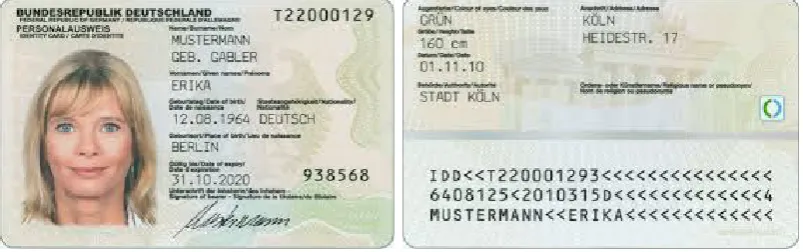
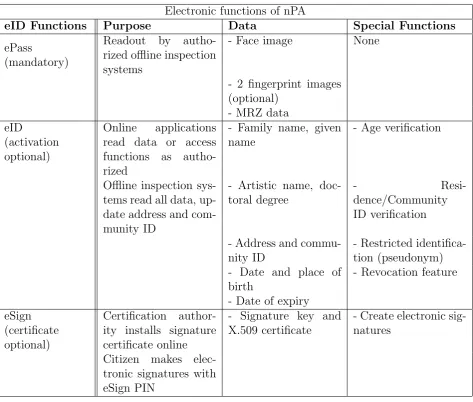
data and its protection. Data minimization functions are also included in the eID function which are described later in this section. Biometric data of the user stored on the eID card (for e.g. photo, fingerprints, eye color, height and personal signature) are never transmitted to the service providers or via the Internet. Only the sovereign authorities who possess the authorization and the technical means can query such sensitive information. Figure2.1 is the visual representation of the German eID card2 and table 2.1 provides an overview of its main functions.
Figure 2.1: German eID card (nPA)
The important design goals of nPA were: privacy, data security and citizens’ ability to know the extent of access that the external services have to their own per-sonal data. Thus it protects against the misuse of data and identity theft as well as supports the principles of data avoidance and minimization. The citizens can use this card to securely access both online business services and also offline services (non-Internet) such as for hiring cars or at ticket vending machines. Biometric data is strongly protected; it can be only read when the eID card is physically present and can only be accessed by the official authorities such as police, tax authorities and so on. The unique feature in the German eID card is that the data on the contactless chip is fully under the control of the card owner and the service providers must authorize to the eID card before any data can be read from it. The service provider can prove its authorization via a card verifiable certificate (CVC) and the eID card owner has to further grant permission to such a service provider by entering a secret 6-digit PIN. The eID card consists of data minimization func-tions such as age verification, residence verification and restricted identification in addition to the data as mentioned in the Table 2.1. The objective of these func-tions is to transmit from the user to the service provider only the minimum data
2More visuals on the German eID card format and data present on it can be found at
Electronic functions of nPA
eID Functions Purpose Data Special Functions
ePass
(mandatory)
Readout by autho-rized offline inspection systems
- Face image None
- 2 fingerprint images (optional)
- MRZ data eID
(activation optional)
Online applications read data or access functions as autho-rized
- Family name, given name
- Age verification
Offline inspection sys-tems read all data, up-date address and com-munity ID
- Artistic name, doc-toral degree
-
Resi-dence/Community ID verification
- Address and commu-nity ID
- Restricted identifica-tion (pseudonym) - Date and place of
birth
- Revocation feature
- Date of expiry eSign
(certificate optional)
Certification author-ity installs signature certificate online
- Signature key and X.509 certificate
- Create electronic sig-natures
[image:21.595.91.565.97.499.2]Citizen makes elec-tronic signatures with eSign PIN
Table 2.1: Overview of electronic functions of nPA
that is needed for that specific transaction. The working of these functions work is briefly described below:
1 Age verification function by which the service provider (SP) will get the information about a user’s age, for instance, if a certain age is reached, say 16 or 18 years, based on a reference/test date sent to the chip of the eID card by the service provider. This function requires the proof of the age verification right by the SP terminal to the card. The test date is actually the date
the age verification function is a simple ’yes’ or ’no’ answer that is returned to the service provider instead of actual birth date of the eID cardholder. The test date is sent as a part of the Terminal Authentication (explained in Section2.4.2) and verified by the chip in order to prevent targeted narrowing down of the cardholder’s age by sending repeated queries to the card with different test dates.
During TA, the test date is sent as a part of the auxiliary data which is signed by the SP terminal and verified by the chip. So this auxiliary data is authenticated at the end of TA. As it is mandatory for TA to be executed only once within a secure session, the test date can be sent only once to the card chip within a session. If the SP terminal wishes to send the test dates many times, it has to establish a new secure session each time with the card. This necessitates the user to enter her PIN everytime in order to initiate PACE and then TA. So, in conclusion, it is not feasible to find the actual age of the cardholder by sending different test dates repeatedly to the card.
2 Residence verification function by which the service providers can verify if the eID cardholder lives in a particular region or a city. This function does not transmit the full address of the cardholder but just compares the regional identifier (or the official municipality code number) of the cardholder’s ad-dress against a reference regional identifier sent to the card by the service provider and a simple ’yes’ or ’no’ answer is returned. The official municipal-ity code number contains the information consisting of the land (i.e. Bun-desland), the administrative region, city or district and the municipality. To provide regionally or localized services to the citizens, the service providers can send query concerning the place of residence and this residence query also enables a query corresponding to other levels such as land, administra-tive region or district. This is helpful for the service providers who would like to offer services for the inhabitants of a particular administrative region only. As in the age verification procedure, the place queried is transmitted as part of the Terminal Authentication data so that it is not possible for a service provider to narrow down the place of residence by sending repeated queries to the card.
service provider that is sent as a part of its authorization certificate. Thus, a service provider will be able to recognize the user as the owner of a specific eID card when a service is accessed using the pseudonym. However, the user has to provide her consent for the access of her pseudonym by the service provider by entering her eID PIN. This function is useful in the instances such as, when a user wishes to enter an online forum or participate in an online survey without having to give away any of her personally identifying data during the registration. The pseudonym generation procedure in nPA is discussed in more detail in the Section2.5.
2.2
The eID function in nPA
The electronic identification or the eID function is one of the three major functions of the nPA as mentioned earlier in the Section 2.1 (Also, mentioned in Table 2.1). With the activation of this eID function, nPA can be used for the mutual identification and authentication of the citizens and the Service Providers (SP); this ensures both parties to know who the counterpart claims to be. Elec-tronic authentication is meant to establish a trusted and a secure channel between the eID card chip and the provider. The card owner proves her authenticity by the possession of card and secret PIN whereas SP proves its authenticity with the aid of an authorization certificate. Technically, only the service providers who have the approval of Federal Office of Administration (Vergabestelle f¨ur Berech-tigungszertifikate)3 can read the data from any eID card. The service provider is responsible for protecting the data that is read from the eID from misuse or falling into hands of third parties.
The German eID card infrastructure consists of several components both on the user and service provider sides. Typically, a user needs the following components in order to use the eID function during online transactions: (1) an eID card with an activated eID function (2) a local card reader (3) The eID-Client application (Ausweissapp software).
A service provider (SP) needs the following components in place if he wishes to integrate the eID function into the existing services: (1) an offline or an online service portal with an authorization certificate that grants the service provider a controlled access to the data on the eID card (2) an eID-Server (attached SP eID server or a third party eID server) that handles the authentication by communi-cating with the eID card using the cryptographic protocols.
3Vergabestelle f¨ur Berechtigungszertifikate (VfB) : A new government institution, the Issuing
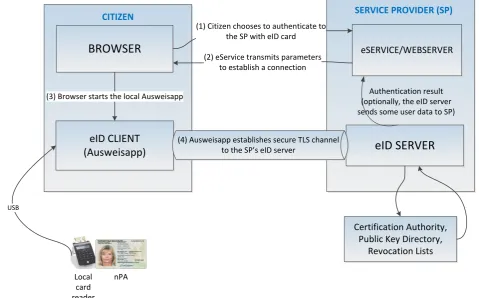
The online eID authentication process is described as follows:
1. The user visits the an online website eService and requests a service from the service provider (SP). The SP requires the user to authenticate with her eID card.
2. The eService sends a webpage with an embedded link4 and all the necessary parameters to the user’s browser in order to establish a secure connection between the eID-Client and the eID-Server (Identity Provider).
3. The user clicks on the link and the user’s browser (User-Agent) performs a corresponding HTTP GET command to start the eID-Client application (Ausweisapp).
4. The eID-Client application establishes a TLS channel to the eID-Server and displays the user’s data requested by the SP to the user on her browser. The citizen decides which data the SP is allowed to obtain. By entering the PIN, the citizen gives her consent for the data access and transmission. Another secure messaging channel is setup on the top of this TLS channel by the session keys generated during Extended Access Control (EAC) protocols; Within this secure and trusted channel, the actual authentication takes place and the required user data/attributes are sent to the eID-Server.
5. The eID-Server verifies the user attributes and performs user authentication. It conveys the result of this authentication to the service provider and op-tionally sends the user attributes if requested by the service provider; but the attributes are sent only if the service provider has the rights to read those attributes and the transmission is permitted by the user. On a successful authentication, the service provider grants access for the service to the user.
The communication between the technical components of nPA during the eID authentication is shown in the figure 2.2.
2.3
Realization of electronic authentication
func-tion in nPA
Many eID cards in the existing eID systems are equipped with X.509 certificates for TLS client authentication [14]. But when the X.509 certificate is
transmit-4It is an embedded link pointing to the following URL
BROWSER
eID CLIENT (Ausweisapp)
eSERVICE/WEBSERVER
eID SERVER
(3) Browser starts the local Ausweisapp
(2) eService transmits parameters to establish a connection
Certification Authority, Public Key Directory,
Revocation Lists (4) Ausweisapp establishes secure TLS channel
to the SP’s eID server (1) Citizen chooses to authenticate to
the SP with eID card
CITIZEN SERVICE PROVIDER (SP)
Authentication result (optionally, the eID server sends some user data to SP)
Local card reader
USB
[image:25.595.51.531.123.421.2]nPA
Figure 2.2: Online authentication procedure with nPA
ted over the unprotected channel during the TLS handshake, the user’s privacy is lost as some sensitive identity information contained in these certificates like the cardholder’s name is exposed. Due to this reason, nPA does not use X.509 cer-tificates for the TLS authentication, instead, nPA uses Extended Access Control mechanisms which makes nPA more secure and privacy-friendly. In this section, we describe the infrastructure and cryptographic primitives that are used as a part of nPA online authentication.
2.3.1
PKI Infrastructure used in nPA
The German eID document makes use of two Public Key Infrastructures (PKI) for realizing its electronic functionality in a secure manner:
(1) Country Signing Certificate Authority (CSCA) for verifying the authenticity of the eID documents (during Passive Authentication).
(2) Country Verifying Certificate Authority (CVCA) for protecting the biometric data stored on the eID document and verifying the authorization and the access rights of the service providers (during Terminal Authentication).
Country Signing Certificate Authority (CSCA)
The CSCA is operated by the Federal Office for Information Security (BSI). The CSCA generates the German root certificates (CSCA certificates) on a regular basis, which in turn serve as the source for the private keys of the document signing certificates of the ID card manufacturer. These private keys are used by the authorized ID card manufacturer to sign the data files on the eID document. The document signing certificate is also electronically stored on the identity card. Using the CSCA root certificate, it is possible to verify whether an electronic identity card was indeed created on behalf of the issuing nation and whether the data on the card have been changed in any way since production. This is realized using Passive Authentication [1].
Country Verifying Certificate Authority (CVCA)
The CVCA is also operated by the BSI. It is the authority that generates the German root certificates whose private keys are used to sign the document verifier certificate of the certified document verifiers (DVs). The DVs are responsible for issuing the certificates authorizing the service providers for reading the electronic identity documents and also define the individual read rights, i.e. what informa-tion can be read from the identity documents. This authorizainforma-tion is verified by the eID card’s RF chip during Terminal Authentication.
Figure 2.3: CVCA PKI for citizen applications of the eID card [1]
2.3.2
Passwords used in nPA
In nPA, Password Authenticated Connection Establishment (PACE) protocol is used as a secure and a practical mechanism to restrict access to the applications based on a particular knowledge, i.e. based on passwords that are either printed on the document or only known to the legitimate holder of the document. The detailed description of PACE can be found in the Section 2.4.1. The passwords used during the PACE protocol for reading the data from the card are listed in this section with respect to ePass, eID and eSign functions of nPA [2].
• The eID supports the ePass function where physical identification is carried out by the authorized official inspection systems. For this ePass function, Card Access Number (CAN) or Machine Readable Zone (MRZ) printed on the card is used as the password.
PIN is associated with a retry counter that is decreased for every failed au-thentication. To access the unblocking mechanism of the PIN, there is a password, PIN Unblock Key (PUK) which is a long secret password that is known only to the legitimate holder of the eID card. If the PIN is blocked and the user sucessfully enters the PUK, the PIN gets unblocked. PUK is a non-blocking password; however, it may be associated with a usage counter that is decreased for every successful authentication.
• For the card owner to exercise the eSign function, the certification author-ity installs the signature certificate online and eID PIN is the password for authenticating the card owner to the CA. Once the signature certificate is installed, the eID card owner can sign the documents electronically by using eSign PIN.
2.3.3
Keys used in EAC protocols and cryptographic
prim-itives used in nPA
The keys and operations for the symmetric key encryption and authentication, their notations are briefly described below in a algorithm-independent manner. Symmetric keys are derived from a shared secret K and an (optional) nonce r or from a password π using a Key Derivation Function (KDF)5. The KDF is used to derive encryption keys and MAC (Message Authentication Code6) keys. The technical guideline BSI TR-03110 [2] summarizes the keys to be used in nPA as follows:
• Deriving a key for message encryption is denoted by KEnc = KDFEnc(K,[r]).
• Deriving a key for message authentication is denoted by KMAC=KDFMAC(K,[r]).
• Deriving a key from a password π (suitable password is chosen based on the terminal type; for more information refer the previous subsection on the Passwords used in nPA) is denoted by Kπ=KDF( π).
The operations for encrypting and decrypting a message are denoted as follows:
• Encrypting a plaintext m with key KEnc is denoted by c = E(KEnc,m).
5The definition for a KDF given in the Wikipedia is: A key derivation function (or KDF)
de-rives one or more secret keys from a secret value such as a master key or other known information such as a password or passphrase using a pseudo-random function.
6A message authentication code (often MAC) is a short piece of information used to
• Decrypting a ciphertext c with key KEnc is denoted by m = D(KEnc,c).
The operation for computing an authentication code t on message m with key KMAC is denoted as t = MAC(KMAC,m).
The KDF, Encryption, MAC and Key Agreement functions used in nPA are implemented using the following cryptographic primitives [2] [15]:
• The KDF used is the hashing function SHA-2567.
• Encryption function used is AES-128 CBC8 (AES-128 in Cipher Block Chaining mode).
• MAC function used isAES-128 CMAC9(AES-128 with Cipher-based Mes-sage Authentication Code.)
• Key establishment in nPA is done using ECDH10 (Elliptic Curve Diffie-Hellman algorithm).
• ECDSA(Elliptic Curve Digital Signature Algorithm) is used for authoriza-tion certificates and signatures.
An overview of optimal keylengths for the keys used in nPA’s cryptographic algorithms for the years 2013-2015 in accordance with BSI recommendations is as follows:
• For asymmetric cryptographic operations, the keylength specified is 1976 bits (For long-term security level, 2048 bits is recommended for RSA operations).
• For symmetric key cryptographic operations, the keylength specified is 128 bits.
• For discrete logarithmic functions, the keylength recommended is 256 bits and group size is 2048 bits.
• For elliptic curve cryptographic functions, recommended keylength is 224 bits.
The above information was retrieved from the web source BlueKrypt Crypto-graphic Keylength Recommendation11 under the BSI recommendations section
7Secure Hash Algorithm: http://tools.ietf.org/html/rfc6234
8AES-CBC algorithm: http://tools.ietf.org/html/rfc3602
9AES-CMAC algorithm: http://tools.ietf.org/html/rfc4493
10Information on ECDH and ECDSA can be found at http://www.ietf.org/rfc/rfc4492.txt
and further comparison of keylength recommendations by other standards with the BSI standards can also be found at the same website.
Table 2.2 enlists all the sets of keys used during PACE and Extended Access Control (EAC) protocols that take place in the nPA eID authentication process. In this table, we have redefined the notations of the keys mentioned in the BSI TR-03110 [2] and we use these keys’ notations in the Section 2.4 while describing each of the EAC protocol specifications.
Protocol Keys on the card
chip C
Keys for the Termi-nal T
Note
PACE PKCe, SKCe PKTe, SKTe All keys are ephemeral
DH keys Terminal
Au-thentication
PKCVCA PKT, SKT The chip verifies the
certificate chain re-ceived from the termi-nal using the public key of the CVCA. Chip
Authenti-cation
PKC, SKC PKTe’, SKTe’ The key pair used by the terminal is an ephemeral key pair different from the ephemeral PACE key pair.
Restricted-Identification (Pseudonyms)
SKID PKsector The chip should not
provide the corre-sponding public key PKID, the terminal must not be provided the corresponding private key SKSector. The keys PKID and SKSector are externally used to generate revocation lists.
[image:30.595.90.564.228.610.2]2.4
EAC Protocols used in the eID Online
Au-thentication
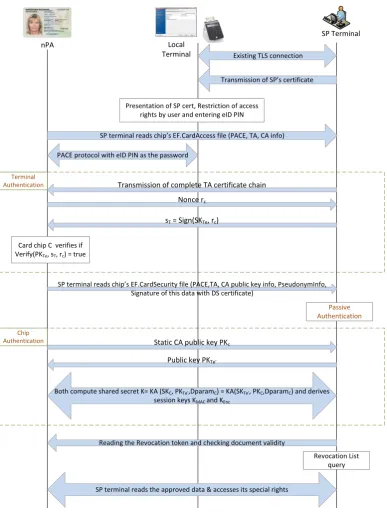
The Extended Access Control (EAC) mechanism comprises an array of protocols that are always executed in a specific order, depending on which electronic identity document is to be read [2]. The general authentication procedure in nPA can be briefly described in the following steps:
1. Password Authenticated Connection Establishment (PACE): As the name suggests, PACE protocol is meant to authenticate the user to the card reader as the legitimate owner of the card by entering the PIN (Password); it is also meant to create a secure channel between the card and the reader in order to avoid the card being read from a distance without an explicitly granted access by the card owner. PACE starts the secure messaging between the card and the card reader only if the indication of the card reader/terminal type (inspection terminal, an authentication terminal or a signature termi-nal) and its requested access rights are successfully checked. Thus, PACE provides trust points for the next step Terminal authentication.
2. Terminal Authentication (TA): During this protocol, the terminal sends the complete certificate chain starting with the CVCA certificate that is verifiable with CVCA public key and ending with the terminal certificate. Thus the chip can verify the authenticity of the certificates and extract the static public key of the terminal. The terminal generates the ephemeral public key to be used later on for the chip authentication. The chip sends a nonce, the terminal signs the nonce with its static private key which the chip can verify with the public key extracted from the terminal certificate. If the authentication is successful, then the eID card chip grants the read/write access rights to the data groups based on the terminal access rights. The terminal authentication also restricts those access rights to Secure Messaging to be established by the authenticated ephemeral public key.
4. Chip Authentication (CA): In this phase, the authenticity of the chip is verified i.e. its is checked if the chip is forged or original. The terminal’s ephemeral public key computed by the chip during CA is compared with the ephemeral public key generated by the terminal during Terminal Authentica-tion. If it matches, then both chip and the terminal move ahead to agreeing on a shared secret key. Then the chip derives the session keys based on the shared secret key and generates an authentication token which is verified by the terminal in the next step. The chip is authenticated if this verification is successful. Then the chip restarts the secure messaging with the newly generated CA session keys; the security context established by this securing messaging will be used for all the further communication between the card and the authenticated terminal.
Figure2.4 illustrates the simplified version of EAC protocols in the order as they are executed in nPA and the protocols are explained in detail in the further sec-tions.
2.4.1
Password Authenticated Connection Establishment
(PACE)
Any communication with the chip of the ID card can only be performed if the cardholder enters her PIN to the chip. This guarantees a so-called two-factor authentication based on ownership (the ID card) and knowledge (the PIN). As the chip is contactless, the PIN cannot be sent ’over the air’ without additional protection [11]. The Password Authenticated Connection Establishment (PACE) protocol is designed for such an access control, mainly to protect the RF chip on the card to be read at a distance without an explicitly granted access. The national identity documents like the passports used Basic Access Control but in the case of nPA, PACE is used as an alternative to the Basic Access Control (BAC).
nPA
SP Terminal
Existing TLS connection
Card chip C verifies if Verify(PKTe, sT, rc) = true
Both compute shared secret K= KA (SKC, PKTe',DparamC) = KA(SKTe', PKC,DparamC) and derives session keys KMAC and KEnc
Chip Authentication
PACE protocol with eID PIN as the password
Nonce rc
Transmission of complete TA certificate chain
sT = Sign(SKTe, rc)
Public key PKTe’
Static CA public key PKc
Transmission of SP’s certificate
Terminal Authentication
Reading the Revocation token and checking document validity
Passive Authentication Presentation of SP cert, Restriction of access
rights by user and entering eID PIN
Revocation List query
SP terminal reads the approved data & accesses its special rights
Local Terminal
SP terminal reads chip’s EF.CardSecurity file (PACE,TA, CA public key info, PseudonymInfo, Signature of this data with DS certificate)
[image:33.595.103.491.63.583.2]SP terminal reads chip’s EF.CardAccess file (PACE, TA, CA info)
Figure 2.4: Simplified flow diagram of EAC protocols in nPA
Depend-ing on the numberDepend-ing convention used for the serial numbers, the authors estimate the practical entropy of the MRZ is in between 50 bits (using al-phanumeric, random serial numbers) and 40 bits (using sequential serial numbers).
• If the execution time of BAC is increased then the time required for the attacker to be in contact with the chip is also prolonged [16]. However, as this measure may seem to avoid skimming attack it does not resolve the problem of eavesdropping.
On the other hand, PACE enables PIN-protection to the data present on the identity document (eID card in our case) and it is a password authenticated Diffie-Hellman key agreement protocol that provides secure communication and explicit password-based authentication of the card chip and the terminal. PACE ensures that the contactless RF chip in the electronic ID card cannot be read without direct access and the data exchanged with the reading device is encrypted before getting transmitted. This protocol establishes Secure Messaging between a card chip and a terminal based on weak (short) passwords. Although the entropy of the password used to authenticate the local terminal can be very low (6-digit), the security provided by PACE is high because strong session keys resulting from PACE are independent of the strength of the password [2].
The transformation of a short password (PIN code) into a strong session key in PACE involves a mapping function, which is used to map a random number to parameters used for asymmetric cryptography. Two mapping alternatives are currently defined [16]:
• Generic Mapping: It is based on the generic group operations. This can be generically adapted to all asymmetric cryptography systems and is easy to implement on smart cards.
• Integrated Mapping: In this type of mapping, a random number is directly integrated in the parameters used for asymmetric cryptography. While this is easy to implement for standard cryptography, it requires more sophisticated algorithms for elliptic curve cryptography.
Furthermore, the cryptographic algorithms used by PACE for key agreement (KA), encryption (Enc) and message authentication (MAC) functions are Elliptic Curve Key Agreement (ECDH to be precise), AES 128 CBC-Mode and AES 128 CMAC respectively.
her PIN code. Then, a secure communication channel is established between the card and the service provider’s terminal by the PACE session keys.
In the case of an online authentication, PACE is used for PIN-sharing and to create a secure channel only between the eID card and the local card reader on the user’s side. The TLS channel established by the Ausweissapp with the eID-Server secures the communication between the eID-Client (the client application Ausweisapp which is further connected to the card reader and the card) and the eID-Server until the chip authentication session keys are established.
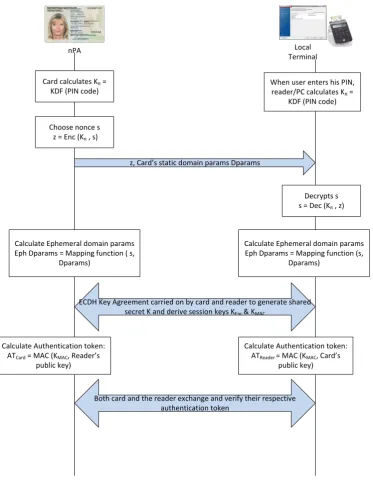
The PACE protocol between the card chip C and the terminal T is summarized in the following steps and also illustrated in the Figure2.5.
1. C randomly and uniformly chooses a nonce s, encrypts the nonce to z = E(Kπ, s) where Kπ=KDF( π) is derived from the shared password π; then
the chip sends this ciphertextz to the terminal T along with its static domain parameters DparamC.
2. T recovers the plaintext s = D(Kπ, z) with the help of the shared password π.
3. Now, both C and T perform the following steps:
(a) They compute the ephemeral domain parametersEphDparamC = Map(DparamC,s).
(b) They perform an anonymous Diffie-Hellman key agreement based on the ephemeral domain parameters and generate the shared secret K
like this:
K = KA(SKCe, PKTe, EphDparamC) = KA(SKTe, PKCe, EphDparamC).
During this key agreement both the chip and the terminal must check if PKCe 6= PKTe.
(c) They derive the session keys: KMAC = KDFMAC(K) and KEnc =
KDFEnc(K).
(d) They exchange and verify the authentication token ATT = MAC(KMAC, PKCe) and ATC = MAC(KMAC, PKTe).
nPA Local Terminal
Choose nonce s z = Enc (Kπ , s)
z, Card’s static domain params Dparams
Decrypts s s = Dec (Kπ , z)
Card calculates Kπ =
KDF (PIN code)
When user enters his PIN, reader/PC calculates Kπ =
KDF (PIN code)
Calculate Ephemeral domain params Eph Dparams = Mapping function ( s,
Dparams)
Calculate Ephemeral domain params Eph Dparams = Mapping function (s,
Dparams)
ECDH Key Agreement carried on by card and reader to generate shared secret K and derive session keys KEnc & KMAC
Calculate Authentication token: ATCard = MAC (KMAC, Reader’s
public key)
Calculate Authentication token: ATReader = MAC (KMAC, Card’s
public key)
[image:36.595.106.480.87.574.2]Both card and the reader exchange and verify their respective authentication token
Figure 2.5: PACE protocol as used in nPA
2.4.2
Terminal Authentication (TA)
to access the data on the chip. A service provider holds an authorization certifi-cate encoding its public key and its access policy. The RF chip in the identity document is designed so that it enables reading of specific data only when the reader device (endpoint at an SP) can demonstrate an explicit read authorization for these specific data (e.g. only date of birth). The Country Verifying Certifi-cate Authority certifiCertifi-cate (CVCA certifiCertifi-cate) is stored on the RF chip to verify this authorization. This certificate forms the root of the Country Verifier Public Key Infrastructure (CV-PKI), a hierarchy of authorization certificates for reading sensitive data from identity documents [1]. The TA authenticates the ephemeral public key of the terminal PKTe that will be used to set up Secure messaging with Chip Authentication in the next phase. As the terminal might access sensitive data, further communication must be protected and the chip of the card must also bind the terminal access rights to the secure messaging session established by PKTe. In case of nPA, PACE is used before TA and the chip’s identifier IDC is
computed using the chip’s ephemeral PACE public key PKCe. All messages must be transmitted with Secure Messaging in Encrypt-then-Authenticate mode using the session keys derived from PACE.
The TA between Chip C and the terminal T consists of the following steps [2] and it is also depicted in the Figure 2.4
1. T sends a certificate chain to C. The chain starts with a certificate that is verifiable with the CVCA public key stored on the chip and ends with the Terminal Certificate.
2. C verifies the certificates and extracts the terminal’s static public key PKT.
3. T generates an ephemeral Diffie-Hellman key pair (SKTe, PKTe, DparamC)
and sends the compressed ephemeral public key Comp(PKTe) to the chip C. T may also send some auxiliary data ADataT to C.
4. C randomly chooses a challenge rC and sends it to T.
5. T responds with the signature sT calculated as shown below: sT =Sign(SKTe, IDC k rCk Comp(PKTe) k ADataT)
6. C checks if Verify(PKTe,sT, IDC k rCk Comp(PKTe) kADataT) = true.
TA with the value of Comp(PKTe) that will be calculated by the terminal during the Chip Authentication.
2.4.3
Passive Authentication (PA)
The purpose of Passive Authentication (PA) is to validate the authenticity and integrity of the data on the RF chip of the identity document. The data stored on the chip is digitally signed with a document signing certificate which in turn signed with a Country Signing Certificate Authority certificate (CSCA certificate)12 that is available to an officially authorized ID card manufacturer. When an identity document is read, PA verifies the signature of the data stored on the RF chip and traces it back to the CSCA certificate thus verifying if the integrity of the data on the chip is intact and is indeed signed by the authorized ID manufacturer [1].
A more technical decription of PA is given below (For this, we have referred to the BSI TR-03127 [17]):
The EF.CardAccess file stored on the eID card consists of informational fields such as PACEInfo, CAInfo, CADomainParameterInfo, PrivilegedTerminalInfo, TAInfo and CardInfoLocator. These security information is collectively contained in a Security Object. This file is read by the reader terminal before the execution of PACE protocol as it is always readable by any terminal. On the other hand, the EF.CardSecurity file consists of CA PublicKeyInfo, RestrictedIdentification-Info, DomainParams, signature over this entire Security Object data along with Document Signing (DS) authority’s Certificate (which includes CSCA certificate) in addition to all the security information present in the EF.CardAccess file. Thus EF.CardSecurity file contains the secured contents of the Security Object and the read access right to this particular file is restricted to terminals that support PACE and TA and it can be read only after the execution of PACE and TA.
The terminal T conducts the following checks during PA:
• T compares the unsecured security information that was read from the EF.CardAccess file before PACE to the secured contents of the Security Object read from the EF.CardSecurity file after PACE+TA. T verifies if the corresponding information in both the files match and they have not been modified in any manner.
• T verifies the signature over the secured contents of the Security object present in the EF.CardSecurity file. As T already knows the public key of
CSCA, it checks the validity of the DS certificate which includes CSCA cer-tificate. Upon the successful verification of both signature and the certificate, the terminal T is assured of the authenticity and integrity of the data on the card is intact.
Passive Authentication must be performed in combination with Chip Authen-tication to confirm the genuineness of both the RF chip on the card as well as the data stored on this chip. If PA is performed after CA , the Document Security Object is used for PA (version 1). When PA is performed before CA, the Card Security Object (read from EF.CardSecurity file stored on the RF chip) or the Chip Security Object are used (Version 2). Only after a successful validation of the respective Security Object, the chip and its data may be considered genuine.
2.4.4
Chip Authentication (CA)
The Chip Authentication Protocol is an ephemeral-static Diffie-Hellman key agree-ment protocol that provides a secure communication and a unilateral authentica-tion of the chip. The purpose of CA is to prove to the service provider that the eID card chip is an official chip issued by the German government (BSI), to confirm that it is not a forged or a cloned chip and to establish a secure connection between the chip and the service provider terminal in the case of an online authentication. The public key of the chip is signed by the card manufacturer during its process of generation; thus, the use of the signed key verifies the authenticity of the chip and at the same time, a strongly-encrypted and authenticated end-to-end channel is established between the chip and the service provider.
CA provides an explicit authentication of the chip by verifying the authen-tication token (smart card chip in this case) and implicit authenauthen-tication of the stored data by performing the Secure Messaging using the new session keys [2]. In the present version of CA that is described in this section, Terminal Authentica-tion (TA) is performed before CA where the terminal’s ephemeral public key pair (SKTe’, PKTe’, DparamC) is generated as a part of TA (This ephemeral key pair is
different from the pair used in PACE). The following steps are performed by the chip C and the terminal T during CA and CA is also illustrated in the Figure 2.4
1. Chip C sends its static Diffie-Hellman public key PKC and the domain pa-rameters DparamC to the terminal T.
2. T sends its ephemeral public key PKTe’ to C.
4. Both C and T compute the following:
The shared secretK = KA(SKC, PKTe’,DparamC) = KA(SKTe’, PKC,DparamC)
5. C randomly chooses a nonce rC and derives the session keys from K and rC
for Secure messaging :
KMAC = KDFMAC(K, rC) and KEnc = KDFEnc(K, rC). C then
com-putes an authentication token ATC = MAC(KMAC, PKTe’) and sendsrC and
ATC to the terminal T.
6. T derives session keys for Secure Messaging from K and rC:
KMAC = KDFMAC(K, rC) and KEnc = KDFEnc(K, rC). Then, T
verifies the authentication token ATC.
If Chip Authentication was successfully performed, Secure Messaging is restarted using the derived session keys KMAC and KEnc. Otherwise, Secure Messaging is continued using the session keys that were previously established during the PACE protocol.
One of the design principles in the German eID card was the non-usage of unique identifiers for the ID card in order to preserve the citizen’s privacy to an extent and this is the reason for the Diffie Hellman key pairs not being unique for a chip [11]. For privacy reasons, the secret private key SKC is shared with a batch of other cards to build anonymity sets so that anonymity only holds with respect to that set. Sharing a key is necessary, because otherwise a particular card could be traced using the corresponding public key that is transmitted to the terminal at the start of the chip authentication phase. Moreover, if each ID card were equipped with a unique chip authentication key, a service provider might gain a unique identifier as a side effect of the protocols. Therefore a batch of cards share the same secret chip authentication key, making them indistinguishable at the protocol level. We analyze the adverse side effects of this shared key approach as one of the main topics in Section 2.8.1.
![Figure 2.3: CVCA PKI for citizen applications of the eID card [1]](https://thumb-us.123doks.com/thumbv2/123dok_us/9853785.486558/27.595.126.467.97.331/figure-cvca-pki-citizen-applications-eid-card.webp)
![Table 2.2Control (EAC) protocols that take place in the nPA eID authentication process.In this table, we have redefined the notations of the keys mentioned in the BSITR-03110 [ enlists all the sets of keys used during PACE and Extended Access2] and we use these keys’ notations in the Section 2.4 while describingeach of the EAC protocol specifications.](https://thumb-us.123doks.com/thumbv2/123dok_us/9853785.486558/30.595.90.564.228.610/protocols-authentication-redened-notations-mentioned-notations-describingeach-specications.webp)