http://wrap.warwick.ac.uk/
Original citation:
Wonnacott, Elizabeth, Newport, Elissa L. and Tanenhaus, Michael K. (2008) Acquiring and processing verb argument structure : distributional learning in a miniature language. Cognitive Psychology, Vol.56 (No.3). pp. 165-209.
Permanent WRAP url:
http://wrap.warwick.ac.uk/51388
Copyright and reuse:
The Warwick Research Archive Portal (WRAP) makes this work of researchers of the University of Warwick available open access under the following conditions. Copyright © and all moral rights to the version of the paper presented here belong to the individual author(s) and/or other copyright owners. To the extent reasonable and practicable the material made available in WRAP has been checked for eligibility before being made available.
Copies of full items can be used for personal research or study, educational, or not-for-profit purposes without prior permission or charge. Provided that the authors, title and full bibliographic details are credited, a hyperlink and/or URL is given for the original metadata page and the content is not changed in any way.
Publisher’s statement:
“NOTICE: this is the author’s version of a work that was accepted for publication in Cognitive Psychology. Changes resulting from the publishing process, such as peer review, editing, corrections, structural formatting, and other quality control mechanisms may not be reflected in this document. Changes may have been made to this work since it was submitted for publication. A definitive version was subsequently published in Cognitive Psychology, Vol.56 (No.3). pp. 165-209.
http://dx.doi.org/10.1016/j.cogpsych.2007.04.002
A note on versions:
The version presented here may differ from the published version or, version of record, if you wish to cite this item you are advised to consult the publisher’s version. Please see the ‘permanent WRAP url’ above for details on accessing the published version and note that access may require a subscription.
Acquiring and Processing Verb Argument Structure:
Distributional Learning in a Miniature Language
Elizabeth Wonnacott1
Elissa L. Newport2
Michael K. Tanenhaus2
University of Oxford, UK1
University of Rochester, NY, USA2
Address for Correspondence:
Elizabeth Wonnacott
Department of Experimental Psychology
South Parks Road, Oxford, OX1 3UD.
Telephone: +44 (0)1865 271319
Abstract
Adult knowledge of a language involves correctly balancing lexically-based and
more language-general patterns. For example, verb-argument structures may sometimes
readily generalize to new verbs, yet with particular verbs may resist generalization. From
the perspective of acquisition, this creates significant learnability problems (Baker 1979),
with some researchers claiming a crucial role for verb semantics in the determination of
when generalization may and may not occur (Pinker, 1989). Similarly, there has been
debate regarding how verb-specific and more generalized constraints interact in sentence
processing (Trueswell et al 1993; Mitchell 1987) and on the role of semantics in this
process (Hare et al 2003). The current work explores these issues using artificial language
learning. In three experiments using languages without semantic cues to verb distribution,
we demonstrate that learners can acquire both verb-specific and verb-general patterns,
based on distributional information in the linguistic input regarding each of the verbs as
well as across the language as a whole. As with natural languages, these factors are
shown to affect production, judgments and real-time processing. We demonstrate that
learners apply a rational procedure in determining their usage of these different
input-statistics and conclude by suggesting that a Bayesian perspective on statistical learning
may be an appropriate framework for capturing our findings.
Key Words
Language Acquisition, Sentence Processing, Verb Argument Structures, Eye-tracking,
Introduction
Adult language incorporates both regular, abstract operations and patterns that are
idiosyncratic or specific to particular lexical items. The complex interplay between these
two types of process is particularly clear in the relationship between verbs and the
argument structure constructions in which they may occur. For example, consider the use
of the ditransitive structure in English. For many verbs this construction provides an
alternative to the use of a prepositional form, as in (1):
(1) Jack gave/brought/threw/ the ball to Henry.
Jack gave/brought/threw Henry the ball.
In addition, the construction may be spontaneously applied to new verbs. For
example, Gropen, Pinker, Hollander, Goldberg, and Wilson (1989) demonstrated that
children who were taught the new verb pilk with the meaning ‘transfer by car’ would
produce such sentences as “he is pilking him the horse”. Yet despite this apparent
productivity, certain verbs are unexpectedly ungrammatical in the ditransitive, as in *Jack
donated/carried/pushed Henry the ball. This illustrates a phenomenon known as
subcategorization: particular verbs are constrained (or ‘subcategorized’) as to the set of
constructions with which they may occur (Chomsky, 1965). This combination of
generalization and lexical restriction turns out to be common across many constructions
in different languages (see Pinker, 1989, for a review of the Dative, Causative,
acquisition. If learners are able to extend verbs to new constructions, how do they learn
that some new verb-construction combinations are ungrammatical, rather than simply
absent from the particular sample of speech they have heard thus far? This constitutes a
significant learning problem, sometimes known as “Baker’s Paradox,” which has
received a great deal of attention in the language acquisition literature (e.g. Baker, 1979;
Bowerman, 1988; Braine, 1971; Braine & Brooks, 1995; Brooks & Tomasello, 1999;
Pinker, 1989; Theakston, 2004). Although it has been proposed that very young children
may avoid the issue by adhering to extreme lexical conservatism (see Tomasello 2000;
Fisher 2002a; Tomasello & Abbot-Smith 2002; Gertner, Fisher, & Eisengart, 2006 for
review and discussion of the evidence), all researchers agree that, at least from around 3
years of age, children do generalize. When this occurs we also see over-generalization,
where children use constructions with verbs for which they are ungrammatical (e.g. *Jay
said me no, Gropen et al. 1989). In this article our focus is on how the retreat from
overgeneralization can be achieved i.e. how learners who are able to generalize balance
this ability with their knowledge of verb-specific constraints. One obvious source of
potential evidence, direct correction from caregivers, has been shown to be very rare in
the input to young children (Braine, 1971; Brown & Hanlon, 1970; Newport, Gleitman &
Gleitman, 1977). Debate has therefore focused on two alternate sources of evidence: verb
semantics and distributional information.
The semantics approach
One approach to a range of difficult problems in syntax acquisition has been to
distributions and to propose that these play a significant role in acquisition (Grimshaw,
1981; Morgan & Demuth, 1996; Morgan & Newport, 1981; Pinker, 1984, 1989). This has
sometimes been referred to as the ‘bootstrapping’ approach, implying that the semantic or
perceptual properties are inherently more accessible than the distributional patterns
themselves, and therefore might serve as a vehicle by which the distribution can be
indirectly acquired. For the current problem, semantic factors would seem to be
particularly promising, since there is a strong correlation between a verb’s meaning and
the set of structures in which it may occur (Fisher, Gleitman, & Gleitman, 1991;
Gleitman, 1990). Most fundamentally, the use of a particular argument structure imposes
constraints on the number of arguments that must be associated with the verb. For
example, causal events generally require structures with two NP slots, and transfer events
require structures with three NP slots. Furthermore, the use of a particular structure may
also have more subtle semantic connotations1, for example the use of the ditransitive
implies not only transfer but also transfer of possession (Green 1974; Goldberg, 1995;
Jackendoff, 1972; Levin, 1993; Pinker, 1984, 1989).
Young children show an awareness of these correlations between meaning and
structure in their usage of new verbs (Gropen, Pinker, Hollander & Goldberg, 1991a,b;
Gropen, Pinker, Holander, Goldberg & Wilson, 1989), and many researchers agree that
these semantic properties play some constraining role in the acquisition of verb
distribution (e.g. Bowerman 1988; Braine & Brooks, 1995; Pinker, 1984,1989). Pinker
(1989) takes the bootstrapping approach further, proposing that children acquire a
complex system of semantically and morpho-phonologically defined ‘narrow’ verb
belong to a class of verbs which do not occur in the di-transitive construction and which
share the meaning ‘continuous parting of force in some manner causing accompanied
motion’.) However, several researchers have pointed out that some of the postulated
class criteria are inconsistent, so that they do not capture the full pattern of verb-structure
co-occurrences (Bowerman 1988; Braine & Brooks, 1995; Goldberg 1995, chapter 5).
The general conclusion is that, although there are strong correlations between the two,
verb distribution cannot be reduced to verb semantics (or a combination of semantic and
perceptual cues). Moreover, experimental evidence suggests that, even when the
generalizations captured by Pinker’s classes are real and productive in the adult grammar,
young children may only acquire this semantic knowledge relatively late in development
(Ambridge, Pine, Rowland and Young, in press; Brooks & Tomasello, 1999).
More generally, a large body of research highlights the complexities involved in
acquiring verb semantics at any developmental stage – specifically, the difficulty in
extracting verb meanings from purely environmental contingencies (Gleitman, 1990;
Gleitman, Cassidy, Nappa, Papafragou, & Trueswell, 2005; Gillette, Gleitman, Gleitman,
& Lederer, 1999; Snedeker, 2000). In fact, Gleitman and colleagues have argued that the
problem is so hard as to be intractable for many verbs. Instead, they propose that the
acquisition of verb semantics itself relies on a process of distributional learning, i.e. that
learners make use of information about the linguistic structures in which a verb has
occurred to make inferences about its meaning – a process sometimes called ‘syntactic
bootstrapping’ (Gleitman, 1990). One piece of evidence for this process is that young
children are able to use the syntactic frame in which a new verb occurs to make
This line of research clearly challenges any account in which prior learning of
verb-semantics provides the crucial ‘bootstrap’ for acquiring verb-syntax. In addition, the
syntactic bootstrapping literature provides a further motivation for the current work.
Gleitman and colleagues have claimed that “the set of frames associated with single
verbs provides convergent evidence as to their full expressive range” (Gleitman et al.,
2005; see also Fisher et al., 1991). Thus an important component of that theory is that
learners are able to acquire verb-structure co-occurrences independent of verb meaning.
The current work investigates this learning process.
The statistical approach
An alternative to using semantic correlates to acquire verb distribution is to extract that
information directly from the set of verb-structure combinations occurring in the input.
Such a theory was first proposed by Braine (1971) and has recently gained in popularity
(e.g. Braine & Brooks, 1995; Goldberg, 1995; 2007; Theakston, 2004; Tomasello 2000).
Two potential learning processes have been discussed: pre-emption and the
entrenchment.
Pre-emption refers to the evidence provided by encountering a verb in
construction A when construction B would have provided the same communicative
function. The hypothesis is that the pre-emption of B provides evidence that it is
ungrammatical with that verb. (Related hypotheses have been propounded for many
aspects of language acquisition, e.g. Markman (1989)’s principle of mutual exclusivity
for word learning, Pinker (1984)’s uniqueness principle for morphology). Goldberg
encountered will often be less felicitous than the form it preempts (given that no two
constructions are entirely synonymous, Givon, 1985). For example, since the
periphrastic causative is not generally associated with direct causation, the sentence ‘He
made the rabbit disappear’ should be less felicitous than ‘*He disappeared the rabbit’.
Thus encountering the former sentence in place of the latter could provide the child with
evidence that disappear is ungrammatical in the transitive. There is evidence for the use
of this information, but so far only in older children (4.5 year olds, Brooks & Tomasello,
1999; 6 year olds, Brooks & Zizak, 2002).
In contrast, entrenchment has been construed as blind to the semantic or
pragmatic properties of verbs or constructions. The notion is that encountering a verb
frequently in the input ‘entrenches’ its use with the particular constructions with which it
has occurred, making it less likely to be generalized for use with a new construction
(Braine & Brooks, 1995). A number of studies have found evidence for entrenchment in
child language. Tomasello, Dodson and Lewis (1999) found that three year olds were
more likely to produce over-generalizations with low frequency English verbs (*he
arrived me to school) than high frequency equivalents (*he came me to school).
Similarly, Theakston (2004) and Ambridge et al. (in press) found that five year olds were
likely to give such over-generalizations higher grammaticality ratings when they involved
low frequency verbs. Mathews, Lieven, Theakston and Tomasello (2005) explored the
ability of 2;6 year olds to use known English verbs with a new construction introduced
during the experiment (SOV word order), finding that they were more likely to produce
Although there is some question as to whether entrenchment and pre-emption are
really distinct (see Goldberg, 2005, for the argument that frequency effects reflect the
verb’s more frequent occurrence in specific pre-empting constructions), these phenomena
provide evidence that learners are sensitive to the frequencies of various combinations of
verbs and structures occurring in the input and that they use this information to make
inferences as to the status of ‘missing’ verb-structure pairs. This account concurs with a
growing body of research demonstrating that learners come equipped with powerful
statistical learning mechanisms. For example, Saffran, Newport and Aslin (1996;
Saffran, Aslin & Newport, 1996) showed that adults and young infants could track the
frequencies and conditionalized probabilities of syllable co-occurrence patterns in a
speech stream and apply these statistics to the process of word segmentation; Mintz
(2002) showed that adult learners could abstract syntactic categories on the basis of word
co-occurrences. The current work explores whether statistical learning can be extended to
the problem of verb argument structure acquisition. We also explore whether this same
learning process can account for related phenomena in real-time sentence processing.
Verb argument structures in sentence processing
Verb subcategorization has also featured in a parallel literature on on-line
sentence processing. Here the focus has largely been on statistical rather than absolute
constraints (sometimes known as a verb’s subcategorization ‘profile’). For example,
many verbs in English may be followed by a choice of complement structures but are
constrained as to how readily they occur with these structures (for instance, find may
and Arthur found Trillianwas in the car,but is more likely to occur with a direct object).
In this literature too, debate has focused on role of this verb-specific knowledge versus
more generalized patterns. One influential approach has proposed that real-time
comprehension is primarily influenced by biases which operate above the level of
individual verbs (Frazier, 1987; Frazier & Fodor, 1978; Frazier & Rayner, 1982).
According to this theory, these biases arise from an inherent preference for syntactic
simplicity (embodied in various parsing principles such as Minimal Attachment), which
influences the structures assigned during real time parsing, irrespective of the particular
lexical items involved. Although early experimental work appeared to support this
hypothesis (Clifton, Frazier & Randall, 1983, Ferreira & Henderson, 1990; Mitchell,
1987), a large body of work now indicates that verb-specific biases have a strong and
immediate influence in real-time processing (Garnsey, Pearlmutter, Meyers, & Lotocky,
1997; Snedeker & Trueswell, 2004; Trueswell & Kim, 1998; Trueswell, Tanenhaus, &
Kello, 1993; but cf. Kennison 2001). For instance, Trueswell, Tanenhaus, & Kello (1993)
investigated whether readers were sensitive to the likelihood of particular English verbs
being followed by a either a direct object or a sentential complement. Participants’
eye-movements were monitored as they read pairs of sentences such as: ‘The chef
found/claimed (that) the recipe would require using fresh basil’. Reading times suggested
a bias to interpret the post-verbal NP (the recipe) as a direct object with direct object
biased verbs like find, but not with sentential complement biased verbs like claim,
indicating that subcategorization information was accessed and used to determine
been found in spoken language comprehension, with both adults and children (Snedeker
& Trueswell, 2004; Trueswell, Sekerina, Hill & Logrip, 1999).
Although the influence of lexically-based, verb-specific biases is now well
established, there is evidence that more abstract, verb-general biases also play a role in
processing. In particular, it has been shown that post-verbal nouns are occasionally
interpreted as direct objects, evenwith verbs which have never occurred with that type of
complement (Mitchell, 1987; Juliano & Tanenhaus, 1993). This phenomenon suggests a
verb-independent structural bias, which has been attributed to the inherent preferences of
the parsing architecture (Frazier, 1987; Mitchell, 1987). However, Juliano and Tanenhaus
(1993, 1994) argued that these effects occur primarily with low frequency verbs. This
effect of frequency, akin to the process of entrenchment discussed in the developmental
literature, would again appear to signature a statistical process. Juliano and Tanenhaus
suggest that the bias may arise from the general preponderance of that type of
complement structure across the verbs of the language. This hypothesis has been
explored in a number of computational models (Juliano & Tanenhaus, 1994; Tabor,
Juliano & Tanenhaus, 1997; Kim, Bangalore & Trueswell, 2002). Critically, these models
track both verb-specific statistics (the likelihood of particular verb occurring in a
particular structure) and verb-general statistics (the occurrence of different argument
structures, across verbs in the language).
Despite the apparent success of these statistical accounts, it is not possible to
conclude that even verb-specific biases are actually distributional in nature. A recent
2003, 2004). This work demonstrates that the subcategorization preferences which play a
role in online processing are sense contingent. For example, for the verb find, its locate
sense is subcategorized to occur only with a direct object, and processing is sensitive to
this information (Hare et al., 2003). One interpretation of these results is that
distributional analyses are performed not over particular lexical forms, but over particular
senses of those forms. However, these findings at least raise the possibility that structural
preferences may be entirely driven by verb-semantics. The strong correlations between
verb distribution and verb semantics, which hold in each natural language, make it
impossible to determine whether verb biases are a result of the verb’s own distributional
history or of its membership in some more general semantic classes.
One method of avoiding the confounds inherent in natural language is to explore
the learning of artificial languages, in which these factors can be disentangled. One
previous study found evidence that learners could acquire and use probabilistic
subcategorization patterns which were entirely distributional in nature. Wonnacott and
Newport (2005) exposed learners to an artificial language in which all verbs could occur
with either of two constructions, but occurred with one construction twice as often as the
other. In contrast to natural language input, there were no semantic or structural reasons
to prefer the use of any construction with any verb. Participants were then asked to
produce their own sentences in the language. The central finding of this study was that
the tendency to use each construction with any verb matched the probabilities of the
input: participants used the dominant construction twice as often with each verb. In the
experiments reported below, we extend this methodology to ask whether learners can
distributional nature of the input influences learners’ usage of these different input
statistics.
The current work
We explore the hypothesis that the subcategorization phenomena reported in the
acquisition and processing literatures can be accounted for by statistical learning
processes (cf. Saffran et al., 1996; Mintz, Newport & Bever, 2002; Thompson &
Newport, 2007) -- that is, that learners track the occurrences and co-occurrences of verbs
and structures in the input, and can use that information in a sophisticated way to make
inferences about the underlying language system. Our approach suggests that the problem
of learning when to restrict constructions to specific verbs, versus generalize their use, is
part of a larger process of balancing verb-specific and verb-general statistical
information.
The benefits of using artificial languages as a means of obtaining precise control
over the input to learning is now well established (Aslin, Saffran & Newport, 1998;
Braine, 1963; Hudson Kam & Newport, 2005; Gerken, 2006; Gomez, 2002; Mintz, 2002;
Moeser & Bregman, 1972; Morgan & Newport, 1981; Morgan, Meier & Newport, 1987;
Saffran et al., 1996; Wonnacott & Newport, 2005). In addition, there is emerging
evidence that artificial languages exhibit many of the same signature results in processing
as those obtained with natural language stimuli (e.g., Magnuson, Tanenhaus, Aslin &
Dahan, 2003). Here the methodology allows us to create languages in which the
relationship between verbs and potential argument structures is entirely distributional in
semantic or phonological correlates to verb behavior), and then to manipulate
verb-structure co-occurrences across different artificial languages, to observe how different
distributional patterns affect learning.
In order to explore not only whether learners acquire different distributional
relationships, but also how they use that information, all of the experiments involved
three different language tests: grammaticality judgment, production, and online
comprehension. Although most artificial language experiments have relied on
grammaticality judgments (Braine 1990; Gomez, 2002; Moeser & Bregman, 1972;
Morgan et al., 1987; Morgan & Newport, 1981; Saffran et al., 1996), some studies have
also included tests of production and online comprehension (production: Hudson-Kam &
Newport, 2005; Wonnacott & Newport, 2005; online comprehension: Magnuson et al.,
2003). Including all three measures in the same experiments will allow us to compare
different modes of learning. As in Wonnacott and Newport 2005, the production test was
set up to ascertain the tendency to produce each of the possible constructions with each of
the verbs in the language. The function of the online comprehension test was to test the
tendency to predicteach of the constructions’ likelihood with different verbs. To that end,
this test employed eye-tracking in the Visual World Paradigm (Altmann & Kamide,
1999; Cooper, 1974; Tanenhaus et al., 1995).
Each of the four languages used in these experiments had the same basic
vocabulary of nouns and verbs, and involved the same two argument structures (Verb
different languages was whether and how often different verbs occurred in each of the
two structures, with no semantic or other cues to verb distribution in any language.
In Experiment 1 we investigate whether participants can acquire verb-specific
constraints (i.e. learn that certain verbs can occur in only one of two competing
constructions), even in the presence of a class of unconstrained ‘alternating’ verbs that
occur in both constructions. We also ask whether, as in natural language learning and
processing, these results are modulated by verb frequency. In Experiment 2 we ask
whether we can tip the balance between acquiring verb-specific constraints and
generalizing by manipulating the distribution of verb types across the language as a
whole. We expose learners to a language containing a larger and more varied class of
alternating verbs than in Experiment 1, asking whether this makes them more likely to
generalize alternating frames to the constrained verbs. In Experiment 3, we expose
learners to languages in which verb-specific and verb-general patterns are probabilistic
and examine the influence of these statistics on the different language behaviors. We ask
what happens when these different statistics are in conflict, and whether this conflict is
affected by the overall distributional properties of the language.
Taken together, these experiments will allow us to determine whether
distributional learning mechanisms are able to acquire the types of lexical constraints
discussed in the acquisition and processing literatures, and also how the distributional
details of the input influence the balance between applying lexical patterns and
Experiment 1
The aim of Experiment 1 was to investigate whether participants could learn
verb-specific construction constraints -- that is, to avoid over-generalizing with verbs that only
occurred in one of two constructions when the language also contained a class of verbs
that occurred in both constructions. To this end, we exposed learners to a language with
three verb classes: a class of alternating verbs (occurring equally often in each of the two
possible constructions) and two classes of one-construction verbs (each occurring only in
one of the two constructions). This set-up was intended to resemble the pattern seen with
alternating constructions in natural languages. However, there were no semantic or
phonological cues to verb class. Thus in this experiment participants could only acquire
verb subcategorization restrictions by paying attention to the actual verb-structure
co-occurrence statistics. Although all three classes of verbs were equal in size and
frequency, we also manipulated individual verb frequency within the one-construction
verb classes. We predicted that we would see frequency effects mimicking those seen in
natural languages, i.e. that participants would be less likely to produce, accept and predict
over-generalizations with high frequency verbs than with low frequency verbs.
Method
Participants
Fourteen adult native English speakers participated in the experiment. Most were
undergraduate students at the University of Rochester; the remainder were former
individually. They were paid daily for their participation and received a bonus upon
completion of the entire experiment.
Description of the Language
The language had the following features:
Vocabulary
Nouns: There were five two-syllable nouns, each beginning with a different initial
consonant and referring to 5 puppet animals [flugat (BEE), blergen (LION), slagum
(LADYBUG), nagid (ELEPHANT), tombat (GIRAFFE)]. (The vocabulary set is adapted
from that used in Hudson Kam & Newport, 2005). In contrast to verbs, referents were
fixed across participants. There were no lexical restrictions on nouns; each occurred
freely with all verbs and in each of the verbal structures.
Verbs: There were 12 one-syllable verbs [glim, norg, frag, flern, semz, gund,
loom, mer, rov, shen, gofe] denoting 12 transitive actions [PUSH, STROKE, TICKLE,
ROCK, KISS, HUG, RAM, BOP, JUMP-ON, DRAG, SIT-ON]. The assignment of verbs
to actions was randomized across participants (as was the assignment of verbs to the verb
classes – see Verb Classes, below).
Particles: There was one particle word ‘ka’. This had no referent but occurred in
one of the two constructions and could be regarded as a linguistic marker of that
construction.
The language contained two possible sentence constructions:
Verb Noun1 Noun2 (e.g., glim tombat blergen)
Verb Noun2 Noun1 Particle (e.g., glim blergen tombat ka)
Both of the two constructions corresponded to a simple transitive event structure in which
Noun1 was the agent and Noun2 the patient of the act denoted by the verb. (Henceforth
we refer to the two constructions as the VAP (verb agent patient) and VPA_ka (verb
patient agent ‘ka’) constructions). For example, if glim means HIT, tombat means
GIRAFFE, and blergen meansLION, then:
glim tombat blergen means THE GIRAFFE HIT THE LION
glim blergen tombat ka also means THE GIRAFFE HIT THE LION
These forms were designed to have the following crucial properties:
Synonymy. Although it would be unusual, perhaps impossible, to find two
entirely synonymous forms in any natural language (Givon, 1985), our aim in this work
was to test whether syntactic constraints can be learned in the absence of semantic or
pragmatic cues. Therefore in these experiments VN1N2 and VN2N1kawere synonymous,
so there could be no functional reason for preferring either construction for any specific
verb.
Temporary ambiguity. Sentences in this language were potentially ambiguous
until the final particle. That is, if a learner hears Verb Noun Noun …, she will not know if
this was a Verb Agent Patient or Verb Patient Agent sequenceuntil the final ka particle is
(or isn’t) heard. Crucially, however, this ambiguity holds only if the language learner
participants’ expectations about the structure they are hearing before they hear the
disambiguating ka particle, we may learn: (a) whether they have acquired verb
subcategorization and (b) whether they are able to use this knowledge in real-time
sentence comprehension.
For example, imagine a participant is hearing the sentence:
glim flugat blergen ka
RAM BEE LION PARTICLE
as it unfolds. If the learner has acquired the constraint that glim can occur only in the
VPA_ ka construction, and if he or she is able to apply this constraint online, then as soon
as the sentence begins and the verb is identified, the VPA_ ka construction (and not the
VAP construction) should be activated. Each noun begins with a distinct consonant. Thus
as soon as the first noun is identified, the learner will expect this to be the patient. In the
present example, this will be at the point where she has heard glim f….At this point the
learner should predict a sentence semantics in which BEE is the patient of the event
RAM. On the other hand, if the learner thinks that glim can occur in both constructions,
then the VAP and VPA_ka constructions will both be activated. In this case, the
participant will not assume that BEE is the patient of RAM action until the final ka
particle has been heard.
Verb Classes. The 12 verbs were divided into three classes:
4 VAP-onlyverbs (verbs that always occurred with the VAP structure)
4 alternatingverbs (verbs that occurred with each structure 50% of the time)
Henceforth we will refer to VAP-only and VPA_ka-only verbs as one-construction verbs.
The two one-construction verb classes were then further sub-divided into low
frequency (2 verbs) and high frequency (2 verbs). Low frequency verbs occurred in the
input set less often than the alternating verbs, and the high frequency verbs occurred
more often than the alternating verbs (see Input Sentence Sample).
To make sure there was no accidental preferred association between any verbs
and their construction classes, a different random assignment was performed for each
participant. This ensures that there are no unnoticed regularities between verb class and
semantic or phonological features.
Input Sentence Sample. The input set in this experiment had the following distributional
properties:
VAP-only, VPA_ka-only and alternating verb classes occurred equally often.
VAP and VPA_ka constructions occurred equally often.
Within the verb classes, verbs occurred equally often, except that high frequency
verbs occurred three times as often as low frequency verbs and 1.5 times as often
as alternating verbs.
Materials
Sentences were built from a set of pre-recorded sound files for each of the
intonation pattern appropriate to each of the possible sentence positions in which it could
occur, and the resulting sound files were edited so that words of each type were of a
standard duration (verb 470 ms, noun in first position 570 ms, noun in second position
625 ms, particle 470 ms). The words were concatenated into sentences in real-time during
the experiment. This methodology ensured that word boundaries occurred at the same
point across sentences, and also that two sentences such as glim tombat blergen and glim
tombat blergen ka were identical up until the final ka particle. Participants questioned
after the experiment seemed unaware that sentences were not produced as whole units.
These audio stimuli were played along with video clips which provided the semantics.
The clips involved scenes in which pairs of puppets engaged in simple transitive events
(e.g. GIRAFFE HIT LION). The experiment ran using ExBuilder, a custom software
package. The software was responsible for concatenating sentences from the word sound
files and performed the participant-by-participant vocabulary randomization and the
assignment of verbs to verb classes.
Procedure
A 5-day procedure was used for this experiment. One procedure was followed on
days 1-3 (which were primarily for sentence exposure) and another on days 4 and 5
(which were primarily for testing).
Procedure Days 1 to 3.
Part 1 - Vocabulary Learning: Participants viewed static pictures of each of the
short vocabulary test in which they saw each picture and produced the appropriate noun
orally. They then received feedback and help from the experimenter. This process was
then repeated. Most participants could name every animal correctly by the second
vocabulary test on day 1, and all participants could do this on day 2.
Part 2 - Sentence Exposure: Participants viewed a set of 144 transitive scene
sentence pairs. The input set had the structure described above, and sentences were
presented in random order. Participants were instructed to repeat the sentence out loud to
help themselves learn.
Part 3 - Short Tests: These tests were mainly included to give participants some
experience of the test procedures and were not scored. In order to assess whether test
exposure would dilute the frequency manipulation, half of the participants were not given
this part of the experiment on days 1 and 3. However, there were no differences between
these groups, so the participants are all included in all analyses. Participants took the
three tests in the order described below. Test items were presented in random order in
each test.
Production Test: In each test trial, participants saw a scene and heard the verb
corresponding to the action in the scene, followed by a pause. Their task was to complete
the sentence. This method, which follows the procedure established by Hudson Kam and
Newport (2005), allows participants to demonstrate knowledge of sentence structure and
verb class without having explicitly memorized each of the twelve verbs. There were 12
Online Comprehension Test: In each trial participants viewed two video scenes
showing the same pair of animals and the same event, but with reversed roles taken by
the agent and patient (e.g. video 1: BEE RAM LION, video 2: LION RAM BEE). They
then heard a sentence in the language (e.g. glim flugat blergen ka) and had to choose
which scene depicted the correct meaning of the sentence. There were 12 test items, one
for each verb. In order to minimize interference with the input statistics, all of the
sentences we used obeyed the verb subcategorization restrictions that appeared in the
input set: VAP-only verbs occurred with the VAP construction, and VPA_ka-only verbs
occurred with the VPA_ka construction. Two of the four alternating verbs occurred with
the VAP construction, and two occurred with the VPA_ka construction.
On days 1-3 we did not record eye movements during the Online Comprehension
Test. However, the purpose of these tests was to familiarize participants with the test
format that would be used on days 4 and 5. Thus trials included specific procedures for
re-calibration and centralizing eye-fixations. The structure of each trial was as follows:
A white cross appeared in the center of the screen, which participants clicked on
to start the trial. (When the test was eye-tracked, an automatic drift correction of the
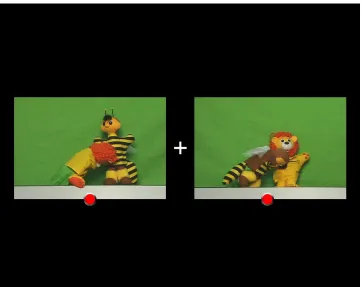
calibration was performed at this point). The two videos then appeared side by side on the
screen, frozen on the first frame (see figure 1). Video 1 played, followed by Video 2, and
the two pictures remained frozen on the screen in final frame. Another white cross
appeared between the two pictures, and participants clicked on this cross to play the
sentence (this centralized fixations, ensuring that participants were not looking at either
a picture by using the mouse to click on a red button at the bottom of that picture. They
could only do this after the sound file had finished playing. Choosing the picture ended
the trial.
FIGURE 1 ABOUT HERE
Grammaticality Judgment Test: Participants viewed a video scene and heard a
sentence with either a VAP or a VPA_ka structure. There were 12 test items, one for each
verb. For one-construction verbs, half of these sentences broke the subcategorization
restrictions of the input sentences, i.e. two VAP-only verbs occurred with VPA_ka, and
two VPA_ka-only verbs occurred with VAP. Two of the four alternating verbs occurred
with the VAP construction and two occurred with the VPA_ka construction. Participants
were asked to make two responses, one after the other:
- Is this a correct sentence in the language? [Participants click ‘Yes’ or ‘No’]
- Give the sentence a score out of 5, where 5 means ‘definitely a correct sentence in
the language’ and 1 means ‘definitely not a correct sentence in the language’.
[Participants click on a number between 1 and 5].
Measures of both binary judgment and ratings were included on the assumption that they
would show differences in sensitivity. However, no such differences were found. Since
the two measures yielded an identical pattern of results in all of the experiments, the
ratings data are not included in this paper.
Part 1 - Vocabulary Test: Participant saw pictures of each animal and said the
appropriate noun. All participants scored 100% on both days.
Part 2 - Intermittent Short Exposure and Longer Tests.
Short Sentence Exposure 1:Participants viewed a subset of 72 sentences from the
exposure set used on the previous days. Again they were instructed to repeat the sentence
out loud to help themselves learn.
Production Test: This was exactly like the production test given on days 1-3,
except that there were 24 test items, 2 per verb, and all the scenes used in this test were
entirely novel, i.e. had not occurred in the sentence exposure or the previous production
test. (This ensured that participants could not base their productions on specific
memorized sentences.) We scored the percentage of productions which correctly applied
one of the two possible sentence constructions, and the proportion of these which
corresponded to each construction for each verb.
Short Sentence Exposure 2: Participants viewed a subset of 24 sentences from the
exposure set. (This was included between tests to refresh participants’ knowledge of the
language and to minimize test effects on this knowledge).
Online Comprehension Test: This was like the Online Comprehension Test given
on days 1-3, except that there were now 24 test items, 2 per verb (sentences with
one-construction verbs obeyed the verb’s subcategorization restrictions, and each alternating
verb occurred once with each construction); all of the sentences used were entirely novel,
and participants were now eye-tracked while listening to the sentences and viewing the
two scenes.
Eye-movements were monitored using an Eyelink II head mounted eye-tracker.
At the beginning of the Online Comprehension Test, the system was mounted and the
eye-tracker calibrated using the standard nine-point Eyelink calibration procedure. As
described above, the trials included components which allowed for drift correction and
centralized fixations. Eye-movements were monitored from the point at which the
sentence began playing until the participant finished the trial by clicking on the red button
at the bottom of one of the pictures (only possible after the sentence had finished). The
Eyelink software automatically parses the eye track into three categories: saccades,
fixations, and blinks. A look to one of the two pictures was defined from saccade onset to
the end of the fixation. Because participants tended to look slightly below the picture
when they clicked on the red button, the bottom border was extended by 15 pixels to
capture more fixations. We recorded the average proportions of looks to each of the two
pictures every 4ms, as the sentence unfolded in time.
Short Sentence Exposure 3: Participants viewed another subset of 24 sentences.
(This was included between tests to refresh participants’ knowledge of the language and
minimize tests effects on this knowledge).
Grammaticality Judgment Test: This was exactly like the test on days 1-3 except
that there were now 24 test sentences, two per verb; and all of the sentences used in the
test were novel. Each verb occurred with each of the two constructions, so that half of the
recorded whether participants judged each verb to be grammatical in each of the two
constructions.
Results
Overall, 98% of productions were found to have word orders conforming to one
of the two possible constructions (verb agent patient or verb patient agent particle),
showing that participants had indeed mastered the basic language structures2. The small
minority of incorrect sentences had one of two other word orders: verb agent patient
particle or verb patient agent. These were excluded from the analyses that follow.
Figure 2 shows, for each verb class, the proportion of correct productions which
used the VAP construction (since incorrect productions are excluded, all remaining
productions used the VPA_ka construction). In these and all subsequent experiments,
there were no reliable effects of Practice Test Exposure (whether participants had taken
the extra practice tests on days 1 and 2) or Day of Testing (whether the test was taken on
day 4 or day 5), and these factors did not interact with the effects of either Verb Class or
Verb Frequency. These factors are therefore collapsed.
FIGURE 2 ABOUT HERE
Overall, 58.8% of productions were produced with the VAP construction, a
marginally significant bias towards that construction (t=1.8, p<0.1, df=13). However, in
spite of this bias, participants demonstrated clear knowledge of the subcategorization
restrictions on the one-construction verbs. The majority of productions with VAP-only
verbs used the VPA_ka construction. Alternatingverbsused each of the two constructions
approximately equally often (the slight bias towards the VAP construction was not
significant within this class, t=0.75, df=13, p>0.05). Overall, the main effect of verb class
was significant (F(2,24)=16.31, p<0.01), and planned comparisons showed significant
differences between all three classes (VAP-only versus VPA_ka-only: t=4.9, p<0.01,
df=13, VAP-only versus alternating: t=3.76, p<0.01, df=13, and VPA_ka-only versus
alternating: t=2.49, p<0.05, df=13).
As predicted, this learning of verb restrictions was modulated by verb frequency:
participants used the correct construction more often with high frequency verbs than with
low frequency verbs, F(1,12)=5.12, p<0.05. This effect mirrors so-called entrenchment
effects in natural languages: participants are less likely to use verbs in new structures
(i.e., to produce overgeneralizations) when those verbs have occurred more frequently in
the input.
Grammaticality Judgment Test
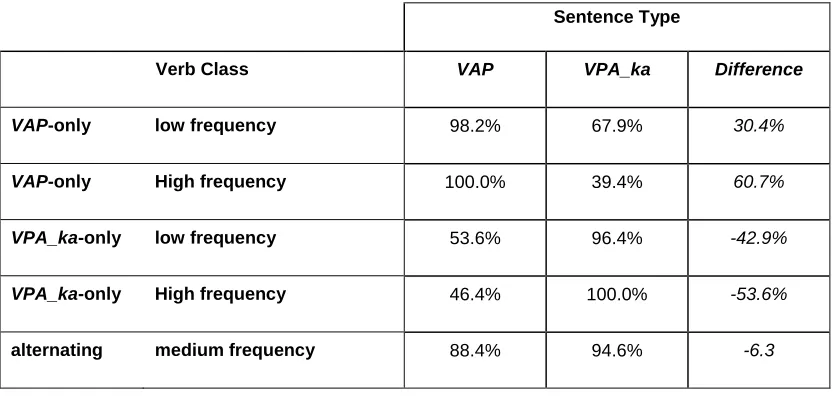
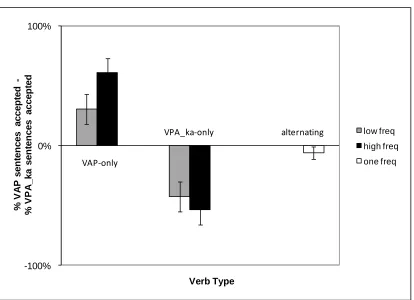
Figure 3 shows, for each of the different verb types, the difference between the
grammaticality judgments given to sentences using the VAP construction and those using
the VPA_ka construction. (These scores are calculated by subtracting the judgment scores
for each construction type. These raw data are shown in Table 1.) Note that the scores are
with respect to the VAP construction, so that a score of 100% would mean always
accepting VAP sentences and rejecting VPA_ka construction sentences, -100% would
mean always accepting VPA_ka sentences and rejecting VAP sentences, and 0% would
FIGURE 3 ABOUT HERE
TABLE 1 ABOUT HERE
The difference scores show a significant main effect of verb class (F(2,24)=16.27,
p<0.01). Participants were more likely to accept the VAP construction with VAP-only
verbs and more likely to accept the VPA_ka construction with VPA_ka-only verbs,
whereas with alternating verbs they accepted the two structures approximately equally
often. Planned comparisons showed significant differences between all three classes
(VAP-only versus VPA_ka-only: t=4.39, p<0.01, df=13, VAP-only versus alternating:
t=3.84, p<0.01,df=13, and VPA_ka-only versus alternating: t=3.3, p<0.01, df=13).
For the two one-construction classes, we also observed effects of verb frequency
(F(1,12)=6.81, p<0.05). Turning from the difference scores to the scores for the different
construction types (see Table 1), we can see that this is largely due to the greater
tendency to reject incorrect overgeneralizations: for VAP-only verbs: 67.9% of low
frequency and 39.4% of high frequency verbs were accepted in sentences with the
VPA_ka construction; for VAP-only verbs: 46.4% of low frequency and 55.4% of high
frequency verbs were accepted in sentences with the VAP construction. Again, this
mirrors the entrenchment effects which have been described in the developmental
literature.
In contrast to the results of the other tests, we see no bias towards the VAP
construction in these data (in fact there were 2% more VPA_ka productions overall, t=
Online comprehension test
Overall participants chose the correct picture on 95.7% of trials, showing again
that they had mastered the two possible word orders in the language. However, the
purpose of this test was to ascertain whether participants were able to use their
knowledge of verb subcategorization to form expectations in real time processing. That
is, we asked whether looking preference would reveal different points of disambiguation
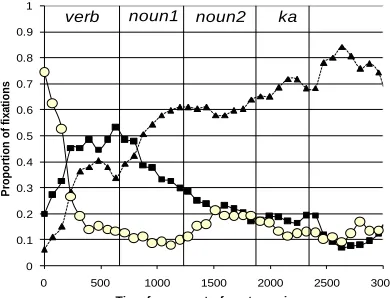
for the one-construction and alternating verbs. Figure 4 shows the proportion of looks to
each of the two pictures as participants heard sentences using each of the two
constructions.
FIGURE 4 ABOUT HERE
The results are particularly clear when we compare looking patterns as
participants hear VPA_ka sentences that begin with VPA_ka-only versus VPA_ka
sentences that begin with alternating verbs. When the sentence begins with a VPA_ka
-only verb, participants begin to look more often at the picture corresponding to the
VPA_ka sentence at around 916ms, i.e. during the first noun. In contrast, when the
sentence begins with a alternatingverb, looks to the VPA_ka picture do not begin to rise
until around 1900, i.e. after the participant has heard the disambiguating ka particle
(before that time, in the critical region there is a bias towards the VAP construction). This
demonstrates that participants show verb-specific biases online, and that, as in natural
For VAP sentences the comparison is less clear. In both cases, there are more
looks to the VAP picture in the critical region. In the case of the alternating verb, this
again demonstrates the inherent bias towards the VAP construction. However, in both
cases there are, by chance, more looks to the VPA_ka picture in the initial period, causing
looks to the VAP picture to rise even before the first noun has been heard (at which point
there is no reason to identify either picture with either of the two constructions). Thus it
is not possible in either case to identify the true point of disambiguation.
In order to factor out the effects of previous looking behavior, and to allow easy
comparison across the different verb types, we also counted the total proportion of looks
to each picture which began during the critical region from the beginning of the first
noun (when they first potentially have enough information to identify the sentence
structure), up to the beginning of the ka particle (the final disambiguating information).
Allowing the standard 200ms for programming an eye-movement (Hallet, 1986), this
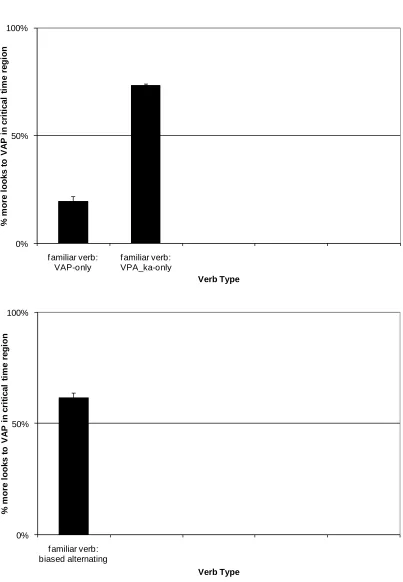
period was taken to be the time period 669-1850ms. These data are shown in Figure 5.
FIGURE 5 ABOUT HERE
There is a clear influence of verb type on looking behavior within this critical
period. For the subcategorized verbs, the majority of looks were in the direction of the
appropriate picture. There was a significant main effect of verb class, (F(2,24)=6.11,
p<0.01), and planned comparisons showed significant differences between the VAP-only
and VPA_ka–only classes (t=2.81, df=13, p<0.05) and VPA_ka-only and alternating
classes (t=2.56, df=13, p<0.05). However, alternating verbs also showed a VAP bias and
df=13, p>0.05), due to the strong bias towards the VAP construction for the alternating
class, which was itself significant (t=2.68, p<0.05, df=13).
We also examined the data from one-construction verbs for effects of frequency.
Although these effects were in the expected direction, they were not significant
(frequency effect for VAP class: F(1,12)=1.39, p>0.05, frequency effect for VPA_ka
class: F(1,12)=0.26, p>0.05, overall frequency effect: F(1,12)=3.56, p>0.05).
Discussion
The central finding of this experiment is that participants were able to acquire
verb-specific subcategorization constraints from the input distribution. That is, they
successfully learned the permissible and non-permissible constructions for each verb.
Since there are no semantic or phonological cues to verb class and no pre-empting
structures indicating missing ungrammatical forms, we conclude that this is accomplished
through entirely statistical processes: tracking the frequency of the various verb-structure
co-occurrences and using this as evidence as to the status of both the occurring and the
missing verb-structure combinations. It is important to emphasize that these constraints
were successfully learned even though the language showed heterogeneity in the way
constructions were used with different classes of verbs. Although the majority of verbs in
the miniature language were subcategorized to occur with only one construction, a
substantial number could occur with both constructions (four verbs in each of the three
classes). In addition, participants’ ability to avoid over-generalization is particularly
nouns), so the learning could not have been accomplished by memorizing specific
sentences or verb-noun combinations from the input exposure set.
Results from the three different tests were highly consistent: learners avoided
overgeneralizations in their own productions, judged over-generalized forms to be less
grammatical, and used their knowledge of verb subcategorization in real-time parsing.
This last result was particularly striking in that we saw an influence of verb-class on
eye-movements at the earliest possible moment, suggesting that participants were forming
expectations about upcoming structure as soon as the verb was processed. This provides
strong evidence that our artificial language stimuli are being parsed in a manner akin to
natural language and establishes that purely distributional verb-biases can play a role in
this process. The only difference between the three tests was that, whereas participants
were clearly biased to predict the VAP construction and show a marginal preference for
that construction in production, this bias did not affect judgments of grammaticality. (We
return to this point in the Discussion of experiment 2).
In addition, we saw frequency effects within the one-construction verb classes:
participants were less likely to produce or accept new structures with high frequency
verbs. This result is important for two reasons. First, it mimics the entrenchment effects
reported in the acquisition and processing literatures, suggesting that our learners are
following a similar development path to learners of natural languages. (We acknowledge
that, as our two constructions have the same meaning, our effects might also be described
as statistical pre-emption (Goldberg, 2005) Whether the same effects would have been
research.) Secondly, observing learners’ behavior with verbs for which they have had
different amounts of exposure has provided us with a window into the learning process. It
shows us the process by which our learners are able to retreat from over-generalization:
the more often they hear a verb used in only one of the constructions, the more certain
they are that it shouldn’t be generalized. We expect that increased exposure to our
languages would make learners increasingly less likely to over-generalize.
Experiment 2
The central finding of Experiment 1 was that learners were able to learn that
certain verbs were (arbitrarily) subcategorized to occur only with one construction, even
in the presence of a class of verbs which could occur in both. This constrained behavior
can be described as lexical conservatism – the treatment of each verb was dependent on
that verb’s own behavior in the past. However, though we have emphasized this
conservative behavior, which shows successful acquisition of the verb classes, our
learners did sometimes generalize, as we saw whenever they made an ‘error’ with the
one-construction verbs. In this case, the treatment of these verbs must be affected by the
behavior of the other verbs in the input. Thus, as in real acquisition, learners of these
languages must balance what they know about verbs in general against their verb-specific
knowledge. Our hypothesis is that this balancing process depends on the distributional
details on the input (though we acknowledge that other semantic and phonological factors
will also play a role in natural languages). We have already seen one distributional factor
which affects the tendency to generalize: individual verb frequency. In Experiment 2, we
on distributional factors outside of that verb’s own history. In particular, we explore
whether changing aspects of the class of alternating verbs might make learners more
likely to extend that class and treat all verbs as alternating.
In Experiment 1, the presence of a class of unrestricted, alternating verbs did not
prevent learners from acquiring subcategorization restrictions on other verbs. However,
two aspects of the language may have helped to make the limits of that class minimally
confusing. First, there were only half as many alternating verbs as one-construction
verbs, so that learners observed mostly lexically conservative behavior. This may have
encouraged them to attend to lexically-based distributional information. Second, although
we included frequency distinctions within the one-construction verb classes, all verbs in
the alternating class occurred equally frequently. This may have provided the learner with
additional evidence that there was a distinct set of verbs which could occur with both
constructions. If, in contrast, verbs within the alternating class occurred with varying
frequencies, a rational learner might be less sure whether all verbs in the language might
likewise fall in this class, since the absence of sentences in which some verbs occurred in
certain structures might simply be due to the low frequency of those combinations.
In Experiment 2, we manipulated these factors. Learners were exposed to a
language in which verb-structure co-occurrence patterns were identical to those in
Experiment 1 (one-construction verbs occurred 100% of the time in one structure,
alternating verbs occurred 50% of the time in each structure), but the class of alternating
verbs had two new properties: It was twice as large (in terms of number of verbs and
which occurred with varying degrees of frequency. In addition, the frequency distinction
within the two one-construction verb classes was increased from 3:1 to 5:1. This was
done in an effort to increase the likelihood of finding these effects, particularly in the
eye-tracking data, where they did not appear in Experiment 1.
Method
Participants
Fourteen native English speakers participated in the experiment. Most were
undergraduate students at the University of Rochester; the remainder were former
students or age mates who attended another college. Again, participants were run and
tested individually, paid daily for their participation, and received a bonus upon
completion of the entire experiment.
Description of the Language
The language used in Experiment 2 was identical to that used in Experiment 1
except for the division of verbs into verb classes.
Verb Classes: The 12 verbs were divided into VAP-only verbs, VPA_ka-only verbs and
alternatingverbs. However, in this experiment the distribution was as follows:
2 VAP-onlyverbs (1 high frequency, 1 low frequency)
2 VPA_ka-onlyverbs (1 high frequency, 1 low frequency)
Again, a different random assignment of verbs to verb classes was performed for each
participant.
Input Sentence Sample: The input set in this experiment had the following distributional
properties:
Within the verb classes, verbs occurred equally often, except that high frequency
verbs were five times as frequent as low frequency verbs and mid frequency verbs
were three times as frequent as low frequency verbs.
Overall, the VAP-onlyand VPA_ka-only constructions occurred equally often.
Materials
These were same as those used in Experiment 1.
Procedure
The procedure was very similar to that used in Experiment 1. In order to maintain
the required frequency contrast (for some verbs to be heard five times as often as others),
the exposure set was slightly larger. Also, no participants took tests on days 1 and 3 since
that was found to have no effect on later performance in Experiment 1.
Procedure Days 1 to 3:
Part 2 - Sentence Exposure: Participants viewed a set of 216 transitive scene
sentence pairs. The input set had the structure described above, with sentences presented
in random order. Again participants were instructed to repeat the sentence out loud to
help themselves learn.
Part 3 - Short Tests: (Day 2 only) As in Experiment 1.
Procedure on Days 4 and 5:
Part 1 - Vocabulary Test:As in Experiment 1.
Part 2 - Intermittent Short Exposure and Longer Tests.
Short Sentence Exposure 1: Participants viewed a subset of 108 sentences from
the exposure set used on the previous days. Again they were instructed to repeat the
sentence out loud to help themselves learn.
Production Test: As in Experiment 1.
Short Sentence Exposure 2: Participants viewed a subset of 36 sentences.
Eye-tracked Comprehension Test:As in Experiment 1.
Short Sentence Exposure 3:Participants viewed a subset of 36 sentences.
Results
Production Test
Overall, 94% of participants’ productions were found to conform to one of the
two correct word orders. Again, incorrect productions were excluded from subsequent
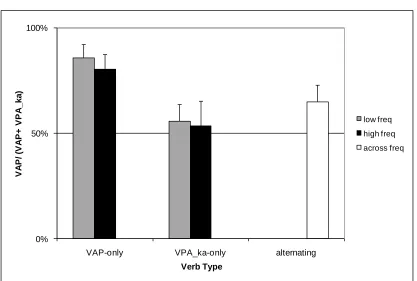
analyses. Figure 6 shows the proportion of trials in which participants produced the
VPA_ka construction for each of the different verb types. As in Experiment 1, there is a
main effect of verb class (F(2,26)=4.38, p<0.05), showing some learning of the verb
subcategorization. However, the tendency to over-generalize is clearly stronger than in
the previous experiment. This is particularly clear with the VPA_ka-onlyverbs, which are
actually produced slightly more often with the VAP construction. In general, there is a
strong bias for that construction (across the three verb classes, an average of 68% of
productions occurred in that construction, compared to chance: t=3.74, df=13, p<0.05).
There are no effects of verb frequency for one-construction verbs (F(1,12)=.45, p>0.05).
FIGURE 6 ABOUT HERE
Grammaticality Judgment Test
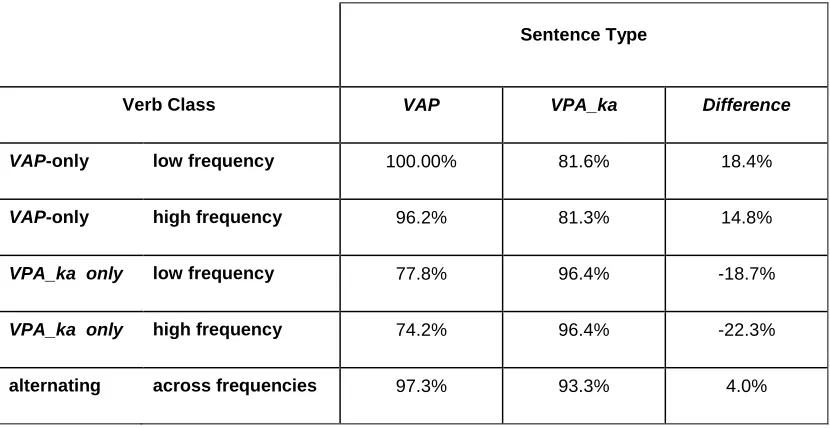
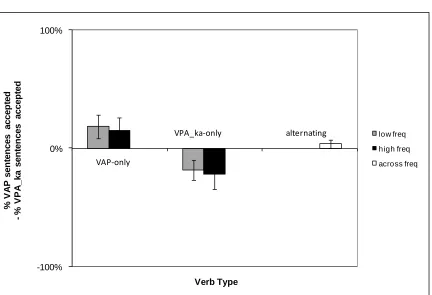
Difference scores are shown in Figure 7, with the raw judgment data for verbs in
each construction shown in Table 2. In contrast to Experiment 1, the majority of
verb-construction combinations were judged to be grammatical, including overgeneralizations
with one-construction verbs. There is only a marginal effect of verb class (F(1.09,