Abstract—Many attempts have been made to introduce computational thinking into elementary, secondary, and K–12 education. In Japan, programming will be introduced into the elementary-school curriculum in 2020. Parents play a very important role in primary education and their attitudes about education have a considerable influence on their children’s attitudes. To investigate parents’ concerns about elementary-school children learning to program computers, this study gathered data using a questionnaire survey to provide a basis for analysis.
Index Terms—computational thinking, elementary school, programming education, parents’ concerns
I. INTRODUCTION
HERE have been widespread attempts to introduce computational thinking to elementary/secondary or K–12 education [1],[2]. The term “computational thinking” was first used by Papert [3] and popularized by Wing [4]. According to Wing, “‘Computational thinking’ involves solving problems, designing systems, and understanding human behavior, by drawing on concepts that are fundamental to computer science.” (p. 33). Additionally, she stated that computational thinking is a fundamental skill for everyone and that it should be added to every child’s analytical ability. Her article generated significant interest among educators and education researchers; as a result, many studies related to K–12 computational thinking have been carried out since its publication. In the United Kingdom, computing was introduced as a new primary- and secondary-school subject in 2014. The primary teachers’ guide to computing states repeatedly that computational thinking is extremely important.
As computational thinking increasingly draws attention, programming education is also receiving attention as one of the ways of teaching computational thinking. Lye and Koh [5] have argued that “[p]rogramming is more than just coding, for it exposes students to computational thinking which involves problem-solving using computer science concepts, and is useful in their daily lives” (p. 51). In Japan, the Central Council for Education in the Ministry of Education, Culture, Sports, Science, and Technology submitted a report that
Manuscript received December, 2018; revised December 21, 2018. This work was supported by JSPS KAKENHI, grant number JP18K02832.
Yukiko Maruyama, IT Education Center, Tokai University, Japan. e-mail:[email protected].
suggested introducing programming education to elementary schools. Another council report argued that elementary-school programming classes should aim to foster students’ “programming thinking” (author’s translation), rather than actually teaching children to code. Programming thinking is considered to be a similar concept to computational thinking and a part of computational thinking. So far, however, there has been little public understanding of the need for programming education. Instead, misconceptions and anxieties about programming education have begun to spread among parents. Parents play a key role in elementary education and their attitudes toward education have considerable influence on their children’s attitudes. Researchers have investigated the topic of parent-child collaboration in relation to robotics education [6], [7] and programming [8], [9]. Parental misconceptions and anxieties about programming education could prevent them from becoming positively involved in their children’s learning. It is therefore very important to understand why parents are concerned about programming education. This paper provides the results of a preliminary investigation into parents’ concerns about programming education in elementary schools. The results of the analysis reveal interesting regional differences.
II. RELATED WORKS
As mentioned above, parents’ attitudes toward education have a considerable influence on children’s attitudes.
Hart [9] carried out a computer science based workshop that targeted fourth- through sixth-graders (mainly girls) and their parents. The participants took part in an attitudinal survey during the first and last sessions of the workshop. The survey results showed that, between the initial and final sessions, the participants’ perceptions of general computer use, potential computing science careers, and perceived gender-based differences in ability became much more positive. Moreover, much of the feedback from parents was also positive.
Lin and Liu [8] observed three parent-child pairs in a computer camp used MSWLogo. They found that parent-child collaborations during programming naturally fell into a special form of “pair programming” and that the children wrote programs in a more systematic and disciplined way. They also found that the programs produced by these participants were more compact, well-structured, and contained fewer error.
Cuellar et al. [6] conducted a robotics education workshop
Study of Regional Differences in Parents’
Concerns about Programming Education in
Elementary School
Y. Maruyama
in which parents and children interacted by experimenting with robotics concepts and developing problem-solving skills. They hypothesized that students would become more interested in technology and parents would give them more encouragement to choose engineering and science majors. Over the course of the workshop, the researchers observed enhanced teamwork and interactions, as well as a positive view of the initiative.
Thus, parents’ involvement in education significantly impacts children’s attitudes and outcomes. Unfortunately, some parents have little confidence in their children’s educational engagement, particularly in relation to new technologies.
Feng et al. [10] regard parents as important influencers of children deciding whether to attend robotics courses and whether to use educational robots. They have investigated parents’ perception of edutainment products, including programmable bricks. They designed a questionnaire to measure whether parents considered programable bricks useful or felt confident using them to teach their children. Of the 55 parents contacted, 26 submitted valid questionnaires; the results showed that parents considered programable bricks useful but did not feel confident about using them to teach their children. Feng et al. advised future researchers to develop customized courses for parents and children and develop other ways to build parents’ confidence, enabling them to use programable bricks to teach their children.
Lin et al. [11] investigated parents’ perceptions of educational robots. Completed self-report questionnaires from 29 parents showed that they had a positive attitude toward educational robots and thought that it would be beneficial for their children to learn about them. However, they also found that parents did not feel confident about using educational robots to teach or play with their children. They therefore recommended teaching parents to use and understand educational robots.
III. INVESTIGATION
A. Procedure
The survey for this study was carried out in November 2017 and March 2018, using a questionnaire. Two elementary schools were asked to invite their children’s parents to participate in the survey, using classroom teachers to distribute and collect the questionnaires. Both schools were public elementary schools, one in Tokyo, the capital area (hereafter referred to as school T). The other was located in Yamagata Prefecture, in provincial Northeast Japan (hereafter referred to as school Y).
B. Questionnaire
The questionnaire included the following six sections: (1) demographics; (2) interest in and attitudes towards programming education in elementary school; (3) expectations for introducing programming education into elementary school; (4) anxieties about programming education in elementary school; (5) attitudes about and confidence in supporting children at home; and (6) their own experiences of computer usage. Other questions related to
English education; these have not been included in the present paper.
C. Participants
Eighty-nine (56: school T; 33: school Y) valid responses were obtained. Of the 89 respondents, 75 (49: school T; 26: school Y) were mothers and 7 (1: school T; 6: school Y) were fathers of elementary school children (7 were non-responses). The average age of respondents was 42.1 (43.1: school T; 40.6: school Y. There were 20 non-responses). The children’s school years are shown in Table 1 below.
IV. FINDINGS AND DISCUSSION
This section compares the results of the two schools. All of the p-values in this section derive from a Mann-Whitney U test (*p<0.05, **p<0.01).
A. Usage of computer
[image:2.595.344.522.269.363.2]Table 2 shows how the respondents self-evaluated their own computer usage. While 43.1% of respondents from school T evaluated themselves as “Quite skilled” or “Capable,” no parents from school Y considered themselves “Quite skilled” and only 30.3% assessed themselves as “Capable.” When asked about using computers at work (Table 3), about 45% of those from school Y responded “I have a computer-related job” or “I use a computer for work” in contrast with about 30% from school T. When asked about using computers in daily life (Table 4), more than 60% responded that they used computers often or sometimes. Overall, the respondents seemed relatively familiar with computers but not very skilled. It is possible that respondents from school Y downplayed their own abilities.
TABLE 1
School year of respondents’ children
School year Freq. (school T) Freq. (school Y)
1 0 0
2 0 0
3 0 8
4 27 11
5 0 15
6 6 22
TABLE 2
Self-evaluation: using computers
Responses School T
Freq. (%)
School Y Freq. (%) Quite skilled 2 (3.6) 0 (0.0)
Capable 22 (40.0) 10 (30.3)
[image:2.595.322.546.579.766.2]Not very skilled 18 (32.7) 15 (45.5) Not skilled at all 13 (23.6) 8 (24.2) non-response: 1 TABLE 3
Experiences of using a computer at work
Responses School T
Freq. (%)
B. Interests in and attitudes towards programming education
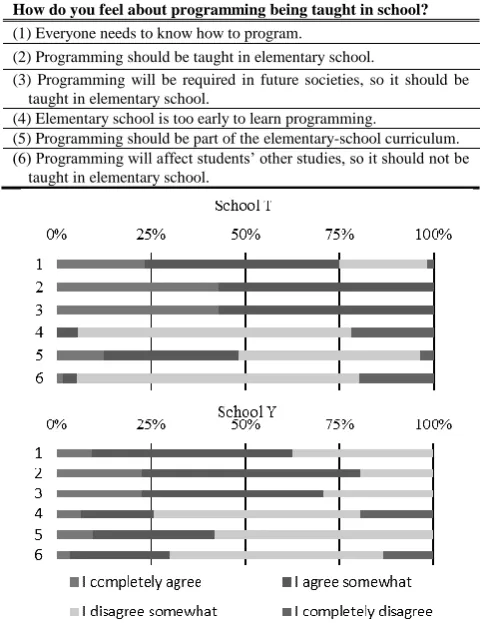
Fig. 1 shows the participants’ responses to questions about their own interest in programming education (Table 5). The majority of respondents from school T were interested in programming education in elementary school and all were in favor of it. By contrast, about 30% of the respondents from school Y were not interested in programming education in elementary school and more than a few respondents opposed to it. A graph for item 4 in Fig. 1 shows that about 80% of respondents from school Y did not know (very much or at all) what children currently learned about computer in elementary school. By contrast, half of the respondents from school T stated that they did know (very well or somewhat). Overall, respondents from school T were more familiar with the content of programming education.
In relation to the parents’ attitudes toward programming education (Table 6 and Fig. 2), there were statistically significant differences in the responses to Questions 2, 3, and 6 (p = 0.006 < 0.01, p = 0.001 < 0.01 and p = 0.018 < 0.05). In questions 2 and 3, all participants from school T agreed that it was appropriate to teach programming in elementary school. In school Y, about 25% responded “somewhat disagree” and
more than 25% agreed with the statement, “Programming will affect students’ other studies, so it should not be taught in elementary school.” (Question 6) Moreover, although there was no statistically significant difference, 25% of those in school Y thought that “Elementary school is too early to learn programming.” (Question 4).” Respondents from school Y were much more cautious about introducing programming education in elementary school.
C. Expectations and anxieties about programming
education
When it came to the participants’ expectations about introducing programming education (Table 7 and Fig. 3), Fig. 3 shows that expectations were generally higher among parents at school T. There were statistically significant differences in items 1, 2, 3, 5, 6, 7, 8, 9, 10, 13, and 14 ( p = 0.010*, p = 0.009**, p = 0.002**, p = 0.037*, p = 0.011*, p = 0.002**, p = 0.020*, p = 0.001**, p = 0.14*, p = 0.000** and p = 0.001**). The expectations measured in items 9s, 13, and 14 were relatively low at school Y. Item 9 relates to the children’s future careers; items 13 and 14 relate to general skills.
The extent to which parents expected their children to achieve more as a result of programming education followed the same trends (Table 8 and Fig. 4). Fig. 4 shows that expectations were generally higher at school T than at school Y. There were statistically significant differences for items 1, 2, 6, 7, 8, 9, 10, 11, 12, 13, and 14 ( p = 0.002**, p = 0.001**, p = 0.017*, p = 0.047*, p = 0.001**, p = 0.045*, p = 0.000**, p = 0.003**, p = 0.008**, p = 0.000** and p = 0.000**). TABLE 4
Experience of using computers in daily life
Responses School T
Freq. (%)
School Y Freq. (%) I use one often 16 (28.6) 6 (18.2) I use one sometimes 19 (33.9) 14 (42.4) I seldom use one 12 (21.4) 7 (21.2) I never use one 9 (16.1) 6 (18.2)
TABLE 5
Questions concerning your interest in programming education (1) Are you interested in programming education in elementary school? (2) Do you know what the new Course of Study (teaching guidelines issued by the Ministry of Education, Culture, Sports, Science and Technology) for elementary schools stipulates regarding programming education?
(3) Are you in favor of or opposed to programming education in elementary school?
(4) Do you know what children currently learn concerning computers in elementary school?
TABLE 6
Questions about your attitude towards programming education How do you feel about programming being taught in school? (1) Everyone needs to know how to program.
(2) Programming should be taught in elementary school.
(3) Programming will be required in future societies, so it should be taught in elementary school.
(4) Elementary school is too early to learn programming.
(5) Programming should be part of the elementary-school curriculum. (6) Programming will affect students’ other studies, so it should not be
taught in elementary school.
[image:3.595.45.286.449.678.2]Fig. 2. Responses to questions about participant attitudes toward programming education
Among these, expectations for items 6 (writing computer programs), 10 (thinking logically), 12 (doing well in other subjects), 13 (developing good communication skill) and 14 (developing good collaborative skills) were relatively low in school Y. It possibly that respondents from school Y had less information than those at school T. The results reveal their anxieties.
TABLE 8
Questions about expectations for children’s achievement To what extent do you want programming classes in elementary school to accomplish the following?
(1) Children will enjoy using computers.
(2) Children will be inclined to uses computers.
(3) Children will be able to use computers to write compositions.
(4) Children will be able to use computers to draw pictures.
(5) Children will understand how a computer works.
(6) Children will be able to write computer programs.
(7) Children will be adept at using computers.
(8) Children will learn how to use the Internet.
(9) Children will be able to understand arithmetic and science.
(10) Children will learn to think logically.
(11) Children will think about the steps one must follow when performing a task.
(12) Children will be better able to study other subjects.
(13) Children will be better able to communicate their thoughts.
[image:4.595.318.540.282.742.2](14) Children will be better able to work with others.
Fig. 3. Responses to questions about expectations following the introduction of programming education
TABLE 7
Questions about expectations for introducing programming education What effect do you think it will have to teach programming in elementary school?
(1) Children will become skilled at using computers (2) Children will enjoy using computers
(3) Children will learn to think logically (4) It will help with work in future
(5) Children will enjoy arithmetic and science (6) Children will learn about using ICT (7) Children will learn ICT skills
(8) It will produce personnel with advanced ICT skills (9) It will make Japan a global powerhouse in ICT (10) Children will learn problem-solving skills (11) Children will learn to be creative
[image:4.595.54.283.314.762.2](12) Children will learn how to express themselves (13) Children will learn problem-identifying skills (14) Children will be better able to communicate
With regard to anxieties, (Table 9 and Fig. 5). Fig. 5 shows that parents at school Y had higher levels of anxiety than those at school T. There were statistically significant differences for items 2, 3, 5, 7 and 9 (p = 0.026*, p = 0.000**, p = 0.002**, p = 0.031* and p = 0.001**). In particular, school-Y parents worried about the content and uncertain aims of programming education (Items 2 and 3). It is probable that these uncertainties led them to have low expectations of programming education. It is therefore necessary to provide information on programming education to all parents.
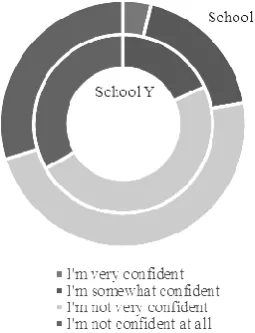
[image:5.595.302.553.64.405.2]Parental anxiety about supporting children at home (Item 9) was also higher at school Y than at school T. However, there were no statistically significant differences in parents attitudes toward or confidence about supporting their children’s education (Table 10, Figs. 6, 7, and 9).
TABLE 9
Questions about parents’ anxieties about programming education Are you anxious about the following items concerning programming education in elementary schools? (1) There are not enough teachers to provide instruction. (2) Programming education does not have clear aims.
(3) Perhaps programming will adversely affect the study of other subjects.
(4) The content taught differs depending on the school and teacher. (5) Children’s workload will increase.
(6) I wonder whether my child can keep up. (7) I wonder whether I can provide guidance at home.
(8)I wonder whether programming education in elementary school leads to improvements in middle school comprehension.
(9) The content of programming education is not clear
TABLE 10
Questions about parents’ anxieties about supporting children at home (1) Do you think supplementary instruction outside school will
be necessary for programming education?
(2) Do you think you will help to provide supplementary programming instruction at home?
[image:5.595.52.284.257.738.2](3) If you plan to provide supplementary instruction at home, how much confidence do you have in your own ability to do this?
[image:5.595.369.503.351.523.2]Fig. 5. Responses to questions concerning parents’ anxieties about programming education
Fig. 6. Responses to questions about the need for support
Fig. 7. Responses to questions about providing support
[image:5.595.376.504.575.742.2]V. CONCLUSION
This paper has investigated parents’ concerns about programming education. The results of the analysis reveal the following regional differences:
1) Parents in the capital area were more familiar with the content of programming education than parents in the provincial area.
2) Parents in the provincial area were more cautious about introducing programming education at the elementary-school level.
3) Parents in the provincial area had low expectations and high levels of anxiety about programming education, probably as a result of insufficient information about programming education. It is therefore essential to provide information on programming education to all parents.
4) Although provincial parents felt more anxious about supporting their children at home, there were no differences in the parents’ attitudes toward supporting their children’s learning at home.
REFERENCES
[1] V. Barr and C. Stephenson, Bringing computational thinking to K–12: What is involved and what is the role of the computer science education community? Acm Inroads, Vol. 2, No. 1, pp. 48–54, 2011.
[2] S. Grover and R. Pea, Computational thinking in K–12: A review of the state of the field. Educational Researcher, Vol. 42, No. 1, pp. 38–43, 2013.
[3] S. Papert, Mindstorms: Children, Computers, and Powerful Ideas, 2nd ed., Basic Books, New York, 1993.
[4] J. M. Wing, Computational Thinking, Communications of the ACM, Vol. 49, No. 3, pp. 33–35, 2006.
[5] S. Y. Lye and J. H. L. Koh, Review on teaching and learning of computational thinking through programming: What is next for K–12? Computers in Human Behavior, Vol. 41, pp. 51–61, 2014.
[6] F. Cuellar, C. Penaloza, and G. Kato, Robotics education initiative for parent-children interaction. In RO-MAN, August 2013 IEEE, pp. 364–365.
[7] R. Roque, K. Lin, and R. Liuzzi, “I’m Not Just a Mom:” Parents Developing Multiple Roles in Creative Computing. Singapore: International Society of the Learning Sciences, 2016.
[8] C. H. Lin, E. Z. F. Liu, and Y. Y. Huang, Exploring parents' perceptions towards educational robots: Gender and socio-economic differences. British Journal of Educational Technology, 43(1), 2012.
[9] M. L. Hart, Making contact with the forgotten K–12 influence: Are you smarter than YOUR 5th grader? Proceedings of the 41st ACM technical symposium on Computer science education, Wisconsin, USA, pp. 254–258, 2010.
[10] H. C. Feng, C. H. Lin, and E. Z. F. Liu, Parents' perceptions of educational programmable bricks for kids. British Journal of Educational Technology, 42(2), pp. E30–E33, 2011.