Abstract— Nowadays, cloud systems are very topical concept
almost in every industry, yet many organizations have not fully comprehended the terms and its implications. Many advantages of Cloud Services (CS) are referred in the literature such as low operational costs, accessibility, flexibility and more. Selecting the most suitable CS for the company is a critical process for the businesses since it is an essential way to gain a competitive advantage over rivals; but at the same time, it retains a considerable risk to fail due to the unsuitable selection. Moreover, CS can be an essential instrument to gain efficiency in supply chain management (SCM). Motivated by this critical importance, this study proposed a linguistic decision-making procedure for CS selection for supply chains. 2-Tuple integrated SAW-EDAS methodology is suggested and to test the plausibility of the integrated approach a small case study about a company from Turkey is given with the evaluated results.
Index Terms—Cloud computing, Cloud service selection, 2-Tuple-EDAS, Group decision-making
I. INTRODUCTION
HORTLY cloud services (CS) is a model to empower advantageous, on-demand network access. It is accessible to a shared pool of build-up computing resources which can be easily maintained [1]. CS enables businesses to move their simple computing tasks to remote servers. This transformation process results in an investment cost. Specialization of third-party service providers that focus on defined tasks with related equipment and human resources can provide more affordable and high-quality services.
Besides choosing the best third-party supplier for the company, choosing the most appropriate CS for the business is also possess a critical role for the competitive advantage. Therefore, CS offering products need to be well assessed with its negative and positive properties.
Also, in the logistics sector where supply chains are the backbone of the system, their integration with a CS system is an essential advantage in the market. In a global market, the internet contributes to various opportunities that cause a technology-driven competitive advantage[2]. IT is a very
This work is financially supported by Galatasaray University Research
Fund with project number 19.102.002.
Deniz Uztürk is with Department of Business Administration,
Galatasaray University 34349 İstanbul, Turkey([email protected])
Gülçin Büyüközkan is with the Department of Industrial Engineering, Galatasaray University, 34349 İstanbul, Turkey Tel: +902122274480, Fax: +902122595557 ([email protected])
A. Fahri Negüs is with Department of Business Administration, Galatasaray University 34349 İstanbul, Turkey ([email protected])
M. Yaman Öztek is with Department of Business Administration, Galatasaray University 34349 İstanbul, Turkey ([email protected])
well accepted critical resource for a successful supply chain management (SCM). It augments the supply chain's performance, and it provides better planning[3], [4].
Wrong CS provider selections can cause harmful business partnerships that can damage the company with unsuitable service [5]. Choosing the right CS supplier is crucial since a third-party CS company becomes a business partner with the company. Regarding this, having a parallel roadmap between the company and the supplier turned out to be essential. Nevertheless, companies struggle with complicated e-SCM systems that can diminish the efficiency of the organization. Motivated by these critical roles of CS supplier in the business, this study focuses on CS selection methodology.
Since various criteria must be evaluated to obtain a better assessment of CS, this process could be approached as a multi-criteria decision-making (MCDM) problem. This study proposed a new combined MCDM methodology for a CS provider selection. For that propose, first, an in-depth literature review has been made to gather key index criteria to choose the CS provider. Simple Additive Weighting Method (SAW) have been suggested to weigh the criteria and to be able to make the selection; the EDAS method has been proposed. Both SAW and EDAS method have been used with their fuzzy extensions to better deal with uncertainties and to create flexible decision-making environments for decision makers (DMs).
SAW method is one of the oldest weighting methods that is based on weighted average [6]. An evaluation score is calculated for each alternative by multiplying the scaled value given to the alternative of that attribute with the weights of relative importance directly assigned by decision maker followed by summing of the products for all criteria [7]. Enabling a proportional linear transformation of the raw data is the advantage of this method.
EDAS method was first introduced by Ghorabaee et al. in 2015 [8]. It uses the average solution to examine the alternatives. Negative Distance from Average (NDA) and Positive Distance from Average (PDA) are attended as the appraisal for this method. Both methods’ fuzzy extension has been generated and applied to various MCDM problems. In this study, two approaches have been combined to provide a robust and secure CS selection problem.
The remainder of this paper is as follows: the next section gives a literature review about CS evaluation criteria, and the latter gives the literature about EDAS tool. Section IV provides the detailed steps of the proposed methodology with preliminaries. Afterward, the case study is presented
An Integrated Cloud Service Selection
Methodology for Businesses
Deniz Uztürk, Gülçin Büyüközkan, M. Yaman Öztek and A. Fahri Negüs
with the results. Finally, conclusions are given at the end with future works.
II.CLOUD SERVICES
Cloud technologies are the future of new business models where dynamic monitoring of computing resources and the availability of information is enabled [9]. Today, CS is a very topical issue in companies, and various CS providers have been popped-up due to this demand. This expansion on the number of CS suppliers creates a challenge to choose the most suitabşe provider for the business. Different variety of criteria must be evaluated to reach the right decision. To detect the selection criteria, the company must know itself very well to generate its needs for the CS. In the literature, it exists various criteria to evaluate CS provider. There are a different variety of cloud services available for users. Hence, the literature has been already motivated by related problems in this area. For example, a new model has been developed by Li et al. to evaluate the reliability of cloud services [10]. In this study, the importance of confidentiality, integrity, auditability, and availability have been accentuated.
Moreover, Bose at al. have proposed trust related factors as evaluation criteria for CS [11]. A wide variety of authors suggests investment, maintenance, integration and flexibility as the cost dimensions. Another issue mentioned in the literature about CS is service quality [12], [13].
Besides, vendor-related criteria are also very essential for evaluation. It covers the capacity and ability of the vendor in related product besides with vendor's reputation[14]. According to the literature review, this study has grouped CS assessment criteria. Criteria and sub-criteria have been given in Table I.
TABLE I EVALUATION CRITERIA
1st level criteria 2nd level criteria
Cost Investment cost
Maintenance cost
Flexibility cost
Support cost
Integration cost
Quality SLA management
Service stability
Management Billing
Monitoring
Reporting
System capacity Communication
Memory
Speed
Cloud security Confidentiality
Availability
III. LITERATURE REVIEW
In this study, the fuzzy extension of EDAS has been used to select among the different CS suppliers. Existing literature is filled with F-EDAs applications for selection problems. Some recent studies are generally focusing on the selection of convenient supplier or evaluation of suppliers in different variety of sectors. Following Table gives the application areas of works done with a fuzzy extension of EDAS in recent years.
TABLE II
RECENT STUDIES APPLIED F-EDAS
Reference Application Area
[15] Selecting the most suitable manufacturer of PVC carpentry for
the apartment refurbishing
[16] Developing a life cycle sustainability decision-support
framework for ranking hydrogen production pathways
[17] Subcontractor evaluation
[18] Construction equipment evaluation with sustainability
considerations
[19] Interval-valued neutrosophic EDAS for prioritization of the UN’s goals
[20] New GDM approach proposition
[21] Cultural heritage item preservation, renovation, and
adaptation
[22] Supplier evaluation and order allocation with environmental
considerations with type-2 fuzzy sets
[23] Service quality evaluations in airlines
[24] Stochastic EDAS method for multi-criteria decision-making
with normally distributed data
[25] Interval type-2 fuzzy sets integrated EDAS for subcontractor
selection
[26] Supplier selection in the fuzzy environment
Since various convenient applications are made with F-EDAS for selection problems, this study is also selected the same method to choose the most appropriate CS supplier.
IV. METHODOLOGY
This paper approached CS provider selection as the MCDM problem, and Fuzzy EDAS (F-EDAS) have been suggested for the selection methodology. The offered methodology consists of 2 phases:
Phase 1 consist of:
1. Determining evaluation criteria 2. Weighting of the criteria 3. Determining alternatives.
In this phase, F-SAW method is suggested to obtain the relative importance of assessment criteria.
In Phase 2 the necessary steps are as follows:
1. Forming a decision matrix with assessment criteria and detected alternatives.
2. Constructing an average value matrix.
3. Calculating positive and negative distances to average values.
4. Calculation of weighted sum of distances. 5. Normalization of weighted sum values.
6. Calculating appraisal scores to rank the alternatives
Steps mentioned above are the primary steps of the EDAS method. The details of fuzzy logic and operations are given in the Preliminary section. The general framework of the proposed technique is presented in Figure 1.
Both phases consist of the tools based on the DM’s knowledge about the subject. Both MCDM tools are extended with fuzzy logic, and this integration enables linguistic assessments by DMs. Linguistic variables facilitate the decision-making process and allow DMs to express their opinion with linguistic variables to better reflect the impreciseness and haziness.
1
•Determining selection criteria
2
•Detecting weights of the criteria
3
•Determining alternatives
• Forming a decision matrix .
4
• Constructing average value matrix 5
• Calculating the positive and negative distance 6
• Calculation of weigted sum of distances 7
• Normalization of weighted sum of distances. 8
• Calculating apparaisal score .
9
Literature Review
Experts
Fuzzy Linguistic
[image:3.595.128.478.48.251.2]Group Decision Making
Fig. 1 Essential stages of the suggested methodology
A.Preliminaries
A fuzzy extension of EDAS and SAW tools are suggested in this study. Basic fuzzy operations generated by Zadeh have been applied to extend these tools [27]. Detailed operations are defined as follows for the F-EDAS application [26]:
A trapezoidal fuzzy number’s (TFN) membership function is given as in Eq. (1):
(1)
The basic operations such as subtraction, multiplication, division, and addition are already defined in fuzzy sets [26]:
(2)
where k is a crisp number and is a TFN.
Basic operations of two different fuzzy sets
and are as follows:
(3)
Multiplication:
(4)
(5)
Division:
(6)
Defuzzification of a TFN is the essential property of fuzzy logic. A fuzzy variable can be defined as a crisp number by the following relation. Defuzzification of a TFN
and is as follows:
(7)
V.CASE STUDY
To test the plausibility of the suggested the viability and the effectiveness of the framework will be verified with a case study application. An SME faced with the difficulties of choosing an efficient cloud service supplier. To meet the needs of a customer, CS evaluation criteria will be used to make a CS provider selection. For this purpose:
Step 1: First, three DMs have been gathered to set up a decision-making group. Criteria have been settled as it is mentioned in Table I.
Step 2: Linguistic scales have been given and explained to DMs, and they have made their assessments to identify criteria weights. Table III represents the linguistic scale.
TABLE III
LINGUISTIC SCALES FOR DMS [28] Linguistic
Term Abbreviation
Fuzzy Scale Absolutely
High AH 0,80 0,90 1,00 1,00
Very High VH 0,70 0,80 0,80 1,00
High H 0,50 0,60 0,70 0,80
Equal E 0,40 0,50 0,50 0,60
Low L 0,20 0,30 0,40 0,50
Very Low VL 0,10 0,20 0,20 0,30
Absolutely
Low AL 0,00 0,00 0,10 0,20
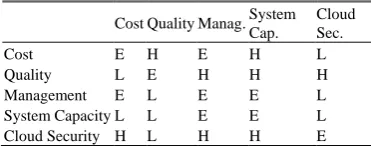
The DMs have been assessed each criterion to obtain their relative weights. They made a pairwise comparison, and F-SAW method is applied to get their weights. As an example, pairwise comparison of first level criteria made by first DM is given in Table IV; afterward Table V gives the relative importance of each criterion.
TABLE III
PAIRWISE COMPARISON OF FIRST LEVEL CRITERIA
Cost Quality Manag. System
Cap.
Cloud Sec.
Cost E H E H L
Quality L E H H H
Management E L E E L
System Capacity L L E E L
Cloud Security H L H H E
[image:3.595.333.519.695.768.2]relative importance of evaluation criteria is obtained as in Table IV.
TABLE IV
NORMALIZED WEIGHTS OF CRITERIA
1st Level
Criteria Weight 2nd Level Criteria Weight
Cost 0,191 Investment Cost 0,049
Maintenance Cost 0,024
Flexibility Cost 0,047
Support Cost 0,052
Integration Cost 0,022
Service Quality 0,199 Sla Management 0,079
Service Stability 0,149
Management
Services 0,157 Billing 0,094
Monitoring 0,050
Reporting 0,050
System
Qualifications 0,168 Communication 0,095
Memory 0,033
Speed 0,066
Cloud Security 0,285 Confidentiality 0,084
Availability 0,104
The service stability and availability are assigned as the
most important criteria for the selection. The weighting of the criteria possesses critical importance since they are the strategical decisions of the business. The weighting guides the evaluation of alternatives, and it designates the company’s strategical rout while adopting CS.
Step 3: Alternatives have been identified. Possible provider list has been gathered with the help of experts and online search about the CS providers. Five possible alternatives are detected as: SkyAtlas [29], Vodafone [30], Maximus [31], Turkcell [32], DorukCloud [33]. The alternatives are assessed by experts. To preserve the anonymity of the selected alternatives, the alternatives are given as A1, A2... etc. (unordered).
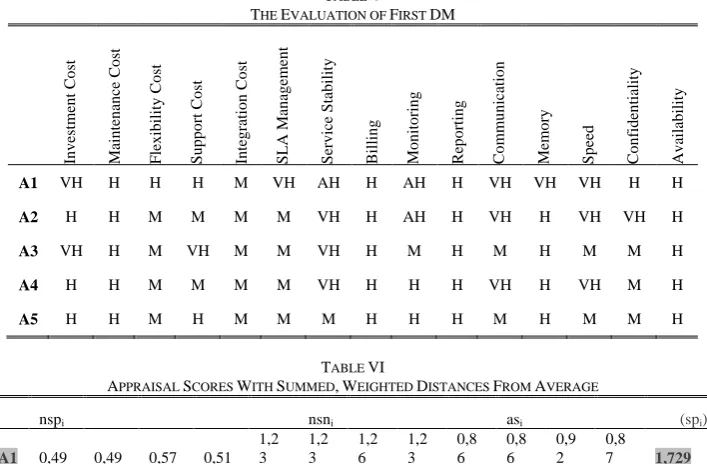
Step 4: Decision matrix is constructed, and F-EDAS steps have been applied. Table V represents the evaluation of first DM as an example, and Table VI gives the appraisal scores with the weighted sum of the distance from average.
TABLE V
THE EVALUATION OF FIRST DM
Inv estment Co st Mainten an ce Co st Flex ib ility Co st Su p p o rt Co st Integ ration Co st SLA Manag em en t Service Stab ility Billin g Mon ito ring Rep o rting Co m m u n icatio n Mem o ry Sp eed Co n fiden tiality Av ailab ility
A1 VH H H H M VH AH H AH H VH VH VH H H
A2 H H M M M M VH H AH H VH H VH VH H
A3 VH H M VH M M VH H M H M H M M H
A4 H H M M M M VH H H H VH H VH M H
A5 H H M H M M M H H H M H M M H
TABLE VI
APPRAISAL SCORES WITH SUMMED,WEIGHTED DISTANCES FROM AVERAGE
nspi nsni asi
k
(spi)A1 0,49 0,49 0,57 0,51
1,2 3 1,2 3 1,2 6 1,2 3 0,8 6 0,8 6 0,9 2 0,8
7 1,729
A2 0,36 0,30 0,27 0,36
1,1 4 1,1 4 1,1 4 1,1 7 0,7 5 0,7 2 0,7 1 0,7
6 1,469
A3 -0,33 -0,33 -0,31 -0,36
0,8 5 0,8 5 0,8 6 0,8 3 0,2 6 0,2 6 0,2 7 0,2
3 0,521
A4 -0,02 -0,02 -0,05 0,01
0,9 9 0,9 9 0,8 0 0,7 8 0,4 8 0,4 8 0,3 8 0,4
0 0,938
A5 -0,44 -0,44 -0,48 -0,52
1,2 2 1,2 2 1,2 1 0,7 6 0,3 9 0,3 9 0,3 7 0,1
2 0,754
Step 5: Highest appraisal score gives the most suitable alternative for this problem. Hence, the first alternative with the appraisal score 1,729 is the appropriate CS supplier for this company.
VI. CONCLUSION
Cloud computing is the backbone of the networks that we use today. It enables flexibility with low capital investment and scalability for all companies. These benefits also provide a compelling competitive advantage in the market. Today, different providers were involved in the market due to the high demand for cloud technologies. However, they do not propose the same level of service quality or
convenience.
Still, some companies have some problems due to complex electronic systems. They struggle to adapt or to use the system for their benefits. As this kind of struggles is noticed, the importance of making the right choice for CS becomes more and more essential for the business.
Motivated by this problem, this study proposes a selection
methodology for CS. The process has been approached as an MCDM problem. Combination of two different MCDM tool has been suggested for the methodology.
[image:4.595.56.282.87.277.2] [image:4.595.121.475.306.538.2]selection problem. Then the EDAS method has been recommended to select the most suitable CS provider alternative. Also, the fuzzy extension of EDAS has been suggested in order to deal with uncertainties. Moreover, fuzzy linguistic scales have provided a more flexible and efficient environment to DMs while making their assessment.
For further studies, the interactions between evaluation criteria may be invested with different MCDM tools such as DEMATEL. In our study an in-depth literature survey helped us to generate the evaluation criteria; in the future, they can be enriched by taking information from the sector's applications and experienced experts. Furthermore, to compare the compatibility of the suggested methodology, same selection problem can be applied with different MDCM tools. Also, different granulated linguistic sets can be included in the decision-making process to better reflect the decision-making group’s opinion.
ACKNOWLEDGMENT
The authors thank the experts due to their contribution to the application.
REFERENCES
[1] P. Mell and T. Grance, “The NIST Definition of Cloud
Computing,” p. 7, 2011.
[2] B. T. Hazen, L. Allison Jones‐Farmer, C. G. Cegielski, and Y. Wu,
“Adoption of cloud computing technologies in supply chains: An
organizational information processing theory approach,” Int Jrnl
Logistics Management, vol. 23, no. 2, pp. 184–211, Aug. 2012.
[3] K. K. Boyer and G. T. M. Hult, “Extending the supply chain:
integrating operations and marketing in the online grocery
industry,” Journal of Operations Management, vol. 23, no. 6, pp.
642–661, 2005.
[4] C. Giménez and H. R. Lourenço, “e‐SCM: internet’s impact on
supply chain processes,” The International Journal of Logistics
Management, vol. 19, no. 3, pp. 309–343, Nov. 2008.
[5] M. Whaiduzzaman, A. Gani, N. B. Anuar, M. Shiraz, M. N. Haque,
and I. T. Haque, “Cloud Service Selection Using Multicriteria
Decision Analysis,” The Scientific World Journal, 2014. [Online].
Available:
https://www.hindawi.com/journals/tswj/2014/459375/abs/. [Accessed: 19-Mar-2019].
[6] C.-L. Hwang and K. Yoon, “Methods for Multiple Attribute
Decision Making,” in Multiple Attribute Decision Making: Methods
and Applications A State-of-the-Art Survey, C.-L. Hwang and K. Yoon, Eds. Berlin, Heidelberg: Springer Berlin Heidelberg, 1981, pp. 58–191.
[7] A. Afshari, M. Mojahed, and R. M. Yusuff, “Simple Additive
Weighting approach to Personnel Selection problem,” International
Journal of Innovation, vol. 1, no. 5, p. 5, 2010.
[8] M. Keshavarz Ghorabaee, E. K. Zavadskas, L. Olfat, and Z.
Turskis, “Multi-criteria inventory classification using a new method of evaluation based on distance from average solution (EDAS),”
Informatica, vol. 26, no. 3, pp. 435–451, 2015.
[9] L. Sun, H. Dong, F. K. Hussain, O. K. Hussain, and E. Chang,
“Cloud service selection: State-of-the-art and future research
directions,” Journal of Network and Computer Applications, vol.
45, pp. 134–150, Oct. 2014.
[10] Z. Li, L. Liao, H. Leung, B. Li, and C. Li, “Evaluating the
credibility of cloud services,” Computers & Electrical Engineering,
vol. 58, pp. 161–175, Feb. 2017.
[11] R. Bose, X. (Robert) Luo, and Y. Liu, “The Roles of Security and
Trust: Comparing Cloud Computing and Banking,” Procedia -
Social and Behavioral Sciences, vol. 73, pp. 30–34, Feb. 2013.
[12] S. K. Garg, S. Versteeg, and R. Buyya, “A framework for ranking
of cloud computing services,” Future Generation Computer
Systems, vol. 29, no. 4, pp. 1012–1023, Jun. 2013.
[13] Z. Li, L. O’Brien, H. Zhang, and R. Cai, “On a Catalogue of
Metrics for Evaluating Commercial Cloud Services,” in 2012
ACM/IEEE 13th International Conference on Grid Computing, Beijing, China, 2012, pp. 164–173.
[14] N. Ghosh, S. K. Ghosh, and S. K. Das, “SelCSP: A Framework to
Facilitate Selection of Cloud Service Providers,” IEEE
Transactions on Cloud Computing, vol. 3, no. 1, pp. 66–79, Jan. 2015.
[15] Z. Stevic, M. Vasiljevic, E. K. Zavadskas, S. Sremac, and Z.
Turskis, “Selection of Carpenter Manufacturer using Fuzzy EDAS
Method,” Inz. Ekon., vol. 29, no. 3, pp. 281–290, 2018.
[16] J. Ren and S. Toniolo, “Life cycle sustainability decision-support
framework for ranking of hydrogen production pathways under uncertainties: An interval multi-criteria decision-making approach,”
J. Clean Prod., vol. 175, pp. 222–236, Feb. 2018.
[17] M. Keshavarz-Ghorabaee, M. Amiri, E. K. Zavadskas, Z. Turskis,
and J. Antucheviciene, “A Dynamic Fuzzy Approach Based on the EDAS Method for Multi-Criteria Subcontractor Evaluation,”
Information, vol. 9, no. 3, p. 68, Mar. 2018.
[18] M. Keshavarz Ghorabaee, M. Amiri, E. K. Zavadskas, and J.
Antucheviciene, “A new hybrid fuzzy MCDM approach for
evaluation of construction equipment with sustainability
considerations,” Arch. Civ. Mech. Eng., vol. 18, no. 1, pp. 32–49,
Jan. 2018.
[19] A. Karasan and C. Kahraman, “A novel interval-valued
neutrosophic EDAS method: prioritization of the United Nations
national sustainable development goals,” Soft Comput., vol. 22, no.
15, pp. 4891–4906, Aug. 2018.
[20] G. Ilieva, “Group Decision Analysis Algorithms with EDAS for
Interval Fuzzy Sets,” Cybern. Inf. Technol., vol. 18, no. 2, pp. 51–
64, 2018.
[21] Z. Turskis, Z. Morkunaite, and V. Kutut, “A Hybrid Multiple
Criteria Evaluation Method of Ranking of Cultural Heritage
Structures for Renovation Projects,” Int. J. Strategy. Prop. Manag.,
vol. 21, no. 3, pp. 318–329, Sep. 2017.
[22] M. Keshavarz Ghorabaee, M. Amiri, E. K. Zavadskas, Z. Turskis,
and J. Antucheviciene, “A new multi-criteria model based on interval type-2 fuzzy sets and EDAS method for supplier evaluation
and order allocation with environmental considerations,” Comput.
Ind. Eng., vol. 112, pp. 156–174, Oct. 2017.
[23] M. Keshavarz Ghorabaee, M. Amiri, E. K. Zavadskas, Z. Turskis,
and J. Antucheviciene, “A new hybrid simulation-based assignment approach for evaluating airlines with multiple service quality
criteria,” J. Air Transp. Manag., vol. 63, pp. 45–60, Aug. 2017.
[24] M. Keshavarz Ghorabaee, M. Amiri, E. K. Zavadskas, Z. Turskis,
and J. Antucheviciene, “Stochastic EDAS method for multi-criteria
decision-making with normally distributed data,” J. Intell. Fuzzy
Syst., vol. 33, no. 3, pp. 1627–1638, 2017.
[25] M. Keshavarz Ghorabaee, M. Amiri, E. K. Zavadskas, and Z.
Turskis, “Multi-Criteria Group Decision-Making Using an
Extended Edas Method with Interval Type-2 Fuzzy Sets,” E M
Ekon. Manag., vol. 20, no. 1, pp. 48–68, 2017.
[26] M. Keshavarz Ghorabaee, E. K. Zavadskas, M. Amiri, and Z.
Turskis, “Extended EDAS Method for Fuzzy Multi-criteria
Decision-making: An Application to Supplier Selection,” Int. J.
Comput. Commun. Control, vol. 11, no. 3, pp. 358–371, Jun. 2016.
[27] L. A. Zadeh, “A Fuzzy-Algorithmic Approach to the Definition of
Complex or Imprecise Concepts,” in Systems Theory in the Social
Sciences: Stochastic and Control Systems Pattern Recognition Fuzzy Analysis Simulation Behavioral Models, H. Bossel, S. Klaczko, and N. Müller, Eds. Basel: Birkhäuser Basel, 1976, pp. 202–282.
[28] C. Kahraman, M. K. Ghorabaee, E. K. Zavadskas, S. C. Onar, M.
Yazdani, and B. Oztaysi, “Intuitionistic fuzzy EDAS method: an
application to solid waste disposal site selection,” Journal of
Environmental Engineering and Landscape Management, vol. 25, no. 1, pp. 1–12, Jan. 2017.
[29] “SkyAtlas – Real Cloud Platform | Cloud Server, Cloud Storage,
Network Infrastructure.” [Online]. Available:
http://www.skyatlas.com/. [Accessed: 19-Mar-2019].
[30] “Vodafone Business,” Vodafone. [Online]. Available:
http://www.vodafone.com.tr/. [Accessed: 19-Mar-2019].
[31] “Koç Sistem.” [Online]. Available: https://www.kocsistem.com.tr/.
[Accessed: 19-Mar-2019].
[32] “Turkcell Bulut.” [Online]. Available:
https://www.turkcell.com.tr/kurumsal/bulut. [Accessed: 19-Mar-2019].
[33] “DorukNet | DorukCloud,” DorukNet | DorukCloud. [Online].
Available: https://www.doruk.net.tr/705-cloud/788-dorukcloud/.