POSITIVES AND PROBLEMS
Economic history is, from the greater part, the story of the market expanding from the farm to the town, from the region to the state, from one state to another. in the 20th century, the development of
markets was slowed down by two world wars and the economic recession. new technologies and political pressures after the WW2 accelerated this develop-ment. The cold war from the 40s to the 80s then pressed the U.S. into using trade liberalisation and economic growth as the weapon in their fight against communism. The success of the first trade negotia-tions lowered the average custom duties from 40% in 1946 to 4% in 1995.
After two world wars, Europe perceived an eco-nomic unification as a protection against national-ism. Technology complemented politics. Even before the origin of the internet, the decreasing transport prices – from airplanes to under-ocean cables and satellites – helped the global trade.
globalisation develops this process, but it also leaves it, at least in one important aspect. Till the recent past, the states we perceived as independent units interconnected prevalently by trade. This now ceases to be valid. Enterprises and financial markets still more overcome the national borders in their production, marketing and investment decisions.
Behind this boom, there stands the still stronger persuasion of the supra-national forms that many markets are really global nowadays. in the endeav-our to be present in the highest number of national markets, the companies try to utilise on one side the economy of scale, and on the other, they aim at being
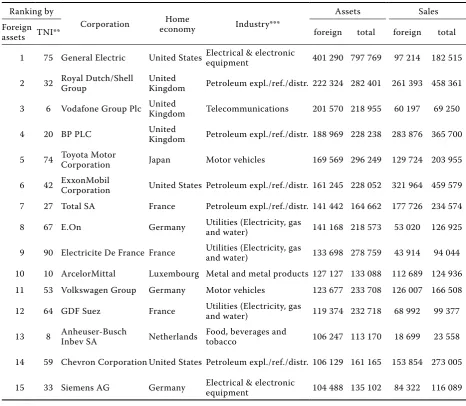
in the front of the technological changes, which may now occur practically anywhere in the world (Table 1).
Moreover, the corporations still more organise their production globally, the construction, production and assembling are realised in many different countries. The trans-national enterprises are not the only ones to aim at higher sales and profits, however, they are not the only driving force of globalisation. The driving force is also the governments. one of the indicators proving this is the unending endeavour to create the unified market in Europe. This reflects the persua-sion that European enterprises will have problems to succeed in the global markets if they are oriented at the isolated national markets. in the case of the poorer countries, the best proof is their endeavour to enter the WTo. Their motive is the belief that the global trade and investments can help the economic development by supplying new products, technolo-gies and managerial abilities. This is no myth – the success of a state depends, in the first place, on the abilities of people, the purposefully spent investments and the governmental policy. But the incorporation into the wider world economy can also be of help (Keegan and Schlegelmilch 2001).
if globalisation is as excellent as that, why is it also so risky? The answer is hidden in the fact, that two problems could neutralise its potential contribu-tions. The first is the economic non-stability. global economy could be more apt to the much more painful cycles of growth and decline than national economies. The theoretical presupposition that the international trade and investments lead to the growth of the level of living is valid only in case when the investments are used properly and the trade flow is not one-sided.
Globalisation – challenges, rewards, question
Vladimír JENÍČEK
Faculty of International Relations, University of Economics, Prague,
Czech Republic
Abstract: globalisation is at the beginning of the new century a double-edged weapon: a strong driving force of economic growth, the development of new technologies and the growth of the level of living in the poor as well as rich countries, but also a controversory process which damages national sovereignty, undermines the local culture and traditions and presents a threat of the economic and social non-stability. The key question of the 21st century then is, whether the states will be
able to keep the process under control or whether they will become its victims.
Key words: globalisation, positives, problems, asymmetry, risks, agrarian dimension of globalisation
The greatest danger is that the world becomes still more dependent on the U.S. prosperity and the eventual slow down or recession of development – caused by the stock market drop, the loss of the consumers’ trust or a higher interest rate – might cause an international slump down. Even if globalisation is mainly a sponta-neous process, it does not mean that it is always the unavoidable or irreversible process. governments can protect more or less the local industry and workers against imports or discriminate foreign investors. if only several countries proceed like this, the impact will be of little influence. The global capital would go where it will be welcome and where it could reach profit. And this is just the logic, which has persuaded so
many countries to accept globalisation. if they do not do so, other states will. regarded from this viewpoint, most governments are persuaded that the positives of globalisation prevail over its negatives.
[image:2.595.62.529.278.684.2]The technology and the flows of information, people and goods over the borders transform the basic human endeavours by a way which is only now gaining in intensity. For the first time from the end of the WW2 and from the beginning of the atomic age, people in different countries feel intensively that the present is just now, that the forms which will determine human life, work and entertainment for the next decades and centuries are going to be coined in the coming weeks, months and years.
Table 1. The world’s top 15 non-financial Tncs, ranked by foreign assets, 2008*
ranking by
corporation economyhome industry***
Assets Sales
Foreign
assets Tni** foreign total foreign total
1 75 general Electric United States Electrical & electronic equipment 401 290 797 769 97 214 182 515
2 32 royal Dutch/Shell group United Kingdom Petroleum expl./ref./distr. 222 324 282 401 261 393 458 361
3 6 Vodafone group Plc United Kingdom Telecommunications 201 570 218 955 60 197 69 250
4 20 BP PLc United Kingdom Petroleum expl./ref./distr. 188 969 228 238 283 876 365 700
5 74 Toyota Motor corporation Japan Motor vehicles 169 569 296 249 129 724 203 955
6 42 ExxonMobil corporation United States Petroleum expl./ref./distr. 161 245 228 052 321 964 459 579
7 27 Total SA France Petroleum expl./ref./distr. 141 442 164 662 177 726 234 574
8 67 E.on germany Utilities (Electricity, gas and water) 141 168 218 573 53 020 126 925
9 90 Electricite De France France Utilities (Electricity, gas and water) 133 698 278 759 43 914 94 044
10 10 ArcelorMittal Luxembourg Metal and metal products 127 127 133 088 112 689 124 936 11 53 Volkswagen group germany Motor vehicles 123 677 233 708 126 007 166 508
12 64 gDF Suez France Utilities (Electricity, gas and water) 119 374 232 718 68 992 99 377
13 8 Anheuser-Busch inbev SA netherlands Food, beverages and tobacco 106 247 113 170 18 699 23 558
14 59 chevron corporation United States Petroleum expl./ref./distr. 106 129 161 165 153 854 273 005
15 33 Siemens Ag germany Electrical & electronic equipment 104 488 135 102 84 322 116 089
*All data are based on the companies’ annual reports unless otherwise stated
**Tni, the Transnationality index, is calculated as the average of the following three ratios: foreign assets to total as-sets, foreign sales to total sales and foreign employment to total employment
***industry classification for companies follows the United States Standard industrial classification as used by the United States Securities and Exchange commission (SEc)
The revolution in human activity goes on from science to technology, from politics to the ways of war. Biology and its technological application aspire at becoming the same in the 21. century, what was physics for the 20. century: the fundamental science of the day which would enable to reach an enormous progress, but which will also bring about serious ethical questions. Very soon, scientists will be able to prolong the productive life by cloning and perfect organ transplantations. But should they do so? This sort of questions will very soon, as well as in the distant future, engulf the politics after 2000.
The economic strength of globalisation, driven by the motif of the Anglo-American capitalism and the limited sovereignty on which the social states of the EU agreed, will lower the importance of national borders and it will limit the powers of the national state (Dicken 2003).
The most important changes which will influence also the future regard the world population, which entered the new millennium in the numbers overcom-ing six billion people. however, in 2050 this number should be by three billion higher. The growth of American population will be caused during the next years by the lower mortality in consequence of the better medical care. Another source of increase will
be immigrants. Ageing of the population in the U.S., Japan and Western Europe will in the next decades increase the pressure on the radical increase of im-migrants. Population growth in the poorest areas of the world, where 40% people are younger than 15, will become an undrying resource of labour. The aim of economic development is to create the conditions enabling people to live a long, healthy and active life.
“however, if the influence of the markets reaches that far that it determines the social and political oc-currences, the opportunities and fruits of globalisation are often divided unjustly and unequally: power and riches are concentrated in the selected group of people, nations and trans-national companies, while the rest is moved off to the margin”, states the report of the Program of United nations for Development (PnUD).
The result is the “absurd and dangerous polarisation inside the nations and among the nations. People and nations will refuse world integration and dependency, if it brings them nothing, and on the opposite, if it increases their vulnerability. The isolation stresses in economy, politics and culture will grow.”
however, removing poverty is not regarded unthink-able, as it were only several years ago. Even the word “poverty” is being pushed into the background by the development specialists, since it evokes the feeling of the inferiority of the people it regards (Tables 2 and 3).
The specialists prefer the expression “seclusion”, which evokes the minority waiting for its opportunity. The “secluded” are divided into the “income poor” and “humanly poor”, which expresses the learning that the insufficient incomes are not the only obstacle for people who want to lead at least a little bit decent life. Such things as clean water, sewage, health care and education system are the important prerequisites for increasing the level of living.
[image:3.595.65.290.94.254.2]A simple measure of the results of the individual countries or continents in this fight is the per capita income (which has doubled since 1960 notwithstand-ing the fact that also the world population has dou-bled), the population literacy, the newborn infants mortality and the average life expectancy. All these indices show an improvement.
Table 2. The poorest world countries (according to the per capita per year gDP in USD)
Burundi 160
Democratic republic of the congo 163
Liberia 222
Malawi 326
Sierra Leone 341
Ethiopia 345
niger 352
nepal 427
Mozambique 428
gambia 430
Source: World Bank (2011b)
Table 3. Economic growth in the world (yearly gDP change in %)
2008 2009 2010 2011
Advanced economies 0.243 –3.231 2.708 2.167
Emerging and developing economies 6.013 2.513 7.073 6.435
central and Eastern Europe 3.038 –3.634 3.734 3.133
World total 2.834 –0.577 4.766 4.220
[image:3.595.63.536.664.749.2]The representatives of the world government are meeting to discuss under the auspices of the U.n. the catastrophic situation of the poor countries. Some time ago, they together agreed on the debt relief to the poorest world countries (Table 4).
Many of the debts, which were abolished, were anyway regarded as not payable and therefore lost. notwithstanding the numbers, the discussion on the debt relief revives the legend that for this destroying burden of the enormous poor countries indebtment, there is responsible the West, and on the more gen-eral level, that it is also responsible for the lack of help in the fight against poverty as such. The reality is just the opposite.
only few developing countries really seriously fight their poverty. in most of the others, public expenditures support on the contrary the members of the middle and upper classes that is mainly town population.
The economies of poor countries are thus mainly aimed against their own poor inhabitants and that in many ways. one of them is the artificial increasing of employment in the public sector. State administration workers get high salaries compared to the average incomes in the country and the jobs in the state sec-tor often supply a life-long occupation to the middle classes members. Free university education becomes another form of the resources re-distribution from the poor to the rich ones, since also the poor contribute by their taxes to the university costs, even if they only very rarely study at them. Public expenditures on the basic education are very often grabbed by the school trade unions, which can ensure the privileges and advantages of their members by them. Free resources of water and electricity are usually aimed at the town middle class population and rich farmers.
The overwhelming part of the empirical data (sup-plied mainly by the World Bank) testified that the development of the poorest countries is basically
blocked, and that mainly by the inability of their gov-ernments to manage the country and by an enormous corruption. To be able to start any development, it is necessary that the country has a sufficiently stable and efficient government, which would continually push through the appropriate economic policy. South Korea had the per capita income lower than Somalia in 1960; at present it is the oEcD member.
The empirical research demonstrates that the de-velopment assistance is mostly very inefficient since it is supplied non-critically to the governments, which use it for the enrichment of the narrow elite. of course, the West is not without guilt, either. The ex-imperial powers advantaged their ex-colonies without regard whether they asked for assistance or utilised it afterwards. Also during the cold war, the financial assistance flows were influenced rather by the alliance loyalty principles.
Moreover, many bilateral credits were in reality rather business credit collaterals, from which mainly the creditor countries advantaged.
The debt relief, even if morally laudable, brings about two misleading messages: it says to the gov-erning class of the poor indebted countries that corruption pays; and it strengthens the belief of the public in the West that the problems of the poor countries were caused by their politicians. if we do not get rid of these mistakes, the debt relief will only end by setting the base for the new round of indebtment, corruption and endless poverty (ghemawat 2003).
AGRARIAN DIMENSIONS OF GLOBALISATION
[image:4.595.65.533.85.217.2]We can state that the position of agriculture in the process of globalisation is formed in the decisive measure by the globalisation processes the effects of
Table 4. number of people with income less than 1.25 USD per dayin millions
1996 1999 2002 2005
East Asia and Pacific 622.31 635.06 506.83 316.21
Europe and central Asia 21.76 24.28 21.73 17.29
Latin America and the caribbean 53.07 55.29 56.59 45.25
Middle East and north Africa 10.58 11.54 10.3 10.99
South Asia 594.42 588.92 615.86 595.58
Sub-Saharan Africa 355.57 382.66 389.76 388.38
Total 1 697.74 1 697.74 1 601.07 1 373.69
which are often formed as contradictory. The aim is to characterise, on the base of the methodological issue of the crisis aspects of globalisation, the qualita-tive trends in the position of agriculture with regard to the economic, non-production, institutional and other aspects(Vošta 2012).
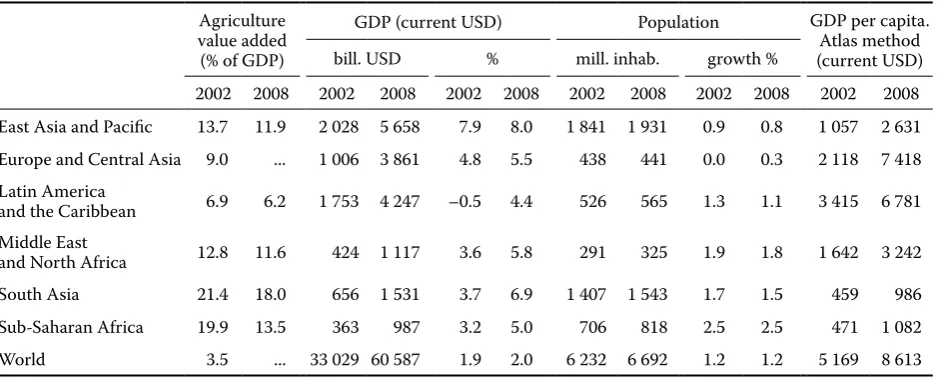
Agriculture, which represented practically through the whole hitherto history of humankind the decisive economic activity for most of the population, loses its prevalence (the share in gDP, number of jobs) in one country after the other during several genera-tions. however, this fact cannot decrease the role of agriculture from the viewpoint of its irreplaceable position in the food production, environmental im-pacts, countryside forming, infrastructure and other roles (Table 5).
The future of agriculture cannot be separated from the long-term and global aspects of the whole economy and society development. The basic determination factors of the agriculture development are connected with the existence of the growing economic dispropor-tion between the developed market and developing economies of the present world. Without regard to the considerable decrease of the share of agriculture in gDP or the number of workers, it is necessary to revaluate the role of agriculture in solving the global problems of the world and its sustainable develop-ment (cihelková 2011).
here, there are still more strengthened the ten-dencies which are marked as a great danger of the present time: the non-critical preference of free mar-ket (“marmar-ket fundamentalism”), what is connected with the overestimation of the market mechanism possibilities, overlooking the social, political and ethical dimension of the society development and suppressing the critical way of thinking. in total, this
leads to limiting of the positive development of the civil society prerequisites.
Sustainable development of human civilisation is based on the multi-criterial approach, which issues, besides economic approaches, from the value orien-tation at human development, respecting social and environmental criteria etc. Sustainable development is of the global character, even if the approaches to solving the global problems are different in different parts of the world. on the example of the environ-ment sphere, it can be demonstrated, that, at a cer-tain simplification, we can determine the European and American model. The European model issues mainly from using the normative tools and it sup-ports the relevant measures by subsidies from the society resources. A higher utilisation of economic tools and the market together with a higher address-ing level of the governmental programs is typical for the American model.
it is necessary to state that the globalisation process does not mean the unification of the approaches to sustainable development, sustainable agriculture, forming the models of agriculture in the world or to the other numerous dimensions of the human civilisation development. globalisation represents a great challenge for the economists, politicians and all citizens. The conflicting questions for the poor and rich countries or social groups are very various and serious.
[image:5.595.65.535.562.752.2]The position of agriculture in the globalising world at the beginning of 21st century cannot be marginal, at least because practically one half of the Earth popu-lation is still economically dependent on agriculture, even if agriculture represents only 3.5% of the world gDP. The lasting importance of the production func-tion of agriculture for the nutrifunc-tion of the total world
Table 5. Development indicators
Agriculture value added
(% of gDP)
gDP (current USD) Population gDP per capita. Atlas method (current USD) bill. USD % mill. inhab. growth %
2002 2008 2002 2008 2002 2008 2002 2008 2002 2008 2002 2008 East Asia and Pacific 13.7 11.9 2 028 5 658 7.9 8.0 1 841 1 931 0.9 0.8 1 057 2 631 Europe and central Asia 9.0 ... 1 006 3 861 4.8 5.5 438 441 0.0 0.3 2 118 7 418 Latin America
and the caribbean 6.9 6.2 1 753 4 247 –0.5 4.4 526 565 1.3 1.1 3 415 6 781 Middle East
and north Africa 12.8 11.6 424 1 117 3.6 5.8 291 325 1.9 1.8 1 642 3 242
South Asia 21.4 18.0 656 1 531 3.7 6.9 1 407 1 543 1.7 1.5 459 986
Sub-Saharan Africa 19.9 13.5 363 987 3.2 5.0 706 818 2.5 2.5 471 1 082
World 3.5 ... 33 029 60 587 1.9 2.0 6 232 6 692 1.2 1.2 5 169 8 613
population is accompanied by the growing role of the non-production function.
DISCUSSION
The understanding of globalisation is different, some understand its sense as the interconnecting of the world into one common whole, another, on the contrary, underlines the diversity, which this mutual interconnecting reveals and which has to be sus-tained. The globalisation problem is so complex that the participants of the debates and discussions only rarely agree on what they really have in mind under this notion. nevertheless, it is possible to discern several main motives, which cover its dimension in a relatively precise way.
Economic growth
Even if the intellectuals, politicians or the ngos argue in any way, they usually agree on one point: globalisation is, above all, the economic phenomenon.
At the beginning of the 70s, capitalism based on market economy reached a new phase. new mar-kets opened and, owing to the better transport, the movement of goods all over the planet accelerated. computers added to it also the possibility of a quick money transfer. it is no problem any more to move several billions among countries and continents in several minutes (UncTAD 2004).
The flows of goods and money intertwine mutually as the fibres of the cobweb all over the world and create one big global market. To succeed in it means to throw away the proud national label and to build trans-national companies which alone can utilise fully the possibilities of the new unified market. The last decades labelled as the “merger decades” are the best proof of this trend.
All this brings about many positive points: the qual-ity and supply of goods increase, production costs and consumers prices decrease, new work opportunities emerge, the level of living increases. however, the friendly face of globalisation has also its diverted side: the world economy is more apt to unexpected fluctuations – the Asian, russian and Brazil crises are only three examples out of many. in the electronic financial net, there circulate trillions of dollars, which do not always find the best utilisation.
The next point is the key role of the supra-national firms in the global economic system, what necessarily brings about also the possibility of their economic power misuse. This is reflected not only in the
mo-nopolist practices (e.g. the example of the Microsoft during the last time), but also by the pressures on politicians.
Social asymmetry
Economic globalisation has also other negative trends – namely in the social sphere. From the un-precedented economic growth the world is experi-encing during the last 20 years, not all are profiting in the same way.
The fruit of the growth is harvested namely by the countries which are moving away from the poor more than ever. This is not a sentence out of the propagation leaflet of the globalisation opponents. By similar words, the wealth distribution process is evaluated also in the international Monetary Fund official documents.
into the official language of the iMF and other international organisations, there have long ago en-tered the sentences on “the rich north and the poor, by diseases afflicted South and on the deepening gap between both poles”. The economic gap does not grow only in the relationship of the rich and poor countries. The identical trend is followed by the economists and sociologists also inside the individual countries. For example in the U.S., the average income of an industrial worker is even 300 times lower than the top manager income. Twenty years ago, this rate was lower by half.
This, among other, testifies to the fact registered by many researches: globalisation sides to the edu-cated, very flexible and adaptable people who can evaluate an information in a lightning and can utilise them efficiently. on the opposite, people sentenced to less qualified manual jobs enjoy practically no profit from globalisation. They can be practically immediately replaced by the cheaper labour from the South (Scholte 2000).
Environment
The accelerated economic growth, driven to the considerable extent by the enormous trans-national colossuses, burdens not only the social system, but also the environment.
the big production halls and infrastructures. global warming also represents a real danger.
global economy cannot be imagined without a perfectly functioning transport, which, on the other hand, is the most damaging for the nature in the water, air as well as the dry land.
The only way how to leave this merry-go-round is, according to the environmentally oriented sociolo-gists and economists, a higher environmental literacy (the consciousness of the symbiosis of man and his/ her environment), which will gradually press the big firms and the whole “global village” into changing their behaviour.
Information democracy
With spreading the environmental literacy, there is also connected the last motive of globalisation – information democracy. The world computer net has opened the hitherto unknown possibilities of spread-ing information, mutual communication, discussion and interconnecting the group of close attitudes. in the virtual electronic countryside, there are created certain modern “agoras”, on which the problematic fight for the global society future proceeds.
its individual knots created by this way in the in-ternet web are the base of the just originating infor-mation democracy, the most important features of which is the still more precise division of power, the intensity of which is still changing. The originating tension will during time become the main driving force of the whole social structure. The openness (the number of the internet users is increasing) of this global structure and its division into the almost infinite number of knots disables, at the same time, it is closing, tying the powers towards the centre – in other words, a new totality.
The information democracy development during the last ten years shows already the first results: the necessary reform of many international organisations and a higher pressure on the regional management and the state government. The only already visible negative point is the more or less free spreading of the extreme and xenophobic dogmas through the net. however, these cannot ever be fully eradicated by any – not even information – democracy.
CONCLUSION
globalisation was evoked by the technological, social and cultural changes, which decreased considerably the economic distances among the countries. The
improvement of the transport and communication technologies decreased the costs of transport of goods, money, people and information. The traditional gov-ernmental policies limiting the trans-border transac-tions were mitigated or even removed, in consequence of that there occurred the growth of the international trade and the FDi. globalisation changes the proper-ties of the world economy and influences the base of the successful economic approaches to development, what increases the need to ensure the economic de-velopment sustainability. globalisation increases the possibilities of private individuals and enterprises, but it decreases the possibilities of politicians in the traditional sphere. globalisation then means that the markets, investments and intra-enterprise relation-ships are still less determined by the national borders. All this is owing to the supra-national companies, the FDi, common enterprises, common research and development or technological licences (Yip 2003).
The contradictions of globalisation or the shift of the decisive economic, social and political activi-ties lay, besides creating the big economy or policy, also the in the division, fractioning and multiplying. convergence and divergence are two sides of the same coin. This shortcoming of the natural simplicity has also its disadvantages – the basic misunderstanding and distortion it brings about.
The velocity of globalisation increases namely with the velocity of the scientific and technological progress. Under the influence of its storming de-velopment, there occurred not only a considerable progress of the economic life internalisation, but also the innovation dynamism in the technological sense.
globalisation is supported by liberalisation and vice versa, globalisation accelerates liberalisation. in all countries, the key element of liberalisation was the increased external opening. Liberalisation extended the effective economic space and supported the glo-balisation process. Producers and investors are still more behaving as if the world economy were one market with the regional and national sub-areas, rather than the system of national economies connected by the economic and investment flows. however, the globalisation level of trade, the FDi, international finances and labour mobility is different.
globalisation is by its nature complex and diverse at least in three basic spheres (mutually intercon-nected) – economic, social and political.
Economic globalisation does not lead either to the origin of a homogeneous market, nor to the lead-ership of one pattern of the enterprise structure. globalisation in fact leads to creating of the appro-priate conditions for the whole series of different, mutually intertwined directions, i.e. it extends the field of activity where the mutual influencing of dif-ferent actors of the market and enterprises occurs. This re-creates the international economic environ-ment from the individual naturally divided national economies (mutually influencing each other on the base of the national comparative advantage) in the economy, where there is created the multitude of different competitive advantages by the way inde-pendent on the nation/state as a social, economic and political unit. A more important point of the economic globalisation is the numerousness of the playing fields rather than creating the world without borders as one playing field. World economy is far from the real integration, but it will support other integration of new technology and a considerable drop of the telecommunication prices in future. Thus, technologies will act as the driving force of globalisa-tion. globalisation means a higher efficiency of the world resources utilisation and thus also higher aver-age incomes, but its costs and yields will be divided unequally. non-qualified workers in rich economies will meet with a lower demand for their labour, since it will be paid abroad. Therefore, there emerges the risk of the political concession towards free market and capital flows.
Social sphere is the second level of the growing global complexity. The development of complex and mutually overlapping features of the in-building and clearing of the system does not lead to the homogene-ous world culture of entrepreneurship based on the strengthening, extending basic form of capitalism, but it will probably create the conditions, which neither one country, nor the developed world as a whole can manage. The governments do not support globalisation of the communication means, but they rather limit here, more than in other sectors, foreign direct investments.
The heterogeneousness of globalisation reflects in the political spheres. The state as the only and the most important organisational stage and institu-tional structure in the world was changed over as a consequence of globalisation. Still, it is further one of the biggest driving forces of globalisation, which answers to the more complex tension typical for the new environment. The social state was first replaced
by the state of competition, which then changed into the remainder state. The activities of the state are still more that of the remainder in the sense of the scope of the political tools and the reached results.
The global market powers not only exclude any kind of compensation for those who loose in glo-balisation, so that its impacts are not mitigated, but they even refuse the independent democracy. The next century will be the century of globalisation, the century of capitalism, which will be more capitalist since globalisation will help the basic changes in the competition fight rules. Those who want to further increase their level of living, will have to be prepared for the competition growth and the change of the rules of the game in the world markets.
The period of globalisation brings about a new face of the role of the state – the state loses its importance as the toll of management, since its influence is de-creasing together with the disappearing obstacles. its economic and political role is limited to the increasing mobility of production factors. For the state, there are left only the basic functions (e.g. infrastructure). The role of the state has not diminished; however, it has only changed to the detriment of its traditional spheres. in the market mechanism, the role of the state shifts to creating of such environment for the private enterprising, in the frame of which it regards a higher relying on the market powers. The politicians in poor as well as rich countries started to call, without regard to the fact whether there are of the left or the right wing, for lower taxes and public consumption, a lower regulation of industry, privatisation of the state-owned enterprises – in general, for a higher economic flexibility (Jessop 2003).
of optimism or pessimism are both mistaken, since the global capital market, notwithstanding its over-estimating, still does not exist. Leading at a higher financial interrelating is healthy, however. The unified global market is still far away, but the development direction is correct.
For the public, the international trade is the most obvious proof of the world economy globalisation. According the indicator of the import and export volumes, the world economy becomes still more in-terconnected after the WW2. The international trade development was supported by the common world diminishing of the trade obstacles (custom duties, import quotas), economic opening of the countries, which traditionally were the small players in the world economy, and the quickly decreasing transport costs. Less transport is demanded per every 1 USD of the import or export value. Simultaneously, the transport costs themselves have decreased steeply. in many countries, liberalisation of the state influ-ence helped a further acceleration of the process. A series of technological inventions (the container utilisation and the multi-modal transport) led to a quick improvement of the productivity in operating the cargo and the process itself, by which the greatest obstacle of trade decreased.
globalisation brought about a new world, which was transformed by the information and communi-cation technologies. in this world, enterprises are functioning at all places, since they utilise flexibly the cheap raw materials resources, the lowest production costs and the most efficient markets from the sale viewpoint. Thus, they help to increase the welfare, what also issues from the international trade theo-ries. The activities of the internationally functioning enterprises are mutually complementing – capital looks for cheap labour, new products and markets, international companies have influence and represent one of the ways by which globalisation is pushing through. it influences considerably both production and trade and the sphere of global investment. They play the key role also in spreading the technologies all over the world.
The basic direction of the economic moving over reflects two mutually balancing powers. Moving over is still easier together with the decreasing transport costs and the growing incomes in developing coun-tries. however, in the poor countries, the impulses to the movements decrease together with the quickly growing incomes. The net impact in the starting years of industrialisation tends to a higher emigra-tion. notwithstanding the stricter immigration rules in many rich countries in the 70s, the migration has increased slightly in the 80s and at the beginning
of the 90s. new obstacles have slightly limited this growth during the last years.
The global labour market does not exist yet, and if it sometimes emerges, then only for the highly qualified workers. During the last 30 years, the for-eign trade and the trans-border movement of tech-nologies, labour and capital was considerable. in the same period in the DMEs, the demand for the more experienced workers grew to the detriment of the less experienced ones and the income gap between the two groups extended. globalisation undoubtedly identifies with a higher unemployment of the less specialised workers and the growing income disparity. An important tendency in the DME labour market is a considerable shift from the less experienced to the more experienced workers. This led to a consid-erable growth of incomes and income disparity of these two groups in some countries, as well as to the unemployment increase of the less educated workers in other countries. Different impacts on wages and employment in different countries are explained by the differences in the labour market structures. in the countries with relatively flexible wages in the decentralised labour market (the U.S. and still more also the U.K.), the decrease of the relative demand for the less experienced workers led to the relative wage decrease of these workers. on the opposite, in countries with relatively non-flexible wages in the concentrated labour market (Fr, DE, iT), it led to a lower relative employment (rugman 2003).
immigration brings different welfare to the accepting country. Theoretically, the net impact of immigration on the home wages is not clear. nevertheless, empiri-cal researches on the impact of immigrants on the home workers are not unanimous –their influence seems to be little. Almost all researches register only a small impact of the international trade on wages and income disparity. The average estimate of the international trade impact on wages and employ-ment is non-zero, but it is surely less than could be expected, since the import competition is overesti-mated. The empirical proofs testify to the modest impact of globalisation on wages, employment and income disparity in the DMEs.
on the other side, the technology changes have led to the piercing shift to the more experienced workers to the detriment of the less experienced ones. The belief that globalisation endangers wages and jobs is contradicted by the historical proof that the free trade and the free flow of capital and labour improves the global wealth and tends to improve the national wealth of all included countries.
of material as well as spiritual values. on the other hand, world economy develops as a polycentric system, in which there occur clashes among the individual elements, the power influences and interests of the stronger ones are pushed through to the detriment of the weaker ones. World economy globalisation continues at considerable differences on the tech-nological, economic and cultural level, the strength and the size of states and the mechanisms of their impact. Therefore, there prevail the opinions that the adapting processes are lagging behind the globalisa-tion development not only in the developing and transforming countries, but also in the developed economies. At the present development level, these negative viewpoints cannot be totally excluded, they can be only minimised. Therefore, the endeavours to know fully the globalisation phenomenon is perceived as positive, since they enable to minimise its negative impacts (Jeníček 2003).
At present, there are many theories describing globalisation, which are in many regards contradic-tory to each other. ones expect the bright future, another describe globalisation as the greatest evil. Where is the world really going under the pressure of globalisation, it is not clear and it will be shown only by the future.
REFERENCES
cihelková E. (2011): climate change in the context of global environmental governance possibilities. Agricultural Economics – czech, 57: 436–443.
Dicken P. (2003): global Shift: reshaping the global Eco-nomic Map in the 21st century. guilford Press, new York.
ghemawat P. (2003): Semiglobalization and competitive Strategy. harvard Business School, Boston.
Jeníček V. (2003): World Economy globalization. c.h. Beck, Prague.
Jessop B. (2003): globalization: it’s about time too! Po-litical Science Series 85/2003, institute for Advanced Studies, Vienna.
Keegan W.J., Schlegelmilch B.B. (2001):global Marketing Management, a European Perspective. Pearson Educa-tion, Washington.
rugman A.M. (200): regional strategy and the demise of globalization. Journal of international Management, 9: 409–417.
Scholte J.A. (2000): globalization: A critical introduction. Macmillan, London.
UncTAD (2004): Development and globalization. Wash-ington, D.c.
Yip g.S. (2003): Total global Strategy ii. river Prentice hall, Pearson Education, new York.
organization for Economic cooperation and Development (oEcD). Available at www.oecd.org
World Trade organization (WTo). Available at www.wto. org
iMF (2010). World Economic outlook Database. Available at http://www.imf.org/external/pubs/ft/weo/2010/02/ weodata/index.aspx
UncTAD/Erasmus University database.
Vošta M. (2012): Agriculture under the conditions of glo-balisation focussed on the expansion of the EU. Agri-cultural Economics – czech, 58: 165–171.
World Bank (2009). World Development indicators. Avail-able at http://data.un.org/Explorer.aspx?d=Ki
World Bank (2011). Povcalnet. Available at http://iresearch. worldbank.org/Povcalnet/povDuplic.html
World Bank (2011). World Development indicators data-base. Available at http://databank.worldbank.org/ddp/ home.do?Step=12&id=4&cno=2
Arrived on 30th May 2011
Contact address: