Proceedings of the 57th Annual Meeting of the Association for Computational Linguistics
, pages 6345–6381
6345
Topic Modeling with Wasserstein Autoencoders
Feng Nan
†
, Ran Ding
∗
‡
, Ramesh Nallapati
†
, Bing Xiang
†
Amazon Web Services
†
, Compass Inc.
‡
{
nanfen, rnallapa, bxiang
}
@amazon.com
†
‡
Abstract
We propose a novel neural topic model in the
Wasserstein autoencoders (WAE) framework.
Unlike existing variational autoencoder based
models, we directly enforce Dirichlet prior on
the latent document-topic vectors. We exploit
the structure of the latent space and apply a
suitable kernel in minimizing the Maximum
Mean Discrepancy (MMD) to perform
distri-bution matching. We discover that MMD
per-forms much better than the Generative
Adver-sarial Network (GAN) in matching high
di-mensional Dirichlet distribution. We further
discover that incorporating randomness in the
encoder output during training leads to
signif-icantly more coherent topics. To measure the
diversity of the produced topics, we propose a
simple topic uniqueness metric. Together with
the widely used coherence measure NPMI, we
offer a more wholistic evaluation of topic
qual-ity. Experiments on several real datasets show
that our model produces significantly better
topics than existing topic models.
1
Introduction
Probabilistic topic models (
Hoffman et al.
,
2010
)
have been widely used to explore large
collec-tions of documents in an unsupervised manner.
They can discover the underlying themes and
or-ganize the documents accordingly. The most
pop-ular probabilistic topic model is the Latent
Dirich-let Allocation (LDA) (
Blei et al.
,
2003
), where the
authors developed a variational Bayesian (VB)
al-gorithm to perform approximate inference;
sub-sequently (
Griffiths and Steyvers
,
2004
) proposed
an alternative inference method using collapsed
Gibbs sampling.
More recently, deep neural networks have been
successfully used for such probabilistic models
with the emergence of variational autoencoders
∗
This work was done when the author was with Amazon.
the prior, essentially making the encoder output
independent of the input. This leads to the
prob-lem commonly known as
posterior collapse
(
He
et al.
,
2019
). Although various heuristics such as
KL-annealing (
Bowman et al.
,
2016
) have been
proposed to address this problem, they are shown
to be ineffective in more complex datasets (
Kim
et al.
,
2018
).
In this work we leverage the expressive power
and efficiency of neural networks and propose a
novel neural topic model to address the above
difficulties. Our neural topic model belongs to
a broader family of Wasserstein autoencoders
(WAE) (
Tolstikhin et al.
,
2017
). We name our
neu-ral topic model W-LDA to emphasize the
connec-tion with WAE. Compared to the VAE-based topic
models, our model has a few advantages. First,
we encourage the latent document-topic vectors to
follow the Dirichlet prior directly via distribution
matching, without any Gaussian approximation;
by preserving the Dirichlet prior, our model
repre-sents a much more faithful generalization of LDA
to neural network based topic models. Second,
our model matches the
aggregated
posterior to the
prior. As a result, the latent codes of different
ex-amples get to stay away from each other,
promot-ing a better reconstruction (
Tolstikhin et al.
,
2017
).
We are thus able to avoid the problem of posterior
collapse.
To evaluate the quality of the topics from
W-LDA and other models, we measure the coherence
of the representative words of the topics using
the widely accepted Normalized Pointwise
Mu-tual Information (NPMI) (
Aletras and Stevenson
,
2013
) score, which is shown to closely match
hu-man judgments (
Lau et al.
,
2014
). While NPMI
captures topic coherence, it is also important that
the discovered topics are diverse (not repetitive).
Yet such a measure has been missing in the topic
model literature.
1
We therefore propose a
sim-ple Topic Uniqueness (TU) measure for this
pur-pose. Given a set of representative words from all
the topics, the TU score is inversely proportional
to the number of times each word is repeated in
the set. High TU score means the representative
words are rarely repeated and the topics are unique
to each other. Using both TU and NPMI, we are
able to provide a more wholistic measure of topic
quality. To summarize our main contributions:
1
Most papers on topic modeling only present a selected
small subset of non-repetitive topics for qualitative
evalua-tion. The diversity among the topics is not measured.
• We introduce a uniqueness measure to
evalu-ate topic quality more wholistically.
• W-LDA produces significantly better quality
topics than existing topic models in terms of
topic coherence and uniqueness.
• We experiment with both the WAE-GAN and
WAE-MMD variants (
Tolstikhin et al.
,
2017
)
for distribution matching and demonstrate
key performance advantage of the latter with
a carefully chosen kernel, especially in high
dimensional settings.
• We discover a novel technique of adding
noise to W-LDA to significantly boost topic
coherence. This technique can potentially be
applied to WAE in general and is of
indepen-dent interest.
2
Related Work
Adversarial Autoencoder (AAE) (
Makhzani et al.
,
2015
) was proposed as an alternative to VAE. The
main difference is that AAE regularizes the
aggre-gated posterior to be close to a prior distribution
whereas VAE regularizes the posterior to be close
to the prior.
Wasserstein autoencoders (WAE)
(
Tolstikhin et al.
,
2017
) provides justification for
AAE from the Wasserstein distance minimization
point of view. In addition to adversarial training
used in AAE, the authors also suggested using
Maximum Mean Discrepancy (MMD) for
distri-bution matching. Compared to VAE, AAE/WAEs
are shown to produce better quality samples.
higher dimension (size of the vocabulary) than the
latent document-topic space (number of topics),
we believe it is much more challenging for ATM
to train and perform well compared to W-LDA.
Our work is also related to the topic of
learn-ing disentangled representations. A disentangled
representation can be defined as one where
gle latent units are sensitive to changes in
sgle generative factors, while being relatively
in-variant to changes in other factors (
Bengio et al.
,
2013
). In topic modeling, such disentanglement
means that the learned topics are coherent and
distinct. (
Rubenstein et al.
,
2018
) demonstrated
that WAE learns better disentangled
representa-tion than VAE. Interestingly, (
Rubenstein et al.
,
2018
) argue for adding randomness to the encoder
output to address the dimensionality mismatch
be-tween the intrinsic data and the latent space. One
of our contributions is to discover that by properly
adding randomness, we can significantly improve
disentanglement (topic coherence and uniqueness)
of WAE. Therefore we offer yet another evidence
to the advantage of randomized WAE.
3
Background
3.1
Latent Dirichlet Allocation
LDA is the most popular topic model. Suppose
there are
V
words in the vocabulary, each
docu-ment is represented as a BoW
w
= (
w
1
, . . . , w
N
)
,
where
wn
is the word at position
n
and assume
there are
N
words in the document. The
num-ber of topics
K
is pre-specified.
Each topic
βk, k
= 1
, . . . , K
is a probability distribution over
the words in the vocabulary. Each document is
assumed to have a mixed membership of the
top-ics
θ
∈ <
K
,
P
k
θk
= 1
, θk
≥
0
. The
genera-tive process for each document starts with drawing
a document-topic vector from the Dirichlet prior
distribution with parameter
α
. To generate the
n
th
word in the document, a topic
z
n
∈ {
1
, . . . , K
}
is
drawn according to the multinomial distribution
θ
and the word is then drawn according to the
multi-nomial distribution
β
z
n. Thus, the marginal
likeli-hood of the document
p
(w
|
α, β
)
is
Z
θ
N
Y
n
=1
K
X
z
n=1
p
(
w
n
|
z
n
, β
)
p
(
z
n
|
θ
)
!
p
(
θ
|
α
)
dθ
Given a document
w
, the inference task is to
de-termine the conditional distribution
p
(
θ
|
w)
.
3.2
Wasserstein Auto-encoder
The latent variable generative model posits that a
target domain example (eg. document
w
) is
gener-ated by first sampling a latent code
θ
from a prior
distribution
P
Θ
and then passed through a decoder
network. The resulting distribution in the target
domain is
P
dec
with density:
p
dec
(w) =
Z
θ
p
dec
(w
|
θ
)
p
(
θ
)
dθ.
(1)
The key result of (
Tolstikhin et al.
,
2017
) is that in
order to minimize the optimal transport distance
between
P
dec
and the target distribution
P
w
, it is
equivalent to minimizing the following objective
for some scalar value of
λ
:
inf
Q(θ
|
w
)
E
P
wE
Q(θ
|
w
)
[
c
(
w
,
dec
(
θ
))] +
λ
· D
Θ
(
Q
Θ
, P
Θ
)
,
(2)
where
c
is a cost function and
Q
Θ
:=
E
Pw
Q
(
θ
|
w)
is the aggregated posterior or the encoded
distri-bution of the examples;
D
Θ
(
Q
Θ
, P
Θ
)
is an
arbi-trary divergence between
Q
Θ
and
P
Θ. Similar to
VAE, the WAE objective consists of a
reconstruc-tion term and a regularizareconstruc-tion term. Note the key
difference is that the regularization term for WAE
is on the aggregated posterior whereas the term for
VAE is on the posterior distribution.
Two different divergences were proposed for
D
Θ
(
Q
Θ
, P
Θ
)
.
The first is GAN-based, setting
D
Θ
(
Q
θ
, P
Θ
) =
D
J S
(
Q
Θ
, P
Θ
)
(
Goodfellow et al.
,
2014
). A discriminator (an adversary) is
intro-duced trying to separate “true” points sampled
from
P
Θ
and “fake” ones sampled from
Q
Θ. The
second is Maximum Mean Discrepancy
(MMD)-based (
Gretton et al.
,
2012
), setting
D
θ
(
Q
θ
, P
θ
) =
MMDk
(
Q
Θ
, P
Θ
)
. For a kernel function
k
: Θ
×
Θ
→ <
, the MMD is defined as
MMDk
(
Q
Θ
, P
Θ
)
=
k
Z
Θ
k(
θ,
·
)
dP
Θ
(
θ
)
−
Z
Θ
k(
θ,
·
)
dQ
Θ
(
θ
)
k
H
k,
(3)
where
H
is the Reproducing Kernel Hilbert Space
(RKHS) of real-valued functions mapping
Θ
to
<
and
k
is the kernel function;
k(
θ,
·
)
can be
con-sidered as the feature mapping of
θ
to a higher
di-mensional space.
4
W-LDA
a slight abuse of notation, a document is a BoW
w
, where
wi
is the number of occurrences of the
i
th vocabulary word in the document.
4.1
Encoder-decoder
The encoder of W-LDA consists of an Multi-Layer
Perceptron (MLP) mapping
w
to an output layer
of
K
units before applying softmax to obtain the
document-topic vector
θ
∈
S
K
−
1
. The encoder
acts as the recognition network to perform
effi-cient inference:
Q
(
θ
|
w)
≈
p
(
θ
|
w)
. Unlike
VAE-based method, we have the option to use
determin-istic encoder
θ
=
enc
(w)
, which is conceptually
and computationally simpler. In this case
Q
(
θ
|
w)
is a Dirac Delta distribution. Given
θ
, the decoder
consists of a single layer neural network mapping
θ
to an output layer of
V
units before applying
softmax to obtain
w
ˆ
∈
S
V
−
1
.
w
ˆ
is a
probabil-ity distribution over the words in the vocabulary.
Mathematically, we have
ˆ
wi
=
P
V
exp
hi
j
=1
exp
hj
,
h
=
βθ
+
b,
(4)
where
β
= [
β
1
, . . . , β
K
]
is the matrix of
topic-word vectors as in LDA and
b
is an offset
vec-tor. The reconstruction loss for the autoencoder
is simply the negative cross-entropy loss between
the BoW
w
and the
w
ˆ
from the decoder:
c
(w
,
w) =
ˆ
−
V
X
i
=1
w
i
log ˆ
w
i
.
(5)
4.2
Distribution matching
We explored both GAN and MMD-based options
for
D
Θ
(
Q
Θ
, P
Θ
)
. For GAN, we additionally
in-troduce an MLP as a discriminator network. We
alternate between minimization and maximization
as done in (
Tolstikhin et al.
,
2017
;
Makhzani et al.
,
2015
). Unfortunately, we are unable to train the
GAN-based W-LDA as we face a vanishing
gradi-ent problem and the encoder fails to update for
dis-tribution matching. We investigate this issue
fur-ther in Section
6.4
and demonstrate through a toy
example that MMD is better suited than GAN for
matching high dimensional Dirichlet distributions.
We therefore focus on the MMD-based method.
The immediate question is which kernel function
to use for MMD. Since our task is to match the
Dirichlet distribution, it is natural to seek kernel
functions that are based on meaningful distance
metrics on the simplex. We therefore choose to
use the information diffusion kernel (
Lafferty and
Lebanon
,
2002
), which uses the geodesic distance:
d
(
θ, θ
0
) = 2 arccos
K
X
k
=1
q
θ
k
θ
k
0
!
.
Intuitively, it first maps points on the simplex to
a sphere via
θ
k
→
√
θ
k
and then measures the
distance between points on the curved surface.
Compared to the more common L-2 distance, the
geodesic distance is much more sensitive to points
near the boundary of the simplex, which is
es-pecially important for sparse data (
Lafferty and
Lebanon
,
2002
). The information diffusion kernel
we use is
k(
θ, θ
0
) = exp
−
arccos
2
K
X
k
=1
q
θkθ
0
k
!!
.
(6)
The MMD in (
3
) can be unbiasedly estimated
us-ing
m
samples via
\
MMD
k
(
Q
Θ
, P
Θ
) =
1
m
(
m
−
1)
X
i
6
=
j
k(
θ
i
, θ
j
)
+
1
m
(
m
−
1)
X
i
6
=
j
k(
θ
0
i
, θ
0
j
)
−
2
m
2
X
i,j
k(
θi, θ
0
j
)
,
(7)
where
{
θ
1
, . . . , θm
}
are sampled from
Q
Θ
and
{
θ
0
1
, . . . , θ
0
m
}
are sampled from
P
Θ
. This form can
be more easily understood by writing the norm in
(
3
) in terms of an inner product and expand the
product of sums.
In practice, the reconstruction loss (
5
) can be
orders of magnitude larger than the regularization
term
D
Θ
(
Q
Θ
, P
Θ
)
. We therefore need to
multi-ply a scaling factor to the reconstruction loss in
order to balance the two terms. Yet, we would
like to avoid introducing an additional
hyperpa-rameter. Consider a baseline case where the
doc-ument length is
s
and contains only one unique
word; further assume the output of the decoder
is completely uninformative, i.e.
w
ˆ
i
= 1
/V, i
=
1
, . . . , V
; then
s
log
V
is the reconstruction loss.
By setting the scaling factor to
1
/
(
s
log
V
)
, we can
normalize the reconstruction loss to 1 with respect
to this baseline case. Empirical study suggests that
such a choice works well across multiple datasets.
4.3
Adding noise
Specifically, for each training example we sample
a random Dirichlet vector from the prior
θ
noise
∼
P
Θ
and mix with the encoder output
θ
=
enc
(w)
:
θ
+
= (1
−
α
)
θ
+
αθ
noise
,
(8)
where
α
∈
[0
,
1]
is the mixing proportion.
α
= 0
is equivalent to not adding any noise;
α
= 1
is
equivalent to using purely noise and ignore the
en-coder output altogether. We use
θ
+
as input to
the decoder and compute the reconstruction loss
for stochastic gradient optimization. Note that
al-though adding noise appears similar to the
repa-rameterization trick in VAEs, it is much more
flex-ible and not restricted to the “location-scale”
fam-ily of distributions as in VAEs.
5
Topic extraction and TU measure
We can extract the top words based on the decoder
matrix weights. Specifically, The representative
words of the
k
th topic are those corresponding to
the top entries of
β
k
sorted in descending order.
As explained in the introduction, we evaluate the
quality of the topics in terms of both topic
unique-ness (TU) and coherence (NPMI). We propose a
simple measure of TU defined as follows. Given
the top
L
words from each of the
K
topics, the
TU for topic
k
is TU
(
k
) =
L
1
P
L
l
=1
cnt(
1
l,k
)
, k
=
1
, . . . , K,
where cnt
(
l, k
)
is the total number of
times the
l
th
top word in topic
k
appears in the
top words across all topics. For example, if the
l
th
top word in topic
k
appears only in topic
k
,
then cnt
(
l, k
) = 1
; on the other hand, if the
word appears in all the topics then cnt
(
l, k
) =
K
.
Finally, the average TU is computed as TU
=
1
K
P
K
k
=1
TU
(
k
)
. The range of the TU value is
be-tween
1
/K
and 1. A higher TU value means the
produced topics are more diverse.
6
Experiments and Results
We conduct experiments on a synthetic
cor-pus generated according to the LDA model and
six widely used real world benchmark datasets:
20NG (the same version as (
Srivastava and
Sut-ton
,
2017
)), AGNews,
2
DBpedia (
Lehmann
et al.
,
2013
) , Yelp review polarity from the Yelp
Dataset Challenge in 2015, NYTimes (
Dheeru and
Karra Taniskidou
,
2017
) and Wikitext-103 (
Merity
et al.
,
2016
). We use the same version of AGNews,
2
http://www.di.unipi.it/˜gulli/AG_corpus_of_news_
articles.html
dataset
#train
#test
vocab
avg.doc.len
#class
Synthetic LDA
10000
-
100
30
-20NG
10926
7266
1995
52.5
20
AGNews
96000
7600
31827
17.6
4
DBPedia
448000
70000
10248
21.3
14
Yelp P.
448000
38000
20000
57.5
2
NYTimes
242798
29977
102660
330.6
-Wikitext-103
28472
60
20000
1392.2
-Table 1: Dataset summary
LDA (C.G.)
Online LDA
ProdLDA
NTM-R
W-LDA
0.88
0.98
0.76
0.52
0.94
Table 2: Precision in topic recovery: W-LDA is
com-petitive with the best models.
DBpedia and Yelp review polarity as (
Zhang et al.
,
2015
). These datasets have very different
char-acteristics in terms of vocabulary size, document
length and the number of samples. Four of them
have class labels associated with the documents.
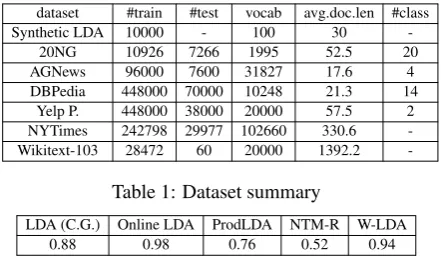
Table
1
summarizes the basic statistics.
6.1
Baselines
We evaluate W-LDA against existing topic model
methods:
1.
Collapsed Gibbs Sampling LDA
as implemented in the Mallet package (
McCal-lum
,
2002
);
2.
Online LDA as implemented in
the Gensim package (
Reh˚uˇrek and Sojka
ˇ
,
2010
);
3.
ProdLDA (
Tolstikhin et al.
,
2017
):
VAE-based, uses Gaussian approximation of the
Dirich-let prior in the softmax space;
4.
NTM-R (
Ding
et al.
,
2018
): VAE-based, improvement of NVDM
(
Miao et al.
,
2016
), uses pretrained word
embed-dings for coherence regularization.
6.2
Synthetic topic recovery
[image:5.595.308.529.61.193.2]46, 4, 44, 30, 81, 40, 87, 13, 58, 62
46, 4, 44, 30, 81, 40, 13, 87, 62, 58
13, 81, 29, 33, 27, 1, 7, 83, 2, 39
13, 81, 29, 27, 33, 1, 7, 83, 39, 2
88, 67, 16, 13, 14, 3, 75, 8, 61, 71
88, 67, 16, 13, 14, 3, 75, 8,
44
,
32
[image:6.595.116.249.98.205.2]38, 17, 57, 48, 23, 56, 50, 83, 16, 82
38, 17, 57, 48, 23, 50, 56, 83, 16, 82
44, 86, 32, 62, 20, 99, 83, 88, 51, 31
44, 86, 32, 62, 20, 88, 99, 83,
16
, 31
Table 3: Top 10 word indices ordered in decreasing
im-portance. Each cell corresponds to a topic, in which the
first row is the ground truth and the second row is
W-LDA output. The false positives are in bold. W-W-LDA
recovers the ground truth topics very well.
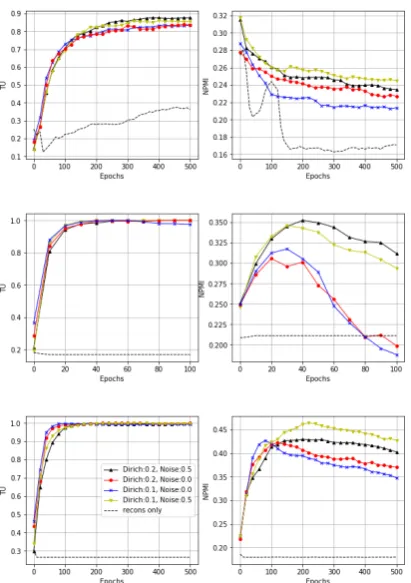
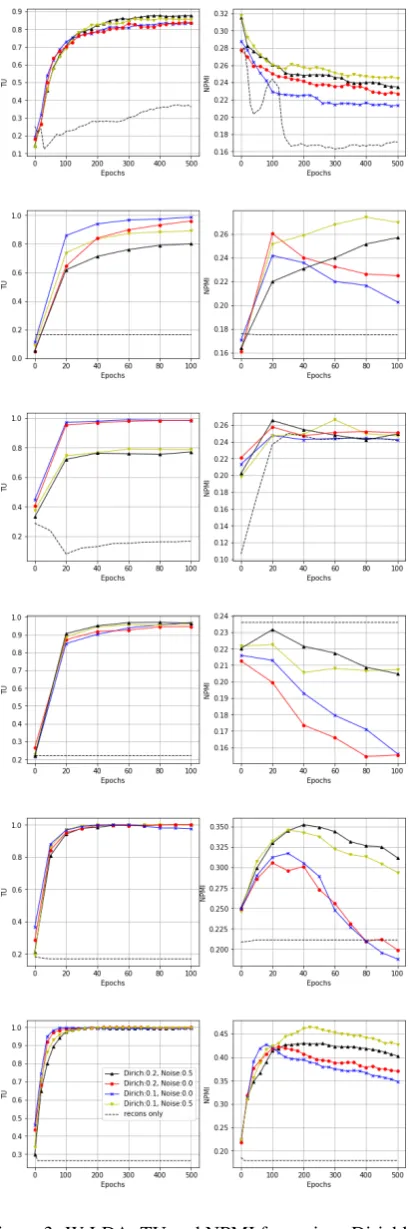
Figure 1: W-LDA: TU and NPMI for various Dirichlet
parameters and noise
α
for 20NG (top row); NYTimes
(2nd row) and Wikitext-103 (bottom row).
Adding
Dirichlet noise generally improves topic NPMI.
Min-imizing reconstruction loss only (without distribution
matching in latent space) generally leads to mode
col-lapse of latent space where only one dimension is
non-zero and the failure to learn the topics.
6.3
Parameter settings for benchmarking
The parameter settings to run the real world
datasets are as follows. For LDA with collapsed
Gibbs sampling we use the default Mallet
param-eter settings and run 2000 iterations.
For
On-line LDA we use the default Gensim
parame-ter settings and run 100 passes. For ProdLDA,
we use the original implementation provided by
the authors.
3
We tune the dropout probability
on the latent vector (the
keep_prob
parameter
in the original implementation) as we find it has
significant impact on topic quality. We vary it
from 0.4 (recommended value in the original
pa-per) to 1.
We find that setting it to 0.4 gives
the highest NPMI; setting it to 1 gives better TU
but much lower NPMI. For NTM-R, we vary the
Word Embedding Topic Coherence (WETC)
coef-ficient in
[0
,
1
,
2
,
5
,
10
,
50]
and observe that setting
it to 10 usually gives the best results in terms of
NPMI and TU; setting it to 50 indeed raises the
NPMI but the TU becomes very low and the
top-ics consist of repetitive and generic words. For
W-LDA, we set the Dirichlet parameter to 0.1
and 0.2 and use MMD with the information
dif-fusion kernel (
6
); we set the noise coefficient
α
=
{
0
,
0
.
1
,
0
.
2
,
0
.
3
,
0
.
4
,
0
.
5
,
0
.
6
}
.
Similar to
ProdLDA, we use ADAM optimizer with high
mo-mentum
β
1
= 0
.
99
and learning rate of
0
.
002
as
they can overcome initial local minima. To be
con-sistent, we set the encoder layers of W-LDA and
ProdLDA the same as NTM-R, with two hidden
layers and 100 neurons in each layer.
For the evaluation of topic quality, we monitor
the NPMI and TU for all algorithms over a
reason-able number of iterations (either when the topic
quality begins to deteriorate or stops improving
over a number of iterations) and report the best
re-sults from the different parameter settings.
6.4
Benchmark results and ablation study
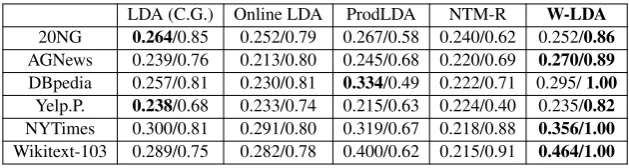
The benchmark results are summarized in Table
4
. We observe that LDA with collapsed Gibbs
sampling produces similar topics as Online LDA.
Although the NPMI of the topics produced by
ProdLDA is high, the TU score is low, which
means the topics are repetitive.
For a
qualita-tive inspection, we identify several repetiqualita-tive
top-ics that ProdLDA produces on the Wikitext-103
in Table
6
together with the best aligned topics
3
[image:6.595.79.285.336.628.2]LDA (C.G.)
Online LDA
ProdLDA
NTM-R
W-LDA
20NG
0.264
/0.85
0.252/0.79
0.267/0.58
0.240/0.62
0.252/
0.86
[image:7.595.141.456.61.145.2]AGNews
0.239/0.76
0.213/0.80
0.245/0.68
0.220/0.69
0.270/0.89
DBpedia
0.257/0.81
0.230/0.81
0.334
/0.49
0.222/0.71
0.295/
1.00
Yelp.P.
0.238
/0.68
0.233/0.74
0.215/0.63
0.224/0.40
0.235/
0.82
NYTimes
0.300/0.81
0.291/0.80
0.319/0.67
0.218/0.88
0.356/1.00
Wikitext-103
0.289/0.75
0.282/0.78
0.400/0.62
0.215/0.91
0.464/1.00
Table 4: Benchmark results for 50 topics. The numbers in each cell are NPMI/TU. Overall our method (W-LDA)
achieves much higher NPMI as well as TU than existing methods.
LDA (C.G.)
Online LDA
ProdLDA
NTM-R
W-LDA
20NG
0.513
0.473
0.213
0.433
0.431
AGNews
0.848
0.825
0.827
0.857
0.853
DBpedia
0.906
0.890
0.112
0.916
0.938
Yelp P.
0.869
0.865
0.777
0.862
0.856
Table 5: Test accuracies for the document classification
task. W-LDA is competitive with the best models.
from W-LDA. The topics from W-LDA are much
more unique. A complete comparison of the topics
from all of the methods can be found in the
Ap-pendix. NTM-R generally achieves a higher TU
than LDAs and ProdLDA but has lower NPMI.
Overall W-LDA achieves much higher NPMI as
well as TU than existing methods, especially on
NYTimes and Wikitext-103.
Document classification:
Since W-LDA is not
based on variational inference, we cannot compute
the ELBO based perplexity as a performance
met-ric as in (
Miao et al.
,
2016
;
Srivastava and Sutton
,
2017
;
Ding et al.
,
2018
). To compare the
predic-tive performance of the latent document-topic
vec-tors across all models, we use document
classifica-tion accuracy instead. Detailed setup can be found
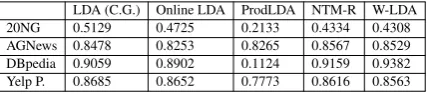
in the Appendix to save space. The accuracies on
the test set are summarized in Table
7
. We observe
that the latent vectors from W-LDA have
competi-tive classification accuracy with LDAs and
NTM-R. ProdLDA performs significantly poorly on
DB-pedia dataset; further inspection shows that the
distribution of the document-topic vectors
pro-duced by ProdLDA on test and training data are
quite different. Next, we carry out ablation study
on W-LDA.
Distribution matching:
What if we only
mini-mize the reconstruction loss of the auto-encoder,
without the loss term associated with the
distribu-tion matching? We found that across all datasets
in general, the learning tends to get stuck in bad
local minima where only one dimension in the
la-tent space is non-zero. The decoder weights also
fail to produce meaningful topics at all. The NPMI
season, playoff, league, nhl, game, rookie, touchdown, player, coach, goaltender season, nhl, playoff, game, rookie, shutout, player, league, roster, goaltender touchdown, fumble, quarterback, kickoff, punt, yardage, cornerback, linebacker, rushing, preseason
infantry, casualty, troop, battalion, artillery, reinforcement, brigade, flank, division, army brigade, casualty, troop, infantry, artillery, flank, battalion, commanded, division, regiment artillery, casualty, destroyer, battalion, squadron, reinforcement, troop, regiment, guadalcanal, convoy
battalion, brigade, infantry, platoon, bridgehead, regiment, panzer, rok, pusan, counterattack mph, km, tropical, westward, landfall, flooding, northwestward, rainfall, northeastward, extratropical
mph, km, landfall, tropical, storm, hurricane, rainfall, flooding, extratropical, saffir km, mph, tropical, westward, rainfall, flooding, convection, landfall, extratropical, storm dissipating, tropical, dissipated, extratropical, cyclone, shear, northwestward, southwestward, saffir, convection
Table 6: Comparison of select ProdLDA and W-LDA
topics on Wikitext-103. ProdLDA topics are repetitive
(above the dashed line in each cell); W-LDA topics are
unique (below the dashed line in each cell).
and TU values are plotted in dashed lines in
Fig-ure
3
. This confirms the importance of distribution
matching in our topic model.
Dirichlet parameter and noise effects:
We
study the effect of the Dirichlet parameter that
controls the sparsity and the amount of noise
added to the latent vector during training. Due to
space limit, we only plot the TU and NPMI curves
for 3 datasets in Figure
3
. The full set of plots on
all datasets can be found in the Appendix. We
ob-serve that NPMI can be significantly improved by
setting the noise coefficient
α
to
0
.
5
compared to
0 (no added noise). It may appear surprising that
such a high level of noise is beneficial; however,
we note that due to the sparsity of the Dirichlet
noise, the significant elements of the encoder
out-put
θ
would remain significant in
θ
+
in Eq. (
8
).
In other words, the variance from the noise does
not wash out the signal; it helps spread out the
latent space to benefit the training of the decoder
network. This highlights the importance of
ran-domness in the WAE framework on the one hand
and the importance of Dirichlet assumption in the
topic model on the other hand. The effect of
set-ting the Dirichlet parameter to 0.1 or 0.2 is more
mixed, signaling that the inherent topic sparsity in
these datasets can be different.
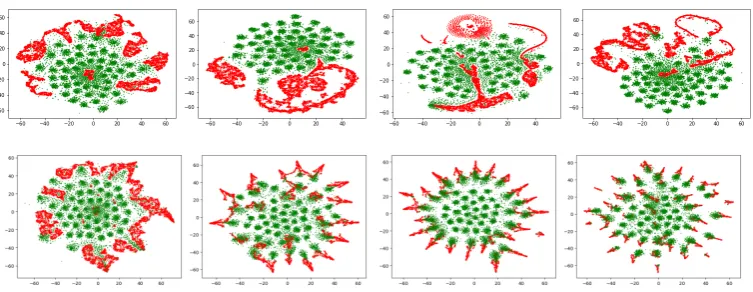
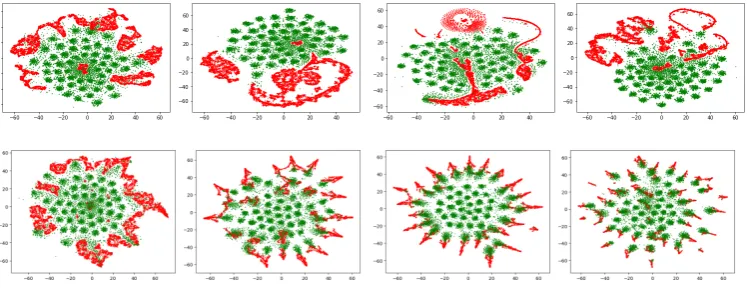
Figure 2: t-SNE plot of encoder output vectors (red) and samples from the Dirichlet prior (green) over epochs.
First row corresponds to epochs 0,10,30,99 of GAN training; second row corresponds to those of MMD training.
experiment. Our setup is as follows.
100000
input
vectors are drawn from a 2D spherical Gaussian
distribution. The encoder network consists of two
hidden layers with 2 neurons in each layer and a
2D output layer with softmax. There is no decoder
and no reconstruction loss. The goal is to train
the encoder network so that the output appears to
come from a 2D Dirichlet prior distribution of
pa-rameter 0.1. Due to space limit, Figure 1 in the
Appendix shows that both GAN and MMD
train-ing successfully match the Dirichlet prior. Next,
we increase the number of neurons in each
hid-den and output layer to 50 and set the prior to a
50D Dirichlet distribution of parameter 0.1. Since
there is no easy way to visualize the 50D
distribu-tion, we use t-SNE (
Maaten and Hinton
,
2008
) to
reduce the vectors to 2D and scatter plot the
en-coder output vectors (red) together with samples
from the true Dirichlet prior (green) in Figure
5
.
Since the samples from the 50D Dirichlet prior
tends to be sparse, there are roughly 50 green
clus-ters corresponding to the 50 modes. We see that
GAN (first row) fails to match the Dirichlet prior.
On the other hand, MMD (second row) is able to
gradually match the Dirichlet prior by capturing
more and more clusters (modes).
Given recent report that GAN learns
challeng-ing distributions much better than MMD (
Li et al.
,
2017
), our model offers an alternative view in
sup-port of the latter. The success of using MMD in
W-LDA is perhaps not surprising; the Dirichlet
distribution is supported in the space of simplex,
which behaves much more regularly than the space
of pixels in images. Furthermore, the information
diffusion kernel that we choose is able to exploit
such regularity in the geometry.
7
Conclusion and Future Work
We have proposed W-LDA, a neural network
based topic model. Unlike existing neural
net-work based models, W-LDA can directly enforce
Dirichlet prior, which plays a central role in the
sparse mixed membership model of LDA. To
mea-sure topic diversity, we have proposed a topic
uniqueness measure in addition to the widely used
NPMI for coherence. We report significant
im-provement of topic quality in both coherence and
diversity over existing topic models.
We
fur-ther make two novel discoveries: first, MMD
out-performs GAN in matching high dimensional
Dirichlet distributions; second, carefully adding
noise to the encoder output can significantly boost
topic coherence without harming diversity. We
be-lieve these discoveries are of independent interest
to the broader research on MMD, GAN and WAE.
While we were not successful in training
W-LDA using the GAN-based method, we
acknowl-edge that many new formulations of GAN have
been proposed to overcome mode collapse and
vanishing gradient such as (
Arjovsky et al.
,
2017
;
Gulrajani et al.
,
2017
). A future direction is to
im-prove the GAN-based training of W-LDA.
References
Nikolaos Aletras and Mark Stevenson. 2013.
Evaluat-ing topic coherence usEvaluat-ing distributional semantics.
In
Proceedings of the 10th International Conference
on Computational Semantics, IWCS 2013, March
19-22, 2013, University of Potsdam, Potsdam,
Ger-many
, pages 13–22.
Martin Arjovsky, Soumith Chintala, and L´eon Bottou.
2017. Wasserstein generative adversarial networks.
In
International Conference on Machine Learning
,
pages 214–223.
Y Bengio, Aaron Courville, and Pascal Vincent. 2013.
Representation learning: A review and new
perspec-tives
.
IEEE transactions on pattern analysis and
machine intelligence
, 35:1798–1828.
David M. Blei, Andrew Y. Ng, Michael I. Jordan, and
John Lafferty. 2003.
Latent dirichlet allocation.
Journal of Machine Learning Research
, 3:2003.
Samuel R. Bowman, Luke Vilnis, Oriol Vinyals,
An-drew M. Dai, Rafal Jozefowicz, and Samy
Ben-gio. 2016. Generating sentences from a continuous
space.
Dua Dheeru and Efi Karra Taniskidou. 2017.
UCI
ma-chine learning repository
.
Ran Ding, Ramesh Nallapati, and Bing Xiang.
2018. Coherence-aware neural topic modeling. In
EMNLP
, pages 830–836. Association for
Computa-tional Linguistics.
Ian Goodfellow, Jean Pouget-Abadie, Mehdi Mirza,
Bing Xu, David Warde-Farley, Sherjil Ozair, Aaron
Courville, and Yoshua Bengio. 2014.
Generative
adversarial nets
.
In Z. Ghahramani, M. Welling,
C. Cortes, N. D. Lawrence, and K. Q. Weinberger,
editors,
Advances in Neural Information Processing
Systems 27
, pages 2672–2680. Curran Associates,
Inc.
Arthur Gretton, Karsten M Borgwardt, Malte J Rasch,
Bernhard Sch¨olkopf, and Alexander Smola. 2012. A
kernel two-sample test.
Journal of Machine
Learn-ing Research
, 13(Mar):723–773.
T. L. Griffiths and M. Steyvers. 2004.
Finding
scien-tific topics
.
Proceedings of the National Academy of
Science
, 101:5228–5235.
Thomas L. Griffiths, Michael I. Jordan, Joshua B.
Tenenbaum, and David M. Blei. 2004.
Hierarchi-cal topic models and the nested chinese restaurant
process
. In S. Thrun, L. K. Saul, and B. Sch¨olkopf,
editors,
Advances in Neural Information Processing
Systems 16
, pages 17–24. MIT Press.
Ishaan Gulrajani, Faruk Ahmed, Martin Arjovsky,
Vin-cent Dumoulin, and Aaron C Courville. 2017.
Im-proved training of wasserstein gans. In
Advances
in Neural Information Processing Systems
, pages
5767–5777.
Junxian He, Daniel Spokoyny, Graham Neubig, and
Taylor Berg-Kirkpatrick. 2019. Lagging inference
networks and posterior collapse in variational
au-toencoders.
arXiv preprint arXiv:1901.05534
.
Matthew Hoffman, Francis R. Bach, and David M.
Blei. 2010.
Online learning for latent dirichlet
allo-cation
. In J. D. Lafferty, C. K. I. Williams, J.
Shawe-Taylor, R. S. Zemel, and A. Culotta, editors,
Ad-vances in Neural Information Processing Systems
23
, pages 856–864. Curran Associates, Inc.
Yoon Kim, Sam Wiseman, Andrew Miller, David
Son-tag, and Alexander Rush. 2018.
Semi-amortized
variational autoencoders
.
In
Proceedings of the
35th International Conference on Machine
Learn-ing
, volume 80 of
Proceedings of Machine Learning
Research
, pages 2678–2687, Stockholmsm¨assan,
Stockholm Sweden. PMLR.
Yoon Kim, Kelly Zhang, Alexander M Rush, Yann
Le-Cun, et al. 2017. Adversarially regularized
autoen-coders.
arXiv preprint arXiv:1706.04223
.
Diederik P Kingma and Max Welling. 2013.
Auto-encoding variational bayes.
arXiv
preprint
arXiv:1312.6114
.
John D. Lafferty and Guy Lebanon. 2002.
Informa-tion diffusion kernels. In
Advances in Neural
In-formation Processing Systems 15 [Neural
Informa-tion Processing Systems, NIPS 2002, December
9-14, 2002, Vancouver, British Columbia, Canada]
,
pages 375–382.
Jey Han Lau, David Newman, and Timothy Baldwin.
2014. Machine reading tea leaves: Automatically
evaluating topic coherence and topic model quality.
In
Proceedings of the 14th Conference of the
Euro-pean Chapter of the Association for Computational
Linguistics
, pages 530–539.
Jens Lehmann, Robert Isele, Max Jakob, Anja
Jentzsch, Dimitris Kontokostas, Pablo N. Mendes,
Sebastian Hellmann, Mohamed Morsey, Patrick van
Kleef, S¨oren Auer, and Christian Bizer. 2013.
Db-pedia - a large-scale, multilingual knowledge base
extracted from wikipedia
.
Semantic Web –
Interop-erability, Usability, Applicability
.
Chun-Liang Li, Wei-Cheng Chang, Yu Cheng,
Yim-ing Yang, and Barnab´as P´oczos. 2017. Mmd gan:
Towards deeper understanding of moment matching
network. In
Advances in Neural Information
Pro-cessing Systems
, pages 2203–2213.
L.J.P.V.D. Maaten and GE Hinton. 2008. Visualizing
high-dimensional data using t-sne.
Journal of
Ma-chine Learning Research
, 9:2579–2605.
Alireza Makhzani, Jonathon Shlens, Navdeep Jaitly,
Ian Goodfellow, and Brendan Frey. 2015.
Adversar-ial autoencoders.
arXiv preprint arXiv:1511.05644
.
Stephen Merity, Caiming Xiong, James Bradbury, and
Richard Socher. 2016.
Pointer sentinel mixture
models.
CoRR
, abs/1609.07843.
Yishu Miao, Lei Yu, and Phil Blunsom. 2016.
Neu-ral variational inference for text processing. In
In-ternational Conference on Machine Learning
, pages
1727–1736.
Radim ˇ
Reh˚uˇrek and Petr Sojka. 2010. Software
Frame-work for Topic Modelling with Large Corpora. In
Proceedings of the LREC 2010 Workshop on New
Challenges for NLP Frameworks
, pages 45–50,
Val-letta, Malta. ELRA.
http://is.muni.cz/
publication/884893/en
.
Paul K Rubenstein, Bernhard Schoelkopf, and Ilya
Tol-stikhin. 2018. On the latent space of wasserstein
auto-encoders.
arXiv preprint arXiv:1802.03761
.
Akash Srivastava and Charles Sutton. 2017.
Autoen-coding variational inference for topic models.
arXiv
preprint arXiv:1703.01488
.
Ilya Tolstikhin, Olivier Bousquet, Sylvain Gelly, and
Bernhard Schoelkopf. 2017.
Wasserstein
auto-encoders.
arXiv preprint arXiv:1711.01558
.
Rui Wang, Deyu Zhou, and Yulan He. 2018.
Atm:
Adversarial-neural topic model.
arXiv preprint
arXiv:1811.00265
.
Xiang Zhang, Junbo Zhao, and Yann LeCun. 2015.
8
Appendix: synthetic topic recovery
experiment details
We construct a synthetic corpus of 10000
docu-ments following the LDA generative process. The
vocabulary size is 100 and there are 5 topics and
Dirichlet parameters is 0.1. For all models we set
the number of topics to be 5. For LDA with
col-lapsed Gibbs sampling, we use the default
param-eters of Mallet and run 2000 iterations. For
On-line LDA we run 200 iterations using the default
parameters. We set the encoder network to have
two hidden layers with 10 units each for the
NTM-R, ProdLDA and W-LDA. For these 3 methods,
we run 50 epochs and evaluate the topics every
10 epochs to choose the best epoch. We disable
the WETC parameter for NTM-R because there is
no word embedding. We set the Dirichlet
param-eter to 0.1 for W-LDA without adding noise. For
ProdLDA we set the
keep_prob
parameter to 1.
9
Appendix: additional TU and NPMI
plots for W-LDA
Due to space limit, we only provided TU and
NPMI plots for 3 datasets in Figure 1 in the main
paper. Here we provide the complete plots for all
datasets in Figure
3
. Note that even though the
NPMI in Yelp P. without distribution matching is
high, the TU is very low. The topics turn out to
consist of highly repetitive words such as “good”,
“nice”, “love”.
10
Appendix: document classification
[image:11.595.314.519.62.678.2]Besides exploring the corpus using interpretable
topics, another usage for topic model is to act as
a feature transformation of documents for
down-stream task such as document classification. We
compare the predictive performance of the latent
document-topic vectors across all models. We set
the number of topics for all models to be 50. For
the neural network based models, we extract the
output of the encoder as the features for
docu-ment classification. For LDA, we extract the
in-ferred document-topic vectors.
A linear
multi-class multi-classifier with cross entropy loss is
mini-mized using Adam optimizer with learning rate of
0.01 for 100 iterations for all models. Finally we
choose the best parameter setting for each model
based on the accuracy on a separate validation
set. For NTM, we vary the topic coherence
pa-rameter between 0 and 50; for ProdLDA we vary
LDA (C.G.)
Online LDA
ProdLDA
NTM-R
W-LDA
20NG
0.5129
0.4725
0.2133
0.4334
0.4308
AGNews
0.8478
0.8253
0.8265
0.8567
0.8529
DBpedia
0.9059
0.8902
0.1124
0.9159
0.9382
Yelp P.
0.8685
0.8652
0.7773
0.8616
0.8563
Table 7: Test accuracies for the document classification
task. W-LDA is competitive with the best models.
the
keep_prob
parameter between 0.4 and 1.
For W-LDA, we set the Dirichlet parameter to 0.1
and vary the Dirichlet prior parameter between 0.1
and 0.7. The accuracies on the test set are
sum-marized in Table
7
. We observe that the latent
vectors from W-LDA have competitive
classifica-tion accuracy with LDAs and NTM-R. ProdLDA
performs significantly poorly on DBpedia dataset;
further inspection shows that the distribution of the
document-topic vectors produced by ProdLDA on
test and training data are quite different.
11
Appendix: MMD vs GAN in
distribution matching
In our experiments we encountered vanishing
gradient problem for the GAN-based W-LDA.
The encoder was not able to learn to match
the prior distribution. To investigate further we
compare MMD and GAN in distribution
match-ing via a synthetic experiment.
We show that
both approaches perform well for low dimensional
Dirichlet distribution yet MMD performs much
better than GAN in higher dimensional setting.
Our setup is as follows.
100
,
000
input vectors are
drawn from a 2D spherical Gaussian distribution.
The encoder network consists of two hidden layers
with 2 neurons in each layer and a 2D output layer
with softmax. The goal is to train the encoder
net-work so that the output appears to come from a 2D
Dirichlet prior distribution of parameter 0.1.
Since the 2 dimensions of the output vector sum
to 1, we can visualize the resulting distribution
via the histogram of the first dimension. The
his-togram from the true 2D Dirichlet prior of
parame-ter 0.1 is shown in the right most sub-figure on the
second row of Figure
4
. After 20 epochs of GAN
training, the encoder output distribution is able to
match that of the prior as shown in the first row
of Figure
4
. Similarly, MMD training is able to
match that of the prior as shown in the second row
of Figure
4
. Next, we increase the number of
neu-rons in each hidden and output layer to 50 and set
the prior to a Dirichlet distribution of parameter
0.1. Since there is no easy way to visualize the 50
Figure 4: Histogram for the encoded latent distribution over epochs. First row corresponds to epochs 0, 10, 20 and
50 of GAN training; second row corresponds to epochs 0, 10, 20 and 50 of MMD training; the right most figure
on the second row corresponds to the histogram of the prior distribution: 2D Dirichlet of parameter 0.1
[image:13.595.115.489.500.644.2]12
Appendix: topic words
The numbers at the beginning of each row are topic ID, TU and NPMI for each topic.
12.1
Topic words on 20NG
LDA Collapsed Gibbs sampling: NPMI=0.264, TU=0.854
[ 0 - 0.85 - 0.30594]: ['question', 'answer', 'correct', 'order', 'wrong', 'claim', 'knowledge', 'doubt', 'original', 'reason']
,→
[ 1 - 0.49762 - 0.28311]: ['thing', 'find', 'idea', 'couple', 'make', 'ago', 'put', 'guess', 'read', 'happy'] [ 2 - 1 - 0.41173]: ['god', 'jesus', 'bible', 'christian', 'church', 'christ', 'faith', 'christianity', 'lord', 'sin'] [ 3 - 0.88333 - 0.27473]: ['life', 'hell', 'man', 'death', 'love', 'body', 'dead', 'world', 'die', 'point']
[ 4 - 0.79762 - 0.32737]: ['case', 'point', 'fact', 'make', 'situation', 'clear', 'avoid', 'idea', 'simply', 'position'] [ 5 - 0.95 - 0.35637]: ['drive', 'scsi', 'disk', 'hard', 'controller', 'floppy', 'ide', 'rom', 'tape', 'card']
[ 6 - 0.95 - 0.19716]: ['mr', 'president', 'stephanopoulos', 'package', 'today', 'house', 'press', 'myers', 'george', 'continue']
,→
[ 7 - 0.61429 - 0.26655]: ['work', 'job', 'lot', 'school', 'year', 'business', 'experience', 'make', 'learn', 'time'] [ 8 - 0.73333 - 0.29981]: ['time', 'day', 'long', 'times', 'week', 'end', 'give', 'night', 'stop', 'rest']
[ 9 - 0.95 - 0.28707]: ['gun', 'control', 'police', 'crime', 'carry', 'rate', 'weapon', 'defense', 'times', 'firearm'] [ 10 - 0.9 - 0.32923]: ['windows', 'dos', 'os', 'screen', 'software', 'driver', 'mode', 'pc', 'ibm', 'memory'] [ 11 - 0.93333 - 0.27132]: ['price', 'offer', 'sale', 'interested', 'buy', 'sell', 'mail', 'shipping', 'company',
'condition'] ,→
[ 12 - 0.88333 - 0.29119]: ['team', 'hockey', 'season', 'league', 'nhl', 'year', 'game', 'division', 'city', 'pick'] [ 13 - 0.95 - 0.30172]: ['evidence', 'argument', 'true', 'exist', 'truth', 'science', 'existence', 'theory', 'atheism',
'statement'] ,→
[ 14 - 0.9 - 0.30554]: ['israel', 'jews', 'jewish', 'israeli', 'peace', 'arab', 'land', 'state', 'islam', 'human']
[ 15 - 0.75833 - 0.32471]: ['state', 'government', 'law', 'rights', 'bill', 'states', 'federal', 'public', 'court', 'united'] [ 16 - 0.81667 - 0.24906]: ['small', 'large', 'size', 'type', 'area', 'difference', 'free', 'order', 'work', 'set']
[ 17 - 0.93333 - 0.26958]: ['health', 'medical', 'number', 'food', 'disease', 'care', 'pain', 'blood', 'study', 'msg'] [ 18 - 0.85833 - 0.23656]: ['chip', 'encryption', 'clipper', 'government', 'law', 'technology', 'enforcement', 'escrow',
'privacy', 'phone'] ,→
[ 19 - 0.9 - 0.14479]: ['period', 'la', 'power', 'pp', 'win', 'van', 'play', 'ny', 'cal', 'de']
[ 20 - 0.83333 - 0.24515]: ['good', 'pretty', 'nice', 'worth', 'bad', 'level', 'class', 'quality', 'luck', 'thing'] [ 21 - 1 - 0.22251]: ['car', 'bike', 'engine', 'speed', 'dod', 'road', 'ride', 'front', 'oil', 'dealer']
[ 22 - 0.80833 - 0.19851]: ['file', 'output', 'entry', 'program', 'build', 'section', 'info', 'read', 'int', 'number'] [ 23 - 0.93333 - 0.21397]: ['window', 'server', 'motif', 'application', 'widget', 'display', 'subject', 'mit', 'sun', 'set'] [ 24 - 0.85833 - 0.23623]: ['post', 'article', 'group', 'posting', 'news', 'newsgroup', 'reply', 'read', 'response', 'mail'] [ 25 - 0.9 - 0.26876]: ['image', 'graphics', 'version', 'ftp', 'color', 'format', 'package', 'jpeg', 'gif', 'contact'] [ 26 - 0.76429 - 0.31668]: ['sense', 'make', 'moral', 'choice', 'person', 'personal', 'human', 'means', 'objective',
'understand'] ,→
[ 27 - 0.8 - 0.27119]: ['back', 'side', 'left', 'put', 'head', 'end', 'turn', 'top', 'hand', 'picture']
[ 28 - 0.59762 - 0.28526]: ['people', 'person', 'make', 'live', 'thing', 'talk', 'give', 'stop', 'realize', 'means'] [ 29 - 0.73333 - 0.25073]: ['book', 'word', 'read', 'law', 'reference', 'find', 'matthew', 'text', 'context', 'david'] [ 30 - 0.88333 - 0.2469]: ['water', 'war', 'military', 'time', 'air', 'south', 'plan', 'nuclear', 'force', 'ago'] [ 31 - 0.9 - 0.18688]: ['cs', 'uk', 'ed', 'ac', 'john', 'david', 'ca', 'mark', 'jim', 'tom']
[ 32 - 0.78333 - 0.20401]: ['key', 'bit', 'number', 'public', 'des', 'message', 'algorithm', 'security', 'part', 'block'] [ 33 - 0.66429 - 0.26271]: ['big', 'bad', 'make', 'lot', 'stuff', 'remember', 'back', 'gm', 'guy', 'guess']
[ 34 - 0.9 - 0.25369]: ['home', 'woman', 'wife', 'building', 'left', 'mother', 'door', 'remember', 'family', 'leave'] [ 35 - 0.95 - 0.21317]: ['power', 'ground', 'current', 'wire', 'cable', 'supply', 'circuit', 'hot', 'box', 'run'] [ 36 - 0.9 - 0.30954]: ['system', 'data', 'systems', 'software', 'computer', 'design', 'analysis', 'level', 'digital',
'high'] ,→
[ 37 - 0.95 - 0.22316]: ['university', 'research', 'national', 'information', 'center', 'april', 'california', 'office', 'washington', 'conference']
,→
[ 38 - 0.875 - 0.33608]: ['armenian', 'turkish', 'armenians', 'people', 'turkey', 'armenia', 'turks', 'greek', 'genocide', 'government']
,→
[ 39 - 0.83333 - 0.24725]: ['game', 'year', 'play', 'hit', 'baseball', 'goal', 'player', 'average', 'flyers', 'shot'] [ 40 - 1 - 0.22238]: ['black', 'fire', 'light', 'white', 'face', 'fbi', 'red', 'local', 'thought', 'koresh']
[ 41 - 0.93333 - 0.22892]: ['code', 'line', 'source', 'set', 'include', 'simple', 'library', 'language', 'write', 'object'] [ 42 - 0.85 - 0.23873]: ['card', 'video', 'mac', 'bit', 'apple', 'monitor', 'board', 'ram', 'memory', 'modem']
[ 43 - 0.83333 - 0.26739]: ['mail', 'list', 'send', 'information', 'internet', 'email', 'anonymous', 'request', 'ftp', 'address']
,→
[ 44 - 0.65833 - 0.30522]: ['reason', 'wrong', 'agree', 'point', 'true', 'feel', 'find', 'opinion', 'reading', 'experience'] [ 45 - 0.9 - 0.13391]: ['db', 'call', 'copy', 'al', 'section', 'mov', 'cs', 'place', 'bh', 'dangerous']
[ 46 - 0.9 - 0.21481]: ['world', 'history', 'media', 'germany', 'german', 'europe', 'usa', 'american', 'great', 'part'] [ 47 - 0.85833 - 0.21134]: ['problem', 'work', 'advance', 'fine', 'friend', 'find', 'recently', 'error', 'machine', 'cross'] [ 48 - 1 - 0.37787]: ['space', 'nasa', 'earth', 'launch', 'satellite', 'shuttle', 'orbit', 'moon', 'mission', 'lunar'] [ 49 - 0.83929 - 0.30421]: ['money', 'cost', 'pay', 'support', 'insurance', 'make', 'private', 'million', 'administration',
'government'] ,→
Online LDA: NPMI=0.252, TU=0.788
[ 0 - 0.78333 - 0.33403]: ['drive', 'disk', 'scsi', 'hard', 'controller', 'ide', 'floppy', 'tape', 'system', 'bus'] [ 1 - 0.9 - 0.25403]: ['jews', 'greek', 'jewish', 'turkish', 'turkey', 'greece', 'turks', 'adam', 'western', 'movement'] [ 2 - 0.86667 - 0.17326]: ['new', 'period', 'york', 'chicago', 'st', 'pp', 'second', 'pittsburgh', 'los', 'power'] [ 3 - 0.68333 - 0.24503]: ['encryption', 'government', 'law', 'technology', 'enforcement', 'privacy', 'security', 'new',
'clipper', 'escrow'] ,→
[ 4 - 0.76429 - 0.23766]: ['widget', 'application', 'window', 'use', 'display', 'set', 'server', 'xt', 'motif', 'resource'] [ 5 - 0.95 - 0.23512]: ['good', 'article', 'book', 'read', 'ago', 'paper', 'reading', 'reference', 'excellent', 'bob'] [ 6 - 0.825 - 0.24322]: ['card', 'video', 'monitor', 'bit', 'screen', 'port', 'mode', 'vga', 'color', 'bus']
[ 7 - 0.9 - 0.29799]: ['available', 'ftp', 'graphics', 'software', 'data', 'information', 'also', 'version', 'contact', 'package']
,→
[ 8 - 0.62708 - 0.31925]: ['one', 'people', 'think', 'true', 'may', 'question', 'say', 'point', 'evidence', 'even'] [ 9 - 0.82292 - 0.18638]: ['bike', 'dod', 'pain', 'day', 'one', 'side', 'back', 'ride', 'like', 'first']
[ 10 - 1 - 0.37787]: ['space', 'nasa', 'launch', 'earth', 'satellite', 'orbit', 'shuttle', 'moon', 'lunar', 'mission'] [ 11 - 1 - 0.1984]: ['line', 'radio', 'tv', 'mark', 'audio', 'try', 'end', 'two', 'edge', 'center']
[ 12 - 0.80625 - 0.24895]: ['power', 'board', 'memory', 'supply', 'ram', 'case', 'battery', 'motherboard', 'one', 'pin'] [ 13 - 0.5625 - 0.26666]: ['people', 'right', 'government', 'rights', 'state', 'well', 'society', 'system', 'law', 'militia'] [ 14 - 0.36042 - 0.3857]: ['like', 'people', 'think', 'get', 'know', 'one', 'really', 'want', 'say', 'something']
[ 15 - 0.9 - 0.35912]: ['god', 'religion', 'believe', 'atheism', 'christian', 'religious', 'exist', 'belief', 'islam', 'existence']
,→
[ 20 - 0.8 - 0.24168]: ['university', 'program', 'research', 'national', 'conference', 'science', 'new', 'april', 'organization', 'billion']
,→
[ 21 - 0.85 - 0.11704]: ['year', 'last', 'win', 'la', 'cal', 'min', 'det', 'van', 'mon', 'tor']
[ 22 - 0.775 - 0.22759]: ['game', 'goal', 'scsi', 'play', 'shot', 'puck', 'flyers', 'net', 'penalty', 'bit'] [ 23 - 0.65208 - 0.39624]: ['god', 'jesus', 'one', 'church', 'bible', 'christ', 'christian', 'us', 'faith', 'people'] [ 24 - 0.60625 - 0.30005]: ['money', 'buy', 'one', 'price', 'pay', 'insurance', 'cost', 'get', 'like', 'new'] [ 25 - 0.95 - 0.1792]: ['ca', 'uk', 'cs', 'david', 'de', 'michael', 'ac', 'tom', 'john', 'andrew']
[ 26 - 0.81667 - 0.19665]: ['sale', 'price', 'offer', 'new', 'shipping', 'condition', 'dos', 'cd', 'sell', 'interested'] [ 27 - 0.9 - 0.24906]: ['sound', 'mike', 'record', 'oh', 'night', 'okay', 're', 'last', 'eric', 'sorry']
[ 28 - 0.51458 - 0.34604]: ['much', 'time', 'one', 'like', 'good', 'better', 'think', 'get', 'well', 'really'] [ 29 - 0.85625 - 0.13969]: ['db', 'al', 'cs', 'mov', 'bh', 'channel', 'byte', 'pop', 'push', 'one']
[ 30 - 0.76875 - 0.34827]: ['armenian', 'armenians', 'turkish', 'people', 'genocide', 'armenia', 'one', 'russian', 'soviet', 'azerbaijan']
,→
[ 31 - 0.9 - 0.25769]: ['list', 'internet', 'mail', 'address', 'news', 'email', 'send', 'posting', 'anonymous', 'information']
,→
[ 32 - 0.67262 - 0.28665]: ['windows', 'dos', 'software', 'use', 'system', 'mac', 'problem', 'pc', 'file', 'driver'] [ 33 - 0.85833 - 0.27275]: ['gun', 'file', 'crime', 'bill', 'law', 'control', 'police', 'weapon', 'states', 'firearm'] [ 34 - 0.74762 - 0.24866]: ['study', 'health', 'number', 'rate', 'use', 'april', 'among', 'report', 'page', 'risk'] [ 35 - 0.76667 - 0.21434]: ['window', 'sun', 'keyboard', 'server', 'mouse', 'motif', 'xterm', 'font', 'mit', 'get'] [ 36 - 0.62292 - 0.26581]: ['car', 'engine', 'speed', 'front', 'oil', 'one', 'may', 'get', 'like', 'right'] [ 37 - 0.95 - 0.1132]: ['vs', 'gm', 'la', 'pt', 'pm', 'ma', 'mg', 'md', 'tm', 'mi']
[ 38 - 0.9 - 0.28248]: ['israel', 'israeli', 'arab', 'san', 'land', 'arabs', 'francisco', 'palestinian', 'state', 'jews'] [ 39 - 0.9 - 0.27416]: ['medical', 'disease', 'public', 'soon', 'cancer', 'trial', 'treatment', 'health', 'gordon',
'medicine'] ,→
[ 40 - 0.81875 - 0.2017]: ['fire', 'fbi', 'koresh', 'gas', 'dog', 'batf', 'compound', 'one', 'people', 'story'] [ 41 - 0.73125 - 0.2485]: ['key', 'des', 'public', 'algorithm', 'bit', 'nsa', 'encryption', 'one', 'rsa', 'ripem'] [ 42 - 0.85 - 0.36136]: ['team', 'game', 'season', 'hockey', 'league', 'year', 'play', 'nhl', 'player', 'baseball'] [ 43 - 0.66429 - 0.19931]: ['entry', 'section', 'must', 'use', 'cross', 'program', 'info', 'number', 'source', 'may'] [ 44 - 0.77917 - 0.24336]: ['us', 'war', 'country', 'government', 'military', 'american', 'people', 'world', 'nuclear',
'america'] ,→
[ 45 - 0.9 - 0.16519]: ['master', 'feature', 'slave', 'pin', 'systems', 'tank', 'model', 'jumper', 'drive', 'japanese'] [ 46 - 0.56042 - 0.22238]: ['mr', 'people', 'know', 'president', 're', 'us', 'one', 'stephanopoulos', 'think', 'go'] [ 47 - 0.82054 - 0.21982]: ['ground', 'wire', 'hot', 'circuit', 'use', 'one', 'wiring', 'neutral', 'cable', 'current'] [ 48 - 0.80833 - 0.24895]: ['output', 'file', 'program', 'int', 'printf', 'char', 'entry', 'input', 'oname', 'stream'] [ 49 - 0.90625 - 0.19526]: ['code', 'media', 'call', 'one', 'object', 'stuff', 'date', 'btw', 'way', 'deal']
ProdLDA : NPMI=0.268, TU=0.59
[ 0 - 0.58333 - 0.21393]: ['int', 'char', 'oname', 'buf', 'printf', 'output', 'null', 'entry', 'file', 'stream'] [ 1 - 0.7 - 0.19171]: ['stephanopoulos', 'administration', 'president', 'senior', 'sector', 'congress', 'mr', 'russian',
'package', 'russia'] ,→
[ 2 - 0.43333 - 0.095146]: ['tor', 'det', 'que', 'pit', 'nj', 'min', 'la', 'buf', 'van', 'cal']
[ 3 - 0.65 - 0.18382]: ['bike', 'brake', 'gear', 'gateway', 'rider', 'manual', 'quadra', 'filter', 'mhz', 'motherboard'] [ 4 - 0.345 - 0.46605]: ['interface', 'rom', 'controller', 'disk', 'ram', 'floppy', 'motherboard', 'mb', 'slot', 'scsi'] [ 5 - 0.70833 - 0.40336]: ['israel', 'israeli', 'arab', 'arabs', 'islamic', 'lebanon', 'lebanese', 'palestinian', 'jew',
'murder'] ,→
[ 6 - 0.56667 - 0.32953]: ['privacy', 'escrow', 'encryption', 'security', 'wiretap', 'enforcement', 'secure', 'encrypt', 'anonymous', 'ripem']
,→
[ 7 - 0.43333 - 0.3356]: ['jesus', 'passage', 'matthew', 'doctrine', 'scripture', 'holy', 'prophet', 'church', 'prophecy', 'pope']
,→
[ 8 - 0.55 - 0.273]: ['export', 'ftp', 'mit', 'xt', 'widget', 'server', 'unix', 'directory', 'vendor', 'font'] [ 9 - 0.425 - 0.36579]: ['jesus', 'faith', 'passage', 'god', 'doctrine', 'belief', 'christ', 'existence', 'church',
'biblical'] ,→
[ 10 - 0.60833 - 0.12043]: ['app', 'professor', 'rider', 'annual', 'league', 'genocide', 'francisco', 'armenian', 'art', 'arab']
,→
[ 11 - 0.65 - 0.20985]: ['stephanopoulos', 'mr', 'president', 'senate', 'consideration', 'meeting', 'myers', 'promise', 'decision', 'package']
,→
[ 12 - 0.71667 - 0.29307]: ['xt', 'image', 'xlib', 'amiga', 'toolkit', 'processing', 'resource', 'jpeg', 'workstation', 'server']
,→
[ 13 - 0.8 - 0.31247]: ['anonymous', 'privacy', 'cryptography', 'rsa', 'cipher', 'electronic', 'ftp', 'ripem', 'internet', 'pgp']
,→
[ 14 - 0.56667 - 0.16196]: ['stephanopoulos', 'president', 'clipper', 'scheme', 'mr', 'escrow', 'myers', 'restriction', 'nsa', 'wiretap']
,→
[ 15 - 0.395 - 0.40117]: ['armenians', 'turkish', 'armenian', 'turks', 'armenia', 'genocide', 'massacre', 'muslim', 'turkey', 'jews']
,→
[ 16 - 0.5 - 0.29259]: ['holy', 'jesus', 'son', 'father', 'lord', 'spirit', 'matthew', 'prophecy', 'satan', 'prophet'] [ 17 - 0.95 - 0.16966]: ['health', 'hus', 'among', 'child', 'culture', 'md', 'volume', 'laboratory', 'age', 'safety'] [ 18 - 0.31667 - 0.34482]: ['jesus', 'god', 'matthew', 'passage', 'prophecy', 'christ', 'holy', 'faith', 'lord', 'prophet'] [ 19 - 0.85 - 0.11794]: ['db', 'byte', 'mov', 'bh', 'cs', 'ax', 'pop', 'push', 'west', 'ah']
[ 20 - 0.45 - 0.092708]: ['tor', 'det', 'que', 'pit', 'van', 'nj', 'cal', 'la', 'gm', 'min']
[ 21 - 0.83333 - 0.3036]: ['conclude', 'universe', 'existence', 'atheism', 'atheist', 'religious', 'belief', 'conclusion', 'evidence', 'truth']
,→
[ 22 - 0.4 - 0.35819]: ['hitter', 'season', 'defensive', 'puck', 'braves', 'baseball', 'playoff', 'league', 'coach', 'team'] [ 23 - 0.63333 - 0.32329]: ['windows', 'colormap', 'window', 'microsoft', 'application', 'menu', 'dos', 'screen', 'widget',
'default'] ,→
[ 24 - 0.37833 - 0.34674]: ['scsi', 'motherboard', 'ide', 'quadra', 'ram', 'vga', 'meg', 'mhz', 'adapter', 'isa'] [ 25 - 0.53333 - 0.30136]: ['hitter', 'coach', 'offense', 'career', 'team', 'season', 'baseball', 'pitcher', 'dog',
'defensive'] ,→
[ 26 - 0.56667 - 0.16056]: ['detroit', 'winnipeg', 'det', 'playoff', 'calgary', 'tor', 'vancouver', 'pp', 'rangers', 'gm'] [ 27 - 0.69167 - 0.37335]: ['god', 'belief', 'faith', 'truth', 'reject', 'absolute', 'bible', 'christianity', 'christian',
'revelation'] ,→
[ 28 - 0.44167 - 0.24637]: ['turkish', 'jews', 'greece', 'greek', 'muslims', 'jewish', 'matthew', 'lebanese', 'pope', 'christ']
,→
[ 29 - 0.63333 - 0.16721]: ['wiring', 'wire', 'oname', 'buf', 'entry', 'char', 'outlet', 'int', 'output', 'printf']
[ 30 - 0.575 - 0.33351]: ['rom', 'disk', 'controller', 'floppy', 'feature', 'interface', 'connector', 'slot', 'mb', 'jumper'] [ 31 - 0.67 - 0.21175]: ['armenians', 'apartment', 'woman', 'neighbor', 'troops', 'secretary', 'armenian', 'girl', 'armenia',
'afraid'] ,→
[ 32 - 0.42 - 0.35202]: ['greek', 'turks', 'armenian', 'greece', 'minority', 'armenians', 'muslim', 'muslims', 'genocide', 'lebanese']
,→
[ 33 - 0.5 - 0.30162]: ['puck', 'flyers', 'season', 'score', 'hitter', 'braves', 'coach', 'team', 'nhl', 'career'] [ 34 - 0.545 - 0.21961]: ['ide', 'scsi', 'meg', 'bus', 'isa', 'dos', 'hd', 'controller', 'adapter', 'slave']
[ 35 - 0.68333 - 0.29779]: ['os', 'server', 'pixel', 'vendor', 'image', 'processing', 'documentation', 'xterm', 'unix', 'mit']
,→
[ 36 - 0.8 - 0.2106]: ['file', 'gun', 'united', 'congress', 'handgun', 'journal', 'prohibit', 'february', 'firearm', 'senate']
,→
[ 37 - 0.68333 - 0.3552]: ['winnipeg', 'calgary', 'montreal', 'detroit', 'rangers', 'nhl', 'hockey', 'leafs', 'louis', 'minnesota']
,→
[ 39 - 0.7 - 0.3484]: ['satellite', 'mission', 'space', 'nasa', 'shuttle', 'lunar', 'spacecraft', 'launch', 'international', 'earth']
,→
[ 40 - 0.395 - 0.22319]: ['hockey', 'nhl', 'league', 'armenian', 'massacre', 'turkish', 'draft', 'armenians', 'genocide', 'turks']
,→
[ 41 - 0.7 - 0.1999]: ['motherboard', 'amp', 'hd', 'brake', 'mhz', 'monitor', 'tire', 'upgrade', 'bike', 'compatible'] [ 42 - 0.56667 - 0.25204]: ['widget', 'visual', 'resource', 'xt', 'application', 'colormap', 'app', 'export', 'default',
'converter'] ,→
[ 43 - 0.7 - 0.28056]: ['earth', 'space', 'shuttle', 'mission', 'orbit', 'km', 'nasa', 'sky', 'lunar', 'foundation'] [ 44 - 0.60333 - 0.34564]: ['mhz', 'scsi', 'modem', 'ram', 'vga', 'processor', 'cache', 'port', 'screen', 'printer'] [ 45 - 0.66667 - 0.19954]: ['encryption', 'key', 'escrow', 'clipper', 'algorithm', 'enforcement', 'des', 'secure', 'wiretap',
'session'] ,→
[ 46 - 0.73333 - 0.086758]: ['mw', 'db', 'wm', 'na', 'rg', 'van', 'md', 'mov', 'sl', 'bh']
[ 47 - 0.40333 - 0.40371]: ['scsi', 'controller', 'mb', 'cache', 'disk', 'card', 'windows', 'floppy', 'vga', 'ram'] [ 48 - 0.57 - 0.21702]: ['armenians', 'father', 'armenian', 'apartment', 'armenia', 'february', 'azerbaijan', 'woman',
'soviet', 'investigation'] ,→
[ 49 - 0.64167 - 0.31175]: ['militia', 'sentence', 'jews', 'constitution', 'arab', 'israeli', 'lebanese', 'arabs', 'israel', 'nazi']
,→
%\end{verbnobox}
NTM-R: NPMI=0.24, TU=0.624
[0-0.78333-0.22157]: ['marriage', 'exist', 'evidence', 'surely', 'sick', 'perhaps', 'appear', 'air', 'serious', 'raise'] [1-0.465-0.16851]: ['monitor', 'jesus', 'surrender', 'lot', 'dave', 'drive', 'put', 'disk', 'love', 'soon']
[2-0.33167-0.37993]: ['ide', 'controller', 'vga', 'card', 'floppy', 'adapter', 'hd', 'scsi', 'mb', 'video']
[3-0.73667-0.23189]: ['lebanon', 'surrender', 'evidence', 'reaction', 'islamic', 'death', 'soon', 'government', 'happen', 'effect']
,→
[4-0.83333-0.39082]: ['armenian', 'armenians', 'turks', 'armenia', 'turkish', 'genocide', 'turkey', 'israel', 'arab', 'israeli']
,→
[5-0.79-0.20377]: ['mask', 'punishment', 'surrender', 'try', 'religious', 'guess', 'patient', 'always', 'islam', 'bible'] [6-0.64167-0.24654]: ['year', 'consider', 'certain', 'besides', 'day', 'blame', 'pretty', 'evidence', 'damage', 'go'] [7-0.28667-0.33766]: ['ide', 'scsi', 'drive', 'disk', 'controller', 'floppy', 'isa', 'card', 'bus', 'ram']
[8-0.83333-0.3028]: ['hockey', 'toronto', 'cal', 'coach', 'game', 'league', 'winnipeg', 'rangers', 'detroit', 'playoff'] [9-0.54167-0.25723]: ['fan', 'season', 'team', 'toronto', 'game', 'last', 'year', 'braves', 'hit', 'miss']
[10-0.80833-0.18641]: ['insurance', 'false', 'difficult', 'find', 'clipper', 'relatively', 'regard', 'chip', 'etc', 'damn'] [11-0.395-0.24484]: ['please', 'sale', 'email', 'version', 'mail', 'modem', 'thanks', 'mailing', 'macintosh', 'ftp'] [12-0.88333-0.19338]: ['weapon', 'federal', 'military', 'warrant', 'population', 'government', 'judge', 'worry', 'attitude',
'ago'] ,→
[13-0.55278-0.22393]: ['interested', 'advance', 'os', 'dos', 'thanks', 'box', 'apple', 'windows', 'monitor', 'file'] [14-0.75833-0.18371]: ['round', 'year', 'go', 'else', 'money', 'digital', 'air', 'lot', 'wait', 'clinton']
[15-0.62833-0.18964]: ['mail', 'ftp', 'sale', 'workstation', 'email', 'eric', 'via', 'project', 'thanks', 'test']
[16-0.775-0.17498]: ['san', 'nasa', 'clipper', 'administration', 'americans', 'houston', 'gun', 'gm', 'closer', 'president'] [17-0.60333-0.24235]: ['realize', 'arab', 'israeli', 'jews', 'religious', 'surrender', 'shall', 'raise', 'atheism', 'carry'] [18-0.68333-0.29585]: ['hitter', 'hit', 'baseball', 'coach', 'team', 'flyers', 'staff', 'braves', 'season', 'player'] [19-0.55333-0.24486]: ['motif', 'image', 'mode', 'thanks', 'appreciate', 'pc', 'widget', 'vga', 'available', 'graphics'] [20-0.41667-0.24645]: ['cable', 'disk', 'ram', 'thanks', 'board', 'mb', 'modem', 'video', 'sale', 'adapter']
[21-0.7-0.26178]: ['widget', 'input', 'key', 'toolkit', 'chip', 'window', 'menu', 'error', 'default', 'int']
[22-0.565-0.38053]: ['god', 'christian', 'heaven', 'faith', 'christianity', 'jesus', 'hell', 'sin', 'interpretation', 'bible'] [23-0.44278-0.18352]: ['appreciate', 'thanks', 'card', 'windows', 'post', 'luck', 'vga', 'anybody', 'advance', 'thank'] [24-0.71667-0.19024]: ['window', 'toolkit', 'server', 'key', 'motif', 'pgp', 'mit', 'session', 'utility', 'stream'] [25-0.76167-0.23294]: ['properly', 'catholic', 'thanks', 'bible', 'sex', 'easy', 'moral', 'religion', 'mine', 'appropriate'] [26-0.83333-0.18606]: ['design', 'doctor', 'car', 'alive', 'imagine', 'brain', 'go', 'suppose', 'something', 'student'] [27-0.78333-0.22233]: ['israel', 'kill', 'jews', 'arab', 'woman', 'americans', 'responsible', 'nothing', 'civil', 'gordon'] [28-0.44778-0.27568]: ['windows', 'mod