https://doi.org/10.17221/154/2018-CJAS
Supported by the Ministry of Agriculture of the Czech Republic (Projects No. QK1810253 and No. MZE RO0718).
Estimation of inbreeding effect on conception
in Czech Holstein
Michala Hofmannová*, Josef Přibyl, Emil Krupa, Petr Pešek
Institute of Animal Science, Prague-Uhříněves, Czech Republic *Corresponding author: [email protected]
Citation: Hofmannová M., Přibyl J., Krupa E., Pešek P. (2019): Estimation of inbreeding effect on conception in Czech Hol-stein. Czech J. Anim. Sci., 64, 309–316.
Abstract:The influence of calculated inbreeding coefficients on the conception of heifers and cows was analysed by a two-trait binary model for conceived/not conceived after each insemination on 677 234 Czech Holstein cows and heifers with 3 248 299 insemination records as the covariable in a statistical model. The data between 1996 and 2014 were analysed. Various effects and their statistical influence on traits were tested by a generalized linear model. Consequently, genetic parameters were estimated by the Gibbs sampling method and used in predicting breeding values using the best linear unbiased prediction by animal model (BLUP-AM). The mean for the conception rate of cows averaged over lactations was 33.7% and for heifers it reached 53.8%. Average inbreeding coefficient increased from 1% in 1996 to almost 5% by 2013 and was in the range of 0–45%. The rate of inbreeding per generation was 0.20%. Although the effect of inbreeding was statistically significant (P = 0.05) for both traits, the proportion of vari-ability explained by the models was relatively low. Estimated genetic parameters were low for both traits. Coefficient of heritability was 2.00% and 1.30% for cows and heifers, respectively, whereas coefficients of repeatability reached 6.09% and 7.08% for cows and heifers, respectively. The random effect of the permanent environment (PE) reached higher values than the additive genetic variance (G) and explained 5.67% and 4.09% of variability for cows and heif-ers, respectively. A negative impact of inbreeding on heifer and cow conception was observed, whereby every 10% increase in inbreeding coefficient resulted in a conception decline by 2.23%. Calculated Spearman’s rank correlation coefficient between estimated breeding values considering and not considering the effect of inbreeding was close to one. Presented results indicate that inbreeding has a negligible influence on the breeding values of conception. The results also indicate that it is not necessary to include inbreeding coefficient in the routine breeding value evalua-tion of concepevalua-tion rate of heifers and cows. On the other hand, monitoring of inbreeding is necessary to avoid an increase of its rate.
Keywords: BLUP; breeding value; dairy cattle; Gibbs sampling; inbreeding depression
The artificial insemination era jointly with global market and together with efficient and more ac-crued estimation of breeding values, not only in dairy cattle populations, makes high pressure on using small groups of excellent breeding animals, especially breeding bulls. The breeding objectives, focused only on an increase of milk yield and improvement of milk solid components (Brade 2016) in breeding programs, also have a
frequent mating of related individuals could result in inbreeding depression as a measurable impact of F on traits. The inbreeding depression could negatively impress on all economically important production and reproductive traits (Sorensen et al. 2005; Zhang et al. 2015). Even though some authors concluded that F had a negligible impact on large populations, its effect is more evident in smaller local populations (du Toit et al. 2012). As Bjelland et al. (2013) concluded, the negative impact of inbreeding depression on production traits (Thompson et al. 2000) as well as on repro-duction or survivability trait (Mc Parland et al. 2007) has been well documented. For example, in Spanish dairy cattle Gonzales-Recio et al. (2007) revealed that the pregnancy rate decreased by 1.68% in cows with the F value between 6.25% and 12.5%. These authors also found that inbreeding depression had a greater effect in cows with F higher than 25%. Also Sorensen et al. (2005) stated that it is necessary to monitor inbreeding in dairy cattle which increases with selection intensity, when in the Holstein population in Denmark it rose from 0.74 to 1.03 within ten years and in the Danish Red breed even from 0.32 to 1.07.
Biotechnological manipulation of sperm and ovum (Kurykin et al. 2016) as well as of freezing techniques for semen and embryos (Dolezalova et al. 2016) are being tested to improve fertility.
The negative impact of F on maternal ability or on early embryo vitality was also reported. For example, Dezetter et al. (2015) found a relation-ship between declining fertility and inbreeding, egg and embryo quality (Luttgenau et al. 2016), and the onset of the luteal phase after egg re-lease (Tenghe et al. 2016) could also be affected. Inbreeding could also influence fitness, mastitis and metritis according to Pinedo et al. (2016). Nevertheless, fertility traits are relatively lowly heritable (Jakubec et al. 2010) and therefore it is more difficult to select individuals so that the reproductive capacity of cows could thereby be improved (Weller and Ron 1992), it is also impor-tant to measure the influence of F on them. This claim is supported by some authors’ opinion that the influence of inbreeding depression on lowly heritable traits is usually undervalued; even the decreasing reproductive measures due to selec-tion for milk yield are currently the most common reason for removing cows from herds (Muller et al. 2017). Rokouei et al. (2010) detected a
delete-rious effect of inbreeding on milk yield (ranging from –18 to –27 kg of milk per 1% increase in inbreeding) whereas an impact on reproductive traits was negligible (except for calving interval and age at first calving).
The aims of the present study were to analyse inbreeding in the Czech Holstein population and to estimate inbreeding depression for conception rates of heifers and cows by using two-trait animal models. Assumptions were that inbreeding has a negative impact on analysed fertility traits and the inbreeding coefficient should be included in the routine system of breeding value estimation for the Czech Holstein population performed in the Czech Republic.
MATERIAL AND METHODS
The input data covered information about con-ception and pedigrees collected by the Holstein Cattle Breeders Association of the Czech Repub-lic and provided by Plemdat Ltd responsible for routine processing of breeding data.
Data obtained for all inseminations of heifers and cows born between 1996 and 2014 were analysed. Only purebred Holstein females were used. Each insemination was considered as an alternative bi-nary trait of conceiving (conceived/not conceived) of heifers or cows. Females with calving interval longer than 500 days were omitted from analyses. Total number of herds in the evaluated data was 858. The herds that did not satisfy the minimum number of observations (10 per one herd) were also omitted. In total, 3 248 299 observations (2 399 143 from cows and 849 156 from heifers) for 677 234 cows and heifers were used in this study after data editing. The mean value for the number of observations per herd was 989 and 2796 for heifers and cows. On average, after data editing there were 1.67 and 4.93 conceptions for each heifer and cow, respectively.
The appropriate pedigree file contained all
ani-mals with data,their parents and all other
https://doi.org/10.17221/154/2018-CJAS
the pedigree completeness index (PCI). Maximum generations traced back were assumed as the number of generations between an animal and its earliest ancestor. Average equivalent complete generations (i.e. number of generations in a comparable complete pedigree) were computed according to Maignel et al. (1996) using the formula:
where:
N = number of animals in a reference population
nj = total number of ancestors of animal j in the popula-tion under study
gij = number of generations between animal j and its an- cestor i
The percentage of known ancestors was the relative expression of all known ancestors per generation. The pedigree completeness index was computed following the MacCluer et al. (1983) algorithm. This procedure summarised the proportion of known ancestors in each ascending generation. It quantifies the change in detecting inbreeding in the pedigree (Sorensen et al. 2005). The following equations were used:
where:
k = maternal or sire line of an individual
ai = proportion of known ancestors in generation i d = number of generations found
The values can vary between 0 and 1. If all
an-cestors are known, Id = 1, if one of the parents is
unknown, Id = 0.
The software packages POPREP (Groeneveld et al. 2009) and PEDIG (Boichard 2002) were used for the calculation of the above-mentioned param-eters. The inbreeding coefficients were calculated for all individuals using a procedure described by Colleau (2002) incorporated into the CFC software package (Sargolzaei et al. 2006).
First, the General Linear Model (GLM) procedure of SAS statistical package (Version 9.4, 2013) was applied to the data for studying the influence of factors affecting the investigated traits. Several statistical models were tested separately for cows
and heifers while including fixed effects in different combinations. Fixed effects in statistical models of evaluation were as follows: age at insemination in days, interval from calving to first insemination (insemination interval, only for cows), inbreeding coefficient and lactation number (only for cows). Additional information was included in order to create the following peer groups: (1) Herd, year and
season of birth (HYSb). The four seasons were defined
here as spring (March–May), summer (June–Au-gust), autumn (September–November), and winter (December–February). (2) Herd, year and season of
insemination (HYSi). The season was defined here by
each calendar month. (3) Insemination technician
and year of insemination (TYi). (4) Sire and year of
insemination (SY). In addition to these fixed effects, there were two random effects: genetic animal ef-fect (G), and permanent environment of the female (PE). The effects of age at insemination, interval from calving to first insemination, and inbreeding coefficient were assumed as quadratic regression. After iterative rounds to remove groups with small
numbers of observations, there were 28 172 HYSb
groups, 70 545 HYSi groups, 4884 SY groups, and
2083 TYi groups. There were 4.8 records per each
female on average.
In addition, two-trait models were used for the estimation of genetic parameters and components of variances and covariances by the Gibbs sampling method as it is incorporated into the GibbsF90 software (Misztal et al. 2002). In this study, Gibbs sampling counted 800 000 iterations. The average components of variance were taken from the last 130 000 iterations and were used as final covari-ance matrices.
The statistical model of BLUP evaluation in matrix notation can be written as follows:
Y = Xb + Za + Wu + e
where:
Y = vector of observations of traits (conception in cows and in heifers)
X, Z,W = known incidence matrices for the fixed effects, the random additive genetic animal effect, and the random permanent environmental effect of female
b = vector of fixed effects
a = vector of random additive genetic animal effects
u = vector of random permanent environmental effects of female
e = vector of residuals
∑∑
= == N
j n
i g
j
ij N
ceg
1 12
1 1
mat pat k a d
I d
i i k
d 1 ,
1
=
=
∑
=
mat d pat d
mat d pat d
d
I
I
I
I
I
− −
− −
Then, the BLUP-AM using the BlupF90 software (Misztal et al. 2014) was used to assess how the inclusion of the effect of inbreeding coefficient influenced the breeding value. The convergence
criterion for the BLUP-AM was set at 10−17. The
calculation was run for comparison with or without inbreeding coefficients. Spearman’s rank correla-tion coefficient was used for the quantificacorrela-tion of relationships between different types of breeding values and was calculated by the CORR procedure as it is implemented in the SAS statistical package (Version 9.4, 2013).
RESULTS
The data included females from the first to the
12th lactation, and the average was within the
range of the third lactation. The oldest cow con-ceived for the last time at 5444 days. The mean insemination (conception) success rate was 33.7% for cows (averaged over lactations) and 53.8% for heifers. The average interval from calving to first insemination was 132 days.
To calculate inbreeding coefficients, 1 235 982 animals were included in the CFC program. Of these, 976 900 animals had known inbreed-ing coefficients. Among bulls, 23 094 sires had 1 203 688 known progenies. Among cows, 839 639 dams had 1 140 223 known progenies. The data included 25 423 founders with 32 435 progenies. Overall, 70 336 animals had unknown dams and 6871 animals had unknown sires. Both parents were known for 1 113 352 animals. There were 19 405 full-sib groups. Table 1 shows that most individuals (65.93%) had inbreeding coefficients between 0% and 5%, there was one cow with the inbreeding coefficient of 43.92%. Only 0.39% (4780 animals) had inbreeding coefficients exceeding 10%. The average inbreeding coefficient in 1996 was 1.3% and by 2013 it was almost 5%. This rising trend is illustrated in Figure 1.
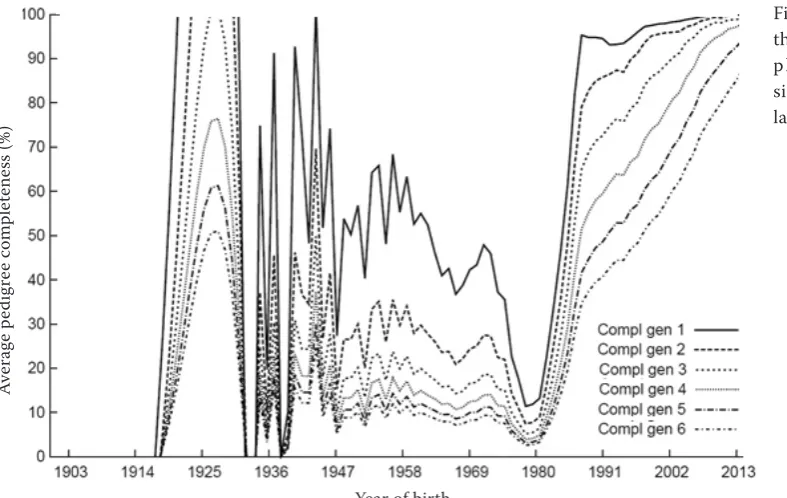
The accuracy and reliability of calculated in-breeding coefficients and subsequently the derived parameters depend to a large extent on the qual-ity of the pedigree to be evaluated. The trend of the pedigree completeness index for the last six generations since 1985 is presented in Figure 2. In 1987, over 90% of all animals in the first gen-eration had known ancestors, with slightly de-creasing percentage in the next generations. The maximum number of generations of ancestors was 26 whereas the equivalent number of known generations reached 5.56 years.
[image:4.595.304.534.95.259.2]Average equivalent complete generations (i.e. the number of generations in a comparable complete pedigree) were 10.28. Another important param-eter of the population dynamics is expressed by the number of contributing founders to genetic variability of the breed. Within the evaluated popu-lation, 14 980 animals reported 100% of the total genetic variability. 75% of the genetic variability of the population was explained by 304 animals and half of the genetic variability was explained by 60 animals.
Table 1. Distribution of animals based on inbreeding coefficient
Inbreeding coefficient Animals n Total (%) 0.10 < F ≤ 0.45 4 780 4 780 0.39 0.05 < F ≤ 0.10 157 228 162 008 12.72 0.00 < F ≤ 0.05 814 892 976 900 65.93 0.00 ~ non-inbred 259 082 1 235 982 20.96
0 0.01 0.02 0.03 0.04 0.05 0.06
1997 1998 1999 2000 2001 2002 2003 2004 2005 2006 2007 2008 2009 2010 2011 2012 2013
Inbreeding
coefficient
[image:4.595.306.531.641.756.2]Year
[image:4.595.65.291.681.757.2]Figure 1. The increasing trend of average inbreeding coef-ficient per year
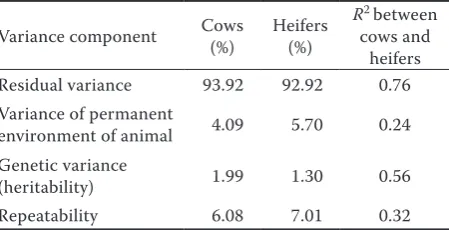
Table 2. Estimated proportions of variance for all random effects
Variance component Cows (%) Heifers (%) R
2 between cows and
heifers Residual variance 93.92 92.92 0.76 Variance of permanent
environment of animal 4.09 5.70 0.24 Genetic variance
https://doi.org/10.17221/154/2018-CJAS
The best model in GLM included effects of herd-year-season of birth, herd-herd-year-season of insemina-tion, insemination technician-year of inseminainsemina-tion, age at insemination, insemination interval, sire-year of insemination, lactation number, and inbreeding coefficient explained 34% of the variance in concep-tion for cows and 22% of the variance in concepconcep-tion for heifers. Even though the best model included all fixed effects, the two herd-year-season effects
(HYSb, HYSi) were the most important. These two
effects explained 33% of the variance in pregnancy for cows and 20% of the variance in pregnancy for heifers. Adding the effect of inbreeding increased the explanation of variability in conception by a maximum of 0.01%. All fixed effects were
statisti-cally significant, with P-values < 0.00001.
From outputs from Gibbs sampling, Table 2
shows that heritability for cows was h2 = 1.99%
with repeatability of 6.08% and for heifers h2 =
1.30% with repeatability of 7.00%. PE was more important than G because it explained 4.09% of the variability for cows and 5.70% for heifers. Residual, genetic, and phenotype correlations between cows and heifers were intermediate. The correlations for PE between cows and heifers and their repeatability were low.
Although the input data were alternative traits – they had only two values (yes/no), the results of the effects were continuous variables showing nearly normal distributions. Table 3 presents standard
deviations for the original input data (ID) and then standard deviations for effects estimated by BLUP-AM. The largest standard deviations were for the two herd-year-season effects and the lowest variabilities were for PE and breeding value. PE and estimated breeding values (EBV) for heifers were less variable than were those for cows. This may be due to the lower values of genetic parameters and lower number of records on heifers than on cows.
Average p
edig
re
e c
om
ple
tene
ss (%)
[image:5.595.67.461.94.343.2]Year of birth
Figure 2. Trend of the pedigree com-pleteness index since 1985 for the last six generations
Table 3. Standard deviations of original data, effects in-cluded in the best linear unbiased prediction by animal model (BLUP-AM) and predicted breeding values (in %)
Effect n4 Cows (%) Heifers (%) Original input data1 3 248 299 47.28 49.86 Herd-year-season of birth2 28 172 12.31 30.24 Herd-year-season
of insemination2 70 545 13.55 31.03 Technician-year
of insemination2 2 083 9.12 18.11 Lactation number2 12 5.46 – Sire-year2 4 884 6.18 14.95 Permanent environment2 677 234 3.06 2.91 Estimated breeding value3 1 223 658 4.98 2.40
[image:5.595.305.533.545.699.2]Using the BLUP calculation with the effect of inbreeding, two additional effects were included: linear and quadratic of regression terms. The av-erage predicted breeding value was by 3.6 units higher when inbreeding was included than the average estimated breeding value without inclu-sion of inbreeding coefficient, as shown in Table 4. Because of a lower standard deviation, the vari-ability of “inbred” breeding values was smaller.
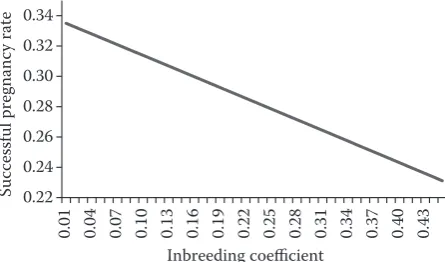
In comparison with cows, heifers had higher aver-age predicted breeding values with lower variances (Table 4). Like in cows, heifers also showed lower pre-dicted breeding values with higher variability when inbreeding was not included in the model equation (Table 4). The correlation between inbreeding and non-inbreeding breeding values was 0.99 (the value was the same when computed only with individuals with higher inbreeding). Therefore, the inclusion of inbreeding in the model did not affect the predic-tion of breeding value. Even though no influence of inbreeding on breeding value was identified, the influence of inbreeding on conception was found (see Figure 3, produced from BLUP).
DISCUSSION
Overall, the quality of the pedigree of the reference population is at a good level and it can be assumed
that the inbreeding coefficients are calculated with sufficient precision. The influence of the inbreeding level on conception and on breeding value predic-tion was derived from the following researches: inbreeding has been shown to have negative effects on the interval from calving to first insemination, days open (Bezdicek et al. 2007), calving interval (Rokouei et al. 2010), conception rate (Dezetter et al. 2015), as well as embryo quality, development and viability (Hinrichs et al. 2015). In addition to its occurrence in cattle, inbreeding is extremely prevalent also in horses (Szwaczkowski et al. 2016; Vostra-Vydrova et al. 2016) and inbreeding depres-sion is known to occur in bird populations (Cecchi et al. 2016). In our study the negative influence of inbreeding on conception was confirmed (Figure 3), but the prediction of EBV was not affected. One of the reasons could be that EBV also includes the values of the relatives which might not be influenced by inbreeding depression. Results could also be influenced by the statistical model. For example, in the official national evaluation for the Czech Republic the quantity of milk in the first 100 days of lactation is included in the model. The effect of lactation (lactation number) was included in our model which partly cumulated the age of the animal with the quantity of milk and physiological stress of animals.
A certain shortcoming that could affect the re-sults was the limited number of known generations of ancestors although all available data were used to calculate inbreeding coefficients. Inbreeding coefficients were calculated also for individu-als without taking into account the possibility of unknown inbred ancestors, as described by Van-Raden (1992); it is possible that the coefficients of individual animals are not very accurate.
[image:6.595.63.531.113.185.2]Despite an insignificant change in the predic-tion of breeding values, the negative influence of inbreeding on the reproductive capacity of females was demonstrated. The level of inbreeding depres-sion was comparable with the standard deviation of breeding values.
Table 4. Basic statistical characteristics of predicted breeding values for conception of cows and heifers (in %)
Cows Mean Median Standard deviation Minimum Maximum
Cows without inbreeding –7.23 –8.06 5.68 –35.21 12.05
Cows with inbreeding –6.87 –7.32 4.98 –34.12 11.05
Heifers without inbreeding –2.75 –2.60 2.82 –24.44 10.15
Heifers with inbreeding –2.38 –1.98 2.40 –23.30 11.07
0.22 0.24 0.26 0.28 0.30 0.32 0.34
0.01 0.04 0.07 0.10 0.13 0.16 0.19 0.22 0.25 0.28 0.31 0.34 0.37 0.40 0.43
Successful
pregnancy
rate
Inbreeding coefficient
[image:6.595.66.289.594.725.2]https://doi.org/10.17221/154/2018-CJAS
The heritabilities for milk yield and conception explained by these model equations were low, relative to heritabilities used in routine evaluation (39.00% for milk yield, 4.40% for cow conception and 3.90% for heifer conception).
It would be appropriate in future studies either to include the inbreeding effect directly in the equa-tion of the accredited animal breeding model or to determine the inbreeding coefficient for unknown individuals according to VanRaden (1992). An ideal approach would be to evaluate both inbreeding calculations (using 0 and average inbreeding coef-ficients for unknown ancestors) because in older generations with poorly known records the average values of inbreeding coefficients could be signifi-cantly distorted and overestimated. In addition to traditional calculations, it would also be useful to use genomic results when single nucleotide poly-morphism (SNP) chips are available, as it is pos-sible to estimate homozygous DNA segments with unambiguous precision using chips (Aliloo et al. 2017) and quantitative trait locus (QTL) sections were shown to positively affect reproductive char-acteristics in cows (Muller et al. 2017).
The influence of the negative energy balance could also be included in the breeding value prediction (Brade 2016). Furthermore, it would be appropriate to take into account the quality of eggs and embryos (Hinrichs et al. 2015) and the onset of the luteal phase after egg release (Tenghe et al. 2016).
CONCLUSION
The inbreeding coefficient need not necessarily be included in the calculations used in predicting breeding value for the conception of the Czech Holstein population because the estimated breed-ing values are the same regardless of the inbreed-ing inclusion. Inbreedinbreed-ing does not influence the prediction because the estimated breeding value considers information also from the relatives. However, the inbreeding coefficient should be taken into account in the mating plan, because inbreeding negatively affects not only reproduc-tive traits, which was documented here, but also productive traits such as milk yield or percentage of milk components. In addition to including tradi-tional records, it is appropriate to link phenotypic indicators with genomic information on heterosis and recombination and to take these into account
when estimating breeding values for conception in dairy cattle. In addition to the influence of in-breeding on conception, a significant influence of PE was also proved. Because the effect of cow’s PE is more important than G, PE should be included in the model equation for dairy cattle conception. We can better focus on the improvement of the environment but it is also necessary to improve the genetic trend which is currently negative.
Acknowledgement.We thank the Holstein Cattle
Breeders Association of the Czech Republic for the systematic data recording and Plemdat for providing the data.
REFERENCES
Aliloo H., Pryce J.E., Gonzalez-Recio O., Cocks B.G., God-dard M.E., Hayes B.J. (2017): Including nonadditive ge-netic effects in mating programs to maximize dairy farm profitability. Journal of Dairy Science, 100, 1203–1222. Bezdicek J., Subrt J., Filipcik R., Bjelka M., Dufek A. (2007):
The effect of inbreeding on service period and pregnancy length in Holsteins and Czech Flecviehs after the first calving. Archiv für Tierzucht, 50, 455–463.
Bjelland D.W., Weigel K.A., Vukasinovic N., Nkrumah J.D. (2013): Evaluation of inbreeding depression in Holstein cattle using whole-genome SNP markers and alternative measures of genomic inbreeding. Journal of Dairy Sci-ence, 96, 4697–4706.
Boichard D. (2002): Pedig: A Fortran package for pedigree analysis suited to large population. In: 7th World Congress on Genetics Applied to Livestock Production, Montpel-lier, France, 525–528.
Brade W. (2016): Do we need specialized breeding objec-tives for different production systems in German Hol-steins? Tieraerztliche Umschau, 71, 454–465.
Cecchi F., Giacolane G., Paci G. (2016): Inbreeding de-pression in Lizard canary breed estimated by pedigree analysis. Czech Journal of Animal Science, 61, 15–21. Colleau J.J. (2002): An indirect approach to the extensive
calculation of relationship coefficients. Genetics Selec-tion EvoluSelec-tion, 34, 409–421.
Dezetter C, Leclerc H, Mattalia S, Barbat A, Boichard D., Durocq V. (2015): Inbreeding and crossbreeding pa-rameters for production and fertility traits in Holstein, Montbéliarde, and Normande cows. Journal of Dairy Science, 98, 4904–4913.
af-fecting bull sperm characteristics after thawing. Czech Journal of Animal Science, 61, 515–525.
du Toit J., van Wyk J.B., Maiwashe A. (2012): Assessment of inbreeding depression for functional herd life in the South African Jersey breed based on level and rate of inbreed-ing. South African Journal of Animal Science, 42, 55–62. Gonzalez-Recio O., Lopez de Maturana E., Gutierrez J.P.
(2007): Inbreeding depression on female fertility and calving ease in Spanish dairy cattle. Journal of Dairy Science, 90, 5744–5752.
Groeneveld E., Westhuizen B., Maiwashe A., Voordewind F., Ferraz J.B. (2009): POPREP: A generic report for popula-tion management. Genetics and Molecular Research, 8, 1158–1178.
Hinrichs D., Bennewitz J., Wellmann R., Thaller G. (2015): Estimation of ancestral inbreeding effect on stillbirth, calv-ing ease and birth weight in German Holstein dairy cattle. Journal of Animal Breeding and Genetics, 132, 59–67. Jakubec V., Bezdicek J., Louda F. (2010): Selection –
Inbreed-ing – Hybridization. Agrovýzkum Rapotín s.r.o., Rapotín, Czech Republic. (in Czech)
Kurykin J., Hallap T., Jalakas M., Padrik P., Kaart T., Johan-nisson A., Jaakma U. (2016): Effect of insemination-related factors on pregnancy rate using sexed semen in Holstein heifers. Czech Journal of Animal Science, 61, 568–577. Luttgenau J., Purschke S., Tsousis G., Bruckmaier R.M.,
Bollwein H. (2016): Body condition loss and increased serum levels of nonesterified fatty acids enhance pro-gesterone levels at estrus and reduce estrous activity and insemination rates in postpartum dairy cows. Theriog-enology, 85, 656–663.
Mac Cluer J., Boyce A.J., Dyke B., Weitkamp L.R., Pfennig D.W., Parsons C.J. (1983): Inbreeding and pedigree struc-ture in Standardbred horses. The Journal of Heridity, 74, 394–399.
Maignel L., Boichard D., Verrier E. (1996): Genetic vari-ability of French dairy breeds estimated from pedigree information. Interbull Bulletin, 14, 49–54.
Mc Parland S., Kearney J.F., Rath M., Berry D.P. (2007): Inbreeding effects on milk production, calving perfor-mance, fertility, and conformation in Irish Holstein-Friesians. Journal of Dairy Science, 90, 4411–4419. Misztal I., Tsuruta S., Strabel T., Auvray B., Druet T., Lee
D.H. (2002): Blupf90 and related programs (BGF90). In: Proc. 7th World Congress on Genetics Applied to Live-stock Production, Montpellier, France, 19–23.
Misztal I., Tsuruta S., Lourenco D., Aguilar I., Legarra A., Vitezica Z. (2014): Manual for BLUPF90 family of pro-grams. University of Georgia, Athens, USA.
Muller M.P., Rothammer S., Seichter D., Russ I., Hinrichs D., Tetens J., Thaller G., Medugorac I. (2017): Genome-wide
mapping of 10 calving and fertility traits in Holstein dairy cattle with special regard to chromosome 18. Journal of Dairy Science, 100, 1987–2006.
Pinedo P.J., Melendez P., Paudyal S., Krauss R., Arias F., Lopez H., Luco A., Vergara C.F. (2016): Association between disease occurrence and fertility of dairy cows in three geographic regions of Chile. Theriogenology, 86, 817–823. Rokouei M., Torshizi R.V., Shahrbabak M.M., Sargolzaei
M., Sorensen A.C. (2010): Monitoring inbreeding trends and inbreeding depression for economically important traits of Holstein cattle in Iran. Journal of Dairy Science, 93, 3294–3302.
Sargolzaei M., Iwaisaki H., Colleau J.J. (2006): CFC: A tool for monitoring genetic diversity. In: Proc. 8th World Con-gress on Genetics Applied in Livestock Production, Belo Horizonte, Brazil, 27–28. (CD-ROM communication) Sorensen A.C., Sorensen M.K., Berg P. (2005): Inbreeding
in Danish dairy cattle breeds. Journal of Dairy Science, 88, 1865–1872
Szwaczkowski T., Gregula-Kania M., Stachurska A., Bo-rowska A., Jaworski Z., Gruszecki T.M. (2016): Inter- and intra-genetic diversity in the Polish konik horse: Implica-tions for the conservation program. Canadian Journal of Animal Science, 96, 570–580.
Tenghe A.M.M., Berglund B., Wall E., Veerkamp R.F., de Koning D.J. (2016): Opportunities for genomic prediction for fertility using endocrine and classical fertility traits in dairy cattle. Journal of Animal Science, 94, 3645–3654. Thompson J.R., Everett R.W., Hammerschmidt N.L. (2000):
Effects of inbreeding on production and survival in Hol-stein. Journal of Dairy Science, 83, 1856–1864.
Thornhill N.W. (1993): The Natural History of Inbreeding and Outbreeding: Theoretical and Empirical Perspectives. The University of Chicago Press, Chicago, USA and London, UK. VanRaden P.M. (1992): Accounting for inbreeding and
crossbreeding in genetic evaluation of large population. Journal of Dairy Science, 75, 3136–3144.
Vostra-Vydrova H., Vostry L., Hofmanova B., Krupa E., Veselá Z. Schmidova J. (2016): Genetic diversity within and gene flow between three draught horse breeds using genealogical information. Czech Journal of Animal Science, 61, 462–472. Weller J.I., Ron M. (1992): Genetic analysis of fertility traits in Israeli Holstein by linear and threshold models. Journal of Dairy Science, 75, 2541–2548.
Zhang Q.Q., Calus M.P.L., Guldbrandtsen B., Lund M.S., Sahan G. (2015): Estimation of inbreeding using pedigree, 50k SNP chip genotypes and full sequence data in three cattle breeds. BMC Genetics, 16, 88.