DEVELOPMENT OF AN AUTONOMOUS ROBOTIC HAND WITH HUMAN INTERACTION CAPABILITIES
K. Kelly, M. Culleton, C. McGinn
Department of Mechanical and Manufacturing Engineering, Trinity College. Dublin 2. Ireland.
ABSTRACT
A multiple degree-of-freedom hand has been developed which can interact with a human on a fundamental level. The robotic hand is closely modelled on a human hand, consisting of four fingers and a thumb. The digits are actuated using five servo motors to provide independent motion and control. The robotic hand uses a webcam and artificial intelligence to detect and process a user’s hand position. This human interaction capability has allowed the robotic hand to perform simple operations such as playing a human in a game of rock paper scissors. The latter has been showcased at a number of events to promote engineering as a career choice.
Basic artificial intelligence has been integrated into the system to allow the robotic hand to process and react to a video input stream. This has been used to allow the hand to make a more informed choice based on the current scenario. Potential future applications of the robotic hand in manufacturing are explored.
KEYWORDS: Robotics, Student Recruitment
1. INTRODUCTION
1.1 History of Robotics
The use of robots in industry first took off in the automotive sector, where automated robots became a part of the assembly process. This began in 1961 with ‘UNIMATE’, the first fully automated robot (Figure 1.1). This robot was used by General Motors as an automated die casting mould which quenched molten steel into the various automobile parts required for production [1].
However this is not what is usually imagine when the word ‘robot’ is mentioned. This term was first coined by the play writer Karel Čapek from his use of the word in the 1920’s play “Rossum’s Universal Robots” [2]. In this science fiction play, the robot refers to an automation built by Rossum which eventually rises up against humankind (Figure 1.2).
Figure 1.1: 'UNIMATE' – The First Industrial Robot [3]
Figure 1.2: Machine Built by Rossum which was Termed ‘Robot’ [2]
1.2 Robotics in Education
Over the past number of years Ireland has seen large growth in the number of students choosing to go on to third level education, increasing from 61,961 students in 2007 to 71,466 students in 2011. However the number of those electing to pursue a career in engineering has not followed this trend, with numbers falling from 40,570 to 30,363 over the same time period [4]. This is less than desirable, as the report “Engineering and Knowledge Island 2020: Engineers Ireland” sees a greater demand for engineers in Ireland if the country is to become one of the more advanced economies by 2020 [5].
The use of robotics is a possible solution to this, as it helps to show engineering in a new and more attractive light. It allows for interaction with the prospective students, which is felt is a more effective way of promotion. With this in mind, a robotic hand has been developed which can interact with a human by playing them in a game of rock paper scissors.
1.3 Previous Development
Prior work in this area had seen the general concept proved by constructing a basic hand with vision capabilities. The design used three DC motors to wind and unwind five wires which ran the length of each finger, with the motors located in a separate vicinity to the hand. The vision was carried out using a webcam and the MatLAB Image Processing Toolbox. This toolbox helped to extract and decipher the user’s hand, which was carried out using the principle of background subtraction. The hand, named RPS (an acronym of rock paper scissors), is shown in (Figure 1.3).
[image:2.595.150.444.531.629.2]1.4 Project Aims
Building on the previous work done, the work reported here aimed to design and develop a fully autonomous hand which can:
1) Closely follow the movement, positioning, and speed of a human hand in a game of rock paper scissors.
2) Remain within the limits of the human hand in regards to size and proportionality.
3) Interact with the user in both visual and audio communication. 4) Use artificial intelligence to predict the human’s next choice.
5) Be developed in the future to perform additional tasks such as object manipulation.
2. PRINCIPLE OF OPERATION
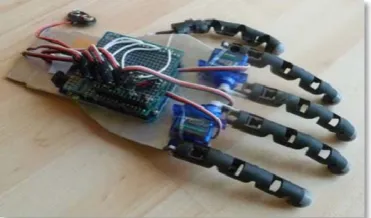
The new design, suitably named RPS2, operates by use of five servo motors (Turnigy TG9e Micro Servos) which are directly connected to the fingers at the Metacarpophalangeal/MP joint (knuckle). These motors are controlled by an Arduino, an open source microcontroller which can be easily programmed to allow it to communicate with other devices.
To match the robotic hand to that of a human, the micro servo motors are located on either side of the hand base. This allows the base to be located along the centreline of the robotic hand, which gives the hand a more realistic design as it allows the fingers to be aligned at the correct depth.
As the fingers rotate, they automatically contract into a fist position. This is achieved by running a wire through each finger, whose ends are fixed to a stationary location on the hand. By carefully choosing this location, the rotation caused by the servo motors generates adequate tension within the wires to force the fingers to curl into a fist position.
In order for this method to work, the fingers themselves must naturally return to the open position. If not, during release the fingers would remain curled as the wire slackens. The fingers from the previous design were reused, as they’re structure and material choice were well chosen to overcome this problem.
3. PHYSICAL CONSTRUCTION
[image:3.595.206.392.551.660.2]Aluminium was chosen as the hand’s base material in order to minimize its weight. This is important as the hand is located a significant distance from the arm’s fulcrum (elbow). The base is of thickness 2mm, which is sufficiently adequate for its required purpose. The remaining parts are attached to the hand base as shown below in Figure 3.1.
As mentioned, the fingers curl during rotation due to the wires being fixed to a stationary point. From Figure 3.1, it can be seen that the path of each wire is forced over the top two servo motors. This ensures that the maximum tension is generated from the fingers downward rotation.
The arm of RPS2 is made from a thin-walled plastic cylindrical pipe, whose internal diameter allows for a secure connection with the hand without major modification. Two slots are inserted into the pipe, which prevent the hand from rolling and/or pitching during operation.
A servo motor is used to drive the hand and arm, which was specked using a simple moment calculation. This is connected to the arm as shown in Figure 3.2. As can be seen, a square bar is used for the drive shaft as it ensures that all the torque generated by the servo motor is successfully transmitted to the arm.
[image:4.595.304.469.282.390.2]The motor and arm are mounted to a supporting aluminium base, which is light enough to maintain the robot’s portability but heavy enough to anchor the extruding arm. The finished product, as seen in Figure 3.3, is encased within Perspex in order to protect RPS2 from its surrounding environment as well as to protect the public from the moving components.
Figure 3.2: Connection between Motor and Shaft
Figure 3.3: Fully Assembled Rig
4. AESTHETICS
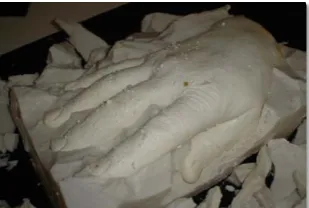
As the project was expected to receive significant amounts of public exposure, aesthetics was an important consideration to be made. Initially it was conceived to create a flexible, detailed mould which would give RPS2 a more humanlike appearance. This was achieved using alginate and liquid latex rubber, the result of which is shown in Figure 4.1.
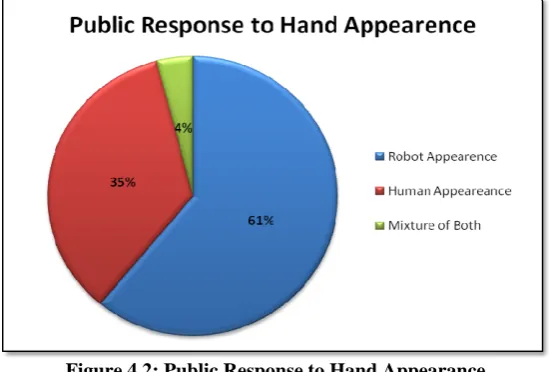
[image:4.595.218.373.532.636.2]However, based on public feedback during a number of demonstrations, it was found that the majority of people would prefer the hand to look robotic rather than resembling that of a human. A questionnaire was distributed at these events, the results of which are shown below (based on 117 participants).
Figure 4.2: Public Response to Hand Appearance
A portion of those who said that RPS2 should have a human appearance said that this was only the case if it could be accurately done. However for this to be achieved, the robot hand would be approaching “the uncanny valley”. This valley, which was proposed by Japanese roboticist Dr. Masahiro Mori, captures the response of people to the appearance of a robot as it becomes more humanlike. According to Dr. Mori, as a robot begins to strongly resemble a human there is a huge decrease in public acceptance. This is a psychological reaction, and occurs when the robot has just enough differences to that of a human to seem eerie or disturbing [6].
With the results of the questionnaire in mind, RPS2 maintained its robotic appearance. However it was still deemed important that the hand have an outer casing for protective and safety reasons. Perspex was chosen as the material would not hinder the observer’s view of the hand in operation. This was beneficial for the promotional aspect of the project. The protective casing can be seen in Figure 3.3, shown previously.
5. COMPUTER VISION
Software was written using Python on the Linux operating system. There were a number of reasons for the transition from MATLAB, but the main advantage was the ability to create a more computationally efficient program by use of the processing speed of Linux and the many optimized libraries and modules developed for Python.
5.1 Program Structure
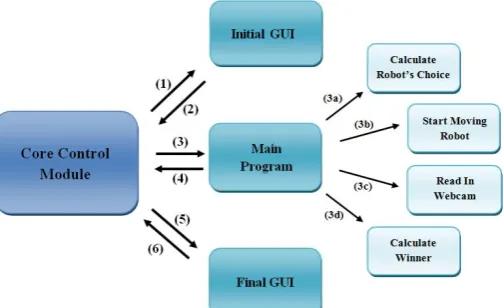
Figure 5.1 shows the key sections of the Python program and how they are related. The numbering shows the game sequence:
2) The user clicks the button to play the game, which returns the program to the core control module.
3) The core control module launches the main program, which carries out a number of tasks:
a. The robots hand choice for the game is calculated, which is done using basic artificial intelligence.
b. The calculated choice is sent to RPS2, which now begins to play the game.
c. The webcam is opened and the users hand is read in.
d. Using the recorded webcam images, the user’s choice is calculated using a number of algorithms from the OpenCV library. This choice is compared with the robot’s choice to find the winner of the game. 4) The calculated winner is passed back to the core control module, which
determines the score based on the previous games.
5) The core control module launches another window, which shows the winner of the game and the current score between RPS2 and the user.
[image:6.595.172.424.308.462.2]6) When the user chooses to play another game, the program returns to the core module. The core module now launches the main program, as the initial GUI is no longer required.
Figure 5.1: Python Program Structure
5.2 Vision Software
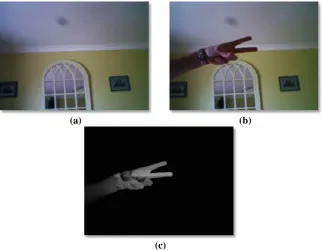
To detect and process the webcam stream, a number of OpenCV libraries were used. OpenCV is an open source which provides over 2,500 optimized algorithms for real-time image processing. In this project, the computer vision software can naturally be split into the capturing, extraction, and processing of the users hand.
(a) (b)
[image:7.595.138.461.53.303.2](c)
Figure 5.2: (a) Initial Background (b) Final Image (c) Result of Background Subtraction
The extracted image is converted into binary image which is much easier to computationally process. This requires a number of functions to be called, such as the threshold, smoothing and opening operator. The result is a definite black and white image of the user’s hand, an example of which is shown in Figure 5.3.
Figure 5.3: Binary Image of Hand
At this stage of the image processing, the program can determine whether the hand was inserted into the frame from the left or right hand side. It is capable of flipping the image if required, which ensures efficiency as it reduces the number of methods which needed to be called during the program.
While the binary image above is much clearer, it still contains the arm of the user. This is undesirable, as it leads to significant variance between images. Hence the hand is isolated using a bounding rectangular border and a number of empirical relationships.
to maintain computational efficiency, the hand image is simplified to a basic polygon (Figure 5.5). This simplification also acts to remove small discrepancies between the hand positioning of different users, which allows for a smaller training database to be used. The comparison is achieved by comparing the nodes and characteristics of the simplified polygon with those in the training database. A number representing the similarities of each comparison is generated, and from this the best match can be found.
[image:8.595.188.463.230.353.2]A positive feature of the program is that it calculates the best average match as well as the best individual match. These values are absolute, which give an indication of how certain the program is with its decision. If both calculations indicate the same position, then the program can be reasonably confident that the calculated position is equal to the user’s choice. If they differ, then the program can examine both calculations to determine the most likely choice.
Figure 5.4: Isolation of Hand Figure 5.5: Simplified Polygon
6. ARTIFICIAL INTELLIGENCE
To expand the project and provide RPS2 with basic artificial intelligence, game theory was introduced into the Python program. This theory allows RPS2 to learn as it plays by making use of resources available online. These resources define the optimum strategy to take during a game of rock paper scissors in order to minimize the likelihood of loosing. The theory is based on the fact that humans cannot truly be random in nature as their subconscious dictates their decision.
During the running of each game, RPS2 makes its choice based on this theory. Although quite basic, the code can easily be expanded in the future in order to create a more advanced and complicated decision making process. However the present code is effective, as it makes its choice at random unless it is quite certain it is going to win. For the initial game, it has been found that complete novices most commonly pick rock while more experienced players pick paper. Hence in order to minimize the likelihood of loosing, RPS2 begins by choosing paper.
While this artificial intelligence is very basic and specific in its application, it acts as strong foundation on which more sophisticated intelligence programs can be developed. These will allow RPS2 to interact with a human at a more advanced level, which will increase the number potential applications where the robotic hand can be used.
7. CONCLUSION
The project has developed significantly over the past year. The overall result is a more autonomous and reliable robotic hand with greater movement and detection capabilities. Each finger can now be controlled individually which has increased the potential of the hand. An arm and elbow joint have been introduced, allowing for greater movement while also enhancing the gameplay experience.
With regards to software, significant developments in the computer code has allowed for a more approachable and efficient program. The transition to Python and OpenCV libraries has increased the processing capabilities of RPS2, as well as its robustness.
Aesthetics has also been considered due to the project’s public exposure. This aesthetic appeal and its capability to interact with the public has resulted in RPS2 becoming a successful tool for promoting engineering to prospective students. It has been showcased at numerous events throughout the year, and was well received at each event.
These improvements all mean that RPS2 is now not only able to play a game of rock paper scissors against a human, but can potentially be used in more advanced applications where precise movement and detection capabilities are required. RPS2 is an excellent starting point for any project, as it has branched into multiple fields which could be explored. It is a robotic arm which has independent control of each finger, vision detection and processing capabilities, and basic artificial intelligence. These provide huge scope for future development, as the robot can easily be modified to perform in a variety of applications. These applications may be based in areas such as the manufacturing or medical sector, or as a continued way of promoting engineering to prospective students.
8. REFERENCES
[1] P. Mickle. 1961: A peep into the automated future, n.d.. [Online]. Available: http://www.capitalcentury.com/1961.html. [Accessed 14 10 2011].
[2] J. Isom. A Brief History of Robotics, 2004. [Online]. Available: http://robotics.megagiant.com/history.html. [Accessed 26 October 2011] [3] Practical Robotic Services. The Start of a Revolution, n.d.. [Online].
Available: http://www.prsrobots.com/1961.html. [Accessed 15 October 2011].
[4] Central Applications Office. Higher Education Applicants,n.d.. [Online]. Available: http://www.statcentral.ie/viewStat.asp?id=216. [Accessed 10 06 2012].
[5] B. Woods. Development of an Interactive Game Playing Robot. Trinity College , Dublin, 2011.
![Figure 1.1: 'UNIMATE' – The First Industrial Robot [3]](https://thumb-us.123doks.com/thumbv2/123dok_us/999138.614454/2.595.150.444.531.629/figure-unimate-the-first-industrial-robot.webp)