products. Final puriRcation of the ester product is carried out in a rectiRcation column with only a few stages. The entrainer is recovered using a one-step liquid}liquid extraction (LLE) column with water as the extractant.
Wuestet al. found they could prepare ethyl acetate by addition of ethanol to a melt of chloro-acetic acid andp-toluene sulfonic acid and purify the ester product using azeotropic distillation. The ester and water form a minimum boiling binary azeotrope and therefore affect the ester/alcohol separation. Water and ethyl chloroacetate are removed overhead and the product is decanted. In this manner the ester is practically alcohol-free. This process avoids forma-tion of the ternary ester/alcohol/water azeotropes which are difRcult to separate.
Hills et al. found that azeotropic distillation is useful in the puriRcation of esters produced using an enzymatic route. For example, isopropyl myristate can be prepared with lipase or immobilized lipase from myristic acid and propane-2-ol. The water pro-duced in the reaction is removed by azeotropic distil-lation.
Conclusion
For almost 100 years azeotropic distillation has been an essential tool in the separation of puriR ca-tion of many industrial chemicals. There are distinct advantages to using azeotropic distillation, including energy savings, increased recovery and ability to separate components contained in close boiling, pinch point and azeotropic mixtures. Azeotropic distillation will undoubtedly remains a viable alterna-tive for simplifying difRcult separations found in in-dustry.
See also: I/Distillation. II/Distillation: Energy Manage-ment; High and Low Pressure Distillation; Historical Devel-opment; Instrumentation and Control Systems; Modelling
and Simulation; Multicomponent Distillation; Theory of Distillation; VapourILiquid Equilibrium: Correlation and Prediction; VapourILiquid Equilibrium: Theory.
Further Reading
Catalogue of Successful Hazardous Waste Reduction/ Re-cycling Projects. Energy Pathways Inc. and Pollution Probe Foundation (1987) Prepared for Industrial Pro-grams Branch, Conservation&Protection Environment Canada, March, p. 84.
Guinot H and Clark FW (1938) Azeotropic distillation in industry.Transactions of the Institute of Chemical En-gineers16: 189}199.
Hills GA, Macrae AR and Poulina RR (1989) Eur. Pat. Appl. EP383,405, 16 Feb.
Horsely LH (1973)Azeotropic Data III. Washington DC: American Chemical Society.
Mato Vazques F, Bonilla Alonso D and Gonzalez Benito G (1990) PuriRcation of commercial acetic acid esters by azeotropic distillation. Part I. Selection of azeotropic agents. Quim. Ind. (Madrid) 36(5): 444}449.
Mato Vazques F, Bonilla Alonso D and Gonzalez Benito G (1990) Preparation of high-purity esters and recovery of azeotropic agents. Part II. PuriRcation of commercial acetic acid esters by azeotropic distillation.Quim.Ind. (Madrid) 36(6): 543}547.
Ohura H, Uchida Y, Yasaki A and Kishimoto S (1993) EP 0 529 413 A2. 13 Mar.
Taylor AM and Wheelhouse RW (1992) EP 0 467 531 A1. 22 Jan.
Te C and Shih TT (1989) Development of an azeotropic distillation scheme for puriRcation of tetrahydrofuran. Fluid Phase Equilibria.5thInternational Conference on
Fluid Properties and Phase Equilibria for Chemical Pro-cess Design, 30 Apr}5 May, Vol. 52, pp. 161}168. Banff, Alberta, Canada.
Wuest W, Leischner H and Esser H (1989) Eur. Pat. Appl. EP 315,096, 10 May.
Young S (1902) The preparation of absolute alcohol from strong spirit. Journal of the Chemical Society 81: 707}717.
Batch Distillation
M. Barolo, Universita% di Padova, Padova, Italy
Copyright^ 2000 Academic Press
Introduction
The interest in batch distillation has been steadily increasing in the last few years. This is a natural reSection of a change in industrial trends. In fact, the
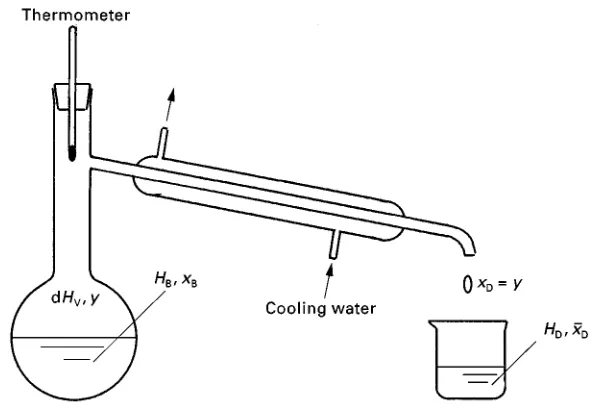
Figure 1 Apparatus for simple distillation.
from an efSuent stream. Examples of industrial ap-plications of batch distillation include: the recovery of chloroform, butanol, water, organic and inorganic acids from process broths in the pharmaceutical in-dustry; the concentration of acetone from dilute aqueous mixtures and the removal of water from butyl alcohol in the Rne chemistry industry and the manufacture of alcoholic beverages from fermented mixtures in the food and beverages industry.
The success of batch distillation as a method of separation is undoubtedly due to its Sexibility. In fact, a single batch column can separate a multicom-ponent mixture into several product cuts within a single batch but if the separation were carried out continuously, either a train of columns or a multi-pass operation would be required. Also, whenever completely different mixtures must be processed from day to day, the versatility of a batch column is still unexceeded. These attributes are crucial for respon-ding quickly to a market demand characterized by short product lifetimes and severe speciRcation re-quirements.
Equipment Arrangements and
Process Modelling
Simple Distillation
The simplest batch distillation apparatus is shown in Figure 1. The operation is known as simple distillation or differential distillation. This is the oldest manifestation of distillation itself; it was used by many ancient cultures as a way of producing alcoholic beverages, essential oils and perfumes.
With regard to the separation of a binary mixture, the batch apparatus is run as follows. The pot is continuously heated, so that a vapour rich in the more volatile component is produced, condensed and col-lected in the external receiver. Indicating withxBand y the instantaneous mole fractions of the more volatile component in the liquid and vapour phases in equilibrium, and with HB the molar amount of boiling liquid remaining in the pot, the following material balances hold during any small time interval:
dHV"!dHB [1] ydHV"!d(HBxB) [2] where dHVis the molar amount of vapour produced during the same time interval. Combining [1] and [2], and integrating from the original feed conditions (HF moles of boiling liquid of mole fraction z) to the present conditions, leads to the so-called Rayleigh equation:
lnHB
HF "
xBz dxB y!xB
[3]
Eqn [3] can be integrated numerically or graphi-cally. It relates the amount of liquid remaining in the pot to the composition of this liquid. The molar amountHDand average compositionxNDof the liquid accumulated in the receiver can be determined from the following material balances:
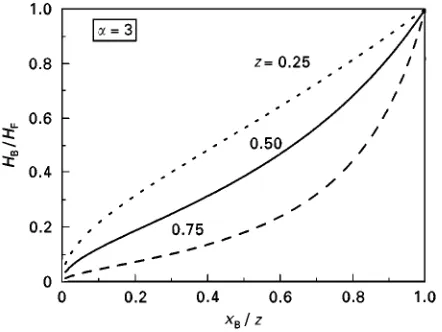
Figure 2 Simple distillation: fraction of the initial charge re-covered after the purification of three different binary feeds from a light impurity.
and:
HFz"HBxB#HDxND [5] If the system displays a constant relative volatility (), the integration of eqn [3] can be performed ana-lytically, leading to:
lnHB
HF"
ln 1!z 1!xB#
1 !1ln
xB(1!z) z(1!xB)
[6]
A graphical representation eqn [6] is presented in Figure 2. It is shown that, for a given fractional puriRcationxB/zof the feed, a larger amount of liquid can be recovered at the end of the batch when the feed is leaner in the more volatile component. It is also clear that it is not possible to obtain aRnite amount of the pure heavy component, whatever the feed com-position.
For a mixture of Nc components, Nc Rayleigh equations of the form [3] can be derived, and an iterative procedure is usually employed in order to determine the composition proRle of each component as a function of the amount of liquid remaining in the still. In the case of constant relative volatility mix-tures, direct calculation of the composition proRles can be accomplished by deRning the amountbiof the ith component remaining in the pot (bi"HBxB, i). It can be shown that:
bi fi
"
bj fj?i,j
[7]
wherejis an arbitrarily chosen reference component,
fi"HFzi, andi, jis the relative volatility of the ith component with respect to the reference one. From
the deRnition ofbi, it follows that: xB,i" Ncbi
i"1bi
[8]
Differential distillation is a very simple way of separating a mixture of several components into cuts of different purities, for example for laboratory applications. However, it permits only rough separations, even with large energy con-sumption (it is a one-theoretical-stage operation). This is the reason why multistaged columns with reSux are employed whenever a sharper separation is needed.
Batch Recti\cation
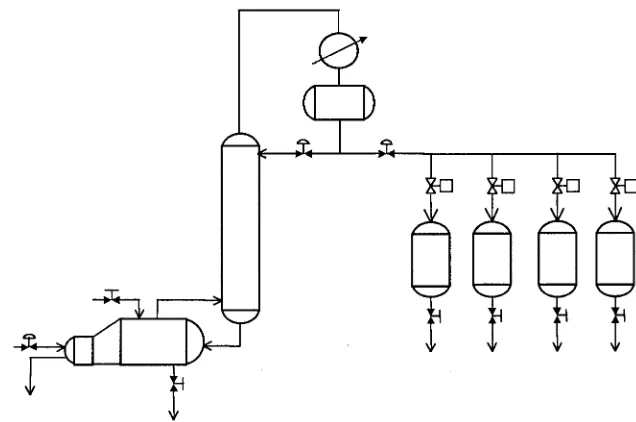
A typical batch distillation column (a batch rectiRer) is shown inFigure 3. The feed mixture is charged to a large reboiler, to which a heating medium (e.g. steam) is also fed. The vapour reaching the top of the column is condensed, and partially returned as reSux. A distillate stream is withdrawn, which sequentially feeds a series of tank receivers. The column may be a staged or a packed one.
Since in practice it is much more frequently reques-ted to operate an existing column rather than to design a new one, only the issues of modelling and operating an existing rectiRer will be addressed in the following sections.
Regardless of the operating mode, the column-modelling approaches can be grouped into three main classes: short-cut modelling, approximate modelling and rigorous modelling.
Short-cut models Short-cut models usually assume that the column dynamic behaviour can be approxi-mated as a sequence of steady states (pseudo-steady-state approximation), which in turn is true when the column and reSux drum hold-ups can be neglected compared to that of the reboiler. This assumption allows the short-cut models that have been devised for the design of continuous columns to be employed at every time step in the simulation of batch columns. When binary mixtures are considered, a graphical representation of the process can be obtained by means of classical McCabe}Thiele diagrams. For multicomponent mixtures, a modiRcation of the Fenske}Underwood}Gilliland design approach is of-ten employed for simulating the batch column operation.
Figure 3 Sketch of a batch rectifier.
optimization studies, when a large number of cases need to be evaluated quickly, and a result of limited accuracy is acceptable. Rigorous results can be ob-tained by the subsequent use of more accurate models.
Approximate models Approximate models are used whenever a more realistic representation of the col-umn dynamics is required. In this case, the tray and reSux drum liquid hold-ups are explicitly taken into account, even though they are usually assumed to be constant throughout the whole operation. Other usual assumptions are: boiling feed, total condensa-tion without subcooling, perfect mixing in all parts, negligible vapour hold-ups, constant boil-up rate, constant molar overSows, ideal tray behaviour and negligible pressure drops and heat losses.
The set of equations usually employed to model a column with a separating capacity ofNideal trays is as follows:
Reboiler
dHB
dt "L!V [9]
d(HBxB,j)
dt "Lx1,j!VyB,j j"1, 2,2,Nc!1 [10]
Bottom tray(tray 1)
H1 dx1, j
dt "L(x2, j!x1, j)!V(y1, j!yB, j) j"1, 2,2,Nc!1 [11]
Trayi
Hi dxi, j
dt "L(xi#1, j!xi, j)!V(yi, j!yi\1, j) j"1, 2,2,Nc!1 [12] Top tray(trayN)
HN dxN, j
dt "L(xD, j!xN, j)!V(yN, j!yN\1, j) j"1, 2,2,Nc!1 [13] ReWux drum
dHD
dt "0 (V"L#D) [14] HD
dxD, j
dt "V(yN, j!xD, j) j"1, 2,2,Nc!1
[15] Thermodynamic equilibrium in stagei
yi, j"Ki, jxi, j j"1, 2,2,Nc!1 [16] Summation constraints
xi, Nc"1! Nc\1
k"1
xi, k [17]
yi, Nc"1! Nc\1
k"1
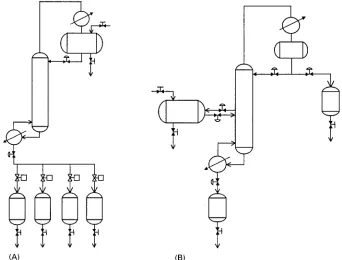
Figure 4 Sketch of (A) a batch stripper and (B) a middle-vessel batch column.
In the above equations,Hi,HDandHBare the tray, reSux drum and reboiler hold-ups respectively;xi, jis the mole fraction of componentjin stagei;L,Vand
D are the liquid, vapour and distillate molar Sow rates (respectively);Ki, jis the vapour/liquid equilib-rium ratio of componentjin stagei; andtis the time. Any suitable thermodynamic model can be used for the representation of the equilibrium ratio; deviations from the ideal tray behaviour can be taken into ac-count using the Murphree tray efRciency concept. Due to possible wide ranges in the relative volatilities and/or large differences in tray and reboiler hold-ups, the system of differential equations is frequently stiff. As a starting point for the integration, it is often assumed that the reboiler, reSux drum and all trays areRlled with the boiling liquid feed at the beginning of the operation.
Approximate models provide a fairly accurate de-scription of the column dynamics, and are frequently used in process design and process optimization applications.
Rigorous models When a still more accurate de-scription of the process dynamics is needed (for example, when it is required to model accurately the operation of an existing column), a rigorous model should be employed. In this case, almost all of the previous assumptions are relaxed, which consider-ably increases the computational load. The
deter-mination of the system and equipment parameters (like the Murphree tray efRciency, for example) is done byRtting some of the modelled proRles to actual plant data.
Other Column Arrangements
In the attempt to improve the Sexibility of batch distillation operation as a whole, a closer look at alternative column conRgurations has been under-taken in the last few years. These different kinds of columns have been known since the 1950s, but a thorough understanding of their dynamic behaviour and features has only recently been achieved.
In the batch stripper represented inFigure 4A, the feed is charged to the reSux drum, while multiple cuts are withdrawn from the bottom of the column se-quentially. In the middle-vessel batch column (Fig-ure 4B), the feed is charged to an intermediate vessel, and the product/impurity removal is accomplished simultaneously from both the top and the bottom ends. The reboilers of both columns may be consider-ably smaller than the reboiler of a batch rectiRer.
Figure 5 Binary batch distillation at constant reflux ratio
(three-ideal-stage column).
A preliminary simulation with a simpliRed model (or even with a short-cut one) should be used to assess the most proRtable conRguration for separating a given feed (amount and composition), subject to the given purity constraints.
Column Operation
The operation of a batch rectiRer only will be con-sidered in here. The most popular operating modes are: constant reSux ratio (with variable distillate composition), constant distillate composition (with variable reSux ratio) and total reSux (no product take-off). The former two operations are in fact semi-batch operations; the latter one is truly a semi-batch opera-tion. Operation at optimal reSux ratio should be mentioned too, but }since it is often accomplished through a series of constant reSux ratio sequences } this operating mode will not be considered here. In the following, the components are numbered in order of decreasing ease of separation (i.e. com-ponent 1 is the most volatile one, comcom-ponent 2 is the second most volatile, and componentNcis the least volatile).
From a practical point of view, regardless of the operating policy, the operation of a multicomponent column is carried out in three steps: (i) a start-up phase; (ii) a main cut production phase; and (iii) a slop cut removal phase. The last two steps are repeated sequentially. The following actions take place during the start-up phase: the column and receivers are possibly cleaned from the materials processed in the previous batch; cooling of the condenser is started; steam is fed to the reboiler, so that the material to be processed is heated up to its bubble point and starts to vaporize; as soon as the overhead vapour has been condensed and has Rlled the reSux drum, liquid is returned to the top of the column, and the column is run at total reSux; consequently, the column trays are sequentiallyRlled with liquid.
The start-up procedure is very general, and goes on until either the steady state is approached, or the lighter product purity speciRcation is reached in the reSux drum. The other two phases vary according to the operating policy employed.
Constant Re]ux Ratio Operation
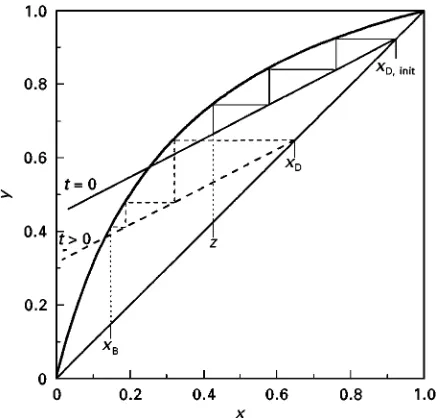
In the case of the separation of a binary mixture, a short-cut modelling approach is useful in order to have a graphical representation of the process. In a McCabe}Thiele diagram, at a given valuer"L/D
of the reSux ratio, the slope of the operating line is Rxed during the operation (Figure 5).
While the distillation is proceeding, the operating line shifts down along the diagonal line. The mole fraction of the more volatile component in the distil-late is continuously decreasing, and, at any instant of time, the reboiler composition is determined by step-ping off N stages along the operating/equilibrium lines.
If both the top and the bottom purity speciRcations (xspec
D and xspecB , respectively) are assigned, the reSux ratio should be chosen such that the Rnal amount
Hfinal
B of bottom product, as calculated through eqns [4] and [5] withxB"xspec
B andxND"xspecD , is the same as the amount calculated by means of the Rayleigh equation:
lnH final B HF "
xspec
B
z
dxB xD!xB
[19] The integral of eqn [19] can be evaluated numer-ically or graphnumer-ically. The total amountQrof energy to be supplied at the reboiler is given by:
Qr"(r#1)Hfinal
D [20]
whereis the molar latent heat of vaporization of the mixture, and Hfinal
D is the Rnal amount of distillate product collected.
Figure 6 Typical evolution of the profiles of the average product composition, product amount and instantaneous distillate
composi-tion for an ideal ternary mixture under constant reflux ratio operacomposi-tion.
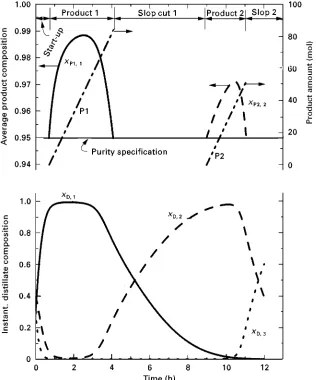
neither sufRciently rich in component 1 to allow fur-ther accumulation of product 1, nor is it sufRciently rich in component 2 to allow beginning the with-drawal of product 2. Therefore, the distillate stream is diverted to another tank, and the collection of slop cut 1 is started. When the concentration of compon-ent 2 in the reSux drum meets the second product’s speciRcation, the distillate stream is diverted to a third receiver, and the accumulation of product 2 is initiated. The operation proceeds this way until all the products but the heaviest have been collected in the receivers. The heaviest product (product Nc) is recovered in the reboiler at the end of the operation. Therefore, at the end of the operationNc main cuts (products) and at mostNc!1 slop cuts are obtained. The slop cuts need to be reprocessed in subsequent batches.
It should be noted that, unless this issue has been addressed at the column design stage, the whole tray
hold-up drains to the reboiler when the steam supply is stopped. This must be taken into account when estimating online the Rnal reboiler composition in order to detect the time when the distillation should be interrupted.
The plot of a typical evolution of the proRles of the average product composition, product amount and instantaneous distillate composition for the separ-ation of a nonazeotropic ternary mixture at constant reSux ratio is shown in Figure 6. The proRles were determined with the approximate model described previously, and a constant relative volatility mixture was considered.
Figure 7 Binary batch distillation at constant distillate
composi-tion (three-ideal-stage column).
component in the scale of relative volatilities. This may prove advantageous for the control of the operation.
Operation at constant reSux ratio is the most popular in industry, because it is very easy to accomplish. However, some considerations deserve attention at this point. In order to implement this operating policy practically, a measure of the distil-late and reboiler compositions should be available online, which is not usually the case. Therefore, the product composition needs to be inferred from secondary measurements, which should be available online quickly and at a low cost (like temperature and Sow rates, for example). Also, operating the column at a constant reboiler duty is often easier than operat-ing it at constant vapour boil-up, as was done in the previous numerical example. Finally, it should be noted that the column pressure may be decreased during the batch in order to improve the ease of separation of the less volatile components.
Constant Distillate Composition Operation
For the separation of a binary mixture under the quasi-steady-state assumption, a quick glance at the process can be obtained again by using a McCabe}Thiele representation, as shown in Figure 7.
In order to get the desire speciRcationxspec
D from the very beginning of the operation, the initial value of the reSux ratio must be such that the feed composi-tionzis exactly obtained in the still when stepping off
Nstages fromxspec
D . Then, the reSux ratio (hence, the
slope of the operating line) is continuously increased during the batch in order to keep the distillate com-position on speciRcation. The operation is interrupted when either the reboiler composition has reached the desired composition, or the reSux ratio is so high that continuing the operation would be uneconomical (or even impossible, in an actual column).
The determination of the total amount of energy that needs to be supplied to the still is obtained by the following equation:
Qr"
Hfinal D
0
(r#1)dHD [21]
whose integration requires knowingras a function of
HD. By combining eqns [4] and [5], withxND"xspecD , it is found that:
HD"HF
z!xB xspec
D !xB
[22]
which enables relating the instantaneous reboiler composition (xB) to the amount of product (HD) col-lected up to the same instant. Therefore, since the reSux ratio can be related toxBat any instant of time, eqn [21] can be easily integrated.
In a multicomponent separation, product 1 is col-lected until the reSux ratio reaches the prespeciRed maximum value. Then, the reSux rate is decreased in order to allow a quick removal of the remaining traces of the most volatile component (these traces are accumulated in slop cut 1). At the same time, this enables the front of the second lightest component to build up in the column so that, when the reSux drum composition meets the speciRcation for product 2, the accumulation of this product is started. The production phase and the slop removal phase are then repeated sequentially; productNcis eventually recovered from the reboiler.
Figure 8 Binary batch distillation at total reflux
(three-ideal-stage column).
response to changes in the distillate composition. Therefore, if good control at a constant set point is provided, the product purity usually increases while this product is being removed from the column. This is because the separating capacity of the column in-creases during the batch, due to the increase of the reSux rate.
From a practical point of view, this kind of opera-tion is harder to implement than constant reSux ratio, even if a measure or an estimate of the distillate composition is available online. Because the dynam-ics of the process may change signiRcantly as the batch proceeds, conventional proportional plus inte-gral controllers often prove to be inadequate for tight composition control. Care should be taken when the reSux rate increases widely, because the liquid loading to the column might increase to a point thatSooding conditions are reached.
Total Re]ux Operation
This operation is the best suited for binary mix-tures, whose components should be recovered at a relatively high degree of purity. The feed charge
HF is split between the reSux drum (HD kmol) and the reboiler (HB kmol), and the column is operated at total reSux for the whole duration of the batch. Under the assumptions of quasi-steady-state opera-tion and constant relative volatility, the operaopera-tion can be analysed easily. For a given pair of product speciRcations, the minimum number Nmin of theor-etical stages necessary in order to achieve the de-sired separation can be determined from the Fenske
equation:
Nmin" 1
lnln
xspec
D (1!xspecB ) xspec
B (1!xspecD )
[23]
If the operation is feasible in the available column, the requested top and bottom hold-ups are calculated immediately by eqns [4] and [5], withxB"xspec
B and xND"xspec
D .
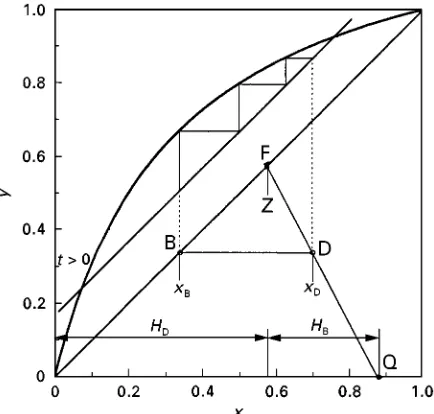
At any time t, the operating line is parallel to the diagonal line in a McCabe}Thiele diagram (Figure 8), and moves towards the diagonal as time progresses according to the following dynamics:
V(y!x)"HD dxD
dt [24]
or:
V(y!x)"!HB dxB
dt [25]
Since, at timet, the following material balance holds true:
xD!z z!xB
"HB HD
[26] the reSux drum and reboiler compositions at the same time instant can be determined by using the auxiliary line FQ, where the abscissaaQof the auxiliary point Q on thex-axis is such that:
aQ!z z "
HB HD
[27]
The segment BD is drawn, where B is on the diag-onal line withaB"xB, and D is on the auxiliary line FQ withaD"xD. The product compositions at timet are correct if the segment BD, is parallel to thex-axis. The total amount of heat to be supplied to the reboiler is given by:
Qr"HD
xspecD
z
dxD
y!x"!HB
xspecB
z
dxB
y!x [28]
From a practical standpoint, the advantages of this operating mode are:
E the column always operates at its maximum frac-tionating capacity;
E column operation is very easy: only a level control-ler is necessary, which keeps the reSux drum hold-up at the speciRed value; no product switchovers are required;
However, it should also be observed that unavoid-able uncertainties in the feed amount, feed composi-tion and column hold-up would act in such a way as to prevent reaching the desired purity speciRcations for both products. In order to ensure that the more valuable product is recovered on speciRcation, the hold-up of the vessel containing this product should be set somewhat smaller than requested theoretically; a conventional temperature controller may be cas-caded to the reSux drum level controller in order to adjust the level setpoint online, according to the de-sired purity requirements. Another way to reduce (and even eliminate) the effect of the uncertainties is using a middle-vessel batch column.
For multicomponent separations, a cycling opera-tion may be employed: the column is operated at total reSux until a steady state is approached; distillate is then taken as total draw-off for a short period of time; then, the operation is switched back to total reSux, and the operating cycle is repeated.
Conclusion
As was noted in the Introduction, batch distillation as a way of separating a given mixture in multiple frac-tions is becoming more and more frequent, especially in the Rne chemicals, pharmaceutical, biochemicals, food and beverages industries. While it is true that batch distillation usually consumes more energy than continuous distillation, it nevertheless provides more Sexibility and requires less capital investment. This is an economic incentive, particularly when small vol-ume or high added-value products are to be re-covered. Still, there is a certain reluctance among operators to use this process. In fact, its unsteady nature, together with the need for monitoring, switching and discharging a series of cuts, may un-avoidably confuse plant personnel.
From an engineering perspective, modelling and simulation of the operation is no longer as hard a task as it was in the past. The understanding of the process is fairly comprehensive (at least for conven-tional columns), so that all the operating steps char-acterizing a batch distillation process can be modelled in some detail. The availability of computer hardware at low cost makes it possible to solve all the model equations in a reasonably short time. It should be stressed that the availability of a reliable process model is a crucial issue for proRtably utilizing an
existing batch column. If a good model is available, then it can be used toRnd out the optimal operating policy for the batch, i.e. to determine which are the sequence of reSux ratios during the batch and the strategy for reprocessing slop cuts between batches that would maximize a prescribed proRt function. A process model can also prove useful for the closed-loop control of the operation. Advanced control strategies employ process models to get online estima-tions of the product composiestima-tions, thus eliminating the need to resort to expensive hardware analysers; more efRcient control laws than the classical propor-tional plus integral algorithm can also be developed if a process model is available. Finally, process models can be employed within a training pro-gramme to instruct the plant personnel on how to interpret the column dynamics, and its response to process uploads: this may prove useful in improving the operator’s conRdence about this unsteady unit operation.
See also: II/Distillation: Historical Development; Instru-mentation and Control Systems; Multicomponent Distilla-tion; Pilot Plant Batch DistillaDistilla-tion; Theory of Distillation.
Further Reading
Diwekar UM (1995)Batch Distillation:Simulation, Opti-mal Design,and Control. Bristol: Taylor-and-Francis. Hart DR (1992) Batch distillation. In: Kister HZ (ed.)
Distillation Design. New York: McGraw-Hill. Holland CD (1966)Unsteady State Processes with
Applica-tions in Multicomponent Distillation. Englewood Cliffs: Prentice-Hall.
Luyben WL (1990)Process Modeling,Simulation,and Con-trol for Chemical Engineers. New York: McGraw-Hill. Macchietto S and Mujtaba IM (1996) Design of opera-tion policies for batch distillaopera-tion. In: Reklaitis GV, Sunol AK, Rippin DWT and Hortac,su OG (eds) Batch Processing Systems Engineering } Fundamentals and Applications for Chemical Engineering. Berlin: Springer. Muhrer CA and Luyben WL (1992) Batch distillation. In: Luyben WL (ed.) Practical Distillation Control. New York: Van Nostrand Reinhold.
Robinson CS and Gilliland ER (1950)Elements of Frac-tional Distillation. New York: McGraw-Hill.
Rose LM (1985)Distillation Design in Practice. Amster-dam: Elsevier.
Seader JD and Henley EJ (1998) Separation Process Principles. New York: John Wiley.
Stichlmair JG and Fair JR (1998) Distillation: Principles and Practice. New York: Wiley-VCH.