Headquarters, Department of the Army
DISTRIBUTION RESTRICTION: Approved for public release; distribution is unlimited.
FM 3-34.230
(Formerly FM 5-105)
i Field Manual
No. 3-34.230
Headquarters Department of the Army
Washington, DC, 3 August 2000
Distribution Restriction: Approved for public release; distribution is unlimited. *This publication supersedes FM 5-105, 30 September 1993.
TOPOGRAPHIC OPERATIONS
Contents
Page PREFACE... v
INTRODUCTION ... vi
Chapter 1 THE ARMY'S OPERATIONAL CONCEPT FOR BATTLE COMMAND ...1-1 Overview ... 1-1 Army XXI ... 1-1 Army After Next... 1-2 Battlefield Operating Systems... 1-2 Future Operational Capabilities... 1-3 Modeling and Simulations/Mission Planning and Rehearsal Systems... 1-3 Battlefield Visualization ... 1-3 Terrain Visualization ... 1-5 Army Operations ... 1-6 Offense... 1-6 Defense... 1-6 Stability... 1-6 Support... 1-7
Chapter 2 ORGANIZATIONS AND FORCE STRUCTURE ... 2-1 Unified Commands ... 2-1 Joint Task Force ... 2-1 Army Forces ... 2-1 National Imagery and Mapping Agency ... 2-2 Defense Logistics Agency ... 2-2 Corps of Engineers ... 2-2 Topographic-Engineering Center ... 2-3 TEC’s Commercial Imagery Library ... 2-3 Key Capabilities ... 2-4 US Army Space and Missile Command ...2-4 Army Service Level ...2-4 TRADOC Program Integration Office—Terrain Data ... 2-4 Maneuver-Support Battle Laboratory ... 2-5 Program Executive Office—Command, Control and
ii
Page FM 3-34.230
Defense Mapping School ... 2-6 Quartermaster ... 2-6 Communications Systems ... 2-6 Intelligence Units ... 2-6 Engineers ... 2-7
Chapter 3 TOPOGRAPHIC SUPPORT ... 3-1 Topographic Support Personnel ... 3-1 Topographic Operations and Functions ... 3-2 METT-TC factors ... 3-3 Command and Control ... 3-3 Intelligence ... 3-3 Maneuver, Mobility, and Survivability ... 3-4 Fire Support ... 3-5 Air Defense ... 3-5 Logistics... 3-5 Strategic Topographic Support ... 3-6 Theater Topographic Support ... 3-6 Database Management ... 3-6 Terrain Analysis ... 3-7 Digital Cartography ... 3-7 Low-Volume Product Reproduction ... 3-7 Topographic Survey ... 3-7 Reproduction ... 3-7 Special-Products Storage, Distribution, and Dissemination ... 3-8 Corps Topographic Support ... 3-8 Division Topographic Support ... 3-10 Database Management ... 3-11 Topographic Database Development (Predeployment) ... 3-13 Terrain Analysis ... 3-14 Topographic Survey ... 3-15 Topographic Production ... 3-15
iii Page
Global Positioning System—Survey ... 4-8 Automated Integrated Survey Instrument ... 4-9
Appendix A METRIC CONVERSION CHART ... A-1
Appendix B STANDARD AND NONSTANDARD TOPOGRAPHIC PRODUCTS ... B-1 Overview ... B-1 Standard Topographic Products and Services ... B-1 Nonstandard Topographic Products ... B-2 Mobility... B-3 Terrain Elevation... B-4 Special-Purpose Product Builder... B-4 Intervisibility ... B-5 Tactical Dam Analysis ... B-6 Integrated Meteorological System ... B-6 Environmental and Climatology ... B-7 Terrain-Evaluation Tools ... B-7 Digital Data Viewer ... B-8 Line of Site... B-8 Terrain Category... B-8 Perspective View ... B-8 Oblique View... B-8 Flythrough... B-9 Panorama ... B-9 GPS Waypoints and Tracks... B-9 Distance Measurements ... B-9 Coordinate Conversion ... B-9 Elevation Merge... B-9 Elevation or Slope Merge with Maps or Imagery ... B-10 Summary ... B-10
Appendix C FUTURE OPERATIONAL CAPABILITIES ... C-1 Information-Management Environment ... C-1 Information-Requirements Management ... C-1 Information-Collection Management... C-2 Information-Production Management ... C-2 Information-Delivery Management... C-2 Work-Group Management ... C-3 Cross-Cueing Management... C-3 WIN/DISN Communications Management ... C-3 IGI C&P Environment ... C-3 Airborne C&P... C-4 Airborne Mission Management and Planning ... C-4 Theater Downlinked-Imagery Processing... C-4 Commercial C&P ... C-4 Service-Provider Resource Management... C-5 Geodetic and Topographic Survey ... C-5 Assisted/Automated Target Recognition, Assisted/Automated
iv
Page FM 3-34.230
Data Preparation ...C-6 Data Analysis...C-7 Information Generation ...C-7 Exploitation Support ...C-7 A&D Environment...C-7 Storage Services ...C-7 Discovery Services ...C-8 Dissemination and Retrieval Services ...C-8 Access Services ...C-8 Media-Generation Services ...C-8 Communications-Infrastructure Environment ...C-8
Appendix D DATABASE MANAGEMENT ...D-1 Digital Terrain Data ...D-1 Foundation Data ...D-1 MSDS (Data Generation) ...D-2 Enriched Data ...D-3
Appendix E ANNEXES ... E-1
Appendix F LEGACY SYSTEMS ... F-1 Cartographic-Revision Subsystem ... F-1 Image-Based Products Subsystem ... F-1 Storage and Distribution Subsystem ... F-2 Reproduction Subsystem ... F-2 C2Subsystem ... F-2 Military Geographic Information Subsystem ... F-3 Downsized Direct-Support System ... F-3 Digital Topographic Support System—Low-Rate Initial Production... F-3 Survey Subsystem ... F-3
GLOSSARY ... Glossary-1
BIBLIOGRAPHY ... Bibliography-1
This field manual (FM) describes doctrine for topographic operations in support of the United States (US) Army’s strategic, operational, and tactical missions.
The Army’s strategic challenge is to prepare for the rise of a major military competitor who is both competent and capable. All topographic operations must rise to the challenges of providing topographic information to a battle commander so that the battle space can be visualized in time, space, and distance. This requires absolute fidelity and definition of the battle space for decision making and mission execution.
Appendix A contains an English-to-metric measurement conversion chart.
The proponent of this publication is HQ TRADOC. Send comments and recommendations on Department of the Army (DA) Form 2028 directly to Commandant, US Army Engineer School (USAES), ATTN: ATSE-DOT-DD, Directorate of Training, 320 Engineer Loop, Suite 336, Fort Leonard Wood, Missouri 65473-8929.
Unless this publication states otherwise, masculine nouns and pronouns do not refer exclusively to men.
Introduction
Geospatial information and services (GI&S) incorporate the processes that collect, manage, extract, store, disseminate, and exploit geographic information and imagery. This process is an evolutionary change that reflects the expansion of previous topographic operations within the Army. The GI&S play a significant role in military operations. Geospatial information (GI) provides the foundation upon which all other battle-space information is referenced to form the common operating picture. The GI&S aid the commander in visualizing the battle space to plan and execute military operations effectively, to navigate, and to target the adversary accurately. The GI&S support plays an important role in the full range of military operations; commanders cannot afford to conduct military operations without up-to-date GI.
The GI&S within the future force structure combine the resources of national and commercial capabilities and host nations with the Army topographic-engineering community. This union allows the topographer to provide the battlefield commander a clear understanding of the current state (with relation to the enemy and the environment) and the ability to envision a desired end state (which represents mission accomplishment). The topographer molds the geographic information into map products, tactical decision aids (TDAs), user-defined topographic-analysis products or data sets, and precise geodetic-positioning products. These products can then be digitally transmitted or graphically plotted/ printed to enhance battlefield visualization.
The engineer’s GI&S technology is the cornerstone for information dominance that is critical for a smaller, agile, and more lethal army.
The Army's Operational Concept for Battle Command 1-1
The Army's Operational Concept
for Battle Command
Historically, the Army has used the term command and control (C
2) to
describe the system that commanders used to plan, direct, coordinate, and
control combat operations or other military activities. Because of confusion
created by this terminology, the Army now emphasizes that command and
control are two distinct, but interdependent, concepts rather than one. The
commander and his staff, as a team, use command with control to
accomplish the mission.
OVERVIEW
1-1. Battle command is the commander's portion of C2. Battle command is the art of battle decision making, leading, and controlling operations. It includes—
• Controlling operations and motivating soldiers and their organizations into actions to accomplish missions.
• Visualizing the current and future states, then formulating a concept of the operation to progress from one phase to the other.
• Assigning missions.
• Prioritizing and allocating resources. • Selecting the critical time and place to act.
• Knowing how and when to make adjustments during the fight.
1-2. Battle command requires the commander to have the mental agility, discipline, and experience necessary to make timely, relevant, and high-payoff decisions; to optimize the force's capabilities; and to control the tempo of mission execution.
ARMY XXI
1-3. Army XXI is the programmed force for the Army in the near-term development cycle. This cycle is undergoing upgrades to existing systems to take advantage of new technologies and opportunities immediately available for organizational improvement. United States Army Training and Doctrine Command (TRADOC) Pamphlet (Pam) 525-5 guides this development and addresses the familiar TRADOC requirements—doctrine, training, leader development, organization, materiel, and soldiers (DTLOMS).
FM 3-34.230
1-2 The Army's Operational Concept for Battle Command
equipment has been an integral part of experimentation and evaluation to identify the specific functional and operational requirements for Army XXI.
ARMY AFTER NEXT
1-5. The Army After Next (AAN) is about ideas. The AAN project has become a laboratory—part technology oriented, part military-science oriented—in which the Army works with other government services and agencies, academic institutions, and civilian industry to build ideas about the future. The AAN differs from the efforts of other futures groups in that its participants take extra care to subject ideas to both the considered experience of military history and the analytical rigor of state-of-the-art gaming.
BATTLEFIELD OPERATING SYSTEMS
1-6. The tactical level of major war functions—the battlefield operating systems (BOSs)—are those occurring on the battlefield and performed by the force to execute operations (battles and engagements) successfully and to accomplish military objectives directed by the operational commander. The following are the BOSs and some examples of how they relate to topographic operations (refer to Appendix B for examples of standard and nonstandard topographic products as they apply to these systems):
• C2(battlefield visualization).
• Intelligence (mobility products and corridors and lines of communication [LOC]).
• Maneuver (bivouac sites, concealment, drop zones, and staging areas). • Fire support (cover, concealment, mobility, and survey control points
[SCPs]).
• Air defense (air avenues of approach, flight-line masking, and target acquisition).
• Mobility/survivability (M/S) (on- and off-road mobility predictions). • Logistics (information on supply routes, railways, airfields, and storage
facilities).
1-7. Topographic units provide support to all BOSs on the battlefield; however, the major emphasis for GI&S support is provided to the intelligence BOS for the intelligence preparation of the battlefield (IPB) and the M&S BOS for the engineer battlefield assessment (EBA).
1-8. The commander directs the intelligence effort by selecting and prioritizing intelligence requirements. These requirements support him in conducting and planning operations. The information he needs to visualize the outcome of current operations is called the commander's critical information requirements (CCIR), which includes information on both friendly and threat forces. The threat-information portion of the CCIR is the commander's priority intelligence requirements (PIR). The CCIR and PIR direct the operations of the topographic unit supporting the commander. In designating PIR, the commander establishes—
The Army's Operational Concept for Battle Command 1-3 • When he wants it.
• How he wants it.
FUTURE OPERATIONAL CAPABILITIES
1-9. Future operational capabilities (FOC) are statements of operational capabilities required by the Army to develop war-fighting concepts (refer to the TRADOC Pam 525-series) approved by the TRADOC commander. The FOC address specific war-fighting capabilities, not functions or operations. Topographic operations in support of Force XXI and the AAN will be influenced by the integrated FOC, the branch/functional FOC, and the TRADOC-proponent FOC as described in TRADOC Pam 525-66. Refer to Appendix C for more FOC information.
MODELING AND SIMULATIONS/MISSION PLANNING AND REHEARSAL SYSTEMS
1-10. Technology provides the tools to allow a commander to visualize and assess the sequence of actions from the current state to the desired end state. There must be an integrated system to assist him in optimizing mission planning, to facilitate effective rehearsals, and to monitor understanding of his intent before and during mission execution. Training and combat systems must be similar and provide simulation-independent war-fighter descriptions of real-world processes, entities, environments, implementations, and relationships. Software must operate and support live-, virtual-, and constructive-simulation environments to approximate real combat. Technologies, including simulations and artificial intelligence, allow commanders to replicate the real world in an environment where risk is minimal.
1-11. Models and simulations, in conjunction with C2systems, are used for training and preparing for combat. Battlefield trends may be assessed rapidly and provide tools for exploring new courses of action (COAs) based on the current situation. A commander uses these tools by applying common sense and experience rather than accepting the computer solution as the best conclusion.
1-12. Military operations make use of modeling and simulation (M&S) applications for creating and analyzing operational plans and orders. Army C2 systems using M&S applications will facilitate mission rehearsal. These applications must represent combat and the myriad of related support functions with sufficient resolution, fidelity, and detail to ensure high confidence in the results.
BATTLEFIELD VISUALIZATION
1-13. Battlefield visualization is the process whereby the commander develops a clear understanding of the current state with relation to the environment, envisions a desired end state that represents mission accomplishment, then subsequently visualizes the sequence of activity that moves his force from its current state to the end state.
FM 3-34.230
1-4 The Army's Operational Concept for Battle Command
training, practice, experience, wisdom, and available battle-command technologies. Other resources, both human and technological, serve only to assist a commander in formulating a vision and taking action to implement it. To be successful in battle, a commander must apply experience and intuition to sort through the myriad of information available on the battlefield.
1-15. Battlefield visualization requires the use of operational tools that are derived from science and technology. However, technology alone cannot provide a commander with full battlefield visualization. Technology must be used together with a commander’s judgment, wisdom, experience, and intuitive sense to enhance battlefield visualization.
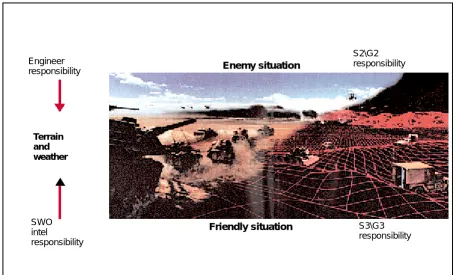
[image:11.612.70.524.302.577.2]1-16. Battlefield visualization is the heart of battle command. A commander must be able to clearly articulate his battlefield vision to his subordinates in his intent statement. This ensures the optimum development of his concept of operations (see Figure 1-1).
Figure 1-1. Battlefield Visualization
1-17. Battlefield visualization is essential to establishing the battlefield framework as described in FM 71-100. The commander must first gain an understanding of the battlefield. This includes the state of his unit, the state of the enemy, and the impact of terrain and weather. He must then visualize the desired end state and envision a sequence of actions (an intellectual war game) that will cause his forces to arrive at the desired end state.
Engineer responsibility
SWO intel
responsibility
S2\G2 responsibility
S3\G3 responsibility Friendly situation
Enemy situation
The Army's Operational Concept for Battle Command 1-5
TERRAIN VISUALIZATION
1-18. Terrain visualization is the process through which a commander sees the terrain and understands its impact on the operation in which he is involved. This includes the impact on both friendly and enemy elements. It is the identification and understanding of terrain aspects that can be exploited by the friendly commander to gain advantage over the enemy as well as those most likely to be used by the enemy. It is the subjective evaluation of the terrain’s physical attributes as well as the physical capabilities of vehicles, equipment, and personnel that must cross over and occupy the terrain. Terrain visualization is closer to military art than to military science.
1-19. Terrain visualization is a basic and fundamental leadership skill. A battle commander must understand how terrain influences every aspect of military operations. Commanders require a detailed awareness of the entire situation, including the environment, enemy, and friendly situations.
1-20. Terrain visualization is far from a new requirement. However, in the era of force projection, every means available must be used to provide battle commanders with this fundamental knowledge of terrain while planning for operations. Information technology and force digitization provide a means to that end. Terrain visualization is a component of battlefield visualization. It portrays and allows a detailed understanding of the background upon which enemy and friendly forces and actions are displayed. Topography provides the picture whereby the user can visualize the terrain. Terrain visualization includes the subordinate elements of data collection, database development, analysis, display, distribution, and database management. These elements include both new and changed tasks due to the new way of looking at the battlefield based on digital data. The elements are designed to provide the necessary visualization for the commander and to control and manage a central terrain database. The process of terrain visualization depends highly on joint and combined digital terrain processing means and the uninterrupted electronic transfer of large amounts of information.
1-21. A commander requires the ability to see the battlefield on which his units and the enemy will deploy, maneuver, and fight. The resolution of information demanded increases as the echelon of command decreases. Lower echelons may require slope, elevation, trafficability, vegetation, or natural-and man-made-feature information layers in much more detail. Commnatural-anders have traditionally visualized the battlefield’s four dimensions (width, depth, height, and time) using traditional two-dimensional paper maps. The current and emerging terrain-visualization tools will enhance the commander’s view of the battle space by providing oblique, perspective, and other views in four dimensions.
FM 3-34.230
1-6 The Army's Operational Concept for Battle Command
1-23. Terrain visualization is a significant part of the military decision-making process. In this process, a commander uses the topographic-analysis element within his echelon to collect, analyze, evaluate, and interpret military geographic information on the terrain’s natural and man-made features in combination with other factors to provide predictive information and advice about the terrain’s effect on military operations. Simply stated, the commander requires topographic analyses to increase his knowledge of the battlefield.
ARMY OPERATIONS
1-24. Operations are designed and conducted to accomplish assigned missions. Army forces conduct operations to compel, deter, reassure, and support. All operations are composed of four basic categories—offense, defense, stability, and support—around which commanders design their operations to achieve victory. The categories of operations apply to both violent and nonviolent environments. The strength in recognizing and employing categories is that they allow a commander operational flexibility in accomplishing a broad range of missions. In training, planning, and executing, this comprehensive view toward operations enables forces to change their focus based on the changing context within which operations are conducted.
OFFENSE
1-25. Offensive operations carry the fight to the enemy. They are decisive operations—the commander's ultimate means of imposing his will on the enemy. Offensive operations combine both force and terrain objectives. There are four general types of offensive operations—
• Movement to contact (MTC). • Attack.
• Exploitation. • Pursuit.
DEFENSE
1-26. Defensive operations are those undertaken to cause an enemy’s attack to fail. Although they are a stronger category, they cannot achieve a decision alone. Defensive operations must ultimately be combined with or followed by an offensive action. Defensive operations orient on force and terrain. In planning these operations, commanders ordinarily combine three basic types of defensive operations—
• Mobile defense. • Area defense. • Retrograde.
STABILITY
The Army's Operational Concept for Battle Command 1-7 nature, stability operations complement and are complemented by offensive, defensive, and support operations.
SUPPORT
1-28. Support operations provide essential supplies and services to assist designated groups. They are conducted mainly to relieve suffering and to assist civil authorities in responding to crises. Support operations may be independent actions or they may complement offensive, defensive, and stability operations. The vast majority of offensive, defensive, and stability operations will likely require complementary support operations before, during, and after execution.
Organizations and Force Structure 2-1
Chapter 2
Organizations and Force Structure
The GI&S assets are task-organized (based on METT-TC) to support
Army, joint, and combined operations at all levels and throughout the
spectrum of conflict. These assets remain flexible to meet mission
requirements. Units may deploy in full to support the operation or they
may employ split-based operations. The GI&S support for split-based
operations requires a robust communications system for transmitting data
and products between the deployed element and the split-based element.
Split-based logistics include everything from one squad to a company
minus the support platoon. In most situations, a squad of terrain analysts
and surveyors will deploy into a theater of operations (TO) with the
initial-entry force. Additional topographic elements will follow based on the size
of force buildup. The entry force will provide rapid-response mapping and
TDA support for the task force (TF), while GI&S support will continue
from the split-based element using national and commercial sources not
readily available to the forward-presence element.
UNIFIED COMMANDS
2-1. Unified and component commanders define military task requirements to support contingency plans (CONPLANs), operation plans (OPLANs), and operations orders (OPORDs) based on the commander's concept of the operation. The corresponding echelon for topographic support and the theater GI&S officer advise the Intelligence Directorate (J2) and other staff officers in preparing the global geospatial information and services (GGI&S) annex for each CONPLAN, OPLAN, or OPORD. The commander outlines the specific support requirements needed for the command.
JOINT TASK FORCE
2-2. Joint task force (JTF) topographic support assets identify GI&S requirements to support OPORDs and coordinate support within their TF. They also collect, review, and validate topographic requirements from component commands. These topographic assets can come from a division, corps, or theater unit, depending on the JTF’s task organization.
ARMY FORCES
2-2 Organizations and Force Structure
NATIONAL IMAGERY AND MAPPING AGENCY
2-4. The National Imagery and Mapping Agency’s (NIMA’s) role is to support the war fighter through priorities established by the commanders in chief (CINCs). This support comes in the form of imagery, imagery intelligence, and GI (including standard maps and data sets) in support of national security objectives. The agency's vision is to guarantee ready access to the world's imagery, imagery intelligence, and GI.
2-5. NIMA has technical and liaison representatives at the CINC level who work with the staff and the GI&S officer to establish requirements and priorities and to identify the best products and services that NIMA can provide. These representatives prioritize, validate, and consolidate requirements identified by major subordinate commands (MSCs).
2-6. NIMA has a global mission, as established by the NIMA Act of 1996. It has the unique responsibilities of managing and providing imagery and GI to national policy makers and military forces. NIMA is also an established part of the US intelligence community in recognition of its unique responsibilities and global mission. The agency incorporates the now disestablished Defense Mapping Agency (DMA), the Central Imagery Office, and the Defense Dissemination Program Office in their entirety. It also incorporates the mission and functions of the Central Intelligence Agency's (CIA's) National Photographic Interpretation Center. Also included in NIMA are the imagery exploitation, dissemination, and processing elements of the Defense Intelligence Agency, the National Reconnaissance Office, and the Defense Airborne Reconnaissance Office.
2-7. NIMA brings together in a single organization the imagery tasking, production, exploitation, and dissemination (TPED) responsibilities and the mapping, charting, and geodetic functions of eight separate organizations of the defense and intelligence communities. NIMA continues to improve support to national and military customers through comprehensive management of US imaging and geospatial capabilities.
DEFENSE LOGISTICS AGENCY
2-8. The Defense Logistics Agency (DLA) is a logistics combat-support agency whose primary role is to provide supplies and services to US military forces worldwide. The DLA's mission includes managing over four million consumable items and processing over 30 million annual distribution actions. The DLA manages the inventory of NIMA’s hard-copy media (including paper maps, charts, compact disks—read-only memory [CD-ROMs], laser disks, publications, and pamphlets). The DLA processes customer requisitions and inquiries. It is responsible for receipt processing, storing, issuing, packing, shipping, filling subscriptions, and processing customer-unique requirements.
CORPS OF ENGINEERS
FM 3-34.230
Organizations and Force Structure 2-3 and Alexandria, Virginia. The ERDC’s headquarters is located in Vicksburg, Mississippi.
2-10. The ERDC provides world-renowned scientists and engineers using the latest in specialized equipment to address problems facing the military and the nation. Research support includes—
• Mapping and topographic analysis.
• Infrastructure design, construction, operations, and maintenance. • Structural engineering.
• Cold regions and ice engineering. • Coastal and hydraulic engineering. • Environmental quality.
• Geotechnical engineering.
• High-performance computing and information technology. The following are laboratories within the ERDC:
• The Coastal and Hydraulics Laboratory in Vicksburg, Mississippi. • The Cold Regions Research and Engineering Laboratory in Hanover,
New Hampshire.
• The Construction Engineering Research Laboratory in Champaign, Illinois.
• The Environmental Laboratory in Vicksburg, Mississippi. • The Geotechnical Laboratory in Vicksburg, Mississippi.
• The Information Technology Laboratory in Vicksburg, Mississippi. • The Structures Laboratory in Vicksburg, Mississippi.
• The Topographic-Engineering Center in Alexandria, Virginia.
TOPOGRAPHIC-ENGINEERING CENTER
2-11. The Topographic-Engineering Center (TEC) in Alexandria, Virginia, provides technical expertise and analytical products that support topographic engineering. The TEC is under the command of the ERDC’s commander, who is subordinate to the Commanding General, USACE. The TEC serves as the Army's center of technical expertise on all digital topographic matters. Its mission is to provide the war fighter with a superior knowledge of the battle space and to support the nation's civil and environmental initiatives through research, development, and expertise in the topographic and related sciences. The TEC has 5 major divisions with 16 branches of support.
2-12. The TEC provides a variety of topographic services to the Army along with topographic research, development, testing, evaluation, M&S, and acquisition. The TEC supplies software to support GI&S. It also provides technical support for TEC-developed software, commercial-off-the-shelf (COTS)/nondevelopmental-item hardware, TDA software, survey and positioning systems, digital databases, and digital imagery.
TEC’S COMMERCIAL IMAGERY LIBRARY
2-4 Organizations and Force Structure
commercial/civil imagery (C2I) acquisition. This action was designed to prevent Army agencies or organizations from duplicating C2I data purchases.
KEY CAPABILITIES
2-14. Efficient management of the research, acquisition, and distribution of imagery and products is increasingly important as Army units expand their use of this technology, especially with the fielding of the Digital Topographic Support System (DTSS). The GID serves several functions in its role as monitor (as defined in a memorandum of understanding [MOU] between the Army and the US Geological Survey [USGS], dated November 26, 1990). These functions include—
• Acting as the Army's primary point of contact (POC) for C2I sources to support engineer- and terrain-analysis operations and applications. • Acting as the monitor for all Army purchases of C2I.
• Serving as a repository of purchases and scenes available to the Department of Defense (DOD) that are crucial to Army missions.
US ARMY SPACE AND MISSILE COMMAND
2-15. The US Army Space and Missile Defense Command (SMDC) optimizes access to space-based information sources and communication means in support of Army operations. The SMDC uses commercial, foreign, and DOD satellite assets to augment standard topographic data sources and data distribution. Such satellite assets generate responsive data input to the Geographic Information Systems (GISs) operated by Army topographic units. The SMDC serves as the Army’s leader for direct downlinking of topographic imagery data as well as the development of tactics, techniques, and procedures (TTPs) on the preprocessing and transfer of remote-sensing data. At the tasking of the DA Deputy Chief of Staff for Operations and Plans (DCSOPS), the Army Space Command (ARSPACE) (located within the SMDC) provides rapid-response imagery. ARSPACE maintains the capability to deploy rapidly with emerging space-based spectral-imagery technology in support of topographic task organizations.
ARMY SERVICE LEVEL
2-16. The Deputy Chief of Staff for Intelligence (DCSINT) at Headquarters, DA (HQDA) is responsible for developing (in coordination with the DCSOPS) topographic plans and programs, identifying and validating Army mapping requirements, and coordinating mapping issues with the Office of the Joint Chiefs of Staff, NIMA, and other DOD organizations. The chief of engineers is responsible for executing the Army’s topographic program and providing GI&S advice and technical support to the DA staff (refer to Army Regulation [AR] 115-11 for more information).
TRADOC PROGRAM INTEGRATION OFFICE—TERRAIN DATA
FM 3-34.230
Organizations and Force Structure 2-5 experimentation, combat developments, and M&S. This mission incorporates the integration, interoperability, and commonality aspects of terrain data and products for the necessary development, testing, production, and fielding of Army systems requiring digital terrain data. The TPIO reports to the Commander, TRADOC through the Commander, US Army Maneuver Support Center (MANSCEN) and the Deputy Commanding General, Combined Arms Center.
2-18. The TPIO will integrate terrain data requirements for live, virtual, and constructive M&S for the training, exercises, and military operations (TEMO); advanced concepts and requirements (ACR); and research, development, and acquisition (RDA) domains.
MANEUVER-SUPPORT BATTLE LABORATORY
2-19. The Maneuver-Support Battle Laboratory’s (MSBL’s) mission is to be the Army’s primary maneuver-support war-fighting experimentation resource. The MSBL integrates experimentation actions across the DTLOMS spectrum and provides enhanced capabilities to soldiers through analyses, insights, and recommendations to the architects of the future army. The MSBL ensures that topography (as a part of maneuver support) is included in all future war-fighting concepts. The lab conducts analyses of experiments to provide input across the DTLOMS spectrum. The MSBL’s enduring battlefield function is performing operations to protect the force from the effects of enemy action and providing the force with the freedom of movement during military operations. The enduring battlefield functions of maneuver, fires, battle command, and sustainment all require continuous support from maneuver-support forces that are composed primarily of military police (MP), chemical, and engineer soldiers.
PROGRAM EXECUTIVE OFFICE—COMMAND, CONTROL AND COMMUNICATIONS SYSTEMS
2-20. The Program Executive Office for Command, Control, and Communications Systems (PEOC3S) is the material-developer manager for Army Battlefield Command Systems (ABCSs). This office provides overall architecture-based engineering and integration management and oversight for developing command, control, and communications (C3) systems throughout each ABCS’s life cycle. The DTSS is included within the ABCS to provide geographic information and support services.
PROJECT DIRECTOR, COMBAT TERRAIN INFORMATION SYSTEM
2-21. The Combat Terrain Information System (CTIS) is an Army program managed by the PEOC3S and colocated at the TEC. The CTIS project director is responsible for project management and the material development and acquisition program for a CTIS. He develops and acquires assigned tactical topographic-support systems that include the following:
2-6 Organizations and Force Structure
2-22. These systems will enable topographic units to analyze and develop reports and to manage the geographic information database to provide terrain visualization to commanders. The DTSS will also facilitate dissemination of digital and hard-copy topographic products to all battlefield functional areas.
US ARMY ENGINEER SCHOOL
2-23. The USAES located under the MANSCEN is the Army's school for all engineers and is the TRADOC proponent for topography. The engineer component of the MANSCEN is responsible for developing topographic concepts, materiel requirements, combat developments, training requirements, and doctrine for the design of the topographic force structure and all matters related to Army topographers and topographic units.
DEFENSE MAPPING SCHOOL
2-24. The Defense Mapping School (DMS) conducts Army topographic institutional training at all levels with direction from the USAES. Entry-level training is focused on developing basic cartographic and terrain-analysis skills. Midlevel training is focused on managing GI&S data, developing advanced topographic-analysis skills, and generating products. The leadership training is focused on integrating GI&S throughout the military planning and decision-making process. The DMS also provides mobile training teams for sustainment training to the units. It is one of four schools in NIMA’s training arm; it falls under the National Imagery and Mapping College (NIMC) located at Fort Belvoir, Virginia.
QUARTERMASTER
2-25. Quartermaster Corps proponent units have the responsibility at all levels for distributing (storage, requisition, processing, and issuance) unclassified standard geospatial products to units that maintain a standard DOD activity address code (DODAAC). Classified products are distributed through logistics units; however, units must have a DODAAC capable of receiving classified documents.
COMMUNICATIONS SYSTEMS
2-26. The signal community is responsible for providing state-of-the-art communication systems for rapidly moving data and products to the maneuver commander. These systems will ensure that the common topographic operating environment (CTOE) is available for every ABCS platform down to the lowest level. The C2systems relying on digital geospatial data must receive that data according to procedures established by signal elements.
INTELLIGENCE UNITS
FM 3-34.230
Organizations and Force Structure 2-7 and engineers consolidate and prioritize requirements for the division and corps terrain units. Intelligence units also assist in collecting imagery and information to augment the topographic database.
ENGINEERS
2-28. From the Office of Chief of Engineers at HQDA down through the division engineer, the engineer officer has special staff responsibility as the functional proponent for topography and for executing the topographic mission. The analysis technician (215D) at all echelons is the terrain-analysis and GI&S expert. All engineer officers have topographic expertise in terrain visualization and assist in collection requirements for terrain data to fill data voids in GI&S databases. Engineer officers are responsible for planning and estimating for mobility, countermobility, survivability, and general-engineering missions.
2-29. The echelons-above-corps (EAC) topographic-engineer battalion is the Army Service Component Command (ASCC) topographic asset. The battalion commander is the theater topographic engineer. The battalion has a headquarters and headquarters company (HHC), an EAC topographic-engineer company, and a separate numbered planning and control (P&C) detachment. The EAC company contains terrain-analysis, map- and data-reproduction, data-generation, survey, and database capabilities. The terrain platoon maintains a database for the theater area of operation (AO). The company develops, maintains, disseminates, and deploys the theater’s topographic database. This database provides GI&S for EAC commanders. It supports corps-and-below topographic requirements. The P&C detachment locates with the theater headquarters to prioritize topographic requirements. These EAC assets can conduct topographic operations from home-station, split-based logistics, or deployed environments.
Topographic-Engineer Battalion
2-30. The commander of the topographic-engineer battalion at EAC has oversight of all topographic units in the theater. Figures 2-1 and 2-2, pages 2-8 and 2-9, show active topographic companies at the EAC and corps levels. The topographic-engineer battalion commander is responsible for—
• Providing the P&C element to the appropriate theater component staff. • Providing general support (GS) to unified and specified commands. • Providing GS to subordinate topographic units for requirements
beyond their capability.
• Furnishing topographic support to all Army units at EAC.
• Managing the in-theater, topographic-production program (including topographic databases).
• Generating data.
• Collecting and managing data.
• Providing supply-point storage and distribution of special topographic products at EAC and corps levels.
• Assisting assigned units with topographic technical supplies.
230 rga niz ation s a n d Fo rc e Stru c ture MAINTENANCE & SUPPORT PRODUCTION PLATOON OPERATIONS SUPPORT PLATOON GRAPHIC SUPPORT PHOTOMAPPING SURVEY 2 SQDS PRINT TERRAIN PLATOON 1 81T30 1 81L30 1 82D30/20 1 81T20 2 81T10 6 TOTAL 1 81L30 1 81L20 7 81L10 9 TOTAL 1 81T30 3 81T20 7 81T10 2 81L10 13 TOTAL 1 81L30 2 81L20 7 81L10 10 TOTAL 1 82D40 2 82D30 4 82D20 10 82D10 17 TOTAL 5 81T20 20 81T10 25 TOTAL 4 92A1 4 TOTAL 1 03/21B 1 81Z 2 TOTAL 1 02/21B 1 81L40 2 TOTAL 1 215D 1 81T40 2 TOTAL CO HQS 1 02/21B 1 81T40 1 92G40 1 92Y30 1 54B20 1 75B20 1 92G20 2 92G10 1 92Y10 10 TOTAL 1 63B4 1 52C2 1 63B2 1 63S2 1 51T1 1 52D1 1 52C1 2 63B1 1 63S1 1 77F1 11 TOTAL
TERRAIN 5 SQDS
1 02/21B 1 81T40 1 92G40 1 92Y30 1 54B20 1 75B20 1 92G20 2 92G10 1 92Y10 10 total Support platoon 4 92A1 4 total Operations Maintenance and support 1 81T30 1 81L30 1 82D30/20 1 81T20 2 81T10 6 total 1 63B4 1 52C2 1 63B2 1 63S2 1 51T1 1 52D1 1 52C1 2 63B1 1 63S1 1 77F1 11 total 1 03/21B 1 81Z 2 total Co HQ 1 02/21B 1 81L40 2 total Production
platoon 1 215D1 81T40 2 total Terrain platoon 1 81L30 1 81L20 7 81L10 9 total Graphic support Photomapping Survey (2 squads) Print
Terrain (5 squads)
[image:22.612.89.710.66.485.2]1 81T30 3 81T20 7 81T10 2 81L10 13 total 1 81L30 2 81L20 7 81L10 10 total 1 82D40 2 82D30 4 82D20 10 82D10 17 total 5 81T20 20 81T10 25 total
F M 3-3 4 .23 0 O rg a niz ati ons and Force Structu re 2 -9 MAINTENANCE & SUPPORT PRODUCTION PLATOON OPERATIONS SUPPORT PLATOON GRAPHIC SUPPORT PHOTOMAPPING SURVEY 2 SQDS PRINT TERRAIN PLATOON 1 81T30 1 81L30 1 82D30/20 1 81T20 2 81T10 6 TOTAL 1 81L30 1 81L20 7 81L10 9 TOTAL 1 81T30 3 81T20 7 81T10 2 81L10 13 TOTAL 1 81L30 2 81L20 7 81L10 10 TOTAL 1 82D40 2 82D30 4 82D20 10 82D10 17 TOTAL 5 81T20 20 81T10 25 TOTAL 92A1 TOTAL 1 03/21B 1 81Z 2 TOTAL 1 02/21B 1 81L40 2 TOTAL 1 215D 1 81T40 2 TOTAL CO HQS 02/21B 81T40 92G40 92Y30 54B20 75B20 92G20 2 92G10 92Y10 0 TOTAL 1 63B4 1 52C2 1 63B2 1 63S2 1 51T1 1 52D1 1 52C1 2 63B1 1 63S1 1 77F1 11 TOTAL
TERRAIN 5 SQDS
1 02/21B 1 81T40 1 92G40 1 92Y30 1 54B20 1 75B20 1 92G20 2 92G10 1 92Y10 10 total Support platoon 4 92A10 4 total 1 81T30 1 81L30 1 82D30 1 81T20 2 81T10 6 total 1 63B4 1 52C2 1 63B2 1 63S2 1 51T1 1 52D1 2 52C1 2 63B1 2 63S1 2 92A1 1 77F1 15 total 1 03/21B 1 81Z 2 total Co HQ 1 02/21B 1 81L40 2 total Production platoon 1 215D 1 81T40 2 total Terrain platoon
Terrain (4 squads) 4 81T20 16 81T10 20 total Spec prod dist sec Graphic support
[image:23.612.88.721.85.503.2]Photomapping Print Survey (2 squads) Operations Maintenance and support 1 215D 1 81T40 2 total 1 81T30 3 81T20 4 81T10 5 81L10 13 total 1 81L30 2 81L20 7 81L10 10 total 1 82D40 2 82D30 4 82D20 10 82D10 17 total 1 81L30 1 81L20 7 81L10 9 total 1 215D 1 81T40 2 total
2-10 Organizations and Force Structure
Topographic-Engineer Company
2-31. The corps topographic-engineer company is a DS asset that focuses on the corps’s contingency areas. It is responsible for all terrain analysis and GI&S support to the corps. The terrain platoon maintains a database for the corps’s area of interest (AOI). The corps company places emphasis on quick-response topographic decision aids and maintains collection and management of the corps database. It conducts topographic operations from a home base or while it is split based or fully deployed. The corps topographic-engineer company works for the corps engineer and provides terrain-analysis and GI&S support to the corps staff and all MSCs. The corps G2 and Assistant Chief of Staff, G3, (Operations and Plans) (G3) are consistently the critical supported staff elements.
Nondigital Division Topographic-Analysis Detachment
2-32. The division topographic-analysis detachment (see Figure 2-3) is responsible for all terrain-analysis and GI&S support to the division (collecting, analyzing, managing, integrating, and disseminating the division’s geospatial database). The terrain-analysis detachment is attached to each division. It works with the division staff for planning operations and integrating terrain and GI&S products into the IPB process.
Figure 2-3. Nondigital Division Terrain Detachment
Digital Division Terrain Detachment
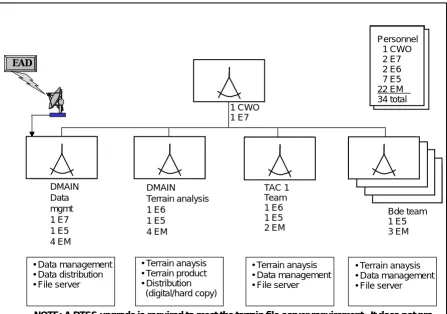
2-33. The digital division terrain detachment is responsible for all terrain-analysis and GI&S support to the division. The terrain-terrain-analysis detachment is attached to each division. It works for the division engineer and colocates with the planning and operations staff. The terrain-analysis detachment works with the engineer mobility cell for planning operations and integrating the terrain analysis and GI&S into the IPB and EBA processes. The detachment is responsible for collecting, analyzing, managing, integrating, and disseminating the division’s GI&S database. The detachment is task-organized into squads to support the division main (DMAIN), the tactical command post (TAC), and the maneuver brigade command posts (CPs) when the division is deployed (see Figure 2-4). These squads will colocate with the
DMAIN 1 E6 1 E5 4 EM
1 CWO
1 E7 Personnel
FM 3-34.230
[image:25.612.94.541.218.532.2]Organizations and Force Structure 2-11 division headquarters in garrison to consolidate efforts to support the division’s planning process. When deployed, the squads will provide terrain-analysis and GI&S support to the commander at their echelon through the organic engineer brigades or battalions. They will also maintain the secondary topographic-data storage device. Tailored terrain-analysis products and database management provide brigade and battalion commanders with the CTOE and the effects of terrain and weather on their soldiers, weapons, and tactics.
Figure 2-4. Digital Division Terrain Detachment
EAD 1 CWO 1 E-7 1 E-6 1 E-5 4 EM DMAIN Terrain Analysis DMAIN Data Mgmt 1 E-7 1 E-5 4 EM TAC 1 Team 1 E-6 1 E-5 2 EM 1 CWO 2 E-7 2 E-6 7 E-5 22 EM 34 Total PERSONNEL Bde Teams 1 E-5 3 EM
• Data Management • Data Distribution • File Server
• Terrain Analysis • Terrain Product
Distribution
(Digital/hard copy)
• Terrain Analysis • Data Management • File Server
• Terrain Analysis • Data Management • File Server
NOTE: DTSS upgrade required to meet terrain file server requirement.
Does not provide for media production, feature extraction, or volume hard copy DMAIN Data mgmt 1 E7 1 E5 4 EM 1 CWO 1 E-7 TAC 1 Team 1 E6 1 E5 2 EM DMAIN Terrain analysis 1 E6 1 E5 4 EM Bde team 1 E5 3 EM Personnel 1 CWO 2 E7 2 E6 7 E5 22 EM 34 total
• Data management • Data distribution • File server
• Terrain anaysis • Terrain product • Distribution • (digital/hard copy)
• Terrain anaysis • Data management • File server
NOTE: DTSS upgrade required to meet terrain file server requirement. It does not provide for media production, feature extraction or volume hard copy.
• Terrain anaysis • Data management • File server
EAD 1 CWO 1 E-7 1 E-6 1 E-5 4 EM DMAIN Terrain Analysis DMAIN Data Mgmt 1 E-7 1 E-5 4 EM TAC 1 Team 1 E-6 1 E-5 2 EM 1 CWO 2 E-7 2 E-6 7 E-5 22 EM 34 Total PERSONNEL Bde Teams 1 E-5 3 EM
• Data Management • Data Distribution • File Server
• Terrain Analysis • Terrain Product
Distribution
(Digital/hard copy)
• Terrain Analysis • Data Management • File Server
• Terrain Analysis • Data Management • File Server
NOTE: DTSS upgrade required to meet terrain file server requirement.
Does not provide for media production, feature extraction, or volume hard copy DMAIN Data mgmt 1 E7 1 E5 4 EM 1 CWO 1 E7 TAC 1 Team 1 E6 1 E5 2 EM DMAIN Terrain analysis 1 E6 1 E5 4 EM Bde team 1 E5 3 EM Personnel 1 CWO 2 E7 2 E6 7 E5 22 EM 34 total
• Data management • Data distribution • File server
• Terrain anaysis • Terrain product • Distribution
(digital/hard copy)
• Terrain anaysis • Data management • File server
NOTE: A DTSS upgrade is required to meet the terrain file-server requirement. It does not pro-vide for media production, feature extraction, or volume hard copy.
Topographic Support 3-1
Topographic Support
Computer technology has changed the Army’s mapping, data-collection,
and battlefield-planning processes. As computer power and accessibility
have grown during the 1970s and 1980s, new methods of map making and
terrain analysis have been developed. Military commanders have long
realized the interdependence of the earth’s land features and their success
on the battlefield. Those military leaders who stand out in history
visualized the terrain and its effects on the battle’s outcome. Today’s
topographic engineer (along with his GI&S tools) is able to represent the
terrain and its effects more accurately and faster to help the commander
visualize the terrain. The commander’s knowledge of the terrain will allow
him to obtain a superior advantage in shaping the battle space; it is a key
portion of information dominance leading to successful operations.
TOPOGRAPHIC SUPPORT PERSONNEL
3-1. The engineer officer at theater, corps, division, and brigade is the terrain-visualization expert. He is responsible for assisting the commander in visualizing the terrain and its impact on friendly and enemy operations. The process includes identifying and understanding those terrain aspects that the commander can exploit to gain advantage over the enemy as well as those that the enemy will most likely exploit. Terrain visualization is a subjective evaluation of the terrain’s physical attributes as well as the physical capabilities of the vehicles, equipment, and people that must cross or occupy the terrain. This situational awareness (friendly and enemy elements, terrain, and weather) allows the commander to visualize the battle space.
3-2. The engineer terrain-analysis technician (215D) is the terrain-analysis and GI&S expert within the Army’s force structure. His primary function is to help the commander and his staff in understanding the battle space by assimilating and integrating large volumes of geographic information and transforming it into visualization, information, and knowledge.
3-3. The topographic analyst (81T) supervises and/or performs cartographic and terrain-analysis duties. He collects and processes military geographic information from sensed imagery, digital data, intelligence data, existing topographic products, and other collateral data sources; edits cartographic and terrain-analysis products; and advises command and staff officers on topographic operations and special map-product planning.
FM 3-34.230
3-2 Topographic Support
3-5. The lithographer (81L) is the large-volume printing expert. He operates and performs operator maintenance on offset duplicators and presses, copy cameras, platemakers, and various types of bindery and film-processing equipment. He also supervises and performs all printing and binding, camera operations, layout, and platemaking activities.
3-6. The topographic-engineering supervisor (81Z) supervises topographic surveying, cartography, and lithographic activities and assists in topographic planning and control activities. The topographic-engineering supervisor determines requirements and provides technical supervision of topographic mapping and other military geographic intelligence programs, including geodetic and topographic surveying. He assists in command supervision and coordination of map reproduction and topographic nonstandard-product distribution. He provides staff supervision and principal noncommissioned officer (NCO) direction to units engaged in performing topographic-engineering missions.
TOPOGRAPHIC OPERATIONS AND FUNCTIONS
3-7. Topographic operations include terrain analysis, geodetic survey, production and reproduction, database management, and exploitation. While each function provides information about the battle space’s physical characteristics, the focus of topographic operations is on terrain analysis and the presentation of its results to the commander. Rapid analyses of terrain factors and environmental effects are essential for deploying advanced weapon systems effectively, visualizing the battle space, targeting, planning air and ground missions, and countering enemy weapons and intelligence-collection capabilities. Terrain database management is evolving as another critical GI&S mission. Database management incorporates the collection, production, and dissemination of GI.
3-8. Terrain analysis is the study of the terrain’s properties and how they change over time, with use, and under varying weather conditions. Terrain analysis starts with the collection, verification, processing, revision and, in some cases, actual construction of source data. It requires the analysis of climatology (current and forecasted weather conditions), soil conditions, and enemy or friendly vehicle performance metrics. In short, it turns raw data into usable information. Terrain analysis is a technical process and requires the expertise of terrain-analysis technicians (215D) and topographic analysts (81T).
Topographic Support 3-3
METT-TC FACTORS
3-10. METT-TC factors must be considered in topographic operations to provide the commander with the correct topographic products and analysis. Since these factors vary in any given situation, the term METT-TC dependent is a common way of denoting that the proper approach to a problem depends on these factors and their interrelationship in that specific situation. The application of METT-TC occurs within each BOS across the entire operational spectrum. The GI&S support detailed in this manual is focused on EAC, the corps, and division through brigade.
COMMAND AND CONTROL
3-11. In the modern battlefield, the magnitude of available information (including geographic information) challenges leaders at all levels. Ultimately, they must assimilate thousands of bits of information to visualize the battlefield, assess the situation, and direct military action to achieve victory. Topographic analysts are an essential link for the commander to visualize the battlefield. Topographic analysts provide the commander’s staff with timely GI&S for planning, coordinating, and establishing control measures consistent with the commander’s intent. The Army does not fight alone; it integrates its efforts within the theater commander’s unified operations along with other services, other national agencies, and allied and coalition forces. This necessitates a common operational picture whose foundation is based on geographic information. The management and exploitation of the terrain database is a topographic-engineer function.
INTELLIGENCE
3-12. Intelligence uses the IPB process to analyze the weather, terrain, and threat in a specific geographic area for all types of operations. The IPB integrates threat doctrine with weather and terrain as they relate to the mission within a specific battlefield environment. This is done to determine and evaluate threat capabilities, vulnerabilities, and probable COAs. This analytical process builds an extensive database for each potential area in which a unit may be required to operate. The IPB determines the impact of the threat, weather, and terrain on operations. The terrain-analysis portion of the IPB process is critical for determining how the enemy will project its forces within the AO and, ultimately, the AOI.
3-13. The IPB supports staff estimates and decision making. Applying the IPB process helps the commander selectively apply and maximize his combat power at critical points in time and space on the battlefield by—
• Determining the threat's likely COA.
• Describing the environment (and its effects) that friendly units are operating within.
The IPB is a continuous process consisting of the following four steps:
FM 3-34.230
3-4 Topographic Support
identifies the battlefield characteristics that require in-depth evaluation of their effects on friendly and threat operations (such as terrain, weather, logistical infrastructure, and demographics). These characteristics are analyzed in more detail within the command's AO and battle space.
• Describe the battlefield's effects. The G2/S2 identifies the limitations and opportunities the environment offers for potential operations of friendly and threat forces. This evaluation focuses on the general capabilities of each force until COAs are developed later in the IPB process. This step always includes an examination of terrain and weather, but it may also include discussions of the characteristics of geography and infrastructure and their effects on friendly and threat operations. Products developed in this step might include—
■ A population-status overlay.
■ Overlays that depict the military aspects and effects of terrain. ■ A weather-analysis matrix.
■ Integrated products such as modified combined-obstacle overlays (MCOOs).
• Evaluate the threat. The G2/S2 and his staff analyze the command's intelligence holdings to determine how the threat normally organizes f o r c o m b a t a n d h o w i t c o n d u c t s o p e r a t i o n s u n d e r s i m i l a r circumstances.
• Determine the threat’s COA. The G2/S2 integrates the results of the previous steps into a meaningful conclusion. He determines the threat’s likely objectives and available COAs given what it normally prefers to do and the effects of the specific environment in which it is currently operating.
MANEUVER, MOBILITY, AND SURVIVABILITY
3-14. GI&S support to maneuver, mobility, and survivability are closely related. Engineers use the EBA as their mission planning and decision-making process. In the IPB phase, the engineer begins with the intelligence assessment of the enemy’s objectives, capabilities, and probable COAs. He then analyzes the terrain using the five military aspects of terrain provided by the terrain-analysis unit—observation and fields of fire, cover and concealment, obstacles, key terrain, and avenues of approach (OCOKA). His OCOKA analysis is based not only on characteristics of the ground, but also on the enemy and the commander’s intent. The engineer assessment produces advice on battle positions and engagement-area siting as well as initial information necessary to develop the obstacle plan and shape the battle space. 3-15. The EBA assesses the following engineer functions:
• Mobility.
• Countermobility. • Survivability.
Topographic Support 3-5 3-16. During mission planning, terrain analysts support the EBA and the commander to visualize the battle space by thoroughly portraying the military advantages and disadvantages. The GI&S provide the detailed information necessary to understand the battle space with respect to maneuver, mobility and survivability.
FIRE SUPPORT
3-17. Fire-support (FS) assets in support of maneuver forces include field-artillery (FA) systems, mortars, tactical air units, naval gunfire, Army aviation units, and offensive electronic warfare. Essential topographic support provided to FS assets includes SCPs or TDAs.
3-18. FA survey planning and coordination begin at the corps’s artillery survey planning and coordination element (SPCE) with an interface between the topographic engineers and the SPCE at division artillery (DIVARTY) and FA brigades. Army aviation assets are provided topographic support in the form of flight-line-masking, shaded-relief, and vertical-obstruction TDAs. These TDAs support mission planning and rehearsal.
AIR DEFENSE
3-19. Air-defense artillery (ADA) assets protect maneuver forces from enemy air attack. Support provided to ADA assets includes SCPs and TDAs such as—
• Flight-line masking. • Air avenues of approach. • Elevation tint.
• Flight-line target locator. • Obstructed-signal loss. • Surface-wind direction. • Visibility.
ADA survey planning and coordination begins at the corps’s artillery SPCE, with an interface between the topographic engineers.
LOGISTICS
3-20. Logistics is the provision of personnel, logistics, and other support required for maintaining and prolonging operations or combat until mission accomplishment. The art of logistics is integrating strategic, operational, and tactical support while simultaneously moving units, personnel, equipment, and supplies in timely execution of the commander's intent and his concept of operations.
3-21. Logistics elements are provided with essential topographic information such as—
• LOC TDAs.
• Possible resupply points. • Assembly-area TDAs.
FM 3-34.230
3-6 Topographic Support
• Facilities (seaports, airfields, warehouses, fuel-storage, utilities, medical, financial institutions, and postal systems).
STRATEGIC TOPOGRAPHIC SUPPORT
3-22. Strategic support (as required by national authority) includes GI&S support from NIMA and other national assets. The type and level of support is determined by the mission. It may include standard or nonstandard products provided through the DLA and information provided by NIMA, the TEC, the Defense Intelligence Agency (DIA), host nations, and many other sources. This support is discussed in Chapter 2.
THEATER TOPOGRAPHIC SUPPORT
3-23. Army theater topographic units provide commanders at designated echelons with timely, accurate knowledge of the battle space through terrain visualization. These units support the Army's force-projection mission by rapidly producing special topographic products and maintaining and manipulating topographic databases. Theater topographic units perform terrain analyses, geodetic surveys, and special map reproduction. They also manage the theater-level topographic database.
3-24. The EAC support includes a battalion HHC, a topographic-engineer company providing GS to the theater, and a P&C team located with the Army component command or the JTF. The battalions maintain a strong support relationship with all topographic assets located within their theater and are responsible for assisting in the resupply of their assigned topographic units while deployed.
3-25. The battalion commander is the theater’s topographic officer. He recommends the task organization and employment of all topographic assets in the theater. He maintains visibility of all topographic personnel, equipment, logistics, and operations within his theater. He uses his P&C teams to assist with coordinating requirements and recommending priorities for GI&S. The EAC topographic battalion ensures that the full spectrum of functional support is provided within the theater. This support includes—
• Database management. • Terrain analysis. • Digital cartography.
• Low-volume product reproduction. • Topographic survey.
• Reproduction.
• Special-products storage, distribution, and dissemination.
DATABASE MANAGEMENT
Topographic Support 3-7 commander must understand the limitations, accuracy, and intended uses of t h e G I da t a b a s e . Da t a b a s e m a na g e m e n t i nc l u de s th e a cq ui s i t i o n , manipulation, formatting, storage, and distribution of all hard-copy and digital data and products.
TERRAIN ANALYSIS
3-27. The terrain platoon supports the decision-making process at the theater level by providing the commander with essential decision aids and GI&S. Terrain-analysis platoons at the theater level are primarily focused on providing terrain analysis across the entire theater operational spectrum. This support is initially one level above corps. This enables the planners to identify key areas to enhance and focus the terrain platoon’s in-depth analysis and collection efforts. Terrain analysis is the primary mission of topographic operations during the planning phase. The analysis uses a series of feature layers collected at the appropriate resolution and detail to describe the battle space. The analysts modify and update the database using data available from all sources (national and locally collected). This allows the analyst to supply a current picture of the battle space. Appendix B provides a representative list of topographic products that support an analysis of the military aspects of terrain.
DIGITAL CARTOGRAPHY
3-28. Digital cartography is the process of displaying terrain features and elevation data using standard symbology understood by military forces. It uses computer hardware and software to automate the process.
LOW-VOLUME PRODUCT REPRODUCTION
3-29. Low-volume product reproduction is the hard-copy production of maps and GI products using the terrain platoon’s organic printing capabilities. The volume is usually less than 200 copies per product. These products are normally distributed over the counter to the requestor.
TOPOGRAPHIC SURVEY
3-30. Topographic survey is the process of determining the relative positions of points on, above, or beneath the earth’s surface by using traditional or satellite-based measurement systems. Theater topographic-survey platoons may be tasked with a number of different missions to support terrain platoons, FA, Army aviation, ADA, intelligence, chemical, armor, combat service support (CSS), signal, US Air Force (USAF), or NIMA. Topographic-survey support is discussed in depth in FM 5-532.
REPRODUCTION
FM 3-34.230
3-8 Topographic Support
• Single-color lithographic presses. • A DTSS.
• Xerographic-type (black-and-white) copiers and laser or bubble-jet color copiers.
• Color plotters.
• Digital-film processors.
3-32. Lithographic presses are used for high volume (over 5,000 copies) monochrome and multicolor printing of standard-size map products (22 1/2 x 29 1/2 inches). The time required for printing increases with each additional color. Time constraints may make multicolor products impractical. NIMA is responsible for printing and the DLA is responsible for distributing bulk map products. Army quartermaster units are responsible for distribution at the operational and tactical levels as a routine supply activity. Theater-level topographic units are responsible for providing digital and hard-copy nonstandard products to theater customers. Dissemination of nonstandard products to theater customers will be accomplished in the most expeditious manner (electronically, through normal supply channels, intelligence channels, or customer pick up). Production assets provide—
• Map substitutes (including image- and vector-based maps). • Expedient revisions or updates to topographic data.
• Studies of terrain-analysis overlays and graphics. • Special-purpose products (see Appendix B). • Geodetic survey and precise positions.
• Digital data (transform, develop, or duplicate). • Map overprints.
SPECIAL-PRODUCTS STORAGE, DISTRIBUTION, AND DISSEMINATION
3-33. The theater production element may produce large-volume special products for command-wide distribution. These products will be distributed through the supply system with a national stock number (NSN). Low-volume (less than 200) and medium-volume (200 to 1,000) products will be distributed by the most expeditious means (not to exclude the Army’s supply system).
CORPS TOPOGRAPHIC SUPPORT
3-34. The senior corps engineer is responsible for all engineer matters, including topographic engineering. The senior topographic commander assigned to the corps is the corps topographic officer. He is responsible for—
• Coordinating corps GI&S requirements for terrain analysis, database management, production, and survey.
• Tasking and prioritizing the corps topographic company’s work effort in DS of the corps.
• Facilitating the corps topographic company’s DS to the G3/G2.
• Managing, collecting, maintaining, and distributing the corps’s digital topographic database.
Topographic Support 3-9 • Preparing the topographic annex or appendix to corps plans and
orders.
• Assisting the G2 in defining requirements for topographic products to support the corps.
• Providing production (printing) and survey assistance for the rapid replication of topographic products.
3-35. Topographic support at the corps level consists of a company-sized element in a DS role. This element’s capabilities include the same full spectrum of topographic support as the battalion with the exception of the DTSS-B and its production capabilities. The company is task-organized by the corps engineer and receives missions through the assistant corps engineer (ACE). The corps topographic-company commander serves as the corps topographic officer, assisted by the corps GI&S officer assigned to the corps engineer staff section. A company’s terrain-analysis platoon provides DS and GS to the corps by performing terrain analyses and furnishing rapid-response and special-purpose GI&S to the corps staff. This facilitates current and future operations, plans, and corps-level maintenance of the CTOE. The corps’s printing assets are centrally located to optimize production support. Corps surveyors normally operate throughout the corps’s AO.
3-36. The company may task-organize in support of a division or TF for a limited time or in support of a particular tactical operation. Requirements that exceed the capability of corps topographic assets are referred to the EAC topographic battalion. If the distance from the battalion or the tactical situation dictates, the corps may receive an attached portion of an EAC topographic company.
3-37. The corps topographic company ensures that the full spectrum of functional support is provided within the corps’s area. This support includes— • Database management. Maintaining the corps’s database includes development and management for all topographic units within the corps. The database functions of the corps topographers mirror those of the theater. The capability to produce GI&S data at the corps level is much more robust than at the division level. As with theater topographic operations, corps topographic units provide GI&S to the corps’s force-protection and force-projection missions by rapidly developing, maintaining, and manipulating GI databases and by producing special topographic products. Refer to Appendix D for a detailed description of database management.
FM 3-34.230
3-10 Topographic Support
products that support an analysis of the military aspects of terrain, which is not all-inclusive.
• Decision aids. Decision aids are a basic part of the corps IPB and EBA analyses. They are rapidly created for quick integration with other intelligence products. This facilitates the corps intelligence and engineer operations planning for analyzing the AO. The terrain analyst analyzes the battlefield terrain and the effects of weather and the environment to predict terrain impacts on military operations. An intelligence order-of-battle analyst correlates the work accomplished by the terrain analyst with aspects of terrain and enemy combat-systems capabilities to analyze the military aspects of terrain (OC OKA ). Togeth er, these two an al ysts p rovide th e tac tic a l commander with more valuable information than either could provide separately. Analysts at the corps level may also augment a division terrain team with products, data, equipment, and soldiers.
3-38. The following corps functions and capabilities are the same as those in the theater:
• Digital cartography.
• Low-volume product reproduction. • Topographic survey.
• Reproduction.
• Special-product distribution and dissemination.
DIVISION TOPOGRAPHIC SUPPORT
3-39. The senior division engineer is responsi