58
NILC-SWORNEMO at the Surface Realization Shared Task: Exploring
Syntax-Based Word Ordering using Neural Models
Marco A. S. CabezudoandThiago A. S. Pardo Interinstitutional Center for Computational Linguistics (NILC) Institute of Mathematical and Computer Sciences, University of S˜ao Paulo
S˜ao Carlos - SP, Brazil
[email protected], [email protected]
Abstract
This paper describes the submission by the NILC Computational Linguis-tics research group of the University of S˜ao Paulo/Brazil to the Track 1 of the Surface Realization Shared Task (SRST Track 1). We present a neural-based method that works at the syntac-tic level to order the words (which we refer by NILC-SWORNEMO, standing for “Syntax-based Word ORdering using NEural MOdels”). Additionally, we ap-ply a bottom-up approach to build the sen-tence and, using language-specific lexi-cons, we produce the proper word form of each lemma in the sentence. The results obtained by our method outperformed the average of the results for English, Por-tuguese and Spanish in the track.
1 Introduction
In recent years, Universal Dependencies1 (UD) have gained interest from many researchers across different areas of Natural Language Processing (NLP). Currently, there are treebanks for about 50 languages that are freely available2.
UD treebanks have already proved useful in the development of multilingual applications, becom-ing an advantage for developers. Thus, the cre-ation of an appliccre-ation for a specific language may be replicable to other languages.
The Surface Realization Shared Task (Mille et al.,2018) aims at continuing with the develop-ment of natural language generation methods fo-cused on the surface realization task. In this edi-tion of the task, two tracks were proposed: (1)
1
Available at http://universaldependencies.org/#en
2Available at https://lindat.mff.cuni.cz/repository/
xmlui/handle/11234/1-1983
Shallow Track, which aimed at ordering the words in a sentence and recovering their correct forms, and (2) Deep Track, which aimed at ordering the words and introducing missing functional words and morphological features.
For building the dataset for the Shallow Track, the UD structures were processed as follows:
• the information on word ordering is removed by randomly scrambling the words;
• the words are replaced by their lemmas.
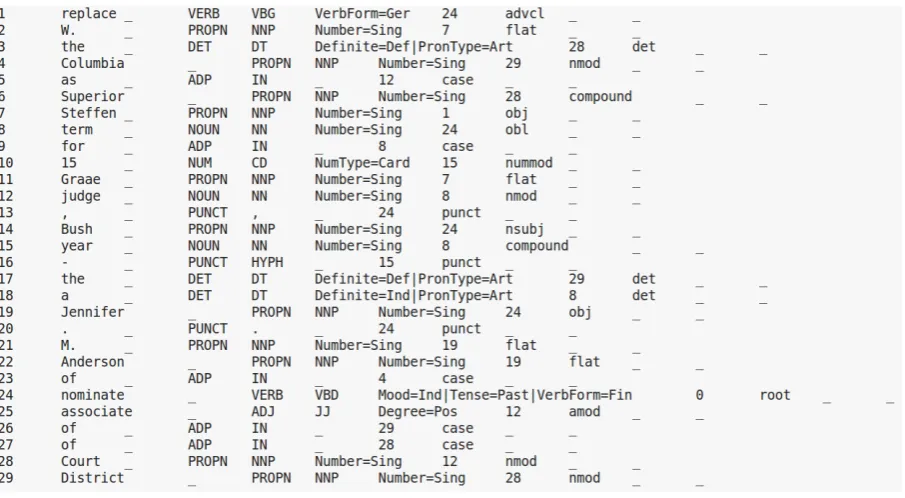
An example of the input data to this track is shown in Figure1. In this example, we may see in-formation about lemmas, grammatical categories, inflection information and dependency relations.
Track 1 can be seen as word ordering and in-flection generation tasks. Word ordering is a fun-damental problem in Natural Language Genera-tion (Reiter and Dale,2000). This problem have been widely studied, e.g., we may see the works proposed for the Shared Task in Surface Realiza-tion (Belz et al., 2011). In relation to this prob-lem, this has been addressed using language mod-eling (Schmaltz et al., 2016) and syntax-based approaches (Zhang and Clark, 2015). Recently, sequence-to-sequence models have also been used to tackle this problem, obtaining good results (Hasler et al.,2017).
Figure 1: Unordered sentence in CoNLL format - “Bush nominated Jennifer M. Anderson for a 15-year term as associate judge of the Superior Court of the District of Columbia, replacing Steffen W. Graae.”
some conclusions and future work are discussed in Section4.
2 System Description
Our proposal was motivated by the works of (Hasler et al., 2017) and (Zhang and Clark,
2015). Thus, we tackled the problem by apply-ing a syntax-based word orderapply-ing strategy usapply-ing a sequence-to-sequence model (seq-2-seq). This way, we could take advantage of the importance of the syntactic information in the word ordering process (in this case, dependency relations) and the length of the sequence of words to be ordered. Thus, we could try to order sub-trees and then ap-ply a bottom-up approach to compose the original sentence. We have to note that our approach have a limitation related to non-projective tree structures, because the allowed realizations will be generated from the dependency structure.
Additionally, we could benefit from the abil-ity of the seq-2-seq model to deal with short se-quences (delimited by the length of words in a syn-tactic level, i.e., a sub-tree generated by the depen-dency relations), and the few number of hyperpa-rameters to tune, facilitating the training.
2.1 Data Preparation
As we mentioned, we used a neural model to order the words in the syntactic level, and this kind of model requires several instances to learn. There-fore, the first step was to generate and prepare our dataset.
The dataset used to train our models was composed by the training dataset provided by the task and a portion of the Europarl corpus (Koehn,2005), comprising approximately 70,000 sentences for each language (English, Portuguese, and Spanish).
As our neural model works on words of a sen-tence according to their syntactic levels, we had to preprocess the dataset to get the words of each sen-tence by syntactic level. Thus, we run the UDPipe tool (Straka and Strakov´a, 2017) on the dataset and obtained all the information about lemmas, grammatical categories, and dependency relations. Then, we got all the sub-trees (sub-root and chil-dren, only via breadth search) and generated a se-quence for each sub-tree.
depen-dency relation. We used the POS-Tags and the dependency relations to bring more linguistic in-formation into our models.
An example of a sub-tree may be seen in Figure2. The returned sequence of this sub-tree was as follows: “term|NOUN|root for|ADP|case judge|NOUN|nmod year|NOUN|compound a|DET|det”.
Figure 2: Sub-tree of the sentence that includes “term”, “for”, “judge”, “year”, and “a”
One problem related to the training dataset generation was the possibility of the sub-tree’s elements to appear in different ordering in the CoNLL format. This would produce dif-ferent instances, as we build the samples by breadth search in a sub-tree. Thus, we could get the sample “term|NOUN|root for|ADP|case judge|NOUN|nmod year|NOUN|compound a|DET|det” or “term|NOUN|root judge|NOUN|nmod year|NOUN|compound for|ADP|case a|DET|det”, depending on the order in which they are presented in the CoNLL format, and producing different outputs in our model. This should not be a problem because models have to generalize independently of the order. However, we adopted a strategy to deal with this problem. The strategy was to generate a few permutations for each initial instance of the dataset and join them to build the dataset. We might generate all possible permutations for each initial instance of the dataset, but this would not be good in our case. Instead, we assumed that few permutations would be enough to generalize. Thus, we experimented generating 5, 10 and 15 instances for each instance in the dataset and tested in the neural model. Experiments showed that 5 permutations were enough to achieve a good performance and incrementing to 10 or 15 did not bring improvements.
Finally, it is important to highlight that the lem-mas of proper nouns were replaced by the expres-sion “PROPN” in order to reduce data sparsity.
2.2 Word Ordering
The neural model that we used was a sequence-to-sequence model (Encoder-Decoder) (Sutskever et al.,2014) in which the input was composed by a sequence of tokens in a sub-tree extracted by the syntactic dependency relations (described in Sub-section2.1) and the output was composed by the lemmas of the same sequence in the correct order. In general, each token in the encoder was repre-sented by embeddings composed by the concate-nation of the word embedding, the embedding of the grammatical category and the embedding of the dependency relation. We used word embed-dings of 300 dimensions provided by GloVe ( Pen-nington et al., 2014) for English3, Portuguese4 (Hartmann et al., 2017), and Spanish (built over the corpus provided byCardellino(2016)). In the case of the other features, we used the number of values that they may assume to generate the size of the embedding.
The type of cells in the Recurrent Neural Net-work (RNN) that we used was the Long Short-Term Memory (LSTM). We used a Bidirectional LSTM (Bi-LSTM) in the Encoder because it could give us a general understanding of the sentence (saving relations in two directions). In the case of the Decoder, we used two layers and the attention mechanism proposed byBahdanau et al.(2014) in order to consider all words in the contexts (due to the unordered words). This proposal was similar to the recurrent neural network language model proposed in (Hasler et al.,2017).
Finally, we used a Adam Optimizer with a ini-tial learning rate of 0.001, a dropout value of 0.3, 500 hidden units, 15 epochs, and, for the genera-tion of the sequence, we applied beam search of size 10. Let us mention that we used OpenNMT (Klein et al., 2017) to train our model. These parameters were effective during the training, ex-cepting the number of epochs because we did not try other settings.
2.3 Sentence Building
After the execution of the neural model, we got the words of all sub-trees (obtained by the syntac-tic levels) in the correct order. In order to build the sentence, we applied a bottom-up approach. Thus, we continuously started to join fragments
(belong-3
Available at https://nlp.stanford.edu/projects/glove/
4Available at http://www.nilc.icmc.usp.br/nilc/index.php/
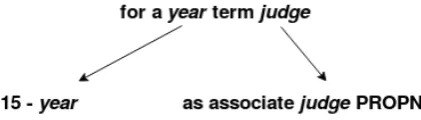
ing to sub-trees) with the sub-trees in an immedi-ately higher level until the top of the tree. The joining was performed using the token in common in both sub-trees. For example, in Figure3, it may be seen the fragment “15 - year” in a sub-tree and the fragment “for a year term judge” in an imme-diate higher level, where the joining produced the fragment “for a 15 - year term judge”.
Figure 3: Portion of the ordered sub-trees
As we may see in Figure3, one of the fragments contains the expression “PROPN”. In cases where there was a “PROPN” symbol, our method simply replaced it by the correct proper noun in the orig-inal fragment. In other cases, our method had to find the correct place for each proper noun in the fragment. Additionally, there were several cases where the neural model could not obtain all the words in the fragment, mainly in situations where the number of tokens in the input was too long.
To solve these problems, we used a 3-gram language model for English (Chelba et al.,
2013), Portuguese (Cunha, 2016) and Spanish (Cardellino,2016) in order to find the correct posi-tion of the words and the proper nouns. That moti-vated us to follow a bottom-up approach to build a sentence. Thus, the joining between two neighbor syntactic levels makes more sense (as analyzing from the lowest levels brings correct expressions like “15 - year” or “as associate judge”, instead of “for a year term judge”).
2.4 Inflection Generation
In order to recover the correct words included in a sentence (and not lemmas), we created a lexicon for each language (English, Portuguese and Span-ish).
To do this, we ran the UDPipe tool5 on the Europarl corpus for English, Portuguese and Spanish (Koehn, 2005) in order to get the lemmas and the inflection information. For example, in the sentence “I ran all day”, we
5UDPipe is a trainable pipeline for tokenization, part of
speech tagging, lemmatization and dependency parsing of CoNLL files. It contains models for several languages. It is available at http://ufal.mff.cuni.cz/udpipe.
got the following information about “ran”: “run Mood=Ind|Tense=Past|VerbForm=Fin”, which means that “ran” is in indicative mood, in the past tense and in its finite form, and the lemma is “run”.
It is important to highlight that we only ex-tracted the inflection information of words that belong to some specific grammatical categories, as auxiliary verbs, verbs, determiners, adjectives, pronouns, and nouns, since these categories usu-ally contain inflection information.
The lexicons generated for English, Portuguese and Spanish contain 44,667, 143,058, and 155,482 entries, respectively. With these lexicons, we ex-ecuted the last step of our process, the inflection generation. Once the target sentence was ordered, we analyzed each token of the sentence and found its respective inflection word using the appropriate lexicon. It should be noted that there was no pref-erence in inflection selection because we used our lexicon as a hash table, i.e., we were worried about the occurrence of the lemma and the morphologi-cal information to get the inflection.
Finally, we applied some rules to handle con-tractions and other types of problems (as the use of commas).
3 Results and Analysis
The performance of the methods in the Task 1 was computed using the following four metrics:
• BLEU (Papineni et al.,2002): precision met-ric that computes the geometmet-ric mean of the n-gram precisions between the generated text and reference texts, adding a brevity penalty for shorter sentences. We use the smoothed version and report results for n = 1, 2, 3, and 4;
• NIST (Doddington, 2002): related n-gram similarity metric weighted in favor of less fre-quent n-grams, which are taken to be more informative;
• CIDEr (Vedantam et al.,2015): designed for image description, and similar in spirit to NIST (in that it assigns lower weights to n-grams that are common to the reference texts) (determined by using TF-IDF metric);
number of character insertions, deletions and substitutions (all at cost 1) required to turn the system output into the (single) reference text.
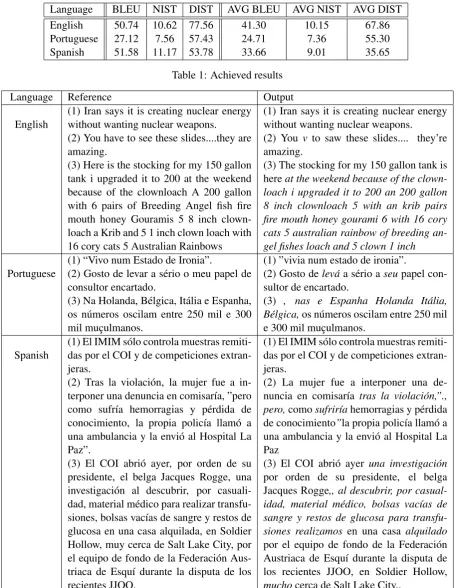
For now, only the results for BLEU, NIST and DIST have been released. The results of our method for the test data are shown in Table 1, as well as the average results for all the systems that participated in the track. One may see that our method outperformed the average for each lan-guage.
Some examples of the results obtained for En-glish, Portuguese and Spanish are shown in Table
2. As we may see, in sentence 1 for English, Por-tuguese and Spanish, the generated sentences were exactly the same as the reference. This may be ex-plained by the short size of the sentences (except-ing for Spanish, whose sentence is not so short).
In sentence 3 for English and 2 and 3 for Span-ish, we may see that, even though the results were not correct (in relation to the ordering), some frag-ments could make sense (“The stocking for my 150 gallon tank is here...” in sentence 3 for En-glish) and, sometimes, texts are still understand-able (like sentences 2 and 3 for Spanish), preserv-ing the overall meanpreserv-ing of the sentence.
We could also realize some limitations in our proposal. Firstly, we had some troubles with the software for lexicon building and it was necessary to review and correct some entries. For example, the sentence 2 in English contains the word “v” and the correct word was “have”, and the sentence 2 in Portuguese shows the word “lev´a” and the cor-rect word should be “levar”.
Another limitation is related to the number of children in each level of the syntactic tree. In cases where the root of a sub-tree had several chil-dren, the seq-to-seq model returned incomplete se-quences and the post-processing had more work to do, and, therefore, it usually performed poorly. For example, in sentence 3 for Portuguese, the syntactic tree has “Holland” as root in a level and “Spain”, “It´alia”, “Belgium”, “,”, “or”, and “em” are its children, and the result was not in correct order. Besides, a higher number of punctuations, missing words and proper nouns produced some mistakes in some cases, like sentence 2 for Span-ish.
4 Conclusions and Future Work
In this paper, we presented a neural-based sur-face generation method that works at the syntac-tic level to order the words. Overall, our method outperformed the average results for English, Por-tuguese and Spanish. For Portuguese, the lan-guage in which we are particularly interested, we produced the best results for the NIST metric (al-though there is no statistical difference in relation to the system in the second place), and the second best results for BLEU and DIST, which we con-sider to be very good results.
Among the positive aspects, we noted that our method works fine when the length of the sentence is not too long. Furthermore, even though the re-sults were not correct in some cases (in relation to the ordering), some fragments could make sense and, sometimes, texts were still understandable.
As future work, we may mention the review of the lexicons and possibly the implementation of a better inflection generator. Moreover, we would like to explore algorithms to deal with punctua-tions in order to improve the performance of our method.
Acknowledgments
The authors are grateful to FAPESP, CAPES and CNPq for supporting this work.
References
Dzmitry Bahdanau, Kyunghyun Cho, and Yoshua
Bengio. 2014. Neural machine translation by
jointly learning to align and translate. CoRR, abs/1409.0473.
Anja Belz, Michael White, Dominic Espinosa, Eric Kow, Deirdre Hogan, and Amanda Stent. 2011. The first surface realisation shared task: Overview and
evaluation results. In Proceedings of the 13th
Eu-ropean Workshop on Natural Language Generation, ENLG ’11, pages 217–226, Stroudsburg, PA, USA. Association for Computational Linguistics.
Cristian Cardellino. 2016.Spanish Billion Words Cor-pus and Embeddings.
Ciprian Chelba, Tomas Mikolov, Mike Schuster, Qi Ge, Thorsten Brants, and Phillipp Koehn. 2013. One bil-lion word benchmark for measuring progress in sta-tistical language modeling.CoRR, abs/1312.3005.
Andre Luiz Verucci da Cunha. 2016.
Language BLEU NIST DIST AVG BLEU AVG NIST AVG DIST English 50.74 10.62 77.56 41.30 10.15 67.86 Portuguese 27.12 7.56 57.43 24.71 7.36 55.30 Spanish 51.58 11.17 53.78 33.66 9.01 35.65
Table 1: Achieved results
Language Reference Output
English
(1) Iran says it is creating nuclear energy without wanting nuclear weapons.
(1) Iran says it is creating nuclear energy without wanting nuclear weapons.
(2) You have to see these slides....they are amazing.
(2) You v to saw these slides.... they’re amazing.
(3) Here is the stocking for my 150 gallon tank i upgraded it to 200 at the weekend because of the clownloach A 200 gallon with 6 pairs of Breeding Angel fish fire mouth honey Gouramis 5 8 inch clown-loach a Krib and 5 1 inch clown clown-loach with 16 cory cats 5 Australian Rainbows
(3) The stocking for my 150 gallon tank is hereat the weekend because of the clown-loach i upgraded it to 200 an 200 gallon 8 inch clownloach 5 with an krib pairs fire mouth honey gourami 6 with 16 cory cats 5 australian rainbow of breeding an-gel fishes loach and 5 clown 1 inch
Portuguese
(1) “Vivo num Estado de Ironia”. (1) ”vivia num estado de ironia”. (2) Gosto de levar a s´erio o meu papel de
consultor encartado.
(2) Gosto delev´aa s´erio aseupapel con-sultor de encartado.
(3) Na Holanda, B´elgica, It´alia e Espanha, os n´umeros oscilam entre 250 mil e 300 mil muc¸ulmanos.
(3) , nas e Espanha Holanda It´alia, B´elgica,os n´umeros oscilam entre 250 mil e 300 mil muc¸ulmanos.
Spanish
(1) El IMIM s´olo controla muestras remiti-das por el COI y de competiciones extran-jeras.
(1) El IMIM s´olo controla muestras remiti-das por el COI y de competiciones extran-jeras.
(2) Tras la violaci´on, la mujer fue a in-terponer una denuncia en comisar´ıa, ”pero como sufr´ıa hemorragias y p´erdida de conocimiento, la propia polic´ıa llam´o a una ambulancia y la envi´o al Hospital La Paz”.
(2) La mujer fue a interponer una de-nuncia en comisar´ıa tras la violaci´on,”., pero,comosufrir´ıahemorragias y p´erdida de conocimiento”la propia polic´ıa llam´o a una ambulancia y la envi´o al Hospital La Paz
(3) El COI abri´o ayer, por orden de su presidente, el belga Jacques Rogge, una investigaci´on al descubrir, por casuali-dad, material m´edico para realizar transfu-siones, bolsas vac´ıas de sangre y restos de glucosa en una casa alquilada, en Soldier Hollow, muy cerca de Salt Lake City, por el equipo de fondo de la Federaci´on Aus-triaca de Esqu´ı durante la disputa de los recientes JJOO.
(3) El COI abri´o ayer una investigaci´on por orden de su presidente, el belga Jacques Rogge,, al descubrir, por casual-idad, material m´edico, bolsas vac´ıas de sangre y restos de glucosa para transfu-siones realizamos en una casa alquilado por el equipo de fondo de la Federaci´on Austriaca de Esqu´ı durante la disputa de los recientes JJOO, en Soldier Hollow, muchocerca de Salt Lake City,.
Table 2: Examples of generation for English, Portuguese and Spanish
Ciˆencias Matem´aticas e de Computac¸˜ao - Universi-dade de S˜ao Paulo, Brasil.
George Doddington. 2002. Automatic evaluation
of machine translation quality using n-gram
co-occurrence statistics. In Proceedings of the
Sec-ond International Conference on Human Language Technology Research, HLT ’02, pages 138–145, San Francisco, CA, USA. Morgan Kaufmann Publishers Inc.
Marcos Treviso, J´essica Silva, and Sandra Alu´ısio.
2017. Portuguese word embeddings: Evaluating
on word analogies and natural language tasks. In
Proceedings of the 11th Brazilian Symposium in In-formation and Human Language Technology, pages 122–131. Sociedade Brasileira de Computac¸˜ao.
Eva Hasler, Felix Stahlberg, Marcus Tomalin, Adri`a de Gispert, and Bill Byrne. 2017. A comparison of
neural models for word ordering. InProceedings of
the 10th International Conference on Natural Lan-guage Generation, INLG 2017, Santiago de Com-postela, Spain, September 4-7, 2017, pages 208– 212.
Guillaume Klein, Yoon Kim, Yuntian Deng, Jean
Senellart, and Alexander Rush. 2017. Opennmt:
Open-source toolkit for neural machine translation. In Proceedings of ACL 2017, System Demonstra-tions, pages 67–72. Association for Computational Linguistics.
Philipp Koehn. 2005. Europarl: A Parallel Corpus for Statistical Machine Translation. InConference Pro-ceedings: the tenth Machine Translation Summit, pages 79–86, Phuket, Thailand. AAMT, AAMT.
Simon Mille, Anja Belz, Bernd Bohnet, Yvette
Gra-ham, Emily Pitler, and Leo Wanner. 2018. The
First Multilingual Surface Realisation Shared Task
(SR’18): Overview and Evaluation Results. In
Pro-ceedings of the 1st Workshop on Multilingual Sur-face Realisation (MSR), 56th Annual Meeting of the Association for Computational Linguistics (ACL), pages 1–10, Melbourne, Australia.
Kishore Papineni, Salim Roukos, Todd Ward, and Wei-Jing Zhu. 2002. Bleu: A method for automatic eval-uation of machine translation. InProceedings of the 40th Annual Meeting on Association for Computa-tional Linguistics, pages 311–318, Stroudsburg, PA, USA. Association for Computational Linguistics.
Jeffrey Pennington, Richard Socher, and Christopher Manning. 2014. Glove: Global Vectors for Word
Representation. In Proceedings of the 2014
Con-ference on Empirical Methods in Natural Language Processing (EMNLP), pages 1532–1543, Doha, Qatar. Association for Computational Linguistics.
Ehud Reiter and Robert Dale. 2000. Building Natural
Language Generation Systems. Cambridge Univer-sity Press, New York, NY, USA.
Allen Schmaltz, Alexander M. Rush, and Stuart M. Shieber. 2016. Word ordering without syntax. In
Proceedings of the 2016 Conference on Empirical Methods in Natural Language Processing, pages 2319–2324. The Association for Computational Lin-guistics.
Milan Straka and Jana Strakov´a. 2017. Tokenizing,
pos tagging, lemmatizing and parsing ud 2.0 with
udpipe. InProceedings of the CoNLL 2017 Shared
Task: Multilingual Parsing from Raw Text to Univer-sal Dependencies, pages 88–99, Vancouver, Canada. Association for Computational Linguistics.
Ilya Sutskever, Oriol Vinyals, and Quoc V. Le. 2014. Sequence to sequence learning with neural
net-works. In Proceedings of the 27th International
Conference on Neural Information Processing Sys-tems - Volume 2, NIPS’14, pages 3104–3112, Cam-bridge, MA, USA. MIT Press.
Ramakrishna Vedantam, C. Lawrence Zitnick, and
Devi Parikh. 2015. Cider: Consensus-based
im-age description evaluation. InIEEE Conference on
Computer Vision and Pattern Recognition, CVPR 2015, Boston, MA, USA, June 7-12, 2015, pages 4566–4575.
Yue Zhang and Stephen Clark. 2015.
Discrimina-tive syntax-based word ordering for text generation.