5234
A Unified Multi-task Adversarial Learning Framework for
Pharmacovigilance Mining
Shweta Yadav, Asif Ekbal, Sriparna Saha, Pushpak Bhattacharyya Indian Institute of Technology Patna
Patna, India
{shweta.pcs14,asif,sriparna,pb}@iitp.ac.in
Abstract
The mining of adverse drug reaction (ADR) has a crucial role in the pharmacovigilance. The traditional ways of identifying ADR are reliable but time-consuming, non-scalable and offer a very limited amount of ADR relevant information. With the unprecedented growth of information sources in the forms of so-cial media texts (Twitter, Blogs, Reviews etc.), biomedical literature, and Electronic Medical Records (EMR), it has become crucial to ex-tract the most pertinent ADR related informa-tion from these free-form texts. In this paper, we propose a neural network inspired multi-task learning framework that can simultane-ously extract ADRs from various sources. We adopt a novel adversarial learning-based ap-proach to learn features across multiple ADR information sources. Unlike the other exist-ing techniques, our approach is capable to ex-tracting fine-grained information (such as ‘In-dications’, ‘Symptoms’, ‘Finding’, ‘Disease’,
‘Drug’) which provide important cues in phar-macovigilance. We evaluate our proposed approach on three publicly available real-world benchmark pharmacovigilance datasets, a Twitter dataset from PSB 2016 Social Me-dia Shared Task, CADEC corpus and Medline ADR corpus. Experiments show that our uni-fied framework achieves state-of-the-art per-formance on individual tasks associated with the different benchmark datasets. This estab-lishes the fact that our proposed approach is generic, which enables it to achieve high per-formance on the diverse datasets. The source code is available here1.
1 Introduction
Early detection and monitoring of adverse drug reactions (ADRs) can minimize the deleteri-ous impact on patients and health-care systems (Hakkarainen et al., 2012; Sultana et al., 2013).
1https://bit.ly/2EMln36
For prevention, the drug safety organizations known as pharmacovigilance agencies conduct post-market surveillance to identify the drug’s side effects post-release. However, the majority of the existing ADE surveillance systems utilizes passive spontaneous reporting system databases, such as the Federal Drug Administration’s Ad-verse Event Reporting System (FAERS) (Li et al.,
2014). These systems are often under-reported, bi-ased and delayed. To overcome the limitation of a passive reporting system, active methods to ADR monitoring continuously explores frequently up-dated ADR data sources (Behrman et al.,2011).
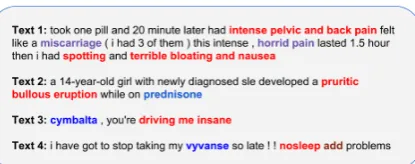
Figure 1: Sample sentences from CADEC (Text1), MEDLINE (Text 2) and Twitter (Text 3,4) dataset. The token in red representsADR, purple denotesFinding, blue representDrug nameand brown colour text repre-sentsIndication.
• Multiple Context:Context carries an essen-tial role in determining the semantic labels of the medical concepts. For example, consider the following tweets:
Tweet 1: “Advil cured my horrific pain, but made my stomach upset”
Tweet 2: “Advil cured my upset stomach but gave me a horrific pain”
The above tweets, although have a similar medical concept, their contexts specify the associated class types. In Tweet 1, ‘pain’ refers to the class type Symptom, while in Tweet 2, it refers to ADR.
• Multiple word form: Social media text of-fers some inherently distinct challenges such as containing short word-forms ( eg,“need to sleep 24/7”), misspelled wordforms (eg, “ flu-oxetine, it just make me so tiered ’), abbre-viated words (eg, CIT forCitopram), slangs (eg, “seroquel knocked me out”), implicit sense (eg, “hard time getting some Z’s”), symbols (such as emoticons), and figurative languages (eg, “quetiapine zombie”). This arbitrariness increases the difficulty level in capturing the semantic relationships between the different types.
To overcome these limitations, several machine learning and deep learning models are introduced for ADR mining. However, these models are very task-specific and often fail to show reasonable ac-curacies when these evaluated for some other do-mains or other annotation schemes.
In this paper, we propose a unified multi-task learning (MTL) framework that works on the con-cept of adversarial learning. Our model is capa-ble of learning several tasks associated with ADR monitoring with different levels of supervisions collectively. The proposed approach differs from
the previous studies in two aspects:
Firstly, most of the existing methods in multi-task learning attempt to divide the features of differ-ent tasks based on task-specific and task-invariant feature space, considering only component-wise parameters. The major drawback of this mecha-nism is that the common feature space often in-corporates the task-specific feature space, leading to feature redundancy. Given this issue in multi-task learning (MTL), in our proposed framework we employ adversarial learning (Goodfellow et al.,
2014), which helps in eliminating redundant fea-tures from the feature space and prevent the con-tamination between shared and task-specific fea-tures. Secondly, we also employ the highway and residual connection whenever necessary to avoid the vanishing gradient problem and improve the performance of our deep neural model (multi-headed attention based stacked recurrent and con-volutional neural network).
Contributions:
Contributions of our current work can be summa-rized as follows:
(1) We propose a unified multi-task learning (MTL) framework for pharmacovigilance min-ing that exploits the capabilities of adversarial learning to learn the shared complementary fea-tures across the multiple ADR datasets. To our best knowledge, this is the very first attempt to study the effect of adversarial learning method in MTL environment, especially for pharmacovigi-lance mining.
(2) Our proposed model is capable of automati-cally identifying the various information (such as
Symptom,Finding,Disease,Drug), in addition to the ADR.
(3) We validate our proposed framework on three popular benchmark datasets, namely Twitter (Sarker et al.,2016), CADEC (Karimi et al.,2015) and MEDLINE (Gurulingappa et al., 2012a) for pharmacovigilance mining, having different anno-tation schemes. We extract the following tags:
ADR, Drugs, and Indications from the Twitter dataset,ADR,Disease,Drug,Finding; and Symp-tomfrom the CADEC dataset; andDrugandADR
mentions from the MEDLINE dataset. Figure-1
shows exemplary sentences from each dataset.
Figure 2: Proposed model architecture for pharmacovigilance mining. (all the neurons representation are hypo-thetical). The right part of the image describes theComponent 1andComponent 2.
2 Related Work
Depending upon the source of data, we categorize the previous works as:
(i) Biomedical Text and Electronic Medical Record:
Several Natural Language Processing (NLP) tech-niques have been proposed to extract ADRs from the Electronic Medical Record (Wang et al.,2009;
Friedman,2009;Aramaki et al.,2010) and medi-cal case reports (Gurulingappa et al.,2011). Gu-rulingappa et al. (2012a) adapted machine learn-ing technique for the identification and extraction of potential adverse drug event relations from the MEDLINE case reports. Unlike other spontaneous data sources such as social media, both EMR and medical case reports offer several advantages of having complete records of patients’ medical his-tory, treatment, conditions and the possible risk factors, and is also not restricted to the patients experiencing ADRs (Harpaz et al., 2012b). Re-cently, a study conducted by (Sarker and Gonza-lez,2015) utilized the data from MEDLINE case reports and Twitter. They proposed several textual features and investigated how the combination of different datasets would increase the performance of identifying ADRs. With the advancement of the neural network technique, (Huynh et al.,2016) investigated multiple neural network (NN) frame-works for ADR classification on both medical case reports and Twitter dataset.
(ii) Social Media: Social media offers a very rich and viable source of information for iden-tifying potential ADRs in a real-time. Leaman
et al. (2010) conducted very first study utilizing user comments from their social media post. In total, the dataset contains 6,890 user comments. The research shows that user comments are highly beneficial in uncovering the ADRs. Further works (Gurulingappa et al., 2012b;Benton et al., 2011;
Harpaz et al.,2012a) utilized the lexicon-based proach to extract the ADRs. However, these ap-proaches are only restricted to a number of target ADRs. Nikfarjam and Gonzalez(2011) exploited rule-based technique over naive lexicon-based ap-proach on the same dataset which was capable of detecting ADR not included in lexicons.
With the emergence of annotated data, sev-eral research works have employed supervised machine learning techniques such as Support Vector Machine (SVM) (Sarker and Gonzalez,
2015), Conditional Random Field (CRF) ( Nikfar-jam et al.,2015) and Random Forest (Zhang et al.,
2016).
In recent years with the introduction of deep learning techniques, most of the studies utilize deep learning model to predict ADRs. Lee et al.
results show that CRF can assist RNN model in capturing the context well. The most rele-vant work to this study is the work conducted by
Chowdhury et al. (2018). They learned jointly for three tasks: binary classification, ADR label-ing, and indication labeling using RNN-attention-coverage model.
3 Methodology
With our adversarial multi-task framework, we jointly learn to label the ADR events from mul-tiple ADR datasets. ADR labeling is a sequence labeling problem. For a given input sequenceX, the model learns to find the optimal tag sequence
y∗. Mathematically,
y∗ = arg max
y
P(Y|X) (1)
Our proposed adversarial multi-task framework is depicted in Figure 2. Our model comprises of five components:
(1) Embedding Layer: It captures the meaning and semantic associations between pharmacovigi-lance word that appears in the text.
(2) Encoder/Feature Extractor Layer, which generates both task-specific and task-shared fea-ture. Each of these feature generator modules con-sists of Convolutional Neural Network (CNN) fol-lowed by stacked Bi-Gated Recurrent Unit (GRU). Task-specific feature generator is responsible for capturing the features specific to the task. In the task-shared feature generator, there is an addi-tional adversarial learning component, where fea-ture extractor (Generator) is working operates ad-versarially towards a learnable multi-layer percep-tron (Discriminator), preventing it from making an accurate prediction about the types of the task the feature generated from.
(3) Concatenation Layer:This is responsible for concatenating the feature representation obtained by both the feature extractor modules.
(4) Multi-head Attention Layer: This learns to encode better the given word by looking at the other words in the text.
(5) CRF Layer: This is used to predict the most probable tag sequence.
3.1 Input Text
The input to our model is a sequence of words
X = (x1, x2, . . . , xn) corresponding to
social-media posts/medical case reports comprising ofn
words.
3.2 Embedding Layer
This layer generates two forms of representations:
Word embedding: maps each wordxito low
di-mensional vectorwi ∈ Rde. We use pre-trained word embedding of dimensionde.
Character embedding:: to capture the morpho-logical features. The character embedding can help in capturing the representations of the out of vocabulary (OOV) words, misspelt words and variations in noun or verb phrase. When it comes to the social media text, this issue even becomes more crucial to resolve. Character embedding is one of the ways to resolve this issue. It allows the model to learn lexical patterns (e.g. suffix or pre-fix) which eventually helps in capturing the out-of-vocabulary (OOV) words and some other infor-mation which is difficult to capture through word embedding.
We employ CNN for character embedding. Let C = {c1, c2, . . . , ck} be the character
se-quence of wordsxihaving lengthl. Each
charac-tercj is represented as a one-hot vector of length C, which is the number of unique characters in the dataset. The resulted one-hot representations of all the characters in the word are stacked to form a matrixM ∈Rk×|C|. Thereafter, we apply several
filters of different width to this matrix. The width of these filters varies from 1 to k, i.e., these fil-ters look at 1 to k-gram character sequences. The max-pooling operation is performed followed by the convolutional operation to pick the most rel-evant feature. We call this character embedding feature asci.
Finally, the output of word embedding for the
ithword is the concatenation of word embedding
wiand the character embeddingci. For eachxi ∈ X, the embedding layer generate the embedding in the following way:
ei=wi⊕ci (2)
3.3 Feature Extractor
et al.,2016;Costa-juss`a and Fonollosa,2016). Let us the consider the input sequence to this layer is E = {e1, e2, . . . , en}. A convolution
operation is performed over the zero-padded se-quence Ep. Similar to the character embedding, a set of k filter of size m are applied to the se-quence. We obtain convoluted featuresctat given
timetfort= 1,2, . . . , n.
ct=relu(F[et−m−1 2
. . . et. . . et+m−1 2
]) (3)
Then, we generate the feature vectors C0 = [c01, c02. . . c0n], by applying max pooling onC.
Inspired by the success of stacked attentive RNN in solving other NLP tasks (Wu et al.,2016;
Graves et al., 2013; Dyer et al., 2015; Prakash et al., 2016), we use the stacked GRU to encode the input text. The stacked GRU is an extension to GRU model that has multiple hidden GRU lay-ers. The purpose of using multiple GRUs layers is to learn more sophisticated conditional distribu-tions from the data (Bahdanau et al., 2015). In this work, we employ vertical stacking strategy where the output of the previous layer of GRU is fed to the highway layer and corresponding out-put is passed as inout-put to the next layer of GRU. Let the number of layers in stacked GRU isLthen the GRU computes the hidden state for each layer
l∈Las follows:
hlk=GRU(hl −1
k , h l
k−1) (4)
where,hlk is the hidden state representation atlth
layer. The input h0
k to the first layer (l = 1) of
GRU are initialized randomly. The first layer of GRU unit at kth word feature takes the input as the embedding layer output ek of the kth word.
We compute the forward (−h→k) and backward (
←− hk)
hidden state for each wordkin the sentence. The final hidden state at layerl ∈ L is computed by
augmenting both the hidden states:zkl = [−h→kl⊕←h−lk]. The final input text representation from stacked Bi-GRU layer is calculated by taking the hidden state of the last layer (L) of the GRU as follows:
h1, h2, . . . , hn= [
−→
hL1⊕ ←−
hL1],[ −→
hL2⊕ ←−
hL2], . . . ,[ −→
hLn⊕
←−
hLn] (5)
We compute the overall input text representation by concatenating the output of CNN layerC0 and stacked Bi-GRU (eq.5) as follows:
z1, z2, . . . , zn= [c
0
1⊕h1],[c
0
2⊕h2], . . . ,[c
0
n⊕hn] (6)
The above approach to generate task specific fea-ture is computed at for each task separately. In or-der to capture the common features along the task,
we utilize the above feature extractor framework which serves as a Generator model and the feed forward neural network as a Discriminator.
3.4 Task Discriminator Layer
Our feature extractor layer is generating two types of features, shared and task-specific. Ideally both feature spaces should be mutually exclusive. To ensure that task-specific features of given task do not exist in the shared space, we exploit the con-cept of adversarial training (Goodfellow et al.,
2014) into shared feature space. We follow the same method as introduced by (Liu et al.,2017) to make the shared feature space uncontaminated by the task-specific features.
For achieving the aforementioned strategy, a
Task DiscriminatorD is used to map the
attention prioritized shared feature to estimate the task of its origin. In our case, Task Discriminatoris a fully connected layer us-ing a softmax layer to produce the probability dis-tribution of the shared features belonging to any task. The shared feature extractor (c.f. 3.3) works asGenerator (G) to generate shared features. The shared feature extractor is made to work in an adversarial way, preventing the discriminator from predicting the task and hence preventing contam-ination in the shared space. The adversarial loss is used to train the model. Let us assume that the shared feature (c.f. equation6) is{zs
1, z2s, . . . , zsn}.
It can be represented as:
D(zs) =sof tmax(znsW d
+bd) (7)
whereWdandbdare the weight matrix and bias, respectively.
3.5 Concatenation Layer
Let us denote the shared and task-specific features for input text arezs = {zs1, zs2, . . . , zns}andzt = {zt1, zt2, . . . , ztn}. Finally, the output of the feature extractor layer is computed as the concatenation of the shared and task-specific feature as follows:
S=z1s⊕z
t
1, z
s
2⊕z
t
2, . . . , z
s n⊕z
t n =s1, s2, . . . , sn−1, sn
(8)
3.6 Multi-head Attention Layer
et al.,2017) can be precisely described as follows:
Attention(Q, K, V) =softmax(QK T
√
d )V (9)
where,Q, K andV are the query, key and value matrix. In our experiment, all these values are equivalent to theS(with the multiplication of the respective learning weights) and d is the dimen-sion of the feature extraction units. Multi-head at-tention first linearly projects the queries, keys and values to the given no. of the head (t) using differ-ent linear projections. Then these projections per-form the scaled dot-product attention in parallel. Finally, these results of attention are concatenated and once again projected to get the new represen-tation. Formally, the multi-head attention at head
ican be computed by:
headi =Attention(SWiQ, SWiK, SWiV)
S0 =W(head1⊕head2⊕, . . . ,⊕headt)
(10)
whereWiQ,WiKandWiV are the weight matrices.
3.7 Conditional Random Field Layer
In sequence labeling problem there is often a dependency between the successive labels. In-stead of predicting the current label independently through softmax layer, we employ the CRF ( Laf-ferty et al., 2001) layer, which takes care of the previous label to predict the current label. Firstly, the attentive feature at given time step t is pro-jected to another space which has a dimension equal to the number of output tags. Mathemati-cally, it can be formulated as follows:
ot=WSS,t+b S
(11)
Thereafter, we calculate the score to predict a given label sequenceyas follows:
score(y|X) = n
X
t=1
(At−1,t+ot,yt) (12)
where A is the transition score matrix. Finally, we select the tag sequence with highest score as follows:
ˆ
y = arg max
y∈Y
score(y|x) (13)
In decoding stage, we use Viterbi algorithm to compute the optimal tag sequence.
4 Experimental Details
4.1 Network Training
We have optimized two different losses to train our multi-task model. The first loss is task-specific loss ofLtask, which is specific for each task. Apart from task-specific loss, we also optimize the ad-versarial loss to train the network not correctly to predict the task.
For task-specific loss, we use negative log-likelihood objective as the loss function for each task. Given the total number of task T and N
training samples(xi, yi)from taskt∈T, the task
lossLtaskcan be computed by the following equa-tion:
Ltask=− T
X
t=1
N
X
i=1
logp( ˆyit|xti) (14)
The likelihood functionp( ˆyit|xti)can be computed
by the following equation:
p( ˆyit|xti) =
escore( ˆyit|xti)
P
y∈Ye
score(yit|xti) (15)
Thescore(.)function is computed by the equation
12. The adversarial loss trains the shared feature extractor to generate the shared features such that the task discriminator layer cannot reliably recog-nize which task the input text comes from. The adversarial lossLadv can be computed as follows:
Ladv= min G
max D
T
X
t=1
N
X
i=1
dtilog
D G(xti))]
(16)
where dti is the gold label indicating the type of the current task andxtiis theithexample of taskt. The min-max optimization problem is addressed by the gradient reversal layer (Ganin and Lempit-sky,2015). The final loss of the model is defined by the following equation:
L=α× Ltask+β× Ladv (17)
whereαandβ are the scalar parameter.
4.2 Hyper-parameters
We use the pre-trained word embedding 2 from
Pyysalo et al. (2013) of dimension 200. It is trained on the combination of PubMed and PMC biomedical texts with texts extracted from a recent English Wikipedia dump. We set the maximum length of input text as44and maximum character
length of 10. The CNN based character embed-ding length of100is used in this experiment. The optimal hidden state dimension of GRU is set to be100. We use4GRU layers to form the stacked GRU layer. The CNN layer uses the filter set:
{2,3,4}. In multi-head attention layer, we use a total of4heads to compute the attentive represen-tation. We set the dropout rate to0.5. The batch size is set to16and value of loss weightsαandβ
are set to be0.8and0.2, respectively. The Adam Optimization (Kingma and Ba,2015) method with a learning rate of 0.01 is used during training to optimize the network weights. The optimal val-ues of hyper-parameters are achieved through the 10-fold cross validation experiment.
4.3 Datasets
We use three different ADR labeling datasets : PSB 2016 Social Media Shared Task for ADR Extraction dataset (Twitter), CADEC, and MED-LINE to evaluate our multi-task model perfor-mance. It is to be noted that our model is trained simultaneously on the different ADR datasets. The different datasets used in the experiment are as follows:
1. Twitter dataset: The first dataset, which we use is the Twitter dataset from PSB 2016 So-cial Media Shared Task for ADR Extraction task. It contains 572 tweets which are fully annotated for mentions of ADR, tweet ID, start and end offset, UMLS ID, annotated text span and the related drugs. We extracted the following three tags from this dataset: ADR,
Drugs, andIndications.
2. CADEC adverse drugs events dataset: The another dataset, which we use is the CADEC adverse drugs event dataset. It contains a total of 1248 sentences containing different tags. Our model extract the following tags from CADEC Corpus: ADR,Disease,Drug,
FindingandSymptom.
3. MEDLINE ADR dataset: This ADR corpus was released byGurulingappa et al.(2012b). It was derived from the MEDLINE case re-ports3. This case report provides information about the symptoms, signs, diagnosis, treat-ment and follow-up of individual patients. This corpus contains 2972 documents with
3https://www.nlm.nih.gov/bsd/indexing/
training/PUB_050
20967 sentences. Out of which, 4272 sen-tences are annotated with names and rela-tionships between drugs, adverse effects and dosages. Our model extract the Drug and
ADRmentions in the sentences.
5 Result and Analysis
We evaluate the pharmacovigilance labeling tasks in terms of Precision, Recall and F1-Score. Un-like the existing system, we evaluate the perfor-mance of our model, using the exact matching scheme, where a prediction sequence is counted as correct only if all the sequence labels are pre-dicted correctly. We will begin by first describing the baselines models, followed by the results ob-tained from the proposed model and then present the analysis of the results.
5.1 Baselines
We compare our adversarial multi-task model with the following state-of-the-art baselines. It is to be noted that these baselines are re-implementation of the state-of-the-art methods for ADR extrac-tion.
(1) ST-BLSTM: This is a single task model for ADR labeling with Bi-LSTM as sentence encoder. In our experiment, we build the individual model for each dataset.
(2) ST-CNN: This model is similar to baseline ST-BLSTM, but instead of using Bi-LSTM for sen-tence encoder, we use CNN with filters:{2,3,4}.
(3) CRNN: In this model CNN and LSTM are to-gether used for sentence encoder (Huynh et al.,
2016). We adopt the same architecture for ADR extraction by classifying each token of the sen-tence into a pre-defined set of tags.
(4) RCNN: This model is similar to the third base-line, but here we extract the LSTM feature first and then pass these features as the input to the CNN network.
(5) MT-BLSTM: It is a multi-task model ( Chowd-hury et al., 2018) with a shared Bi-LSTM layer across the task for sentence encoder and task-specific Bi-LSTM for each task. The final repre-sentation is obtained by concatenating shared and task-specific Bi-LSTM.
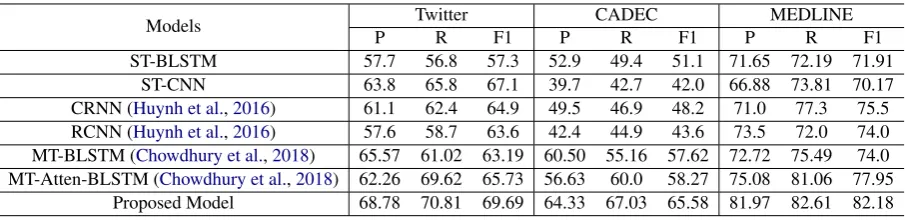
Models Twitter CADEC MEDLINE
P R F1 P R F1 P R F1
ST-BLSTM 57.7 56.8 57.3 52.9 49.4 51.1 71.65 72.19 71.91
ST-CNN 63.8 65.8 67.1 39.7 42.7 42.0 66.88 73.81 70.17
CRNN (Huynh et al.,2016) 61.1 62.4 64.9 49.5 46.9 48.2 71.0 77.3 75.5
RCNN (Huynh et al.,2016) 57.6 58.7 63.6 42.4 44.9 43.6 73.5 72.0 74.0
MT-BLSTM (Chowdhury et al.,2018) 65.57 61.02 63.19 60.50 55.16 57.62 72.72 75.49 74.0 MT-Atten-BLSTM (Chowdhury et al.,2018) 62.26 69.62 65.73 56.63 60.0 58.27 75.08 81.06 77.95
Proposed Model 68.78 70.81 69.69 64.33 67.03 65.58 81.97 82.61 82.18
Table 1: Result comparison of the proposed method with the state-of-art baseline methods. Here, ‘P’, ‘R’, ‘F1’ represents Precision, Recall and F1-Score. The results on CADEC and MEDLINE are on 10-fold cross validation; for the twitter dataset, we use the train and test sets as provided by the PSB 2016 shared task.
Model
Components Twitter CADEC MEDLINE Proposed Model 69.69 65.58 82.18
– Character Embedding 67.63 (2.06↓) 56.10 (9.48↓) 76.34 (5.84↓)
– Multi-head Attention 68.65 (1.04↓) 60.51 (5.07↓) 77.71 (4.47↓)
[image:8.595.73.526.61.171.2]– Adversarial Learning 68.11 (1.58↓) 58.57 (7.01↓) 71.21 (10.97↓)
Table 2: Ablation study on all the dataset. The val-ues in the bracket shows the absolute decrements (↓) in the proposed model by removing the respective com-ponent. It shows the contribution (in terms of model performance in F1 Score) of that component in our pro-posed model.
5.2 Results
The extensive results of our proposed model with comparisons to the state-of-the-art baselines tech-niques are reported in Table 1. Our proposed model outperforms the state-of-the-art baselines techniques by fair margins in terms of precision, recall and F1-Score for all the datasets. In our first experiment, we train two models (i.e. Single-Task BLSTM and Multi-Single-Task BLSTM) to analyze the effect of the multi-task model (MT-BLSTM) over a single task model (ST-BLSTM). On all the three datasets, we can visualize from Table1that, the multi-task framework with its sharing scheme can help in boost the performance of the sys-tem. We observe the performance improvement of5.89, 6.52 and2.09 F1-Score points on Twit-ter, CADEC, and MEDLINE dataset, respectively. The similar improvement is also observed in terms of precision and recall.
In comparison to the baseline 5 model, our proposed method achieve the improvement of
6.5, 7.96, and 8.18 F1-Score points on Twit-ter, CADEC, and MEDLINE dataset, respectively. This shows the robustness of our proposed multi-task method. We also compare our proposed sys-tem with MT-Atten-BLSTM model. The results show the performance improvement of3.96,7.31,
and4.23F1 Score points for Twitter, CADEC and MEDLINE dataset, respectively. The improve-ments over all the baselines methods are statisti-cally significant asp <0.05.
5.3 Ablation Study
To analyze the impact of various component of our model, we perform the ablation study (c.f.
Table-2) by removing one component from the proposed model and evaluate the performance on all the three datasets. Character embedding is found to be the most crucial component on Twitter, and CADEC datasets as both of these datasets are from the social media text and carry the nature of the short text and out of vocabulary words.
To prove our hypothesis (introduction of adver-sarial learning in the multi-task framework can make shared space independent of the task in-variant features), we exclude the adversarial loss from our proposed framework. We could see a significant decline in performance. This depicts that making the task shared space free from the contamination of task-specific feature, can signifi-cantly improve the performance of the system. Re-moval of the multi-head attention also lead to drop of an average 4% F1-Score points across all the datasets.
6 Analysis
Sentence 1 fluoxetine and quet combo zombified me ahh the med merrygoround bipolar
Actual Labels B-Drug O B-Drug O B-ADR O O O O O B-Indication
MT-LSTM B-Drug O B-Drug O O O O O O O O
MT-LSTM-Atten B-Drug O B-Drug O B-ADR O O O O O O
Proposed Approach B-Drug O B-Drug O B-ADR O O O O O B-Indication
Sentence 2 clozapine-induced tonic-clonic seizure managed with valproate implication for clinical care
Actual Labels B-Drug B-ADR I-ADR O O O O O O O
MT-LSTM B-Drug O O O O O O O O O
MT-LSTM-Atten B-Drug O B-ADR O O B-ADR O O O O
[image:9.595.75.526.63.149.2]Proposed Approach B-Drug B-ADR I-ADR O O O O O O O
Table 3: Comparison of the predictions of the proposed approach with the baseline models.
Type-1
Sentence 1 too much zoloft and seroquel to get the horn my life is lie Actual O O B-Drug O B-Drug O O O B-ADR I-ADR I-ADR O O
Predicted O O B-Drug O B-Drug O O O O O O O O
Type-2
Sentence 2 pain in upper right arm could not sleep on it or move it behind my back Actual B-ADR I-ADR I-ADR I-ADR I-ADR O O O O O O O O O O O Predicted B-ADR I-ADR I-ADR I-ADR I-ADR I-ADR I-ADR I-ADR I-ADR I-ADR I-ADR I-ADR I-ADR I-ADR I-ADR I-ADR
Type-3
Sentence 3 terrible joint pain could not move shoulder hip hurt Actual O B-ADR B-ADR B-ADR I-ADR I-ADR I-ADR B-ADR I-ADR Predicted B-ADR I-ADR I-ADR B-ADR I-ADR I-ADR I-ADR I-ADR I-ADR
Table 4: Exemplar description of various types of error. Here, Type-1 represent the error due ‘Presence of implicit mention’. Type-2 represent the error due to ‘Issue in annotation’ and Type-3 represents the error of type ‘Boundary detection problem’.
In the sentence 2, we observe that, only MT-LSTM-Atten model is able to predict the partial ADR (i.e. seizure instead of tonic-clonic seizure.), while our model is able to predict the full ADR phrase correctly.
6.1 Error Analysis
In this subsection, we analyze the different sources of errors which lead to mis-classification. We closely study the false positive and false negative instances and come up with the following obser-vations:
(1) Presence of implicit mention: We observe that in the Twitter dataset user often tends to use very implicit and creative language to de-scribe their adverse drug reaction. For e.g., in the sentence-1 of Table-4, user describes his ADR as ‘horn my life’ by taking drug (zoloft and seroquel).
(2) Issue in annotation:For the CADEC dataset, we observe some of the sentences are not com-pletely tagged. For e.g., in the sentence-2 of
Table-4, here ‘could not sleep’, ‘move it behind my back’ is also an ADR, in addition to ‘pain in upper right arm’. However, the first two ADRs are not labeled in the dataset.
(3) Boundary detection problem: We also ob-serve that, our system sometimes fails to detect the proper boundary. This might be because of the task sharing feature, which learns the feature distributions across the dataset which may not be correct for the given dataset as shown in sentence-3 of Table-4.
7 Conclusion
In this paper, we have proposed an end-to-end multi-task framework that provides a unified so-lution for pharmacovigilance mining. We have utilized an adversarial training based multi-task framework, which ensures that task-specific and task shared features are not contaminated. We evaluated this framework on three benchmark pharmacovigilance datasets. Our results demon-strate the capability of our model across all the datasets. In future, we would like to assist the model with multiple linguistic aspects of social media text like figurative languages.
Acknowledgement
Sriparna Saha and Asif Ekbal gratefully ac-knowledge the Young Faculty Research Fellow-ship (YFRF) Award, supported by Visvesvaraya PhD scheme for Electronics and IT, Ministry of Electronics and Information Technology (MeitY), Government of India, being implemented by Dig-ital India Corporation (formerly Media Lab Asia) for carrying out this research. Authors acknowl-edge “Shusrut: ezDI Research Lab on Health In-formatics”, Department of Computer Science and Engineering, IIT Patna, India.
References
drug effects from clinical records. Studies in health technology and informatics, 160 Pt 1:739–43.
Dzmitry Bahdanau, Kyunghyun Cho, and Yoshua Ben-gio. 2015. Neural machine translation by jointly learning to align and translate. In 3rd Inter-national Conference on Learning Representations, ICLR 2015, San Diego, CA, USA, May 7-9, 2015, Conference Track Proceedings.
Rachel E Behrman, Joshua S Benner, Jeffrey S Brown, Mark McClellan, Janet Woodcock, and Richard Platt. 2011. Developing the sentinel systema na-tional resource for evidence development. New Eng-land Journal of Medicine, 364(6):498–499.
Adrian Benton, Lyle Ungar, Shawndra Hill, Sean Hen-nessy, Jun Mao, Annie Chung, Charles E Leonard, and John H Holmes. 2011. Identifying potential ad-verse effects using the web: A new approach to med-ical hypothesis generation. Journal of biomedical informatics, 44(6):989–996.
Shaika Chowdhury, Chenwei Zhang, and Philip S. Yu. 2018. Multi-task pharmacovigilance mining from social media posts. In Proceedings of the 2018 World Wide Web Conference, WWW ’18, pages 117–126, Republic and Canton of Geneva, Switzer-land. International World Wide Web Conferences Steering Committee.
Marta R. Costa-juss`a and Jos´e A. R. Fonollosa. 2016.
Character-based neural machine translation. In Pro-ceedings of the 54th Annual Meeting of the Associa-tion for ComputaAssocia-tional Linguistics (Volume 2: Short Papers), pages 357–361, Berlin, Germany. Associa-tion for ComputaAssocia-tional Linguistics.
Chris Dyer, Miguel Ballesteros, Wang Ling, Austin Matthews, and Noah A. Smith. 2015. Transition-based dependency parsing with stack long short-term memory. InProceedings of the 53rd Annual Meeting of the Association for Computational Lin-guistics and the 7th International Joint Conference on Natural Language Processing (Volume 1: Long Papers), pages 334–343, Beijing, China. Associa-tion for ComputaAssocia-tional Linguistics.
Clark C Freifeld, John S Brownstein, Christopher M Menone, Wenjie Bao, Ross Filice, Taha Kass-Hout, and Nabarun Dasgupta. 2014. Digital drug safety surveillance: monitoring pharmaceutical products in twitter. Drug safety, 37(5):343–350.
Carol Friedman. 2009. Discovering novel adverse drug events using natural language processing and mining of the electronic health record. In Conference on Artificial Intelligence in Medicine in Europe, pages 1–5. Springer.
Yaroslav Ganin and Victor S. Lempitsky. 2015. Un-supervised domain adaptation by backpropagation. InProceedings of the 32nd International Conference on Machine Learning, ICML 2015, Lille, France, 6-11 July 2015, pages 1180–1189.
Ian Goodfellow, Jean Pouget-Abadie, Mehdi Mirza, Bing Xu, David Warde-Farley, Sherjil Ozair, Aaron Courville, and Yoshua Bengio. 2014. Generative ad-versarial nets. In Advances in neural information processing systems, pages 2672–2680.
Alex Graves, Abdel-rahman Mohamed, and Geoffrey Hinton. 2013. Speech recognition with deep recur-rent neural networks. InAcoustics, speech and sig-nal processing (icassp), 2013 ieee internatiosig-nal con-ference on, pages 6645–6649. IEEE.
Harsha Gurulingappa, Juliane Fluck, Martin Hofmann-Apitius, and Luca Toldo. 2011. Identification of ad-verse drug event assertive sentences in medical case reports. InFirst international workshop on knowl-edge discovery and health care management (KD-HCM), European conference on machine learning and principles and practice of knowledge discovery in databases (ECML PKDD), pages 16–27.
Harsha Gurulingappa, Abdul Mateen-Rajpu, and Luca Toldo. 2012a. Extraction of potential adverse drug events from medical case reports. Journal of biomedical semantics, 3(1):15.
Harsha Gurulingappa, Abdul Mateen Rajput, Angus Roberts, Juliane Fluck, Martin Hofmann-Apitius,
and Luca Toldo. 2012b. Development of a
benchmark corpus to support the automatic extrac-tion of drug-related adverse effects from medical case reports. Journal of biomedical informatics, 45(5):885–892.
Katja M Hakkarainen, Khadidja Hedna, Max Petzold, and Staffan H¨agg. 2012. Percentage of patients with preventable adverse drug reactions and preventabil-ity of adverse drug reactions–a meta-analysis. PloS one, 7(3):e33236.
Rave Harpaz, William DuMouchel, Nigam H Shah, David Madigan, Patrick Ryan, and Carol Friedman. 2012a. Novel data-mining methodologies for ad-verse drug event discovery and analysis. Clinical Pharmacology & Therapeutics, 91(6):1010–1021.
Rave Harpaz, Santiago Vilar, William DuMouchel, Ho-jjat Salmasian, Krystl Haerian, Nigam H Shah, Her-bert S Chase, and Carol Friedman. 2012b. Comb-ing signals from spontaneous reports and electronic health records for detection of adverse drug reac-tions. Journal of the American Medical Informatics Association, 20(3):413–419.
Trung Huynh, Yulan He, Alistair Willis, and Stefan Rueger. 2016. Adverse drug reaction classification with deep neural networks. InProceedings of COL-ING 2016, the 26th International Conference on Computational Linguistics: Technical Papers, pages 877–887, Osaka, Japan. The COLING 2016 Orga-nizing Committee.
Yoon Kim, Yacine Jernite, David Sontag, and Alexan-der M. Rush. 2016. Character-aware neural lan-guage models. InProceedings of the Thirtieth AAAI Conference on Artificial Intelligence, AAAI’16, pages 2741–2749. AAAI Press.
Diederik P. Kingma and Jimmy Ba. 2015. Adam: A method for stochastic optimization. In 3rd Inter-national Conference on Learning Representations, ICLR 2015, San Diego, CA, USA, May 7-9, 2015, Conference Track Proceedings.
John D. Lafferty, Andrew McCallum, and Fernando C. N. Pereira. 2001. Conditional random fields: Probabilistic models for segmenting and labeling se-quence data. InProceedings of the Eighteenth Inter-national Conference on Machine Learning, ICML ’01, pages 282–289, San Francisco, CA, USA. Mor-gan Kaufmann Publishers Inc.
Robert Leaman, Laura Wojtulewicz, Ryan Sullivan, Annie Skariah, Jian Yang, and Graciela Gonzalez. 2010. Towards internet-age pharmacovigilance: ex-tracting adverse drug reactions from user posts to health-related social networks. In Proceedings of the 2010 workshop on biomedical natural language processing, pages 117–125. Association for Compu-tational Linguistics.
Kathy Lee, Ashequl Qadir, Sadid A. Hasan, Vivek Datla, Aaditya Prakash, Joey Liu, and Oladimeji Farri. 2017. Adverse drug event detection in tweets with semi-supervised convolutional neural networks. InProceedings of the 26th International Conference on World Wide Web, WWW ’17, pages 705–714, Republic and Canton of Geneva, Switzer-land. International World Wide Web Conferences Steering Committee.
Hui Li, Xiao-Jing Guo, Xiao-Fei Ye, Hong Jiang, Wen-Min Du, Jin-Fang Xu, Xin-Ji Zhang, and Jia He. 2014. Adverse drug reactions of spontaneous re-ports in shanghai pediatric population. PLoS One, 9(2):e89829.
Pengfei Liu, Xipeng Qiu, and Xuanjing Huang. 2017.
Adversarial multi-task learning for text classifica-tion. In Proceedings of the 55th Annual Meet-ing of the Association for Computational LMeet-inguistics (Volume 1: Long Papers), pages 1–10, Vancouver, Canada. Association for Computational Linguistics.
Azadeh Nikfarjam and Graciela H Gonzalez. 2011. Pattern mining for extraction of mentions of adverse drug reactions from user comments. In AMIA An-nual Symposium Proceedings, volume 2011, page 1019. American Medical Informatics Association.
Azadeh Nikfarjam, Abeed Sarker, Karen Oconnor, Rachel Ginn, and Graciela Gonzalez. 2015. Phar-macovigilance from social media: mining adverse drug reaction mentions using sequence labeling with word embedding cluster features. Journal of the American Medical Informatics Association, 22(3):671–681.
Aaditya Prakash, Sadid A. Hasan, Kathy Lee, Vivek V. Datla, Ashequl Qadir, Joey Liu, and Oladimeji Farri. 2016. Neural paraphrase generation with stacked residual LSTM networks. InCOLING 2016, 26th International Conference on Computational Lin-guistics, Proceedings of the Conference: Techni-cal Papers, December 11-16, 2016, Osaka, Japan, pages 2923–2934.
S Pyysalo, F Ginter, H Moen, T Salakoski, and S Ana-niadou. 2013. Distributional semantics resources for biomedical text processing. InProceedings of LBM 2013, pages 39–44.
Abeed Sarker and Graciela Gonzalez. 2015. Portable automatic text classification for adverse drug reac-tion detecreac-tion via multi-corpus training. Journal of biomedical informatics, 53:196–207.
Abeed Sarker, Azadeh Nikfarjam, and Graciela Gon-zalez. 2016. Social media mining shared task work-shop. In Biocomputing 2016: Proceedings of the Pacific Symposium, pages 581–592. World Scien-tific.
Rupesh K Srivastava, Klaus Greff, and J¨urgen Schmid-huber. 2015. Training very deep networks. In C. Cortes, N. D. Lawrence, D. D. Lee, M. Sugiyama, and R. Garnett, editors, Advances in Neural Infor-mation Processing Systems 28, pages 2377–2385. Curran Associates, Inc.
Gabriel Stanovsky, Daniel Gruhl, and Pablo Mendes. 2017. Recognizing mentions of adverse drug reac-tion in social media using knowledge-infused recur-rent models. InProceedings of the 15th Conference of the European Chapter of the Association for Com-putational Linguistics: Volume 1, Long Papers, vol-ume 1, pages 142–151.
Janet Sultana, Paola Cutroneo, and Gianluca Trifir`o. 2013. Clinical and economic burden of adverse drug reactions. Journal of pharmacology & phar-macotherapeutics, 4(Suppl1):S73.
Elena Tutubalina and Sergey Nikolenko. 2017. Combi-nation of deep recurrent neural networks and condi-tional random fields for extracting adverse drug re-actions from user reviews. Journal of Healthcare Engineering, 2017.
Ashish Vaswani, Noam Shazeer, Niki Parmar, Jakob Uszkoreit, Llion Jones, Aidan N Gomez, Łukasz Kaiser, and Illia Polosukhin. 2017. Attention is all you need. InAdvances in Neural Information Pro-cessing Systems, pages 5998–6008.
Yonghui Wu, Mike Schuster, Zhifeng Chen, Quoc V Le, Mohammad Norouzi, Wolfgang Macherey,
Maxim Krikun, Yuan Cao, Qin Gao, Klaus
Macherey, et al. 2016. Google’s neural ma-chine translation system: Bridging the gap between human and machine translation. arXiv preprint arXiv:1609.08144.