J. Range Manage.
56:
370-374 July 2003
Oxalate and tannins assessment in Atriplex halimus L. and A. nummularia L.
M. MW. ABU-ZANAT, F. M. AL-HASSANAT, M. ALA WI AND G. B. RUYLE
Authors are Associate Professor of Range Management, and former Graduate Student, Dept. of Animal Production; Professor of Organic Chemistry, Dept.
of Chemistry, Jordan University, Amman, Jordan; and Professor of Range Management, School of Renewable Natural Resources, The University of Arizona, Tucson, Ariz.
Abstract
The study was conducted at 3 locations in the arid region of Jordan to assess the seasonal changes of oxalate and tannins in Atriplex halimus L. and A. nummularia L. plants commonly used for revegetation of degraded rangelands. During spring and fall seasons, 20 shrubs of each species were selected randomly at each location, 20 similar twigs per shrub were clipped and analyzed for oxalate and tannins. Atriplex halimus contained higher levels of oxalate (7.00%) compared with A. nummularia plants (6.20%) (P < 0.001). Oxalate levels averaged 8.29 and 4.92% in spring and fall season, respectively. Plants of A. halimus accumulated more oxalate in spring than those of A. nummularia. Clipping had no effect on oxalate concentration. The seedlings of A. num- mularia contained more oxalate than old plants whereas old shrubs of A. halimus contained more oxalate than the young seedlings. The browse of A. halimus contained more condensed and hydrolyzable tannins (1.05% and 0.67%, P < 0.0001) than A.
nummularia (0.80% and 0.39%, P < 0.0001), respectively.
Clipping had no effect on the levels of tannic phenols, condensed and hydrolyzable tannins. Young plants of the 2 species had higher levels of condensed tannins compared to older plants.
However, seedlings of A. nummularia contained significantly higher levels of condensed tannins compared to A. halimus seedlings (1.57% and 1.47%, respectively). Atriplex halimus syn- thesized more oxalate, tannic phenols, condensed and hydrolyz- able tannins than A. nummularia. These secondary metabolites may explain the low palatability of Atriplex halimus compared to A. nummularia.
Resumen
El estudio se condujo en t 3 localidades de la region arida de Jordania para evaluar los cambios estacionales del los oxalatos y taninos en Atriplex halimus L. y A. nummularia L., plantas comunmente utilizadas para revegetar areas de pastizal degradadas. Durante primavera y otono en cada localidad se seleccionaron aleatoriamente 20 arbustos de cada especie y se cortaron 20 ramas similares por arbusto y fueron analizadas para determinar el contenido de oxalatos y taninos. El Atriplex halimus presento mas altos niveles de oxalatos (7.00%) que el A.
nummularia (6.20%) (P < 0.001). Los niveles de oxalatos prome- diaron 8.29 y 4.92% en primavera y otono respectivamente. En primavera, las plantas de A. halimus acumularon mas oxalatos que las de A. nummularia. El corte no tuvo efecto en la concen- tracion de oxalatos. Las plantulas de A. nummularia contenian mas oxalatos que las plantas viejas mientras que los arbustos viejos de A. halimus presentaron a mas oxalatos que las plantu- las. El forraje ramoneable de A. halimus contenia mas taninos condensados a hidrolizables (1.05 % y 0.67%, P < 0.0001) que A.
nummularia (0.80% y 0.39%, P < 0.0001). El corte no tuvo efecto en los niveles de fenoles tanicos y taninos condensados a hidroliz- ables. Las plantas jovenes de las dos especies tuvieron niveles mas altos de taninos condensados que las plantas viejas. Sin embargo, las plantulas de A. nummularia contenian niveles signi- ficativamente mas altos de taninos condensados que las plantulas de A. halimus (1.57% y 1.47%, respectivamente). Atriplex hal- imus sintetizo mas oxalatos, fenoles tanicos, taninos condensados e hidrolizables que A. nummularia. Estos metabolitos secundar- ios pueden explicar la baja gustocidad del Atriplex halimus com- parado con el A. nummularia.
Key Words: Atriplex halimus, Atriplex nummularia, tannins, oxalate, clipping, arid region
Rangelands in Jordan cover 90% of the total surface area of the country. Serious declines in productivity have occurred over extensive areas of these lands. This decline takes the form of depletion of high value fodder species and their replacement by plants that are less productive, less palatable, and less nutritious than the original plants they replaced (Abu-Zanat 1995).
Artificial revegetation may be a tool for rehabilitation of these degraded rangelands. Because of drought and scarcity of precipi-
Research was funded by the Government of Jordan and the European Commission as Project No: SEM/03/628/021 (Jordan Arid Zone Productivity Project: JAZPP). Authors wish to thank Dr. M. Tabbaa for assistance in statistical analyses.
Manuscript accepted 25 Sept. 02.
tation, fodder shrubs are preferred to herbaceous species for rangeland revegetation. In Jordan, the common fodder shrubs that are used for revegetation are Atriplex halimus L. and A. nummu- laria L. Atriplex halimus is native to Jordan and represents 60 to 70% of saltbush plantations in the Middle East region (LeHouerou 1994) whereas, Atriplex nummularia is an intro- duced species from Australia. However, they contain secondary chemical compounds, which may restrict grazing by herbivores.
The type, level and activity of these chemical compounds depend on the age of plants as well as growing conditions (Cheeke 1995).
Atriplex species accumulate oxalates (James 1977, Libert and Franceschi 1987) up to 4-16% DM (Barry and Blaney 1987).
Both soil salinity and moisture can alter the level of oxalate in the plant. Plants growing in saline soil need oxalates for osmo-regu- lation of Na, K and Cl ions (Cymbaluk et al. 1986). Under high
370 JOURNAL OF RANGE MANAGEMENT 56(4) July 2003
soil moisture, Atriplex halimus plants were reported to accumulate higher levels of oxalate in leaves and twigs (Ellern et al.
1974). Plants containing 10% oxalate or more are considered toxic and should not be grazed (James 1977).
Tannins, on the other hand, are a chemi- cally diverse group of water-soluble phe- nols, which bind proteins to form insolu- ble complexes (Hagerman et al. 1992).
The level of tannins in the plant is not con- stant. Factors within the plant and the external environment influence the vari- ability of tannin levels. Within a given species the proportion of tannins may change with plant maturity and/or climatic stress (Singleton 1981). Factors that may increase tannin level in plants are low soil fertility, drought and high temperature.
Tannins inhibit cellulolytic and protolytic enzymes and decrease the production of volatile fatty acids, microbial DNA and RNA in the rumen. Feeding tannins to ruminant animals in large amounts have produced negative effects on the animal, inducing low feed palatability, inhibited digestion, and may cause systematic ani- mal poisoning (Singleton 1981, Kumar and Singh 1984).
The objectives of this study were to: 1) assess the seasonal levels of oxalate and tannins in Atriplex halimus and A. nummu- laria in the and region of Jordan, and 2) compare the effect of clipping versus no
clipping on the level of tannins and oxalate in the browse of the 2 species.
Materials and Methods
Experimental Sites
The study was conducted at 3 locations:
Khanasry (36° 03' 05" E, 32° 26' 4" N), Muwaqqar (36° 13' 30" E, 31° 46' 40" N) and Khalideyah (36° 17' 42" E, 32° 10 36"
N) research stations. These locations are classified in Jordan as arid lands with annual rainfall of 100-200 mm. Rainfall is basically irregular, sporadic, and poorly distributed. Maximum and minimum tem- peratures ranged between 11-35° C and 2- 17° C, respectively with a relative humidi- ty of 57%, which ranged between 86% in winter and 40% in summer. The soil is mainly silt-clay with a pH between 6.7-8.1.
Plant Material
In 1985, seeds of Atriplex halimus were
collected from Jordan and seeds of Atriplex nummularia were introduced from Australia. All plant collections were propagated at the Khalideyah Nursery,
Mafraq Governorate, which is the only source of all saltbush plantations existing at the experimental sites and range reserves in Jordan. In October 1996, seedlings of A. halimus and A. nummula- ria (9 months old) were transplanted in contour furrows at the 3 experimental sites. Old shrubs (5-10 years) of both species existed at all the sites.
Sampling
Browse from seedlings and old plants of A. halimus and A. nummularia was col- lected during May (spring season) and November (fall season) in 1997. At each location, 20 shrubs of each species and age class were selected randomly and tagged with plastic wires at the main stem.
Twenty identical twigs (1 cm in diameter, 10-15 cm long) from each shrub were selected randomly from all sides of the shrub and clipped. The samples from each shrub were placed into plastic bags for weight determination and chemical analy- sis. In November 1997, regrowth of twigs previously clipped in May were re-clipped to determine the effect of clipping (a simu- lation of grazing) on the content of tannins and oxalate.
Chemical Analysis
Since the equipment for freeze drying is
not available, the samples were dried using an air-circulating oven at 25° C for 48 hours according to Makker et al. (1988) and dry weights were recorded. The low drying temperature was selected to prevent the degradation of tannins by excessive heating (Makker et al. 1988). Waterman and Mole (1994) preferred that the drying temperature should be higher than 40° C to avoid oxidation by the still active enzymes and lower than 60° C to avoid heat dam- age and polymerization. The partially dried samples were ground to 0.2-mm mesh size and stored in plastic bags into a refrigerator at 3 ±
1°
C for later chemical analysis. The dry matter of browse was determined by placing the residues of samples in an oven and dried at 100 ± 5°
C for 48 hours.
Oxalate content was determined accord- ing to the procedure of the AOAC (1990).
A sample weighing 1.5 g was treated with HCL (6 M), boiled for 30 minutes and the solution was filtered into a 100 ml volu- metric flask. The solution was treated with 5 ml of tungstophosphoric acid reagent, after filtration the pH of the solution was
adjusted to 4-4.5 using NH4OH and acetate buffer. Test tubes were centrifuged at 1700 rpm for 15 minutes and the oxalate crystals were redissolved by 5 ml
of H2SO4 (10 %) and titrated with KMnO4 (0.01 M). All types of oxalates existing in the plant material were con- verted to oxalic acid, precipitated and titrated with KMnO4.
Tannins were determined according to Makker and Goodchild (1996). Tannins were extracted from the sample (100 mg) using 10 ml of 70% ultra-pure acetone, immersed into an ice-cold sonicator and exposed to ultra-sonic for 15 minutes, transferred into a test tube and centrifuged at 3000 rpm for 20 minutes. The super- natant was separated and stored at 3° C.
The dye Folin-Ciocalteau was added to 0.5 ml of the extract and absorbtion of the dye-phenolics complex was measured at 725 nm wavelength. The amount of total phenols as tannic acid equivalent was determined from a calibration curve (10- 60 mg tannic acid/ liter). Tannins were precipitated using polyvinil pyrrolidones and 1.0 ml of the tannins extract was cen- trifuged at 3000 rpm for 15 minutes and the supernatant containing only simple non-tannic phenols was collected. The dye Folin-Ciocalteau was added to 0.5 ml of the supernatant and absorbance of the dye- phenolics complex was measured at 725 nm wavelength. Tannic phenols were cal- culated as the difference between total phenols and non-tannic phenols.
Condensed tannins were determined by mixing the tannic extract with butanol- HCL reagent and ferric ammonium sulfate in a screw cap test tube. The test tube was heated in a water bath (97-100° C) for 60 minutes, cooled and absorbance was mea- sured at 550 nm wavelength. Hydrolyzable tannins were calculated as the difference between tannic phenols and condensed tan- nins. Duplicates of each sample were ana- lyzed for the confirmation of results. All results were expressed on a dry matter basis.
The least square analysis of variance was performed on data using the SAS General Linear Models (GLM) procedure for a randomized complete block design (SAS 1988). The first analysis compared experimental sites, shrub species, season and the appropriate interactions. The sec- ond analysis compared shrub species, age
(seedlings versus old plants) and the appropriate interactions. The third analysis compared the effect of previous clipping on these components in secondary growth tissue and included experimental sites, shrub species, time of clipping and the appropriate interactions. Variables consid- ered in the statistical analysis were oxalates, total phenols, non-tannic phe- nols, tannic phenols, condensed and
JOURNAL OF RANGE MANAGEMENT 56(4) July 2003
371hydrolyzable tannins. A protected LSD test was used to compare means.
Results and Discussion
Oxalate
Shrub Species
Oxalate content differed between Atriplex halimus and A. nummularia
(Table 1). Regardless of location or sea- son, A. halimus contained significantly (P
< 0.001) higher levels of oxalate (7.01%) compared with A. nummularia (6.20%).
The oxalate content in the 2 shrub species ranged between 4.17% and 10.67% and averaged 6.5%. The oxalate values report- ed in this study are within the range of val- ues (4-1%) reported in various studies reviewed by Barry and Blaney (1987). A significant (P < 0.0001) location x shrub species interaction in oxalate content resulted from high levels of oxalates in A.
halimus (7.84%) and low levels of
oxalates in A. nummularia (5.97%) at the Khalideyah site. The soils of this site are characterized by high salt content.
Season
Seasonal variations greatly affected the level of oxalate in A. halimus and A. num- mularia. The 2 saltbush species contained much higher levels of oxalate during spring (8.96% and 7.62%) compared to fall season (5.06% and 4.78%) for A. hal- imus and A. nummularia, respectively.
Moisture stress during the fall season may have reduced oxalate levels, or mature tis- sue synthesized less oxalate (Ellern et al.
1974). During the fall season, there was no significant difference in oxalate content between the two-saltbush species, where- as, in the spring, plants of A. halimus accumulated more oxalate than A. nummu- laria (Table 1). There was a significant (P
<0.0001) location x season interaction in oxalates content due to variations in soil salinity among the experimental sites.
Table 2. Seasonal changes in levels' of total phenolic compounds, non-tannic phenols, tannic phe- nols, condensed tannins and hydrolyzable tannins in Atriplex halimus and Atriplex nummularia plants growing at 3 locations in the arid region of Jordan.
Location Spring Fall
A.
halimus
A.nummularia
A.halimus nummularia ---
(%)--- Total phenols
Khanasry 1.98ab2 1.22c
Muwaqqar 2.15a 1.69b
Khalideyah 2.28a 1.43bc
Location mean3 2.14a 1.45b
Season mean3 Non-tannic phenols
1.79a
Khanasry 0.14c 0.28a
Muwaqqar 0.12c 0.21b
Khalideyah 0.23b 0.25b
Location mean3 0.16b 0.25a
Season mean3 Tannic phenols
O.21
a
Khanasry 1.84a 0.95c
Muwaqqar 2.02a 1.48b
Khalideyah 2.03a 1.18bc
Location mean3 1.97a 1.20c
Season mean3 Condensed tannins
1.58a
Khanasry 1.57a 0.74e
Muwaqqar 1.08c 1.15c
Khalideyah 1.25b 1.05c
Location mean3 1.30a 0.98b d
Season mean3 Hydrolyzable tannins
1.14a
Khanasry 0.27cd
O.21d
Muwaqqar O.95ab 0.32cd
Khalideyah 0.78bc 0.13d
Location mean3 0.67a 0.22b
Season mean3 0.44b 0.62a
'Least square means
as % on drymatter basis. Standard errors of least square means are 0.11, 0.01,
0.1 1, 0.03 and 0.11for total phenols, non-tannic phenols, tannic phenols, condensed tannins
andhydrolyzable tannins, respectively.
2Means
within columns and rows for each parameter followed by the same letter are not significantly different at the 0.05 level of probability.
Clipping
Clipping had no effect on the oxalate concentrations of saltbush plants, 4.99% in unclipped twigs versus 4.80% in regrowth.
Clipping was confined to some twigs and not for the whole shrub. This lenient clip- ping was not severe enough to induce sub- stantial differences in oxalate synthesis of saltbush plants.
Table 1. Seasonal changes in oxalate levels' in Atriplex halimus and Atriplex nummularia plants growing at 3 locations in the arid region of Jordan.
Location Spring
A.
halimus
A.nummularia
Fall
A.
halimus
A.nummularia
Khanasry 8.53 ± 0.20b2 7.80 ± 0.18c Muwaqqar 7.67 ± 0.20c 7.29 ± 0.18c Khalideyah 10.67 ± 0.18a 7.77 ± 0.20c
Species mean3 8.96a 7.62b
Season mean3 8.29a
5.35 ± 0.18d 5.37 ± 0.18d 4.83 ± 0.18de 4.80 ± 0.16e
5.00±0.16de 4.17±0.18f
5.06c 4.78c
4.92b
'Least square means as
% on drymatter basis
±standar error.
2Means
within columns and rows followed by the same letter are not significantly different at the 0.05 level of probability.
3Means
within
arow followed by the same letter are not significantly different at the 0.05 level of probability.
Shrub Age
A significant interaction (P < 0.001) existed between shrub species and age.
Seedlings of A. nummularia contained more oxalate than old plants (9.65% and 7.63%, P > 0.0001)
,whereas old shrubs of A. halimus (10.69%) contained more oxalate than the young seedlings (8.8%) (P
< 0.0001). Young seedlings of A. nummu-
laria contained more oxalate (9.65 %) than the seedlings of A. halimus (8.83%) (P < 0.005). During early stages of growth, there is a rapid rise in oxalate con- tent followed by a decline in oxalate level as the plant matures (Davis 1981, Hodgkinson 1977).
Tannins Shrub Species
Atriplex halimus contained more total phenols (1.88% vs 1.36%), tannic phenols (1.72% vs 1.19%), condensed tannins (1.0% vs 0.80%) and hydrolyzable tannins (0.6% vs 0.3%) than A. nummularia (P <
0.0001) (Table 2). Levels of tannic phe-
372 JOURNAL OF RANGE MANAGEMENT 56(4) July 2003
nols in the 2 saltbush species varied between 0.61% to 2.05% and averaged 1.46%. These values are much higher than those reported by Davis (1981) for various saltbush species in different countries (0.32% to 0.9%). Variation in levels of tannins among saltbush plants and even within the same species could be attrib- uted to differences in soil and climatic conditions of the sites (Barry and Blaney 1987). Difference in plant ability to syn-
thesize tannins is well-documented
(Mangan 1988, Davis 1981). These higher levels of tannins in the tissues of A. hal- imus may explain its low palatability com- pared to the browse of A. nummularia.
The type of tannins is more important than the quantity of tanninc phenols regarding the nutrition of animals. The hydrolyzable tannins have adverse effects on health and nutrition of animals com- pared to condensed tannins which mainly reduce the palatability of feeds. Plants of
A. halimus contained more condensed and hydrolyzable tannins (1.05 and 0.67%) than those of A. nummularia (0.89 and 0.39%). The ratio of hydrolyzable to con- densed tannins was 0.64 in A. halimus compared to 0.49 in A. nummularia plants.
A significant (P < 0.0001) shrub species by location interaction in condensed tan- nins resulted from high content of con- densed tannins in A. halimus (1.07%) and low levels in A. nummularia (0.75%) at the Khalideyah site. A similar pattern of shrub species by location interaction (P <
0.0001) was also noted for hydrolyzable tannins which peaked to 0.97% in A. hal- imus and dropped to the lowest levels (0.15%) in A. nummularia plants.
Season
In spring, saltbush plants contained higher levels of tannic phenols and con- densed tannins (1.58% and 1.14%) com- pared to fall levels (1.33% and 0.70%, respectively) (P < 0.001). These results did not agree with the findings of Davis (1981), who observed no significant dif- ferences in the levels of tannin phenols in A. halimus plants compared to A. nummu- laria in spring and fall seasons.
The temporal variation in tannic phenols resulted from the variation of environmen- tal factors prevailing in the 2 seasons.
Saltbush plants synthesized more tannins in the spring season, apparently because of more favorable growth factors prevailing in spring compared to fall season, or due to the higher metabolic rate of the younger tissues. Twigs in the fall season had a low
leaf: stem ratio compared to more leafi- ness in the spring. Since most of tannins exists in the leaves (Van Soest 1994, Barahona et al. 1997), it was expected that spring growth would contain higher levels of total and condensed tannins than the fall growth and regrowth.
Clipping
Clipping of saltbush plants had no effect on the level of total (P > 0.3) or condensed tannins (P > 0.8). This means that the severity of defoliation of saltbush shrubs was not enough to stimulate or hinder the ability of plants to synthesize tannic com- pounds. The lenient and confined clipping of selected twigs did not enhance the biosynthesis of total tannins as a defensive mechanism against herbivores.
Shrub Age
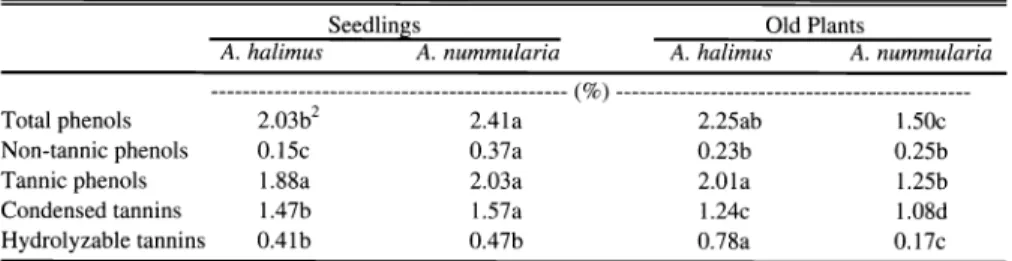
Significant difference (P < 0.001) in total tannins existed between young and old plants of A. nummularia (2.03% and 1.25%, respectively) but not in A. halimus (Table 3). However, condensed tannins were higher in various plants of both species. Young plants tended to produce more condensed tannins than old plants because they are more leafy. Young plants of A. halimus contained similar levels of total tannins as young seedlings of A.
nummularia. However, seedlings of A.
nummularia contained significantly (P <
0.01) higher levels of condensed tannins compared to A. halimus seedlings (1.57%
and 1.47%, respectively).
Potential Toxicity Problems
Allison et al. (1977) reported that sheep ingesting between 39-51 g of calcium oxalate per day are likely to develop acute signs of toxicity. Theoretically, if sheep consume a diet solely of Atriplex plants grown in Jordan, they will ingest about 132 g of calcium oxalate (6.6% calcium
oxalate =66 g per kg DM x 2 kg per day per sheep =132 g) and are likely to devel- op acute signs of toxicity. Practically, the potential of toxicoses due to oxalate levels present in the browse of saltbush is low because of selectivity and adaptation of ruminants to high levels of oxalate. James and Butcher (1972) reported that sheep can consume a diet containing 6% oxalate
without showing any toxicity signs.
However, these animals developed diar- rhea and refused to consume such a diet again. Oxalate poisoning occurs at the point where oxalate is absorbed faster than it can be degraded by ruminal microflora.
Animals can gradually adapt increasing populations of oxalate degrading microbes in the rumen. Adapted animals can con- sume 30% more oxalate than unadapted ones (James 1977). In general, oxalate poi- soning is a complex issue. Factors such as chemical form of oxalate, animal maturity, adaptation of animals to saltbush, the com- position of the diet, and the availability of water for animals could influence the sus- ceptibility of animals to oxalate poisoning.
Several studies dealt with the problem of toxicity due to high levels of tannins ( > 6
%) in animals diet (Kumar and Singh 1984). However, animals refused to con- sume diets containing > 2% tannins (Donnelly and Anthony 1969). Moderate levels of tannins (less than 4%) in forages can have beneficial responses in ruminants due to the increased amount of bypass pro- teins, resulting in higher growth rates (Nunez-Hernandez et al. 1991). The levels of tannins in the saltbushes grown in Jordan are not expected to have adverse effects on sheep grazing these plantations associated with abundance of herbaceous plants.
Conclusion
In summary, our study showed that the 2 saltbush species contained higher levels of
Table 3. Levels' of total phenolic compounds, non-tannic phenols, tannic phenols, condensed tan- nins and hydrolyzable tannins in Atriplex halimus and Atriplex nummularia seedlings compared to old plants growing in the arid region of Jordan.
Seedlings Old Plants
A.
halimus
A.nummularia
A.halimus
A.nummularia --- (%)---
Total phenols 2.03b2
2.41aNon-tannic phenols
0.15c 0.37aTannic phenols 1.88a 2.03a la
Condensed tannins
1.47b 1.57aHydrolyzable tannins
0.41b 0.47b'Least square means
as % on drymatter basis. Standar errors of least square means are 0.196, 0.089, 0.007, 0.087, 0.027 and 0.071 for total phenols, non-tannic phenols, tannic phenols, condensed tannins and hydrolyzable tannins, respectively.
Means within
a rowfollowed
by the same letter arenot significantly different
at the 0.05 levelof probability.
JOURNAL OF RANGE MANAGEMENT 56(4) July 2003 373
oxalate, tannic phenols and condensed tan- nins during spring compared to fall sea- son. Atriplex halimus is characterized by high levels of oxalate, tannic phenols, con- densed and hydrolyzable tannins than A.
nummularia which explanis its low palata- bility. Spring clipping of saltbush plants had no significant effect on oxalate or tan- nins concentration of subsequent clippings taken in fall. The levels of secondary metabolites found in our experiments indi- cate that if sheep were to consume a diet solely of Atriplex, they would be likely to develop acute toxicity symptoms. Future work should examine the different chemi- cal forms of oxalates and tannins in the browse of saltbushes in response to differ- ent defoliation intensities and under differ- ent environmental conditions.
Literature Cited
Abu-Zanat, M. 1995. Establishment and pro- duction of fodder shrubs in Jordan. Regional Planning Workshop on Fodder Shrubs.
Tunis, Tunisia, 3-6 July.
Allison, M.J., E.T. Littlekid, and L.F. James.
1977. Changes in ruminal oxalate degrada- tion associated with adaptation to oxalate ingestion. J. Anim. Sci. 45:1173-1179.
Association of Official Analytical Chemists (AOAC). 1990. Official Methods of Analysis.
15`"